REVIEW 4 major objections 6 minor 22 references
Single-Beat Cuffless Blood Pressure Estimation Using Ear-PPG and ECG with a Lightweight Hybrid Learning Framework
T0 review · 4 major / 6 minor · reviewed 2026-07-30 · grok-4.5
Pith's one-line read Blood-pressure information is already present in a single heartbeat, so cuffless estimates need not wait for multi-second clean windows.
desk verdict Useful hybrid ear-PPG/ECG estimator with real code and solid ablations, but the single-beat / no-long-context claim does not match what the model actually uses. read the letter →
The pith
A machine-rendered reading of the paper's core claim, the machinery that carries it, and where it could break.
The reading
What carries the argument
The hybrid two-branch feature: a 64-dimensional CNN morphological embedding extracted from one normalized 128-sample PPG beat, concatenated with a 30-dimensional vector of hand-crafted ECG/PPG physiology features, then fed to separate LightGBM regressors for SBP and DBP.
What would settle it
Repeat the multi-phase stress protocol on a larger held-out cohort with continuous or beat-aligned reference pressure during exercise and motion, retrain only on prior subjects, and check whether single-beat MAE stays near 4/2 mmHg when every corrupted beat is simply dropped rather than window-averaged.
Extended reading notes
Core claim
Discriminative blood-pressure information is preserved at the single-beat level. A one-dimensional CNN embedding of an individual ear-PPG beat, fused with thirty physiology-grounded features (including PTT statistics and HRV) and regressed by LightGBM, yields subject-disjoint mean absolute errors of 4.02 ± 0.21 mmHg systolic and 1.79 ± 0.05 mmHg diastolic across thirty runs—a 28.2 % cut in combined MAE versus the hand-crafted baseline—without multi-second estimation windows.
Load-bearing premise
That results from a small healthy wearable cohort with cuff labels missing during the hardest exercise phase, mixed with hospital public data under subject-disjoint splits, are enough to claim robust continuous estimation under real dynamic conditions.
Editorial extensions
If this is right
- Wearable BP pipelines can emit an estimate after every clean beat instead of buffering multi-second windows that one bad beat can invalidate.
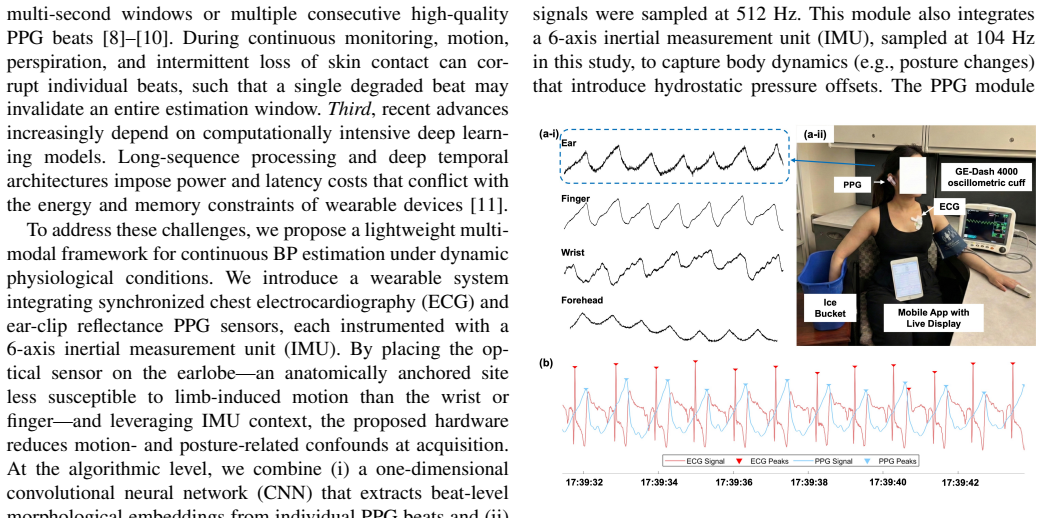
- Ear-clip PPG plus chest ECG with co-located IMUs becomes a practical sensing layout for reducing limb-motion and hydrostatic confounds.
- A sub-2 MB hybrid model with sub-millisecond mobile inference is sufficient for on-gateway cuffless BP without heavy sequence networks.
- Physiology features (PTT, HRV) and learned beat morphology are complementary; either branch alone is weaker than their fusion.
Reading between the lines
- If single-beat sufficiency holds, intermittent contact loss becomes a missing-data problem rather than a full-window failure, simplifying ambulatory duty-cycling and power budgets.
- The same beat-level embedding idea could be stress-tested on wrist or finger PPG to quantify how much of the gain is truly morphological versus the ear’s anatomical stability.
- Because several of the thirty “physiology” features still summarize short sequences, a stricter ablation that freezes all multi-beat statistics would clarify how purely single-beat the method really is.
Editorial analysis
A structured set of objections, weighed in public.
Referee Report
Summary. The paper proposes a wearable cuffless BP system using synchronized chest ECG and ear-clip reflectance PPG (each with a co-located IMU), and a hybrid estimator that concatenates a 64-D 1D-CNN embedding of a single normalized PPG beat with 30 hand-crafted features (PTT statistics, HRV, morphological descriptors) and regresses SBP/DBP with LightGBM. Evaluation mixes subject-disjoint PulseDB subsets with a 10-subject multi-phase stress protocol (rest, cycling, recovery, cold pressor). Across 30 runs the authors report MAE 4.02±0.21 mmHg (SBP) and 1.79±0.05 mmHg (DBP), a 28.2% combined-MAE reduction versus a LightGBM-only baseline, and argue that BP-discriminative information is preserved at the single-beat level without multi-second estimation windows.
Significance. If the accuracy and deployment claims hold under truly dynamic, subject-disjoint conditions, the work is practically useful: ear-PPG with dual IMUs is a sensible motion-robust sensing choice, the hybrid footprint (<2 MB, sub-millisecond Core ML CNN latency) is wearable-relevant, and code is released. Subject-disjoint repeated runs, an ablation, and Bland–Altman analysis are methodological strengths relative to much of the cuffless-BP literature. The significance is tempered by the fact that usable accuracy depends on multi-beat physiology features, so the headline “single-beat / no long temporal context” framing overstates what is demonstrated; the contribution is better read as an efficient hybrid fusion pipeline plus an ear-PPG hardware platform rather than a pure single-beat morphological breakthrough.
major comments (4)
- [Abstract; §II-E; Table II] Central framing vs Table II (§II-E, Table II, Abstract): The claim that “discriminative BP-related information is preserved at the single-beat level” and that estimation works “without long temporal context” is not supported by the ablation. CNN-only regression on single PPG beats yields SBP MAE 71.48 and combined MAE 77.76 (non-informative). Usable error appears only when the 30 hand-crafted features are included; those explicitly comprise PTT mean/median/SD and full HRV suites (SDNN, RMSSD, pNN50, LF/HF, Poincaré, etc.), which are multi-beat sequence statistics (§II-E). The hybrid’s gain is therefore fusion of a weak beat embedding onto multi-beat physiology features. Please reframe the contribution accordingly, or add a strictly per-beat ablation (instantaneous PTT + single-beat morphology only, no HRV/PTT window stats) and report those MAEs.
- [Table I; Table II; §III-A; §III-C] Table II’s hybrid numbers (SBP 3.60, DBP 1.78, combined 5.38, +28.2%) match the best single run cited in §III-A, not the 30-run aggregated means in Table I (4.02±0.21 / 1.79±0.05). The headline 28.2% reduction is therefore not tied to the primary subject-disjoint aggregate. Recompute the ablation on the same 30-run protocol (mean±std for all three models) and report improvement against those means.
- [§II-C; Fig. 4; §III-B] Dynamic/motion claim vs reference labels (§II-C, Fig. 4): Cuff references were omitted entirely during the metabolic-stress/exercise phase—the highest-motion condition emphasized in the Introduction—yet Fig. 4 and the text assert stage-dependent tracking including exercise. Without ground truth in that phase, continuous exercise BP claims are unvalidated. Either collect an alternative reference during exercise, restrict quantitative claims to phases with cuff/ABP labels, or clearly mark exercise traces as qualitative only.
- [§III-A; §II-D] Mixed-cohort evaluation protocol is underspecified (§III-A, §II-D): Each run samples 80 PulseDB + 7 wearable subjects under “subject-disjoint partitioning,” but it is unclear whether wearable subjects appear in train, test, or both roles across runs; how labels are aligned (intermittent cuff vs continuous ABP); and whether metrics pool hospital ABP with healthy-volunteer cuff errors. Given n=10 wearable and domain shift acknowledged in §II-D, report separate PulseDB-only and wearable-held-out metrics (and clarify train/test membership of the 7 wearable subjects per run).
minor comments (6)
- [§II-C] Typo in §II-C: “Expect the cycling stage” → “Except the cycling stage.”
- [§II-A; §II-E] IMU signals are acquired and motivated for motion context but do not appear as model inputs or explicit quality gates in §II-E; clarify whether IMUs are unused in the reported estimator or only for offline QC.
- [§III-B; Fig. 5] Bland–Altman (§III-B, Fig. 5): state numerical bias and 95% LoA for both SBP and DBP in the text; note that excluding “a small fraction of extreme outliers” from the plot (even if not from statistics) should be quantified.
- [References; §I] Reference [12] (Ravi & Larochelle SNAIL/meta-learning) does not support the LightGBM citation; replace with the LightGBM paper (Ke et al.).
- [Fig. 1] Fig. 1 caption mixes (a)/(b) structure and buries the ice-bucket rationale mid-caption; split hardware vs protocol description for readability.
- [§II-E] State the exact composition of the 30 hand-crafted features (list or supplement) so the multi-beat vs single-beat distinction is auditable.
Circularity Check
No significant circularity: supervised BP regression against external cuff/ABP labels, not a self-defining derivation.
full rationale
The paper’s load-bearing claims are empirical ML results (subject-disjoint MAE on PulseDB and a small wearable cohort; ablation vs LightGBM-only and CNN-only), not a first-principles derivation in which the target is recovered from quantities defined in terms of that target. Features (per-beat PTT, multi-beat HRV/PTT statistics, CNN embeddings) are standard predictors; LightGBM is fit to held-out subjects’ external oscillometric/ABP references. There is no self-definitional identity, no fitted parameter renamed as an independent prediction of the same quantity, no load-bearing uniqueness theorem imported from overlapping authors, and no ansatz smuggled in via self-citation that forces the reported errors. Methodological tension between the “single-beat / no long temporal context” framing and the multi-beat nature of some hand-crafted features is an overclaim/correctness issue, not equation-level circularity. Self-contained against external benchmarks; steps empty.
Assumptions & free parameters
free parameters (7)
- CNN embedding dimension (64) and conv layout (1→16→32→64, kernels 7/5/3) =
64-D embedding; 152,802 CNN params
- LightGBM hyperparameters (max depth 7, 31 leaves, lr 0.1, min leaf 20, subsample 0.8, ≤100 iterations) =
depth 7, 31 leaves, lr 0.1
- Hand-crafted feature set size/composition (30 features) =
30 features
- Beat resampling length and amplitude normalization =
128 samples, min–max
- PTT physiological gate (0.05–0.5 s) =
0.05–0.5 s
- CNN training hyperparameters (Adam lr 1e-3, wd 1e-4, batch 256, ≤60 epochs, Smooth L1) =
lr 1e-3, batch 256
- Per-run subject subsample sizes (80 PulseDB, 7 wearable) =
80 + 7 subjects per run
assumptions (6)
- domain assumption Pulse transit time and HRV metrics carry usable information about SBP/DBP across autonomic states.
- ad hoc to paper Single-beat PPG morphology retains discriminative BP-related structure learnable by a small 1D CNN.
- domain assumption Earlobe reflectance PPG is sufficiently stable under motion/cold pressor relative to wrist/finger for beat-level inference.
- domain assumption Intermittent oscillometric cuff (wearable study) and ABP (PulseDB) are adequate labels for beat-wise supervision despite temporal mismatch.
- ad hoc to paper Subject-disjoint splits on the mixed PulseDB+wearable pool are enough to claim generalization under dynamic conditions.
- domain assumption Gradient-boosted trees on concatenated features can capture nonlinear BP mappings with wearable-suitable compute.
Cite this review
Pith. "Pith review of Single-Beat Cuffless Blood Pressure Estimation Using Ear-PPG and ECG with a Lightweight Hybrid Learning Framework." pith.science (2026). https://pith.science/paper/3EQIDA7O
@misc{pith2026260727076,
  author       = {Pith},
  title        = {Pith review of: Single-Beat Cuffless Blood Pressure Estimation Using Ear-PPG and ECG with a Lightweight Hybrid Learning Framework},
  year         = {2026},
  howpublished = {\url{https://pith.science/paper/3EQIDA7O}},
  note         = {Machine review of arXiv:2607.27076}
}
abstract
Continuous cuffless blood pressure (BP) monitoring remains challenging due to motion artifacts, physiological variability, and the limited robustness of conventional pulse transit time (PTT) models under dynamic conditions. Many prior approaches rely on multi-second windows to stabilize estimation, an assumption that is frequently violated during real-world monitoring with intermittent signal corruption. Here, we show that discriminative BP-related information is preserved at the single-beat level and present a lightweight multi-modal wearable framework for continuous BP estimation. The system integrates synchronized chest electrocardiography (ECG) and ear-clip reflectance photoplethysmography, each co-located with a 6-axis inertial measurement unit to provide motion context. We introduce a hybrid learning architecture in which a one-dimensional convolutional neural network extracts a 64-dimensional embedding from individual PPG beats and fuses it with 30 physiology-grounded features, including PTT statistics and heart rate variability, followed by LightGBM regression. The method was evaluated using a multi-phase stress protocol ($n=10$) and the PulseDB public dataset with subject-disjoint validation. Across 30 independent runs, the model achieved mean absolute errors of $4.02 \pm 0.21$~mmHg for systolic BP and $1.79 \pm 0.05$~mmHg for diastolic BP, corresponding to a 28.2\% reduction in combined MAE relative to baseline models. By enabling beat-wise estimation without long temporal context, this framework supports computationally efficient cuffless BP monitoring suitable for wearable deployment under practical resource constraints. The source code for this work is available at https://github.com/SYMBIOX-Lab/BP-wireless.
Figures


Figures from the paper (2 more)


Reference graph
Works this paper leans on
-
[1]
Effect of theory-based training intervention on physical activity and blood pressure in hypertensive patients a randomized control trial: A literature review,
D. Widyarani, “Effect of theory-based training intervention on physical activity and blood pressure in hypertensive patients a randomized control trial: A literature review,”d’Nursing and Health Journal (DNHJ), vol. 1, pp. 25–30, 2020
2020
-
[2]
Hypertension,
World Health Organization, “Hypertension,” Online, 2025, accessed:
2025
-
[3]
Influence of “hospital-community-family
W. Shi, L. Cheng, and Y . Li, “Influence of “hospital-community-family” integrated management on blood pressure, quality of life, anxiety and depression in hypertensive patients,”Computational and Mathematical Methods in Medicine, vol. 2022, pp. 1–9, 2022
2022
-
[4]
M. Burnier and B. M. Egan, “Adherence in hypertension,” Circulation Research, vol. 124, no. 7, pp. 1124–1140, 2019. [Online]. Available: https://www.ahajournals.org/doi/abs/10.1161/CIRCRESAHA. 118.313220
-
[5]
Validation of the dbp-8278b wrist-type fully automatic blood pressure monitor in the general population according to the iso 81060- 2:2018/amd 1:2020 protocol,
Q. Zhou, “Validation of the dbp-8278b wrist-type fully automatic blood pressure monitor in the general population according to the iso 81060- 2:2018/amd 1:2020 protocol,”Blood Pressure Monitoring, vol. 30, pp. 36–39, 2024
2018
-
[6]
Toward ubiquitous blood pressure mon- itoring via pulse transit time: Predictions on maximum calibration period and acceptable error limits,
R. Mukkamala and J. Hahn, “Toward ubiquitous blood pressure mon- itoring via pulse transit time: Predictions on maximum calibration period and acceptable error limits,”Ieee Transactions on Biomedical Engineering, vol. 65, pp. 1410–1420, 2018
2018
-
[7]
Cuf- fless blood pressure estimation algorithms for continuous health-care monitoring,
M. Kachuee, M. M. Kiani, H. Mohammadzade, and M. Shabany, “Cuf- fless blood pressure estimation algorithms for continuous health-care monitoring,”IEEE Transactions on Biomedical Engineering, vol. 64, pp. 859–869, 2017
2017
-
[8]
Continuous ppg-based blood pressure monitoring using multi-linear regression,
S. Haddad, A. Boukhayma, and A. Caizzone, “Continuous ppg-based blood pressure monitoring using multi-linear regression,”IEEE Journal of Biomedical and Health Informatics, vol. 26, no. 5, pp. 2096–2105, 2022
Show all 22 references
-
[9]
Bpnet: A multi-modal fusion neural network for blood pressure estimation using ecg and ppg,
W. Long and X. Wang, “Bpnet: A multi-modal fusion neural network for blood pressure estimation using ecg and ppg,”Biomedical Signal Processing and Control, vol. 86, p. 105287, 2023
2023
-
[10]
End-to-end personalized cuff-less blood pressure monitoring using ecg and ppg signals,
B. N. Suhas, R. Sharma Srinivasa, Y . M. Saidutta, J. Cho, C.-H. Lee, C. Yang, Y . Shen, and H. Jin, “End-to-end personalized cuff-less blood pressure monitoring using ecg and ppg signals,” inProceedings of the IEEE International Conference on Acoustics, Speech and Signal Proc...
2024
-
[11]
An adaptive weight learning-based multitask deep network for continuous blood pressure estimation using electrocardiogram signals,
X. Fan, H. Wang, Y . Zhao, Y . Li, and K. Tsui, “An adaptive weight learning-based multitask deep network for continuous blood pressure estimation using electrocardiogram signals,”Sensors, vol. 21, p. 1595, 2021
2021
-
[12]
A simple neural attentive meta-learner,
S. Ravi and H. Larochelle, “A simple neural attentive meta-learner,” in Advances in Neural Information Processing Systems (NeurIPS), Long Beach, CA, USA, 2017
2017
-
[13]
Effect of acute moderate- intensity cycling on peripheral and central blood pressure at rest and during stress test,
F. Milatz, S. Ketelhut, and R. G. Ketelhut, “Effect of acute moderate- intensity cycling on peripheral and central blood pressure at rest and during stress test,”Journal of the American Society of Hypertension, vol. 8, no. 4, Supplement, p. e53, 2014. [Online]. Available: http...
2014
-
[14]
A novel multimodal physiological model for the noninvasive and continuous measurements of arterial blood pressure,
T. Xiang, Y . Zhang, and Y . Zhang, “A novel multimodal physiological model for the noninvasive and continuous measurements of arterial blood pressure,” in2024 46th Annual International Conference of the IEEE Engineering in Medicine and Biology Society (EMBC), vol. 2024. Unite...
2024
-
[15]
Pulsedb: A large, cleaned dataset based on mimic-iii and vitaldb for benchmark- ing cuff-less blood pressure estimation methods,
W. Wang, P. Mohseni, K. L. Kilgore, and L. Najafizadeh, “Pulsedb: A large, cleaned dataset based on mimic-iii and vitaldb for benchmark- ing cuff-less blood pressure estimation methods,”Frontiers in Digital Health, vol. 4, p. 1090854, 2023
2023
-
[16]
Hypertension, blood pressure, and heart rate variability: the atherosclerosis risk in communities (aric) study,
E. B. Schroeder, D. Liao, L. E. Chambless, R. J. Prineas, G. W. Evans, and G. Heiss, “Hypertension, blood pressure, and heart rate variability: the atherosclerosis risk in communities (aric) study,”Hypertension, vol. 42, no. 6, pp. 1106–1111, 2003
2003
-
[17]
The role of heart rate variability (hrv) in different hypertensive syndromes,
L. B. T. Yugar, J. C. Yugar-Toledo, N. Dinamarco, L. G. Sedenho- Prado, B. V . D. Moreno, T. d. A. Rubio, A. Fattori, B. Rodrigues, J. F. Vilela-Martin, and H. Moreno, “The role of heart rate variability (hrv) in different hypertensive syndromes,”Diagnostics, vol. 13, no. 4, p...
2023
-
[18]
Fast r-cnn,
R. Girshick, “Fast r-cnn,” inProceedings of the IEEE International Conference on Computer Vision (ICCV), Santiago, Chile, 2015, pp. 1440–1448
2015
-
[19]
Robust regularized extreme learning machine with asymmetric huber loss function,
D. Gupta, B. B. Hazarika, and M. Berlin, “Robust regularized extreme learning machine with asymmetric huber loss function,”Neural Com- puting and Applications, vol. 32, no. 16, pp. 12 971–12 998, 2020
2020
-
[20]
Rs transformer: A two-stage region proposal using swin transformer for few-shot pest detection in automated agricultural monitoring systems,
T. Wu, L. Shi, L. Zhang, X. Wen, J. Lu, and Z. Li, “Rs transformer: A two-stage region proposal using swin transformer for few-shot pest detection in automated agricultural monitoring systems,”Applied Sciences, vol. 13, no. 22, p. 12206, 2023. [Online]. Available: https://doi....
2023 doi
-
[21]
An improvement of the convergence proof of the adam-optimizer,
S. Bock, J. Goppold, and M. Weiß, “An improvement of the convergence proof of the adam-optimizer,”arXiv preprint arXiv:1804.10587, 2018. [Online]. Available: https://arxiv.org/abs/1804.10587
2018 arXiv
-
[2025]
Available: https://www.who.int/news-room/fact-sheets/ detail/hypertension
[Online]. Available: https://www.who.int/news-room/fact-sheets/ detail/hypertension
Reviewed July 30, 2026 · model on record in the stance chip above.
Discussion (0). Continue with ORCID to comment.