REVIEW 4 major objections 4 minor 26 references
Enhancing weed detection performance by means of GenAI-based image augmentation
T0 review · 4 major / 4 minor · reviewed 2026-08-12 · deepseek-v4-flash
Pith's one-line read Adding Stable Diffusion-generated synthetic weed images to training data improves compact YOLO detectors, with the largest gains when models are trained from scratch.
desk verdict Useful empirical sweep of GenAI synthetic augmentation for weed detection, but the headline gains are confounded by training-set size and single runs. read the letter →
The pith
A machine-rendered reading of the paper's core claim, the machinery that carries it, and where it could break.
The reading
What carries the argument
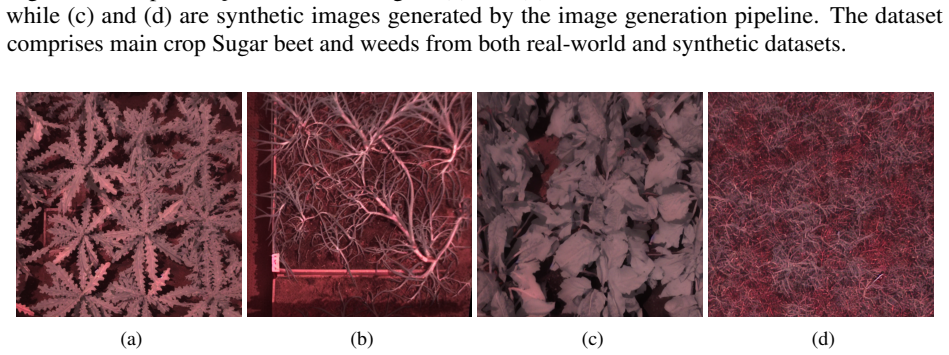
The load-bearing mechanism is a text-to-image augmentation pipeline built on the Segment Anything Model and Stable Diffusion 1.5: the Segment Anything Model converts manually annotated real images into instance masks, the diffusion model is fine-tuned on masked plants and soil backgrounds, and text prompts such as 'A photo of Echinochloa, the Sugar beet plot in the background' generate new weed-in-field scenes. A YOLOv8x model trained on the real images annotates the synthetic images automatically. On the downstream side, synthetic images are randomly added to reach 10% to 200% of the original training-set size, and three compact detectors (YOLOv8n, YOLOv9t, YOLOv10-N) are trained both from COCO-pretrained weights and from scratch.
What would settle it
Train the same YOLO models from scratch on the original set plus the same number of duplicated or newly collected real images for each synthetic-mix condition; if mAP50-95 matches the synthetic-augmented runs, the claim that generated image quality drives the gains is falsified.
Extended reading notes
Core claim
The paper claims that synthetic images generated by a text-prompted, fine-tuned Stable Diffusion pipeline—annotated without human verification by a YOLOv8x model—are a viable and often superior alternative to conventional augmentation (copy-paste, mixup, HSV changes, flipping and rotation) for training compact YOLO nano detectors on a pseudo-RGB sugar-beet weed dataset (red and near-infrared bands composited into RGB-like images). In the from-scratch setting, adding synthetic data produces the most dramatic gains: YOLOv8n mAP50 rises from 0.608 to 0.82 at 40% synthetic data, YOLOv9t from 0.608 to 0.87 at 80–100%, and YOLOv10-N from 0.469 to 0.77 at 190%. In the fine-tuned setting, synthetic augmentation gives smaller but still positive gains (up to 2–4% in mAP50), and advanced traditional methods such as copy-paste and mixup perform comparably. The paper interprets this as evidence that synthetic data enriches the training distribution with new, realistic scenes rather than merely recombining original pixels.
Load-bearing premise
The load-bearing premise is that the performance gains come from the quality of the generated synthetic images, but the experiments lack a control that adds the same number of real images, so training-set size alone could account for part or all of the improvement.
Editorial extensions
If this is right
- Across all three YOLO nano variants, adding synthetic images improves both mAP50 and mAP50-95 relative to no augmentation, with the largest absolute gains in the from-scratch regime.
- From-scratch training becomes practical with synthetic augmentation: YOLOv9t reaches mAP50=0.87 and mAP50-95=0.709 with 80–100% synthetic data, compared with 0.608 and 0.384 without augmentation.
- When COCO-pretrained weights are used, advanced traditional augmentations (copy-paste, mixup) match synthetic augmentation on mAP50, so generative data is most clearly valuable when pretraining is unavailable or the domain shift is large.
- The optimal share of synthetic data varies by model and metric (e.g., 40% for YOLOv8n scratch, 190% for YOLOv10-N scratch), so the augmentation ratio is a tunable hyperparameter rather than a monotonic benefit.
- The paper suggests the pipeline may reduce the needed amount of human-annotated real data, since the real set is used only to train the annotator and the detector.
Reading between the lines
- The experimental design does not hold training-set size fixed: synthetic augmentation adds new unique images while the traditional baselines add no unique images, so a same-size real-image control is needed to separate data quantity from generative quality.
- Because the synthetic labels come from YOLOv8x without human verification, the improvement could partly reflect the annotator's own learned biases rather than the visual fidelity of the generated plants; re-annotating a subset of synthetic images by human experts would isolate this.
- The non-monotonic response curves suggest that the optimal synthetic ratio is model-dependent and could be predicted or scheduled rather than fixed; a validation-based search over ratios is a natural extension.
- The same generation-plus-model-annotation loop could transfer to other object-detection domains with scarce data, provided enough real images exist to train the annotator.
Editorial analysis
A structured set of objections, weighed in public.
Referee Report
Summary. The paper investigates whether synthetic images generated by a fine-tuned Stable Diffusion pipeline can improve weed detection in sugar beet field imagery. The authors add synthetic images to the training set in progressive shares from 10% to 200% of the original size, train three compact YOLO models (YOLOv8n, YOLOv9t, YOLOv10-N) both from COCO-pretrained weights and from scratch, and compare against four traditional online augmentation techniques (copy-paste, mixup, HSV, flipping/rotation). Performance is reported as mAP50 and mAP50-95 on a held-out real test set. The headline results are large gains in the from-scratch setting, e.g., YOLOv8n scratch mAP50 rising from 0.608 to 0.821 at 40% synthetic data, and YOLOv9t scratch mAP50-95 rising from 0.384 to 0.709 at 100% synthetic data.
Significance. If the causal claim were established, the paper would offer a practical recipe for reducing annotation effort in weed detection for edge-device deployment, with an external evaluation protocol (real test set) and coverage of three recent YOLO architectures. The progressive-size experimental design is a useful idea, and the from-scratch improvements are potentially important. However, the central attribution that the gains come from generative image quality is currently confounded by an uncontrolled increase in training-set size, and the lack of any statistical repeatability measures leaves the quantitative claims under-supported. The paper also builds directly on the authors' prior pipeline [12], so independent verification of the synthetic-data generation component is limited.
major comments (4)
- [§3.2, Tables 3–4] The main comparison is confounded by training-set size. In §3.2, synthetic augmentation adds images until the training set is increased by s ∈ {10%,...,200%}, so every synthetic condition trains on 10–200% more unique images than the no-augmentation or traditional-augmentation conditions. The traditional techniques (copy-paste, mixup, HSV, flipping/rotation) are applied as online transforms and do not add unique images. There is no control condition that adds the same number of real images, duplicated real images, or traditionally pre-augmented images at each s. Consequently, the reported gains, especially the from-scratch improvements in Table 3 and Table 4, are consistent with a pure dataset-size effect and do not yet establish the contribution of generative image quality. The paper itself acknowledges this gap in §6 by listing 'traditional offline image augmentation methods ... with progressive addition of data' as future work; this control should be run before the central claim can be supported.
- [Tables 3–4, §4] All reported mAP values appear to come from a single training run per condition. There are no error bars, no multiple seeds, and no significance tests. Many of the COCO-fine-tuned differences are small (1–4% in mAP50), which is within typical run-to-run variation for YOLO training; even some of the from-scratch differences at neighboring synthetic shares vary erratically (e.g., YOLOv8n scratch mAP50: 0.821 at 40%, 0.737 at 50%, 0.744 at 60%). Repeating each condition with at least three seeds and reporting mean±std would let the reader judge whether the observed trends are stable rather than artifacts of a single run.
- [§3.1] The synthetic images are annotated by a model-guided procedure using a fine-tuned YOLOv8x, with no human verification described for the synthetic set. Because synthetic images are likely out-of-domain for an annotator trained only on real images, label noise in the synthetic set is unmeasured and could bias the reported mAP values non-monotonically across the 20 share levels. The paper should quantify annotation quality, for example by reporting a human-audited subset agreement, per-class confidence statistics, or an analysis of how label noise affects the comparison.
- [§3.2, Table 2] It is not reported whether the same effective training budget is used across all conditions. With patience-based early stopping (patience 30) and 300 epochs, larger training sets may change the number of effective epochs and thus the amount of optimization, which is another dimension confounded with synthetic-data quality. The authors should clarify whether each condition was trained for a fixed number of epochs or stopped early, and ideally control for total number of gradient steps or epochs.
minor comments (4)
- [Abstract] The abstract says the technique improves 'the quantity and quality of training datasets', but quality is not directly measured; only downstream mAP is reported. Consider rephrasing to avoid implying a direct quality metric.
- [§3.1] The text states that the image-generation pipeline's output quality was measured with CLIP-IQA, but no CLIP-IQA scores are reported. If these scores exist, reporting them would substantiate the claim of high fidelity and diversity.
- [§2.1] There is a typo in 'hybridtechniques' where a space is missing; the manuscript would benefit from a careful proofreading pass for similar spacing and punctuation issues.
- [§4] The sentence 'the YOLOv8n (scratch) model showed a significant increase in mAP50 of 20%, increasing from 0.608 to 0.82' uses 'significant' in a statistical sense without any statistical test; reword to 'an increase of 0.21' or 'a gain of about 35% relative to baseline'.
Circularity Check
No significant circularity: the central claim is empirical and tested on a real held-out set; the sole self-citation is the image-generation pipeline used as a tool, not as evidence for the outcome.
full rationale
The paper makes no mathematical derivation that could reduce to its inputs. Its central claim is that adding synthetic images from a Stable Diffusion pipeline improves YOLO weed-detection mAP, and this is evaluated on a real test split with standard metrics (mAP50, mAP50-95). The one self-citation, [12] Modak and Stein, is the source of the synthetic-image generation pipeline; it is used as a tool to produce images, not as a theorem or as evidence that augmentation works. The downstream evaluation is external to that pipeline and independent of the fitted configuration, so the self-citation is not load-bearing in a circularity sense. The paper does have a notable dataset-size confound: synthetic augmentation increases the number of training images by 10-200%, whereas the traditional augmentation baselines are online transforms and do not add unique images; the paper's own conclusion section lists 'traditional offline image augmentation methods ... with progressive addition of data' as future work, implicitly acknowledging this gap. This is a validity/attribution concern, not circularity: the improvement is measured on held-out real data, so the claim is falsifiable and not definitionally tied to the inputs. Under the rubric, this earns a low score reflecting one minor self-citation that is not load-bearing.
Assumptions & free parameters
free parameters (3)
- Online augmentation probability =
0.5
- Training hyperparameters (epochs, batch size, learning rate, patience) =
300, 16, 0.01, 30
- Synthetic data share =
10% to 200% in 10% increments
assumptions (4)
- domain assumption Synthetic images generated by the fine-tuned Stable Diffusion pipeline are sufficiently realistic and diverse to serve as effective training data.
- domain assumption Model-guided annotation using YOLOv8x trained on real data produces accurate labels for synthetic images.
- domain assumption The real-world dataset collected from a single experimental site represents the deployment distribution.
- domain assumption The test set labels are ground truth and correctly reflect weed locations.
Cite this review
Pith. "Pith review of Enhancing weed detection performance by means of GenAI-based image augmentation." pith.science (2026). https://pith.science/paper/3EY2H3FH
@misc{pith2026241118513,
  author       = {Pith},
  title        = {Pith review of: Enhancing weed detection performance by means of GenAI-based image augmentation},
  year         = {2026},
  howpublished = {\url{https://pith.science/paper/3EY2H3FH}},
  note         = {Machine review of arXiv:2411.18513}
}
read the original abstract
Precise weed management is essential for sustaining crop productivity and ecological balance. Traditional herbicide applications face economic and environmental challenges, emphasizing the need for intelligent weed control systems powered by deep learning. These systems require vast amounts of high-quality training data. The reality of scarcity of well-annotated training data, however, is often addressed through generating more data using data augmentation. Nevertheless, conventional augmentation techniques such as random flipping, color changes, and blurring lack sufficient fidelity and diversity. This paper investigates a generative AI-based augmentation technique that uses the Stable Diffusion model to produce diverse synthetic images that improve the quantity and quality of training datasets for weed detection models. Moreover, this paper explores the impact of these synthetic images on the performance of real-time detection systems, thus focusing on compact CNN-based models such as YOLO nano for edge devices. The experimental results show substantial improvements in mean Average Precision (mAP50 and mAP50-95) scores for YOLO models trained with generative AI-augmented datasets, demonstrating the promising potential of synthetic data to enhance model robustness and accuracy.
Figures


Reference graph
Works this paper leans on
-
[12]
In: International Conference on Architecture of Computing Systems
Modak, S., Stein, A.: Synthesizing training data for intelligent weed control systems using generative ai. In: International Conference on Architecture of Computing Systems. pp. 112–
-
[1]
Boysen, J., Stein, A.: Ai-supported data annotation in the context of uav-based weed detection in sugar beet fields using deep neural networks. In: 42. GIL-Jahrestagung, Künstliche Intel- ligenz in der Agrar- und Ernährungswirtschaft, pp. 63–68. Gesellschaft für Informatik e.V ., Bonn (2022)
work page 2022
-
[2]
Divyanth, L., Guru, D., Soni, P., Machavaram, R., Nadimi, M., Paliwal, J.: Image-to-image translation-based data augmentation for improving crop/weed classification models for preci- sion agriculture applications. Algorithms 15(11), 401 (2022)
work page 2022
-
[3]
Goodfellow, I.J., Pouget-Abadie, J., Mirza, M., Xu, B., Warde-Farley, D., Ozair, S., Courville, A., Bengio, Y .: Generative adversarial networks (2014), https://arxiv.org/abs/1406. 2661
work page 2014
-
[4]
Sensors 14(8), 15304–15324 (2014)
Herrera, P.J., Dorado, J., Ribeiro, Á.: A novel approach for weed type classification based on shape descriptors and a fuzzy decision-making method. Sensors 14(8), 15304–15324 (2014)
work page 2014
-
[5]
arXiv preprint arXiv:2006.11239 (2020)
Ho, J., Jaini, P., Abbeel, P., Duan, Y .: Denoising diffusion probabilistic models. arXiv preprint arXiv:2006.11239 (2020)
arXiv 2020
-
[6]
real data generation for ai-based selective weeding
Iqbal, N., Bracke, J., Elmiger, A., Hameed, H., von Szadkowski, K.: Evaluating synthetic vs. real data generation for ai-based selective weeding. In: 43. GIL-Jahrestagung, Resilient Agri-Food-Systeme, pp. 125–135. Gesellschaft für Informatik eV , Bonn (2023)
work page 2023
-
[7]
Jocher, G., Chaurasia, A., Qiu, J.: Ultralytics YOLO (jan 2023), https://github.com/ ultralytics/ultralytics, version 8.0.0, AGPL-3.0 License
work page 2023
Show all 26 references
-
[8]
2023 IEEE/CVF International Conference on Computer Vision (ICCV) pp
Kirillov, A., Mintun, E., Ravi, N., et al.: Segment anything. 2023 IEEE/CVF International Conference on Computer Vision (ICCV) pp. 3992–4003 (2023)
2023
-
[9]
Weed Research 31(2), 97–105 (1991)
Kropff, M., Spitters, C.: A simple model of crop loss by weed competition from early observations on relative leaf area of the weeds. Weed Research 31(2), 97–105 (1991)
1991
-
[10]
CoRR abs/1405.0312 (2014), http://arxiv.org/abs/1405.0312
Lin, T., Maire, M., Belongie, S.J., Bourdev, L.D., Girshick, R.B., Hays, J., Perona, P., Ramanan, D., Doll’a r, P., Zitnick, C.L.: Microsoft COCO: common objects in context. CoRR abs/1405.0312 (2014), http://arxiv.org/abs/1405.0312
2014 arXiv
-
[11]
Smart Agricultural Technology 7, 100422 (2024)
Lüling, N., Straub, J., Stana, A., Reiser, D., Clar, J., Griepentrog, H.W.: Unsupervised image-to-image translation to reduce the annotation effort for instance segmentation of field vegetables. Smart Agricultural Technology 7, 100422 (2024)
2024
-
[13]
Computers in biology and medicine 128, 104115 (2021)
Morid, M.A., Borjali, A., Del Fiol, G.: A scoping review of transfer learning research on medical image analysis using imagenet. Computers in biology and medicine 128, 104115 (2021)
2021
-
[14]
Mumuni, A., Mumuni, F.: Data augmentation: A comprehensive survey of modern approaches. Array p. 100258 (2022)
2022
-
[15]
Frontiers in Plant Science 14, 1101943 (2023) Enhancing Weed Detection Performance through GenAI-Based Image Augmentation
Nitin, Gupta, S.B., Yadav, R., Bovand, F., Tyagi, P.K.: Developing precision agriculture using data augmentation framework for automatic identification of castor insect pests. Frontiers in Plant Science 14, 1101943 (2023) Enhancing Weed Detection Performance through GenAI-Base...
2023
-
[16]
Computers and Electronics in Agriculture 206, 107698 (2023)
Rai, N., Zhang, Y ., Ram, B.G., Schumacher, L., Yellavajjala, R.K., Bajwa, S., Sun, X.: Applications of deep learning in precision weed management: A review. Computers and Electronics in Agriculture 206, 107698 (2023)
2023
-
[17]
In: Proceedings of the IEEE conference on computer vision and pattern recognition
Redmon, J., Divvala, S., Girshick, R., Farhadi, A.: You only look once: Unified, real-time object detection. In: Proceedings of the IEEE conference on computer vision and pattern recognition. pp. 779–788 (2016)
2016
-
[18]
In: Proceedings of the IEEE/CVF conference on computer vision and pattern recognition
Rombach, R., Blattmann, A., Lorenz, D., et al.: High-resolution image synthesis with latent diffusion models. In: Proceedings of the IEEE/CVF conference on computer vision and pattern recognition. pp. 10684–10695 (2022)
2022
-
[19]
Sensors 24(3) (2024), https://www.mdpi.com/1424-8220/24/3/893
Sampurno, R.M., Liu, Z., Abeyrathna, R.M.R.D., Ahamed, T.: Intrarow uncut weed detection using you-only-look-once instance segmentation for orchard plantations. Sensors 24(3) (2024), https://www.mdpi.com/1424-8220/24/3/893
2024
-
[20]
In: Proceedings of the IEEE international conference on computer vision
Selvaraju, R.R., Cogswell, M., Das, A., Vedantam, R., Parikh, D., Batra, D.: Grad-cam: Visual explanations from deep networks via gradient-based localization. In: Proceedings of the IEEE international conference on computer vision. pp. 618–626 (2017)
2017
-
[21]
Computers and electronics in agriculture 61(1), 63–78 (2008)
Slaughter, D.C., Giles, D., Downey, D.: Autonomous robotic weed control systems: A review. Computers and electronics in agriculture 61(1), 63–78 (2008)
2008
-
[22]
arXiv preprint arXiv:2405.14458 (2024)
Wang, A., Chen, H., Liu, L., Chen, K., Lin, Z., Han, J., Ding, G.: Yolov10: Real-time end-to-end object detection. arXiv preprint arXiv:2405.14458 (2024)
2024 arXiv
-
[23]
In: Proceedings of the AAAI Conference on Artificial Intelligence
Wang, J., Chan, K.C., Loy, C.C.: Exploring clip for assessing the look and feel of images. In: Proceedings of the AAAI Conference on Artificial Intelligence. vol. 37, pp. 2555–2563 (2023)
2023
-
[24]
Proceedings http://ceur-ws
Wang, X., Li, H., Yue, X., Meng, L.: A comprehensive survey on object detection yolo. Proceedings http://ceur-ws. org ISSN 1613, 0073 (2023)
2023
-
[25]
Precision Agriculture 25(1), 460–485 (2024)
Xu, K., Yuen, P., Xie, Q., Zhu, Y ., Cao, W., Ni, J.: Weedsnet: a dual attention network with rgb-d image for weed detection in natural wheat field. Precision Agriculture 25(1), 460–485 (2024)
2024
-
[26]
arXiv preprint arXiv:2401.15422 (2024)
Zhou, Y ., Guo, C., Wang, X., Chang, Y ., Wu, Y .: A survey on data augmentation in large model era. arXiv preprint arXiv:2401.15422 (2024)
2024 arXiv
Reviewed August 12, 2026 · model on record in the stance chip above.
Discussion (0). Continue with ORCID to comment.