REVIEW 3 major objections 6 minor 1 cited by
The Butterfly Effect: Neural Network Training Trajectories Are Highly Sensitive to Initial Conditions
T0 review · 3 major / 6 minor · reviewed 2026-08-07 · deepseek-v4-flash
Pith's one-line read A single perturbed weight early in training can send identical neural networks to different loss basins.
desk verdict A genuinely useful measurement framework for training sensitivity, with a real empirical counterexample about pre-training stability, but the deterministic-to-stochastic lower-bound claim is too strong as stated. read the letter →
The pith
A machine-rendered reading of the paper's core claim, the machinery that carries it, and where it could break.
The reading
What carries the argument
The central instrument is the spawn-and-perturb experiment. A parent network is trained deterministically from $\theta_0$ to time $t$, split into two copies, one copy is given a perturbation $\varepsilon$ of controlled magnitude $\sigma$, and both copies are trained identically to time $T$; instability is the size of $d(\theta_T, \theta'_T)$ under four dissimilarity measures: $L^2$ parameter distance, the training-loss barrier $\sup_\alpha[\ell(\alpha\theta_T+(1-\alpha)\theta'_T)-\alpha\ell(\theta_T)-(1-\alpha)\ell(\theta'_T)]$, the same barrier after weight matching over neuron permutations, and Angular CKA between penultimate-layer activations. The load-bearing theoretical object is the deterministic training map $T^T(\theta_0; \xi)$ with fixed noise $\xi$, together with the claim that divergence after a single controlled perturbation lower-bounds divergence after independent stochastic noise: $E[d(T(\theta,\xi), T(\theta+\varepsilon,\xi'))]\ge E[d(T(\theta,\xi), T(\theta+\varepsilon,\xi))]$. The perturbations are chosen either in the direction of a batch gradient or as initialization-scaled Gaussian noise, so that stability is probed along both training-relevant and generic directions.
What would settle it
A direct test is to run the spawn-and-perturb protocol at initialization with a single perturbed weight, but after the perturbation train the two copies with independently sampled minibatches rather than identical ones; if the resulting barrier at convergence is not at least as large as the barrier from the identical-noise run, the claimed lower bound fails. A second test is to search even one architecture, task, or optimizer for which the same single-weight perturbation at $t=0$ produces a zero training-loss barrier, which would contradict the claim that early training is universally chaotic.
Extended reading notes
Core claim
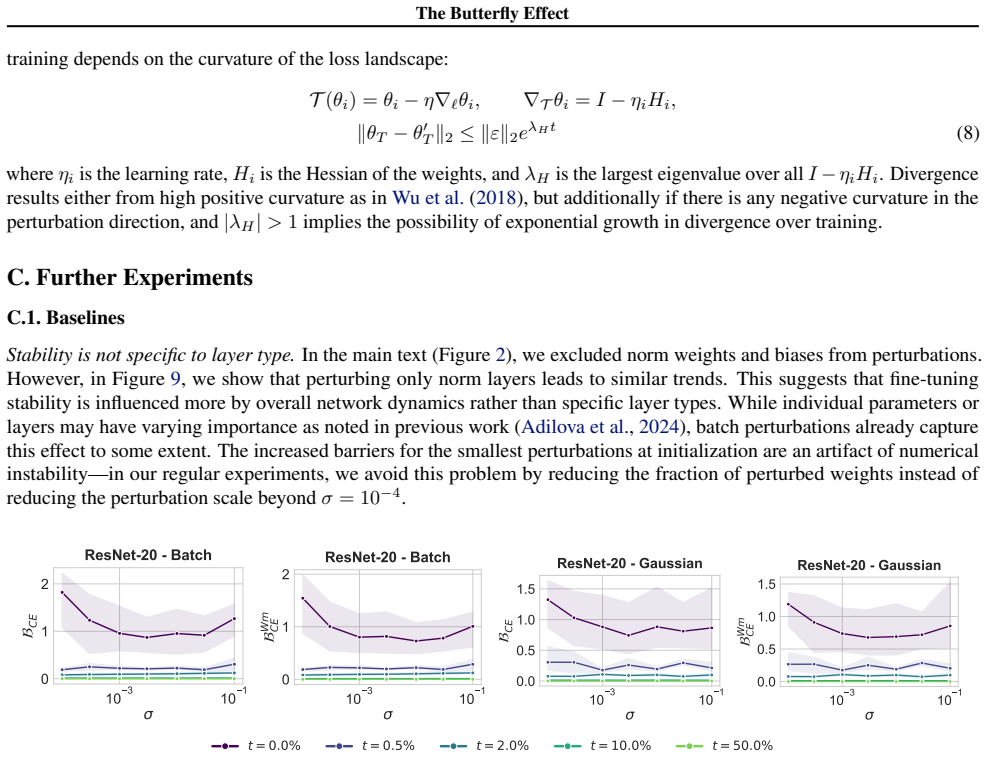
Viewed as a dynamical system, training is an iterated map $T$ on the parameter space; with the random seed fixed, it is deterministic. The paper claims that this map exhibits a butterfly effect: a perturbation $\varepsilon$ applied at $\theta_0$, scaled to as little as one weight (roughly $10^{-4}$ relative to the initialization scale), grows under training so that the final network $\theta'_T$ has a large training-loss barrier from $\theta_T$, even though both copies saw identical batches, augmentations, and seeds. Applying the same perturbation after only $0.5\%$ of training yields a much smaller or negligible barrier, and later perturbations require orders-of-magnitude larger $\varepsilon$ to produce any barrier at all. Weight matching that searches over neuron permutations fails to reduce the barrier, and Angular CKA shows the diverged networks have different intermediate representations, so the divergence is functional rather than a symmetry artifact. The paper presents this as evidence that early training is chaotic in the dynamical-systems sense, not merely noisy.
Load-bearing premise
The load-bearing premise is that a single deterministic perturbation cannot make two identically trained copies diverge less than independent random batches would; if independent noise can sometimes push the two copies closer together, then the deterministic butterfly experiments would not bound the instability of ordinary stochastic training.
Editorial extensions
If this is right
- A model that is stable to training noise can still be unstable to perturbations larger than that noise, so stability measured by seed agreement is not a guarantee of convergence to a single basin.
- Hyperparameter choices that increase early stability, such as longer learning-rate warm-up and wider or shallower architectures, shift but do not eliminate the chaotic phase.
- Fine-tuning stability is not a monotone function of pre-training: for several language-model checkpoints, the most pre-trained model is the most sensitive to perturbations during fine-tuning.
- Because permutation alignment does not remove the barriers, the diverged networks are not equivalent up to neuron reordering, and permutation-based merging methods will not reconnect them by themselves.
- In the vision settings tested, ensembling the original and perturbed networks yields accuracy gains that grow with representational dissimilarity, so deliberate perturbation is a candidate mechanism for ensemble diversity.
Reading between the lines
- If the lower-bound inequality holds in general, then every stochastic training run is at least as unpredictable as these deterministic experiments show, and reproduction efforts should focus on avoiding the chaotic phase (for example, by starting pre-trained or extending warm-up) rather than on controlling noise alone.
- The rapid stabilization within 0.5% of training suggests a sharp dynamical transition; estimating the local Lyapunov exponent (the rate at which nearby trajectories separate) along the training path would locate this transition and could predict the minimum perturbation that survives to convergence.
- The task dependence of stability (CIFAR-100 to CIFAR-10 versus the reverse, and vision versus language) hints that the controlling factor is the geometry of the loss landscape near the starting checkpoint, not the architecture class; a testable prediction is that stability correlates with local curvature at the checkpoint.
- Since weight matching cannot remove the barriers, a natural follow-up the paper leaves open is whether richer alignment methods, such as layer-wise or activation-normalized permutations, could reconnect the divergent networks, or whether the functional differences are irreducible.
Editorial analysis
A structured set of objections, weighed in public.
Referee Report
Summary. The paper proposes a deterministic 'spawn-and-perturb' protocol to measure the sensitivity of neural network training trajectories to small perturbations of the weights. From an initial state, a network is trained to time t, one copy is perturbed by noise of controlled magnitude and direction, and both copies are then trained with identical noise; divergence is measured by L2 parameter distance, training-loss barriers, permutation-aligned barriers, and Angular CKA. Across ResNet, ViT, BERT, and OLMo experiments, the authors report that perturbations as small as a single weight applied at initialization reliably cause large barriers, that stability increases rapidly during early training, that certain hyperparameters (warm-up, wider architectures) improve stability, that pre-trained networks are generally more stable but longer language-model pre-training can reduce fine-tuning stability, and that barrier and L2 growth are not exponential. The paper interprets the results as evidence for a 'butterfly effect' in neural network training with implications for fine-tuning, model merging, and ensembles.
Significance. If the claims hold, this is a clean empirical characterization of trajectory sensitivity that complements prior noise-based spawning experiments and extends them to controlled perturbations of arbitrary size and timing. Strengths of the paper include the carefully designed protocol, the use of multiple complementary divergence measures, the breadth of architectures and tasks, reproducibility-oriented practices (deterministic training, released code), and the absence of fitted free parameters in the reported measurements. The central 'single-weight perturbation causes divergence' finding is striking and falsifiable. However, the paper's stated bridge from deterministic to stochastic training rests on an unproved and in general false inequality, and some headline claims (non-exponential growth, several comparative fine-tuning findings) lack statistical support. These issues are addressable but currently weaken the interpretation of otherwise valuable measurements.
major comments (3)
- [§3.1, displayed inequality after Eq. (1)] The inequality E[d(T(θ,ξ),T(θ+ε,ξ'))] ≥ E[d(T(θ,ξ),T(θ+ε,ξ))] is stated without proof as a general lower bound connecting deterministic same-noise experiments to stochastic training. It is not true for arbitrary stochastic maps and distance metrics: for scalar θ, T(θ,ξ)=ξθ with ξ,ξ' iid uniform ±1, and θ=−ε/2, the same-noise distance is always |ε| whereas the independent-noise expected distance is |ε|/2. Since this inequality is the only stated formal justification for claiming that the deterministic experiments 'lower bound' the instability of regular stochastic training, and since that claim is invoked in the abstract and in the practical fine-tuning/merging discussion, it must either be proved under explicit assumptions on T and d, or reformulated as an empirical observation restricted to the settings verified in Figure 10.
- [§5, Figure 6] The claim that 'neither barrier nor L2 increase exponentially over training' is based on visual inspection of curves that are averaged over perturbation magnitudes, with no statistical test or fitted growth model. This is contribution #5 of the paper and directly contradicts the linearized-dynamics expectation derived in Section B.4, so it needs quantitative support: for example, slopes of log(L2) and log(barrier) versus step with confidence intervals, or a comparison of exponential versus sub-exponential models, and a statement of whether the non-exponential pattern holds per perturbation magnitude or only after averaging.
- [Main figures, especially Figures 2, 4, 5, 6, 7] The main figures do not show error bars or other variance information even though Appendix B reports that evaluations are averaged over only three seeds (two for fine-tuning) per configuration. Several comparative claims in Section 4.4, such as the final MultiBERT checkpoint (2000k) having the largest QNLI barriers and the ImageNet-1k-fine-tuned ViT-Base having larger barriers than its in21k counterpart, depend on differences that may be within seed variance. Adding error bars or shaded confidence regions, or reporting effect sizes, is necessary for the reader to assess the reliability of these quantitative comparisons.
minor comments (6)
- [Abstract] The phrase 'even extremely small perturbations reliably causes otherwise identical training trajectories to diverge' has a subject-verb agreement error ('perturbations ... causes'); please change 'causes' to 'cause'.
- [Equation (5)] There is an extra closing parenthesis in 'dCKA(θT, θ′T)) = CKA [...]'; also, the notation dCKA is used for a distance while CKA is defined as arccos(...), so please make the composition explicit.
- [§3.1, Eq. (1)] The symbol T is overloaded: T denotes both the single-step stochastic map and the total number of training steps in T^T, and the displayed inequality uses a single T while referring to full training. Please use distinct notation for the number of steps and the map.
- [Figure 10] In the right panel, the y-axis label 'Noise L2' is not defined in the caption; please specify whether this is the L2 norm of the perturbation, the expected SGD noise magnitude, or something else.
- [Section C.3 and Section D.2] There are typos: 'corraborate' should be 'corroborate' in Section C.3, and 'tarnsformer' should be 'transformer' in Section D.2.
- [Tables 4 and 5] Barrier values are reported as '0.00 ± 0.00'; please state whether these are exactly zero or simply below the rounding threshold, and if so, give the threshold or report more significant digits.
Circularity Check
No significant circularity: the central claims are direct measurements, and the load-bearing inequality is an unproved but empirically checked assumption rather than a fitted input.
full rationale
The paper's central claims—that tiny deterministic perturbations early in training cause trajectories to diverge into different loss basins—are direct measurements of a fixed training map under controlled perturbations. No parameter is fitted to the claimed outcome and then presented as a prediction; the reported barriers, L2 distances, and CKA values are measurements. The linearized dynamical system in Section B.4 (Eqs. 7 and 8) is presented as a benchmark and is explicitly falsified by the experiments in Figure 6, so it is not an input used to force the result. The inequality in Section 3.1 connecting deterministic same-noise divergence to stochastic training instability is unproved and may be a correctness risk, as the skeptical note observes, but it is not circular: it is an asserted transfer claim that the paper checks empirically for one setting in Figure 10, and it is not derived from the conclusion. Self-citations such as Altıntaş et al. (2023), Sharma et al. (2024), and Lange et al. (2023) are used for prior context, permutation-alignment conventions, and the CKA implementation, respectively; none of these define the measured barriers or the divergence phenomenon itself. No equation in the paper defines its output in terms of its input, and no fitted parameter is relabeled as a prediction. The core empirical findings are therefore self-contained against external benchmarks and do not exhibit circular reasoning.
Assumptions & free parameters
assumptions (4)
- domain assumption Networks with zero barrier are in the same loss basin
- ad hoc to paper E[d(T(θ,ξ),T(θ+ε,ξ'))] >= E[d(T(θ,ξ),T(θ+ε,ξ))] for independent noise ξ, ξ'
- domain assumption Deterministic training with identical seeds reproduces identical networks
- domain assumption Barriers and Angular CKA are valid measures of functional divergence
Cite this review
Pith. "Pith review of The Butterfly Effect: Neural Network Training Trajectories Are Highly Sensitive to Initial Conditions." pith.science (2026). https://pith.science/paper/3F2ACKBU
@misc{pith2026250613234,
  author       = {Pith},
  title        = {Pith review of: The Butterfly Effect: Neural Network Training Trajectories Are Highly Sensitive to Initial Conditions},
  year         = {2026},
  howpublished = {\url{https://pith.science/paper/3F2ACKBU}},
  note         = {Machine review of arXiv:2506.13234}
}
abstract
Neural network training is inherently sensitive to initialization and the randomness induced by stochastic gradient descent. However, it is unclear to what extent such effects lead to meaningfully different networks, either in terms of the models' weights or the underlying functions that were learned. In this work, we show that during the initial "chaotic" phase of training, even extremely small perturbations reliably causes otherwise identical training trajectories to diverge-an effect that diminishes rapidly over training time. We quantify this divergence through (i) $L^2$ distance between parameters, (ii) the loss barrier when interpolating between networks, (iii) $L^2$ and barrier between parameters after permutation alignment, and (iv) representational similarity between intermediate activations; revealing how perturbations across different hyperparameter or fine-tuning settings drive training trajectories toward distinct loss minima. Our findings provide insights into neural network training stability, with practical implications for fine-tuning, model merging, and diversity of model ensembles.
Figures


Figures from the paper (24 more)




Forward citations
Cited by 1 Pith paper
-
Quasi-Monte Carlo Initialization for Meta-Reinforcement Learning
Quasi-Monte Carlo weight priors give a small convergence boost over orthogonal initialization on similar continuous-control tasks, but hurt on dissimilar tasks.
Reference graph
Works this paper leans on
-
[1]
write newline
" write newline "" before.all 'output.state := FUNCTION n.dashify 't := "" t empty not t #1 #1 substring "-" = t #1 #2 substring "--" = not "--" * t #2 global.max substring 't := t #1 #1 substring "-" = "-" * t #2 global.max substring 't := while if t #1 #1 substring * t #2 global.max substring 't := if while FUNCTION format.date year duplicate empty "emp...
-
[2]
Layer-wise linear mode connectivity
Adilova, L., Andriushchenko, M., Kamp, M., Fischer, A., and Jaggi, M. Layer-wise linear mode connectivity. In International Conference on Learning Representations, 2024. URL https://openreview.net/forum?id=LfmZh91tDI
work page 2024
-
[3]
Git re-basin: Merging models modulo permutation symmetries
Ainsworth, S., Hayase, J., and Srinivasa, S. Git re-basin: Merging models modulo permutation symmetries. In International Conference on Learning Representations, 2023. URL https://openreview.net/forum?id=CQsmMYmlP5T
work page 2023
-
[4]
S., Bachmann, G., Noci, L., and Hofmann, T
Alt nta s , G. S., Bachmann, G., Noci, L., and Hofmann, T. Disentangling linear mode connectivity. In UniReps: the First Workshop on Unifying Representations in Neural Models, 2023. URL https://openreview.net/forum?id=PbvPwiySXz
work page 2023
-
[5]
Ba, J. L., Kiros, J. R., and Hinton, G. E. Layer normalization, 2016. URL https://arxiv.org/abs/1607.06450
arXiv 2016
-
[6]
V., Akram, Y., Zucchet, N., Aitchison, L., and Steger, A
Benzing, F., Schug, S., Meier, R., Oswald, J. V., Akram, Y., Zucchet, N., Aitchison, L., and Steger, A. Random initialisations performing above chance and how to find them. In OPT 2022: Optimization for Machine Learning (NeurIPS 2022 Workshop), 2022. URL https://openreview.net/forum?id=HS5zuN_qFI
work page 2022
-
[7]
Shift-Curvature, SGD, and Generalization
Bradley, A. V., Gomez-Uribe, C. A., and Vuyyuru, M. R. Shift-curvature, SGD , and generalization, July 2022. URL http://arxiv.org/abs/2108.09507. arXiv:2108.09507 [stat]
work page Pith review arXiv 2022
-
[9]
Training verifiers to solve math word problems
Cobbe, K., Kosaraju, V., Bavarian, M., Chen, M., Jun, H., Kaiser, L., Plappert, M., Tworek, J., Hilton, J., Nakano, R., Hesse, C., and Schulman, J. Training verifiers to solve math word problems. CoRR, abs/2110.14168, 2021 b . URL https://arxiv.org/abs/2110.14168
arXiv 2021
Show all 73 references
-
[10]
M., Kaur, S., Li, Y., Kolter, J
Cohen, J. M., Kaur, S., Li, Y., Kolter, J. Z., and Talwalkar, A. Gradient descent on neural networks typically occurs at the edge of stability, 2021. URL http://arxiv.org/abs/2103.00065
2021 arXiv
-
[11]
Why do we need weight decay in modern deep learning?, 2024
D'Angelo, F., Andriushchenko, M., Varre, A., and Flammarion, N. Why do we need weight decay in modern deep learning?, 2024. URL http://arxiv.org/abs/2310.04415. arXiv:2310.04415 [cs] version: 2
2024 arXiv
-
[12]
BERT : Pre-training of deep bidirectional transformers for language understanding
Devlin, J., Chang, M.-W., Lee, K., and Toutanova, K. BERT : Pre-training of deep bidirectional transformers for language understanding. In Proceedings of the 2019 Conference of the North A merican Chapter of the Association for Computational Linguistics: Human Language Technol...
2019 doi
-
[13]
An image is worth 16x16 words: Transformers for image recognition at scale
Dosovitskiy, A., Beyer, L., Kolesnikov, A., Weissenborn, D., Zhai, X., Unterthiner, T., Dehghani, M., Minderer, M., Heigold, G., Gelly, S., Uszkoreit, J., and Houlsby, N. An image is worth 16x16 words: Transformers for image recognition at scale. In International Conference on...
2021
-
[14]
Essentially No Barriers in Neural Network Energy Landscape
Draxler, F., Veschgini, K., Salmhofer, M., and Hamprecht, F. Essentially No Barriers in Neural Network Energy Landscape . In Proceedings of the 35th International Conference on Machine Learning , pp.\ 1309--1318. PMLR, July 2018. URL https://proceedings.mlr.press/v80/draxler18...
2018
-
[15]
The role of permutation invariance in linear mode connectivity of neural networks
Entezari, R., Sedghi, H., Saukh, O., and Neyshabur, B. The role of permutation invariance in linear mode connectivity of neural networks. In International Conference on Learning Representations, 2022. URL https://openreview.net/forum?id=dNigytemkL
2022
-
[16]
Deep ensembles: A loss landscape perspective, 2019
Fort, S., Hu, H., and Lakshminarayanan, B. Deep ensembles: A loss landscape perspective, 2019
2019
-
[17]
K., Paul, M., Kharaghani, S., Roy, D
Fort, S., Dziugaite, G. K., Paul, M., Kharaghani, S., Roy, D. M., and Ganguli, S. Deep learning versus kernel learning: an empirical study of loss landscape geometry and the time evolution of the neural tangent kernel. Advances in Neural Information Processing Systems, 33: 0 5...
2020
-
[18]
and Carbin, M
Frankle, J. and Carbin, M. The lottery ticket hypothesis: Finding sparse, trainable neural networks. In International Conference on Learning Representations, 2019. URL https://openreview.net/forum?id=rJl-b3RcF7
2019
-
[19]
K., Roy, D., and Carbin, M
Frankle, J., Dziugaite, G. K., Roy, D., and Carbin, M. Linear mode connectivity and the lottery ticket hypothesis. In Proceedings of the 37th International Conference on Machine Learning, volume 119, pp.\ 3259--3269. PMLR, 2020 a . URL https://proceedings.mlr.press/v119/frankl...
2020
-
[20]
J., and Morcos, A
Frankle, J., Schwab, D. J., and Morcos, A. S. The early phase of neural network training. In International Conference on Learning Representations, 2020 b . URL https://openreview.net/forum?id=Hkl1iRNFwS
2020
-
[21]
P., and Wilson, A
Garipov, T., Izmailov, P., Podoprikhin, D., Vetrov, D. P., and Wilson, A. G. Loss Surfaces , Mode Connectivity , and Fast Ensembling of DNNs . In Advances in Neural Information Processing Systems , volume 31. Curran Associates, Inc., 2018. URL https://proceedings.neurips.cc/pa...
2018
-
[22]
J., Vinyals, O., and Saxe, A
Goodfellow, I. J., Vinyals, O., and Saxe, A. M. Qualitatively characterizing neural network optimization problems, 2015. URL https://arxiv.org/abs/1412.6544
2015 arXiv
-
[23]
H., Ivison, H., Magnusson, I., Wang, Y., Arora, S., Atkinson, D., Authur, R., Chandu, K
Groeneveld, D., Beltagy, I., Walsh, P., Bhagia, A., Kinney, R., Tafjord, O., Jha, A. H., Ivison, H., Magnusson, I., Wang, Y., Arora, S., Atkinson, D., Authur, R., Chandu, K. R., Cohan, A., Dumas, J., Elazar, Y., Gu, Y., Hessel, J., Khot, T., Merrill, W., Morrison, J., Muennigh...
2024 arXiv
-
[24]
Delving deep into rectifiers: Surpassing human-level performance on imagenet classification
He, K., Zhang, X., Ren, S., and Sun, J. Delving deep into rectifiers: Surpassing human-level performance on imagenet classification. In Proceedings of the IEEE International Conference on Computer Vision (ICCV), December 2015. URL https://openaccess.thecvf.com/content_iccv_201...
2015
-
[25]
Deep residual learning for image recognition
He, K., Zhang, X., Ren, S., and Sun, J. Deep residual learning for image recognition. In Proceedings of the IEEE Conference on Computer Vision and Pattern Recognition (CVPR), June 2016
2016
-
[26]
E., and Weinberger, K
Huang, G., Li, Y., Pleiss, G., Liu, Z., Hopcroft, J. E., and Weinberger, K. Q. Snapshot ensembles: Train 1, get M for free. In International Conference on Learning Representations, 2017. URL https://openreview.net/forum?id=BJYwwY9ll
2017
-
[27]
T., Wortsman, M., Schmidt, L., Hajishirzi, H., and Farhadi, A
Ilharco, G., Ribeiro, M. T., Wortsman, M., Schmidt, L., Hajishirzi, H., and Farhadi, A. Editing models with task arithmetic. In International Conference on Learning Representations, 2023. URL https://openreview.net/forum?id=6t0Kwf8-jrj
2023
-
[28]
Analysis of linear mode connectivity via permutation-based weight matching
Ito, A., Yamada, M., and Kumagai, A. Analysis of linear mode connectivity via permutation-based weight matching. In International Conference on Learning Representations, 2025. URL https://openreview.net/forum?id=lYRkGZZi9D
2025
-
[29]
Maximal initial learning rates in deep R e LU networks
Iyer, G., Hanin, B., and Rolnick, D. Maximal initial learning rates in deep R e LU networks. In Krause, A., Brunskill, E., Cho, K., Engelhardt, B., Sabato, S., and Scarlett, J. (eds.), Proceedings of the 40th International Conference on Machine Learning, volume 202 of Proceedi...
2023
-
[30]
Averaging weights leads to wider optima and better generalization
Izmailov, P., Podoprikhin, D., Garipov, T., Vetrov, D., and Wilson, A. Averaging weights leads to wider optima and better generalization. In 34th Conference on Uncertainty in Artificial Intelligence 2018, UAI 2018, pp.\ 876--885, 2018
2018
-
[31]
Neural tangent kernel: Convergence and generalization in neural networks
Jacot, A., Gabriel, F., and Hongler, C. Neural tangent kernel: Convergence and generalization in neural networks. In Advances in Neural Information Processing Systems, volume 31, 2018. URL https://proceedings.neurips.cc/paper_files/paper/2018/file/5a4be1fa34e62bb8a6ec6b91d2462...
2018
-
[32]
The break-even point on optimization trajectories of deep neural networks
Jastrzebski, S., Szymczak, M., Fort, S., Arpit, D., Tabor, J., Cho*, K., and Geras*, K. The break-even point on optimization trajectories of deep neural networks. In International Conference on Learning Representations, 2020. URL https://openreview.net/forum?id=r1g87C4KwB
2020
-
[33]
REPAIR : RE normalizing P ermuted A ctivations for I nterpolation R epair
Jordan, K., Sedghi, H., Saukh, O., Entezari, R., and Neyshabur, B. REPAIR : RE normalizing P ermuted A ctivations for I nterpolation R epair. In International Conference on Learning Representations, 2023. URL https://openreview.net/forum?id=gU5sJ6ZggcX
2023
-
[34]
Linear connectivity reveals generalization strategies
Juneja, J., Bansal, R., Cho, K., Sedoc, J., and Saphra, N. Linear connectivity reveals generalization strategies. In International Conference on Learning Representations, 2023. URL https://openreview.net/forum?id=hY6M0JHl3uL
2023
-
[35]
S., Mudigere, D., Nocedal, J., Smelyanskiy, M., and Tang, P
Keskar, N. S., Mudigere, D., Nocedal, J., Smelyanskiy, M., and Tang, P. T. P. On large-batch training for deep learning: Generalization gap and sharp minima. In International Conference on Learning Representations, 2017. URL https://openreview.net/forum?id=H1oyRlYgg
2017
-
[36]
Similarity of neural network representations revisited
Kornblith, S., Norouzi, M., Lee, H., and Hinton, G. Similarity of neural network representations revisited. In Proceedings of the 36th International Conference on Machine Learning, volume 97, pp.\ 3519--3529. PMLR, 09--15 Jun 2019. URL https://proceedings.mlr.press/v97/kornbli...
2019
-
[37]
Learning multiple layers of features from tiny images, 2009
Krizhevsky, A. Learning multiple layers of features from tiny images, 2009. URL https://www.cs.toronto.edu/ kriz/learning-features-2009-TR.pdf
2009
-
[38]
D., Kwok, D., Matelsky, J
Lange, R. D., Kwok, D., Matelsky, J. K., Wang, X., Rolnick, D., and Kording, K. Deep networks as paths on the manifold of neural representations. In Proceedings of 2nd Annual Workshop on Topology, Algebra, and Geometry in Machine Learning (TAG-ML), volume 221, pp.\ 102--133. P...
2023
-
[39]
Wide neural networks of any depth evolve as linear models under gradient descent
Lee, J., Xiao, L., Schoenholz, S., Bahri, Y., Novak, R., Sohl-Dickstein, J., and Pennington, J. Wide neural networks of any depth evolve as linear models under gradient descent. In Advances in Neural Information Processing Systems, volume 32, 2019. URL https://proceedings.neur...
2019
-
[40]
Exploring neural network landscapes: Star-shaped and geodesic connectivity
Lin, Z., Li, P., and Wu, L. Exploring neural network landscapes: Star-shaped and geodesic connectivity. arXiv preprint arXiv:2404.06391, 2024
2024 arXiv
-
[41]
How good is a single basin? In Proceedings of The 27th International Conference on Artificial Intelligence and Statistics, volume 238, pp.\ 4015--4023
Lion, K., Noci, L., Hofmann, T., and Bachmann, G. How good is a single basin? In Proceedings of The 27th International Conference on Artificial Intelligence and Statistics, volume 238, pp.\ 4015--4023. PMLR, 02--04 May 2024. URL https://proceedings.mlr.press/v238/lion24a.html
2024
-
[42]
and Hutter, F
Loshchilov, I. and Hutter, F. Fixing weight decay regularization in adam. CoRR, abs/1711.05101, 2017. URL http://arxiv.org/abs/1711.05101
2017 arXiv
-
[43]
S., Bigelow, E
Lubana, E. S., Bigelow, E. J., Dick, R. P., Krueger, D., and Tanaka, H. Mechanistic mode connectivity. In Proceedings of the 40th International Conference on Machine Learning, volume 202, pp.\ 22965--23004. PMLR, 23--29 Jul 2023. URL https://proceedings.mlr.press/v202/lubana23a.html
2023
-
[44]
I., Farajtabar, M., Gorur, D., Pascanu, R., and Ghasemzadeh, H
Mirzadeh, S. I., Farajtabar, M., Gorur, D., Pascanu, R., and Ghasemzadeh, H. Linear mode connectivity in multitask and continual learning, 2021. URL https://openreview.net/forum?id=Fmg_fQYUejf
2021
-
[45]
Equivariant deep weight space alignment
Navon, A., Shamsian, A., Fetaya, E., Chechik, G., Dym, N., and Maron, H. Equivariant deep weight space alignment. In Proceedings of the 41st International Conference on Machine Learning, volume 235, pp.\ 37376--37395. PMLR, 21--27 Jul 2024. URL https://proceedings.mlr.press/v2...
2024
-
[46]
What is being transferred in transfer learning? In Advances in Neural Information Processing Systems, volume 33, pp.\ 512--523, 2020
Neyshabur, B., Sedghi, H., and Zhang, C. What is being transferred in transfer learning? In Advances in Neural Information Processing Systems, volume 33, pp.\ 512--523, 2020. URL https://proceedings.neurips.cc/paper_files/paper/2020/file/0607f4c705595b911a4f3e7a127b44e0-Paper.pdf
2020
-
[47]
Do wide and deep networks learn the same things? Uncovering how neural network representations vary with width and depth
Nguyen, T., Raghu, M., and Kornblith, S. Do wide and deep networks learn the same things? Uncovering how neural network representations vary with width and depth. International Conference on Learning Representations, 2021. URL https://openreview.net/forum?id=KJNcAkY8tY4
2021
-
[48]
Pe \ n a, F. A. G., Medeiros, H. R., Dubail, T., Aminbeidokhti, M., Granger, E., and Pedersoli, M. Re-basin via implicit S inkhorn differentiation. In Proceedings of the IEEE/CVF Conference on Computer Vision and Pattern Recognition, pp.\ 20237--20246, June 2023. URL https://o...
2023
-
[49]
SVCCA : Singular vector canonical correlation analysis for deep learning dynamics and interpretability
Raghu, M., Gilmer, J., Yosinski, J., and Sohl-Dickstein, J. SVCCA : Singular vector canonical correlation analysis for deep learning dynamics and interpretability. In Advances in Neural Information Processing Systems, volume 30, pp.\ 6076--6085, 2017. URL https://proceedings.n...
2017
-
[50]
T., Bello-Rivas, J
Redman, W. T., Bello-Rivas, J. M., Fonoberova, M., Mohr, R., Kevrekidis, Y., and Mezic, I. Identifying equivalent training dynamics. In The Thirty-eighth Annual Conference on Neural Information Processing Systems, 2024. URL https://openreview.net/forum?id=bOYVESX7PK
2024
-
[51]
C., and Fei-Fei, L
Russakovsky, O., Deng, J., Su, H., Krause, J., Satheesh, S., Ma, S., Huang, Z., Karpathy, A., Khosla, A., Bernstein, M., Berg, A. C., and Fei-Fei, L. ImageNet Large Scale Visual Recognition Challenge . International Journal of Computer Vision, 115 0 (3): 0 211--252, December 2...
2015 doi
-
[52]
P., and Lobacheva, E
Sadrtdinov, I., Pozdeev, D., Vetrov, D. P., and Lobacheva, E. To stay or not to stay in the pre-train basin: Insights on ensembling in transfer learning. In Advances in Neural Information Processing Systems, volume 36, pp.\ 15936--15964, 2023. URL https://proceedings.neurips.c...
2023
-
[53]
Random teachers are good teachers
Sarnthein, F., Bachmann, G., Anagnostidis, S., and Hofmann, T. Random teachers are good teachers. In Proceedings of the 40th International Conference on Machine Learning, volume 202, pp.\ 30022--30041. PMLR, 23--29 Jul 2023. URL https://proceedings.mlr.press/v202/sarnthein23a.html
2023
-
[54]
The MultiBERTs : BERT reproductions for robustness analysis
Sellam, T., Yadlowsky, S., Tenney, I., Wei, J., Saphra, N., D'Amour, A., Linzen, T., Bastings, J., Turc, I., Eisenstein, J., Das, D., and Pavlick, E. The MultiBERTs : BERT reproductions for robustness analysis. In International Conference on Learning Representations, 2022
2022
-
[55]
M., Rolnick, D., and Dziugaite, G
Sharma, E., Kwok, D., Denton, T., Roy, D. M., Rolnick, D., and Dziugaite, G. K. Simultaneous linear connectivity of neural networks modulo permutation. In Bifet, A., Davis, J., Krilavi c ius, T., Kull, M., Ntoutsi, E., and Z liobait \. e , I. (eds.), Machine Learning and Knowl...
2024
-
[56]
Geometry of the loss landscape in overparameterized neural networks: Symmetries and invariances
Simsek, B., Ged, F., Jacot, A., Spadaro, F., Hongler, C., Gerstner, W., and Brea, J. Geometry of the loss landscape in overparameterized neural networks: Symmetries and invariances. In Proceedings of the 38th International Conference on Machine Learning, volume 139, pp.\ 9722-...
2021
-
[57]
Singh, S. P. and Jaggi, M. Model fusion via optimal transport. In Advances in Neural Information Processing Systems, volume 33, pp.\ 22045--22055, 2020. URL https://proceedings.neurips.cc/paper/2020/hash/fb2697869f56484404c8ceee2985b01d-Abstract.html
2020
-
[58]
P., Adilova, L., Kamp, M., Fischer, A., Schölkopf, B., Tübingen, M.-I., Hofmann, T., and Ch, E
Singh, S. P., Adilova, L., Kamp, M., Fischer, A., Schölkopf, B., Tübingen, M.-I., Hofmann, T., and Ch, E. Landscaping Linear Mode Connectivity . In High-dimensional Learning Dynamics 2024: The Emergence of Structure and Reasoning, 2024
2024
-
[59]
Smith, L. N. A disciplined approach to neural network hyper-parameters: Part 1 -- learning rate, batch size, momentum, and weight decay, April 2018. URL http://arxiv.org/abs/1803.09820. arXiv:1803.09820 [cs]
2018 arXiv
-
[60]
Smith, S. L. and Le, Q. V. A B ayesian perspective on generalization and stochastic gradient descent. In International Conference on Learning Representations, 2018. URL https://openreview.net/forum?id=BJij4yg0Z
2018
-
[61]
The boundary of neural network trainability is fractal, 2024
Sohl-Dickstein, J. The boundary of neural network trainability is fractal, 2024. URL https://arxiv.org/abs/2402.06184
2024 arXiv
-
[62]
Sonthalia, A., Rubinstein, A., Abbasnejad, E., and Oh, S. J. Do deep neural network solutions form a star domain?, 2024. URL https://arxiv.org/abs/2403.07968
2024 arXiv
-
[63]
M., Goyal, S., Wen, K., Kumar, T., Yue, X., Malladi, S., Neubig, G., and Raghunathan, A
Springer, J. M., Goyal, S., Wen, K., Kumar, T., Yue, X., Malladi, S., Neubig, G., and Raghunathan, A. Overtrained language models are harder to fine-tune, 2025. URL https://arxiv.org/abs/2503.19206
2025 arXiv
-
[64]
Nonlinear dynamics and chaos: with applications to physics, biology, chemistry, and engineering
Strogatz, S. Nonlinear dynamics and chaos: with applications to physics, biology, chemistry, and engineering. A Chapman & Hall book. CRC Press, Boca Raton London New York, second edition, first issued in hardback edition, 2019. ISBN 978-0-8133-4910-7 978-0-367-09206-1
2019
-
[65]
W., Thiery, A
Teh, Y. W., Thiery, A. H., and Vollmer, S. J. Consistency and fluctuations for stochastic gradient langevin dynamics. J. Mach. Learn. Res., 17 0 (1): 0 193–225, January 2016. ISSN 1532-4435
2016
-
[66]
Weight averaging for neural networks and local resampling schemes
Utans, J. Weight averaging for neural networks and local resampling schemes. In Proc. AAAI-96 Workshop on Integrating Multiple Learned Models. AAAI Press, pp.\ 133--138, 1996
1996
-
[67]
Vlaar, T. J. and Frankle, J. What can linear interpolation of neural network loss landscapes tell us? In Proceedings of the 39th International Conference on Machine Learning, volume 162, pp.\ 22325--22341. PMLR, 2022. URL https://proceedings.mlr.press/v162/vlaar22a.html
2022
-
[68]
Wang, A., Singh, A., Michael, J., Hill, F., Levy, O., and Bowman, S. R. GLUE : A multi-task benchmark and analysis platform for natural language understanding. In International Conference on Learning Representations, 2019. URL https://openreview.net/forum?id=rJ4km2R5t7
2019
-
[69]
Federated learning with matched averaging
Wang, H., Yurochkin, M., Sun, Y., Papailiopoulos, D., and Khazaeni, Y. Federated learning with matched averaging. In International Conference on Learning Representations, 2020. URL https://openreview.net/forum?id=BkluqlSFDS
2020
-
[70]
H., Kunz, E., Kornblith, S., and Linderman, S
Williams, A. H., Kunz, E., Kornblith, S., and Linderman, S. Generalized shape metrics on neural representations. In Advances in Neural Information Processing Systems, volume 34, pp.\ 4738--4750, 2021. URL https://proceedings.neurips.cc/paper_files/paper/2021/file/252a3dbaeb32e...
2021
-
[71]
C., Guestrin, C., Farhadi, A., and Rastegari, M
Wortsman, M., Horton, M. C., Guestrin, C., Farhadi, A., and Rastegari, M. Learning neural network subspaces. In Proceedings of the 38th International Conference on Machine Learning, volume 139, pp.\ 11217--11227. PMLR, 2021. URL https://proceedings.mlr.press/v139/wortsman21a.html
2021
-
[72]
How SGD selects the global minima in over-parameterized learning: A dynamical stability perspective
Wu, L., Ma, C., and E, W. How SGD selects the global minima in over-parameterized learning: A dynamical stability perspective. In Advances in Neural Information Processing Systems, volume 31, 2018. URL https://proceedings.neurips.cc/paper_files/paper/2018/file/6651526b6fb8f29a...
2018
-
[73]
K., Savarese, P
Yunis, D., Patel, K. K., Savarese, P. H. P., Vardi, G., Frankle, J., Walter, M., Livescu, K., and Maire, M. On convexity and linear mode connectivity in neural networks. In OPT 2022: Optimization for Machine Learning (NeurIPS 2022 Workshop), 2022. URL https://openreview.net/fo...
2022
-
[74]
Going beyond linear mode connectivity: The layerwise linear feature connectivity
Zhou, Z., Yang, Y., Yang, X., Yan, J., and Hu, W. Going beyond linear mode connectivity: The layerwise linear feature connectivity. In Advances in Neural Information Processing Systems, volume 36, pp.\ 60853--60877, 2023. URL https://proceedings.neurips.cc/paper_files/paper/20...
2023
Reviewed August 7, 2026 · model on record in the stance chip above.
Discussion (0). Sign in to comment.