REVIEW 2 major objections 8 minor 57 references
Upside/Downside statistical mechanics of nonequilibrium Brownian motion. I. Distributions, moments, and correlation functions of a free particle
T0 review · 2 major / 8 minor · reviewed 2026-08-14 · deepseek-v4-flash
Pith's one-line read This paper derives exact conditional statistics for Brownian trajectories separated by whether kinetic energy is above or below a threshold, giving closed-form moments that deviate from equipartition by factors such as $1\pm 2/\pi$.
desk verdict A clean, genuinely new conditional-statistics analysis of Brownian energy fluctuations; the closed forms look right, but the derivations live in an unavailable supplement. read the letter →
The pith
A machine-rendered reading of the paper's core claim, the machinery that carries it, and where it could break.
The reading
What carries the argument
The central object is the restricted probability density built by inserting a Heaviside energy selector, $\Theta(E(v)-E^\ddagger)$ for upside or $\Theta(E^\ddagger-E(v))$ for downside, into the Chapman–Kolmogorov convolution of the steady-state initial density $\rho^{(ss)}(v_0)$ with the Gaussian transition density $\rho(vt|v_0 0)$. Normalizing these selected densities converts the integrals into conditional moments and correlations. Because the initial density and the transition density are both Gaussian, the integrals reduce to error functions or confluent hypergeometric series; all transient time dependence flows through the velocity variance $\sigma_v^2(t)=(k_BT/m)(1-e^{-2\gamma t})$ and the factor $G(t)=\sqrt{1-e^{-2\gamma t}}$.
What would settle it
Simulate $\dot v=-\gamma v+\xi(t)$ with Gaussian white noise of strength $2\gamma k_BT/m$, drawing initial velocities from the steady-state Gibbs distribution. At a fixed time $t$, compute the mean squared velocity restricted to trajectories with $\frac12 m v(t)^2>\frac12 m v(0)^2$ (upside) and to trajectories with the opposite inequality (downside). If the two conditional means do not track $(k_BT/m)[1\pm(2/\pi)\sqrt{1-e^{-2\gamma t}}]$, or if the probability of each sign is not $1/2$ at all times, the central claim is disproved.
Extended reading notes
Core claim
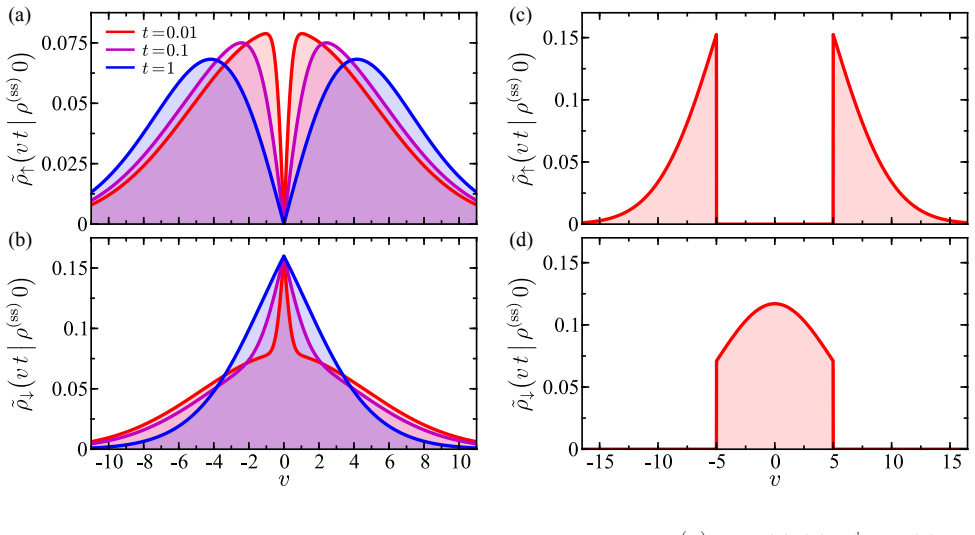
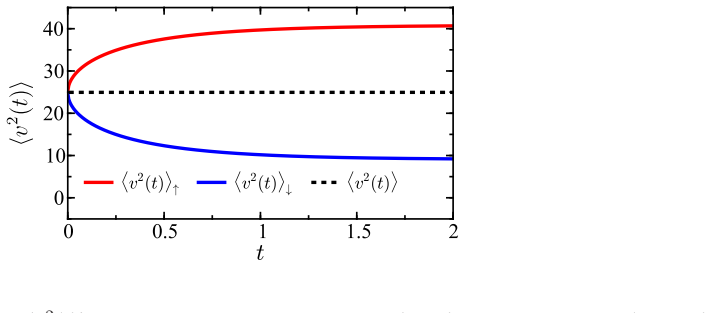
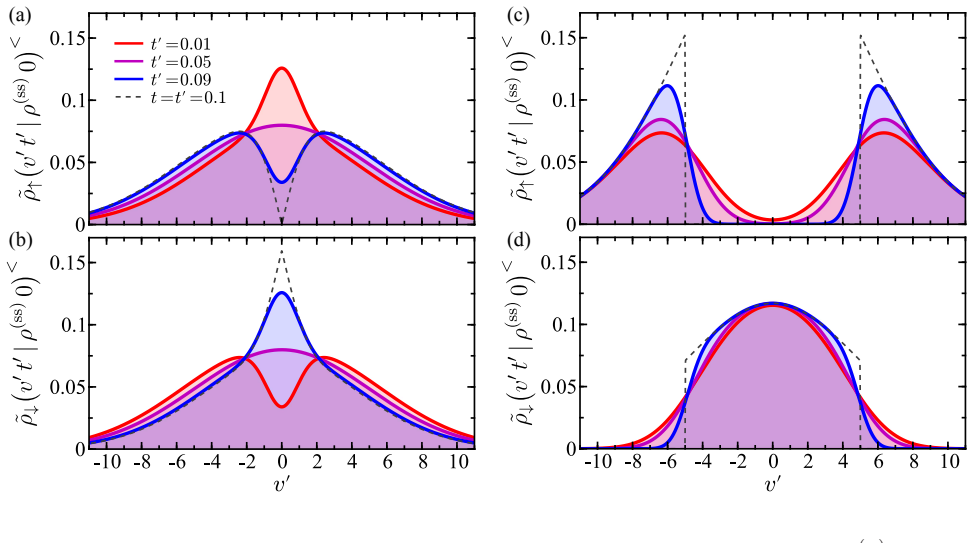
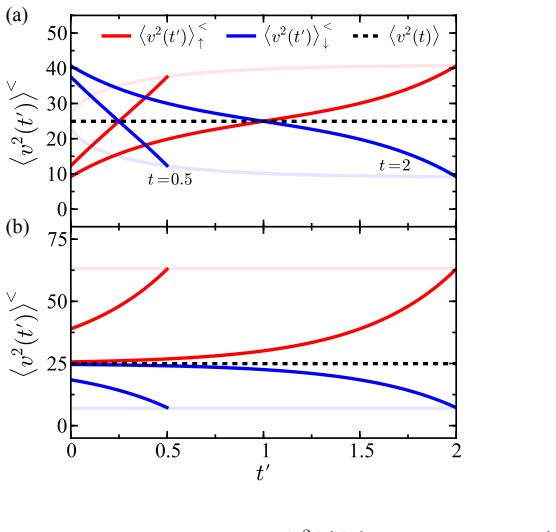
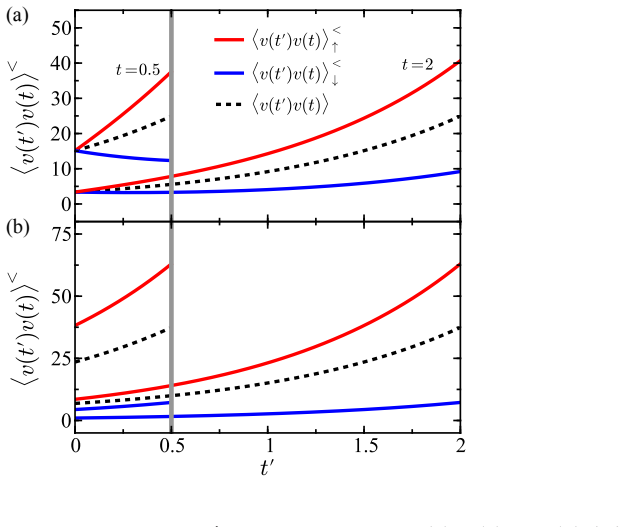
The discovery is that upside/downside Brownian statistics form a closed calculus: with the steady-state Gibbs initial distribution, every one-time and two-time observable can be written explicitly using the Gaussian transition probability of the linear Langevin process together with error functions and confluent hypergeometric series. The signature results are the second velocity moments conditioned on the energy being above or below the initial energy, $\langle v^2(t)\rangle_\uparrow = \frac{k_BT}{m}[1+\frac{2}{\pi}\sqrt{1-e^{-2\gamma t}}]$ and $\langle v^2(t)\rangle_\downarrow = \frac{k_BT}{m}[1-\frac{2}{\pi}\sqrt{1-e^{-2\gamma t}}]$, which are symmetric about the unrestricted equipartition value. For the threshold set at the mean energy, the conditioned second moments are time-independent and strongly asymmetric, about $2.53\,k_BT/m$ upside versus $0.291\,k_BT/m$ downside. The two-time conditioned densities and correlations show that an upside/downside label at a later time reshapes the earlier velocity distribution, with exact time-symmetry for the threshold $E(0)$ and a simple exponential persistence factor $e^{-\gamma(t-t')}$ for the mean-energy threshold.
Load-bearing premise
The load-bearing premise is that the initial velocities are drawn from the steady-state Gibbs distribution and that the velocity dynamics is exactly the linear Langevin process with Gaussian white noise, so every transition probability is exactly Gaussian; if either fails, the closed-form formulas in Section IV do not apply.
Editorial extensions
If this is right
- In the steady-state free-particle case, the equipartition value $k_BT/m$ is recovered only after averaging over both subensembles; conditioning on energy gain or loss displaces the kinetic energy by $\pm(2/\pi)\sqrt{1-e^{-2\gamma t}}\,(k_BT/m)$ at every finite time.
- With the mean energy as threshold, positive and negative energy fluctuations are not mirror images: their one-time kinetic energies are about $2.53$ and $0.291$ times $k_BT/m$, and these values are stationary in time.
- For threshold $E(0)$, the two-time restricted densities are time-symmetric in the sense that at $t'=t/2$ the upside and downside densities coincide, and the conditioned energy at $t'=0$ for an upside process equals the conditioned energy at $t$ for the conjugate downside process.
- The restricted energy change during an upside event with threshold $E(0)$ is $\langle\Delta E\rangle_\uparrow=(2/\pi)k_BT\sqrt{1-e^{-2\gamma t}}$, and during the downside event it is exactly its negative.
- Velocity correlations conditioned on a mean-energy threshold keep the same exponential decay $e^{-\gamma(t-t')}$ as the unrestricted velocity correlation, with amplitudes set by the restricted second moments, so the relaxation time is unchanged while the correlation strength depends on the sign of the fluctuation.
Reading between the lines
- This suggests a direct single-particle test: track a free colloidal or gas-phase particle in a thermal bath, condition its measured squared velocity on whether the instantaneous kinetic energy exceeds its initial value, and compare the conditional means with Eqs. (41)–(42); the predicted long-time deviation from equipartition is the fixed factor $2/\pi$, depending only on the sign of the energy ch
- The same selective construction could be applied to other selectors, such as position, potential energy, or heat flux, by replacing $E(v)$ in the Heaviside function; the resulting conditional fluctuation statistics would be new predictions rather than consequences of this paper.
- The multi-bath partition result previewed in the introduction—that the fraction of energy change attributed to bath $k$ is $\gamma_kT_k/\sum_j\gamma_jT_j$—is not derived here, but it follows naturally from the effective temperature $T=\sum_k\gamma_kT_k/\gamma$ used throughout, so simulating coupled thermostats and measuring per-bath energy exchange during upside/downside events would test it befor
Signed reviews
Editorial analysis
A structured set of objections, weighed in public.
Referee Report
Summary. The paper develops a formalism for the statistical mechanics of a free Brownian particle whose trajectory ensemble is split into "upside" sub-ensembles (system energy above a threshold at time t) and "downside" sub-ensembles (below the threshold). The model is a linear Ornstein-Uhlenbeck velocity process with effective friction γ and effective temperature T defined through coupling to N thermal baths (Sec. II). The authors derive restricted transition probabilities, one-time and two-time conditional densities, velocity and energy moments, energy changes, and velocity correlation functions for two threshold choices: the trajectory-dependent initial energy E(0) and the ensemble-averaged energy ⟨E⟩, with the initial distribution taken to be the steady-state Gibbs distribution. The central output is a set of closed-form expressions, e.g., Eqs. (41)-(42) for the conditional second velocity moments, Eqs. (73)-(74) for two-time restricted moments, and Eqs. (97)-(100) for restricted velocity correlation functions. The paper also presents series representations for the two-time once-restricted densities (Eqs. (61)-(62)) and states that detailed derivations are in a Supplementary Material file.
Significance. If the results are correct, they provide a useful, parameter-free set of conditioned statistics for a Gaussian (Ornstein-Uhlenbeck) velocity process, with no fitted parameters; the inputs are the physical constants of the model. The formulas pass multiple internal consistency checks: the probability-weighted sums of the upside and downside moments reproduce the unrestricted moment (Eqs. (41)-(42) with p↑=p↓=1/2), the two-time correlation functions average to the unrestricted correlation e^{-γ(t-t')} (Eqs. (97)-(98)), and the t→0 and t→∞ limits are consistent with the defining integrals. The multi-bath motivation is plausible and the framework could be applied to energy partitioning in later work. However, the manuscript as submitted is not self-contained: the derivations of the central closed-form results are delegated to a Supplementary Material file that is not included in the arXiv text, so the referee and readers can verify internal consistency but cannot audit the derivations from the defining integrals. A number of typographical errors in key formulas further complicate verification.
major comments (2)
- [Section IV and Section VI] All closed-form results in Section IV are introduced with the statement that 'details of these derivations can be found in the Supplementary Material,' but the supplementary file is not part of the arXiv submission. The paper's central claim is precisely these derivations, from the integral definitions (22)-(25), (37)-(38), (69)-(70), and (95)-(96) to the closed forms (27)-(28), (41)-(42), (51)-(52), (73)-(74), (76)-(77), and (97)-(100). With the supplement absent, the referee can check limits and consistency but cannot verify that the integrals actually reduce to the stated expressions. Please supply the supplementary material as an ancillary file and include in the main text at least one complete derivation, preferably for Eqs. (41)-(42) from Eq. (37), so that the path from the Gaussian transition probability to a closed form is auditable.
- [Section IV D, Eqs. (61)-(62) and Figs. 4-7] The series representations for the two-time once-restricted densities (Eqs. (61)-(62)) are extremely involved, and the text notes that evaluating these sums to convergence is computationally slow. Yet no direct comparison is shown between the closed forms and direct numerical integration of the defining integrals (59)-(60). The figures appear to be based on quadrature of the integral forms, but it is not stated whether the plotted curves use the series or the integrals. Adding a short validation table or a supplementary figure comparing the closed-form expressions with adaptive numerical integration for representative parameter sets would make the central results independently checkable, especially since the derivations are not included in the submission.
minor comments (8)
- [Eq. (28)] The denominator in the expression for the downside density is written with the condition E(t) > E(0); it should be E(t) < E(0) to match the definition of p↓ in Eq. (23). Since p↑ = p↓ = 1/2 in this case, the numerical results are unaffected, but the formula as written is incorrect.
- [Eq. (54)] The definition of p↓↓ is labelled '≡ p↑↑(t′, t | ρ0 0)' after the equality; this should read '≡ p↓↓(t′, t | ρ0 0)'. The same line uses p↑↑ on the left side for the (↑,↑) probability, so the two labels are confused.
- [Section IV A] The text states that both restricted densities 'have a singularity at v=0.' From Eqs. (27)-(28), the upside density is zero at v=0 and the downside density is finite at v=0; only the derivative is discontinuous there. 'Cusp' or 'non-differentiability' would be more accurate than 'singularity'.
- [Section IV B] In the sentence following Eq. (38), the numerator of the restricted moment is described as 'a normalization factor.' The numerator is the unnormalized restricted moment; the denominator p↓ is the normalization factor. Please correct this wording.
- [Eqs. (78)-(79)] In Eq. (79), the second term on the right-hand side carries the condition E(t) > E(0) with a down-arrow subscript; it should be E(t) < E(0) with the down-arrow, in analogy with Eq. (78). The surrounding equations (80)-(85) show that the intended formula is the downside counterpart.
- [Abstract and Introduction] The abstract and introduction emphasize that the model is a 'nonequilibrium Brownian process' driven by multiple thermal sources. Within this paper, however, the restricted observables only depend on the effective friction γ and effective temperature T of Eqs. (6) and (8); the process is an ordinary Ornstein-Uhlenbeck process whose stationary state is the Gibbs distribution of Eq. (11). The multi-bath nonequilibrium content is deferred to later papers. Please adjust the wording so that the reader is not led to expect nonequilibrium-specific results in this paper.
- [Section IV D] The notation in Eqs. (59)-(60) and elsewhere uses both '⏐' and '|' for conditional statements; please standardize to a single symbol. Also, the superscript '<' is used both as a label and as a relational symbol in expressions such as '(v′ t′ < t | ... )', which can be confusing.
- [Title and affiliation] The title contains 'fre e particle' and the affiliation contains 'Phil adelphia'; these appear to be typographical or OCR artifacts and should be corrected in the manuscript source.
Circularity Check
No circularity: the restricted statistics are direct conditional integrals of the standard Gaussian Ornstein-Uhlenbeck transition density, with no fitted parameters or load-bearing self-citation.
full rationale
The paper's derivation chain is self-contained and non-circular. The unrestricted process is the standard linear Ornstein-Uhlenbeck process (Eq. 5) with Gaussian white noise (Eq. 7), and the transition probability is the textbook Gaussian density (Eq. 12). The upside/downside quantities are then defined by inserting Heaviside selectors on the energy into integrals of this known transition density (Eqs. 22-25, 37-38, 53-56, 69-70, 95-96). No parameter is fitted to any subset of the predicted data, and no predicted moment is equal to an input by construction: the closed forms such as Eqs. (41)-(42) and (97)-(100) are nontrivial evaluations of those Gaussian integrals, and the paper states that the detailed evaluations are provided in the Supplementary Material. The self-citations (e.g., Refs. 21-24 and 52-57) are not used to justify the central derivation, and no uniqueness theorem is imported from the authors' prior work. The paper's own limiting checks, such as the reduction of two-time formulas to one-time formulas and the symmetric split about the unrestricted moment, are consistent with conditional expectations and do not indicate circularity. The main genuine caveat is verifiability rather than circularity: Section IV says 'Details of these derivations can be found in the Supplementary Material,' and that supplement is not included in the arXiv version, so the closed-form evaluations cannot be independently audited from the text alone. There is also a minor typo in Eq. (28) involving the condition E(t)>E(0), which does not affect the numerical results because p_up = p_down = 1/2 for that threshold. These are presentation and auditability issues, not circular reasoning.
Assumptions & free parameters
assumptions (3)
- domain assumption The velocity process obeys the linear Langevin equation with Gaussian white noise, leading to a Gaussian transition probability (Eq. 12).
- domain assumption The initial velocity distribution is the steady-state Gibbs distribution, ρ0 = ρ(ss) (Eq. 11), for all explicit closed-form results.
- standard math The multi-temperature system with friction γ = Σ γk has an effective temperature T = Σ γk Tk / γ, giving a steady-state Gibbs distribution (Eqs. 7, 8, 11).
Cite this review
Pith. "Pith review of Upside/Downside statistical mechanics of nonequilibrium Brownian motion. I. Distributions, moments, and correlation functions of a free particle." pith.science (2026). https://pith.science/paper/3FPOQCQJ
@misc{pith2026190800503,
  author       = {Pith},
  title        = {Pith review of: Upside/Downside statistical mechanics of nonequilibrium Brownian motion. I. Distributions, moments, and correlation functions of a free particle},
  year         = {2026},
  howpublished = {\url{https://pith.science/paper/3FPOQCQJ}},
  note         = {Machine review of arXiv:1908.00503}
}
read the original abstract
Statistical properties of Brownian motion that arise by analyzing, separately, trajectories over which the system energy increases (upside) or decreases (downside) with respect to a threshold energy level, are derived. This selective analysis is applied to examine transport properties of a nonequilibrium Brownian process that is coupled to multiple thermal sources characterized by different temperatures. Distributions, moments, and correlation functions of a free particle that occur during upside and downside events are investigated for energy activation and energy relaxation processes, and also for positive and negative energy fluctuations from the average energy. The presented results are sufficiently general and can be applied without modification to standard Brownian motion. This article focuses on the mathematical basis of this selective analysis. In subsequent articles in this series we apply this general formalism to processes in which heat transfer between thermal reservoirs is mediated by activated rate processes that take place in a system bridging them.
Figures

Figures from the paper (4 more)

Reference graph
Works this paper leans on
-
[1]
author C. Jarzynski , journal Phys. Rev. Lett. volume 78 , pages 2690 ( year 1997 ), doi:10.1103/PhysRevLett.78.2690
-
[2]
author D. J. Evans , author E. G. D. Cohen , and author G. P. Morriss , journal Phys. Rev. Lett. volume 71 , pages 2401 ( year 1993 ), doi:10.1103/PhysRevLett.71.2401
-
[3]
author J. Kurchan , journal J. Phys. A volume 31 , pages 3719 ( year 1998 ), http://stacks.iop.org/0305-4470/31/i=16/a=003
work page 1998
-
[4]
author G. E. Crooks , journal Phys. Rev. E volume 61 , pages 2361 ( year 2000 ), doi:10.1103/PhysRevE.61.2361
-
[5]
author U. Seifert , journal Rep. Prog. Phys. volume 75 , pages 126001 ( year 2012 ), http://stacks.iop.org/0034-4885/75/i=12/a=126001
work page 2012
-
[6]
author L. Onsager , journal Phys. Rev. volume 37 , pages 405 ( year 1931 ), doi:10.1103/PhysRev.37.405
-
[7]
author K. Sekimoto , journal Prog. Theor. Phys. Supp. volume 130 , pages 17 ( year 1998 ), doi:10.1143/PTPS.130.17
-
[8]
author U. Seifert , journal Phys. Rev. Lett. volume 95 , pages 040602 ( year 2005 ), doi:10.1103/PhysRevLett.95.040602
Show all 57 references
-
[9]
Van den Broeck , in booktitle Physics of Complex Colloids ( publisher IOS Press , year 2013 ), vol
author C. Van den Broeck , in booktitle Physics of Complex Colloids ( publisher IOS Press , year 2013 ), vol. volume 184 , pp. pages 155--193
2013
-
[10]
author J. L. Lebowitz , journal Phys. Rev. volume 114 , pages 1192 ( year 1959 ), doi:10.1103/PhysRev.114.1192
1959 doi
-
[11]
Rieder , author J
author Z. Rieder , author J. L. Lebowitz , and author E. Lieb , journal J. Math. Phys. volume 8 , pages 1073 ( year 1967 ), doi:10.1063/1.1705319
1967 doi
-
[12]
Casher and author J
author A. Casher and author J. L. Lebowitz , journal J. Math. Phys. volume 12 , pages 1701 ( year 1971 ), doi:10.1063/1.1665794
1971 doi
-
[13]
Segal , author A
author D. Segal , author A. Nitzan , and author P. H\"anggi , journal J. Chem. Phys. volume 119 , pages 6840 ( year 2003 ), doi:10.1063/1.1603211
2003 doi
-
[14]
Segal and author A
author D. Segal and author A. Nitzan , journal Phys. Rev. Lett. volume 94 , pages 034301 ( year 2005 ), doi:10.1103/PhysRevLett.94.034301
2005 doi
-
[15]
Dhar and author J
author A. Dhar and author J. L. Lebowitz , journal Phys. Rev. Lett. volume 100 , pages 134301 ( year 2008 ), doi:10.1103/PhysRevLett.100.134301
2008 doi
-
[16]
Kannan , author A
author V. Kannan , author A. Dhar , and author J. L. Lebowitz , journal Phys. Rev. E volume 85 , pages 041118 ( year 2012 ), doi:10.1103/PhysRevE.85.041118
2012 doi
-
[17]
Sabhapandit , journal Phys
author S. Sabhapandit , journal Phys. Rev. E volume 85 , pages 021108 ( year 2012 ), doi:10.1103/PhysRevE.85.021108
2012 doi
-
[18]
Dhar and author R
author A. Dhar and author R. Dandekar , journal Physica A volume 418 , pages 49 ( year 2015 ), doi:10.1016/j.physa.2014.06.002
2015 doi
-
[19]
author K. A. Velizhanin , author S. Sahu , author C.-C. Chien , author Y. Dubi , and author M. Zwolak , journal Sci. Rep. volume 5 ( year 2015 ), doi:10.1038/srep17506
2015 doi
-
[20]
Murashita and author M
author Y. Murashita and author M. Esposito , journal Phys. Rev. E volume 94 , pages 062148 ( year 2016 ), doi:10.1103/PhysRevE.94.062148
2016 doi
-
[21]
author G. T. Craven and author A. Nitzan , journal Proc. Natl. Acad. Sci. volume 113 , pages 9421 ( year 2016 ), doi:10.1073/pnas.1609141113
2016 doi
-
[22]
author G. T. Craven and author A. Nitzan , journal J. Chem. Phys. volume 146 , pages 092305 ( year 2017 a ), doi:10.1063/1.4971293
2017 doi
-
[23]
author G. T. Craven and author A. Nitzan , journal Phys. Rev. Lett. volume 118 , pages 207201 ( year 2017 b ), doi:10.1103/PhysRevLett.118.207201
2017 doi
-
[24]
Chen , author G
author R. Chen , author G. T. Craven , and author A. Nitzan , journal J. Chem. Phys. volume 147 , pages 124101 ( year 2017 ), doi:10.1063/1.4990410
2017 doi
-
[25]
author R. A. Marcus , journal J. Chem. Phys. volume 24 , pages 966 ( year 1956 ), doi:10.1063/1.1742723
1956 doi
-
[26]
author R. A. Marcus , journal Annu. Rev. Phys. Chem. volume 15 , pages 155 ( year 1964 ), doi:10.1146/annurev.pc.15.100164.001103
1964
-
[27]
author R. A. Marcus and author N. Sutin , journal Biochim. Biophys. Acta volume 811 , pages 265 ( year 1985 ), doi:10.1016/0304-4173(85)90014-X
1985 doi
-
[28]
author R. A. Marcus , journal Rev. Mod. Phys. volume 65 , pages 599 ( year 1993 ), doi:10.1103/RevModPhys.65.599
1993 doi
-
[29]
H \"a nggi , author P
author P. H \"a nggi , author P. Talkner , and author M. Borkovec , journal Rev. Mod. Phys. volume 62 , pages 251 ( year 1990 ), 10.1103/RevModPhys.62.251
1990 doi
-
[30]
author D. G. Truhlar , author B. C. Garrett , and author S. J. Klippenstein , journal J. Phys. Chem. volume 100 , pages 12771 ( year 1996 )
1996
-
[31]
Komatsuzaki and author R
author T. Komatsuzaki and author R. S. Berry , journal Proc. Natl. Acad. Sci. volume 98 , pages 7666 ( year 2001 ), doi:10.1073/pnas.131627698
2001 doi
-
[32]
Bartsch , author R
author T. Bartsch , author R. Hernandez , and author T. Uzer , journal Phys. Rev. Lett. volume 95 , pages 058301(1) ( year 2005 ), doi:10.1103/PhysRevLett.95.058301
2005 doi
-
[33]
Nitzan , title Chemical Dynamics in Condensed Phases: Relaxation, Transfer, and Reactions in Condensed Molecular Systems ( publisher Oxford University Press , year 2006 )
author A. Nitzan , title Chemical Dynamics in Condensed Phases: Relaxation, Transfer, and Reactions in Condensed Molecular Systems ( publisher Oxford University Press , year 2006 )
2006
-
[34]
Hernandez , author T
author R. Hernandez , author T. Bartsch , and author T. Uzer , journal Chem. Phys. volume 370 , pages 270 ( year 2010 ), doi:10.1016/j.chemphys.2010.01.016
2010 doi
-
[35]
Peters , journal J
author B. Peters , journal J. Phys. Chem. B volume 119 , pages 6349 ( year 2015 ), doi:10.1021/acs.jpcb.5b02547
2015 doi
-
[36]
author G. T. Craven and author R. Hernandez , journal Phys. Rev. Lett. volume 115 , pages 148301 ( year 2015 ), doi:10.1103/PhysRevLett.115.148301
2015 doi
-
[37]
Chandler , title Introduction to Modern Statistical Mechanics ( publisher Oxford University Press , year 1987 )
author D. Chandler , title Introduction to Modern Statistical Mechanics ( publisher Oxford University Press , year 1987 )
1987
-
[38]
author W. H. Greene , title Econometric Analysis ( publisher Prentice Hall , year 2002 )
2002
-
[39]
Ranganatham , title Investment Analysis and Portfolio Management ( publisher Pearson Education India , year 2006 )
author M. Ranganatham , title Investment Analysis and Portfolio Management ( publisher Pearson Education India , year 2006 )
2006
-
[40]
author F. K. Reilly and author K. C. Brown , title Investment Analysis and Portfolio Management ( publisher Cengage Learning , year 2011 )
2011
-
[41]
author F. A. Sortino and author R. Van Der Meer , journal J. Portfolio Manage. volume 17 , pages 27 ( year 1991 )
1991
-
[42]
author F. A. Sortino and author L. N. Price , journal J. Invest. volume 3 , pages 59 ( year 1994 )
1994
-
[43]
Keating and author W
author C. Keating and author W. F. Shadwick , journal J. Perf. Measure. volume 6 , pages 59 ( year 2002 )
2002
-
[44]
Ang , author J
author A. Ang , author J. Chen , and author Y. Xing , journal Rev. Financ. Stud. volume 19 , pages 1191 ( year 2006 ), doi:10.1093/rfs/hhj035
2006 doi
-
[45]
Zwanzig , title Nonequilibrium Statistical Mechanics ( publisher Oxford University Press , address London , year 2001 )
author R. Zwanzig , title Nonequilibrium Statistical Mechanics ( publisher Oxford University Press , address London , year 2001 )
2001
-
[46]
Revuelta , author G
author F. Revuelta , author G. T. Craven , author T. Bartsch , and author R. Hernandez , journal J. Chem. Phys. volume 147 , pages 074104 ( year 2017 ), doi:10.1063/1.4997571
2017 doi
-
[47]
author G. T. Craven , author A. Junginger , and author R. Hernandez , journal Phys. Rev. E volume 96 , pages 022222 ( year 2017 ), doi:10.1103/PhysRevE.96.022222
2017 doi
-
[48]
Chandrasekhar , journal Rev
author S. Chandrasekhar , journal Rev. Mod. Phys. volume 15 , pages 1 ( year 1943 ), doi:10.1103/RevModPhys.15.1
1943 doi
-
[49]
author G. E. Uhlenbeck and author L. S. Ornstein , journal Phys. Rev. volume 36 , pages 823 ( year 1930 ), doi:10.1103/PhysRev.36.823
1930 doi
-
[50]
author D. V. Matyushov , journal Proc. Natl. Acad. Sci. volume 113 , pages 9401 ( year 2016 ), doi:10.1073/pnas.1610542113
2016 doi
-
[51]
Cohen , in booktitle Mathematical Analysis, Probability and Applications - Plenary Lectures ISAAC 2015 ( organization Springer , year 2015 ), pp
author L. Cohen , in booktitle Mathematical Analysis, Probability and Applications - Plenary Lectures ISAAC 2015 ( organization Springer , year 2015 ), pp. pages 1--35
2015
-
[52]
note Results for the different case E^ = E(0) and _0 = (v-v_0) are given in the Supplementary Material
-
[53]
note Derivations of restricted transport properties are given in the Supplementary Material
-
[54]
author E. W. Ng and author M. Geller , journal Journal of Research of the National Bureau of Standards B volume 73 , pages 1–20 ( year 1969 )
1969
-
[55]
author M. K. Simon and author D. Divsalar , journal IEEE Trans. Commun. volume 46 , pages 200 ( year 1998 ), doi:10.1109/26.659479
1998 doi
-
[56]
Fayed and author A
author H. Fayed and author A. Atiya , journal Math. Comp volume 83 , pages 235 ( year 2014 ), doi:10.1090/S0025-5718-2013-02720-2
2014 doi
-
[57]
Fayed , author A
author H. Fayed , author A. Atiya , and author A. Badawi , journal Math. Sci. Lett. volume 4 , pages 249 ( year 2015 ), doi:10.12785/msl/040305
2015 doi
Reviewed August 14, 2026 · model on record in the stance chip above.
Discussion (0). Continue with ORCID to comment.