REVIEW 3 major objections 5 minor 1 cited by
Removing Neural Signal Artifacts with Autoencoder-Targeted Adversarial Transformers (AT-AT)
T0 review · 3 major / 5 minor · reviewed 2026-08-08 · deepseek-v4-flash
Pith's one-line read AT-AT is a low-footprint EEG denoiser that uses an autoencoder's correlation with the raw signal to decide where a transformer must reconstruct high-noise sites, achieving greater than 90 percent model-size reduction while matching…
desk verdict A plausible lightweight EEG denoiser whose central mechanism is unproven: the autoencoder-targeting heuristic is never ablated. read the letter →
The pith
A machine-rendered reading of the paper's core claim, the machinery that carries it, and where it could break.
The reading
What carries the argument
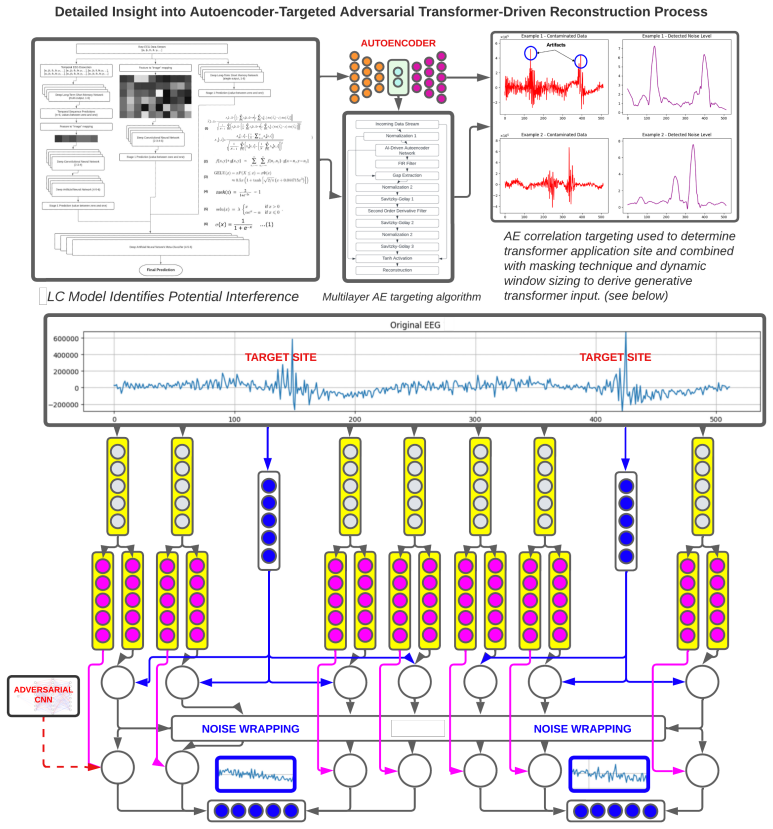
The load-bearing mechanism is the autoencoder-targeted adversarial transformer: a convolutional denoising autoencoder whose reconstruction-vs-raw correlation acts as a noise proxy, a hard 0.8 correlation cutoff that masks 'high-noise' sites, 1x2 tokens that combine raw and autoencoder sample values at each time step, and a five-cycle GAN loop in which a CNN discriminator pushes the transformer-augmented output toward authentic EEG spectra. The autoencoder routes the transformer to only the sites that need it, which is what allows the large model to stay small; the adversarial loop is what keeps the inserted transformer reconstructions from distorting the signal's spectral character.
What would settle it
Compute the same EEGdenoiseNet reconstruction metrics with the transformer invoked at randomly chosen sites or at sites chosen by an oracle, and with the 0.8 threshold varied to 0.6 and 1.0; if random site selection matches AT-AT or the threshold change barely moves the correlation coefficient, the autoencoder-targeting mechanism is not doing the claimed work.
Extended reading notes
Core claim
On its own terms, the paper's discovery is that the sites where a transformer is applied to an EEG signal can be selected by correlation between the raw signal and the output of a denoising autoencoder, rather than by brute-force tokenization over the whole signal. Sites whose correlation falls below 0.8 are treated as high-noise, masked, and reconstructed by the transformer; adversarial training with a CNN discriminator keeps the generated output spectrally EEG-like. In the semi-synthetic setting of EEGdenoiseNet, this design yields a mean reconstructive correlation coefficient of 0.951 at 2 dB and 0.703 at -7 dB, with training time of 249.1 seconds on a T4 GPU, and a model-size reduction of more than 90% relative to published deep-learning baselines. In a real-world pilot appended to the study, AT-AT processing reduced classification error by over 40% and supported 97.0% accuracy on digit-versus-non-digit thought classification when combined with a geometric manifold-learning pipeline.
Load-bearing premise
The system assumes that the correlation between the autoencoder-filtered signal and the raw signal reliably ranks noise levels, so the hard 0.8 cutoff sends the transformer to exactly the sites that need it; the paper gives no sensitivity analysis or independent validation of that proxy.
Editorial extensions
If this is right
- If correct, a transformer-grade EEG-EMG denoiser can run with a >90% smaller footprint than current deep-learning baselines, opening room for on-device BCI deployment.
- Selective invocation means the transformer's capacity is spent only on high-noise sites, so parameter count and training time can be spent where reconstruction error is concentrated.
- Adversarial training in this hybrid loop improves spectral fidelity by more than 10%, implying that spectral realism is a separable objective from temporal reconstruction.
- The reported 249-second training run, close to the 240-second data requirement, suggests retraining on new subjects could be feasible in dynamic BCI settings.
- In the appended real-world pilot, artifact filtering alone lowered downstream classification error by over 40%, implying denoising quality can translate directly to BCI task performance.
Reading between the lines
- A sensitivity analysis of the 0.8 correlation cutoff is the paper's most direct open question; varying the threshold would show whether transformer invocation is genuinely responsible for the reported reconstructions or whether the autoencoder alone does most of the work.
- The autoencoder-as-router idea could transfer to other artifact types, such as ocular or movement artifacts, and to other biosignals, since the noise proxy does not depend on EEG-specific structure.
- Because the benchmark comparison uses best-in-class values from published reports, a same-split, same-hardware direct reimplementation of the cited baselines would be the cleanest test of the >90% size-reduction claim.
- If the MindBigData pilot holds, it suggests that denoising quality can be assessed through downstream task separability, not only reconstruction correlation, justifying artifact-removal evaluations by end-task metrics.
Editorial analysis
A structured set of objections, weighed in public.
Referee Report
Summary. The paper presents AT-AT, a two-stage system for removing EMG artifacts from EEG. A convolutional denoising autoencoder performs an initial pass; a heuristic based on the correlation between the autoencoder output and the raw signal (with a 0.8 cutoff) identifies high-noise sites; a time-series transformer reconstructs those masked sites; and a 1D-CNN discriminator provides adversarial training. The system is evaluated on the EEGdenoiseNet semi-synthetic benchmark at SNR levels of 2 dB and -7 dB, reporting mean CCs of 0.951 and 0.703, tRRMSEs of 0.317 and 0.759, sRRMSEs of 0.270 and 0.800, and a training time of 249.1 s on a T4 GPU. The abstract claims a >90% model size reduction relative to published artifact removal models. An appendix reports a real-world deployment on MindBigData digit/non-digit classification, with a reported 97.0% test accuracy after a downstream geometric machine learning pipeline.
Significance. If validated, AT-AT would provide a low-footprint adversarial transformer denoiser for EEG, potentially useful for resource-constrained BCI applications. The paper has several strengths: the architecture is specified in the appendix, confidence intervals are reported for the main metrics, the benchmark uses external ground truth, and the authors include a preliminary real-world deployment and explicitly acknowledge limited generalization. However, the central claims currently rest on an unablated heuristic and a comparison protocol that does not support the stated performance and model-size conclusions.
major comments (3)
- [Section 2, Figure 1] The autoencoder-targeting heuristic is the central novelty and the basis for the claimed efficiency, but it is never ablated. The paper does not compare AT-AT against the same autoencoder+transformer+GAN without masking, against random masking at the same rate, or against different correlation cutoffs. Without such sensitivity analysis, the reported CC=0.951/0.703 cannot be attributed to the selective application mechanism, and the rationale that the transformer is used only when necessary is unsupported. This is a load-bearing gap.
- [Section 3, Figure 3] The headline claims of "comparable test performance to larger models" and ">90% model size reduction" lack a common evaluation protocol. All comparator values are described as "best extrapolated from reported documentation," no parameter counts are reported for AT-AT or for the comparators, and no details are given about the test splits or contamination protocols used for the baselines. A table with AT-AT and baseline parameter counts under the same counting scheme, and either a common-protocol comparison or an explicit statement of the limits of cross-paper comparison, is required to support the central claims.
- [Section 2, Appendix 4.1] The role of the upstream LC SNR-selection model is underspecified. The text says it "selects the suitable iteration of AT-AT" based on detected SNR, which suggests that multiple AT-AT models are trained per SNR level, yet the reported performance metrics, model size, and 249.1-second training time are not broken down by model instance. The paper should clarify whether the test performance comes from a single model or from an SNR-toggled set of models, and should report the total footprint and training time accordingly.
minor comments (5)
- [Abstract, Section 2] The abstract mentions "published neural data from 67 subjects," but Section 2 restricts training to 120 segments totaling 240 seconds; clarify how the 67 subjects relate to the training and test segments.
- [Section 3] The confidence interval notation is inconsistent: the -7 dB CC is written as "0.679-0.726" while other CIs use commas; please unify the notation.
- [Appendix 4.1] The statement that the upstream LC model "correctly infer SNR across all 100 test cases" refers to SNR classification, not reconstruction accuracy; make this distinction explicit to avoid overinterpreting the result.
- [Appendix 4.2] The reported >40% error reduction and 97.0% test accuracy are based on a single 90:10 train-test split with no cross-validation; the paper should state this limitation directly.
- [Figure 3] Given that the caption indicates the baseline values are extrapolated from documentation, consider also providing a table with the AT-AT confidence intervals and the baseline values so readers can assess overlap without relying on a figure alone.
Circularity Check
No circularity: AT-AT's benchmark evaluation is anchored to external ground truth; self-citations supply architecture priors but do not carry the central claim.
full rationale
The claimed result—mean CC 0.951 at 2 dB and 0.703 at -7 dB on EEGdenoiseNet—is measured against the dataset's ground truth, so it is not a fitted input renamed as a prediction. The autoencoder-targeting step uses a correlation-coefficient proxy to gate transformer invocation, but this proxy is not the reported outcome; the outcome is CC, tRRMSE, and sRRMSE against ground truth, as reported in Section 3. The paper's reliance on prior work [5] for the autoencoder architecture, the upstream LSTM-CNN SNR model, and the adversarial-training ablation is a self-citation chain, but none of these citations proves the benchmark numbers; those numbers come from held-out semi-synthetic tests described in Section 2 and Appendix 4.1. The 0.8 CC cutoff is a hand-set threshold, and the paper explicitly states that 'an evaluation of a sans-transformer method is outside of the scope of this study, but we refer readers to [5]' (Section 2) and that 'all results are preliminary' (Section 3). These are acknowledged evidence gaps and limitations, not circular reductions: the central derivation is not equivalent to its inputs by construction, and the benchmark performance is externally falsifiable against EEGdenoiseNet ground truth. No step in the paper reduces a prediction to a fitted parameter or to a self-citation that is itself unverified and load-bearing, so the circularity score is 0.
Assumptions & free parameters
free parameters (3)
- High-noise site correlation cutoff =
0.8
- GAN cycle count =
5
- Training corpus size =
120 segments, 240 seconds
assumptions (4)
- ad hoc to paper Correlation between autoencoder-filtered and raw signals is a monotone proxy for EMG noise level.
- domain assumption Semi-synthetic EEGdenoiseNet mixtures with added EMG at fixed SNR faithfully represent real EEG-EMG contamination.
- domain assumption Adversarial training enforces fundamental EEG spectral characteristics.
- standard math Ground-truth reconstruction metrics (CC, tRRMSE, sRRMSE) are valid measures of denoising quality.
Cite this review
Pith. "Pith review of Removing Neural Signal Artifacts with Autoencoder-Targeted Adversarial Transformers (AT-AT)." pith.science (2026). https://pith.science/paper/3GGMYCLJ
@misc{pith2026250205332,
  author       = {Pith},
  title        = {Pith review of: Removing Neural Signal Artifacts with Autoencoder-Targeted Adversarial Transformers (AT-AT)},
  year         = {2026},
  howpublished = {\url{https://pith.science/paper/3GGMYCLJ}},
  note         = {Machine review of arXiv:2502.05332}
}
read the original abstract
Electromyogenic (EMG) noise is a major contamination source in EEG data that can impede accurate analysis of brain-specific neural activity. Recent literature on EMG artifact removal has moved beyond traditional linear algorithms in favor of machine learning-based systems. However, existing deep learning-based filtration methods often have large compute footprints and prohibitively long training times. In this study, we present a new machine learning-based system for filtering EMG interference from EEG data using an autoencoder-targeted adversarial transformer (AT-AT). By leveraging the lightweight expressivity of an autoencoder to determine optimal time-series transformer application sites, our AT-AT architecture achieves a >90% model size reduction compared to published artifact removal models. The addition of adversarial training ensures that filtered signals adhere to the fundamental characteristics of EEG data. We trained AT-AT using published neural data from 67 subjects and found that the system was able to achieve comparable test performance to larger models; AT-AT posted a mean reconstructive correlation coefficient above 0.95 at an initial signal-to-noise ratio (SNR) of 2 dB and 0.70 at -7 dB SNR. Further research generalizing these results to broader sample sizes beyond these isolated test cases will be crucial; while outside the scope of this study, we also include results from a real-world deployment of AT-AT in the Appendix.
Figures


Figures from the paper (1 more)

Forward citations
Cited by 1 Pith paper
-
Geometric Machine Learning on EEG Signals
An EEG pipeline combining transformer-based denoising with graph Ricci flow and a GCN reports 0.97 accuracy for digit versus non-digit thought classification, but without baselines or code.
Reference graph
Works this paper leans on
-
[1]
U. Chaudhary, N. Mrachacz-Kersting, and N. Birbaumer. Neuropsychological and neuro- physiological aspects of brain-computer-interface (BCI) control in paralysis. The Journal of Physiology, 599(9):2351–2359, May 2021
work page 2021
-
[2]
S. Cho, S. Cho, S. Park, H. Lee, H. Lee, and M. Lee. Curve your attention: Mixed-curvature transformers for graph representation learning. arXiv preprint arXiv:2309.04082, 2023
arXiv 2023
-
[4]
B. J. Choi and J. Liu. A low-cost transhumeral prosthesis operated via an ML-assisted EEG-head gesture control system. Journal of Neural Engineering , 22(1):016031, 2025. https://iopscience.iop.org/article/10.1088/1741-2552/adae35
-
[5]
B. J. Choi, G. Milsap, C. A. Scholl, F. Tenore, and M. Ogg. Targeted adversarial denoising autoencoders (TADA) for neural time series filtration. arXiv preprint, arXiv:2501.04967, 2025. https://arxiv.org/abs/2501.04967
arXiv 2025
- [6]
-
[7]
A. Creswell, T. White, V . Dumoulin, K. Arulkumaran, B. Sengupta, and A. A. Bharath. Genera- tive adversarial networks: An overview. IEEE Signal Processing Magazine, 35:53–65, January 2018
work page 2018
-
[8]
H. Cui, C. Li, A. Liu, R. Qian, and X. Chen. A dual-branch interactive fusion network to remove artifacts from single-channel EEG. IEEE Transactions on Instrumentation and Measurement, 73:1–12, 2024. Art. no. 4001912
work page 2024
-
[9]
W. De Clercq, A. Vergult, B. Vanrumste, W. Van Paesschen, and S. Van Huffel. Canonical correlation analysis applied to remove muscle artifacts from the electroencephalogram. IEEE Transactions on Biomedical Engineering, 53(12):2583–2587, 2006
work page 2006
Show all 32 references
-
[10]
Huang, G
J. Huang, G. Li, H. Su, and Z. Li. Development and continuous control of an intelligent upper- limb neuroprosthesis for reach and grasp motions using biological signals. IEEE Transactions on Systems, Man, and Cybernetics: Systems, 52(6):3431–3441, June 2022
2022
-
[11]
D. A. Hudson and L. Zitnick. Generative adversarial transformers. In Proceedings of the 38th International Conference on Machine Learning, volume 139, pages 4487–4499, 2021
2021
-
[12]
Iriarte, E
J. Iriarte, E. Urrestarazu, M. Valencia, M. Alegre, A. Malanda, C. Viteri, and J. Artieda. Independent component analysis as a tool to eliminate artifacts in EEG: a quantitative study. Journal of Clinical Neurophysiology, 20(4):249–257, 2003
2003
-
[13]
H. M. Kasem, K.-W. Hung, and J. Jiang. Spatial transformer generative adversarial network for robust image super-resolution. IEEE Access, 7:182993–183009, 2019
2019
-
[14]
Kashihara
K. Kashihara. A brain-computer interface for potential non-verbal facial communication based on EEG signals related to specific emotions. Frontiers in Neuroscience, 8:244, 2014
2014
-
[15]
M. Kaya, M. K. Binli, E. Ozbay, H. Yanar, and Y . Mishchenko. A large electroencephalographic motor imagery dataset for electroencephalographic brain-computer interfaces. Scientific Data, 5, 2018. Article 180211
2018
-
[16]
Koelstra, C
S. Koelstra, C. Muhl, M. Soleymani, J.-S. Lee, A. Yazdani, T. Ebrahimi, T. Pun, A. Nijholt, and I. Patras. Deap: A database for emotion analysis using physiological signals. IEEE Transactions on Affective Computing, 3:18–31, 2011
2011
-
[17]
Krim and M
H. Krim and M. Viberg. Two decades of array signal processing research: The parametric approach. IEEE Signal Processing Magazine, 13:67–94, July 1996. 6
1996
-
[18]
Liang, R
Z. Liang, R. Zhou, L. Zhang, L. Li, G. Huang, Z. Zhang, and S. Ishii. EEGFuseNet: Hybrid unsupervised deep feature characterization and fusion for high-dimensional EEG with an application to emotion recognition. IEEE Transactions on Neural Systems and Rehabilitation Engineerin...
1913
-
[19]
Pacini, T
F. Pacini, T. Pacini, G. Lai, A. M. Zocco, and L. Fanucci. Design and evaluation of CPU-, GPU-, and FPGA-based deployment of a CNN for motor imagery classification in brain-computer interfaces. Electronics, 13(9):1646, 2024
2024
-
[20]
X. R. Pu, P. Yi, K. Chen, Z. Q. Ma, D. Zhao, and Y . Z. Ren. EEGDnet: Fusing non-local and local self-similarity for EEG signal denoising with transformer. Computers in Biology and Medicine, 151(Part A), 2022. Art. no. 106248
2022
-
[21]
M. Z. Soroush, P. Tahvilian, M. H. Nasirpour, K. Maghooli, K. Sadeghniiat-Haghighi, S. Ha- randi, Z. Abdollahi, A. Ghazizadeh, and N. J. Dabanloo. EEG artifact removal using sub-space decomposition, nonlinear dynamics, stationary wavelet transform and machine learning algo- ri...
2022
-
[22]
F. T. Sun, S. A. Desai, T. K. Tcheng, and M. J. Morrell. Changes in the electrocorticogram after implantation of intracranial electrodes in humans: the implant effect. Clinical Neurophysiology, 129(3):676–686, March 2018
2018
-
[23]
Y . Tian, Z. Lubberts, and M. Weber. Curvature-based clustering on graphs. arXiv preprint arXiv:2307.10155, 2023
2023 arXiv
-
[24]
Van Veen, A
G. Van Veen, A. Barachant, A. Andreev, G. Cattan, P. C. Rodrigues, and M. Congedo. Building brain invaders: EEG data of an experimental validation. arXiv preprint arXiv:1905.05182, 2019
1905 arXiv
-
[25]
Vaswani, N
A. Vaswani, N. Shazeer, N. Parmar, J. Uszkoreit, L. Jones, A. N. Gomez, Ł. Kaiser, and I. Polosukhin. Attention is all you need. In Advances in Neural Information Processing Systems, volume 30, 2017
2017
-
[26]
Vivancos and F
D. Vivancos and F. Cuesta. Mindbigdata 2022: A large dataset of brain signals. arXiv preprint arXiv:2212.14746, 2022
2022 arXiv
-
[27]
B. Wang, F. Deng, and P. Jiang. EEGDiR: Electroencephalogram denoising network for temporal information storage and global modeling through retentive network. Computers in Biology and Medicine, 177:108626, 2024
2024
-
[28]
X. Wang, M. Hersche, B. Tömekce, B. Kaya, M. Magno, and L. Benini. An accurate EEGNet- based motor-imagery brain–computer interface for low-power edge computing. In 2020 IEEE International Symposium on Medical Measurements and Applications (MeMeA) , pages 1–6. IEEE, June 2020
2020
-
[29]
Weber, E
M. Weber, E. Saucan, and J. Jost. Characterizing complex networks with forman-ricci curvature and associated geometric flows. Journal of Complex Networks, 5(4):527–550, 2017
2017
-
[30]
J. Yin, A. Liu, C. Li, R. Qian, and X. Chen. A GAN guided parallel CNN and transformer network for EEG denoising. IEEE Journal of Biomedical and Health Informatics, 2023. Early Access, pages 1–12
2023
-
[31]
Zhang, C
H. Zhang, C. Wei, M. Zhao, Q. Liu, and H. Wu. EEGdenoiseNet: A benchmark dataset for deep learning solutions of EEG denoising. Journal of Neural Engineering, 18, 2021. Art. no. 056057
2021
-
[32]
digit" versus “non-digit
H. Zhang, C. Wei, M. Zhao, Q. Liu, and H. Wu. A novel convolutional neural network model to remove muscle artifacts from EEG. In ICASSP 2021 - 2021 IEEE International Conference on Acoustics, Speech and Signal Processing (ICASSP), pages 1265–1269, Toronto, ON, Canada, 2021. 7 ...
2021
-
[2025]
https://arxiv.org/abs/2502.05334
Reviewed August 8, 2026 · model on record in the stance chip above.
Discussion (0). Continue with ORCID to comment.