New Avenues of Heavy Neutral Lepton at Muon Collider
Pith reviewed 2026-06-26 17:14 UTC · model grok-4.3
The pith
New Z' vector boson fusion processes produce heavy neutral leptons at muon colliders without mixing suppression.
A machine-rendered reading of the paper's core claim, the machinery that carries it, and where it could break.
Core claim
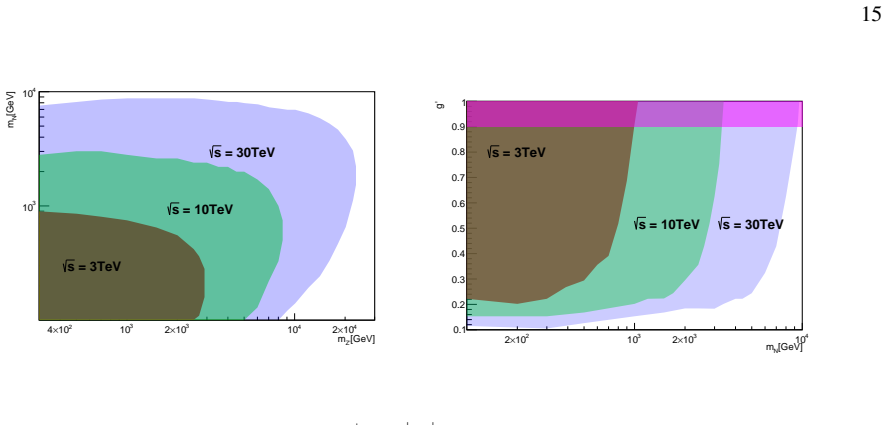
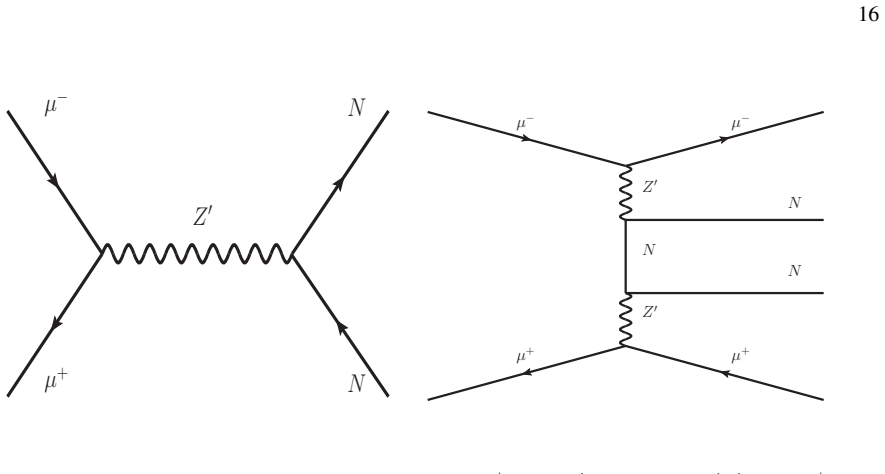
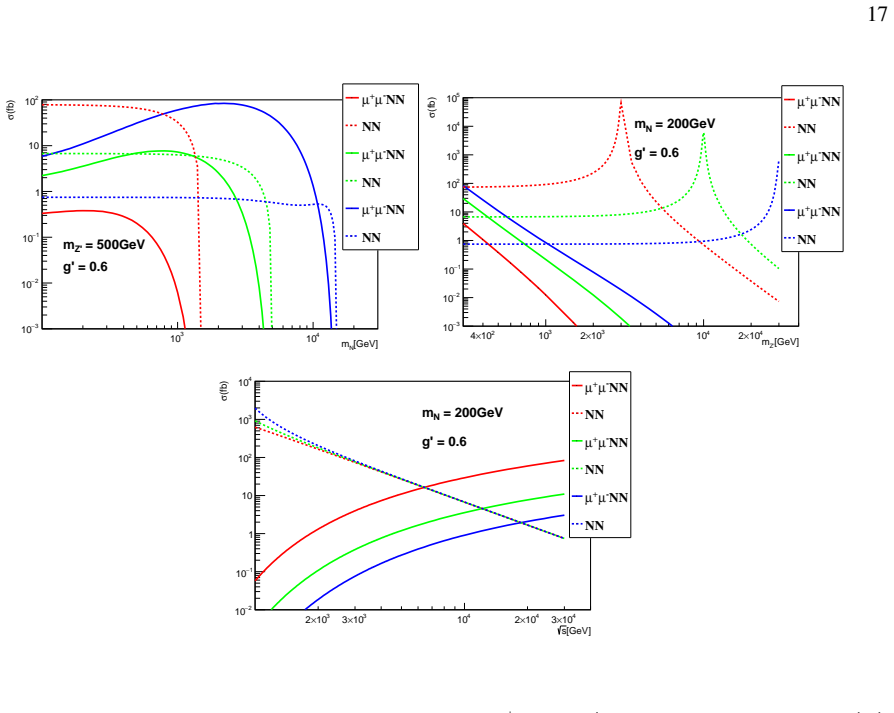
Within the U(1) gauged extension of seesaw models, heavy neutral leptons acquire additional interactions with the new Z' gauge boson and heavy Higgs. At the muon collider these lead to the processes Z'Z'→H→NN and Z'Z'→NN that are not suppressed by the Higgs mixing angle α and that work for heavy Higgs masses above the collider center of mass energy, providing alternative pathways to probe the intrinsic features of the heavy neutral lepton through subsequent lepton number violating decays.
What carries the argument
The Z'Z' vector boson fusion processes to heavy neutral lepton pairs, with and without intermediate heavy Higgs, which enable unsuppressed production rates.
Load-bearing premise
The U(1) extension must introduce a Z' boson that couples sufficiently strongly to the heavy neutral leptons and the heavy Higgs to make the fusion processes observable.
What would settle it
Observation of production rates for heavy neutral leptons via Z' fusion that match the suppressed rates expected from standard model vector boson fusion would indicate the new processes do not provide the claimed advantage.
Figures
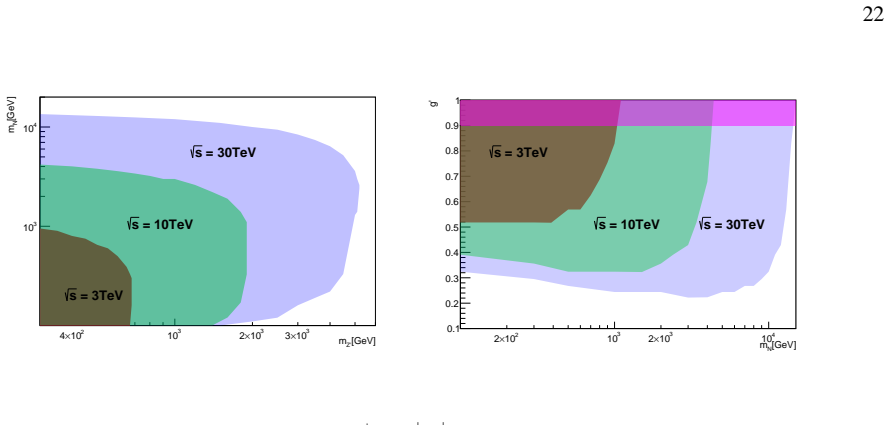
read the original abstract
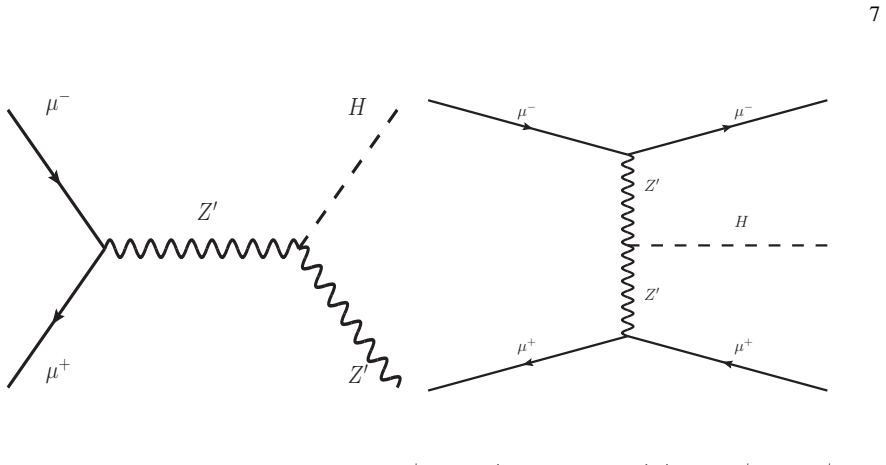
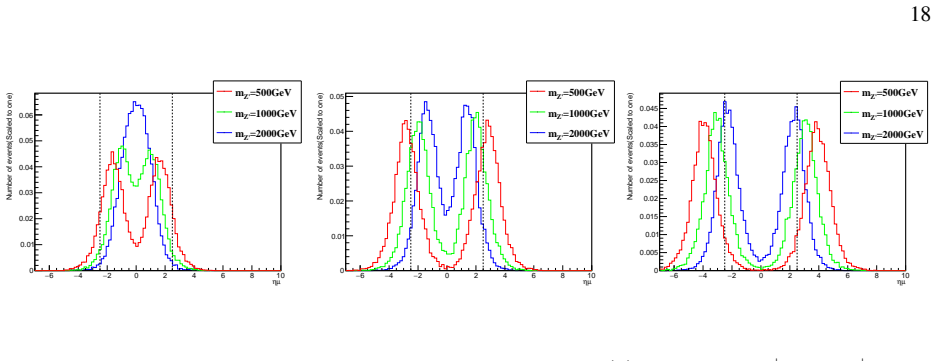
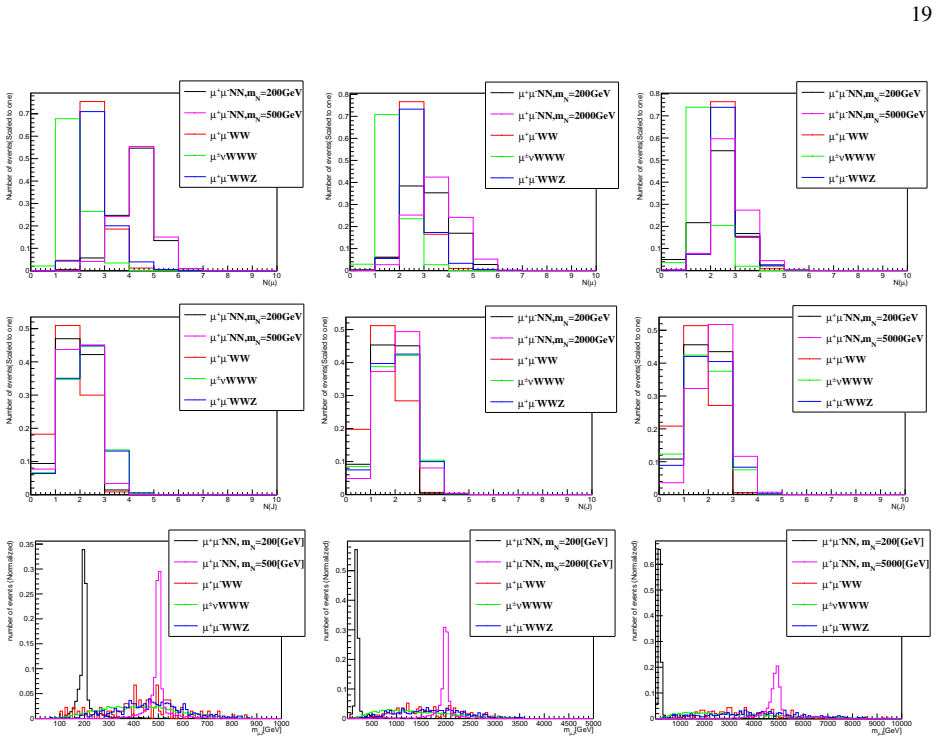
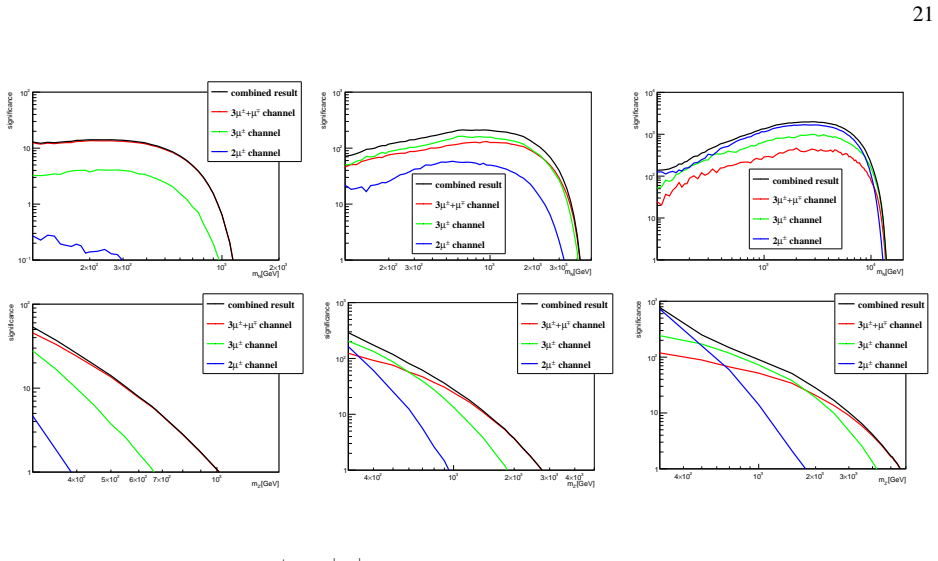
With initial state radiation, the multi-TeV muon collider can be regarded as an electroweak boson collider. The dominant production mode of the certain process becomes the vector boson fusion channel, because the corresponding cross section typically increases logarithmically at high energies. This also holds true for new physics beyond the standard model. Within the $U(1)$ gauged extension of seesaw models, the heavy neutral lepton has additional interactions with the new gauge boson $Z'$ and heavy Higgs $H$. In this paper, we investigate the production of heavy neutral lepton $N$ via the new vector boson fusion processes $Z'Z'\to H\to NN$ with and $Z'Z'\to NN$ without heavy Higgs at the multi-TeV muon collider. Different from the canonical vector boson fusion processes $WW/ZZ\to H\to NN$, the new process $Z'Z'\to H\to NN$ is not suppressed by the small mixing angle $\alpha$ between the Higgs bosons. Meanwhile, the pair production process $Z'Z'\to NN$ is also viable even for heavy Higgs $m_H> \sqrt{s}$. Therefore, these new avenues provide alternative pathways to probe the intrinsic feature of the heavy neutral lepton. We then perform a detailed analysis of the lepton number violation signals via the new vector boson fusion with heavy Higgs $\mu^+\mu^-\to \mu^+\mu^- H \to \mu^+\mu^- NN$ and without heavy Higgs $\mu^+\mu^-\to \mu^+\mu^- NN$, followed by $N\to \mu^\pm jj$, where the two jets from $W$ boson decay are treated as one fat-jet $J$.
Editorial analysis
A structured set of objections, weighed in public.
Referee Report
Summary. The paper investigates production of heavy neutral leptons N at a multi-TeV muon collider in a U(1) gauged extension of the seesaw model. It focuses on new vector-boson-fusion channels Z'Z' → H → NN (with heavy Higgs) and Z'Z' → NN (direct), claiming these avoid suppression by the Higgs mixing angle α that affects standard WW/ZZ → H → NN, remain viable for m_H > √s, and enable lepton-number-violating signals via N → μ± jj (fat-jet) in the processes μ+μ− → μ+μ− H → μ+μ− NN and μ+μ− → μ+μ− NN.
Significance. If the U(1) gauged seesaw extension supplies tree-level Z'Z'H, Z'Z'NN and HNN vertices of unsuppressed strength, the proposed channels would furnish model-specific, α-independent production modes for HNLs at future muon colliders, potentially expanding the parameter space accessible beyond canonical VBF and offering concrete LNV search strategies with fat-jet reconstruction.
major comments (3)
- [Model section / Lagrangian] The central claim that Z'Z'→H→NN evades α suppression rests on the existence of unsuppressed Z'Z'H and HNN vertices; the manuscript must explicitly derive these couplings from the model Lagrangian (presumably in the model-definition section) and show that they remain O(1) independent of the small α that mixes the two CP-even scalars.
- [Process definitions / cross-section calculation] The assertion that Z'Z'→NN is viable for m_H > √s requires demonstration that the direct Z'Z'NN vertex is present at tree level with strength set by the U(1) gauge coupling rather than loop- or mixing-suppressed; without the explicit Feynman rule or cross-section formula, the kinematic claim cannot be verified.
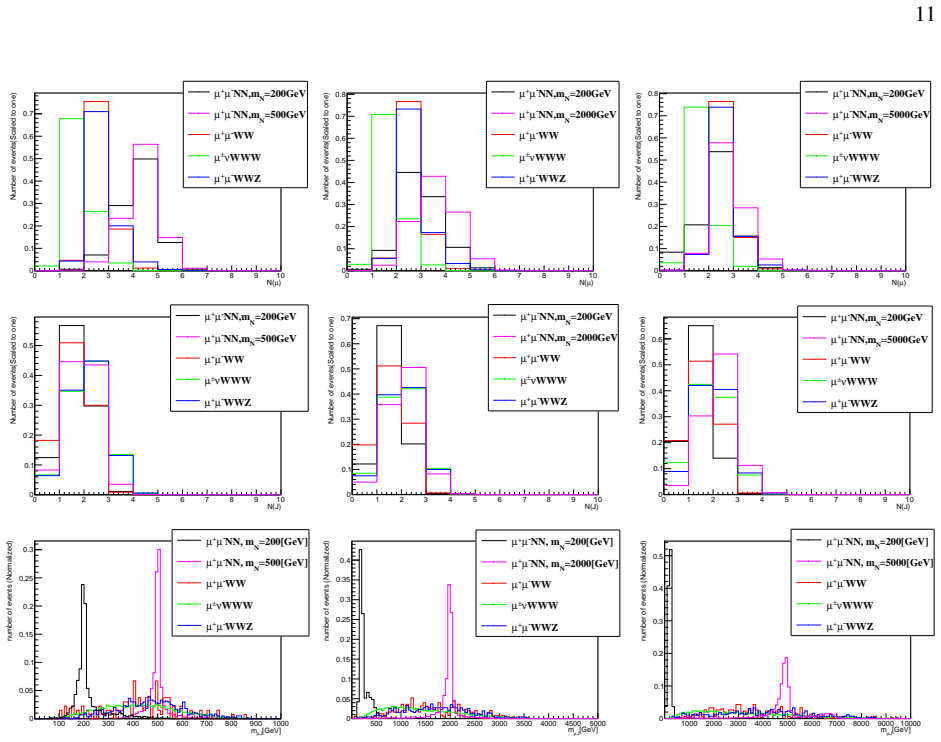
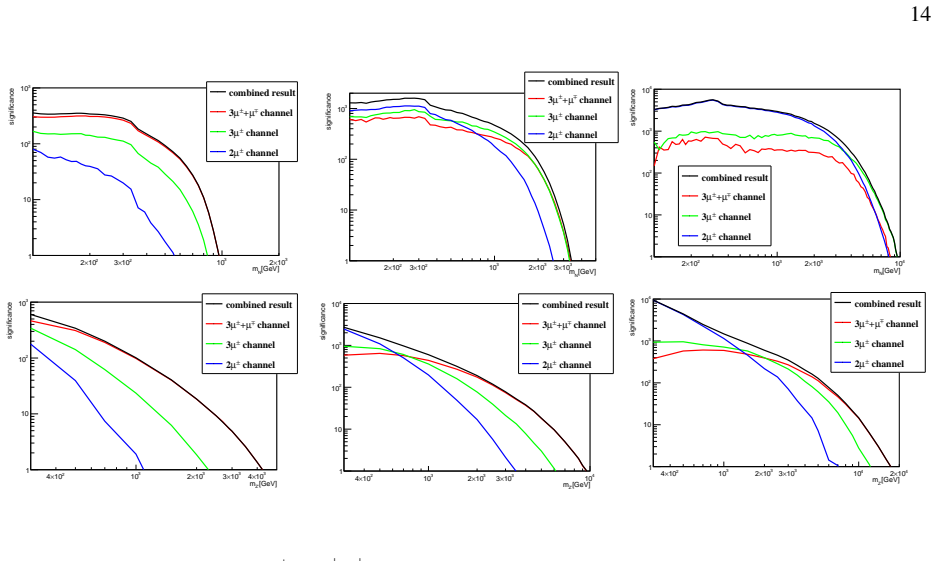
- [Phenomenological analysis / event selection] The subsequent LNV analysis (μ+μ− → μ+μ− NN followed by N → μ± jj) must include quantitative signal and background cross sections after fat-jet tagging; the abstract states the final state but does not report the numerical rates or efficiencies needed to establish observability.
minor comments (2)
- [Signal topology] Notation for the fat jet (denoted J) and the precise definition of the fat-jet algorithm should be stated explicitly when first introduced.
- [Parameter space] The range of free parameters (m_Z', m_H, m_N, α, gauge coupling) over which the new channels dominate should be summarized in a table or plot for clarity.
Simulated Author's Rebuttal
We thank the referee for the thorough review and constructive feedback on our manuscript. We address each major comment below and will revise the paper to strengthen the presentation of the model and results.
read point-by-point responses
-
Referee: [Model section / Lagrangian] The central claim that Z'Z'→H→NN evades α suppression rests on the existence of unsuppressed Z'Z'H and HNN vertices; the manuscript must explicitly derive these couplings from the model Lagrangian (presumably in the model-definition section) and show that they remain O(1) independent of the small α that mixes the two CP-even scalars.
Authors: We agree that explicit derivation is required for clarity. In the revised manuscript we will expand the model section to present the full U(1) gauged seesaw Lagrangian, including the scalar potential and gauge interactions, and derive the Z'Z'H and HNN vertices step by step. These couplings arise directly from the U(1) charge assignments and the vev of the new scalar; they are independent of the CP-even mixing angle α, which only enters the SM-like Higgs couplings. We will add the resulting Feynman rules and confirm their O(1) strength set by the U(1) gauge coupling. revision: yes
-
Referee: [Process definitions / cross-section calculation] The assertion that Z'Z'→NN is viable for m_H > √s requires demonstration that the direct Z'Z'NN vertex is present at tree level with strength set by the U(1) gauge coupling rather than loop- or mixing-suppressed; without the explicit Feynman rule or cross-section formula, the kinematic claim cannot be verified.
Authors: We will add the tree-level Feynman rule for the Z'Z'NN vertex, which follows directly from the U(1) gauge interaction of the heavy neutral leptons with the Z' boson. The vertex strength is proportional to the U(1) gauge coupling g' and does not involve the Higgs mixing angle α or loop factors. We will also include the parton-level cross-section formula for Z'Z' → NN to make the kinematic viability for m_H > √s explicit and verifiable. revision: yes
-
Referee: [Phenomenological analysis / event selection] The subsequent LNV analysis (μ+μ− → μ+μ− NN followed by N → μ± jj) must include quantitative signal and background cross sections after fat-jet tagging; the abstract states the final state but does not report the numerical rates or efficiencies needed to establish observability.
Authors: The manuscript performs a detailed LNV analysis with fat-jet reconstruction, but we acknowledge that the numerical signal and background cross sections (after selection cuts and tagging efficiencies) should be reported more explicitly. In the revision we will add tables and figures showing the post-cut cross sections for both signal channels, the dominant backgrounds, and the resulting efficiencies to quantitatively support the observability claims. revision: yes
Circularity Check
No significant circularity in derivation chain
full rationale
The paper's central claims—that the process Z'Z'→H→NN is unsuppressed by the Higgs mixing angle α and that Z'Z'→NN remains viable for m_H > √s—follow directly from the assumed existence of the U(1) gauged seesaw extension and its additional vertices (Z'Z'H, Z'Z'NN, HNN). No equations, fitted parameters, or self-citations are shown that reduce these statements to definitions or prior fits by construction. The analysis is a model-based proposal resting on standard kinematic and interaction assumptions rather than any self-referential derivation, making the chain self-contained against external benchmarks.
Axiom & Free-Parameter Ledger
free parameters (2)
- Higgs mixing angle α
- m_H, m_Z', m_N
axioms (1)
- domain assumption With initial state radiation the multi-TeV muon collider behaves as an electroweak boson collider where vector boson fusion dominates at high energies.
invented entities (2)
-
Z' gauge boson
no independent evidence
-
Heavy Higgs H
no independent evidence
Reference graph
Works this paper leans on
-
[1]
Fukudaet al.[Super-Kamiokande], Phys
Y . Fukudaet al.[Super-Kamiokande], Phys. Rev. Lett.81, 1562-1567 (1998) [arXiv:hep-ex/9807003 [hep-ex]]
Pith/arXiv arXiv 1998
-
[2]
Q. R. Ahmadet al.[SNO], Phys. Rev. Lett.89, 011301 (2002) [arXiv:nucl-ex/0204008 [nucl-ex]]
Pith/arXiv arXiv 2002
-
[3]
F. P. Anet al.[Daya Bay], Phys. Rev. Lett.108, 171803 (2012) [arXiv:1203.1669 [hep-ex]]
Pith/arXiv arXiv 2012
-
[4]
Minkowski, Phys
P. Minkowski, Phys. Lett. B67, 421-428 (1977)
1977
-
[5]
R. N. Mohapatra and G. Senjanovic, Phys. Rev. Lett.44, 912 (1980)
1980
-
[6]
Schechter and J
J. Schechter and J. W. F. Valle, Phys. Rev. D22, 2227 (1980)
1980
-
[7]
Schechter and J
J. Schechter and J. W. F. Valle, Phys. Rev. D25, 774 (1982)
1982
-
[8]
A. M. Abdullahi, P. B. Alzas, B. Batell,et al.J. Phys. G50, no.2, 020501 (2023) [arXiv:2203.08039 [hep-ph]]
arXiv 2023
-
[9]
Aadet al.[ATLAS], JHEP10, 265 (2019) [arXiv:1905.09787 [hep-ex]]
G. Aadet al.[ATLAS], JHEP10, 265 (2019) [arXiv:1905.09787 [hep-ex]]
arXiv 2019
- [10]
-
[11]
X. G. He, G. C. Joshi, H. Lew and R. R. V olkas, Phys. Rev. D43, 22-24 (1991)
1991
-
[12]
S. Baek, N. G. Deshpande, X. G. He and P. Ko, Phys. Rev. D64, 055006 (2001) [arXiv:hep-ph/0104141 [hep- ph]]
Pith/arXiv arXiv 2001
-
[13]
B. Abiet al.[Muon g-2], Phys. Rev. Lett.126, no.14, 141801 (2021) [arXiv:2104.03281 [hep-ex]]
arXiv 2021
-
[14]
W. Altmannshofer, S. Gori, M. Pospelov and I. Yavin, Phys. Rev. D89, 095033 (2014) [arXiv:1403.1269 [hep- ph]]
Pith/arXiv arXiv 2014
-
[15]
W. Altmannshofer, S. Gori, S. Profumo and F. S. Queiroz, JHEP12, 106 (2016) [arXiv:1609.04026 [hep-ph]]
Pith/arXiv arXiv 2016
-
[16]
Z. L. Han, R. Ding, S. J. Lin and B. Zhu, Eur. Phys. J. C79, no.12, 1007 (2019) [arXiv:1908.07192 [hep-ph]]
arXiv 2019
-
[17]
Aaijet al.[LHCb], Nature Phys.18, no.3, 277-282 (2022) [arXiv:2103.11769 [hep-ex]]
R. Aaijet al.[LHCb], Nature Phys.18, no.3, 277-282 (2022) [arXiv:2103.11769 [hep-ex]]
arXiv 2022
- [18]
-
[19]
P. Foldenauer, Phys. Rev. D99, no.3, 035007 (2019) [arXiv:1808.03647 [hep-ph]]
Pith/arXiv arXiv 2019
- [20]
-
[21]
Z. W. Wang, Z. L. Han, F. Huang, Y . Jin and H. Li, Phys. Rev. D111, no.9, 095017 (2025) [arXiv:2501.08622 [hep-ph]]
arXiv 2025
- [22]
-
[23]
E. Ma, D. P. Roy and S. Roy, Phys. Lett. B525, 101-106 (2002) [arXiv:hep-ph/0110146 [hep-ph]]
Pith/arXiv arXiv 2002
-
[24]
S. Baek, H. Okada and K. Yagyu, JHEP04, 049 (2015) [arXiv:1501.01530 [hep-ph]]
Pith/arXiv arXiv 2015
-
[25]
S. Baek, Phys. Lett. B756, 1-5 (2016) [arXiv:1510.02168 [hep-ph]]. 25
Pith/arXiv arXiv 2016
-
[26]
K. Asai, K. Hamaguchi and N. Nagata, Eur. Phys. J. C77, no.11, 763 (2017) [arXiv:1705.00419 [hep-ph]]
Pith/arXiv arXiv 2017
-
[27]
K. Asai, K. Hamaguchi, N. Nagata, S. Y . Tseng and K. Tsumura, Phys. Rev. D99, no.5, 055029 (2019) [arXiv:1811.07571 [hep-ph]]
Pith/arXiv arXiv 2019
-
[28]
M. Ibe, S. Shirai and K. Watanabe, Phys. Rev. D111, no.9, 095034 (2025) [arXiv:2503.01399 [hep-ph]]
arXiv 2025
- [29]
- [30]
-
[31]
A. Granelli, K. Hamaguchi, N. Nagata, M. E. Ramirez-Quezada and J. Wada, JHEP09, 079 (2023) [arXiv:2305.18100 [hep-ph]]
arXiv 2023
- [32]
-
[33]
Aadet al.[ATLAS], JHEP07, 090 (2023) [arXiv:2301.09342 [hep-ex]]
G. Aadet al.[ATLAS], JHEP07, 090 (2023) [arXiv:2301.09342 [hep-ex]]
arXiv 2023
-
[34]
G. Aadet al.[ATLAS], Phys. Rev. D110, no.7, 072008 (2024) [arXiv:2402.15212 [hep-ex]]
arXiv 2024
-
[35]
Y . M. Andreevet al.[NA64], Phys. Rev. Lett.132, no.21, 211803 (2024) [arXiv:2401.01708 [hep-ex]]
arXiv 2024
-
[36]
J. P. Delahaye, M. Diemoz, K. Long, B. Mansouli ´e, N. Pastrone, L. Rivkin, D. Schulte, A. Skrinsky and A. Wulzer, [arXiv:1901.06150 [physics.acc-ph]]
Pith/arXiv arXiv 1901
-
[37]
C. Accettura, D. Adams, R. Agarwal, C. Ahdida, C. Aim `e, N. Amapane, D. Amorim, P. Andreetto, F. Anulli and R. Appleby,et al.Eur. Phys. J. C83, no.9, 864 (2023) [erratum: Eur. Phys. J. C84, no.1, 36 (2024)] [arXiv:2303.08533 [physics.acc-ph]]
arXiv 2023
-
[38]
Accetturaet al.[International Muon Collider], [arXiv:2504.21417 [physics.acc-ph]]
C. Accetturaet al.[International Muon Collider], [arXiv:2504.21417 [physics.acc-ph]]
-
[39]
G. y. Huang, F. S. Queiroz and W. Rodejohann, Phys. Rev. D103, no.9, 095005 (2021) [arXiv:2101.04956 [hep-ph]]
arXiv 2021
-
[40]
J. Sun, F. Huang and X. G. He, Phys. Lett. B845, 138121 (2023)
2023
-
[41]
A. Dasgupta, P. S. B. Dev, T. Han, R. Padhan, S. Wang and K. Xie, JHEP12, 011 (2023) [arXiv:2308.12804 [hep-ph]]
arXiv 2023
-
[42]
I. Chakraborty, H. Roy and T. Srivastava, Eur. Phys. J. C83, no.4, 280 (2023) [arXiv:2206.07037 [hep-ph]]
arXiv 2023
- [43]
-
[44]
T. H. Kwok, L. Li, T. Liu and A. Rock, Phys. Rev. D110, no.7, 075009 (2024) [arXiv:2301.05177 [hep-ph]]
arXiv 2024
-
[45]
P. Li, Z. Liu and K. F. Lyu, JHEP03, 231 (2023) [arXiv:2301.07117 [hep-ph]]
arXiv 2023
-
[46]
Z. Wang, X. H. Yang and X. Y . Zhang, Phys. Lett. B853, 138643 (2024) [arXiv:2311.15166 [hep-ph]]
arXiv 2024
-
[47]
Q. H. Cao, K. Cheng and Y . Liu, Phys. Rev. Lett.134, no.2, 021801 (2025) [arXiv:2403.06561 [hep-ph]]
arXiv 2025
-
[48]
X. Q. Li, H. Roy, T. Srivastava, Y . D. Yang and X. B. Yuan, [arXiv:2606.11517 [hep-ph]]
-
[49]
D. Barducci and A. Dondarini, JHEP10, 165 (2024) [arXiv:2404.09609 [hep-ph]]
arXiv 2024
-
[50]
M. Frigerio and N. Vignaroli, JHEP04, 008 (2025) [arXiv:2409.02721 [hep-ph]]
arXiv 2025
- [51]
-
[52]
Vignaroli, JHEP10, 125 (2025) [arXiv:2507.01130 [hep-ph]]
N. Vignaroli, JHEP10, 125 (2025) [arXiv:2507.01130 [hep-ph]]
arXiv 2025
-
[53]
E. Antonov, A. Drutskoy and M. Dubinin, JETP Lett.118, no.7, 461-469 (2023) [arXiv:2308.02240 [hep-ph]]
arXiv 2023
-
[54]
W. Liu, K. P. Xie and Z. Yi, Phys. Rev. D105, no.9, 095034 (2022) [arXiv:2109.15087 [hep-ph]]. 26
arXiv 2022
-
[55]
R. Y . He, J. Q. Huang, J. Y . Xu, F. X. Yang, Z. L. Han and F. L. Shao, Chin. Phys. C48, no.9, 093102 (2024) [arXiv:2401.14687 [hep-ph]]
arXiv 2024
-
[56]
Q. Bi, J. Guo, J. Liu, Y . Luo and X. P. Wang, Phys. Rev. D111, no.7, 075001 (2025) [arXiv:2409.17243 [hep- ph]]
arXiv 2025
-
[57]
X. X. Zhang, Z. L. Han, F. Huang and H. Li, [arXiv:2602.05158 [hep-ph]]
- [58]
- [59]
-
[60]
L. K. Yan, Z. L. Han, F. L. Shao and F. X. Yang, [arXiv:2604.24383 [hep-ph]]
-
[61]
A. Costantini, F. De Lillo, F. Maltoni, L. Mantani, O. Mattelaer, R. Ruiz and X. Zhao, JHEP09, 080 (2020) [arXiv:2005.10289 [hep-ph]]
arXiv 2020
-
[62]
T. Han, Y . Ma and K. Xie, Phys. Rev. D103, no.3, L031301 (2021) [arXiv:2007.14300 [hep-ph]]
arXiv 2021
-
[63]
R. Ruiz, A. Costantini, F. Maltoni and O. Mattelaer, JHEP06, 114 (2022) [arXiv:2111.02442 [hep-ph]]
arXiv 2022
-
[64]
T. Li, C. Y . Yao and M. Yuan, JHEP09, 131 (2023) [arXiv:2306.17368 [hep-ph]]
arXiv 2023
-
[65]
O. Mikulenko and M. Marinichenko, JHEP01, 032 (2024) [arXiv:2309.16837 [hep-ph]]
arXiv 2024
-
[66]
P. Dehghani, M. Frank and B. Fuks, Phys. Rev. D112, no.3, 035020 (2025) [arXiv:2506.06159 [hep-ph]]
arXiv 2025
-
[67]
A. Das, T. Nomura and K. Yagyu, [arXiv:2512.03302 [hep-ph]]
-
[68]
F. X. Yang, F. L. Shao, Z. L. Han, F. Huang, Y . Jin and H. Li, JHEP09, 200 (2025) [arXiv:2505.07331 [hep-ph]]
arXiv 2025
-
[69]
M. B. Marcos, A. de Giorgi, L. Merlo and J. L. Tastet, SciPost Phys.18, no.3, 084 (2025) [arXiv:2407.14970 [hep-ph]]
arXiv 2025
- [70]
-
[71]
A. Das, T. Nomura and T. Shimomura, Eur. Phys. J. C83, no.9, 786 (2023) [arXiv:2212.11674 [hep-ph]]
arXiv 2023
-
[72]
T. Hapitas, D. Tuckler and Y . Zhang, Phys. Rev. D105, no.1, 016014 (2022) [arXiv:2108.12440 [hep-ph]]
arXiv 2022
-
[73]
T. Nomura and T. Shimomura, Eur. Phys. J. C81, no.4, 297 (2021) [arXiv:2012.13049 [hep-ph]]
arXiv 2021
-
[74]
S. R. Mishraet al.[CCFR], Phys. Rev. Lett.66, 3117-3120 (1991)
1991
-
[75]
W. Altmannshofer, S. Gori, M. Pospelov and I. Yavin, Phys. Rev. Lett.113, 091801 (2014) [arXiv:1406.2332 [hep-ph]]
Pith/arXiv arXiv 2014
-
[76]
I. M. Lewis, J. L. Scott, M. A. S. Alcaraz and M. Sullivan, Phys. Rev. D112, no.9, 9 (2025) [arXiv:2410.08275 [hep-ph]]
arXiv 2025
-
[77]
W. Kilian, M. Kramer and P. M. Zerwas, Phys. Lett. B373, 135-140 (1996) [arXiv:hep-ph/9512355 [hep-ph]]
Pith/arXiv arXiv 1996
-
[78]
M. Aaboudet al.[ATLAS], Eur. Phys. J. C79, no.8, 639 (2019) [arXiv:1902.04655 [physics.ins-det]]
arXiv 2019
-
[79]
M. T. Arun, A. Chatterjee, T. Mandal, S. Mitra, A. Mukherjee and K. Nivedita, Phys. Rev. D106(2022) no.9, 095035 [arXiv:2204.02949 [hep-ph]]
arXiv 2022
-
[80]
J. Alwall, R. Frederix, S. Frixione, V . Hirschi, F. Maltoni, O. Mattelaer, H. S. Shao, T. Stelzer, P. Torrielli and M. Zaro, JHEP07(2014), 079 [arXiv:1405.0301 [hep-ph]]. 27
Pith/arXiv arXiv 2014
discussion (0)
Sign in with ORCID, Apple, or X to comment. Anyone can read and Pith papers without signing in.