REVIEW 51 references
Observation of correlation-driven topological transport and robust ferromagnetism in 2D CrS$_2$
T0 review · reviewed 2026-07-30 · grok-4.5
Pith's one-line read Catalyst-free CVD-grown 1T-CrS2 is a stable layered ferromagnet above room temperature in which correlations and spin-orbit coupling drive topological Hall transport.
desk verdict Solid materials advance on air-stable high-Tc 1T-CrS2; the topological Hall claim is the soft joint and should be tempered. read the letter →
The pith
A machine-rendered reading of the paper's core claim, the machinery that carries it, and where it could break.
The reading
What carries the argument
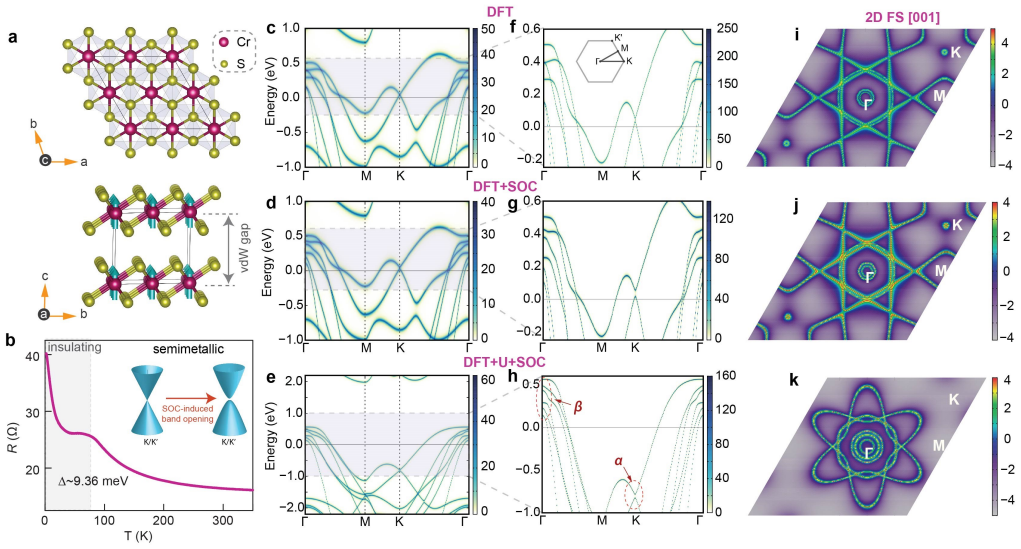
The cooperative DFT+U+SOC reconstruction: spin-orbit coupling gaps the Dirac-like crossings while on-site Coulomb correlations suppress electron pockets, reduce carrier density, and enhance momentum-dependent out-of-plane spin polarization; strong nearest-neighbour ferromagnetic Heisenberg exchange then stabilizes the long-range order.
What would settle it
Real-space magnetic imaging (MFM or Lorentz TEM) that either reveals or rules out non-coplanar spin textures below 30 K at the fields of the Hall hump, or a Berry-curvature transport calculation that quantitatively matches the measured topological Hall amplitude and carrier density.
Extended reading notes
Core claim
Phase-pure layered 1T-CrS2 grown by catalyst-free CVD is a highly stable van der Waals ferromagnet with out-of-plane easy-axis anisotropy and Curie temperature above room temperature. In this material electronic correlations and spin-orbit coupling cooperatively reconstruct the Fermi surface, suppress electron pockets, and produce an emergent topological Hall effect below 30 K, establishing 1T-CrS2 as a correlated 3d layered ferromagnet that hosts both robust magnetism and topological transport.
Load-bearing premise
That the low-temperature Hall hump left after antisymmetrizing up- and down-field sweeps is a genuine topological Hall signal from correlation-driven Berry physics rather than residual multi-band or domain effects.
Editorial extensions
If this is right
- 1T-CrS2 becomes a practical ambient-stable platform for room-temperature two-dimensional spintronics without encapsulation.
- Correlation-driven Fermi-surface reconstruction supplies a design route to topological transport in other 3d transition-metal dichalcogenides.
- Negative magnetoresistance persisting to 350 K shows spin-disorder scattering remains coupled to the ferromagnetic state across a wide temperature window.
- Devices can combine high-Curie-temperature ferromagnetism with a distinct low-temperature topological Hall regime in a single layered crystal.
Reading between the lines
- If the topological Hall signal is momentum-space Berry curvature from the gapped, correlation-reconstructed pockets rather than real-space skyrmions, electrostatic gating through the low-carrier-density Fermi surface should continuously switch the signal on and off.
- The same catalyst-free CVD protocol may extend to other Cr-based 1T dichalcogenides where competing polytypes have blocked phase-pure growth.
- Thickness-dependent topological Hall amplitude would separate bulk Berry-phase contributions from domain-wall or interface scattering.
Signed reviews
Editorial analysis
A structured set of objections, weighed in public.
Circularity Check
Mild phenomenological construction in Eq. 2; core CVD, magnetism, and DFT+U results are not circular by construction.
-
fitted input called prediction
[§II.A, Eq. (2)]
"To capture the continuous semimetal–insulator crossover observed experimentally, we describe the temperature-dependent gap, Δα(T)=ΔSOC+λ[m(T)−mc]/(1+exp[−k(m(T)−mc)]), where ΔSOC is the correlation-induced gap, m(T) is the temperature-dependent magnetization, mc denotes the critical magnetization required for FS reconstruction, λ characterizes the exchange-enhanced contribution to the gap, and k controls the sharpness of the crossover."
The functional form is built so that large low-T magnetization opens/enhances the gap (insulating) and reduced m closes it (semimetallic). Once m(T) and the observed T_TI are known, the crossover is encoded by construction rather than predicted from independent microscopic parameters; λ, k, and mc are free knobs that make the model track the data.
full rationale
The load-bearing experimental claims (catalyst-free CVD of 1T-CrS2, OOP FM with Tc>350 K, MAE≈0.28 MJ m−3, semimetal–insulator crossover, negative MR, and the low-T Hall hump) are direct measurements, not forced by fitted inputs. First-principles MAE (0.27 MJ m−3), LKAG exchanges, and Monte Carlo Tc≈390 K are independent electronic-structure outputs compared to experiment, not tautologies. The only clear construction is the phenomenological gap Δα(T) (Eq. 2), which is explicitly written to track the observed crossover once m(T) is known; it is not sold as an ab initio prediction of T_TI. Choice of U_eff=3.2 eV that suppresses electron pockets is conventional DFT+U practice and is not shown to be reverse-engineered from the Hall data. THE isolation via sweep subtraction is a contested physical interpretation (possible residual AHE hysteresis), not a circular derivation. No self-citation uniqueness theorem or renamed empirical law carries the central claim. Score 2 reflects one minor descriptive construction, not forced central results.
Assumptions & free parameters
free parameters (3)
- U_eff (DFT+U) =
3.2 eV
- Phenomenological gap parameters Δ_SOC, λ, m_c, k in Eq. (2)
- Arrhenius activation energy Δ =
≈9.36 meV
assumptions (5)
- domain assumption DFT-PBE (+D3) with optional SOC and static DFT+U adequately describe Cr t2g bands, magnetic anisotropy, and Fermi-surface topology of 1T-CrS2.
- domain assumption Classical Heisenberg model with LKAG Jij plus Metropolis Monte Carlo yields a reliable Curie temperature for this itinerant 2D magnet.
- ad hoc to paper Antisymmetrized Hall difference R_THE_xy=[R↑_xy−R↓_xy]/2 isolates a topological Hall component distinct from ordinary and anomalous Hall terms.
- standard math Mermin–Wagner evasion by finite MAE allows long-range 2D FM order at finite T.
- domain assumption Goodenough–Kanamori 90° Cr–S–Cr superexchange explains ferromagnetic nearest-neighbor coupling for 3d2 t2g moments.
invented entities (1)
-
Correlation-driven topological Hall regime in 1T-CrS2 below ~30 K
Cite this review
Pith. "Pith review of Observation of correlation-driven topological transport and robust ferromagnetism in 2D CrS$_2$." pith.science (2026). https://pith.science/paper/3HD7PDPN
@misc{pith2026260723625,
  author       = {Pith},
  title        = {Pith review of: Observation of correlation-driven topological transport and robust ferromagnetism in 2D CrS$_2$},
  year         = {2026},
  howpublished = {\url{https://pith.science/paper/3HD7PDPN}},
  note         = {Machine review of arXiv:2607.23625}
}
abstract
The realization of correlated layered magnets hosting robust ferromagnetism with emergent topological transport remains a key challenge in quantum materials. Here we report the first catalyst-free chemical vapour deposition growth of layered 1T-CrS$_2$, establishing a highly stable vdWs ferromagnet with an out-of-plane easy-axis anisotropy and a Curie temperature above room temperature. Transport measurements reveal a semimetal--insulator crossover near 80 K and pronounced negative magnetoresistance up to 350 K. A topological Hall effect emerges below 30 K, a rare signature of correlated transport in layered transition-metal dichalcogenide ferromagnets. First-principles calculations show that spin--orbit coupling gaps Dirac-like crossings, while electronic correlations reconstruct the Fermi surface by suppressing electron pockets and reducing the carrier density, enhancing momentum-dependent out-of-plane spin polarization. Magnetic measurements, supported by Heisenberg exchange calculations, reveal strong nearest-neighbour ferromagnetic exchange that stabilizes long-range ferromagnetism. Our results establish 1T-CrS$_2$ as a rare correlated 3$d$ layered ferromagnet in which electronic correlations and spin--orbit coupling cooperatively drive emergent topological transport.
Figures


Figures from the paper (22 more)


Reference graph
Works this paper leans on
-
[1]
B. A. Bernevig, C. Felser, and H. Beidenkopf,Nature 603, 41 (2022)
2022
-
[2]
Tokura, K
Y. Tokura, K. Yasuda, and A. Tsukazaki,Nat. Rev. Phys. 1, 126 (2019)
2019
-
[3]
Y. Khan, S. M. Obaidulla, A. Gayen, T. Liang, X. Wang, and M. Xu,Nano Today34, 100902 (2020)
2020
-
[4]
N. D. Mermin and H. Wagner,Phys. Rev. Lett.17, 1133 (1966)
1966
-
[5]
Huang, G
B. Huang, G. Clark, E. Navarro-Moratalla, D. R. Klein, R. Cheng, K. L. Seyler, D. Zhong, E. Schmidgall, M. A. McGuire, D. H. Cobden,et al.,Nature546, 270 (2017)
2017
-
[6]
C. Gong, L. Li, Z. Li, H. Ji, A. Stern, Y. Xia, T. Cao, W. Bao, C. Wang, Y. Wang,et al.,Nature546, 265 (2017)
2017
-
[7]
Burkov,Nat
A. Burkov,Nat. Mater.15, 1145 (2016)
2016
-
[8]
B. Li, Z. Wan, C. Wang, P. Chen, B. Huang, X. Cheng, Q. Qian, J. Li, Z. Zhang, G. Sun,et al.,Nat. Mater.20, 818 (2021)
2021
Show all 51 references
-
[9]
D. Tian, S. Zhong, J. Dong, S. Zhou, Z. Liu, K. Chen, W. Zhang, L. Cao, X. He, X. Li,et al.,Nat. Mater.25, 956 (2026)
2026
-
[10]
L. Peng, Y. Yuan, G. Li, X. Yang, J.-J. Xian, C.-J. Yi, Y.-G. Shi, and Y.-S. Fu,Nat. Commun.8, 659 (2017)
2017
-
[11]
Z. Fei, T. Palomaki, S. Wu, W. Zhao, X. Cai, B. Sun, P. Nguyen, J. Finney, X. Xu, and D. H. Cobden,Nat. Phys.13, 677 (2017)
2017
-
[12]
R. Alam, D. Dutta, M. Sariket, N. Kumar, A. Agarwal, and A. N. Pal,Adv. Funct. Mater.35, 2418643 (2025)
2025
-
[13]
S.-Y. Xu, Q. Ma, H. Shen, V. Fatemi, S. Wu, T.-R. Chang, G. Chang, A. M. M. Valdivia, C.-K. Chan, Q. D. Gibson,et al.,Nat. Phys.14, 900 (2018)
2018
-
[14]
P. C. Adak, S. Sinha, A. Agarwal, and M. M. Deshmukh, Nat. Rev. Mater.9, 481 (2024)
2024
-
[15]
Safeer, M
A. Safeer, M. Ghorbani-Asl, W. Jolie, A. V. Krasheninnikov, T. Michely, and J. Fischer,Adv. Funct. Mater.35, e00907 (2025)
2025
-
[16]
Chou, H.-Y
P.-Y. Chou, H.-Y. Sung, C.-H. Wang, C.-W. Huang, and W.-W. Wu,ACS Appl. Mater. Interfaces17, 59665 (2025)
2025
-
[17]
H. Bai, G. R. M. Tainton, M. Och, M. Rimmer, I. Maity, F. Mione, K. Tanwar, R. Cai, J. Parker, K. Zhiquan, E. C. Duran, E. Tillotson, S. Sullivan-Allsop, A. Eggeman, S. Deng, D. Bromley, J. N. Carter-Gartside, A. Vanstone, S. Heutz, W. R. Branford, E. Navarro- Moratalla, J. C....
2025
-
[18]
C. Wang, X. Zhou, Y. Pan, J. Qiao, X. Kong, C.-C. Kaun, and W. Ji,Phys. Rev. B97, 245409 (2018)
2018
-
[19]
Kittel and P
C. Kittel and P. McEuen,Introduction to Solid State Physics(John Wiley & Sons, 2018)
2018
-
[20]
Kumar, S
N. Kumar, S. N. Guin, K. Manna, C. Shekhar, and C. Felser,Chem. Rev.121, 2780 (2020)
2020
-
[21]
Asano and C
K. Asano and C. Hotta,Phys. Rev. B83, 245125 (2011)
2011
-
[22]
Kozii, B
V. Kozii, B. Skinner, and L. Fu,Phys. Rev. B99, 155123 (2019)
2019
-
[23]
H. Hu, X. Feng, Y. Pan, V. Hasse, H. Wang, B. He, and C. Felser,Nat. Commun.16, 119 (2025)
2025
-
[24]
Lee, X.-Q
Y.-H. Lee, X.-Q. Zhang, W. Zhang, M.-T. Chang, C.- T. Lin, K.-D. Chang, Y.-C. Yu, J. T.-W. Wang, C.-S. Chang, L.-J. Li,et al., arXiv preprint arXiv:1202.5458 (2012)
2012 arXiv
-
[25]
Z. Lei, J. Zhan, L. Tang, Y. Zhang, and Y. Wang,Adv. Energy Mater.8, 1703482 (2018)
2018
-
[26]
Shivayogimath, J
A. Shivayogimath, J. D. Thomsen, D. M. Mackenzie, M. Geisler, R.-M. Stan, A. J. Holt, M. Bianchi, A. Crovetto, P. R. Whelan, A. Carvalho,et al.,Nat. Commun.10, 2957 (2019)
2019
-
[27]
F. Cui, X. Zhao, J. Xu, B. Tang, Q. Shang, J. Shi, Y. Huan, J. Liao, Q. Chen, Y. Hou,et al.,Adv. Mater. 32, 1905896 (2020)
2020
-
[28]
M. R. Habib, S. Wang, W. Wang, H. Xiao, S. M. Obaidulla, A. Gayen, Y. Khan, H. Chen, and M. Xu, Nanoscale11, 20123 (2019)
2019
-
[29]
G. K. Rajendran Nair, A. Abdelaziem, X. Zhao, X. Wang, D. Hu, Y. Wu, C. Xun, F. Le Goualher, C. Zhu, P. L. P. Yin,et al.,Phys. Status Solidi RRL16, 2100495 (2022)
2022
-
[30]
W. Ge, P. M. Sass, J. Yan, S. H. Lee, Z. Mao, and W. Wu, Phys. Rev. B103, 134403 (2021)
2021
-
[31]
Trygg, B
J. Trygg, B. Johansson, O. Eriksson, and J. M. Wills, Phys. Rev. Lett.75, 2871 (1995)
1995
-
[32]
Wang, C.-C
M.-C. Wang, C.-C. Huang, C.-H. Cheung, C.-Y. Chen, S. G. Tan, T.-W. Huang, Y. Zhao, Y. Zhao, G. Wu, Y.-P. Feng,et al.,Ann. Phys.532, 1900452 (2020)
2020
-
[33]
Liechtenstein, M
A. Liechtenstein, M. Katsnelson, V. Antropov, and V. Gubanov,J. Magn. Magn. Mater.67, 65 (1987)
1987
-
[34]
J. M. Wills, O. Eriksson, M. Alouani, and D. L. Price, inElectronic Structure and Physical Properies of Solids: The Uses of the LMTO Method Lectures of a Workshop Held at Mont Saint Odile, France, October 2–5, 1998 (Springer, 2000) pp. 148–167
1998
-
[35]
Soriano, M
D. Soriano, M. I. Katsnelson, and J. Fern´ andez-Rossier, Nano Lett.20, 6225 (2020)
2020
-
[36]
Eriksson, A
O. Eriksson, A. Bergman, L. Bergqvist, and J. Hellsvik, Ab Initio Spin Dynamics: Foundations and Applications (Oxford University Press, Oxford, 2017)
2017
-
[37]
Bonilla, S
M. Bonilla, S. Kolekar, Y. Ma, H. C. Diaz, V. Kalappattil, R. Das, T. Eggers, H. R. Gutierrez, M.-H. Phan, and M. Batzill,Nat. Nanotechnol.13, 289 (2018)
2018
-
[38]
Y. Zhao, Y. Wan, C. Huang, P. Gu, X. Zhang, Y. Wu, M. Liu, Y. Li, K. Wang, and E. Kan,J. Am. Chem. Soc. 147, 31212 (2025). 11
2025
-
[39]
L. Meng, Z. Zhou, M. Xu, S. Yang, K. Si, L. Liu, X. Wang, H. Jiang, B. Li, P. Qin,et al.,Nat. Commun. 12, 809 (2021)
2021
-
[40]
Jiang, G
W. Jiang, G. Chen, K. Liu, J. Zang, S. G. Te Velthuis, and A. Hoffmann,Physics Reports704, 1 (2017)
2017
-
[41]
Roychowdhury, P
S. Roychowdhury, P. Yanda, K. Samanta, C. Yi, M. Yao, F. Orlandi, P. Manuel, D. Khalyavin, E. G. D. Valle, P. Constantinou,et al.,Adv. Mater.36, 2305916 (2024)
2024
-
[42]
W. Jie, Z. Yang, F. Zhang, G. Bai, C. W. Leung, and J. Hao,ACS nano11, 6950 (2017)
2017
-
[43]
M. N. Ali, J. Xiong, S. Flynn, J. Tao, Q. D. Gibson, L. M. Schoop, T. Liang, N. Haldolaarachchige, M. Hirschberger, N. P. Ong,et al.,Nature514, 205 (2014)
2014
-
[44]
M. Piva, J. Souza, G. Lombardi, K. Pakuszewski, C. Adriano, P. Pagliuso, and M. Nicklas,Phys. Rev. Mater.7, 074204 (2023)
2023
-
[45]
H. Wang, Y. Dai, G.-M. Chow, and J. Chen,Prog. Mater. Sci.130, 100971 (2022)
2022
-
[46]
Y. L. Huang, W. Chen, and A. T. Wee,SmartMat2, 139 (2021)
2021
-
[47]
Kresse and J
G. Kresse and J. Furthm¨ uller,Comput. Mater. Sci.6, 15 (1996)
1996
-
[48]
J. P. Perdew, K. Burke, and M. Ernzerhof,Phys. Rev. Lett.77, 3865 (1996)
1996
-
[49]
Grimme, J
S. Grimme, J. Antony, S. Ehrlich, and H. Krieg,J. Chem. Phys.132, 154104 (2010)
2010
-
[50]
Szilva, Y
A. Szilva, Y. Kvashnin, E. A. Stepanov, L. Nordstr¨ om, O. Eriksson, A. I. Lichtenstein, and M. I. Katsnelson, Rev. Mod. Phys.95, 035004 (2023)
2023
-
[51]
Entel, A
P. Entel, A. Dannenberg, M. Siewert, H. C. Herper, M. E. Gruner, D. Comtesse, H.-J. Elmers, and M. Kallmayer, Metallurgical and Materials Transactions A43, 2891 (2012). 12 V. SUPPLEMENT AR Y INFORMA TION A. Calculation for lattice parameters from SAED image of 1T-CrS 2 For 1T-...
2012
Reviewed July 30, 2026 · model on record in the stance chip above.
Discussion (0). Continue with ORCID to comment.