REVIEW 3 major objections 6 minor 39 references
On three-cluster resonance structure of hypernuclei $_{\Lambda}^{7}$He, $_{\Lambda}^{7}$Li and $_{\Lambda}^{7}$Be
T0 review · 3 major / 6 minor · reviewed 2026-08-12 · deepseek-v4-flash
Pith's one-line read Three-cluster hypernuclei $^{7}_{\Lambda}\mathrm{He}$ and $^{7}_{\Lambda}\mathrm{Li}$ are predicted to contain extremely narrow resonance states; the narrowest calculated width is 1.09 keV.
desk verdict A useful but not fully verified prediction of narrow three-cluster resonances in light hypernuclei; send to review, but require convergence checks for the widths. read the letter →
The pith
A machine-rendered reading of the paper's core claim, the machinery that carries it, and where it could break.
The reading
What carries the argument
The load-bearing object is the three-cluster wave function in hyperspherical coordinates: the hyperradius $\rho$ controls the overall size of the cluster triangle, and hyperspherical harmonics classify decay channels by the total hypermomentum $K$ and the partial orbital momenta $\lambda$ and $l$ associated with the two Jacobi vectors. The paper combines this basis with a microscopic Hamiltonian in which the $^{4}\mathrm{He}$ and two-nucleon clusters have internal wave functions and interact through the Hasegawa-Nagata nucleon-nucleon potential; the $\lambda$ interacts with each nucleon through the YNG potential, an effective hyperon-nucleon interaction whose Fermi momentum $k_F$ is tuned separately for each hypernucleus to reproduce the ground-state energy. Resonance energies and widths are read from the eigenphase shifts of the S-matrix, and the partial widths are obtained from the orthogonal transformation to eigenchannels. This machinery is what turns a bound-state calculation into a continuum searchable for poles.
What would settle it
A high-resolution missing-mass or breakup experiment on $^{7}_{\Lambda}\mathrm{He}$, with energy resolution better than about 5 keV near the $^{4}\mathrm{He}+2n+\Lambda$ threshold, should find narrow peaks at $E=0.043$ MeV ($3/2^-$) and $E=0.061$ MeV ($1/2^-$); their absence would conflict with the prediction. On the theory side, repeating the continuum calculation with an independent ab initio or complex-scaling method using a different hyperon-nucleon interaction and finding no sub-10-keV poles near these energies would likewise falsify the claim that the narrow width is robust.
Extended reading notes
Core claim
The central claim is that the continuum of these seven-body hypernuclei is not smooth: it contains narrow three-cluster resonance states whose parameters can be extracted from the energy dependence of the three-cluster scattering S-matrix. With the YNG effective hyperon-nucleon interaction, the narrowest states found are the $3/2^-$ resonance in $^{7}_{\Lambda}\mathrm{He}$ at $E=0.043$ MeV with total width $\Gamma=1.09$ keV and the $1/2^-$ resonance at $E=0.061$ MeV with $\Gamma=2.15$ keV; in $^{7}_{\Lambda}\mathrm{Li}$ the narrowest is a $1/2^+$ state at $E=0.333$ MeV with $\Gamma=1.54$ keV. The partial widths show that the dominant decay of the $1/2^-$ state in $^{7}_{\Lambda}\mathrm{He}$ carries about 97% of the width and proceeds through a single hyperspherical channel, while the $1/2^+$ resonances in $^{7}_{\Lambda}\mathrm{Li}$ decay mainly through channels with total hypermomentum $K=2$ and total spin $S=3/2$. The same calculation yields bound-state spectra in satisfactory agreement with alternative cluster models; the resonance predictions are new.
Load-bearing premise
The narrow resonances appear only if the YNG effective hyperon-nucleon interaction, with the Fermi momentum adjusted to reproduce each ground state, remains trustworthy for the three-cluster continuum just above the decay threshold; if the tuned potentials are wrong away from the fitted bound states, the predicted states could be artifacts of the interaction rather than physical resonances.
Editorial extensions
If this is right
- If these states are real, high-resolution experiments should see narrow peaks in the three-body decay of $^{7}_{\Lambda}\mathrm{He}$ and $^{7}_{\Lambda}\mathrm{Li}$ at the predicted energies, with widths of order keV rather than MeV.
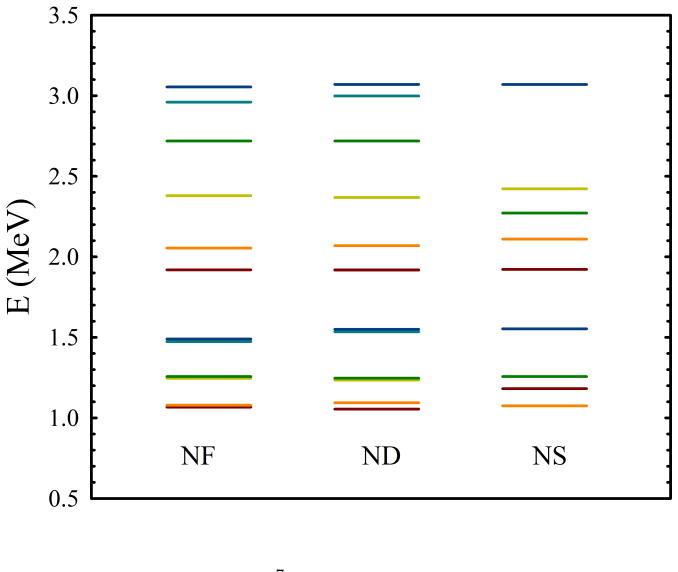
- Observing or ruling out the predicted $3/2^-$ and $1/2^-$ states in $^{7}_{\Lambda}\mathrm{He}$ would directly discriminate among the NF, ND, and NS versions of the YNG potential, since these versions produce different numbers and positions of narrow states.
- The predicted narrow states give concrete targets for independent four-cluster or ab initio continuum calculations, which currently report only broad resonances in $^{7}_{\Lambda}\mathrm{He}$.
- The dominant decay channels listed for each narrow state can be tested by measuring the angular-momentum distribution of the emitted lambda hyperon.
Reading between the lines
- Beyond the paper: because the narrowest states sit very close to the three-cluster threshold, they may be hyperspherical analogs of halo or Efimov-like structures rather than ordinary shell-model excitations; a dedicated study of how their widths vary with the hyperon-nucleon strength could clarify that.
- Beyond the paper: the paper's energy-width correlation for $^{7}_{\Lambda}\mathrm{He}$ suggests a rule of thumb—lower-lying narrow states decay by lambda emission with small orbital momentum, while wider high-lying states involve more mixed channels—that could be tested by varying the YNG potential or the oscillator length.
- Beyond the paper: applying the same machinery to $^{6}_{\Lambda}\mathrm{He}$ or to heavier p-shell hypernuclei would show whether narrow three-cluster resonances are a general feature of hypernuclear continua or specific to these mirror partners.
Editorial analysis
A structured set of objections, weighed in public.
Referee Report
Summary. The manuscript applies the Algebraic Model with Hyperspherical Harmonics Basis (AMHHB) to the hypernuclei 7ΛHe, 7ΛLi, and 7ΛBe, treated as three-cluster systems (4He+2n+Λ, 4He+d+Λ, 4He+2p+Λ). Using the Hasegawa-Nagata NN potential and three versions of the YNG NΛ potential (NF, ND, NS), the authors tune the oscillator length, Majorana exchange, spin-orbit intensity, and Fermi momentum to reproduce subsystem and ground-state energies, then compute bound-state spectra and extract three-cluster continuum resonances from eigenphase shifts via Eq. (24). The central result is a set of narrow and broad resonances, with the narrowest states in 7ΛHe and 7ΛLi having total widths below 10 keV, along with partial widths, dominant decay channels, and Coulomb-shift analysis.
Significance. If the resonance predictions are reliable, the paper offers concrete, channel-resolved predictions for weakly bound and unbound hypernuclear states that could be tested in future experiments, extending a well-established three-cluster method (AMHHB) to hypernuclei and providing a systematic comparison of three YNG interactions. Strengths include the explicit treatment of the Pauli principle and three-body boundary conditions, the comparison with other models in Tables VIII and IX, and the detailed analysis of partial widths and cluster geometry. However, the headline sub-10 keV widths are currently not supported by convergence or uncertainty analysis, and the strong dependence of individual widths on the chosen YNG version means that the quantitative predictions require careful qualification.
major comments (3)
- [Sec. III.D and Eq. (24)] The resonance energies and widths, including the 1.09 keV width of the 3/2− state in 7ΛHe (Table X), are extracted from eigenphase shifts, but the manuscript provides no convergence study for the continuum calculation. Figure 3 demonstrates basis convergence only for bound-state energies; the number of hyperradial functions n_ρ, the energy mesh used for the eigenphase derivative, and the dependence of the S-matrix on K_max (14/13) are not reported. For a width of the order of 1 keV, the eigenphase must be resolved on a scale much smaller than the width, and without numerical stability checks the sub-10 keV widths cannot be distinguished from pseudoresonances.
- [Table X and Sec. III.D] The quantitative width predictions are strongly model-dependent. The 3/2− resonance in 7ΛHe is assigned Γ=1.09 keV (YNG-NF), 14.49 keV (YNG-ND), and 2.14 keV (YNG-NS); similar spreads appear for several states in Tables X and XI. The abstract's statement that the narrowest states have total widths below 10 keV is true only if one selects the narrowest state for each potential, and a reader inferring that the same physical state is predicted with sub-10 keV width would be misled. The paper should either report an uncertainty band from the YNG-version spread or qualify the claim per potential.
- [Sec. III.B, Table III] The Fermi momentum k_F (together with b, Δm, and f_LS) is tuned to reproduce the ground-state energies of the same hypernuclei under study, so the model is calibrated at bound-state energies and the resonance predictions rely on an interaction that is unconstrained in the continuum. Because the resonances are not fitted inputs, they are genuine predictions, but the absence of a sensitivity study (e.g., varying k_F over the fitted range for each YNG version, or repeating the continuum calculation with a different ΛN potential) leaves the extrapolation unvalidated. The large version-to-version spread in the widths indicates that such a study is necessary before the narrow-resonance prediction can be considered established.
minor comments (6)
- [Table X] The YNG-NS block contains duplicate entries for the 1/2+ (E=1.280 MeV) and 5/2− (E=1.419 MeV) states, and the 1/2− and 3/2− states at E=1.456 MeV also appear twice; please correct the table and verify the underlying data.
- [Table XII] The YNG-ND entry '1/2− 1.550 4812.87' differs by more than an order of magnitude from neighboring widths and from the text's description of 'two fairly narrow resonance states' (Sec. III.D); this value should be checked.
- [Abstract] The sentence 'Three versions of the nucleon-hyperon potential, known as the YNG potential, is employed' should read 'are employed' for subject-verb agreement.
- [Sec. III.D] The sentence 'By using the Breit-Wigner approximation for eigenphase shifts or relations (24)' is unclear—Eq. (24) already defines the resonance energy and width from the eigenphase derivative; please indicate whether a Breit-Wigner fit is used in addition to or instead of Eq. (24).
- [Eq. (2)] The quantity m_Λ=1.188 is given without units; specify that it is in units of the nucleon mass.
- [Fig. 8] The caption of Fig. 8 should state the units of the y-axis (degrees or radians) for the phase shifts.
Circularity Check
No significant circularity: the narrow three-cluster resonance parameters are genuine outputs of the calibrated model, not fitted inputs.
full rationale
The paper plainly states its calibration procedure: the Fermi momentum k_F of each YNG version is 'selected to reproduce the ground state 7ΛHe and 7ΛLi' (Sec. III.B, Table III), and parameters m, f_LS, and b are tuned to two-cluster subsystem data (Table I). This calibration is transparent and is not disguised as a prediction. The headline result, i.e., the narrow three-cluster resonance energies and widths in Tables X-XII, is extracted from the eigenphase shifts of the calculated S-matrix via Eq. (24); these resonances are not fitted quantities and do not reduce by construction to any of the calibrated inputs. The bound-state spectra are partly calibrated, but the paper does not claim the ground-state energies as predictions, and the remaining bound states and all resonance parameters depend nontrivially on the many-channel three-cluster dynamics. The AMHHB method is supported by prior published applications by the same group, including the Hoyle-state benchmark in Ref. [18]; these citations provide methodological context rather than an imported uniqueness theorem that forces the result. The lack of a convergence study for resonance widths is a numerical-robustness concern, not circularity, and the spread of widths among YNG-NF, ND, and NS versions is model dependence rather than a self-referential reduction. No step was found in which a predicted quantity equals its input by definition or in which a fitted parameter is renamed as a prediction.
Assumptions & free parameters
free parameters (5)
- oscillator length b =
1.399 fm (7ΛHe, 7ΛBe), 1.357 fm (7ΛLi)
- Majorana exchange parameter adjustment Δm =
0.0579 (7ΛHe, 7ΛBe), -0.0013 (7ΛLi)
- spin-orbit intensity f_LS =
1.000 (7ΛHe, 7ΛBe), 0.348 (7ΛLi)
- Fermi momentum k_F for YNG potential =
7ΛHe: 0.9470 (NF), 0.9530 (ND), 0.9410 (NS); 7ΛLi: 0.9465 (NF), 0.9460 (ND), 1.0440 (NS); 7ΛBe uses 7ΛHe values
- maximum hypermomentum Kmax =
14 (positive parity), 13 (negative parity)
assumptions (7)
- standard math The hyperspherical harmonics form a complete basis and the asymptotic channel wave functions are the Whittaker functions of Eq. (13).
- domain assumption The internal wave functions of the clusters 4He, d, 2n, and 2p are eigenfunctions of a harmonic-oscillator shell-model Hamiltonian and describe each cluster with acceptable precision.
- domain assumption The lambda hyperon is structureless, with spin 1/2 and mass m_Λ = 1.188 in nucleon mass units.
- domain assumption Antisymmetrization is required only among the six nucleons, not between the lambda and nucleons.
- domain assumption The HNP and YNG effective potentials, with the fitted parameters, accurately represent the nucleon-nucleon and nucleon-hyperon interactions in the three-cluster continuum.
- domain assumption Resonance energies and widths can be extracted from the energy dependence of the eigenphase shifts through Eq. (24).
- domain assumption Neglecting the off-diagonal effective charge in the asymptotic Hamiltonian (Z_{c,c'} = 0 for c unequal to c') does not materially change the resonance parameters in the charged cases.
Cite this review
Pith. "Pith review of On three-cluster resonance structure of hypernuclei $_{\Lambda}^{7}$He, $_{\Lambda}^{7}$Li and $_{\Lambda}^{7}$Be." pith.science (2026). https://pith.science/paper/3HL5WR6L
@misc{pith2026260807930,
  author       = {Pith},
  title        = {Pith review of: On three-cluster resonance structure of hypernuclei $_\Lambda^7$He, $_\Lambda^7$Li and $_\Lambda^7$Be},
  year         = {2026},
  howpublished = {\url{https://pith.science/paper/3HL5WR6L}},
  note         = {Machine review of arXiv:2608.07930}
}
abstract
Bound and resonance states of hypernuclei $_{\Lambda}^{7}$He, $_{\Lambda}^{7}$Li and $_{\Lambda}^{7}$Be are studied within a three-cluster model. Within this model, hypernuclei $_{\Lambda}^{7}$He, $_{\Lambda}^{7}$Li and $_{\Lambda }^{7}$Be are considered as three-cluster systems $^{4}$He+$^2n$+$\Lambda$, $^{4}$He+$d$+$\Lambda$, $^{4}$He+$^2p$+$\Lambda$, respectively. Special attention is paid to determining resonance states in the three-cluster continuum of these hypernuclei and to study their nature. One semi-realistic nucleon-nucleon potential is employed to determine the internal structure of the clusters $^{4}$He, $^2n$, $d$ and $^2p$, and their interaction. Three versions of the nucleon-hyperon potential, known as the YNG potential, is employed to determine the interaction of the listed clusters with the lambda hyperon. A set of very narrow and fairly wide resonance states is found in three-cluster continuum of $_{\Lambda}^{7}$He, $_{\Lambda}^{7}$Li and $_{\Lambda}^{7}$Be. The narrowest resonance states were detected in $_{\Lambda}^{7}$He and $_{\Lambda}^{7}$Li and their total width does not exceed 10 keV. The dominant decay channels of these resonance states are revealed.
Figures


Figures from the paper (18 more)




Reference graph
Works this paper leans on
- [1]
- [2]
-
[3]
within a four-cluster model. Two resonance states are determined with the following parameters:E(5/2 +) =0.07 MeV, Γ (5/2+) =1.01 MeV, andE(3/2 +) =0.03 MeV, Γ (3/2+) =1.13 MeV. Energy is measured from the four-cluster threshold 4He+n+n+Λ. The relative position of the resonance states in the three-cluster continuum of 7 ΛBe is shown in Fig. 13. Comparing ...
-
[4]
Excitation energy shift and size difference of low-energy levels in $p$-shell $\Lambda$ hypernuclei
Y. Kanada-En’yo, Phys. Rev. C97, 024330 (2018), arXiv:1709.03375 [nucl-th]
work page Pith review arXiv 2018
-
[5]
Resonant states of neutron-rich $\Lambda$ hypernucleus $^7_{\Lambda}$He
E. Hiyama, M. Isaka, M. Kamimura, T. Myo, and T. Motoba, Phys. Rev. C91, 054316 (2015), arXiv:1504.07735 [nucl-th]
work page Pith review arXiv 2015
-
[6]
X. Li, N. Michel, J. Li, and X.-R. Zhou, Phys. Lett. B868, 139708 (2025), arXiv:2408.16223 FIG. 21. Weights of different oscillator shells in wave functions of the narrowest resonance states in 7 ΛHe. Results are obtained with the YNG-NF potential. 50 [nucl-th]
work page Pith review arXiv 2025
- [7]
-
[8]
H. Le, J. Haidenbauer, U.-G. Meißner, and A. Nogga, Eur. Phy. J. A56, 301 (2020), arXiv:2008.11565 [nucl-th]
arXiv 2020
Show all 39 references
-
[9]
Wirth, D
R. Wirth, D. Gazda, P. Navr´ atil, A. Calci, J. Langhammer, and R. Roth, Phys. Rev. Lett. 113, 192502 (2014), arXiv:1403.3067 [nucl-th]
2014 arXiv
-
[10]
Kn¨ oll and R
M. Kn¨ oll and R. Roth, Phys. Lett. B872, 140074 (2026), arXiv:2501.08013 [nucl-th]
2026
-
[11]
Wirth, D
R. Wirth, D. Gazda, P. Navr´ atil, and R. Roth, Phys. Rev. C97, 064315 (2018), arXiv:1712.05694 [nucl-th]
2018 arXiv
-
[12]
Vida˜ na, A
I. Vida˜ na, A. Polls, A. Ramos, and H.-J. Schulze, Phys. Rev. C64, 044301 (2001)
2001
-
[13]
N. K. Glendenning, D. von-Eiff, M. Haft, H. Lenske, and M. K. Weigel, Phys. Rev. C48, 889 (1993), arXiv:nucl-th/9211012 [nucl-th]
1993 arXiv
-
[14]
Hiyama, Y
E. Hiyama, Y. Yamamoto, T. A. Rijken, and T. Motoba, Phys. Rev. C74, 054312 (2006), arXiv:nucl-th/0610019 [nucl-th]
2006 arXiv
-
[15]
Kanada-En’yo, M
Y. Kanada-En’yo, M. Isaka, and T. Motoba, Prog. Theor. Exp. Phys.2019, 073D01 (2019), arXiv:1803.04089 [nucl-th]
2019 arXiv
-
[16]
Vasilevsky, A
V. Vasilevsky, A. V. Nesterov, F. Arickx, and J. Broeckhove, Phys. Rev. C63, 034606 (2001), arXiv:nucl-th/0005045 [nucl-th]
2001 arXiv
-
[17]
Motoba, H
T. Motoba, H. Bando, and K. Ikeda, Prog. Theor. Phys.70, 189 (1983)
1983
-
[18]
Vasilevsky, F
V. Vasilevsky, F. Arickx, W. Vanroose, and J. Broeckhove, Phys. Rev. C85, 034318 (2012), arXiv:1109.1418 [nucl-th]
2012 arXiv
-
[19]
The width of this resonance state is 1.1 keV and slightly less than the width of the 1/2 + resonance state in 7 ΛLi, whose correlation function is shown in Fig. 17. Fig. 19 indicates that the small distances between the clusters 2nand 4He are dominant in the wave function of t...
-
[20]
A. V. Nesterov, F. Arickx, J. Broeckhove, and V. S. Vasilevsky, Phys. Part. Nucl.41, 716 (2010)
2010
-
[21]
V. S. Vasilevsky, K. Kat¯ o, and N. Z. Takibayev, Phys. Rev. C96, 034322 (2017), arXiv:1706.05514 [nucl-th]
2017 arXiv
-
[22]
V. S. Vasilevsky, K. Kat¯ o, and N. Takibayev, Phys. Rev. C98, 024325 (2018), arXiv:1806.03423 [nucl-th]
2018 arXiv
-
[23]
Vasilevsky, A
V. Vasilevsky, A. V. Nesterov, F. Arickx, and J. Broeckhove, Phys. Rev. C63, 034607 (2001), arXiv:nucl-th/0005047 [nucl-th]
2001 arXiv
-
[24]
Broeckhove, F
J. Broeckhove, F. Arickx, P. Hellinckx, V. S. Vasilevsky, and A. V. Nesterov, Journal of Physics G Nuclear Physics34, 1955 (2007)
2007
-
[25]
Abramowitz and I
M. Abramowitz and I. A. Stegun,Handbook of Mathematical Functions(Dover Publications, 51 New York, 1972)
1972
-
[26]
V. S. Vasilevsky, Y. A. Lashko, and G. F. Filippov, Phys. Rev. C97, 064605 (2018), arXiv:1706.04127 [nucl-th]
2018 arXiv
-
[27]
G. F. Filippov and I. P. Okhrimenko, Sov. J. Nucl. Phys.32, 480 (1981)
1981
-
[28]
G. F. Filippov, Sov. J. Nucl. Phys.33, 488 (1981)
1981
-
[29]
Kalzhigitov, V
N. Kalzhigitov, V. O. Kurmangaliyeva, N. Z. Takibayev, and V. S. Vasilevsky, Ukr. J. Phys. 68, 3 (2023)
2023
-
[30]
Hasegawa and S
A. Hasegawa and S. Nagata, Prog. Theor. Phys.45, 1786 (1971)
1971
-
[31]
Tanabe, A
F. Tanabe, A. Tohsaki, and R. Tamagaki, Prog. Theor. Phys.53, 677 (1975)
1975
-
[32]
Yamamoto, T
Y. Yamamoto, T. Motoba, H. Himeno, K. Ikeda, and S. Nagata, Prog. Theor. Phys. Suppl. 117, 361 (1994)
1994
-
[33]
A. V. Nesterov, Y. A. Lashko, and V. S. Vasilevsky, Nucl. Phys. A1016, 122325 (2021)
2021
-
[34]
O. M. Povoroznyk and V. S. Vasilevsky, Ukr. J. Phys.60, 201 (2015)
2015
-
[35]
N. K. Kalzhigitov, S. Amangeldinova, V. O. Kurmangaliyeva, and V. S. Vasilevsky, arXiv e-prints , arXiv:2509.01932 (2025), arXiv:2509.01932 [nucl-th]
2025
-
[36]
T. A. Rijken, V. G. J. Stoks, and Y. Yamamoto, Phys. Rev. C59, 21 (1999), arXiv:nucl- th/9807082 [nucl-th]
1999
-
[37]
Eckert, P
P. Eckert, P. Achenbach, and et al., Chart of hypernuclides – hypernuclear structure and decay data (2021), https://hypernuclei.kph.uni-mainz.de
2021
-
[38]
A. D. Duisenbay, N. Kalzhigitov, K. Kat¯ o, V. O. Kurmangaliyeva, N. Takibayev, and V. S. Vasilevsky, Nucl. Phys. A996, 121692 (2020), arXiv:1905.07711 [nucl-th]
2020 arXiv
-
[39]
Tanida, H
K. Tanida, H. Tamura, D. Abe, H. Akikawa, K. Araki, H. Bhang, T. Endo, Y. Fujii, T. Fukuda, O. Hashimoto, K. Imai, H. Hotchi, Y. Kakiguchi, J. H. Kim, Y. D. Kim, T. Miyoshi, T. Mu- rakami, T. Nagae, H. Noumi, H. Outa, K. Ozawa, T. Saito, J. Sasao, Y. Sato, S. Satoh, R. I. Sawa...
2001
Reviewed August 12, 2026 · model on record in the stance chip above.
Discussion (0). Continue with ORCID to comment.