Universality of dimensional crossovers in topological insulators
Pith reviewed 2026-06-26 07:18 UTC · model grok-4.3
The pith
Geometric confinement induces a cascade of dimensional reductions in topological insulators, yielding protected 2D and 1D phases even from trivial bulk.
A machine-rendered reading of the paper's core claim, the machinery that carries it, and where it could break.
Core claim
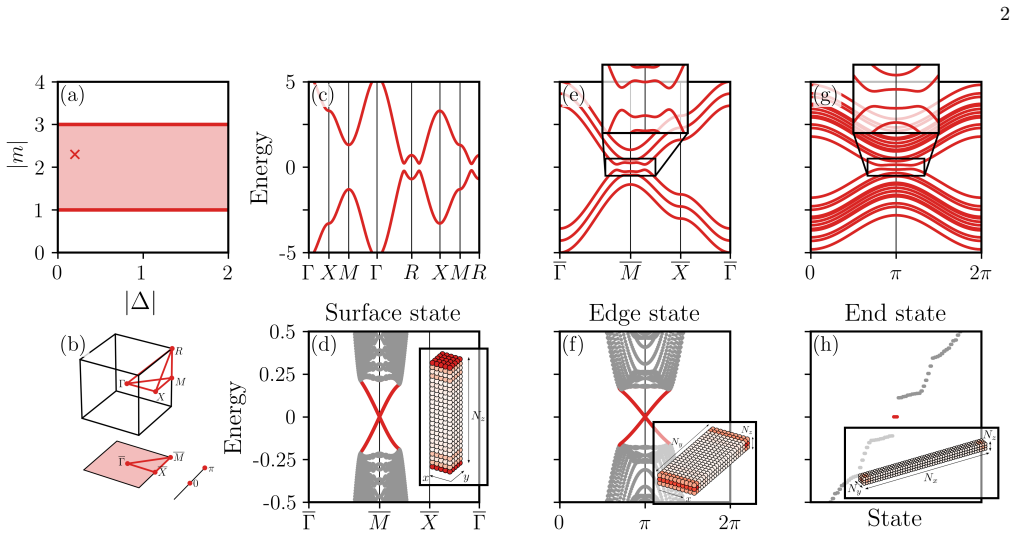
Using minimal tight-binding lattice models of three-dimensional topological insulators subject to geometric confinement, reducing the system size induces a strongly non-monotonic dependence of the topology on thickness and microscopic parameters, leading to a sequence of topological phase transitions that is highly sensitive to surface termination. In particular, a cascade of dimensional reduction occurs from a 3D topological insulator to a 2D quantum spin Hall phase and ultimately to a one-dimensional phase consisting of end states of Kramers pairs protected by inversion symmetry. Both the 2D and 1D topological phases can emerge even when the corresponding 3D bulk phase is topologically tri
What carries the argument
Minimal tight-binding lattice models under geometric confinement, which track the non-monotonic evolution of topological invariants and their sensitivity to boundary termination.
If this is right
- Both the 2D quantum spin Hall phase and the 1D inversion-protected phase can appear in thin films whose three-dimensional bulk is topologically trivial.
- The sequence of dimensional reductions produces universal features in phase diagrams for both 3D-to-2D and 2D-to-1D crossovers.
- Topology in confined systems depends strongly on surface termination, leading to different transition sequences for different boundary conditions.
- A cascade of phase transitions occurs as thickness decreases, with the one-dimensional phase appearing at the smallest sizes.
Where Pith is reading between the lines
- Device fabrication that controls surface termination could be used to select between the 2D and 1D phases in the same material.
- The universality may extend to other symmetry classes of topological materials when similarly confined.
- Transport or spectroscopic measurements on thickness-tuned samples could map the predicted non-monotonic transitions.
- Similar cascades might appear in confined topological superconductors or semimetals.
Load-bearing premise
The minimal tight-binding lattice models accurately represent the essential physics of real three-dimensional topological insulators under geometric confinement, including the role of boundary termination without extra interactions or disorder.
What would settle it
Measurement showing only monotonic change in topological character with film thickness and no emergence of 2D or 1D phases when the 3D bulk is trivial would falsify the central claim.
Figures
read the original abstract
We investigate dimensional crossovers in minimal tight-binding models of three-dimensional (3D) topological insulators subject to geometric confinement. While thin films are commonly understood to host a crossover from a 3D strong topological insulator to a two-dimensional (2D) quantum spin Hall phase via hybridization of surface states, we demonstrate that this picture is incomplete once bulk confinement effects and boundary termination are fully taken into account. Using lattice models, we show that reducing the system size induces a strongly non-monotonic dependence of the topology on thickness and microscopic parameters, leading to a sequence of topological phase transitions that is highly sensitive to surface termination. In particular, we find a cascade of dimensional reduction from a 3D topological insulator to a 2D quantum spin Hall phase and ultimately to a one-dimensional phase consisting of end states of Kramers pairs protected by inversion symmetry. Remarkably, we show that both the 2D and 1D topological phases can emerge even when the corresponding 3D bulk phase is topologically trivial. Our results reveal an unexpected universality in the phase diagrams of 3D-to-2D and 2D-to-1D crossovers, pointing toward a unified framework for topology under dimensional reduction.
Editorial analysis
A structured set of objections, weighed in public.
Referee Report
Summary. The paper investigates dimensional crossovers in minimal tight-binding models of 3D topological insulators under geometric confinement. It reports a strongly non-monotonic dependence of topology on thickness and microscopic parameters, producing a cascade of phase transitions from 3D TI to 2D quantum spin Hall to a 1D phase of inversion-protected Kramers-pair end states. The 2D and 1D phases are shown to emerge even from a topologically trivial 3D bulk, with the phase diagrams claimed to exhibit unexpected universality across 3D-to-2D and 2D-to-1D crossovers that is highly sensitive to surface termination.
Significance. If the numerical results hold, the work challenges the standard hybridization picture of thin-film crossovers by emphasizing bulk confinement and termination effects, and the reported universality could supply a unified framework for topology under dimensional reduction with implications for realizing lower-dimensional states from trivial bulk materials.
major comments (2)
- [Lattice-model construction and parameter choices] The central claims of universality and emergence of 2D/1D phases from trivial 3D bulk rest on the fidelity of the chosen minimal tight-binding models; the manuscript provides no explicit tests (e.g., addition of next-nearest-neighbor terms, orbital mixing, or disorder) showing that the reported phase sequence and termination sensitivity survive in models with more realistic material content.
- [Numerical methods and finite-size analysis] Finite-size scaling and boundary-condition details are load-bearing for the non-monotonic thickness dependence and the 3D-to-2D-to-1D cascade; without documented convergence checks or explicit handling of surface termination in the numerical procedures, it is unclear whether the reported transitions are robust or artifacts of the lattice discretization.
minor comments (1)
- [Abstract] The abstract states the main results clearly but does not indicate the range of thicknesses or the specific microscopic parameters scanned in the phase diagrams.
Simulated Author's Rebuttal
We thank the referee for the careful reading and constructive comments on our manuscript. We address each major comment below and indicate the revisions we will make.
read point-by-point responses
-
Referee: [Lattice-model construction and parameter choices] The central claims of universality and emergence of 2D/1D phases from trivial 3D bulk rest on the fidelity of the chosen minimal tight-binding models; the manuscript provides no explicit tests (e.g., addition of next-nearest-neighbor terms, orbital mixing, or disorder) showing that the reported phase sequence and termination sensitivity survive in models with more realistic material content.
Authors: Our study is explicitly limited to minimal tight-binding models, as stated in the title, abstract, and introduction, with the goal of identifying universal features of dimensional crossovers that arise even in the simplest setting. The universality is demonstrated by varying microscopic parameters and terminations within this class of models. We agree that the manuscript does not contain explicit tests with next-nearest-neighbor terms, orbital mixing, or disorder, which limits direct claims about material realism. To address the concern, we will add a dedicated paragraph in the discussion section clarifying the scope of the minimal-model approach and noting that extensions to more realistic Hamiltonians are left for future work. This is a partial revision. revision: partial
-
Referee: [Numerical methods and finite-size analysis] Finite-size scaling and boundary-condition details are load-bearing for the non-monotonic thickness dependence and the 3D-to-2D-to-1D cascade; without documented convergence checks or explicit handling of surface termination in the numerical procedures, it is unclear whether the reported transitions are robust or artifacts of the lattice discretization.
Authors: We agree that additional documentation is needed. In the revised manuscript we will expand the numerical methods section to include explicit statements on finite-size convergence (e.g., results for multiple system sizes beyond those shown), the precise implementation of open boundary conditions, and how surface termination is encoded in the lattice. We will also add a brief convergence check in the main text or supplementary material confirming that the reported phase sequence remains stable under increased system sizes. This constitutes a full revision on this point. revision: yes
Circularity Check
No circularity: results are direct numerical outputs from lattice model simulations
full rationale
The paper computes topological invariants and phase diagrams via direct diagonalization or similar methods on minimal tight-binding Hamiltonians under confinement. No equations are defined in terms of their own outputs, no parameters are fitted to subsets and then relabeled as predictions, and no uniqueness theorems or ansatzes are imported via self-citation. The reported non-monotonic thickness dependence, 3D-to-2D-to-1D cascades, and emergence of lower-dimensional phases from trivial bulk are presented as simulation outcomes, not tautological re-expressions of the model inputs. The derivation chain is therefore self-contained against external benchmarks.
Axiom & Free-Parameter Ledger
free parameters (1)
- microscopic tight-binding parameters
axioms (1)
- domain assumption Minimal tight-binding models capture the essential topological physics of confined three-dimensional insulators.
Reference graph
Works this paper leans on
-
[1]
(f) Corresponding slab unit cell forN z = 5
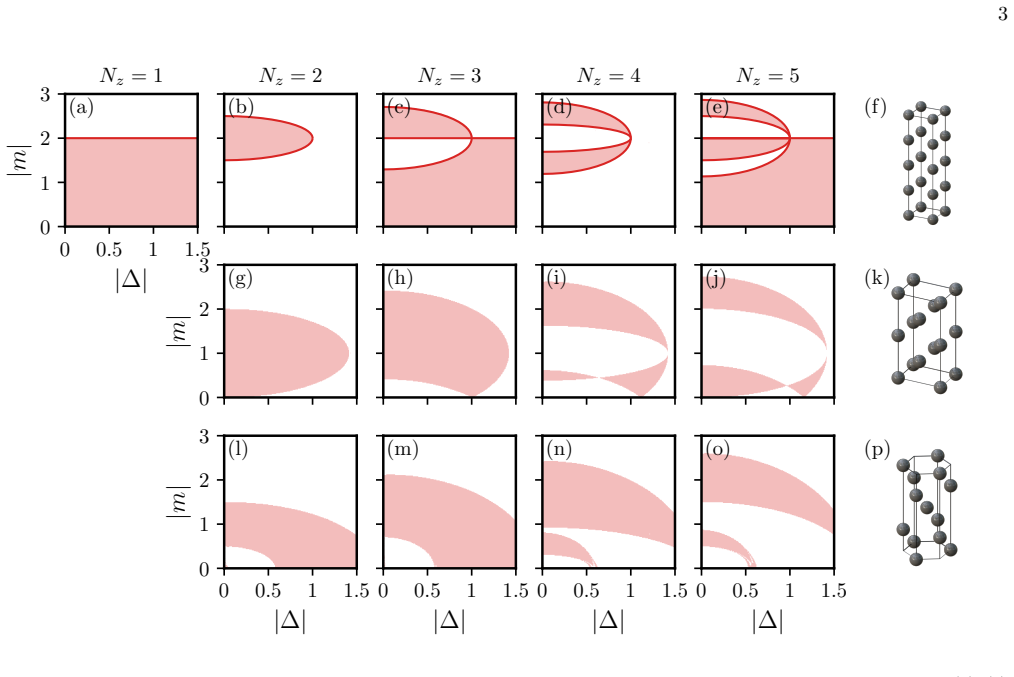
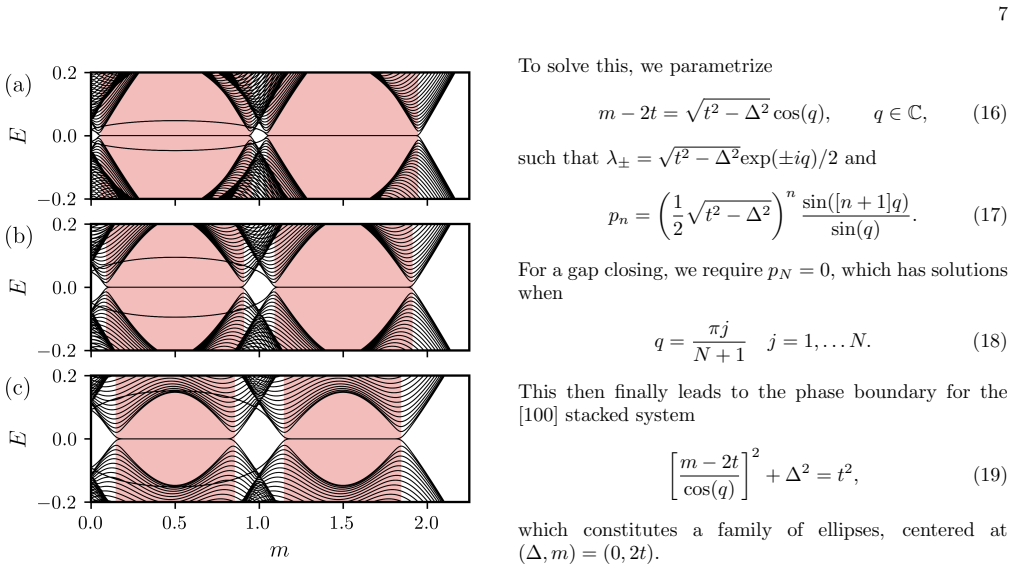
termination forN z = 1–5. (f) Corresponding slab unit cell forN z = 5. (g)–(j) [110] termination forN z = 2–5. (k) Corresponding slab unit cell forN z = 5. (l)–(o) [111] termination forN z = 2–5. (p) Corresponding slab unit cell forN z = 5. Red (white) regions indicate the topological (trivial) phase withν QSH = 1 (0). In (a)-(e), analytical phase boundar...
-
[2]
Materials for the Quantum Age
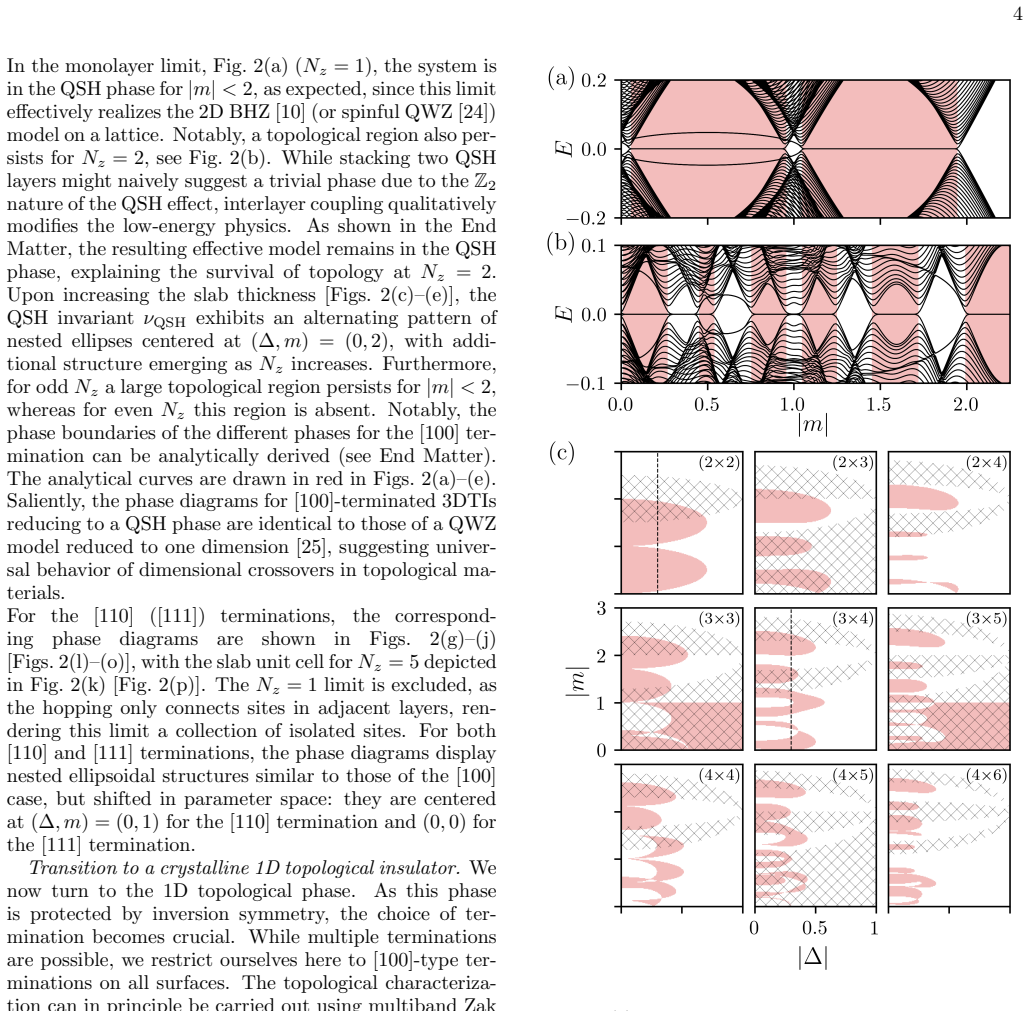
and [111] terminations, the phase diagrams display nested ellipsoidal structures similar to those of the [100] case, but shifted in parameter space: they are centered at (∆, m) = (0,1) for the [110] termination and (0,0) for the [111] termination. Transition to a crystalline 1D topological insulator.We now turn to the 1D topological phase. As this phase i...
-
[3]
Behavior of satellite states As discussed in the main text, the satellite states are deemed not topological, as they disperse with increasing ∆ andm
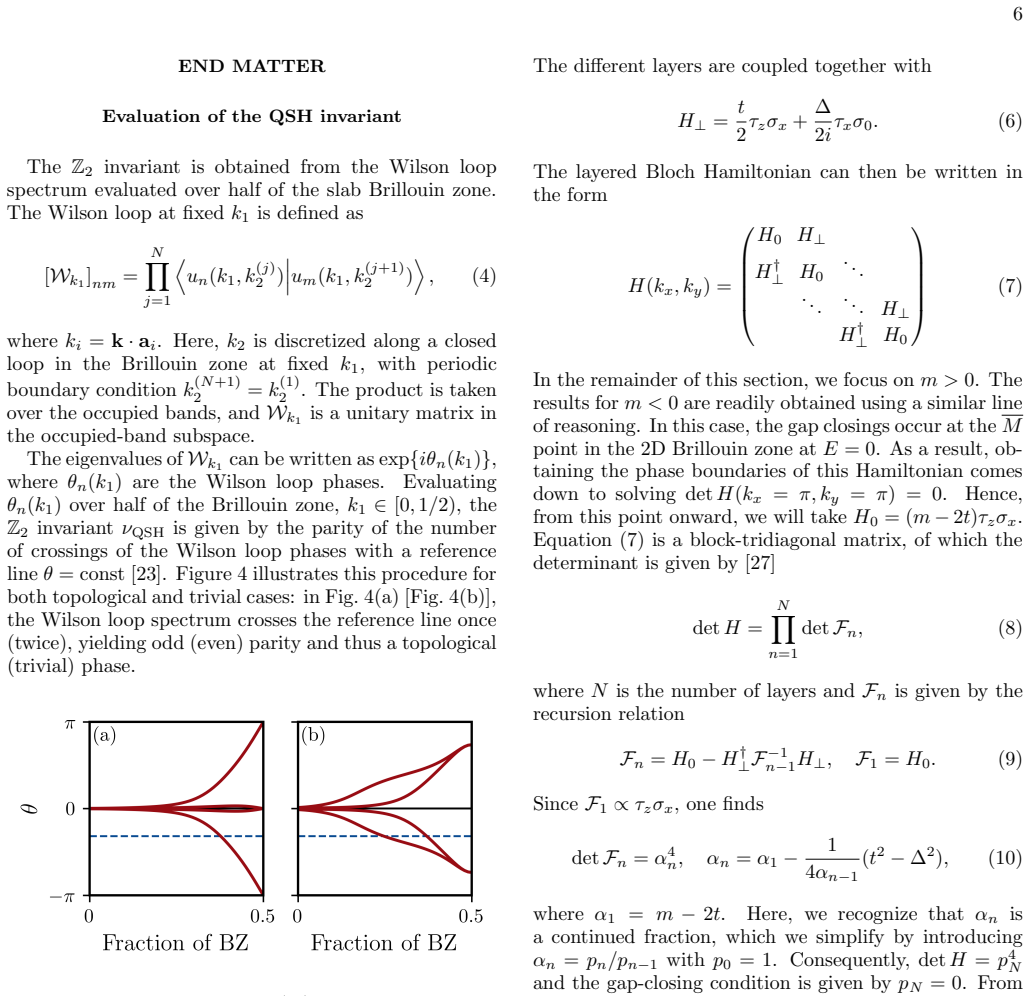
stacked system m−2t cos(q) 2 + ∆2 =t 2,(19) which constitutes a family of ellipses, centered at (∆, m) = (0,2t). Behavior of satellite states As discussed in the main text, the satellite states are deemed not topological, as they disperse with increasing ∆ andm. In Fig. 5, we show the behavior of these states for three representative choices of ∆. Indeed,...
-
[4]
Altland and M
A. Altland and M. R. Zirnbauer, Nonstandard symme- try classes in mesoscopic normal-superconducting hybrid structures, Phys. Rev. B55, 1142 (1997)
1997
-
[5]
A. P. Schnyder, S. Ryu, A. Furusaki, and A. W. Ludwig, Classification of topological insulators and superconduc- tors in three spatial dimensions, Phys. Rev. B78, 195125 (2008)
2008
-
[6]
S. Ryu, A. P. Schnyder, A. Furusaki, and A. W. Lud- wig, Topological insulators and superconductors: tenfold way and dimensional hierarchy, New J. Phys.12, 065010 (2010)
2010
-
[7]
Zhang, K
Y. Zhang, K. He, C.-Z. Chang, C.-L. Song, L.-L. Wang, X. Chen, J.-F. Jia, Z. Fang, X. Dai, W.-Y. Shan,et al., Crossover of the three-dimensional topological insulator Bi2Se3 to the two-dimensional limit, Nat. Phys.6, 584 (2010)
2010
-
[8]
S.-Y. Xu, M. Neupane, I. Belopolski, C. Liu, N. Alidoust, G. Bian, S. Jia, G. Landolt, B. Slomski, J. H. Dil,et al., Unconventional transformation of spin Dirac phase across a topological quantum phase transition, Nat Commun6, 6870 (2015)
2015
-
[9]
Z. Wang, T. Zhou, T. Jiang, H. Sun, Y. Zang, Y. Gong, J. Zhang, M. Tong, X. Xie, Q. Liu,et al., Dimensional crossover and topological nature of the thin films of a three-dimensional topological insulator by band gap en- gineering, Nano Lett.19, 4627 (2019)
2019
-
[10]
C.-X. Liu, H. Zhang, B. Yan, X.-L. Qi, T. Frauenheim, X. Dai, Z. Fang, and S.-C. Zhang, Oscillatory crossover from two-dimensional to three-dimensional topological insulators, Phys. Rev. B81, 041307 (2010)
2010
-
[11]
van Veen, S
F. van Veen, S. K¨ olling, S. R. de Wit, R. Metsch, D. Rosenbach, C. Li, and A. Brinkman, Observation of the surface hybridization gap in the electrical transport properties of the ultrathin topological insulator (Bi 1−x Sbx)2 Te3, Phys. Rev. B112, 045425 (2025)
2025
-
[12]
J. R. Moes, J. F. Vliem, P. M. de Melo, T. C. Wigmans, A. R. Botello-M´ endez, R. G. Mendes, E. F. van Brenk, I. Swart, L. Maisel Liceran, H. T. Stoof,et al., Charac- terization of the edge states in colloidal Bi 2Se3 platelets, Nano Lett.24, 5110 (2024)
2024
-
[13]
B. A. Bernevig, T. L. Hughes, and S.-C. Zhang, Quantum spin Hall effect and topological phase transition in HgTe quantum wells, Science314, 1757 (2006)
2006
-
[14]
Shan, H.-Z
W.-Y. Shan, H.-Z. Lu, and S.-Q. Shen, Effective contin- uous model for surface states and thin films of three- dimensional topological insulators, New J. Phys.12, 043048 (2010). 8
2010
-
[15]
M. M. Asmar, D. E. Sheehy, and I. Vekhter, Topological phases of topological-insulator thin films, Phys. Rev. B 97, 075419 (2018)
2018
-
[16]
Maisel Licer´ an, S
L. Maisel Licer´ an, S. Koerhuis, D. Vanmaekelbergh, and H. Stoof, Topology of Bi 2Se3 nanosheets, Phys. Rev. B 109, 195407 (2024)
2024
-
[17]
Wakatsuki, M
R. Wakatsuki, M. Ezawa, and N. Nagaosa, Majorana fermions and multiple topological phase transition in ki- taev ladder topological superconductors, Phys. Rev. B 89, 174514 (2014)
2014
-
[18]
A. M. Cook and A. E. Nielsen, Finite-size topology, Phys. Rev. B108, 045144 (2023)
2023
-
[19]
Traverso, M
S. Traverso, M. Sassetti, and N. Traverso Ziani, Emerg- ing topological bound states in Haldane model zigzag nanoribbons, npj Quantum Materials9, 9 (2024)
2024
-
[20]
D. J. Klaassen, L. Eek, A. N. Rudenko, E. D. van’t Wes- tende, C. Castenmiller, Z. Zhang, P. L. de Boeij, A. van Houselt, M. Ezawa, H. J. Zandvliet,et al., Realization of a one-dimensional topological insulator in ultrathin ger- manene nanoribbons, Nat Commun16, 2059 (2025)
2059
-
[21]
L. Eek, E. D. van’t Westende, D. J. Klaassen, H. J. Zand- vliet, P. Bampoulis, and C. M. Smith, Electric-field con- trol of zero-dimensional topological states in ultranarrow germanene nanoribbons, Phys. Rev. Lett.135, 206601 (2025)
2025
-
[22]
Z. F. Osseweijer, L. Eek, H. J. Zandvliet, P. Bampoulis, and C. M. Smith, Topology of honeycomb nanoribbons revisited, arXiv preprint arXiv:2603.25497 (2026)
arXiv 2026
-
[23]
Pertsova and C
A. Pertsova and C. M. Canali, Probing the wavefunction of the surface states in Bi 2Se3 topological insulator: a realistic tight-binding approach, New J. Phys.16, 063022 (2014)
2014
-
[24]
S. Mao, A. Yamakage, and Y. Kuramoto, Tight-binding model for topological insulators: Analysis of helical sur- face modes over the whole Brillouin zone, Phys. Rev. B 84, 115413 (2011)
2011
-
[25]
Flores-Calderon, R
R. Flores-Calderon, R. Moessner, and A. M. Cook, Time- reversal invariant finite-size topology, Phys. Rev. B108, 125410 (2023)
2023
-
[26]
R. Yu, X. L. Qi, A. Bernevig, Z. Fang, and X. Dai, Equiv- alent expression of𭟋 2 topological invariant for band in- sulators using the non-abelian berry connection, Phys. Rev. B84, 075119 (2011)
2011
-
[27]
Qi, Y.-S
X.-L. Qi, Y.-S. Wu, and S.-C. Zhang, Topological quan- tization of the spin Hall effect in two-dimensional param- agnetic semiconductors, Phys. Rev. B74, 085308 (2006)
2006
-
[28]
Z. F. Osseweijer, L. Eek, and C. M. Smith, Topology of dimensional crossovers in extended Qi-Wu-Zhang models (2026), in preparation
2026
-
[29]
A. A. Soluyanov and D. Vanderbilt, Smooth gauge for topological insulators, Phys. Rev. B85, 115415 (2012)
2012
-
[30]
L. G. Molinari, Determinants of block tridiagonal matri- ces, Linear algebra and its applications429, 2221 (2008)
2008
discussion (0)
Sign in with ORCID, Apple, or X to comment. Anyone can read and Pith papers without signing in.