REVIEW 4 major objections 4 minor 49 references
Experimental detection of microscopic environments using thermodynamic observables
T0 review · 4 major / 4 minor · reviewed 2026-08-14 · deepseek-v4-flash
Pith's one-line read Thermodynamic inequalities can act as black-box detectors: a negative passive-observable test reveals that a quantum system has been touched by a hidden environment.
desk verdict A credible first experimental demonstration of thermodynamic heat-leak detection on IBM hardware, but the 'unambiguous' claim outruns the error bars because calibration and initial-state systematics are not propagated. read the letter →
The pith
A machine-rendered reading of the paper's core claim, the machinery that carries it, and where it could break.
The reading
What carries the argument
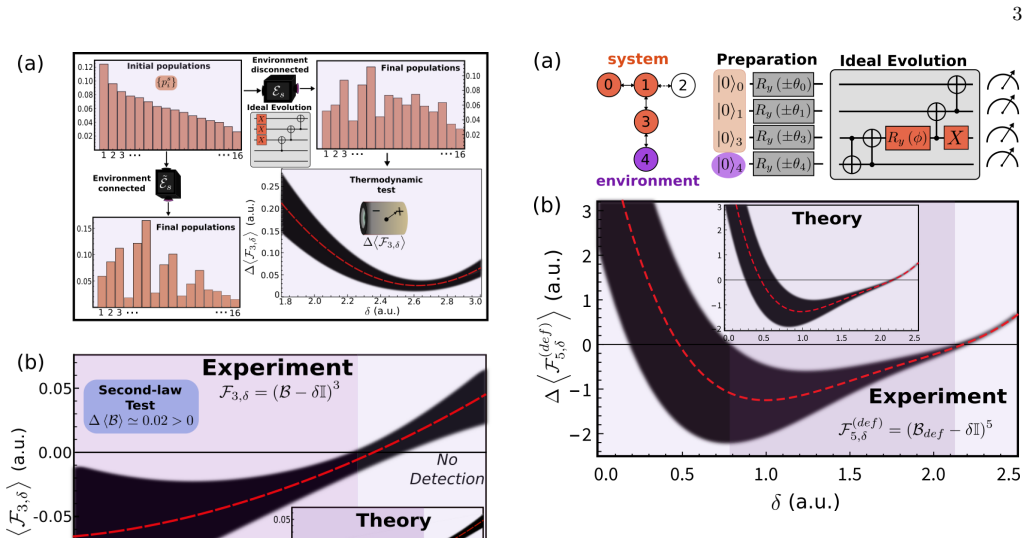
The load-bearing object is the family of passive observables $F_{\alpha,\delta}=(B-\delta I)^\alpha$, where $B=-\ln\rho_s$ and $\delta$ is a shift chosen so that the eigenvalues of $F$ remain a non-decreasing function of the eigenvalues of $B$. Passivity guarantees $\Delta\langle F_{\alpha,\delta}\rangle\ge0$ under any unital transformation, so a negative value signals non-unitality; the expansion $\Delta\langle(B-\delta I)^\alpha\rangle=\sum_{k=0}^\alpha \binom{\alpha}{k}(-1)^k\delta^k\Delta\langle B^{\alpha-k}\rangle$ shows why the shift works, since odd-$k$ terms carry negative signs and can outweigh positive even-$k$ contributions. A second mechanism, passivity deformation, replaces $B$ by $B_{\rm def}=\sum_i \beta_i^{({\rm def})}H_i$ with effective temperatures that keep the observable passive, which reweights the expansion and enables detection when unshifted observables fail. On the resource side, the paper uses shadow estimation of local $k$-qubit operators $\tilde{H}_{k,\{i_m\}}$ to show that $\Delta\langle F_{\alpha,\delta}\rangle$ can be evaluated with $N\sim O\!\left(\frac{\log(n/\mu)}{\varepsilon^2}(n+\delta)^{2\alpha}\right)$ measurements, polynomial in the number of qubits.
What would settle it
Prepare a product thermal state on a processor, apply only unital channels (random mixtures of unitaries or depolarizing noise) with the ancilla environment decoupled, and check that every $\Delta\langle F_{\alpha,\delta}\rangle$ stays nonnegative; then deliberately perturb the readout-correction matrix $M$ (for example, swap the detection probabilities of one qubit) and see whether a negative test appears. If a calibration error alone can produce a violation, the 'hidden-environment' reading of the inequality is not self-contained.
Extended reading notes
Core claim
The central claim is that $\Delta\langle F\rangle=\mathrm{Tr}[F(\rho_s'-\rho_s)]<0$ for a passive observable $F$ is a certificate of non-unital dynamics, which the authors call a heat leak. Given an initial product of thermal states $\rho_s=\otimes_i e^{-\beta_i H_i}/\mathrm{Tr}(e^{-\beta_i H_i})$, the observable $B=-\ln\rho_s$ satisfies $\Delta\langle B\rangle\ge0$ for every unital evolution; the same holds for every $F$ that commutes with $B$ and has eigenvalues given by a non-decreasing function of the eigenvalues of $B$. The experiments implement engineered environment couplings on small superconducting processors: with the environment coupled, the test $\Delta\langle F_{3,\delta}\rangle$ with $F_{3,\delta}=(B-\delta I)^3$ becomes negative in the interval $1.8\lesssim\delta\lesssim2.6$, while $\Delta\langle B\rangle$ and $\Delta\langle F_{2,\delta}\rangle$ do not detect it; in a second experiment, a deformed observable $B_{\rm def}=\beta_0(H_1+H_3)$ makes $\Delta\langle F^{({\rm def})}_{5,\delta}\rangle$ negative for $0.8\lesssim\delta\lesssim2.1$. A theoretical analysis shows that all these tests can be estimated from mean values of local observables, with a measurement count scaling polynomially in the number of qubits.
Load-bearing premise
The whole detection logic rests on the initial state being exactly the product of thermal states in Eq. (1) after readout correction by the calibrated matrix $M$; if that inversion is biased or the state carries residual correlations, a negative test value could appear without any hidden environment, or a real leak could be missed.
Editorial extensions
If this is right
- Heat-leak detection becomes a black-box test: only the initial and final mean values of passive observables are needed, with no trajectory information and no model of the noise channel.
- Because the measurement count grows polynomially with the number of qubits for fixed observable power and shift range, the tests remain feasible where full state or process tomography is not.
- Shifted and deformed passive observables detect leaks that the standard Clausius inequality $\Delta\langle B\rangle\ge0$ and unshifted powers of $B$ miss, so observable choice expands the detectable class.
- The tests are self-contained: they need no comparison with a classical simulation of the ideal circuit, which becomes intractable for large devices.
- In a constructed example, global passivity detects an environment that leaves resource-theory free-energy constraints unviolated, so the method covers cases where other thermodynamic frameworks fail.
Reading between the lines
- The same violation-as-diagnostic principle should transfer to other platforms—bosonic modes, trapped ions, or photonic circuits—where $B=-\ln\rho_s$ can be defined and passive observables measured, although the paper only demonstrates qubit processors.
- Because the paper does not propagate uncertainty in the readout-correction matrix $M$ into the reported confidence intervals, a natural extension is a sensitivity analysis quantifying how much calibration bias can fake or mask a heat leak.
- Sweeping $\alpha$ and $\delta$ yields a curve of test values that may act as a coarse fingerprint of the non-unital part of a noise channel, going beyond binary detection toward classification.
- The same thermodynamic logic could be applied to detect dephasing by choosing passive observables in rotated bases, since pure dephasing is unital and will not trigger the current tests; the paper lists dephasing as an open problem.
Signed reviews
Editorial analysis
A structured set of objections, weighed in public.
Referee Report
Summary. This paper proposes to detect a hidden environment coupled to a quantum system by looking for violations of thermodynamic inequalities. For a product thermal initial state ρ_s = ⊗ e^{-β_i H_i}/Z_i, passive observables F that are diagonal in the energy basis with non-decreasing eigenvalues are predicted to satisfy Δ⟨F⟩ = Tr[F(ρ'_s − ρ_s)] ≥ 0 for unital evolutions. A negative Δ⟨F⟩ is therefore interpreted as a heat leak, i.e., a non-unital component. The authors implement tests with F_{α,δ} = (B − δI)^α and with a deformed observable B_def on IBM quantum processors: a four-qubit system plus one-qubit environment (Melbourne) and a three-qubit system plus one-qubit environment (Essex). They report detection windows (Melbourne 1.8 ≲ δ ≲ 2.6 for F_{3,δ}; Essex 0.8 ≲ δ ≲ 2.1 for a deformed F^{(def)}_{5,δ}) that are negative by more than three standard deviations when the environment is coupled, and non-negative in the decoupled-environment controls. A supplemental analysis uses classical shadows to argue that evaluating these tests requires only O(poly(n)) measurements for fixed α and δ.
Significance. If the claims hold, the work offers a scalable, tomography-free diagnostic for non-unital errors in quantum devices, with the unusual feature that the test is independent of the details of the noise model. Strengths of the manuscript include genuine hardware experiments on two IBM processors, decoupled-environment control runs, and a scaling argument that correctly reduces the estimation of (B − δI)^α to local observables whose shadow norm is independent of n. The central inequality itself is more robust than the paper's stated justification: it holds for all unital maps via the doubly stochastic action on diagonals, not only for mixtures of unitaries, so the detection principle is theoretically sound. However, the experimental evidence for unambiguous detection is not yet airtight because the readout-calibration uncertainty and the non-unital gate-error component of the environment CNOTs are not quantified. With a corrected theoretical statement and the requested robustness analysis, this would be a worthwhile contribution to quantum device characterization.
major comments (4)
- [Main text, paragraph after Eq. (2)] The statement 'For any unital evolution, the final state ρ′s can be written as ρ′s = ∑i qi U(i)s(ρs)U(i)†s' is false for dimensions d > 2, and the following 'i.e.' incorrectly equates 'non unital' with 'not representable as a mixture of unitaries'. In the present four-qubit setting (d = 16), this is a substantive mathematical error. The inequality Δ⟨F⟩ ≥ 0 does, however, hold for every unital map when ρs is diagonal in the eigenbasis of F, because the diagonal of the output state is a doubly stochastic image of the initial diagonal and F has non-decreasing eigenvalues. I recommend replacing the mixture-of-unitaries justification with this majorization argument and defining non-unitality in the standard sense; the detection logic (violation ⇒ non-unital) then remains valid.
- [Supplemental 'Detector noise and characterization of initial states' and 'Statistical error'; main text around Eq. (4)] The error bars do not include the uncertainty in the readout calibration matrix M or the statistical error in the estimate of {p_i^s} from the ten batches, even though B and F are built from those same {p_i^s}. Equations (S12)–(S15) treat F_{α,δ} as a fixed operator and use only the shot noise of the initial and final populations. A biased M^{-1} (from crosstalk or drift) or the reported 0.005 L2 distance between the recovered populations and the nearest product thermal state could reorder the eigenvalues of B and make Δ⟨F_{3,δ}⟩ negative for a unitary or unital evolution. Please provide a quantitative bound: propagate the uncertainty in M (for example, by bootstrapping the calibration data) and verify that the detection intervals 1.8 ≲ δ ≲ 2.6 (Melbourne) and 0.8 ≲ δ ≲ 2.1 (Essex) survive that propagation.
- [Main text, Figs. 2 and 3 and the discussion of the decoupled controls] The decoupled-environment control removes the environment CNOTs, so it does not control for the additional gate errors introduced by those CNOTs in the coupled circuit. The observed negative Δ⟨F⟩ could therefore be caused by the non-unital component of the CNOT gate errors themselves rather than by the engineered thermal coupling. This does not invalidate the method—any actual non-unital component is a heat leak—but it weakens the specific physical claim that the source is the intended environment. An additional control that varies the coupling strength (the number of environment CNOTs or the environment temperature) and shows a systematic dependence of the detection interval would substantially strengthen the demonstration.
- [Supplemental, section on sensitivity of heat leak tests, after Eq. (S7)] The derivation gives Δ⟨F⟩ = −Σ_j Δf_j arξ_j, so a negative Δ⟨F⟩ requires a positive arξ_j. Two sentences later the text states that Δ⟨F⟩ < 0 'only if arξ_j < 0', which is inconsistent with the displayed formula. Since the proof of Theorem 1 is consistent with the formula, this appears to be a sign typo, but it should be corrected because it obscures the logic of the sensitivity claim.
minor comments (4)
- [Supplemental, 'Statistical error'] In the sentence about the Essex processor, the text says 'n = nMel = 4 batches'; the symbol should be nEss (or a similar distinct label) to avoid confusion with the Melbourne batch count.
- [Abstract and main text] There are several typographical errors: 'enviroment' in the abstract, 'in constrast' in the introduction, and 'not a applied' in the supplemental material. A careful proofreading pass is needed.
- [Main text, paragraph after Fig. 2] The sentence 'for 0 ≤ α ≤ 4 no detection occurs with the observables B^α' should be qualified as 'no unambiguous detection within three standard deviations', since the supplemental data show that the mean value of Δ⟨B^α⟩ becomes negative for α ≳ 3.4 even though the confidence interval still contains positive values.
- [Main text, Eq. (6)] The expansion in Eq. (6) is written with a sum over k from 0 to α, and the sign discussion is helpful; it would be even clearer to state explicitly that the bound on δ from the passivity condition must be imposed when α is even, as is later done for F_{2,δ}.
Circularity Check
No circular reduction: the thermodynamic tests are based on externally checkable inequalities and measured populations, not on fitted predictions.
full rationale
The derivation chain is self-contained. Equations (2) and (3) are stated as mathematical constraints for unital dynamics on product-thermal initial states, with Eq. (2) attributed to the Clausius inequality [34] and Eq. (3) to the passive-observable theorem of [27]; neither is inferred from the experimental data, and the cited theorem is parameter-free and does not contain the detection claim. The experiment measures initial and final populations in independent circuits, constructs B_i = -ln p_i^s from the measured initial populations, and evaluates Eq. (4) directly; the sign of Delta<F> is not fitted to produce detection. A violation of the inequality implies non-unital dynamics by the theorem, not by redefinition: 'heat leak' is introduced as a description of non-unital behavior, and the inequality is the evidence. The polynomial scaling result is derived in the Supplemental from the external shadow-tomography bound [29] plus error propagation; it is anchored in the paper's own appendix only in the sense that the derivation is included there. Self-citations [27,28] are present but the load-bearing result is a published theorem with stated assumptions that do not include the target experiment, so they do not constitute circular evidence. The unpropagated readout-inversion uncertainty and the 0.005 L2 distance to a product thermal state are experimental robustness concerns, not circularity of the derivation. Overall: no significant circularity.
Assumptions & free parameters
free parameters (6)
- Measured inverse temperatures of Melbourne system qubits =
beta_i from ground populations p0 = 0.557, 0.611, 0.586, 0.612
- Measured inverse temperature of Melbourne environment qubit =
p0^e = 0.782
- Measured inverse temperatures of Essex system and environment =
p0 = 0.944, 0.652, 0.652, and p0^e = 0.806
- Passivity deformation setting beta_1 to zero in Essex =
beta_1 = 0
- Essex rotation angles =
{0.3*pi, 0.4*pi, 0.4*pi, 0.15*pi}
- Test order alpha and shift windows =
alpha=3, delta in [1.8,2.6]; alpha=5, delta in [0.8,2.1]
assumptions (5)
- standard math Majorization decomposition: rho' = sum_i q_i U_i rho U_i^dagger iff rho majorizes rho'
- ad hoc to paper All standard unital evolutions are convex mixtures of unitaries
- domain assumption Initial state is exactly of the form Eq. (1), a tensor product of thermal states
- domain assumption Readout noise is a fixed invertible linear map M, and M^{-1} yields true populations
- standard math Shadow tomography bound Eq. (S1) from [29] and the error-propagation steps are valid
Cite this review
Pith. "Pith review of Experimental detection of microscopic environments using thermodynamic observables." pith.science (2026). https://pith.science/paper/3HR3EV6A
@misc{pith2026190808968,
  author       = {Pith},
  title        = {Pith review of: Experimental detection of microscopic environments using thermodynamic observables},
  year         = {2026},
  howpublished = {\url{https://pith.science/paper/3HR3EV6A}},
  note         = {Machine review of arXiv:1908.08968}
}
read the original abstract
Modern thermodynamic theories can be used to study highly complex quantum dynamics. Here, we experimentally demonstrate that the violation of thermodynamic constraints allows to detect the coupling of a quantum system to a hidden environment. By using the IBM quantum superconducting processors, we perform thermodynamic tests to detect a qubit environment interacting with a system composed of up to four qubits. The experiments are complemented by theoretical findings that show efficient scalability of the tests with respect to system size. Hence, they may be useful to detect an open system dynamics in situations where other methods (e.g. quantum state tomography) are practically infeasible.
Figures

Reference graph
Works this paper leans on
-
[1]
Estimate the initial and final populations{pi} and {p′ i}
-
[2]
The eigenvalues ofF are obtained by applying a non-decreasing functionf to the eigenvalues ofB. The properties 1 and 2 imply that ∆ ⟨ F ⟩ = Tr[F( ∑ i qiU (i) s ρsU (i)† s −ρs)]≥ 0. (3) Here, we consider the set of passive observables{Fα,δ}≡ {(B− δI)α}, where α is a positive integer and I is the identity operator. Denoting the eigenvalues ofB asBi, withBi≤...
-
[3]
Evaluate the quantitiesξj ≡ ∑j i=1p′↓ i −∑j i=1p↓ i. If ξj > 0 for some 1≤j≤ 2n, there is a heat leak. If ξj≤ 0 for 1≤ j≤ 2n, there can be a heat leak that is undetectable using this method. This kind of heat leak corresponds to a transformation such that ρ′ is not majorized byρ, yet the majorization relation ρ≻ D(ρ′) (which is equivalent toξj≤ 0 for 1≤j≤...
-
[4]
Sort them in non-increasing order
-
[5]
Esposito, U
M. Esposito, U. Harbola, and S. Mukamel, Rev. Mod. Phys. 81, 1665 (2009)
2009
-
[6]
This is read- ily deduced by substituting the explicit expressions Ry(±θ)|0⟩ = cos (θ 2 ) |0⟩± sin (θ 2 ) |1⟩, (S18) into Eq. (S16). A product of an arbitrary numberN of thermal qubit statescanalsobeexpressedasamixtureanalogoustoEq. (S16). Let ρi(θi) = cos2(θi 2 ) |0⟩i⟨0| +sin2(θi 2 ) |1⟩i⟨1| be the state of theith qubit, and let|ψ(θ)⟩i≡ Ry(θ)|0⟩i. By wri...
-
[7]
H.-P. Breuer and F. Petruccione,Open quantum systems (Oxford university press, 2002)
work page 2002
- [8]
Show all 49 references
-
[9]
Seifert, Rep
U. Seifert, Rep. Prog. Phys. 75, 126001 (2012)
2012
-
[10]
Sekimoto, Stochastic energetics, Vol
K. Sekimoto, Stochastic energetics, Vol. 799 (Springer, 2010)
2010
-
[11]
Lostaglio, Rep
M. Lostaglio, Rep. Prog. Phys. 82, 114001 (2019)
2019
-
[12]
Campisi, P
M. Campisi, P. Hanggi, and P. Talkner, Rev. Mod. Phys. 83, 771 (2011)
2011
-
[13]
G. Gour, M. P. Muller, V. Narasimhachar, R. W. Spekkens, and N. Y. Halpern, Phys. Rep. 583, 1 (2015)
2015
-
[14]
Brandao, M
F. Brandao, M. Horodecki, J. O. N. Ng, and S. Wehner, PNAS 112, 3275 (2015)
2015
-
[15]
Horodecki and J
M. Horodecki and J. Oppenheim, Nat. Commun. 4, 2059 (2013)
2013
-
[16]
Lostaglio, D
M. Lostaglio, D. Jennings, and T. Rudolph, Nat. Com- mun. 6, 6383 (2015)
2015
- [17]
-
[18]
Strasberg, G
P. Strasberg, G. Schaller, T. Brandes, and M. Esposito, Phys. Rev. X 7, 021003 (2017)
2017
-
[19]
Esposito, K
M. Esposito, K. Lindenberg, and C. V. den Broeck, New J. Phys. 12, 013013 (2010)
2010
-
[20]
Goold, M
J. Goold, M. Huber, A. Riera, L. del Rio, and P. Skrzypczyk, J. Phys. A: Math. Theor. 49, 143001 (2016)
2016
-
[21]
Sagawa, inLectures on quantum computing, thermo- dynamics and statistical physics (World Scientific, 2013) pp
T. Sagawa, inLectures on quantum computing, thermo- dynamics and statistical physics (World Scientific, 2013) pp. 125–190
2013
-
[22]
M. N. Bera, A. Riera, M. Lewenstein, Z. B. Khanian, and A. Winter, Quantum3, 121 (2019)
2019
-
[23]
Macieszczak, K
K. Macieszczak, K. Brandner, and J. P. Garrahan, Phys- ical review letters121, 130601 (2018)
2018
-
[24]
Vinjanampathy and J
S. Vinjanampathy and J. Anders, Contemporary Physics 57, 545 (2016)
2016
-
[25]
Benenti, G
G. Benenti, G. Casati, K. Saito, and R. S. Whitney, Physics Reports694, 1 (2017)
2017
-
[26]
Uzdin, in Thermodynamics in the Quantum Regime (Springer, 2018) pp
R. Uzdin, in Thermodynamics in the Quantum Regime (Springer, 2018) pp. 681–712
2018
-
[27]
Merali, Nature News551, 20 (2017)
Z. Merali, Nature News551, 20 (2017)
2017
-
[28]
A. C. Barato and U. Seifert, Physical review letters114, 158101 (2015)
2015
-
[29]
heat leak
to show that accurate evaluation of the tests can be achieved with a number of measurements that scales polynomially in the size of the system. Moreover, their diagnostics capability is self-contained, meaning that no additional information besides measurements on the sys- tem...
1908 arXiv
-
[30]
A. M. Timpanaro, G. Guarnieri, J. Goold, and G. T. Landi, Physical review letters123, 090604 (2019)
2019
-
[31]
Gardas and S
B. Gardas and S. Deffner, Scientific reports8, 1 (2018)
2018
-
[32]
Buffoni and M
L. Buffoni and M. Campisi, Quantum Science and Tech- nology 5, 035013 (2020)
2020
-
[33]
Uzdin and S
R. Uzdin and S. Rahav, Physical Review X8, 021064 (2018)
2018
- [34]
-
[35]
Huang, R
H.-Y. Huang, R. Kueng, and J. Preskill, Nature Physics 16, 1050 (2020)
2020
-
[36]
Arute, K
F. Arute, K. Arya, R. Babbush, D. Bacon, J. C. Bardin, R. Barends, R. Biswas, S. Boixo, F. G. Brandao, D. A. Buell, et al., Nature574, 505 (2019)
2019
-
[37]
Boixo, S
S. Boixo, S. V. Isakov, V. N. Smelyanskiy, R. Babbush, N. Ding, Z. Jiang, M. J. Bremner, J. M. Martinis, and H. Neven, Nature Physics14, 595 (2018)
2018
-
[38]
Zhong, H
H.-S. Zhong, H. Wang, Y.-H. Deng, M.-C. Chen, L.-C. Peng, Y.-H. Luo, J. Qin, D. Wu, X. Ding, Y. Hu,et al., Science 370, 1460 (2020)
2020
-
[39]
M. A. Nielsen, Lecture Notes, Department of Physics, University of Queensland, Australia (2002)
2002
-
[40]
Lindblad,Non-equilibrium entropy and irreversibility , Vol
C. Lindblad,Non-equilibrium entropy and irreversibility , Vol. 5 (Springer Science & Business Media, 2001)
2001
-
[41]
Supplemental material
-
[42]
J. Haah, A. W. Harrow, Z. Ji, X. Wu, and N. Yu, IEEE Transactions on Information Theory63, 5628 (2017)
2017
-
[43]
Aaronson, SIAM Journal on Computing49, STOC18 (2019)
S. Aaronson, SIAM Journal on Computing49, STOC18 (2019)
2019
-
[44]
Paini, A
M. Paini, A. Kalev, D. Padilha, and B. Ruck, arXiv preprint arXiv:2011.04754 (2020)
2020 arXiv
-
[45]
O’Donnell and J
R. O’Donnell and J. Wright, inProceedings of the forty- eighth annual ACM symposium on Theory of Computing (2016) pp. 899–912
2016
-
[46]
A. W. Marshall, I. Olkin, and B. C. Arnold, Inequali- ties: theory of majorization and its applications , Vol. 143 (Springer, 1979)
1979
-
[47]
Watrous, The theory of quantum information (Cam- bridge University Press, 2018)
J. Watrous, The theory of quantum information (Cam- bridge University Press, 2018)
2018
-
[48]
M. A. Nielsen and I. Chuang, Quantum computation and quantum information (Cambridge University Press, 2010)
2010
-
[49]
Cramer, M
M. Cramer, M. B. Plenio, S. T. Flammia, R. Somma, D. Gross, S. D. Bartlett, O. Landon-Cardinal, D. Poulin, and Y.-K. Liu, Nature communications1, 1 (2010)
2010
Reviewed August 14, 2026 · model on record in the stance chip above.
Discussion (0). Continue with ORCID to comment.