REVIEW 2 major objections 5 minor 31 references
IBPA turns streaming point clouds into orientable manifold meshes while flagging real holes in real time.
Reviewed by Pith at T0; open to challenge. T0 means a machine referee read the full paper against a public rubric. the ladder, T0–T4 →
T0 review · grok-4.5
2026-07-14 04:16 UTC pith:3HVHY3FG
load-bearing objection Solid engineering conversion of classic BPA into a streaming, topologically clean mesher with online hole flags; usable now for underwater coverage, with one acknowledged heuristic soft spot. the 2 major comments →
IBPA: Real-time Free-form Manifold Mesh Reconstruction via Incremental Ball Pivoting with Integrated Hole Detection
The pith
A machine-rendered reading of the paper's core claim, the machinery that carries it, and where it could break.
Core claim
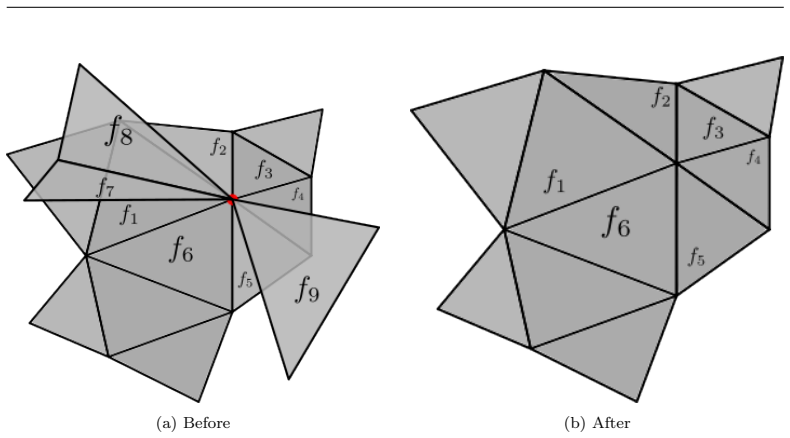
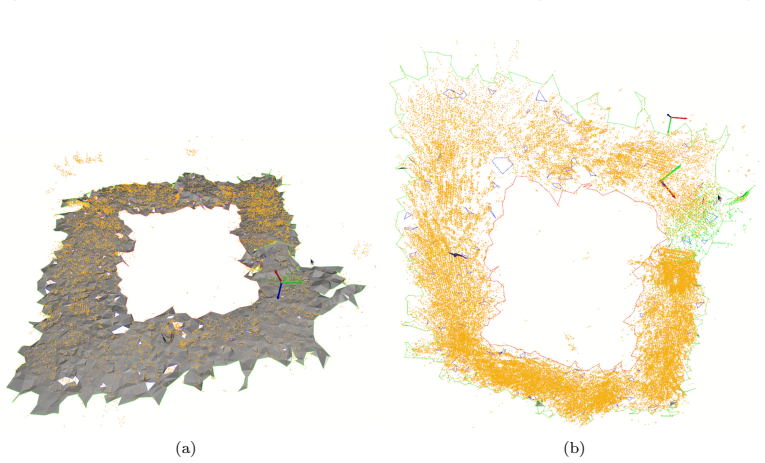
The authors demonstrate that Ball Pivoting can be made fully incremental while preserving edge- and vertex-manifoldness and global orientability: an expandable octree admits new points, empty-ball violations delete only the offending triangles, non-manifold vertices are pruned after each batch, and orientation is enforced on every accepted facet. The same boundary-edge set that drives expansion also yields closed loops that are classified as true holes once their length exceeds a user threshold.
What carries the argument
Incremental Ball Pivoting (IBPA): dynamic octree + empty-ball facet deletion + post-batch removal of 0-disk and 1-disk non-manifold vertices + orientation consistency check, all feeding a boundary-loop extractor that isolates holes without a full-mesh scan.
Load-bearing premise
That periodically keeping only the single longest edge-connected component correctly separates genuine holes from temporary fragmentation caused by empty-ball deletions, without throwing away valid surface that happens to be disconnected for a moment.
What would settle it
Run the algorithm on a known watertight free-form surface that is deliberately split into two large edge-connected pieces by empty-ball deletions; if the longer component is retained and the shorter legitimate patch is permanently discarded, or if a true hole is misclassified as a fragment, the claim fails.
If this is right
- Operators can replan ROV/AUV paths mid-mission using only the red hole boundaries, without random next-best-view sampling.
- Free-form manifold meshes replace DTMs for any bathymetry that contains overhangs or vertical faces.
- Outlier scans are rejected by the empty-ball test, so navigation spikes do not corrupt the growing surface.
- The same pipeline works offline on logged multibeam data and online on vision-based stereo streams.
- Detected holes supply the exact perimeter needed by subsequent hole-filling pose planners.
Where Pith is reading between the lines
- Because the mesh is already an orientable 2-manifold with boundary, any later smoothing step yields a domain on which Stokes’ theorem can be applied directly for integral geometric quantities.
- The same boundary loops that flag missing data could be used as hard constraints for online active-view planning, turning detection into closed-loop coverage.
- If leaf-node orphan limits are made adaptive to local point density, the method could maintain roughly constant reconstruction time even as the map grows.
- Extending the empty-ball test with a line-of-sight filter would further suppress multipath sonar artifacts common in confined underwater spaces.
Editorial analysis
A structured set of objections, weighed in public.
Referee Report
Summary. The paper adapts the classical Ball Pivoting Algorithm into Incremental BPA (IBPA) that constructs an orientable, edge- and vertex-manifold, non-self-intersecting triangle mesh from a stream of oriented point clouds with no assumptions on overlap or spatial distribution. It maintains the empty-ball property via dynamic octree expansion and selective facet deletion (retaining vertices), removes 0-disk and 1-disk non-manifold vertices via Algorithms 2–3, enforces orientation consistency, and flags holes whose boundary length exceeds a user threshold. The method is demonstrated on three offline multibeam AUV datasets and two online vision-based underwater experiments, with open-source ROS-integrated code.
Significance. If the claims hold, IBPA supplies a practical free-form alternative to DTM/DSM height fields for real-time coverage visualization on ROVs/AUVs, correctly representing overhangs and vertical structures while giving operators immediate feedback on incomplete regions. Strengths include a fully constructive pipeline with explicit topological invariants, an expandable octree formulation, open-source reference implementation, and both offline and online real-robot validation that shows outlier resilience and real-time speed. These elements make the work immediately usable for underwater mapping and next-best-view planning.
major comments (2)
- Section 5.3 (and Fig. 13): the policy of retaining only the single longest edge-connected component after every n batches (or on key-press ‘t’) is load-bearing for the hole-detection claim, yet empty-ball deletions can split a valid surface into multiple components. A temporarily shorter but geometrically correct patch is discarded and later reported as missing data. The authors note the event is “rare” and mitigated by a minimum hole-length threshold, but provide no quantification of fragmentation frequency or false-positive rate on the experimental streams; without that evidence the completeness guarantee remains an unmeasured engineering heuristic rather than a topological invariant.
- Section 6: reconstruction quality is assessed only by visual inspection, timing, and qualitative outlier rejection. No quantitative surface-error metrics (Hausdorff distance, normal consistency, or comparison against offline BPA/Poisson on the same point clouds) are reported. Because the central claim includes “geometric fidelity preservation,” the absence of such numbers leaves open whether the incremental deletions and non-manifold culling introduce systematic geometric degradation.
minor comments (5)
- Abstract and Introduction: “DSM/DSM” is a typographical duplication; the second occurrence should be “DTM”.
- Section 4.1.1, Eq. (3): the ceiling-log expression for Δn is correct for the 1-D illustration, yet the subsequent multi-axis example (vertex at (13,−3,2)) would benefit from an explicit statement that the final level is taken as the coordinate-wise maximum before re-coding all existing points.
- Figure 11 pipeline diagram: the decision diamond “keep isolated vertices?” is never referenced in the surrounding text; a one-sentence clarification of when vertices are retained versus deleted would improve readability.
- Section 2.1: the discussion of Voxblox and incremental Poisson correctly notes the lack of manifold guarantees, but a short remark on whether those methods can be post-processed into manifold meshes would help readers gauge the practical advantage of IBPA.
- Table 1: the column header “R hole tolerance” is ambiguous; expanding it to “ball radius R / hole-length tolerance” would remove the need to consult the caption.
Circularity Check
No circularity: IBPA is a constructive algorithmic adaptation of BPA whose manifold/orientability guarantees and hole flags are enforced by explicit local checks, not by fitting or self-definitional reduction.
full rationale
The paper's central claims are engineering constructions, not predictions derived from fitted parameters or uniqueness theorems. Sections 4.1–4.3 adapt classic BPA (Bernardini et al., Digne) by (i) making the octree expandable, (ii) deleting facets that violate the empty-ball condition when new points arrive, (iii) culling 0-disk and 1-disk non-manifold vertices via Algs. 2–3, and (iv) accepting a new triangle only when its orientation matches all neighboring facets. These steps are local geometric predicates; success is verified by the resulting mesh satisfying the stated topological invariants (edge- and vertex-manifold, orientable, non-self-intersecting) and by visual hole highlighting on real MBES and vision data. Self-citations to the authors' prior hole-detection / NBV work ([21], [22]) appear only in the related-work discussion of planning strategies and are not used to justify the reconstruction algorithm itself. No quantity is fitted to data and then re-presented as a prediction; no uniqueness result is imported from the same authors to force the method. The only acknowledged engineering compromise (periodic retention of the longest edge-connected component) is an explicit heuristic, not a circular derivation. Consequently the circularity score is 0.
Axiom & Free-Parameter Ledger
free parameters (4)
- ball radius R
- hole-length tolerance
- max orphan vertices per leaf
- batch size n for full connectivity scan
axioms (4)
- domain assumption Input points either carry consistent normals or normals can be estimated as vectors from each point toward the robot pose.
- standard math A surface is non-orientable if and only if it contains a Möbius strip (Zeeman).
- ad hoc to paper Deleting triangles whose empty ball is violated by a new point, while retaining vertices, eventually restores a valid empty-ball configuration without introducing permanent self-intersections.
- ad hoc to paper After removal of 0-disk and 1-disk non-manifold vertices the remaining mesh is both edge- and vertex-manifold.
read the original abstract
Both Remotely Operated underwater Vehicles (ROVs) and Autonomous Underwater Vehicles (AUVs) are frequently deployed to acquire geometric bathymetric data. However, it is often discovered post-survey that the acquired data coverage is incomplete. Given the high operational cost associated with underwater deployments, it is essential to incrementally visualize surface coverage in real-time to support informed decision-making by both the operators of ROVs and the AUVs during data collection. In addition, traditional incremental surface reconstruction methods, such as Digital Terrain Models (DTMs), are inherently limited in expressiveness: they represent surfaces as height fields, allows only one elevation value per $(x, y)$ coordinate and thus cannot capture overhangs or vertical structures. To overcome these limitations, we adapt the original Ball Pivoting Algorithm (BPA) into an incremental, real-time, and free-form surface reconstruction method, referred to as Incremental BPA (IBPA). Our method incrementally constructs an orientable, manifold mesh from streaming point cloud data without imposing assumptions regarding point cloud overlap or spatial distribution. Furthermore, we introduce a hole detection mechanism that identifies and highlights incomplete mesh regions. Compared to existing approaches, our method supports more complex surface topologies without prior structural assumptions. The source code of our reference implementation is available: https://github.com/Mauhing/Incremental-BPA
Figures





Reference graph
Works this paper leans on
-
[1]
Sheinin, Y
M. Sheinin, Y. Y. Schechner, The next best underwater view, in: Pro- ceedings of the IEEE conference on computer vision and pattern recog- nition, 2016, pp. 3764–3773. 38
2016
-
[2]
Mildenhall, P
B. Mildenhall, P. P. Srinivasan, M. Tancik, J. T. Barron, R. Ramamoor- thi, R. Ng, Nerf: Representing scenes as neural radiance fields for view synthesis, Communications of the ACM 65 (2021) 99–106
2021
-
[3]
Kerbl, G
B. Kerbl, G. Kopanas, T. Leimk¨ uhler, G. Drettakis, 3d gaussian splat- ting for real-time radiance field rendering., ACM Trans. Graph. 42 (2023) 139–1
2023
-
[4]
Campos, R
R. Campos, R. Garcia, P. Alliez, M. Yvinec, A surface reconstruction method for in-detail underwater 3d optical mapping, The International Journal of Robotics Research 34 (2015) 64–89
2015
-
[5]
Bernardini, J
F. Bernardini, J. Mittleman, H. Rushmeier, C. Silva, G. Taubin, The ball-pivoting algorithm for surface reconstruction, IEEE transactions on visualization and computer graphics 5 (2002) 349–359
2002
-
[6]
Digne, An analysis and implementation of a parallel ball pivoting algorithm, Image Processing On Line 4 (2014) 149–168
J. Digne, An analysis and implementation of a parallel ball pivoting algorithm, Image Processing On Line 4 (2014) 149–168
2014
-
[7]
R. A. Newcombe, S. Izadi, O. Hilliges, D. Molyneaux, D. Kim, A. J. Davison, P. Kohi, J. Shotton, S. Hodges, A. Fitzgibbon, Kinectfusion: Real-time dense surface mapping and tracking, in: 2011 10th IEEE International Symposium on Mixed and Augmented Reality, 2011, pp. 127–136. doi:10.1109/ISMAR.2011.6092378
-
[8]
Curless, M
B. Curless, M. Levoy, A volumetric method for building complex models from range images, in: Proceedings of the 23rd annual conference on Computer graphics and interactive techniques, 1996, pp. 303–312
1996
-
[9]
Oleynikova, Z
H. Oleynikova, Z. Taylor, M. Fehr, R. Siegwart, J. Nieto, Voxblox: Incremental 3D Euclidean Signed Distance Fields for on-board MAV planning, in: 2017 IEEE/RSJ International Conference on Intelligent Robots and Systems (IROS), IEEE, Vancouver, BC, 2017, pp. 1366–
2017
-
[10]
doi:10.1109/IROS.2017.8202315
-
[11]
Romanoni, M
A. Romanoni, M. Matteucci, Efficient moving point handling for in- cremental 3d manifold reconstruction, in: International Conference on Image Analysis and Processing, Springer, 2015, pp. 489–499. 39
2015
-
[12]
Piazza, A
E. Piazza, A. Romanoni, M. Matteucci, Real-time cpu-based large-scale three-dimensional mesh reconstruction, IEEE Robotics and Automation Letters 3 (2018) 1584–1591
2018
-
[13]
Sch¨ ops, T
T. Sch¨ ops, T. Sattler, M. Pollefeys, Surfelmeshing: Online surfel-based mesh reconstruction, IEEE transactions on pattern analysis and ma- chine intelligence 42 (2019) 2494–2507
2019
-
[14]
Kazhdan, M
M. Kazhdan, M. Bolitho, H. Hoppe, Poisson surface reconstruction, in: Proceedings of the fourth Eurographics symposium on Geometry processing, volume 7, 2006
2006
-
[15]
Q. Yu, W. Sui, Y. Wang, S. Xiang, C. Pan, Incremental poisson sur- face reconstruction for large scale three-dimensional modeling, in: Pat- tern Recognition and Computer Vision: Second Chinese Conference, PRCV 2019, Xi’an, China, November 8–11, 2019, Proceedings, Part III 2, Springer, 2019, pp. 442–453
2019
-
[16]
Vizzo, X
I. Vizzo, X. Chen, N. Chebrolu, J. Behley, C. Stachniss, Poisson surface reconstruction for lidar odometry and mapping, in: 2021 IEEE interna- tional conference on robotics and automation (ICRA), IEEE, 2021, pp. 5624–5630
2021
-
[17]
J. Ruan, B. Li, Y. Wang, Y. Sun, Slamesh: Real-time lidar simultaneous localization and meshing, in: 2023 IEEE International Conference on Robotics and Automation (ICRA), IEEE, 2023, pp. 3546–3552
2023
-
[18]
J. Niedzwiedzki, P. Lipinski, L. Podsedkowski, IDTMM: Incremental Direct Triangle Mesh Mapping, IEEE Robotics and Automation Letters (2023) 1–8. doi:10.1109/LRA.2023.3293751
-
[19]
Palomeras, N
N. Palomeras, N. Hurt´ os, E. Vidal, M. Carreras, Autonomous explo- ration of complex underwater environments using a probabilistic next- best-view planner, IEEE Robotics and Automation Letters 4 (2019) 1619–1625
2019
-
[20]
next-best-view
A. Bircher, M. Kamel, K. Alexis, H. Oleynikova, R. Siegwart, Receding horizon “next-best-view” planner for 3d exploration, in: 2016 IEEE in- ternational conference on robotics and automation (ICRA), IEEE, 2016, pp. 1462–1468. 40
2016
-
[21]
Hornung, K
A. Hornung, K. M. Wurm, M. Bennewitz, C. Stachniss, W. Burgard, Octomap: An efficient probabilistic 3d mapping framework based on octrees, Autonomous robots 34 (2013) 189–206
2013
-
[22]
M. Yip, C. Schellewald, T. Gambin, A. Stahl, Active pose-autonomous hole-filling techniques for 3d surface reconstruction in underwater ex- ploration, IFAC-PapersOnLine 58 (2024) 293–300
2024
-
[23]
M. Yip, A. Stahl, C. Schellewald, Robust hole-detection in triangular meshes irrespective of the presence of singular vertices, Computer-Aided Design 170 (2024) 103696
2024
-
[24]
R. A. Adams, C. Essex, Calculus: a complete course, 9th edition, Pear- son, 2018
2018
-
[25]
Zeeman, An introduction to topology: The classification theorem for surfaces, (No Title) (1966)
E.-C. Zeeman, An introduction to topology: The classification theorem for surfaces, (No Title) (1966)
1966
-
[26]
C. H. S´ equin, From moebius bands to klein-knottles, in: Proceedings of Bridges 2012: Mathematics, Music, Art, Architecture, Culture, 2012, pp. 93–102
2012
-
[27]
R. P. Grimaldi, Discrete and Combinatorial Mathematics, 5/e, Pearson Education India, 2006
2006
-
[28]
Q.-Y. Zhou, J. Park, V. Koltun, Open3d: A modern library for 3d data processing, arXiv preprint arXiv:1801.09847 (2018)
Pith/arXiv arXiv 2018
-
[29]
Liljeb¨ ack, R
P. Liljeb¨ ack, R. Mills, Eelume: A flexible and subsea resident imr vehi- cle, in: Oceans 2017-Aberdeen, IEEE, 2017, pp. 1–4
2017
-
[30]
M. Singh, K. Alexis, Online refractive camera model calibration in visual inertial odometry, in: 2024 IEEE/RSJ International Confer- ence on Intelligent Robots and Systems (IROS), 2024, pp. 12609–12616. doi:10.1109/IROS58592.2024.10802302
-
[31]
M. Singh, K. Alexis, Deepvl: Dynamics and inertial measurements- based deep velocity learning for underwater odometry, in: 2025 IEEE International Conference on Robotics and Automation (ICRA), 2025, pp. 1–7. doi:10.1109/ICRA55743.2025.11128041. 41
discussion (0)
Sign in with ORCID, Apple, or X to comment. Anyone can read and Pith papers without signing in.