Automated Byzantine-Resilient Clustered Decentralized Federated Learning for Battery Intelligence in Connected EVs
Pith reviewed 2026-05-21 01:42 UTC · model grok-4.3
The pith
ABC-DFL uses blockchain and FLECA to enable Byzantine-resilient decentralized federated learning for EV battery data.
A machine-rendered reading of the paper's core claim, the machinery that carries it, and where it could break.
Core claim
The central discovery is that FLECA, through filtered layered enhanced clustering aggregation, mitigates Byzantine attacks in clustered decentralized federated learning by having EVs filter malicious updates with an adaptive threshold based on reference model deviations and oracles performing robust clustering to isolate trustworthy groups.
What carries the argument
FLECA, the Filtered Layered Enhanced Clustering Aggregation protocol, which performs hierarchical aggregation by filtering updates and clustering trustworthy groups.
If this is right
- FLECA matches the convergence of FedProx when no attacks are present.
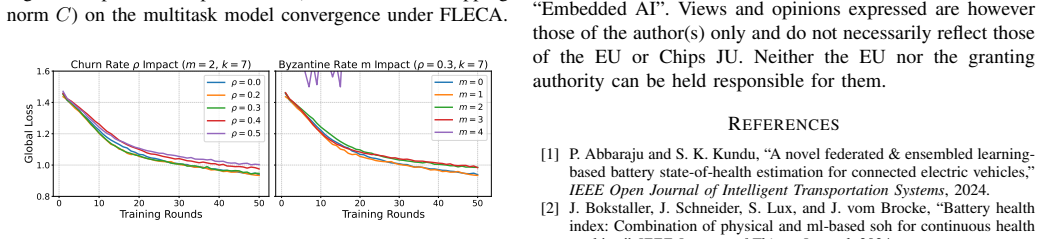
- In adaptive adversarial scenarios, FLECA keeps attack impact scores below 0.10 and beats existing defenses.
- Multitask model experiments validate that the incentive mechanism is effective and fair.
- Benchmarks show ABC-DFL is practical for on-chain and off-chain use in connected EVs.
Where Pith is reading between the lines
- This approach might extend to other privacy-sensitive decentralized applications such as smart city data sharing.
- Testing the system with compromised oracles could reveal additional robustness requirements.
- The use of reference models suggests a need for mechanisms to update references securely over time.
Load-bearing premise
Every EV can maintain and use a reliable reference model update to spot malicious deviations accurately with an adaptive threshold, while oracle nodes remain uncompromised and correctly identify trustworthy clusters.
What would settle it
Demonstrating a scenario where malicious updates evade the adaptive threshold detection and lead to high attack impact scores despite using FLECA.
Figures


read the original abstract
Federated learning (FL) has emerged as a promising paradigm for managing electric vehicle (EV) battery data in intelligent transportation systems (ITS), enabling privacy-preserving tasks such as anomaly detection and capacity estimation. However, most existing frameworks rely on centralized aggregation schemes, which pose critical limitations in terms of security and trust. To address these challenges, we propose ABC-DFL, an automated Byzantine-resilient clustered decentralized federated learning (C-DFL) framework for connected EVs. The proposed incentive-driven C-DFL system replaces the central server with an open-permissioned blockchain, featuring a new dynamic Quorum Byzantine Fault Tolerance (QBFT) protocol and an oracle-based aggregation layer, to enhance trust, security, and automation. At the core of ABC-DFL lies FLECA (Filtered Layered Enhanced Clustering Aggregation), a robust hierarchical aggregation protocol that mitigates Byzantine attacks by having each EV filter malicious updates using an adaptive threshold based on deviations from its reference model update. Oracle nodes, responsible for inter-group aggregation, employ robust clustering to isolate and aggregate model updates from trustworthy EV groups. Comprehensive experimental evaluations demonstrate that FLECA matches FedProx convergence under benign conditions and significantly outperforms existing defenses with attack impact scores below 0.10 in adaptive adversarial scenarios. Furthermore, several learning experiments with multitask models confirm the effectiveness and fairness of the incentive mechanism. Finally, on-chain and off-chain benchmarks validate the practicality of ABC-DFL.
Editorial analysis
A structured set of objections, weighed in public.
Referee Report
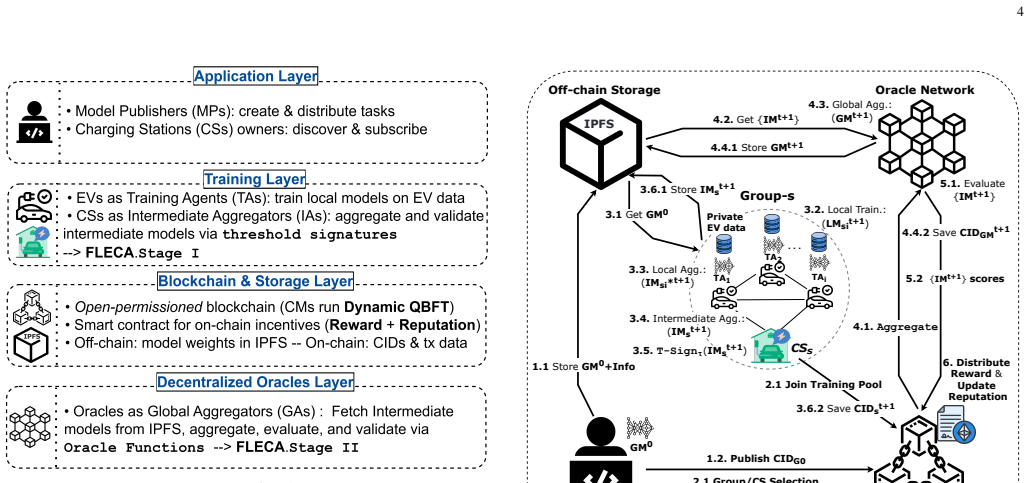
Summary. The manuscript proposes ABC-DFL, an automated Byzantine-resilient clustered decentralized federated learning framework for battery intelligence tasks in connected EVs. It replaces centralized aggregation with an open-permissioned blockchain employing a dynamic Quorum Byzantine Fault Tolerance (QBFT) protocol and an oracle-based layer. At its core is FLECA, a hierarchical aggregation protocol in which each EV filters malicious updates via an adaptive threshold computed from deviations relative to its own reference model update; oracle nodes then apply robust clustering to isolate and aggregate updates from trustworthy clusters. The central empirical claims are that FLECA matches FedProx convergence under benign conditions and achieves attack impact scores below 0.10 under adaptive adversarial scenarios, with additional support from multitask learning experiments and on/off-chain benchmarks.
Significance. If the resilience and convergence claims are substantiated, the framework would represent a practical advance in secure, serverless federated learning for resource-constrained and adversarial IoT/ITS environments. The integration of blockchain incentives, dynamic quorum consensus, and layered filtering/clustering addresses real deployment constraints such as intermittent connectivity and lack of trusted central authority. The work also supplies concrete benchmarks for both learning performance and system overhead, which are valuable for evaluating feasibility in EV networks.
major comments (3)
- [Abstract and §3] Abstract and §3 (FLECA description): The adaptive-threshold filtering mechanism rests on the assumption that every honest EV maintains a reliable, unpoisoned reference model update from which malicious deviations can be detected. No invariant, bootstrap argument, or analysis is supplied showing that this reference remains outside the convex hull of coordinated Byzantine updates, particularly in the first few rounds before any stable reference can form or under mimicry attacks that align malicious updates with the reference while corrupting clusters.
- [Abstract and §5] Abstract and §5 (experimental evaluation): The claim that FLECA yields attack impact scores below 0.10 and significantly outperforms existing defenses is presented without specification of the Byzantine fraction, the precise adaptive attack strategies employed, the definition and computation of the attack impact metric, data exclusion rules, number of independent runs, or statistical significance tests. These omissions prevent independent verification of the reported resilience advantage over baselines such as FedProx.
- [§4] §4 (oracle-based aggregation): The assertion that oracle nodes can reliably isolate trustworthy clusters via robust clustering lacks any analysis of oracle compromise, Byzantine behavior among oracles themselves, or failure modes when model updates lie in high-dimensional spaces where distance-based clustering becomes unreliable.
minor comments (2)
- [§3] The acronym expansion 'Filtered Layered Enhanced Clustering Aggregation' for FLECA is given, yet the manuscript does not clearly delineate which operations constitute the 'layered' aspect of the protocol or how the layers interact with the reference-model filter.
- [§3] Notation for the adaptive threshold and deviation metric is introduced without an explicit equation or pseudocode listing the exact computation performed at each EV.
Simulated Author's Rebuttal
We thank the referee for the insightful comments, which help improve the clarity and rigor of our work on ABC-DFL. We address each major comment below and indicate planned revisions to the manuscript.
read point-by-point responses
-
Referee: [Abstract and §3] Abstract and §3 (FLECA description): The adaptive-threshold filtering mechanism rests on the assumption that every honest EV maintains a reliable, unpoisoned reference model update from which malicious deviations can be detected. No invariant, bootstrap argument, or analysis is supplied showing that this reference remains outside the convex hull of coordinated Byzantine updates, particularly in the first few rounds before any stable reference can form or under mimicry attacks that align malicious updates with the reference while corrupting clusters.
Authors: We acknowledge the validity of this observation. The manuscript relies on the adaptive threshold derived from each EV's local reference update without providing a formal bootstrap argument or analysis against coordinated mimicry attacks in early rounds. To address this, we will revise §3 to include a detailed description of the initialization phase and an informal argument based on the assumption of a majority of honest nodes. Additionally, we will discuss how the oracle-based clustering provides a second layer of defense against mimicry. These changes will be incorporated in the revised manuscript. revision: yes
-
Referee: [Abstract and §5] Abstract and §5 (experimental evaluation): The claim that FLECA yields attack impact scores below 0.10 and significantly outperforms existing defenses is presented without specification of the Byzantine fraction, the precise adaptive attack strategies employed, the definition and computation of the attack impact metric, data exclusion rules, number of independent runs, or statistical significance tests. These omissions prevent independent verification of the reported resilience advantage over baselines such as FedProx.
Authors: We agree that the experimental details are insufficient for full reproducibility. In the revised §5, we will specify the Byzantine fraction (30%), the adaptive attack strategies (including backdoor and model replacement attacks), the attack impact metric (normalized accuracy drop), the number of runs (10), and include p-values from statistical tests. Data exclusion will be clarified as removing updates with extreme deviations. This will strengthen the empirical claims. revision: yes
-
Referee: [§4] §4 (oracle-based aggregation): The assertion that oracle nodes can reliably isolate trustworthy clusters via robust clustering lacks any analysis of oracle compromise, Byzantine behavior among oracles themselves, or failure modes when model updates lie in high-dimensional spaces where distance-based clustering becomes unreliable.
Authors: We partially agree. The paper assumes oracles are reliable due to the permissioned setup and QBFT, but lacks explicit analysis of oracle Byzantine behavior or high-dimensional clustering failures. We will add a paragraph in §4 discussing these issues, including potential mitigations like multi-oracle consensus and use of robust statistics for clustering. However, a comprehensive security proof for oracles is left as future work. revision: partial
Circularity Check
No significant circularity; protocol design is self-contained with explicit assumptions and experimental validation.
full rationale
The paper introduces ABC-DFL and FLECA as a new protocol combining blockchain, QBFT, oracle aggregation, and adaptive-threshold filtering for Byzantine resilience in decentralized FL. No equations or first-principles derivations are presented that reduce to fitted parameters or self-referential inputs by construction. The reference model update and clustering steps are defined directly in the protocol description rather than derived from prior results within the paper. Experimental claims (convergence matching FedProx, attack impact <0.10) rest on simulation benchmarks rather than any closed-loop prediction that presupposes the outcome. While the skeptic correctly notes that the uncompromised reference model assumption lacks a formal invariant proof, this is an unverified assumption rather than a circular reduction; the derivation chain does not collapse to its own inputs.
Axiom & Free-Parameter Ledger
axioms (1)
- domain assumption Byzantine fault tolerance is achievable via dynamic quorum protocols in open-permissioned blockchains for model aggregation
invented entities (2)
-
FLECA (Filtered Layered Enhanced Clustering Aggregation)
no independent evidence
-
dynamic Quorum Byzantine Fault Tolerance (QBFT) protocol
no independent evidence
Lean theorems connected to this paper
-
IndisputableMonolith/Foundation/AbsoluteFloorClosure.leanreality_from_one_distinction unclear?
unclearRelation between the paper passage and the cited Recognition theorem.
FLECA ... each EV filter malicious updates using an adaptive threshold based on deviations from its reference model update. Oracle nodes ... employ robust clustering to isolate and aggregate model updates from trustworthy EV groups.
-
IndisputableMonolith/Cost/FunctionalEquation.leanwashburn_uniqueness_aczel unclear?
unclearRelation between the paper passage and the cited Recognition theorem.
attack impact scores below 0.10 in adaptive adversarial scenarios
What do these tags mean?
- matches
- The paper's claim is directly supported by a theorem in the formal canon.
- supports
- The theorem supports part of the paper's argument, but the paper may add assumptions or extra steps.
- extends
- The paper goes beyond the formal theorem; the theorem is a base layer rather than the whole result.
- uses
- The paper appears to rely on the theorem as machinery.
- contradicts
- The paper's claim conflicts with a theorem or certificate in the canon.
- unclear
- Pith found a possible connection, but the passage is too broad, indirect, or ambiguous to say the theorem truly supports the claim.
Reference graph
Works this paper leans on
-
[1]
P. Abbaraju and S. K. Kundu, “A novel federated & ensembled learning- based battery state-of-health estimation for connected electric vehicles,” IEEE Open Journal of Intelligent Transportation Systems, 2024
work page 2024
-
[2]
Battery health index: Combination of physical and ml-based soh for continuous health tracking,
J. Bokstaller, J. Schneider, S. Lux, and J. vom Brocke, “Battery health index: Combination of physical and ml-based soh for continuous health tracking,”IEEE Internet of Things Journal, 2024
work page 2024
-
[3]
Review of battery state estimation methods for electric vehicles-part i: Soc estimation,
O. Demirci, S. Taskin, E. Schaltz, and B. A. Demirci, “Review of battery state estimation methods for electric vehicles-part i: Soc estimation,” Journal of Energy Storage, vol. 87, p. 111435, 2024
work page 2024
-
[4]
A survey on federated learning in intelligent transportation systems,
R. Zhang, J. Mao, H. Wang, B. Li, X. Cheng, and L. Yang, “A survey on federated learning in intelligent transportation systems,”IEEE Transactions on Intelligent Vehicles, 2024
work page 2024
-
[5]
Privacy-preserved federated learning for autonomous driving,
Y . Li, X. Tao, X. Zhang, J. Liu, and J. Xu, “Privacy-preserved federated learning for autonomous driving,”IEEE Trans. on Intelligent Transporta- tion Systems, vol. 23, no. 7, pp. 8423–8434, 2021
work page 2021
-
[6]
Robust state of health estimation for heterogeneous batteries with privacy preserving,
T. Wang, Z. Zhang, Y . Tao, and Z. Y . Dong, “Robust state of health estimation for heterogeneous batteries with privacy preserving,”IEEE Trans. on Vehicular Technology, vol. 74, no. 6, pp. 8921–8937, 2025
work page 2025
-
[7]
V . S. Naresh, V . S. Sriram, V . J. Krishna, V . D. Chandini, R. N. Sri, K. J. Durga, and V . Poojitha, “Privacy-preserving state of health prediction for electric vehicle batteries: A comprehensive review,”Computers and Electrical Engineering, vol. 118, p. 109416, 2024
work page 2024
-
[8]
T. Han, S. Yue, P. Yang, R. Zhou, and J. Yu, “Source-Free Dynamic Weighted Federated Transfer Learning for State-of-Health Estimation of Lithium-Ion Batteries with Data Privacy,”IEEE Trans. on Power Electronics, vol. 39, no. 11, pp. 15 085–15 100, 2024
work page 2024
-
[9]
Communication-Efficient Learning of Deep Networks from Decentral- ized Data,
B. McMahan, E. Moore, D. Ramage, S. Hampson, and B. A. y. Arcas, “Communication-Efficient Learning of Deep Networks from Decentral- ized Data,” inProceedings of the 20th International Conference on Artificial Intelligence and Statistics. PMLR, 2017, pp. 1273–1282
work page 2017
-
[10]
Split multi-task federated learning for battery health and capacity estimation in electric vehicles,
A. A. Korba, M. A. Bouchiha, and Y . Ghamri-Doudane, “Split multi-task federated learning for battery health and capacity estimation in electric vehicles,”IEEE Transactions on Consumer Electronics, pp. 1–1, 2026
work page 2026
-
[11]
Fed- erated Learning for Generalization, Robustness, Fairness: A Survey and Benchmark,
W. Huang, M. Ye, Z. Shi, G. Wan, H. Li, B. Du, and Q. Yang, “Fed- erated Learning for Generalization, Robustness, Fairness: A Survey and Benchmark,”IEEE Trans. on Pattern Analysis and Machine Intelligence, pp. 1–20, 2024. 16
work page 2024
-
[12]
Source inference attacks: Beyond membership inference attacks in federated learning,
H. Hu, X. Zhang, Z. Salcic, L. Sun, K.-K. R. Choo, and G. Dobbie, “Source inference attacks: Beyond membership inference attacks in federated learning,”IEEE Trans. on Dependable and Secure Computing, vol. 21, no. 4, pp. 3012–3029, 2024
work page 2024
-
[13]
T. Wang and Z. Dong, “Peer-to-Peer Personalized Federated Transfer Learning for Battery State of Health Estimation of Vehicles,”IEEE Trans. on Intelligent Vehicles, pp. 1–12, 2024
work page 2024
-
[14]
Block-fedl: Electric vehicle charging load forecasting using federated learning and blockchain,
S. M. Danish, A. Hameed, A. Ranjha, G. Srivastava, and K. Zhang, “Block-fedl: Electric vehicle charging load forecasting using federated learning and blockchain,”IEEE Trans. on Vehicular Technology, vol. 74, no. 2, pp. 2048–2056, 2025
work page 2048
-
[15]
V . Shejwalkar, A. Houmansadr, P. Kairouz, and D. Ramage, “Back to the drawing board: A critical evaluation of poisoning attacks on production federated learning,” inIEEE Symposium on Security and Privacy, 2022, pp. 1354–1371
work page 2022
-
[16]
Feature importance-aware transferable adversarial attacks,
Z. Wang, H. Guo, Z. Zhang, W. Liu, Z. Qin, and K. Ren, “Feature importance-aware transferable adversarial attacks,” inIEEE/CVF inter- national conference on computer vision, 2021, pp. 7639–7648
work page 2021
-
[17]
V . Shejwalkar and A. Houmansadr, “Manipulating the byzantine: Opti- mizing model poisoning attacks and defenses for federated learning,” in NDSS, 2021
work page 2021
-
[18]
Decentralized federated learning: A survey and perspective,
L. Yuan, Z. Wang, L. Sun, S. Y . Philip, and C. G. Brinton, “Decentralized federated learning: A survey and perspective,”IEEE Internet of Things Journal, vol. 11, no. 21, pp. 34 617–34 638, 2024
work page 2024
-
[19]
Y . A. Sultan, A. A. Eladl, M. A. Hassan, and S. A. Gamel, “Enhancing electric vehicle battery lifespan: integrating active balancing and ma- chine learning for precise rul estimation,”Scientific Reports, vol. 15, no. 1, p. 777, 2025
work page 2025
-
[20]
Analyzing electric vehicle battery health performance using supervised machine learning,
K. Das, R. Kumar, and A. Krishna, “Analyzing electric vehicle battery health performance using supervised machine learning,”Renewable and Sustainable Energy Reviews, vol. 189, p. 113967, 2024
work page 2024
-
[21]
Baybfed: Bayesian backdoor defense for federated learning,
K. Kumari, P. Rieger, H. Fereidooni, M. Jadliwala, and A.-R. Sadeghi, “Baybfed: Bayesian backdoor defense for federated learning,” inIEEE Symposium on Security and Privacy (SP). IEEE, 2023, pp. 737–754
work page 2023
-
[22]
Adaptive Multi-Personalized Federated Learning for State of Health Estimation of Multiple Batteries,
T. Wang, Z. Y . Donget al., “Adaptive Multi-Personalized Federated Learning for State of Health Estimation of Multiple Batteries,”IEEE Internet of Things Journal, vol. 11, no. 24, pp. 39 994–40 008, 2024
work page 2024
-
[23]
K. L. Wong, R. Tse, S.-K. Tang, and G. Pau, “Decentralized Deep Learning Approach for Lithium-Ion Batteries State of Health Forecasting Using Federated Learning,”IEEE Trans. on Transportation Electrifica- tion, vol. 10, no. 4, pp. 8199–8212, 2024
work page 2024
-
[24]
V . L ´opez, O. Fontenla-Romero, E. Hern ´andez-Pereira, B. Guijarro- Berdi˜nas, C. Blanco-Seijo, and S. Fernandez-Paz, “RUL Prediction of Lithium-ion Batteries using a Federated and Homomorphically En- crypted Learning Method,” inProceedings of the 39th ACM/SIGAPP Symposium on Applied Computing, 2024, pp. 565–571
work page 2024
-
[25]
Lithium-ion battery remaining useful life prediction: a federated learning-based approach,
R. Zhong, B. Hu, Y . Feng, S. Lou, Z. Hong, F. Wang, G. Li, and J. Tan, “Lithium-ion battery remaining useful life prediction: a federated learning-based approach,”Energy, Ecology and Environment, vol. 9, no. 5, pp. 549–562, 2024
work page 2024
-
[26]
Mobile charging station placements in internet of electric vehicles: A federated learning approach,
L. Liu, Z. Xi, K. Zhu, R. Wang, and E. Hossain, “Mobile charging station placements in internet of electric vehicles: A federated learning approach,”IEEE Transactions on Intelligent Transportation Systems, vol. 23, no. 12, pp. 24 561–24 577, 2022
work page 2022
-
[27]
Blockchain-based secure communication of intelligent transportation digital twins system,
J. Liu, L. Zhang, C. Li, J. Bai, H. Lv, and Z. Lv, “Blockchain-based secure communication of intelligent transportation digital twins system,” IEEE transactions on intelligent transportation systems, vol. 23, no. 11, pp. 22 630–22 640, 2022
work page 2022
-
[28]
Federated intrusion detection in blockchain-based smart transportation systems,
M. Abdel-Basset, N. Moustafa, H. Hawash, I. Razzak, K. M. Sallam, and O. M. Elkomy, “Federated intrusion detection in blockchain-based smart transportation systems,”IEEE Transactions on Intelligent Transportation Systems, vol. 23, no. 3, pp. 2523–2537, 2021
work page 2021
-
[29]
A. A. Korba, A. Boualouache, and Y . Ghamri-Doudane, “Zero-x: A blockchain-enabled open-set federated learning framework for zero-day attack detection in iov,”IEEE Trans. on Vehicular Technology, vol. 73, no. 9, pp. 12 399–12 414, 2024
work page 2024
-
[30]
Quorum white paper: A permissioned implementation of ethereum
J. M. Chase, “Quorum white paper: A permissioned implementation of ethereum.” 2019. [Online]. Available: https://github.com/ConsenSys/ quorum/blob/master/docs/Quorum%20Whitepaper%20v0.2.pdf
work page 2019
-
[31]
Consensus in the presence of partial synchrony,
C. Dwork, N. Lynch, and L. Stockmeyer, “Consensus in the presence of partial synchrony,”Journal of the ACM (JACM), vol. 35, no. 2, pp. 288–323, 1988
work page 1988
-
[32]
The honey badger of bft protocols,
A. Miller, Y . Xia, K. Croman, E. Shi, and D. Song, “The honey badger of bft protocols,” inProceedings of the 2016 ACM SIGSAC conference on computer and communications security (CCS), 2016, pp. 31–42
work page 2016
-
[33]
hints: Threshold signatures with silent setup,
S. Garg, A. Jain, P. Mukherjee, R. Sinhaet al., “hints: Threshold signatures with silent setup,” in2024 IEEE Symposium on Security and Privacy (S&P), San Francisco, CA, USA. IEEE, 2024, pp. 3034–3052
work page 2024
-
[34]
AutoDFL: A Scalable and Automated Reputation-Aware Decentralized Federated Learning,
M. M. Dif, M. A. Bouchiha, M. Rabah, and Y . Ghamri-Doudane, “AutoDFL: A Scalable and Automated Reputation-Aware Decentralized Federated Learning,” inIEEE/IFIP Network Operations and Manage- ment Symposium (NOMS), 2025, pp. 1–9
work page 2025
-
[35]
Chainlink 2.0: Next steps in the evolution of decentralized oracle networks,
L. Breidenbach, C. Cachin, B. Chan, A. Coventryet al., “Chainlink 2.0: Next steps in the evolution of decentralized oracle networks,” Chainlink Labs, White paper, vol. 1, 2021. [Online]. Available: https://research.chain.link/whitepaper-v2.pdf
work page 2021
-
[36]
A comprehensive survey on local differential privacy,
X. Xiong, S. Liu, D. Li, Z. Cai, and X. Niu, “A comprehensive survey on local differential privacy,”Security and Communication Networks, vol. 2020, no. 1, p. 8829523, 2020
work page 2020
-
[37]
A density-based algo- rithm for discovering clusters in large spatial databases with noise,
M. Ester, H. Kriegel, J. Sander, and X. Xu, “A density-based algo- rithm for discovering clusters in large spatial databases with noise,” inProceedings of the Second International Conference on Knowledge Discovery and Data Mining (KDD-96), 1996, pp. 226–231
work page 1996
-
[38]
S. Micali, M. Rabin, and S. Vadhan, “Verifiable random functions,” in 40th annual symposium on foundations of computer science (cat. No. 99CB37039). IEEE, 1999, pp. 120–130
work page 1999
-
[39]
Verifbfl: Leveraging zk-snarks for a verifiable blockchained federated learning,
A. A. Bellachia, M. A. Bouchiha, Y . Ghamri-Doudane, and M. Rabah, “Verifbfl: Leveraging zk-snarks for a verifiable blockchained federated learning,”arXiv preprint arXiv:2501.04319, 2025
-
[40]
Byzantine-resilient decentralized stochastic gradient descent,
S. Guo, T. Zhang, H. Yu, X. Xie, L. Ma, T. Xiang, and Y . Liu, “Byzantine-resilient decentralized stochastic gradient descent,”IEEE Trans. on Circuits and Systems for Video Technology, vol. 32, no. 6, pp. 4096–4106, 2021
work page 2021
-
[41]
Ma- chine learning with adversaries: Byzantine tolerant gradient descent,
P. Blanchard, E. M. El Mhamdi, R. Guerraoui, and J. Stainer, “Ma- chine learning with adversaries: Byzantine tolerant gradient descent,” Advances in neural information processing systems, vol. 30, 2017
work page 2017
-
[42]
Byzantine-robust dis- tributed learning: Towards optimal statistical rates,
D. Yin, Y . Chen, R. Kannan, and P. Bartlett, “Byzantine-robust dis- tributed learning: Towards optimal statistical rates,” inInternational conference on machine learning. Pmlr, 2018, pp. 5650–5659
work page 2018
-
[43]
FLAME: Taming backdoors in federated learning,
T. D. Nguyen, P. Rieger, H. Chen, H. Yalame, H. M ¨olleringet al., “FLAME: Taming backdoors in federated learning,” in31st USENIX Security Symposium (USENIX Security). USENIX Association, Aug. 2022, pp. 1415–1432
work page 2022
-
[44]
EVBattery: A Large-Scale Electric Vehicle Dataset for Battery Health and Capacity Estimation,
H. He, J. Zhang, Y . Wang, B. Jiang, S. Huang, C. Wang, Y . Zhang, G. Xiong, X. Han, D. Guoet al., “EVBattery: A Large-Scale Electric Vehicle Dataset for Battery Health and Capacity Estimation,”arXiv preprint arXiv:2201.12358, 2022
-
[45]
Local model poisoning attacks to{Byzantine-Robust}federated learning,
M. Fang, X. Cao, J. Jia, and N. Gong, “Local model poisoning attacks to{Byzantine-Robust}federated learning,” in29th USENIX security symposium (USENIX Security 20), 2020, pp. 1605–1622
work page 2020
-
[46]
Badnets: Evaluating backdooring attacks on deep neural networks,
T. Gu, K. Liu, B. Dolan-Gavitt, and S. Garg, “Badnets: Evaluating backdooring attacks on deep neural networks,”Ieee Access, vol. 7, pp. 47 230–47 244, 2019
work page 2019
-
[47]
How to backdoor federated learning,
E. Bagdasaryan, A. Veit, Y . Hua, D. Estrin, and V . Shmatikov, “How to backdoor federated learning,” in23rd International Conference on Artificial Intelligence and Statistics, 2020, pp. 2938–2948
work page 2020
-
[48]
Neuro- toxin: Durable backdoors in federated learning,
Z. Zhang, A. Panda, L. Song, Y . Yang, M. Mahoneyet al., “Neuro- toxin: Durable backdoors in federated learning,” in39th International Conference on Machine Learning. PMLR, 2022, pp. 26 429–26 446
work page 2022
-
[49]
A field guide to federated optimization,
J. Wang, Z. Charles, Z. Xu, G. Joshiet al., “A field guide to federated optimization,”arXiv preprint arXiv:2107.06917, 2021
-
[50]
Can you really backdoor federated learning?
Z. Sun, P. Kairouz, A. T. Suresh, and H. B. McMahan, “Can you really backdoor federated learning?”arXiv preprint arXiv:1911.07963, 2019
discussion (0)
Sign in with ORCID, Apple, or X to comment. Anyone can read and Pith papers without signing in.