REVIEW 3 major objections 5 minor 43 references
Patent-CR: A Dataset for Patent Claim Revision
T0 review · 3 major / 5 minor · reviewed 2026-08-11 · deepseek-v4-flash
Pith's one-line read Patent claim revision gets its first English dataset, with 22,606 draft-to-grant claim pairs, and GPT-4 scoring 6.40 out of 10 in professional human evaluation, still below the examination bar.
desk verdict A genuinely useful patent-claim parallel corpus whose empirical ranking claims rest on a tiny expert-rated sample and an unexamined pairing assumption. read the letter →
The pith
A machine-rendered reading of the paper's core claim, the machinery that carries it, and where it could break.
The reading
What carries the argument
The load-bearing object is the Patent-CR dataset itself, built by pairing the EPO A1/A2 application claims with the later B1 granted claims of the same patent, then filtering to 22,606 pairs. A taxonomy of five revision types (content amendment, term consistency, language precision, concision, renumbering) and a weighted quality formula, Quality = (Completeness*4 + Clarity*2 + Consistency*2 + Linkage*3)/11, carry the evaluation; the professional human evaluation on 60 selected examples and the G-Eval prompt that mirrors it are what the comparisons rest on.
What would settle it
Take a random sample of 100 Patent-CR pairs, give patent attorneys only the A1/A2 claims, and ask them to reproduce the B1 claims; if the added limitations and merged claims cannot be anticipated, then the target is not recoverable from the source and the supervised pairing cannot support the claimed task.
Extended reading notes
Core claim
On the paper's own terms, the central claim is that patent claim revision is a distinct and harder text-revision task, and that a parallel corpus of EPO application and grant claim sets can support it. The dataset construction assumes the granted B1 claims are the gold revision: average claims drop from 13.85 to 10.66 per document while claim length and structural complexity rise, showing revision is about densifying and legally hardening claims rather than simplifying them. With professional human evaluation as the standard, GPT-4 produces the highest quality revision (6.40), fine-tuned SaulLM-7B nearly matches it (6.38), and most other models fail to beat a copy baseline; none reach examination standard. The paper further claims that lexical overlap metrics like BLEU and ROUGE partially track human judgments, SARI and BERTScore do not, and GPT-4-based G-Eval correlates most strongly (Spearman 0.600) with human quality scores.
Load-bearing premise
The granted B1 claims are treated as the gold revision of the A1/A2 application claims, even though real prosecution involves examiner objections and strategic choices whose traces are not in the application text alone.
Editorial extensions
If this is right
- A shared benchmark now exists for training and comparing models on legal-grade claim revision, with the B1 claims as reference targets.
- Fine-tuning a reasonably sized language model on patent claim pairs appears to be the most reliable path to improvement, since both fine-tuned models beat their base versions on every human criterion.
- Automated metrics should be used with caution on this task; GPT-4-based G-Eval is the closest automatic proxy for professional judgment.
- Because GPT-4 still scores 6.40 out of 10, no current LLM output can be trusted to pass examination without human expert post-editing.
- The targets' increasing structural complexity and decreasing readability imply that revision models should not optimize for simplification.
Reading between the lines
- If the B1-as-gold assumption is imperfect, then models trained on Patent-CR may learn examiner-driven narrowing and claim consolidation rather than general drafting skill, so downstream evaluation should test on real prosecution documents.
- The five revision types suggest an auxiliary supervision signal: predicting the edit type per claim could sharpen revision models and make their errors more interpretable.
- The finding that G-Eval aligns with human judgment could be extended to a cheaper screening pipeline: use G-Eval to rank candidate revisions and send only the top candidates to human experts.
- One testable extension is to build matched pairs from other jurisdictions or from intermediate prosecution documents to see whether the gap between GPT-4 and examination standard is intrinsic or an artifact of the EPO pairing.
Signed reviews
Editorial analysis
A structured set of objections, weighed in public.
Referee Report
Summary. The paper introduces Patent-CR, a dataset of 22,606 pairs of EPO A1/A2 application claim sets and corresponding B1 granted claim sets, framed as the first English resource for a new 'patent claim revision' task. The authors define a five-type taxonomy of revisions, report descriptive statistics, and evaluate ten systems (including Copy, general-purpose LLMs, a legal-domain model, fine-tuned variants, and GPT-4) using both professional human ratings on a 60-example subset and automated metrics (SARI, BLEU, ROUGE-L, BERTScore, and GPT-4-based G-Eval). They report that GPT-4 receives the highest human quality score (6.40/10), that fine-tuning improves base models, and that G-Eval correlates best with human judgments among automated metrics, while also concluding that all model outputs remain below the examination standard.
Significance. If the A1/B1 pairing is accepted as a valid revision task, Patent-CR is a valuable, large-scale resource in an underexplored domain, and the paper's reproducible OPS-based construction pipeline, clear taxonomy, explicit model versions, prompt disclosure, and released code are genuine strengths. The finding that patent claim revision differs from generic text revision (targets become more complex and less readable) is interesting and useful for the community. However, the empirical evaluation is severely underpowered for the comparative claims it makes, and the well-posedness of the A1-to-B1 revision task is not established; both issues are load-bearing for the paper's central claims.
major comments (3)
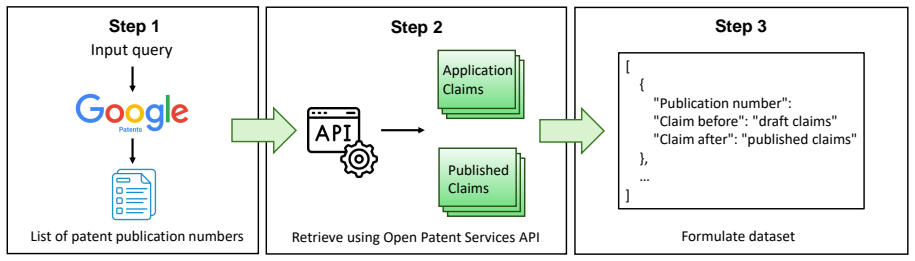
- [§3.1 (Steps 1–2) and §1 (taxonomy)] The dataset's core assumption is that an EPO A1/A2 application claim set and the later B1 granted claim set of the same patent form a valid source–target revision pair, with B1 usable as gold output. This is not validated. The paper's own taxonomy in §1 includes 'content amendment', where 'essential information missing in the draft is included'; in real EPO prosecution that information typically comes from the description, drawings, or the applicant's response to examiner objections, none of which is present in the A1 claim text. Consequently, a substantial fraction of B1 claim sets may not be recoverable from A1 by any deterministic editing process, making the task underdetermined for supervised fine-tuning and for lexical metrics such as SARI, BLEU, and ROUGE-L. The paper should provide quantitative evidence on recoverability (e.g., the fraction of B1 claims or n-grams that have no source in A1, or alignment statistics) or explicitly reframe the resource as a parallel corpus of pre- and post-prosecution claim sets rather than as a well-posed revision benchmark. The Limitations section does not address this pairing-validity issue.
- [§4.2 and Table 3] The human evaluation is too small to support the paper's ranking claims: only 60 examples in total, 6 per model, two raters, no reported inter-annotator agreement, no confidence intervals, and no significance tests. Differences such as GPT-4 at 6.40 versus SaulLM-7B-FT at 6.38 versus Llama-3.1-8B-FT at 6.03 are within plausible noise for n=6. The manuscript should either report per-item scores with bootstrap confidence intervals and inter-rater reliability, or present the human evaluation as qualitative and avoid comparative formulations such as 'GPT-4 outperforms other tested LLMs' (Abstract and §5.5). Without this, the central empirical claim is not supported.
- [Table 5] The correlation analysis between automated metrics and human judgments uses only 9 data points for G-Eval because GPT-4 is deliberately excluded from G-Eval evaluation. With n=9, a Spearman rho of 0.600 is not statistically significant at the conventional 0.05 level, and the paper reports no p-values, confidence intervals, or permutation-based intervals. The claim that 'GPT-4-based automated evaluation has the highest correlation with human judgment' (Abstract) is therefore unsupported. The authors should report significance tests or uncertainty estimates, or temper the claim accordingly.
minor comments (5)
- [§5.5] The text states that GPT-4's feature-linkage score rises 'from 5.67 to 6.67', but Table 3 lists the Copy baseline linkage as 5.33 and GPT-4 as 6.33. The numbers should be corrected.
- [Appendix D] The model descriptions refer to 'Llama-3-8B-Instruct' and 'Llama-3-70B-Instruct', but the rest of the paper consistently uses 'Llama-3.1-8B' and 'Llama-3.1-70B'. Please make the naming consistent.
- [Figure 2 and Table 2] The labels 'Claim before' and 'Claim after' are ambiguous; the B1 text is a granted patent, not merely a 'published' version. Suggest renaming to 'Application claims' and 'Granted claims' to avoid confusion, especially since A1/A2 documents are also published.
- [Appendix E.3] The G-Eval prompt instructs the model to rate 'draft claims' against 'referenced claims', but in the experiment G-Eval is used to score model-generated claims against the gold B1 text. The role of the input text should be clarified so that readers do not think the prompt matches the actual setup.
- [Abstract] The phrase 'initial patent applications rejected by patent examiners' is inaccurate: A1/A2 documents are published applications that may have received objections but are not necessarily 'rejected'. Suggest rewording to 'applications as initially published'.
Circularity Check
No circularity: the dataset construction and evaluations are self-contained, with external human judgment as the gold standard and no fitted parameter or target-derived constant in the analysis.
full rationale
The paper builds Patent-CR as a parallel corpus: EPO A1/A2 application claims are the source and B1 granted claims are the target, retrieved from the EPO OPS API. This is a supervised task definition, not a derivation that reduces to its own inputs. The human evaluation uses licensed patent professionals rating outputs against the B1 reference according to explicit criteria; the G-Eval correlation analysis compares GPT-4-based automatic scores with human scores, so the automatic metric is validated against an external benchmark rather than being defined by it. The self-citations, notably Jiang et al. (2025c) for the five evaluation criteria, supply an evaluation rubric rather than a load-bearing theoretical premise, and the rubric is applied by independent patent professionals. The A1/B1 pairing may be imperfect because prosecution amendments depend on examiner objections and disclosure content absent from the source text, but that is a task-validity concern about whether B1 is recoverable from A1, not a circularity: the paper never claims to derive B1 from A1 by first principles or from a fitted parameter. No equation is defined in terms of the target it predicts, and no fitted input is renamed as a prediction. Therefore the derivation chain is not circular.
Assumptions & free parameters
assumptions (3)
- domain assumption EPO A1/A2 application claims paired with B1 granted claims represent a valid draft-to-revision pair for the task.
- domain assumption The five human evaluation criteria (Completeness, Clarity, Consistency, Linkage, Overall) are sufficient and appropriate for judging patent claim revision quality.
- standard math The 60 human-evaluated examples can be treated as independent observations for correlation analysis.
Cite this review
Pith. "Pith review of Patent-CR: A Dataset for Patent Claim Revision." pith.science (2026). https://pith.science/paper/3I5KWVSO
@misc{pith2026241202549,
  author       = {Pith},
  title        = {Pith review of: Patent-CR: A Dataset for Patent Claim Revision},
  year         = {2026},
  howpublished = {\url{https://pith.science/paper/3I5KWVSO}},
  note         = {Machine review of arXiv:2412.02549}
}
read the original abstract
This paper presents Patent-CR, the first dataset created for the patent claim revision task in English. It includes both initial patent applications rejected by patent examiners and the final granted versions. Unlike normal text revision tasks that predominantly focus on enhancing sentence quality, such as grammar correction and coherence improvement, patent claim revision aims at ensuring the claims meet stringent legal criteria. These criteria are beyond novelty and inventiveness, including clarity of scope, technical accuracy, language precision, and legal robustness. We assess various large language models (LLMs) through professional human evaluation, including general LLMs with different sizes and architectures, text revision models, and domain-specific models. Our results indicate that LLMs often bring ineffective edits that deviate from the target revisions. In addition, domain-specific models and the method of fine-tuning show promising results. Notably, GPT-4 outperforms other tested LLMs, but further revisions are still necessary to reach the examination standard. Furthermore, we demonstrate the inconsistency between automated and human evaluation results, suggesting that GPT-4-based automated evaluation has the highest correlation with human judgment. This dataset, along with our preliminary empirical research, offers invaluable insights for further exploration in patent claim revision.
Figures


Reference graph
Works this paper leans on
-
[1]
Talita Anthonio, Irshad Bhat, and Michael Roth. 2020. https://aclanthology.org/2020.lrec-1.702/ wiki H ow T o I mprove: A resource and analyses on edits in instructional texts . In Proceedings of the Twelfth Language Resources and Evaluation Conference, pages 5721--5729, Marseille, France. European Language Resources Association
work page 2020
-
[2]
Dana Aubakirova, Kim Gerdes, and Lufei Liu. 2023. Patfig: Generating short and long captions for patent figures. In Proceedings of the IEEE/CVF International Conference on Computer Vision, pages 2843--2849
work page 2023
-
[3]
Jishnu Ray Chowdhury, Yong Zhuang, and Shuyi Wang. 2022. Novelty controlled paraphrase generation with retrieval augmented conditional prompt tuning. In Proceedings of the AAAI Conference on Artificial Intelligence, volume 36, pages 10535--10544
work page 2022
-
[4]
Dimitrios Christofidellis, Antonio Berrios Torres, Ashish Dave, Manuel Roveri, Kristin Schmidt, Sarath Swaminathan, Hans Vandierendonck, Dmitry Zubarev, and Matteo Manica. 2022. Pgt: a prompt based generative transformer for the patent domain. In ICML 2022 Workshop on Knowledge Retrieval and Language Models
2022
-
[5]
Hyung Won Chung, Le Hou, Shayne Longpre, Barret Zoph, Yi Tay, William Fedus, Yunxuan Li, Xuezhi Wang, Mostafa Dehghani, Siddhartha Brahma, et al. 2022. Scaling instruction-finetuned language models. arXiv preprint arXiv:2210.11416
arXiv 2022
-
[6]
Pierre Colombo, Telmo Pessoa Pires, Malik Boudiaf, Dominic Culver, Rui Melo, Caio Corro, Andre FT Martins, Fabrizio Esposito, Vera L \'u cia Raposo, Sofia Morgado, et al. 2024. Saullm-7b: A pioneering large language model for law. arXiv preprint arXiv:2403.03883
arXiv 2024
-
[7]
Jacob Devlin, Ming-Wei Chang, Kenton Lee, and Kristina Toutanova. 2019. Bert: Pre-training of deep bidirectional transformers for language understanding. In Proceedings of the 2019 Conference of the North American Chapter of the Association for Computational Linguistics: Human Language Technologies, Volume 1 (Long and Short Papers), pages 4171--4186
2019
-
[8]
Wanyu Du, Vipul Raheja, Dhruv Kumar, Zae Myung Kim, Melissa Lopez, and Dongyeop Kang. 2022. Understanding iterative revision from human-written text. In Proceedings of the 60th Annual Meeting of the Association for Computational Linguistics (Volume 1: Long Papers), pages 3573--3590
work page 2022
Show all 43 references
-
[9]
Abhimanyu Dubey, Abhinav Jauhri, Abhinav Pandey, Abhishek Kadian, Ahmad Al-Dahle, Aiesha Letman, Akhil Mathur, Alan Schelten, Amy Yang, Angela Fan, et al. 2024. The llama 3 herd of models. arXiv preprint arXiv:2407.21783
2024 arXiv
-
[10]
Felix Faltings, Michel Galley, Gerold Hintz, Chris Brockett, Chris Quirk, Jianfeng Gao, and William B Dolan. 2021. Text editing by command. In Proceedings of the 2021 Conference of the North American Chapter of the Association for Computational Linguistics: Human Language Tech...
2021
-
[11]
Tao Fang, Shu Yang, Kaixin Lan, Derek F Wong, Jinpeng Hu, Lidia S Chao, and Yue Zhang. 2023. Is chatgpt a highly fluent grammatical error correction system? a comprehensive evaluation. arXiv preprint arXiv:2304.01746
2023 arXiv
-
[12]
Mor Geva, Eric Malmi, Idan Szpektor, and Jonathan Berant. 2019. Discofuse: A large-scale dataset for discourse-based sentence fusion. In Proceedings of the 2019 Conference of the North American Chapter of the Association for Computational Linguistics: Human Language Technologi...
2019
-
[13]
Edward J Hu, Phillip Wallis, Zeyuan Allen-Zhu, Yuanzhi Li, Shean Wang, Lu Wang, Weizhu Chen, et al. 2021. Lora: Low-rank adaptation of large language models. In International Conference on Learning Representations
2021
-
[14]
Albert Q Jiang, Alexandre Sablayrolles, Antoine Roux, Arthur Mensch, Blanche Savary, Chris Bamford, Devendra Singh Chaplot, Diego de las Casas, Emma Bou Hanna, Florian Bressand, et al. 2024. Mixtral of experts. arXiv preprint arXiv:2401.04088
2024 arXiv
-
[15]
Lekang Jiang and Stephan M Goetz. 2025. Natural language processing in the patent domain: a survey. Artificial Intelligence Review, 58(7):214
2025
-
[16]
Lekang Jiang, Chengzu Li, and Stephan Goetz. 2025 a . Enriching patent claim generation with european patent dataset. arXiv preprint arXiv:2505.12568
2025 arXiv
-
[17]
Lekang Jiang, Pascal A Scherz, and Stephan Goetz. 2025 b . Towards better evaluation for generated patent claims. arXiv preprint arXiv:2505.11095
2025 arXiv
-
[18]
Scherz, and Stefan Goetz
Lekang Jiang, Caiqi Zhang, Pascal A. Scherz, and Stefan Goetz. 2025 c . https://aclanthology.org/2025.findings-naacl.70/ Can large language models generate high-quality patent claims? In Findings of the Association for Computational Linguistics: NAACL 2025, pages 1272--1287, A...
2025
-
[19]
L \'e ane Jourdan, Florian Boudin, Nicolas Hernandez, and Richard Dufour. 2024. Casimir: A corpus of scientific articles enhanced with multiple author-integrated revisions. In LREC-Coling 2024
2024
-
[20]
Zae Myung Kim, Wanyu Du, Vipul Raheja, Dhruv Kumar, and Dongyeop Kang. 2022. Improving iterative text revision by learning where to edit from other revision tasks. In Proceedings of the 2022 Conference on Empirical Methods in Natural Language Processing, pages 9986--9999
2022
-
[21]
J Peter Kincaid, Robert P Fishburne Jr, Richard L Rogers, and Brad S Chissom. 1975. Derivation of new readability formulas (automated readability index, fog count and flesch reading ease formula) for navy enlisted personnel. Technical report, Naval Technical Training Command M...
1975
-
[22]
Jieh-Sheng Lee. 2020. Controlling patent text generation by structural metadata. In Proceedings of the 29th ACM International Conference on Information & Knowledge Management, pages 3241--3244
2020
-
[23]
Jieh-Sheng Lee and Jieh Hsiang. 2020. Patent claim generation by fine-tuning openai gpt-2. World Patent Information, 62:101983
2020
-
[24]
Chin-Yew Lin. 2004. Rouge: A package for automatic evaluation of summaries. In Text summarization branches out, pages 74--81
2004
-
[25]
Yang Liu, Dan Iter, Yichong Xu, Shuohang Wang, Ruochen Xu, and Chenguang Zhu. 2023. https://doi.org/10.18653/v1/2023.emnlp-main.153 G -eval: NLG evaluation using gpt-4 with better human alignment . In Proceedings of the 2023 Conference on Empirical Methods in Natural Language ...
2023 doi
-
[26]
Cislo & Thomas LLP. 2023. https://cisloandthomas.com/overview/typical-fees/ Typical fees . Accessed: 2024-10-15
2023
-
[27]
Shayne Longpre, Le Hou, Tu Vu, Albert Webson, Hyung Won Chung, Yi Tay, Denny Zhou, Quoc V Le, Barret Zoph, Jason Wei, et al. 2023. The flan collection: Designing data and methods for effective instruction tuning. In International Conference on Machine Learning, pages 22631--22...
2023
-
[28]
Andreas Maurer, Massimiliano Pontil, and Bernardino Romera-Paredes. 2016. The benefit of multitask representation learning. Journal of Machine Learning Research, 17(81):1--32
2016
-
[29]
OpenAI. 2023. Gpt-4 technical report. arXiv preprint arXiv:2303.08774
2023 arXiv
-
[30]
Long Ouyang, Jeffrey Wu, Xu Jiang, Diogo Almeida, Carroll Wainwright, Pamela Mishkin, Chong Zhang, Sandhini Agarwal, Katarina Slama, Alex Ray, et al. 2022. Training language models to follow instructions with human feedback. Advances in neural information processing systems, 3...
2022
-
[31]
Kishore Papineni, Salim Roukos, Todd Ward, and Wei-Jing Zhu. 2002. Bleu: a method for automatic evaluation of machine translation. In Proceedings of the 40th annual meeting of the Association for Computational Linguistics, pages 311--318
2002
-
[32]
Alec Radford, Jeffrey Wu, Rewon Child, David Luan, Dario Amodei, Ilya Sutskever, et al. 2019. Language models are unsupervised multitask learners. OpenAI blog, 1(8):9
2019
-
[33]
Vipul Raheja, Dhruv Kumar, Ryan Koo, and Dongyeop Kang. 2023. Coedit: Text editing by task-specific instruction tuning. In Findings of the Association for Computational Linguistics: EMNLP 2023, pages 5274--5291
2023
-
[34]
Emily Reif, Daphne Ippolito, Ann Yuan, Andy Coenen, Chris Callison-Burch, and Jason Wei. 2022. A recipe for arbitrary text style transfer with large language models. In Proceedings of the 60th Annual Meeting of the Association for Computational Linguistics (Volume 2: Short Pap...
2022
-
[35]
Yu, Zhengbao Jiang, Fabio Petroni, Patrick Lewis, Gautier Izacard, Qingfei You, Christoforos Nalmpantis, Edouard Grave, and Sebastian Riedel
Timo Schick, Jane A. Yu, Zhengbao Jiang, Fabio Petroni, Patrick Lewis, Gautier Izacard, Qingfei You, Christoforos Nalmpantis, Edouard Grave, and Sebastian Riedel. 2023. PEER : A collaborative language model. In The Eleventh International Conference on Learning Representations
2023
-
[36]
Alexander Spangher and Jonathan May. 2021. Newsedits: A dataset of revision histories for news articles (technical report: Data processing). arXiv preprint arXiv:2104.09647
2021 arXiv
-
[37]
Sanja S tajner, Kim Cheng Sheang, and Horacio Saggion. 2022. Sentence simplification capabilities of transfer-based models. In Proceedings of the AAAI Conference on Artificial Intelligence, volume 36, pages 12172--12180
2022
-
[38]
Jason Wei, Xuezhi Wang, Dale Schuurmans, Maarten Bosma, Fei Xia, Ed Chi, Quoc V Le, Denny Zhou, et al. 2022. Chain-of-thought prompting elicits reasoning in large language models. Advances in neural information processing systems, 35:24824--24837
2022
-
[39]
Wei Xu, Courtney Napoles, Ellie Pavlick, Quanze Chen, and Chris Callison-Burch. 2016. Optimizing statistical machine translation for text simplification. Transactions of the Association for Computational Linguistics, 4:401--415
2016
-
[40]
Hashemi, Rebecca Hwa, and Diane Litman
Fan Zhang, Homa B. Hashemi, Rebecca Hwa, and Diane Litman. 2017. https://doi.org/10.18653/v1/P17-1144 A corpus of annotated revisions for studying argumentative writing . In Proceedings of the 55th Annual Meeting of the Association for Computational Linguistics (Volume 1: Long...
2017 doi
-
[41]
Tianyi Zhang, Varsha Kishore, Felix Wu, Kilian Q Weinberger, and Yoav Artzi. 2019. Bertscore: Evaluating text generation with bert. In International Conference on Learning Representations
2019
-
[42]
online" 'onlinestring :=
ENTRY address archivePrefix author booktitle chapter edition editor eid eprint eprinttype howpublished institution journal key month note number organization pages publisher school series title type volume year doi pubmed url lastchecked label extra.label sort.label short.list...
-
[43]
write newline
" write newline "" before.all 'output.state := FUNCTION n.dashify 't := "" t empty not t #1 #1 substring "-" = t #1 #2 substring "--" = not "--" * t #2 global.max substring 't := t #1 #1 substring "-" = "-" * t #2 global.max substring 't := while if t #1 #1 substring * t #2 gl...
Reviewed August 11, 2026 · model on record in the stance chip above.
Discussion (0). Continue with ORCID to comment.