A Possible Advanced Positron Signal in AMS-02 Measurements
Pith reviewed 2026-05-07 16:05 UTC · model grok-4.3
The pith
A time-symmetric transport hypothesis models positrons as an admixture of retarded and advanced components to explain their distinct spectrum from electrons in AMS-02 data.
A machine-rendered reading of the paper's core claim, the machinery that carries it, and where it could break.
Core claim
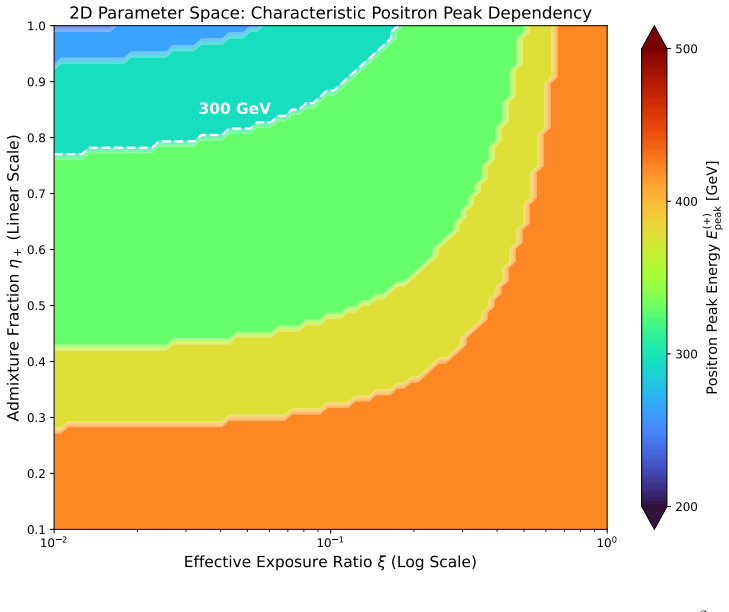
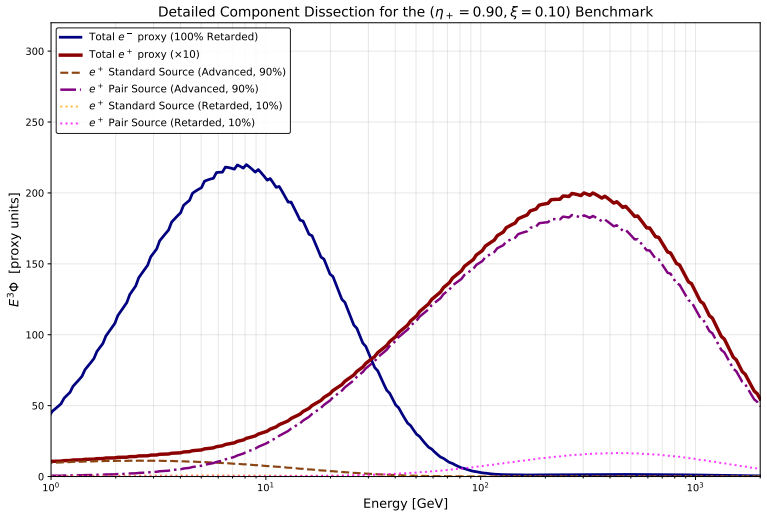
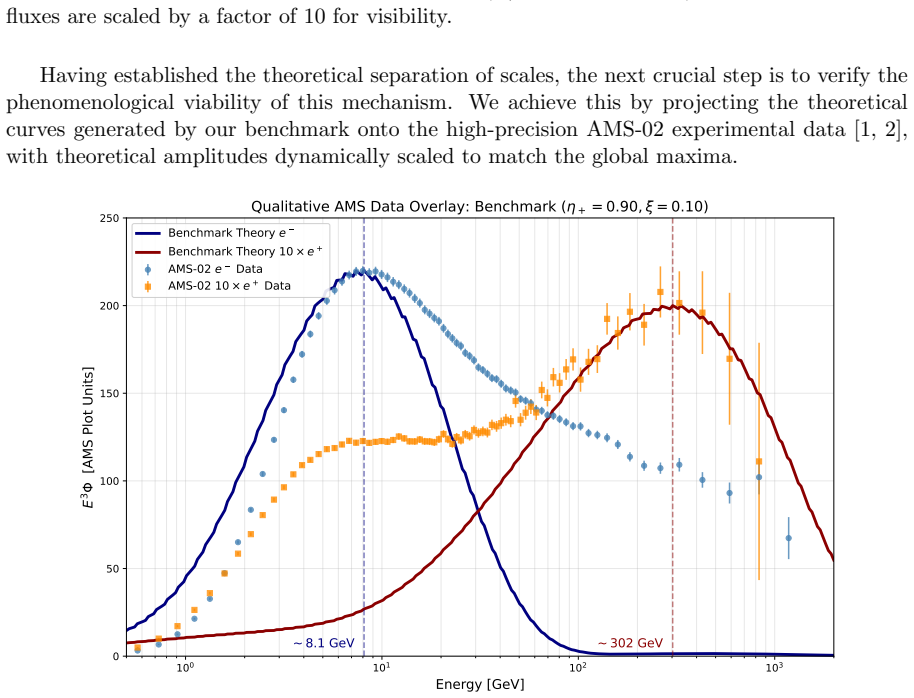
In this framework, the electron sector is treated as purely retarded, while the positron sector is modeled as an effective admixture of retarded and advanced-associated components whose advanced branch experiences a ten-fold reduction in effective radiative exposure; a representative order-of-magnitude benchmark with this property dissects the spectral components and matches the AMS-02 observations.
What carries the argument
The effective admixture of retarded and advanced-associated components for positrons, together with the postulated reduction in radiative exposure for the advanced branch.
If this is right
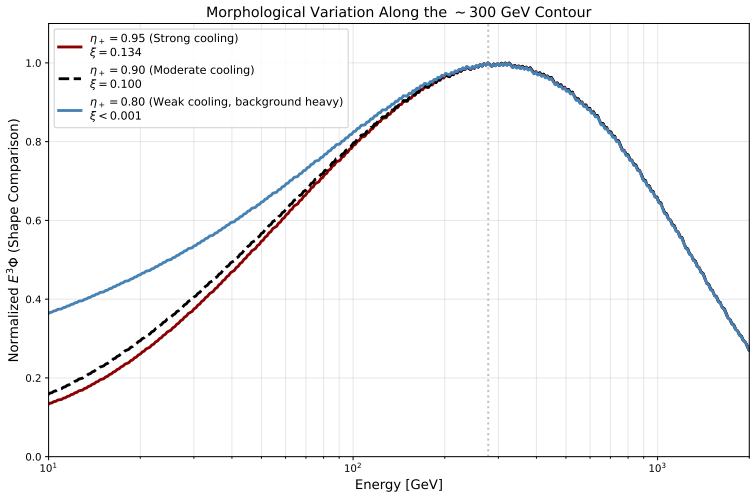
- The peak position remains degenerate across parameters, but the breadth of the turnover region distinguishes physically preferred benchmark regions.
- The minimal model still isolates the widely separated energy scales of the electron and positron spectra.
- Omitting spatial diffusion and solar modulation does not prevent a reasonable match to the AMS-02 data shapes.
- The reduced effective radiative exposure of the advanced branch stands out as the key postulated ingredient that requires further theoretical explanation.
Where Pith is reading between the lines
- If the hypothesis holds, future precision lepton data could tightly constrain the allowed range of admixture fraction and exposure reduction.
- Including spatial diffusion in an extended version of the model would test whether the benchmark region remains stable.
- The approach opens a route to test whether other cosmic-ray asymmetries can be addressed by similar time-symmetric propagation rules.
- Verification would require independent calculations of the advanced-component exposure factor from first principles.
Load-bearing premise
The advanced-associated component of positrons experiences a reduced effective radiative exposure that is introduced as a postulated ingredient without deeper justification.
What would settle it
A high-precision measurement of the positron spectral turnover that cannot be reproduced by any choice of admixture fraction and exposure-reduction factor while keeping the standard b(E) = b0 E squared loss law.
Figures
read the original abstract
AMS-02 measurements show a striking separation between the characteristic energy scales of cosmic-ray electrons and positrons: the electron spectrum peaks near the ordinary retarded cooling scale, while the positron spectrum exhibits a high-energy structure at hundreds of GeV. I ask whether this hierarchy can be interpreted without introducing a dedicated additional positron source, dark matter component, or fine-tuned source population. Motivated by the Dirac/Feynman-Stueckelberg viewpoint, I formulate an effective transport response in which the positron sector contains a retarded branch and an advanced-associated branch with reduced accumulated radiative exposure. Two minimal realizations, a one-zone response model and a local-source response model, are used to compare the AMS-02 electron and positron spectra. In the cleaner local-source realization, the high-energy positron structure is carried predominantly by the advanced-associated branch, with an order-one branch weight and a strongly reduced effective exposure. I also discuss consistency conditions showing that this interpretation cannot be reduced to a simple survival-suppression or ordinary decoherence model. The result should be read as a possible advanced-associated positron response interpretation of the AMS-02 spectral hierarchy, not as a full Galactic propagation fit or a proof of microscopic backward-in-time propagation.
Editorial analysis
A structured set of objections, weighed in public.
Referee Report
Summary. The manuscript proposes a speculative phenomenological benchmark for interpreting the AMS-02 electron and positron spectra via a time-symmetric transport hypothesis. Electrons are treated as purely retarded while positrons are modeled as an effective admixture of retarded and advanced-associated components; the standard radiative loss rate b(E)=b0 E^2 is retained for both, but the advanced positron branch is assigned a reduced effective radiative exposure. A 2D scan over the macroscopic admixture fraction and exposure reduction factor is used to select an order-of-magnitude benchmark (advanced component dominant, factor ~10) whose spectral morphology is then compared to data, while omitting spatial diffusion and solar modulation. The reduced exposure is explicitly flagged as a postulated ingredient needing separate theoretical justification.
Significance. If the reduced-exposure ansatz could be derived from the time-symmetric hypothesis rather than introduced by hand, the framework might offer a novel way to account for the differing electron and positron spectral shapes and energy scales. As written, the exercise demonstrates that a two-parameter adjustment can reproduce observed turnover breadth and scale separation, but this is achieved by construction through post-hoc benchmark selection; the systematic scan is a positive feature, yet the omission of diffusion (which couples to losses to determine the observed index) limits contact with standard propagation calculations.
major comments (3)
- [Abstract] Abstract and model description: the time-symmetric hypothesis is applied only at the level of the effective propagation response, with the ten-fold exposure reduction for the advanced branch introduced as a free parameter and selected via the 2D scan to match AMS-02 morphology; this makes the benchmark choice circular rather than a prediction of the hypothesis, as the paper itself notes that the reduction 'requires deeper theoretical justification'.
- [Results] Results section (benchmark selection): the claim that the framework 'naturally captures the widely separated energy scales' rests on choosing the advanced-dominant, factor-10 point after scanning; the separation is therefore imposed by the fit rather than emerging from the retarded/advanced admixture alone.
- [Introduction] Introduction and model setup: spatial diffusion is omitted entirely, yet in standard lepton propagation it couples directly to the loss term b(E) to set the spectral index; without it the benchmark cannot be compared quantitatively to full transport calculations.
minor comments (1)
- [Model] The notation distinguishing the 'advanced-associated component' from the retarded one would benefit from an explicit equation or schematic diagram showing how the admixture is constructed.
Simulated Author's Rebuttal
We thank the referee for the constructive and detailed comments on our speculative phenomenological benchmark. We address each major comment point by point below, with clarifications on the intent of the work as a minimal benchmark rather than a complete transport model. Where appropriate, we indicate revisions to improve clarity and address the concerns raised.
read point-by-point responses
-
Referee: [Abstract] Abstract and model description: the time-symmetric hypothesis is applied only at the level of the effective propagation response, with the ten-fold exposure reduction for the advanced branch introduced as a free parameter and selected via the 2D scan to match AMS-02 morphology; this makes the benchmark choice circular rather than a prediction of the hypothesis, as the paper itself notes that the reduction 'requires deeper theoretical justification'.
Authors: We agree that the reduction factor is a postulated parameter selected via the scan to reproduce the observed morphology, and the manuscript already flags it as requiring deeper theoretical justification. The work is explicitly presented as a speculative benchmark to explore whether a time-symmetric admixture can connect to the data under this ansatz, rather than a first-principles prediction. To strengthen this distinction, we will revise the abstract to emphasize more clearly that the benchmark is data-informed and phenomenological, avoiding any phrasing that could imply a direct derivation from the hypothesis alone. revision: partial
-
Referee: [Results] Results section (benchmark selection): the claim that the framework 'naturally captures the widely separated energy scales' rests on choosing the advanced-dominant, factor-10 point after scanning; the separation is therefore imposed by the fit rather than emerging from the retarded/advanced admixture alone.
Authors: The scale separation is produced by the retarded/advanced admixture combined with the reduced exposure for the advanced branch; the 2D scan demonstrates that only the advanced-dominant regime with order-of-magnitude exposure reduction yields the observed turnover breadth and separation. The specific benchmark point is chosen as representative after the scan, but the framework shows how the time-symmetric hypothesis, under the reduced-exposure ansatz, can account for the features. We will revise the results section to clarify that 'naturally captures' refers to the morphological outcome of the admixture plus reduced exposure, with the point selected as an order-of-magnitude benchmark. revision: partial
-
Referee: [Introduction] Introduction and model setup: spatial diffusion is omitted entirely, yet in standard lepton propagation it couples directly to the loss term b(E) to set the spectral index; without it the benchmark cannot be compared quantitatively to full transport calculations.
Authors: We acknowledge that omitting spatial diffusion prevents direct quantitative comparison to standard propagation models, where diffusion and losses together determine the spectral index. The minimal setup is intentional to isolate the effect of the time-symmetric hypothesis on the effective propagation response and exposure, without introducing the full complexities of diffusion or solar modulation. We will add explicit discussion in the introduction and conclusions noting this limitation and indicating that incorporating diffusion would be a natural extension for future comparisons. revision: yes
Axiom & Free-Parameter Ledger
free parameters (2)
- admixture fraction
- exposure reduction factor
axioms (2)
- domain assumption Standard high-energy energy-loss form b(E)=b0 E^2 for Galactic leptons
- ad hoc to paper Time-symmetric interpretation of antiparticles applies at the level of effective propagation response
invented entities (1)
-
advanced-associated component
no independent evidence
discussion (0)
Sign in with ORCID, Apple, or X to comment. Anyone can read and Pith papers without signing in.