REVIEW 5 major objections 4 minor 80 references
MARCO: Meta-Reflection with Cross-Referencing for Code Reasoning
T0 review · 5 major / 4 minor · reviewed 2026-08-07 · deepseek-v4-flash
Pith's one-line read MARCO claims that an LLM code-reasoning agent can become progressively smarter during inference by accumulating condensed takeaways from past problems and borrowing proposal-feedback lessons from peer agents.
desk verdict MARCO is a plausible test-time learning recipe for code reasoning, but the current experiments don't separate its mechanisms from the extra compute and context it receives, so the headline claim remains unproven. read the letter →
The pith
A machine-rendered reading of the paper's core claim, the machinery that carries it, and where it could break.
The reading
What carries the argument
The mechanism is a two-channel memory at inference time. Inter-problem, meta-reflection summarizes each problem's reasoning path into a key takeaway, which is added to a knowledge bank and periodically condensed by a knowledge condenser into a short set of transferable sentences. Intra-problem, cross-referencing passes the extracted code and interpreter feedback of each peer agent, forming the lesson pair $\langle B^i_{j',t-1}, \hat{Y}^i_{j',t-1}\rangle$, to the current agent. The prompt template then combines the condensed knowledge $\hat{K}^i$, the agent's own chat history, and peers' lessons, so future generations are conditioned on accumulated experience instead of only on the current problem.
What would settle it
Run MARCO against a baseline given an equally large prompt containing the same number of extra tokens, such as irrelevant summaries and random peer lessons, with the same iteration budget; if accuracy matches MARCO, the mechanisms are not the cause of the improvement.
Extended reading notes
Core claim
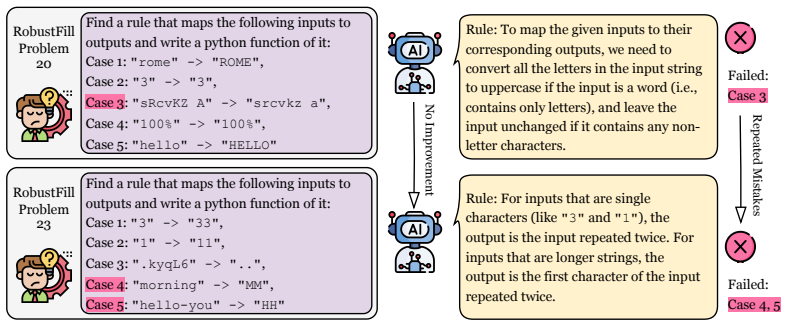
The central claim is that an LLM agent's code-reasoning ability can evolve during inference: with each problem it solves, the agent gets smarter, and the improvement accumulates. MARCO operationalizes this so that the next solution depends not only on the current reasoning path but also on condensed cross-problem knowledge and on the proposal-feedback lessons of peer agents. The evidence includes accuracy gains over CoT, CoC, and RHDA on ListFunction, MiniARC, RobustFill, DeepCoder, CRUXEval, and LiveCodeBench, larger relative gains for weaker backbones, and an ablation showing that removing meta-reflection, the knowledge condenser, or cross-referencing each degrades performance. The paper also reports that the improvement over the baseline grows from the first half to the second half of the problem sequence, which it reads as evidence that the agent is genuinely accumulating knowledge.
Load-bearing premise
The reported gains are attributed to the meta-reflection and cross-referencing mechanisms, but the experiments do not control for the fact that MARCO agents receive a much larger prompt, with accumulated knowledge plus peers' lessons, and more tokens than the baselines, so the improvements may come from extra context rather than from learning.
Editorial extensions
If this is right
- An agent using MARCO should show growing accuracy as it works through a sequence of code-reasoning problems, with larger gains in the second half of the sequence than the first.
- Removing meta-reflection, the knowledge condenser, or cross-referencing should each lower accuracy, so all three components carry part of the gain.
- Two proposal-feedback iterations are enough; spending more iterations reflecting on the same problem does not improve results.
- The benefits should be larger on harder sub-tasks such as abduction and on weaker backbones, where accumulated knowledge has more room to help.
- Condensing the knowledge bank every 8 to 10 problems performs better than shorter or longer periods; too short gives non-generalizable summaries, and too long makes the bank stale.
Reading between the lines
- If the mechanism, rather than just extra prompt tokens, is what drives the gains, MARCO points toward a general inference-time memory layer: any LLM could accumulate condensed takeaways while working through a batch of tasks, with no weight update. The paper does not test this framing.
- The cross-referencing component is a form of social learning among agents; the same proposal-feedback sharing could be tried on non-code reasoning, such as math word problems or planning, where feedback comes from a verifier rather than a Python interpreter.
- A direct control would be to give baselines the same number of extra context tokens, such as random takeaways and random peer lessons, with the same iteration budget; if the gap closes, the cumulative improvement is largely a context and compute effect.
Editorial analysis
A structured set of objections, weighed in public.
Referee Report
Summary. The paper introduces MARCO, an inference-time framework that lets an LLM code-reasoning agent accumulate cross-problem experience through meta-reflection (summarizing past reasoning paths into a condensed knowledge bank) and share intra-problem lessons with peer agents through cross-referencing. The method is evaluated on eight datasets covering inductive, deductive, and abductive code reasoning, with three LLM backbones, against CoT, CoC, and RHDA baselines; the reported tables show consistent gains. Ablations, hyperparameter analyses, and a first-half/second-half comparison are used to argue that the gains come from knowledge accumulation and lesson sharing.
Significance. If the reported gains are causal, MARCO would be a useful step beyond static prompting: it is an inexpensive, training-free way to make a code-reasoning agent improve across a sequence of problems, with results spanning three reasoning subtasks and several model families. The paper is also transparent about the components that need to be tuned, and the qualitative examples in Figure 5 give some evidence that the summarized takeaways are semantically meaningful. The central causal claim, however, is not yet established: the experimental design does not control for MARCO's much larger context, multi-agent sampling, and compute budget, and no variance or code is provided. These are correctable experimental gaps rather than internal inconsistencies.
major comments (5)
- [Section 4.2, Tables 1-2] The reported gains are confounded by inference budget. MARCO uses T=2 iterations (Section 4.4), M peer agents in Eq. (7), and a growing condensed knowledge bank K-hat (Eqs. 4-5), while CoT, CoC, and RHDA receive only the problem text; the manuscript never reports M, total token usage, or a budget-matched baseline. Please add controls that give the baselines the same number of samples and the same total reasoning tokens, and report repeated-run variance and significance tests.
- [Section 4.3, Table 3] The ablations do not isolate the mechanisms. MARCOv1, MARCOv2, and MARCOv3 each remove one component but keep all other extra context and multi-agent budget, and MARCOv2 additionally changes the prompt size (full knowledge bank instead of condensed), so the performance drops could be caused by context length rather than by the removed component. A prompt-budget-controlled comparison, e.g., replacing the condensed knowledge with random or irrelevant takeaways of the same length, is needed.
- [Section 4.4] The hyperparameters T and T_c are selected on ListFunction and then applied to all other datasets, and the main results in Tables 1-2 include ListFunction itself; this creates a risk of selection-on-the-benchmark. Please provide a nested or held-out hyperparameter analysis, or show that the ranking of MARCO versus baselines is stable for a range of T and T_c on the other datasets.
- [Section 4.5, Figure 4 (right)] The first-half/second-half comparison is relative to CoT only and does not rule out a generic 'more context and compute' effect. A same-budget baseline whose prompt grows with random or stale takeaways would also likely show larger absolute gains in the second half as the MARCO pipeline warms up. Please report absolute per-half accuracies and add such a control before claiming that MARCO 'becomes progressively smarter.'
- [Equation (5) and Section 4.5] The condensation step is assumed to preserve transferable knowledge, but the paper provides no quantitative evidence of fidelity; the ablation of the condenser (MARCOv2) is confounded by context size as noted above. Since the knowledge bank is the mechanism behind cumulative improvement, please evaluate condensation fidelity directly, e.g., by comparing condensed versus full-bank prompts at equal token budgets or by measuring information retention.
minor comments (4)
- [Section 4.1] The reference 'Appendix??' is unresolved; the DSL details for RobustFill and DeepCoder need to be filled in.
- [Section 4.2, first paragraph] 'Transductive reasoning' appears where the paper's own taxonomy says 'abductive reasoning'; please correct this terminology.
- [Equations (2) and (7)] The notation is inconsistent: Eq. (2) conditions on full previous paths and full peer paths, while Eq. (7) uses only condensed knowledge and peer lessons; please clarify which information is actually included in the prompts.
- [Figures 4 and 5] The axes in Figure 4 left/middle are not labeled with the variable names, and Figure 5 relies on color markers (blue/green/orange) that may not be legible in grayscale; please add labels and use distinct markers.
Circularity Check
No circularity: MARCO's reported improvements are empirical outcomes on held-out target pairs, not quantities defined into existence by the method's equations.
full rationale
MARCO is an empirical prompting framework, not a formal derivation, and its central claim is that injecting accumulated meta-reflections and peer lessons improves code reasoning. The claimed improvements are measured on held-out input-output pairs within each problem (Section 4.1: half of the pairs are visible, the other half are not), and the cross-problem improvement in Section 4.5 is evaluated on later problems whose answers are not used to construct the condensed knowledge bank. Equations 3-7 define the method's inference procedure, but they do not define the evaluation metric or the reported accuracy; a wrong answer is still wrong regardless of prompt context. The only substantive concern is that baselines receive less prompt context and compute than MARCO, so the gains are not cleanly causally attributed to meta-reflection and cross-referencing specifically. That is a threat to experimental validity, not circularity: the numbers could have come out the other way, and no equation or fitted parameter forces the reported improvements. Hyperparameters are chosen on ListFunction and reused, which risks overfitting but does not make the benchmark result equivalent to the hyperparameter choice by construction. No self-citation chain is load-bearing; the cited prior work is used for baselines and background, not to define away the target result. Accordingly, there are no circular steps to report.
Assumptions & free parameters
free parameters (4)
- Number of refinement iterations T =
2
- Condensation period Tc =
8 to 10
- Number of peer agents M =
not stated
- Meta-reflection and condensation prompt templates =
not disclosed
assumptions (5)
- domain assumption LLM agents respond to in-context knowledge and peer feedback in a way that improves their generated solutions.
- domain assumption The Python interpreter provides correct binary feedback on whether a proposed function matches the visible examples.
- domain assumption The datasets and the held-out input-output splits measure transferable code reasoning rather than memorization.
- ad hoc to paper The condensation step preserves transferable knowledge while removing problem-specific details.
- domain assumption The baseline implementations are comparably optimized and are not disadvantaged by missing the extra context MARCO receives.
invented entities (1)
-
Knowledge bank with condensed takeaways
Cite this review
Pith. "Pith review of MARCO: Meta-Reflection with Cross-Referencing for Code Reasoning." pith.science (2026). https://pith.science/paper/3ICD3UEN
@misc{pith2026250517481,
  author       = {Pith},
  title        = {Pith review of: MARCO: Meta-Reflection with Cross-Referencing for Code Reasoning},
  year         = {2026},
  howpublished = {\url{https://pith.science/paper/3ICD3UEN}},
  note         = {Machine review of arXiv:2505.17481}
}
read the original abstract
The ability to reason is one of the most fundamental capabilities of large language models (LLMs), enabling a wide range of downstream tasks through sophisticated problem-solving. A critical aspect of this is code reasoning, which involves logical reasoning with formal languages (i.e., programming code). In this paper, we enhance this capability of LLMs by exploring the following question: how can an LLM agent become progressively smarter in code reasoning with each solution it proposes, thereby achieving substantial cumulative improvement? Most existing research takes a static perspective, focusing on isolated problem-solving using frozen LLMs. In contrast, we adopt a cognitive-evolving perspective and propose a novel framework named Meta-Reflection with Cross-Referencing (MARCO) that enables the LLM to evolve dynamically during inference through self-improvement. From the perspective of human cognitive development, we leverage both knowledge accumulation and lesson sharing. In particular, to accumulate knowledge during problem-solving, we propose meta-reflection that reflects on the reasoning paths of the current problem to obtain knowledge and experience for future consideration. Moreover, to effectively utilize the lessons from other agents, we propose cross-referencing that incorporates the solution and feedback from other agents into the current problem-solving process. We conduct experiments across various datasets in code reasoning, and the results demonstrate the effectiveness of MARCO.
Figures


Figures from the paper (2 more)


Reference graph
Works this paper leans on
-
[1]
Gpt-4 technical report.arXiv preprint arXiv:2303.08774, 2023
Josh Achiam, Steven Adler, Sandhini Agarwal, Lama Ahmad, Ilge Akkaya, Florencia Leoni Aleman, Diogo Almeida, Janko Altenschmidt, Sam Altman, Shyamal Anadkat, et al. Gpt-4 technical report.arXiv preprint arXiv:2303.08774, 2023
arXiv 2023
-
[2]
Tuo An, Yunjiao Zhou, Han Zou, and Jianfei Yang. Iot-llm: Enhancing real-world iot task reasoning with large language models.arXiv preprint arXiv:2410.02429, 2024
arXiv 2024
-
[3]
Deepcoder: Learning to write programs.arXiv preprint arXiv:1611.01989, 2016
Matej Balog, Alexander L Gaunt, Marc Brockschmidt, Sebastian Nowozin, and Daniel Tarlow. Deepcoder: Learning to write programs.arXiv preprint arXiv:1611.01989, 2016
arXiv 2016
-
[4]
Erkan Bas, ar, Xin Sun, Iris Hendrickx, Jan de Wit, Tibor Bosse, Gert-Jan De Bruijn, Jos A Bosch, and Emiel Krahmer. How well can large language models reflect? a human evaluation of llm-generated reflections for motivational interviewing dialogues. InProceedings of the 31st International Conference on Computational Linguistics, pages 1964–1982, 2025
work page 1964
-
[5]
Graph of thoughts: Solving elaborate problems with large language models
Maciej Besta, Nils Blach, Ales Kubicek, Robert Gerstenberger, Michal Podstawski, Lukas Gianinazzi, Joanna Gajda, Tomasz Lehmann, Hubert Niewiadomski, Piotr Nyczyk, et al. Graph of thoughts: Solving elaborate problems with large language models. InProceedings of the AAAI Conference on Artificial Intelligence, volume 38, pages 17682–17690, 2024
2024
-
[6]
Demystifying chains, trees, and graphs of thoughts.arXiv preprint arXiv:2401.14295, 2024
Maciej Besta, Florim Memedi, Zhenyu Zhang, Robert Gerstenberger, Guangyuan Piao, Nils Blach, Piotr Nyczyk, Marcin Copik, Grzegorz Kwa´sniewski, Jürgen Müller, et al. Demystifying chains, trees, and graphs of thoughts.arXiv preprint arXiv:2401.14295, 2024
arXiv 2024
-
[7]
Zhenni Bi, Kai Han, Chuanjian Liu, Yehui Tang, and Yunhe Wang. Forest-of-thought: Scaling test-time compute for enhancing llm reasoning.arXiv preprint arXiv:2412.09078, 2024
arXiv 2024
-
[8]
Reflective multi-agent collaboration based on large language models.Advances in Neural Information Processing Systems, 37:138595–138631, 2024
Xiaohe Bo, Zeyu Zhang, Quanyu Dai, Xueyang Feng, Lei Wang, Rui Li, Xu Chen, and Ji-Rong Wen. Reflective multi-agent collaboration based on large language models.Advances in Neural Information Processing Systems, 37:138595–138631, 2024
2024
Show all 80 references
-
[9]
Probabilistic tree-of-thought reasoning for answering knowledge-intensive complex questions
Shulin Cao, Jiajie Zhang, Jiaxin Shi, Xin Lv, Zijun Yao, Qi Tian, Juanzi Li, and Lei Hou. Probabilistic tree-of-thought reasoning for answering knowledge-intensive complex questions. arXiv preprint arXiv:2311.13982, 2023
2023 arXiv
-
[10]
A survey on evaluating large language models in code generation tasks.arXiv preprint arXiv:2408.16498, 2024
Liguo Chen, Qi Guo, Hongrui Jia, Zhengran Zeng, Xin Wang, Yijiang Xu, Jian Wu, Yidong Wang, Qing Gao, Jindong Wang, et al. A survey on evaluating large language models in code generation tasks.arXiv preprint arXiv:2408.16498, 2024
2024 arXiv
-
[11]
Llm contextbridge: A hybrid approach for intent and dialogue understanding in ivsr
Changwoo Chun, Daniel Rim, and Juhee Park. Llm contextbridge: A hybrid approach for intent and dialogue understanding in ivsr. InProceedings of the 31st International Conference on Computational Linguistics: Industry Track, pages 794–806, 2025
2025
-
[12]
Robustfill: Neural program learning under noisy i/o
Jacob Devlin, Jonathan Uesato, Surya Bhupatiraju, Rishabh Singh, Abdel-rahman Mohamed, and Pushmeet Kohli. Robustfill: Neural program learning under noisy i/o. InInternational conference on machine learning, pages 990–998. PMLR, 2017
2017
-
[13]
An interactive query generation assistant using llm-based prompt modification and user feedback.arXiv preprint arXiv:2311.11226, 2023
Kaustubh D Dhole, Ramraj Chandradevan, and Eugene Agichtein. An interactive query generation assistant using llm-based prompt modification and user feedback.arXiv preprint arXiv:2311.11226, 2023
2023 arXiv
-
[14]
Dynamic parallel tree search for efficient llm reasoning.arXiv preprint arXiv:2502.16235, 2025
Yifu Ding, Wentao Jiang, Shunyu Liu, Yongcheng Jing, Jinyang Guo, Yingjie Wang, Jing Zhang, Zengmao Wang, Ziwei Liu, Bo Du, et al. Dynamic parallel tree search for efficient llm reasoning.arXiv preprint arXiv:2502.16235, 2025
2025 arXiv
-
[15]
Evaluating large language models in class-level code generation
Xueying Du, Mingwei Liu, Kaixin Wang, Hanlin Wang, Junwei Liu, Yixuan Chen, Jiayi Feng, Chaofeng Sha, Xin Peng, and Yiling Lou. Evaluating large language models in class-level code generation. InProceedings of the IEEE/ACM 46th International Conference on Software Engineering,...
2024
-
[16]
Llm-based test-driven interactive code generation: User study and empirical evaluation.IEEE Transactions on Software Engineering, 2024
Sarah Fakhoury, Aaditya Naik, Georgios Sakkas, Saikat Chakraborty, and Shuvendu K Lahiri. Llm-based test-driven interactive code generation: User study and empirical evaluation.IEEE Transactions on Software Engineering, 2024. 10
2024
-
[17]
Towards llm-driven dialogue state tracking.arXiv preprint arXiv:2310.14970, 2023
Yujie Feng, Zexin Lu, Bo Liu, Liming Zhan, and Xiao-Ming Wu. Towards llm-driven dialogue state tracking.arXiv preprint arXiv:2310.14970, 2023
2023 arXiv
-
[18]
Interpretable contrastive monte carlo tree search reasoning.arXiv preprint arXiv:2410.01707, 2024
Zitian Gao, Boye Niu, Xuzheng He, Haotian Xu, Hongzhang Liu, Aiwei Liu, Xuming Hu, and Lijie Wen. Interpretable contrastive monte carlo tree search reasoning.arXiv preprint arXiv:2410.01707, 2024
2024 arXiv
-
[19]
Clipsyntel: clip and llm synergy for multimodal question summarization in healthcare
Akash Ghosh, Arkadeep Acharya, Raghav Jain, Sriparna Saha, Aman Chadha, and Setu Sinha. Clipsyntel: clip and llm synergy for multimodal question summarization in healthcare. In Proceedings of the AAAI Conference on Artificial Intelligence, volume 38, pages 22031–22039, 2024
2024
-
[20]
Cruxeval: A benchmark for code reasoning, understanding and execution.arXiv preprint arXiv:2401.03065, 2024
Alex Gu, Baptiste Rozière, Hugh Leather, Armando Solar-Lezama, Gabriel Synnaeve, and Sida I Wang. Cruxeval: A benchmark for code reasoning, understanding and execution.arXiv preprint arXiv:2401.03065, 2024
2024 arXiv
-
[21]
Llm-based code generation method for golang compiler testing
Qiuhan Gu. Llm-based code generation method for golang compiler testing. InProceedings of the 31st ACM Joint European Software Engineering Conference and Symposium on the Foundations of Software Engineering, pages 2201–2203, 2023
2023
-
[22]
Longcoder: A long-range pre-trained language model for code completion
Daya Guo, Canwen Xu, Nan Duan, Jian Yin, and Julian McAuley. Longcoder: A long-range pre-trained language model for code completion. InInternational Conference on Machine Learning, pages 12098–12107. PMLR, 2023
2023
-
[23]
Deepseek-r1: Incentivizing reasoning capability in llms via reinforcement learning.arXiv preprint arXiv:2501.12948, 2025
Daya Guo, Dejian Yang, Haowei Zhang, Junxiao Song, Ruoyu Zhang, Runxin Xu, Qihao Zhu, Shirong Ma, Peiyi Wang, Xiao Bi, et al. Deepseek-r1: Incentivizing reasoning capability in llms via reinforcement learning.arXiv preprint arXiv:2501.12948, 2025
2025 arXiv
-
[24]
Reasoning with language model is planning with world model.arXiv preprint arXiv:2305.14992, 2023
Shibo Hao, Yi Gu, Haodi Ma, Joshua Jiahua Hong, Zhen Wang, Daisy Zhe Wang, and Zhit- ing Hu. Reasoning with language model is planning with world model.arXiv preprint arXiv:2305.14992, 2023
2023 arXiv
-
[25]
Thought graph: Generating thought process for biological reasoning
Chi-Yang Hsu, Kyle Cox, Jiawei Xu, Zhen Tan, Tianhua Zhai, Mengzhou Hu, Dexter Pratt, Tianlong Chen, Ziniu Hu, and Ying Ding. Thought graph: Generating thought process for biological reasoning. InCompanion Proceedings of the ACM Web Conference 2024, pages 537–540, 2024
2024
-
[26]
Unlocking the potential of user feedback: Leveraging large language model as user simulators to enhance dialogue system
Zhiyuan Hu, Yue Feng, Anh Tuan Luu, Bryan Hooi, and Aldo Lipani. Unlocking the potential of user feedback: Leveraging large language model as user simulators to enhance dialogue system. InProceedings of the 32nd ACM International Conference on Information and Knowledge Managem...
2023
-
[27]
Large language models cannot self-correct reasoning yet.arXiv preprint arXiv:2310.01798, 2023
Jie Huang, Xinyun Chen, Swaroop Mishra, Huaixiu Steven Zheng, Adams Wei Yu, Xinying Song, and Denny Zhou. Large language models cannot self-correct reasoning yet.arXiv preprint arXiv:2310.01798, 2023
2023 arXiv
-
[28]
Knowledge-aware code generation with large language models
Tao Huang, Zhihong Sun, Zhi Jin, Ge Li, and Chen Lyu. Knowledge-aware code generation with large language models. InProceedings of the 32nd IEEE/ACM International Conference on Program Comprehension, pages 52–63, 2024
2024
-
[29]
Language models for code completion: A practical evaluation
Maliheh Izadi, Jonathan Katzy, Tim Van Dam, Marc Otten, Razvan Mihai Popescu, and Arie Van Deursen. Language models for code completion: A practical evaluation. InProceedings of the IEEE/ACM 46th International Conference on Software Engineering, pages 1–13, 2024
2024
-
[30]
Livecodebench: Holistic and contamination free evaluation of large language models for code.arXiv preprint arXiv:2403.07974, 2024
Naman Jain, King Han, Alex Gu, Wen-Ding Li, Fanjia Yan, Tianjun Zhang, Sida Wang, Ar- mando Solar-Lezama, Koushik Sen, and Ion Stoica. Livecodebench: Holistic and contamination free evaluation of large language models for code.arXiv preprint arXiv:2403.07974, 2024
2024 arXiv
-
[31]
Cotran: An llm-based code translator using reinforcement learning with feedback from compiler and symbolic execution
Prithwish Jana, Piyush Jha, Haoyang Ju, Gautham Kishore, Aryan Mahajan, and Vijay Ganesh. Cotran: An llm-based code translator using reinforcement learning with feedback from compiler and symbolic execution. InECAI 2024, pages 4011–4018. IOS Press, 2024. 11
2024
-
[32]
Towards mitigating hallucination in large language models via self-reflection.arXiv preprint arXiv:2310.06271, 2023
Ziwei Ji, Tiezheng Yu, Yan Xu, Nayeon Lee, Etsuko Ishii, and Pascale Fung. Towards mitigating hallucination in large language models via self-reflection.arXiv preprint arXiv:2310.06271, 2023
2023 arXiv
-
[33]
Self-planning code generation with large language models.ACM Transactions on Software Engineering and Methodology, 33(7):1–30, 2024
Xue Jiang, Yihong Dong, Lecheng Wang, Zheng Fang, Qiwei Shang, Ge Li, Zhi Jin, and Wenpin Jiao. Self-planning code generation with large language models.ACM Transactions on Software Engineering and Methodology, 33(7):1–30, 2024
2024
-
[34]
Playgrounds for abstraction and reasoning
Subin Kim, Prin Phunyaphibarn, Donghyun Ahn, and Sundong Kim. Playgrounds for abstraction and reasoning. InNeurIPS 2022 Workshop on Neuro Causal and Symbolic AI (nCSI), 2022
2022
-
[35]
Training language models to self-correct via reinforcement learning.arXiv preprint arXiv:2409.12917, 2024
Aviral Kumar, Vincent Zhuang, Rishabh Agarwal, Yi Su, John D Co-Reyes, Avi Singh, Kate Baumli, Shariq Iqbal, Colton Bishop, Rebecca Roelofs, et al. Training language models to self-correct via reinforcement learning.arXiv preprint arXiv:2409.12917, 2024
2024 arXiv
-
[36]
Supporting self- reflection at scale with large language models: Insights from randomized field experiments in classrooms
Harsh Kumar, Ruiwei Xiao, Benjamin Lawson, Ilya Musabirov, Jiakai Shi, Xinyuan Wang, Huayin Luo, Joseph Jay Williams, Anna N Rafferty, John Stamper, et al. Supporting self- reflection at scale with large language models: Insights from randomized field experiments in classrooms...
2024
-
[37]
A survey on enhancing reinforcement learning in complex environments: Insights from human and llm feedback.arXiv preprint arXiv:2411.13410, 2024
Alireza Rashidi Laleh and Majid Nili Ahmadabadi. A survey on enhancing reinforcement learning in complex environments: Insights from human and llm feedback.arXiv preprint arXiv:2411.13410, 2024
2024 arXiv
-
[38]
Boosting logical reasoning in large language models through a new framework: The graph of thought.arXiv preprint arXiv:2308.08614, 2023
Bin Lei, Chunhua Liao, Caiwen Ding, et al. Boosting logical reasoning in large language models through a new framework: The graph of thought.arXiv preprint arXiv:2308.08614, 2023
2023 arXiv
-
[39]
Chain of code: Reasoning with a language model-augmented code emulator.arXiv preprint arXiv:2312.04474, 2023
Chengshu Li, Jacky Liang, Andy Zeng, Xinyun Chen, Karol Hausman, Dorsa Sadigh, Sergey Levine, Li Fei-Fei, Fei Xia, and Brian Ichter. Chain of code: Reasoning with a language model-augmented code emulator.arXiv preprint arXiv:2312.04474, 2023
2023 arXiv
-
[40]
Large language model-aware in-context learning for code generation.ACM Transactions on Software Engineering and Methodology, 2023
Jia Li, Chongyang Tao, Jia Li, Ge Li, Zhi Jin, Huangzhao Zhang, Zheng Fang, and Fang Liu. Large language model-aware in-context learning for code generation.ACM Transactions on Software Engineering and Methodology, 2023
2023
-
[41]
Dora: Dynamic optimization prompt for continuous reflection of llm-based agent
Kun Li, Tingzhang Zhao, Wei Zhou, and Songlin Hu. Dora: Dynamic optimization prompt for continuous reflection of llm-based agent. InProceedings of the 31st International Conference on Computational Linguistics, pages 7546–7557, 2025
2025
-
[42]
Selective reflection-tuning: Student-selected data recycling for llm instruction-tuning
Ming Li, Lichang Chen, Jiuhai Chen, Shwai He, Jiuxiang Gu, and Tianyi Zhou. Selective reflection-tuning: Student-selected data recycling for llm instruction-tuning. InFindings of the Association for Computational Linguistics ACL 2024, pages 16189–16211, 2024
2024
-
[43]
Enhancing chain-of-thought reasoning in large language models through text style diversity and prompt fusion
Weichen Li and Weimin Pan. Enhancing chain-of-thought reasoning in large language models through text style diversity and prompt fusion. InThird International Conference on Electronic Information Engineering, Big Data, and Computer Technology (EIBDCT 2024), volume 13181, pages...
2024
-
[44]
Cctest: Testing and repairing code completion systems
Zongjie Li, Chaozheng Wang, Zhibo Liu, Haoxuan Wang, Dong Chen, Shuai Wang, and Cuiyun Gao. Cctest: Testing and repairing code completion systems. In2023 IEEE/ACM 45th International Conference on Software Engineering (ICSE), pages 1238–1250. IEEE, 2023
2023
-
[45]
Deepseek-v3 technical report.arXiv preprint arXiv:2412.19437, 2024
Aixin Liu, Bei Feng, Bing Xue, Bingxuan Wang, Bochao Wu, Chengda Lu, Chenggang Zhao, Chengqi Deng, Chenyu Zhang, Chong Ruan, et al. Deepseek-v3 technical report.arXiv preprint arXiv:2412.19437, 2024
2024 arXiv
-
[46]
Is your code generated by chatgpt really correct? rigorous evaluation of large language models for code generation
Jiawei Liu, Chunqiu Steven Xia, Yuyao Wang, and Lingming Zhang. Is your code generated by chatgpt really correct? rigorous evaluation of large language models for code generation. Advances in Neural Information Processing Systems, 36:21558–21572, 2023. 12
2023
-
[47]
Integration of llms and the physical world: Research and application
Xiaoyu Luo, Daping Liu, Fan Dang, and Hanjiang Luo. Integration of llms and the physical world: Research and application. InProceedings of the ACM Turing Award Celebration Conference-China 2024, pages 1–5, 2024
2024
-
[48]
Llm-a*: Large language model enhanced incremental heuristic search on path planning.arXiv preprint arXiv:2407.02511, 2024
Silin Meng, Yiwei Wang, Cheng-Fu Yang, Nanyun Peng, and Kai-Wei Chang. Llm-a*: Large language model enhanced incremental heuristic search on path planning.arXiv preprint arXiv:2407.02511, 2024
2024 arXiv
-
[49]
Enhancing reasoning capabilities of llms via principled synthetic logic corpus.Advances in Neural Information Processing Systems, 37:73572–73604, 2024
Terufumi Morishita, Gaku Morio, Atsuki Yamaguchi, and Yasuhiro Sogawa. Enhancing reasoning capabilities of llms via principled synthetic logic corpus.Advances in Neural Information Processing Systems, 37:73572–73604, 2024
2024
-
[50]
Ros-llm: A ros framework for embodied ai with task feedback and structured reasoning.arXiv preprint arXiv:2406.19741, 2024
Christopher E Mower, Yuhui Wan, Hongzhan Yu, Antoine Grosnit, Jonas Gonzalez-Billandon, Matthieu Zimmer, Jinlong Wang, Xinyu Zhang, Yao Zhao, Anbang Zhai, et al. Ros-llm: A ros framework for embodied ai with task feedback and structured reasoning.arXiv preprint arXiv:2406.19741, 2024
2024 arXiv
-
[51]
Adaptive graph of thoughts: Test-time adaptive reasoning unifying chain, tree, and graph structures.arXiv preprint arXiv:2502.05078, 2025
Tushar Pandey, Ara Ghukasyan, Oktay Goktas, and Santosh Kumar Radha. Adaptive graph of thoughts: Test-time adaptive reasoning unifying chain, tree, and graph structures.arXiv preprint arXiv:2502.05078, 2025
2025 arXiv
-
[52]
Llms can learn self- restraint through iterative self-reflection.arXiv preprint arXiv:2405.13022, 2024
Alexandre Piché, Aristides Milios, Dzmitry Bahdanau, and Chris Pal. Llms can learn self- restraint through iterative self-reflection.arXiv preprint arXiv:2405.13022, 2024
2024 arXiv
-
[53]
Phenomenal yet puzzling: Testing inductive reasoning capabilities of language models with hypothesis refinement.arXiv preprint arXiv:2310.08559, 2023
Linlu Qiu, Liwei Jiang, Ximing Lu, Melanie Sclar, Valentina Pyatkin, Chandra Bhagavatula, Bailin Wang, Yoon Kim, Yejin Choi, Nouha Dziri, et al. Phenomenal yet puzzling: Testing inductive reasoning capabilities of language models with hypothesis refinement.arXiv preprint arXiv...
-
[54]
A tree-of-thoughts to broaden multi-step reasoning across languages
Leonardo Ranaldi, Giulia Pucci, Federico Ranaldi, Elena Sofia Ruzzetti, and Fabio Massimo Zanzotto. A tree-of-thoughts to broaden multi-step reasoning across languages. InFindings of the Association for Computational Linguistics: NAACL 2024, pages 1229–1241, 2024
2024
-
[55]
Collaborative quest completion with llm-driven non-player characters in minecraft.arXiv preprint arXiv:2407.03460, 2024
Sudha Rao, Weijia Xu, Michael Xu, Jorge Leandro, Ken Lobb, Gabriel DesGarennes, Chris Brockett, and Bill Dolan. Collaborative quest completion with llm-driven non-player characters in minecraft.arXiv preprint arXiv:2407.03460, 2024
2024 arXiv
-
[56]
Self-reflection in llm agents: Effects on problem-solving performance.arXiv preprint arXiv:2405.06682, 2024
Matthew Renze and Erhan Guven. Self-reflection in llm agents: Effects on problem-solving performance.arXiv preprint arXiv:2405.06682, 2024
2024 arXiv
-
[57]
PhD thesis, Massachusetts Institute of Technology, 2020
Joshua Stewart Rule.The child as hacker: building more human-like models of learning. PhD thesis, Massachusetts Institute of Technology, 2020
2020
-
[58]
Reflexion: Language agents with verbal reinforcement learning.Advances in Neural Information Processing Systems, 36:8634–8652, 2023
Noah Shinn, Federico Cassano, Ashwin Gopinath, Karthik Narasimhan, and Shunyu Yao. Reflexion: Language agents with verbal reinforcement learning.Advances in Neural Information Processing Systems, 36:8634–8652, 2023
2023
-
[59]
Learning to summarize from llm-generated feedback.arXiv preprint arXiv:2410.13116, 2024
Hwanjun Song, Taewon Yun, Yuho Lee, Jihwan Oh, Gihun Lee, Jason Cai, and Hang Su. Learning to summarize from llm-generated feedback.arXiv preprint arXiv:2410.13116, 2024
2024 arXiv
-
[60]
Determlr: Augmenting llm-based logical reasoning from indeterminacy to determinacy
Hongda Sun, Weikai Xu, Wei Liu, Jian Luan, Bin Wang, Shuo Shang, Ji-Rong Wen, and Rui Yan. Determlr: Augmenting llm-based logical reasoning from indeterminacy to determinacy. arXiv preprint arXiv:2310.18659, 2023
2023 arXiv
-
[61]
Debugbench: Evaluating debugging capability of large language models.arXiv preprint arXiv:2401.04621, 2024
Runchu Tian, Yining Ye, Yujia Qin, Xin Cong, Yankai Lin, Yinxu Pan, Yesai Wu, Haotian Hui, Weichuan Liu, Zhiyuan Liu, et al. Debugbench: Evaluating debugging capability of large language models.arXiv preprint arXiv:2401.04621, 2024
2024 arXiv
-
[62]
Llama: Open and efficient foundation language models.arXiv preprint arXiv:2302.13971, 2023
Hugo Touvron, Thibaut Lavril, Gautier Izacard, Xavier Martinet, Marie-Anne Lachaux, Timo- thée Lacroix, Baptiste Rozière, Naman Goyal, Eric Hambro, Faisal Azhar, et al. Llama: Open and efficient foundation language models.arXiv preprint arXiv:2302.13971, 2023
2023 arXiv
-
[63]
Dynamic self-consistency: Leveraging reasoning paths for efficient llm sampling.arXiv preprint arXiv:2408.17017, 2024
Guangya Wan, Yuqi Wu, Jie Chen, and Sheng Li. Dynamic self-consistency: Leveraging reasoning paths for efficient llm sampling.arXiv preprint arXiv:2408.17017, 2024. 13
2024 arXiv
-
[64]
Llm-empowered state representation for reinforcement learning.arXiv preprint arXiv:2407.13237, 2024
Boyuan Wang, Yun Qu, Yuhang Jiang, Jianzhun Shao, Chang Liu, Wenming Yang, and Xi- angyang Ji. Llm-empowered state representation for reinforcement learning.arXiv preprint arXiv:2407.13237, 2024
2024 arXiv
-
[65]
Towards self-improvement of llms via mcts: Leveraging stepwise knowledge with curriculum preference learning.arXiv preprint arXiv:2410.06508, 2024
Xiyao Wang, Linfeng Song, Ye Tian, Dian Yu, Baolin Peng, Haitao Mi, Furong Huang, and Dong Yu. Towards self-improvement of llms via mcts: Leveraging stepwise knowledge with curriculum preference learning.arXiv preprint arXiv:2410.06508, 2024
-
[66]
Unveiling factual recall behaviors of large language models through knowledge neurons.arXiv preprint arXiv:2408.03247, 2024
Yifei Wang, Yuheng Chen, Wanting Wen, Yu Sheng, Linjing Li, and Daniel Dajun Zeng. Unveiling factual recall behaviors of large language models through knowledge neurons.arXiv preprint arXiv:2408.03247, 2024
2024 arXiv
-
[67]
Codet5+: Open code large language models for code understanding and generation.arXiv preprint arXiv:2305.07922, 2023
Yue Wang, Hung Le, Akhilesh Deepak Gotmare, Nghi DQ Bui, Junnan Li, and Steven CH Hoi. Codet5+: Open code large language models for code understanding and generation.arXiv preprint arXiv:2305.07922, 2023
2023 arXiv
-
[68]
Chain-of-thought prompting elicits reasoning in large language models
Jason Wei, Xuezhi Wang, Dale Schuurmans, Maarten Bosma, Fei Xia, Ed Chi, Quoc V Le, Denny Zhou, et al. Chain-of-thought prompting elicits reasoning in large language models. Advances in neural information processing systems, 35:24824–24837, 2022
2022
-
[69]
Mindmap: Knowledge graph prompting sparks graph of thoughts in large language models.arXiv preprint arXiv:2308.09729, 2023
Yilin Wen, Zifeng Wang, and Jimeng Sun. Mindmap: Knowledge graph prompting sparks graph of thoughts in large language models.arXiv preprint arXiv:2308.09729, 2023
2023 arXiv
-
[70]
Beyond chain-of-thought: A survey of chain-of-x paradigms for llms.arXiv preprint arXiv:2404.15676, 2024
Yu Xia, Rui Wang, Xu Liu, Mingyan Li, Tong Yu, Xiang Chen, Julian McAuley, and Shuai Li. Beyond chain-of-thought: A survey of chain-of-x paradigms for llms.arXiv preprint arXiv:2404.15676, 2024
2024 arXiv
-
[71]
Jamplate: exploring llm-enhanced templates for idea reflection
Xiaotong Xu, Jiayu Yin, Catherine Gu, Jenny Mar, Sydney Zhang, Jane L E, and Steven P Dow. Jamplate: exploring llm-enhanced templates for idea reflection. InProceedings of the 29th International Conference on Intelligent User Interfaces, pages 907–921, 2024
2024
-
[72]
Softcot: Soft chain-of-thought for efficient reasoning with llms.arXiv preprint arXiv:2502.12134, 2025
Yige Xu, Xu Guo, Zhiwei Zeng, and Chunyan Miao. Softcot: Soft chain-of-thought for efficient reasoning with llms.arXiv preprint arXiv:2502.12134, 2025
2025 arXiv
-
[73]
An Yang, Baosong Yang, Beichen Zhang, Binyuan Hui, Bo Zheng, Bowen Yu, Chengyuan Li, Dayiheng Liu, Fei Huang, Haoran Wei, et al. Qwen2. 5 technical report.arXiv preprint arXiv:2412.15115, 2024
2024 arXiv
-
[74]
Tree of thoughts: Deliberate problem solving with large language models.Ad- vances in neural information processing systems, 36:11809–11822, 2023
Shunyu Yao, Dian Yu, Jeffrey Zhao, Izhak Shafran, Tom Griffiths, Yuan Cao, and Karthik Narasimhan. Tree of thoughts: Deliberate problem solving with large language models.Ad- vances in neural information processing systems, 36:11809–11822, 2023
2023
-
[75]
Rest-mcts*: Llm self-training via process reward guided tree search.Advances in Neural Information Processing Systems, 37:64735–64772, 2024
Dan Zhang, Sining Zhoubian, Ziniu Hu, Yisong Yue, Yuxiao Dong, and Jie Tang. Rest-mcts*: Llm self-training via process reward guided tree search.Advances in Neural Information Processing Systems, 37:64735–64772, 2024
2024
-
[76]
Chain of preference optimization: Improving chain-of-thought reasoning in llms.Advances in Neural Information Processing Systems, 37:333–356, 2024
Xuan Zhang, Chao Du, Tianyu Pang, Qian Liu, Wei Gao, and Min Lin. Chain of preference optimization: Improving chain-of-thought reasoning in llms.Advances in Neural Information Processing Systems, 37:333–356, 2024
2024
-
[77]
Evaluating large language models through role-guide and self-reflection: A comparative study
Lili Zhao, Yang Wang, Qi Liu, Mengyun Wang, Wei Chen, Zhichao Sheng, and Shijin Wang. Evaluating large language models through role-guide and self-reflection: A comparative study. InThe Thirteenth International Conference on Learning Representations, 2025
2025
-
[78]
Unveiling the magic of code reasoning through hypothesis decompo- sition and amendment.arXiv preprint arXiv:2502.13170, 2025
Yuze Zhao, Tianyun Ji, Wenjun Feng, Zhenya Huang, Qi Liu, Zhiding Liu, Yixiao Ma, Kai Zhang, and Enhong Chen. Unveiling the magic of code reasoning through hypothesis decompo- sition and amendment.arXiv preprint arXiv:2502.13170, 2025
2025 arXiv
-
[79]
Can llm replace stack overflow? a study on robustness and reliability of large language model code generation
Li Zhong and Zilong Wang. Can llm replace stack overflow? a study on robustness and reliability of large language model code generation. InProceedings of the AAAI Conference on Artificial Intelligence, volume 38, pages 21841–21849, 2024
2024
-
[80]
Debug like a human: A large language model debugger via verifying runtime execution step-by-step.arXiv preprint arXiv:2402.16906, 2024
Li Zhong, Zilong Wang, and Jingbo Shang. Debug like a human: A large language model debugger via verifying runtime execution step-by-step.arXiv preprint arXiv:2402.16906, 2024. 14
2024 arXiv
Reviewed August 7, 2026 · model on record in the stance chip above.
Discussion (0). Sign in to comment.