Improved Bounds for Open Online Dial-a-Ride on the Line
Pith reviewed 2026-05-25 10:25 UTC · model grok-4.3
The pith
The competitive ratio for open online Dial-a-Ride on the line is at most 2.6662 and at least 2.0585.
A machine-rendered reading of the paper's core claim, the machinery that carries it, and where it could break.
Core claim
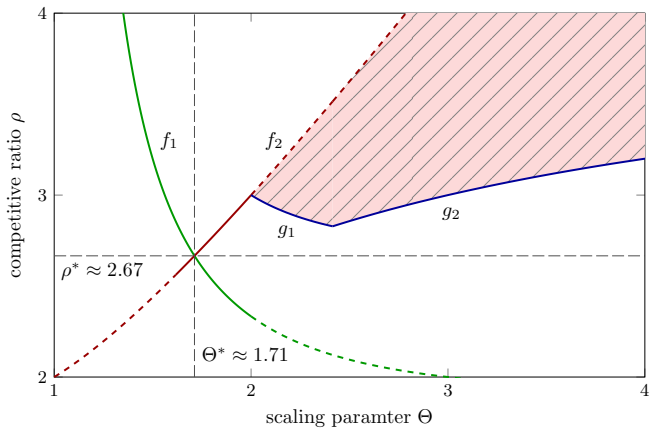
We give a lower bound of 2.0585 on the competitive ratio, which is the first bound that strictly separates online Dial-a-Ride on the line from online TSP on the line in terms of competitive analysis, and is the best currently known lower bound even for general metric spaces. On the other hand, we present an algorithm that improves the best known upper bound from 2.9377 to 2.6662. The analysis of our algorithm is tight.
What carries the argument
Adversarial request sequences for the lower bound combined with a deterministic online algorithm whose movement decisions achieve the 2.6662 ratio in the open non-preemptive line model.
If this is right
- Dial-a-Ride on the line is strictly harder than TSP in the online setting.
- Any online algorithm for request serving on the line must sometimes incur at least 2.0585 times the optimal offline cost.
- The 2.6662 ratio gives a concrete performance guarantee for a deterministic strategy that improves prior guarantees.
- The lower bound construction applies directly to arbitrary metric spaces.
Where Pith is reading between the lines
- The numerical separation may guide the search for similar gaps in other linear or interval-based online problems.
- The tight upper-bound analysis could be adapted to obtain matching ratios in restricted subclasses of request sequences.
- Practical dispatch systems on a line could benchmark against the 2.6662 figure as a worst-case target.
Load-bearing premise
The bounds are derived specifically for the open non-preemptive model on the real line metric.
What would settle it
An explicit request sequence on the line where the given algorithm exceeds ratio 2.6662, or a different online algorithm that stays below 2.0585 against all sequences.
Figures
read the original abstract
We consider the open, non-preemptive online Dial-a-Ride problem on the real line, where transportation requests appear over time and need to be served by a single server. We give a lower bound of 2.0585 on the competitive ratio, which is the first bound that strictly separates online Dial-a-Ride on the line from online TSP on the line in terms of competitive analysis, and is the best currently known lower bound even for general metric spaces. On the other hand, we present an algorithm that improves the best known upper bound from 2.9377 to 2.6662. The analysis of our algorithm is tight.
Editorial analysis
A structured set of objections, weighed in public.
Referee Report
Summary. The manuscript considers the open non-preemptive online Dial-a-Ride problem on the real line. It establishes a lower bound of 2.0585 on the competitive ratio (the first strict separation from online TSP on the line and the best known even for general metrics) via an explicit construction, and presents an algorithm achieving an upper bound of 2.6662 whose analysis is stated to be tight.
Significance. If the bounds and tightness hold, the work improves the best known upper bound from 2.9377 and supplies the first separation result between Dial-a-Ride and TSP on the line under competitive analysis. The explicit lower-bound construction and the claim of tight algorithm analysis are clear strengths that would strengthen the literature on online metric optimization.
minor comments (3)
- [Abstract] The abstract states the numerical bounds without indicating the source of the constants (e.g., solution of a particular optimization problem or case analysis); a brief parenthetical reference to the relevant section would improve readability.
- Notation for the server position, request release times, and the distinction between open and closed variants should be introduced once in a dedicated preliminary section and used consistently thereafter.
- Figure captions should explicitly state the metric, the online algorithm, and the offline optimum being compared so that each figure is self-contained.
Simulated Author's Rebuttal
We thank the referee for the supportive review and recommendation of minor revision. The report lists no specific major comments.
Circularity Check
No significant circularity
full rationale
The paper establishes a lower bound of 2.0585 via an explicit adversarial request sequence on the line and an upper bound of 2.6662 via analysis of a concrete online algorithm, both measured against the optimal offline solution OPT. These constructions and analyses are self-contained within the open non-preemptive model and do not reduce any claimed result to a fitted parameter, self-citation chain, or definitional renaming. The separation from online TSP is obtained directly from the differing request structures rather than by importing uniqueness theorems or ansatzes from prior author work. No load-bearing step equates a prediction to its own input by construction.
Axiom & Free-Parameter Ledger
axioms (1)
- domain assumption Standard model of open non-preemptive online Dial-a-Ride on the real line with requests appearing over time.
Reference graph
Works this paper leans on
-
[1]
Onlin e dial-a- ride problems: Minimizing the completion time
Norbert Ascheuer, Sven Oliver Krumke, and J¨ org Rambau. Onlin e dial-a- ride problems: Minimizing the completion time. In Proceedings of the 17th Annual Symposium on Theoretical Aspects of Computer Scienc e (STACS), pages 639–650, 2000
work page 2000
-
[2]
Mikhail J. Atallah and S. Rao Kosaraju. Efficient solutions to some t rans- portation problems with applications to minimizing robot arm travel. SIAM Journal on Computing , 17(5), 1988
work page 1988
-
[3]
G. Ausiello, E. Feuerstein, S. Leonardi, L. Stougie, and M. Talamo . Al- gorithms for the on-line travelling salesman. Algorithmica, 29(4):560–581, 2001
work page 2001
-
[4]
Tight Analysis of the Smartstart Algorithm for Online Dial-a-Ride on the Line
A. Birx and Y. Disser. Tight analysis of the smartstart algorithm f or online dial-a-ride on the line. In Proceedings of the 36th International Symposium on Theoretical Aspects of Computer Science (STACS) , 2019. Full version: https://arxiv.org/abs/1901.04272
work page internal anchor Pith review Pith/arXiv arXiv 2019
-
[5]
Tight bounds for online TSP on the line
Antje Bjelde, Yann Disser, Jan Hackfeld, Christoph Hansknech t, Maarten Lipmann, Julie Meißner, Kevin Schewior, Miriam Schl¨ oter, and Leen Stougie. Tight bounds for online TSP on the line. In Proceedings of the 28th Annual Symposium on Discrete Algorithms (SODA) , pages 994–1005, 2017. 28
work page 2017
-
[6]
Michiel Blom, Sven O. Krumke, Willem E. de Paepe, and Leen Stougie. The online TSP against fair adversaries. INFORMS Journal on Computing , 13(2):138–148, 2001
work page 2001
-
[7]
The finite capacity dial- a-ride problem
Moses Charikar and Balaji Raghavachari. The finite capacity dial- a-ride problem. In Proceedings of the 39th Annual Symposium on Foundations of Computer Science (FOCS) , pages 458–467, 1998
work page 1998
-
[8]
de Paepe, Jan Karel Lenstra, Jiri Sgall, Ren´ e A
Willem E. de Paepe, Jan Karel Lenstra, Jiri Sgall, Ren´ e A. Sitters, and Leen Stougie. Computer-aided complexity classification of dial-a-ride pro blems. INFORMS Journal on Computing , 16(2):120–132, 2004
work page 2004
-
[9]
On-line single-server dial- a-ride prob- lems
Esteban Feuerstein and Leen Stougie. On-line single-server dial- a-ride prob- lems. Theoretical Computer Science , 268(1):91–105, 2001
work page 2001
-
[10]
Paul C. Gilmore and Ralph E. Gomory. Sequencing a one state-va riable machine: A solvable case of the traveling salesman problem. Operations Research, 12(5):655–679, 1964
work page 1964
-
[11]
D. J. Guan. Routing a vehicle of capacity greater than one. Discrete Applied Mathematics , 81(1-3):41–57, 1998
work page 1998
-
[12]
Th e online dial-a-ride problem under reasonable load
Dietrich Hauptmeier, Sven Oliver Krumke, and J¨ org Rambau. Th e online dial-a-ride problem under reasonable load. In Proceedings of the 4th Italian Conference on Algorithms and Complexity (CIAC) , pages 125–136, 2000
work page 2000
-
[13]
Patrick Jaillet and Michael R. Wagner. Generalized online routing: New competitive ratios, resource augmentation, and asymptotic analy ses. Oper- ations Research, 56(3):745–757, 2008
work page 2008
-
[14]
Sven O. Krumke. Online optimization competitive analysis and beyo nd,
-
[15]
Sven O. Krumke. Online optimization: Competitive analysis and bey ond, 2002
work page 2002
-
[16]
Sven O. Krumke, Willem E. de Paepe, Diana Poensgen, Maarten Lip mann, Alberto Marchetti-Spaccamela, and Leen Stougie. On minimizing the m ax- imum flow time in the online dial-a-ride problem. In Proceedings of the Third International Conference on Approximation and Onlin e Algorithms (WAOA), pages 258–269, 2006
work page 2006
-
[17]
Sven O. Krumke, Luigi Laura, Maarten Lipmann, Alberto March etti- Spaccamela, Willem de Paepe, Diana Poensgen, and Leen Stougie. Non - abusiveness helps: An O(1)-competitive algorithm for minimizing the m ax- imum flow time in the online traveling salesman problem. In Proceedings of the 5th International Workshop on Approximation Algorit hms for Com- binat...
work page 2002
-
[18]
Maarten Lipmann, Xiwen Lu, Willem E. de Paepe, Rene A. Sitters, a nd Leen Stougie. On-line dial-a-ride problems under a restricted inform ation model. Algorithmica, 40(4):319–329, 2004. 29
work page 2004
-
[19]
On the online dial-a-ride problem with time- windows
Fanglei Yi and Lei Tian. On the online dial-a-ride problem with time- windows. In Proceedings of the 1st International Conference on Algorit hmic Applications in Management (AAIM) , pages 85–94, 2005
work page 2005
-
[20]
Online dial-a-ride problem wit h time-windows under a restricted information model
Fanglei Yi, Yinfeng Xu, and Chunlin Xin. Online dial-a-ride problem wit h time-windows under a restricted information model. In Proceedings of the 2nd International Conference on Algorithmic Aspects in Inf ormation and Management (AAIM) , pages 22–31, 2006. 30 A Proof of Lemma 2.3 In this section we prove Lemma 2.3. The proof is almost identical to th e p...
work page 2006
discussion (0)
Sign in with ORCID, Apple, or X to comment. Anyone can read and Pith papers without signing in.