REVIEW 6 major objections 5 minor 54 references
Free-Lunch Augmentation by Revisiting Diffusion-Based Data Generation for Cross-Domain Few-Shot Object Detection
T0 review · 6 major / 5 minor · reviewed 2026-08-07 · deepseek-v4-flash
Pith's one-line read Weakened noise makes diffusion-generated data usable for few-shot detection
desk verdict The SOTA claim outruns the evidence, but the background-inpainting recipe is cheap, training-free, and has real independent support—worth a serious referee, not a desk reject. read the letter →
The pith
A machine-rendered reading of the paper's core claim, the machinery that carries it, and where it could break.
The reading
What carries the argument
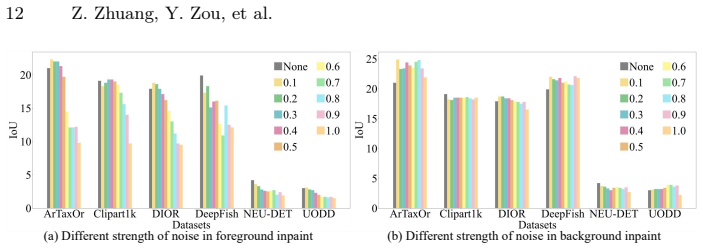
The load-bearing mechanism is a frozen pretrained diffusion inpainting model steered by two controls rather than retrained. A noise-strength scalar $\epsilon$ caps the forward noising at $T=\epsilon T_{\max}$ (with $T_{\max}=1000$), so the reverse pass reconstructs the expert-domain image instead of re-synthesizing it from Gaussian noise; low noise preserves the target content and mitigates the visual gap. The ground-truth bounding box defines an inpainting mask: background inpainting regenerates everything outside the box, exploiting the claim that background semantics transfer across domains, while foreground inpainting regenerates the box region under an LLM-generated category prompt. A selection module then feeds candidate images through a pretrained RPN and keeps the top-$k$ samples by average IoU between predicted and ground-truth boxes, discarding poor generations before they reach the detector. The paper uses CKA (Centered Kernel Alignment) similarity between original and synthesized images as its diagnostic for choosing these design points.
What would settle it
Take a fixed support set, generate SITN candidates, and rank them by CKA to the original; add only high-CKA images to the support set in one condition and only low-CKA images in another, holding selection size fixed. If the low-CKA condition matches or beats the high-CKA condition in detector mAP, the CKA premise is false and the observed gains must come from the selection module or from the added data volume rather than from the paper's gap analysis.
Extended reading notes
Core claim
The paper's central claim is that diffusion-based data augmentation can succeed in cross-domain few-shot object detection when the domain gap is decomposed. It claims that standard diffusion pipelines destroy target-domain information because the model mistakes expert-domain content for noise, and that adding only weakened noise lets the frozen generator preserve the semantic content of the original image instead of replacing it with source-domain material. It further claims that unknown target categories live mostly in the foreground, while backgrounds are shared across domains, so inpainting the background with the pretrained model produces images that stay category-consistent without requiring the model to know the novel class. On top of these two mechanisms, an RPN-based IoU filter selects which synthesized images actually enter the support set, because LLM prompts and foreground inpainting produce a mix of useful and useless candidates. If correct, the paper has a training-free, plug-and-play augmentation that raises detection mAP on six cross-domain benchmarks and segmentation accuracy on four cross-domain few-shot segmentation benchmarks beyond existing methods.
Load-bearing premise
The whole design of the Generation Module rests on the assumption that CKA similarity between a synthesized image and its original is a valid proxy for whether that image will raise detector mAP; if CKA rewards only low-level resemblance, the weakened-noise and background-inpainting choices are not independently grounded.
Editorial extensions
If this is right
- Synthesized images from SITN are safe to add to support sets at 1-shot, 5-shot, and 10-shot settings, and Table 1 shows average mAP gains over every baseline backbone tested.
- Background inpainting alone, without the selection module, already improves most datasets in the paper's ablation, which supports the claim that background transfer is the main driver rather than selection noise.
- The method carries over to cross-domain few-shot segmentation, where the paper reports that applying SITN to the FPTrans baseline raises average accuracy from 62.2 to 66.7 across the four evaluated datasets.
- The generation pipeline is training-free and samples with DDIM in at most 50 steps, giving per-image generation times around 0.02 to 1.5 seconds versus hundreds of seconds for standard DDPM or SDEdit, so the augmentation cost is small enough for routine use.
Reading between the lines
- My inference: because the method is training-free and needs only bounding boxes, it could be layered onto any few-shot detector that exposes support-set annotations, not just the detectors tested here.
- My inference: the background-inpainting step effectively re-renders the scene around the few-shot instances, so it may behave as a style regularizer; a direct test would compare SITN-augmented support sets with style-augmented sets at matched data volume.
- My inference: the selection module's IoU threshold could be tuned per class rather than per dataset, which might extend the gains to the hardest categories where average mAP remains low in the paper.
- My inference: as stronger open-source generators appear, the weakened-noise schedule and IoU filtering may be the durable part of the method; the paper's own swap from SDv1.5 to Nucleus-Image is a step toward testing that.
Editorial analysis
A structured set of objections, weighed in public.
Referee Report
Summary. The paper proposes SITN, a training-free diffusion-based augmentation method for cross-domain few-shot object detection (CDFSOD). The method decomposes the domain gap into visual and semantic components, uses weakened noise (epsilon) to preserve target-domain information, performs foreground/background inpainting with LLM-generated prompts and bounding-box masks, and filters the generated samples with a top-k RPN-IoU selection module. Experiments on six CDFSOD datasets report average mAP improvements over prior state of the art in 1-shot, 5-shot, and 10-shot settings, and the method is also applied to four cross-domain few-shot segmentation datasets.
Significance. If the reported gains hold up, this is a useful and timely contribution: it provides the first systematic demonstration that frozen diffusion priors can be adapted to expert domains for few-shot detection and segmentation without training, through weakened noise and background inpainting. The paper gives explicit credit to the difficulty of the problem, and the background-inpainting-only ablation in Table 3 is a genuine piece of independent evidence that the augmentation itself (not only the selection step) can help. The claimed computational efficiency and compatibility with multiple detectors are also valuable. However, the empirical evidence as presented is not yet strong enough to support the headline state-of-the-art claim, because the main results lack variance estimates, the per-dataset hyperparameters are deferred to an absent appendix, and the selection module is not fully separated from the circularity concern of filtering by the same detector that is later fine-tuned.
major comments (6)
- [Section 5.1, Table 1] The headline SOTA claim rests on average margins of 0.7, 1.0, and 1.5 mAP over DomainRAG in the 1-shot, 5-shot, and 10-shot columns, but the paper reports no error bars, number of seeds, or statistical significance tests. In few-shot fine-tuning such differences are commonly within seed-to-seed variance. Please report mean +/- standard deviation over at least three random seeds, or provide paired per-dataset comparisons, for the main tables.
- [Section 4.3, Eq. (3) and Eq. (6)] The two method hyperparameters, the noise strength epsilon and the top-k count k, are stated to be 'tailored to each target domain dataset' and their values are deferred to the supplementary material, but no appendix or supplement is present in the submitted manuscript. Without a stated validation protocol it is impossible to rule out that these values were selected using the query set. Please report the exact epsilon and k values per dataset, describe the validation split used to choose them, and include a sensitivity analysis over a reasonable range of both hyperparameters.
- [Section 4.3, Eq. (6); Section 5.4, Table 3] The selection module keeps generated images whose RPN proposals, produced by the baseline CD-ViTO detector, have high IoU with ground-truth boxes. Because the same detector is later fine-tuned on the selected samples, part of the measured gain may come from choosing images that the detector already recognizes rather than from genuinely new training signal. The background-only ablation partially mitigates this concern, but the paper should quantify the selection bias, for example by comparing with selection based on a different detector or with random selection of the same number of images. The table also needs an explanation for why Fore.+Back. (22.5 on ArTaxOr, and lower than Back. alone in most rows) is consistently worse than Back. alone.
- [Section 3.1-3.3, Figs. 2-4] The paper uses CKA similarity as the main diagnostic to justify weakened noise and background inpainting, but it never validates that higher CKA between synthesized and original images translates into higher downstream detection mAP. Without such a validation, the design choices in the Generation Module are not empirically grounded; the observed mAP gains could in principle be explained by the selection module alone. Please add an experiment or scatter plot relating CKA values to mAP across noise strengths and inpainting strategies, or explicitly discuss the limitations of CKA as a proxy.
- [Table 2] The reported SDEdit average of 13.2 is inconsistent with the row values (35.5, 41.5, 13.1, 35.7, 9.8, 13.7), whose mean is 24.9. This arithmetic error directly affects the comparison with diffusion-based baselines and must be corrected. Please also verify all average values in Tables 1 and 4, since at least one additional average in Table 2 appears suspect.
- [Section 5.4, Table 4] The abstract and Section 5 claim that SITN also achieves state-of-the-art results on cross-domain few-shot segmentation, but the paper never specifies how the method is adapted to segmentation: the bounding-box masks, RPN-IoU selection, and detection fine-tuning protocol are all detection-specific. Please describe the segmentation adaptation protocol, including how masks are obtained and how selected images are integrated into the segmentation fine-tuning, or temper the CDFSS claim to a preliminary transfer result.
minor comments (5)
- [Abstract, Keywords] The abstract contains a grammatical error ('Our codes is available') and the keyword list includes 'Objection-detection', which should be 'Object Detection'.
- [Section 4.3, Eq. (1)] The LLM used for prompt generation is not named, and no details are given about the prompting strategy or the model version; this makes the generation module hard to reproduce exactly.
- [Section 5.2, Section 5.4] The implementation details are partially deferred to an appendix that is not included in the submitted manuscript, and the caption of Table 3 uses the abbreviation 'Sele.' without defining it. Please make the experimental protocol self-contained.
- [Fig. 12] The computational-efficiency comparison reports generation times for DDPM, SDEdit, DomainRAG, and the proposed method, but no hardware or implementation details are given, and DomainRAG's time includes retrieval steps that are not directly comparable to pure diffusion generation. Please specify the measurement conditions.
- [Section 5.4, 'CKA vs. MMD'] The paragraph states that MMD trends are 'perfectly symmetric' with CKA, but Fig. 11 is not described in enough detail to verify the claim; please report the MMD values and the exact feature representation used.
Circularity Check
Selection Module filters synthetic images using the baseline CD-ViTO detector's own RPN IoU, so a substantial part of the reported mAP gain is self-confirmation of the baseline rather than evidence that the synthesized data add new cross-domain information; background-inpainting-only ablations provide partial independent support.
-
fitted input called prediction
[Section 4.3, Selection Module (Eq. 6); Section 5.4, Selection Module ablation; Table 3]
"We employ the RegionProposalNetwork (RPN) pre-trained on the CD-ViTO model (Baseline) to generate candidate bounding boxes (A) for the extended support set. We calculate the average IoU between predicted boxes and ground truth ones (Y), and only synthesized images with high IoUs are selected. ... These carefully selected samples, combined with the original training data for object detection model finetuning, lead to a substantial overall performance enhancement."
The 'quality' of each synthesized image is defined by the RPN of the very detector (CD-ViTO) that is later fine-tuned and evaluated: selected images are, by construction, the ones the baseline already recognizes with high IoU. Feeding those self-selected easy positives back into the same detector can inflate mAP by reinforcing existing predictions rather than by supplying novel cross-domain training signal. Table 3 shows the selection step contributes a large share of the gain (ArTaxOr: Fore.+Back. 22.5 -> Fore.+Back.+Sele. 26.7 versus baseline 21.0), and the background-inpainting-only row (24.9) is the main independent evidence. Thus part of the 'helpful data' claim reduces to the baseline's own recognition score, though not the whole method.
full rationale
The paper's core generation design is motivated by CKA analyses, but the final evidence is mAP on held-out query sets and the background-inpainting-only ablation improves several datasets (e.g., ArTaxOr 21.0 to 24.9), so the generation module is not equivalent to its inputs by construction. The main circularity is confined to the Selection Module: Eq. (6) selects generated images using an RPN pre-trained on the same CD-ViTO baseline that is then fine-tuned and evaluated, making the 'high-quality sample' label a function of the baseline's own detections. This is a partial self-referential loop rather than a full derivation collapse, because selection is not the only contributor and final evaluation is on query mAP. No load-bearing self-citation was found: references to the authors' prior work (e.g., [22], [29], [51]–[54]) are related-work context, not imported proofs or uniqueness theorems. The missing appendix values for per-dataset noise strength epsilon and top-k, and the deferred fine-tuning details, are reproducibility and validation risks (possible selection on query), but not by themselves circularity.
Assumptions & free parameters
free parameters (2)
- noise strength scalar epsilon =
not reported in main text; varied in Fig. 8
- top-k selection count k =
not reported; 'tailored to each target domain dataset'
assumptions (6)
- domain assumption CKA similarity between original and synthesized images is a valid proxy for whether synthesized images will help downstream detection.
- domain assumption Background regions are semantically more transferable across domains than foreground objects, so background inpainting avoids the semantic gap.
- domain assumption Adding weakened noise (epsilon < 1) keeps the diffusion model from confusing noise with useful target-domain information.
- domain assumption Inpainting within the bounding-box mask preserves object location, so original ground-truth labels remain valid for generated images.
- domain assumption A frozen general-domain diffusion model can serve as a generator for expert domains when given an LLM prompt and partially noised input.
- domain assumption The LLM-generated text prompt faithfully describes the target image and is compatible with the frozen diffusion model.
Cite this review
Pith. "Pith review of Free-Lunch Augmentation by Revisiting Diffusion-Based Data Generation for Cross-Domain Few-Shot Object Detection." pith.science (2026). https://pith.science/paper/3IQX5KW6
@misc{pith2026260804394,
  author       = {Pith},
  title        = {Pith review of: Free-Lunch Augmentation by Revisiting Diffusion-Based Data Generation for Cross-Domain Few-Shot Object Detection},
  year         = {2026},
  howpublished = {\url{https://pith.science/paper/3IQX5KW6}},
  note         = {Machine review of arXiv:2608.04394}
}
read the original abstract
Cross-Domain Few-Shot Object Detection (CDFSOD) aims to transfer knowledge from data-rich upstream generic domains to downstream expert domains using scarce training data, where the significant domain gap and data scarcity make it an unsolved challenge. To address this problem, we revisit a natural yet underexplored approach in CDFSOD: data augmentation, by directly synthesizing data through diffusion models to supplement limited training samples. However, due to large domain gaps, we find that current diffusion methods cannot produce good results, leading to performance even lower than using the original images. To address these limitations, we divide the domain gaps into visual gaps and semantic gaps for separate analysis. For the visual gap, we find that the diffusion model cannot distinguish noise from useful information on expert domains, which can be mitigated by adding weakened noise. For the semantic gap, we find that the background semantics shows much smaller gaps between domains than foreground semantics, and we can bridge this gap by background inpainting. Based on the above analysis, we propose a method (Selective Inpainting with Tailored Noise, SITN) to dynamically take different strategies for downstream data synthesis based on their different gaps from the general domain, including a Generation Module for adding tailored noise and a Selection Module to dynamically select the inpainting regions. Extensive experiments on 6 datasets of CDFSOD and 4 datasets of cross-domain few-shot segmentation (CDFSS) validate that we can synthesize helpful data, achieving new state-of-the-art performance. Our codes is available at https://github.com/zzzzj311-droid/Free-Lunch-SITN
Figures


Figures from the paper (7 more)




Reference graph
Works this paper leans on
-
[1]
arXiv preprint arXiv:2101.091932(3) (2021)
Bevandic, P., Krešo, I., Oršic, M., Šegvic, S.: Dense outlier detection and open- set recognition based on training with noisy negative images. arXiv preprint arXiv:2101.091932(3) (2021)
arXiv 2021
-
[2]
In: Proceedings of the IEEE/CVF Conference on Computer Vision and Pattern Recognition
Bou, X., Facciolo, G., Von Gioi, R.G., Morel, J.M., Ehret, T.: Exploring robust features for few-shot object detection in satellite imagery. In: Proceedings of the IEEE/CVF Conference on Computer Vision and Pattern Recognition. pp. 430–439 (2024)
work page 2024
-
[3]
Boudiaf, M., Kervadec, H., Masud, Z.I., Piantanida, P., Ben Ayed, I., Dolz, J.: Few-shot segmentation without meta-learning: A good transductive inference is all you need? In: Proceedings of the IEEE/CVF conference on computer vision and pattern recognition. pp. 13979–13988 (2021)
2021
-
[4]
IEEE Transactions on Knowledge and Data Engineering (2024)
Cao, H., Tan, C., Gao, Z., Xu, Y., Chen, G., Heng, P.A., Li, S.Z.: A survey on gen- erative diffusion models. IEEE Transactions on Knowledge and Data Engineering (2024)
work page 2024
-
[5]
In: Proceedings of the ieee/cvf international conference on computer vision
Chan, R., Rottmann, M., Gottschalk, H.: Entropy maximization and meta classifi- cation for out-of-distribution detection in semantic segmentation. In: Proceedings of the ieee/cvf international conference on computer vision. pp. 5128–5137 (2021)
2021
-
[6]
Davari, M., Horoi, S., Natik, A., Lajoie, G., Wolf, G., Belilovsky, E.: Reliability of cka as a similarity measure in deep learning (Oct 2022)
work page 2022
-
[7]
In: European conference on computer vision
Fan, Q., Pei, W., Tai, Y.W., Tang, C.K.: Self-support few-shot semantic segmen- tation. In: European conference on computer vision. pp. 701–719. Springer (2022)
work page 2022
-
[8]
In: Proceedings of the IEEE/CVF Conference on Computer Vision and Pattern Recognition
Fei, B., Lyu, Z., Pan, L., Zhang, J., Yang, W., Luo, T., Zhang, B., Dai, B.: Genera- tive diffusion prior for unified image restoration and enhancement. In: Proceedings of the IEEE/CVF Conference on Computer Vision and Pattern Recognition. pp. 9935–9946 (2023)
work page 2023
Show all 54 references
-
[9]
ACM Computing Surveys57(9), 1–66 (2025)
Foo,L.G.,Rahmani,H.,Liu,J.:Ai-generatedcontent(aigc)forvariousdatamodal- ities: A survey. ACM Computing Surveys57(9), 1–66 (2025)
2025
-
[10]
In: European Conference on Computer Vision
Fu, Y., Wang, Y., Pan, Y., Huai, L., Qiu, X., Shangguan, Z., Liu, T., Fu, Y., Van Gool, L., Jiang, X.: Cross-domain few-shot object detection via enhanced open-set object detector. In: European Conference on Computer Vision. pp. 247–
-
[11]
In: Proceedings of the IEEE/CVF conference on computer vision and pattern recognition
Ghiasi, G., Cui, Y., Srinivas, A., Qian, R., Lin, T.Y., Cubuk, E.D., Le, Q.V., Zoph, B.: Simple copy-paste is a strong data augmentation method for instance segmentation. In: Proceedings of the IEEE/CVF conference on computer vision and pattern recognition. pp. 2918–2928 (2021)
2021
-
[12]
In: Proceedings of the IEEE/CVF conference on computer vision and pattern recognition
Go,H.,Lee,Y.,Kim,J.Y.,Lee,S.,Jeong,M.,Lee,H.S.,Choi,S.:Towardspractical plug-and-play diffusion models. In: Proceedings of the IEEE/CVF conference on computer vision and pattern recognition. pp. 1962–1971 (2023)
2023
-
[13]
Gui, G., Gao, B.B., Liu, J., Wang, C., Wu, Y.: Few-shot anomaly-driven generation foranomalyclassificationandsegmentation.In:EuropeanConferenceonComputer Vision. pp. 210–226 (2024)
2024
-
[14]
Han,G.,Lim,S.N.:Few-shotobjectdetectionwithfoundationmodels.In:Proceed- ings of the IEEE/CVF Conference on Computer Vision and Pattern Recognition. pp. 28608–28618 (2024)
2024
-
[15]
He, R., Sun, S., Yu, X., Xue, C., Zhang, W., Torr, P., Bai, S., Qi, X.: Is syn- thetic data from generative models ready for image recognition? arXiv preprint arXiv:2210.07574 (2022) Revisiting Diffusion-Based Data Generation for CDFSOD 17
2022 arXiv
-
[16]
In: Proceedings of the IEEE/CVF Conference on Computer Vision and Pattern Recognition
He, W., Zhang, Y., Zhuo, W., Shen, L., Yang, J., Deng, S., Sun, L.: Apseg: Auto- prompt network for cross-domain few-shot semantic segmentation. In: Proceedings of the IEEE/CVF Conference on Computer Vision and Pattern Recognition. pp. 23762–23772 (2024)
2024
-
[17]
In: Proceedings of the IEEE/CVF conference on computer vision and pattern recognition
Herzog, J.: Adapt before comparison: A new perspective on cross-domain few-shot segmentation. In: Proceedings of the IEEE/CVF conference on computer vision and pattern recognition. pp. 23605–23615 (2024)
2024
-
[18]
Neural In- formation Processing Systems,Neural Information Processing Systems (Jan 2020)
Ho, J., Jain, A., Abbeel, P.: Denoising diffusion probabilistic models. Neural In- formation Processing Systems,Neural Information Processing Systems (Jan 2020)
2020
-
[19]
In: Proceedings of the AAAI Conference on Artificial Intelligence
Huang, J., Wu, Q., Ren, Y., Yang, F., Yang, A., Yang, Q., Pu, X.: Sparse bayesian deep learning for cross domain medical image reconstruction. In: Proceedings of the AAAI Conference on Artificial Intelligence. vol. 38, pp. 2339–2347 (2024)
2024
-
[20]
In: Proceedings of the IEEE/CVF Conference on Computer Vision and Pattern Recognition
Islam, K., Zaheer, M.Z., Mahmood, A., Nandakumar, K.: Diffusemix: Label- preserving data augmentation with diffusion models. In: Proceedings of the IEEE/CVF Conference on Computer Vision and Pattern Recognition. pp. 27621– 27630 (2024)
2024
-
[21]
In: European Conference on Computer Vision
Jabbour, S., Kondas, G., Kazerooni, E., Sjoding, M., Fouhey, D., Wiens, J.: De- pict: Diffusion-enabled permutation importance for image classification tasks. In: European Conference on Computer Vision. pp. 35–51. Springer (2025)
2025
-
[22]
In: Proceedings of the IEEE/CVF Conference on Computer Vision and Pattern Recognition
Jiang, Y., Zou, Y., Li, Y., Li, R.: Remedying target-domain astigmatism for cross- domain few-shot object detection. In: Proceedings of the IEEE/CVF Conference on Computer Vision and Pattern Recognition. pp. 19580–19590 (2026)
2026
-
[23]
In: European conference on computer vision
Lei, S., Zhang, X., He, J., Chen, F., Du, B., Lu, C.T.: Cross-domain few-shot semantic segmentation. In: European conference on computer vision. pp. 73–90. Springer (2022)
2022
-
[24]
In: Proceed- ings of the IEEE/CVF conference on computer vision and pattern recognition
Li, L.H., Zhang, P., Zhang, H., Yang, J., Li, C., Zhong, Y., Wang, L., Yuan, L., Zhang, L., Hwang, J.N., et al.: Grounded language-image pre-training. In: Proceed- ings of the IEEE/CVF conference on computer vision and pattern recognition. pp. 10965–10975 (2022)
2022
-
[25]
In: European conference on computer vision
Li, Y., Mao, H., Girshick, R., He, K.: Exploring plain vision transformer backbones for object detection. In: European conference on computer vision. pp. 280–296. Springer (2022)
2022
-
[26]
arXiv preprint arXiv:2506.05872 (2025)
Li, Y., Qiu, X., Fu, Y., Chen, J., Qian, T., Zheng, X., Paudel, D.P., Fu, Y., Huang, X., Van Gool, L., et al.: Domain-rag: Retrieval-guided compositional image gener- ation for cross-domain few-shot object detection. arXiv preprint arXiv:2506.05872 (2025)
2025
-
[27]
In: Proceedings of the IEEE/CVF Conference on Computer Vision and Pattern Recognition
Liu, J., Wang, Q., Fan, H., Wang, Y., Tang, Y., Qu, L.: Residual denoising diffusion models. In: Proceedings of the IEEE/CVF Conference on Computer Vision and Pattern Recognition. pp. 2773–2783 (2024)
2024
-
[28]
arXiv preprint arXiv:2303.05499 (2023)
Liu, S., Zeng, Z., Ren, T., Li, F., Zhang, H., Yang, J., Li, C., Yang, J., Su, H., Zhu, J., et al.: Grounding dino: Marrying dino with grounded pre-training for open-set object detection. arXiv preprint arXiv:2303.05499 (2023)
2023 arXiv
-
[29]
In: Proceedings of the Computer Vision and Pattern Recog- nition Conference
Liu, Y., Zou, Y., Li, Y., Li, R.: The devil is in low-level features for cross-domain few-shot segmentation. In: Proceedings of the Computer Vision and Pattern Recog- nition Conference. pp. 4618–4627 (2025)
2025
-
[30]
In: Proceedings of the IEEE/CVF conference on computer vision and pattern recognition
Lugmayr, A., Danelljan, M., Romero, A., Yu, F., Timofte, R., Van Gool, L.: Re- paint: Inpainting using denoising diffusion probabilistic models. In: Proceedings of the IEEE/CVF conference on computer vision and pattern recognition. pp. 11461– 11471 (2022)
2022
-
[31]
arXiv preprint arXiv:2208.11970 (2022) 18 Z
Luo, C.: Understanding diffusion models: A unified perspective. arXiv preprint arXiv:2208.11970 (2022) 18 Z. Zhuang, Y. Zou, et al
2022 arXiv
-
[32]
arXiv preprint arXiv:2108.01073 (2021)
Meng, C., He, Y., Song, Y., Song, J., Wu, J., Zhu, J.Y., Ermon, S.: Sdedit: Guided image synthesis and editing with stochastic differential equations. arXiv preprint arXiv:2108.01073 (2021)
2021 arXiv
-
[33]
In: Proceedings of the IEEE/CVF international conference on computer vision
Min, J., Kang, D., Cho, M.: Hypercorrelation squeeze for few-shot segmentation. In: Proceedings of the IEEE/CVF international conference on computer vision. pp. 6941–6952 (2021)
2021
-
[34]
In: Proceedings of the Computer Vision and Pattern Recog- nition Conference
Pan, J., Liu, Y., He, X., Peng, L., Li, J., Sun, Y., Huang, X.: Enhance then search: An augmentation-search strategy with foundation models for cross-domain few- shot object detection. In: Proceedings of the Computer Vision and Pattern Recog- nition Conference. pp. 1548–1556 (2025)
2025
-
[35]
In: Proceedings of the IEEE/CVF conference on computer vision and pattern recognition
Rombach, R., Blattmann, A., Lorenz, D., Esser, P., Ommer, B.: High-resolution image synthesis with latent diffusion models. In: Proceedings of the IEEE/CVF conference on computer vision and pattern recognition. pp. 10684–10695 (2022)
2022
-
[36]
In: Proceed- ings of the IEEE/CVF Conference on Computer Vision and Pattern Recognition
Sain, A., Bhunia, A.K., Chowdhury, P.N., Koley, S., Xiang, T., Song, Y.Z.: Clip for all things zero-shot sketch-based image retrieval, fine-grained or not. In: Proceed- ings of the IEEE/CVF Conference on Computer Vision and Pattern Recognition. pp. 2765–2775 (2023)
2023
-
[37]
In: 2025 IEEE/CVF Winter Conference on Applications of Computer Vision (WACV)
Shangguan, Z., Seita, D., Rostami, M.: Cross-domain multi-modal few-shot object detection via rich text. In: 2025 IEEE/CVF Winter Conference on Applications of Computer Vision (WACV). pp. 6570–6580. IEEE (2025)
2025
-
[38]
In: Pro- ceedings of the AAAI Conference on Artificial Intelligence
Shen, J., Kuang, K., Wang, J., Wang, X., Feng, T., Zhang, W.: Cgmgm: A cross- gaussian mixture generative model for few-shot semantic segmentation. In: Pro- ceedings of the AAAI Conference on Artificial Intelligence. vol. 38, pp. 4784–4792 (2024)
2024
-
[39]
arXiv: Learn- ing,arXiv: Learning (Oct 2020)
Song, J., Meng, C., Ermon, S.: Denoising diffusion implicit models. arXiv: Learn- ing,arXiv: Learning (Oct 2020)
2020
-
[40]
In: Proceedings of the IEEE/CVF conference on Computer Vision and Pattern Recognition
Su, J., Fan, Q., Pei, W., Lu, G., Chen, F.: Domain-rectifying adapter for cross- domain few-shot segmentation. In: Proceedings of the IEEE/CVF conference on Computer Vision and Pattern Recognition. pp. 24036–24045 (2024)
2024
-
[41]
Team, N.A.: Nucleus-image: Sparse moe for image generation (2026)
2026
-
[42]
arXiv preprint arXiv:2302.07944 (2023)
Trabucco, B., Doherty, K., Gurinas, M., Salakhutdinov, R.: Effective data augmen- tation with diffusion models. arXiv preprint arXiv:2302.07944 (2023)
2023 arXiv
-
[43]
In: ICASSP 2023-2023 IEEE International Conference on Acoustics, Speech and Signal Processing (ICASSP)
Xiong, W.: Cd-fsod: A benchmark for cross-domain few-shot object detection. In: ICASSP 2023-2023 IEEE International Conference on Acoustics, Speech and Signal Processing (ICASSP). pp. 1–5. IEEE (2023)
2023
-
[44]
In: Proceedings of the AAAI Conference on Artificial Intelligence
Yan, Q., Chen, G., Zou, Y.: Start small, think big: Curriculum-based relative policy optimization for visual grounding. In: Proceedings of the AAAI Conference on Artificial Intelligence. vol. 40, pp. 11550–11558 (2026)
2026
-
[45]
arXiv preprint arXiv:2308.06721 (2023)
Ye, H., Zhang, J., Liu, S., Han, X., Yang, W.: Ip-adapter: Text compati- ble image prompt adapter for text-to-image diffusion models. arXiv preprint arXiv:2308.06721 (2023)
2023 arXiv
-
[46]
Advances in neural information processing systems35, 6575–6588 (2022)
Zhang, J.W., Sun, Y., Yang, Y., Chen, W.: Feature-proxy transformer for few-shot segmentation. Advances in neural information processing systems35, 6575–6588 (2022)
2022
-
[47]
In: Proceedings of the IEEE/CVF international conference on computer vision
Zhang, L., Rao, A., Agrawala, M.: Adding conditional control to text-to-image diffusion models. In: Proceedings of the IEEE/CVF international conference on computer vision. pp. 3836–3847 (2023)
2023
-
[48]
In: Proceedings of the IEEE/CVF Conference on Computer Vision and Pattern Recognition
Zhang, R., Hu, X., Li, B., Huang, S., Deng, H., Qiao, Y., Gao, P., Li, H.: Prompt, generate,thencache: Cascadeoffoundationmodelsmakesstrongfew-shotlearners. In: Proceedings of the IEEE/CVF Conference on Computer Vision and Pattern Recognition. pp. 15211–15222 (2023) Revisiting...
2023
-
[49]
arXiv preprint arXiv:2305.03048 (2023)
Zhang, R., Jiang, Z., Guo, Z., Yan, S., Pan, J., Ma, X., Dong, H., Gao, P., Li, H.: Personalize segment anything model with one shot. arXiv preprint arXiv:2305.03048 (2023)
2023 arXiv
-
[50]
arXiv preprint arXiv:2309.12969 (2023)
Zhang, X., Liu, Y., Wang, Y., Boularias, A.: Detect everything with few examples. arXiv preprint arXiv:2309.12969 (2023)
2023 arXiv
-
[51]
In: Proceedings of the IEEE/CVF Conference on Computer Vision and Pattern Recognition (CVPR)
Zhao, Y., Zou, Y., Li, Y., Li, R.: Interpretable cross-domain few-shot learning with rectified target-domain local alignment. In: Proceedings of the IEEE/CVF Conference on Computer Vision and Pattern Recognition (CVPR). pp. 41605– 41615 (June 2026)
2026
-
[52]
In: Proceedings of the IEEE/CVF Conference on Computer Vision and Pattern Recognition
Zou, Y., Liu, Y., Hu, Y., Li, Y., Li, R.: Flatten long-range loss landscapes for cross-domain few-shot learning. In: Proceedings of the IEEE/CVF Conference on Computer Vision and Pattern Recognition. pp. 23575–23584 (2024)
2024
-
[53]
Advances in Neural Information Processing Systems37, 116332–116354 (2024)
Zou, Y., Ma, R., Li, Y., Li, R.: Attention temperature matters in vit-based cross- domain few-shot learning. Advances in Neural Information Processing Systems37, 116332–116354 (2024)
2024
-
[54]
arXiv preprint arXiv:2405.17022 (2024)
Zou, Y., Zhang, S., Zhou, H., Li, Y., Li, R.: Compositional few-shot class- incremental learning. arXiv preprint arXiv:2405.17022 (2024)
2024 arXiv
Reviewed August 7, 2026 · model on record in the stance chip above.
Discussion (0). Sign in to comment.