REVIEW 3 major objections 4 minor 19 references
Reinforcement learning for graph theory, Parallelizing Wagner's approach
T0 review · 3 major / 4 minor · reviewed 2026-08-05 · deepseek-v4-flash
Pith's one-line read A parallelized reinforcement-learning search over graphs finds more counterexamples to conjectured Laplacian spectral radius bounds, including three previously open cases, while running faster than the baseline.
desk verdict Three plausible new counterexamples to 2006 Laplacian-radius conjectures, but the paper makes you fetch a calculator to believe them. read the letter →
The pith
A machine-rendered reading of the paper's core claim, the machinery that carries it, and where it could break.
The reading
What carries the argument
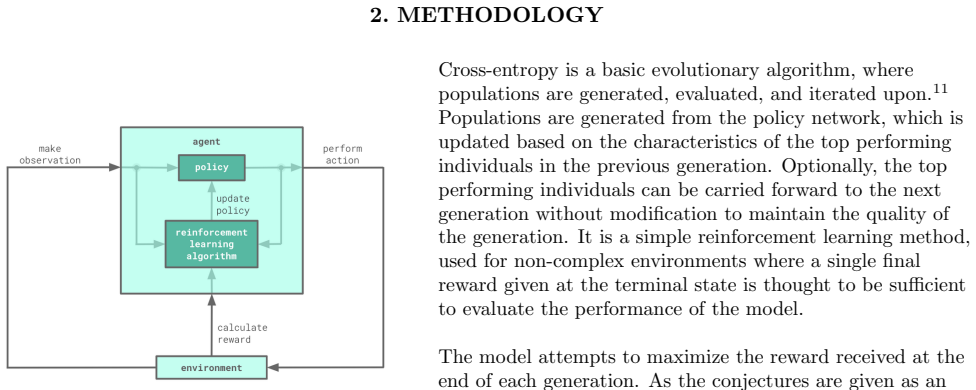
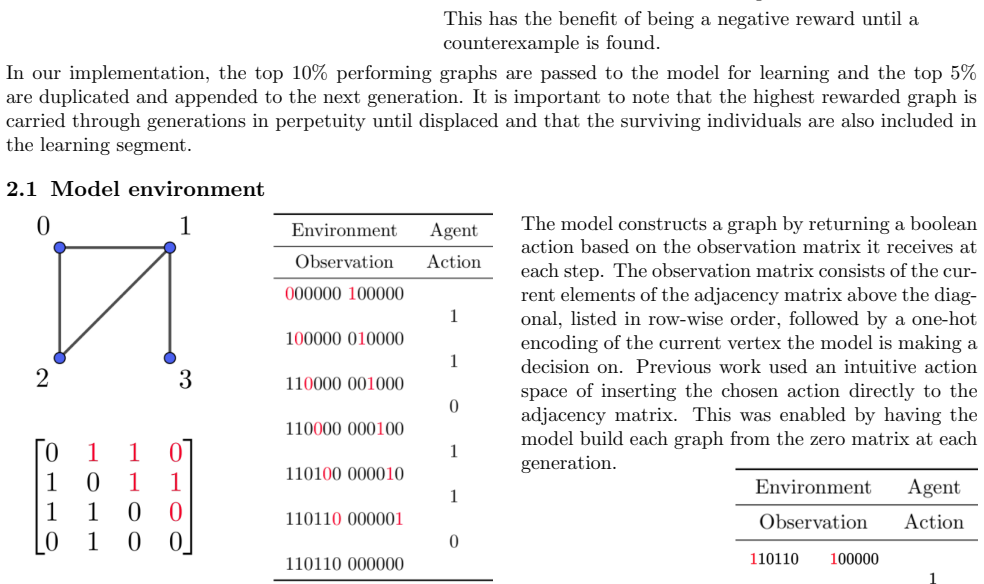
The central mechanism is the cross-entropy method: a policy network proposes graphs, the top 10% by reward update the network, and the top 5% are carried into the next generation. The reward is the graph's Laplacian spectral radius minus the conjectured bound, so ordinary graphs get negative rewards and a counterexample yields a positive one. Two modifications carry the argument: (1) multiple policy networks train in parallel on disjoint batches, and (2) the action is a bit-wise exclusive-or against the observation, so a portion of each batch starts at the previous generation's best graph and mutates it instead of constructing from the zero matrix. This second change is congruent to the old
What would settle it
Compute the largest Laplacian eigenvalue of each of the four adjacency matrices in Appendix A and evaluate the corresponding conjecture formula on that graph; if any graph's spectral radius does not strictly exceed its stated bound, the central claim fails. For the performance claim, re-run the comparison on multiple conjectures with fixed random seeds and measure wall-clock time and number of counterexamples found per run.
Extended reading notes
Core claim
The paper claims that running several cross-entropy reinforcement-learning agents in parallel, with an action space redefined so an agent can mutate the previous best graph rather than build from zero, outperforms the prior single-agent implementation: it finds more counterexamples to conjectured upper bounds on the Laplacian spectral radius in less wall-clock time. It reports four graphs that falsify many of the 68 open bounds from an earlier automated-conjecture catalogue, including three bounds (conjectures 2, 32, 61) for which no counterexamples had been previously published. The decentralization is meant to escape the cross-entropy method's tendency to stall at local optima.
Load-bearing premise
The load-bearing premise is that the four Appendix A graphs genuinely violate the listed conjectures and that the reported speedups are not artifacts of the threading-related random-number-seed behaviour the paper itself flags; an error in the eigenvalue computation, in transcribing the conjecture formulas, or in the RNG handling would collapse the central claims.
Editorial extensions
If this is right
- Three previously open conjectured upper bounds (numbers 2, 32, 61) from the cited catalogue are false, witnessed by graphs on 12 and 20 vertices; any repair of these bounds must accommodate these graphs.
- The parallel, local-optimum-initialized cross-entropy method is faster and finds more counterexamples than the single-model baseline, making it a practical template for automated conjecture falsification in spectral graph theory.
- The four reported graphs each serve as counterexamples to many distinct conjectures, showing that a single extremal graph can witness a cluster of similar bounds.
- The redefined action space reduces to the original when starting from the zero matrix, so the observed gains come from parallel decentralization and seeding with the previous top graph rather than from the XOR formulation alone.
Reading between the lines
- If independently verified, the three new counterexamples stand as a mathematical result independent of the reinforcement-learning framing; the method acts as a discovery tool rather than a proof generator.
- The same parallel search could be pointed at other eigenvalue-based conjectures (adjacency spectral radius, normalized Laplacian, distance matrices) as long as a reward function can be defined, though the paper does not report such experiments.
- The paper itself flags a possible random-number-seed artifact from threading; an ablation with fixed seeds across model counts would clarify whether the speedups are genuinely due to parallelism or to implementation details.
- A controlled comparison with zero seeding of the top graph would isolate whether the quarter-of-batch seeding is the main driver of the performance gain, since the reported experiments do not vary that factor alone.
Editorial analysis
A structured set of objections, weighed in public.
Referee Report
Summary. The paper presents a parallelized, reinforcement-learning implementation (based on a cross-entropy method) for searching for counterexamples to 68 conjectured upper bounds on the Laplacian spectral radius of a graph, originally generated by Brankov et al. The authors reimplement Stevanovic et al.'s code, introduce a redefined action space that toggles bits of the current observation matrix, and run multiple models in parallel. The main claims are (i) the new implementation outperforms the original in both time per generation and in the number of counterexamples found, and (ii) the search discovers three new counterexamples, to Conjectures 2, 32, and 61, using four graphs listed in Appendix A. The paper includes adjacency matrices and conjecture formulas for these graphs but does not report any computed Laplacian spectral radius or bound values.
Significance. If the three claimed counterexamples are correct, the paper would make a modest but real contribution to extremal spectral graph theory: it would close three open conjectures from Brankov et al.'s list and demonstrate that a simple decentralized cross-entropy method can find graphs that standard local search misses. The code is publicly available, which is a strength for reproducibility. However, the verification of the counterexamples is entirely external to the text: the appendix asserts the inequalities but provides no numerical evidence. Since the search reward is defined as the spectral radius minus the conjectured bound, the discovery procedure is coherent and not circular, but an implementation error in either the spectral radius computation or the conjecture formula transcription would invalidate the central claim. The time-complexity comparison also lacks statistical detail. The paper's significance therefore hinges on an independent verification that is neither provided nor pointed to in the repository in enough detail.
major comments (3)
- [Section 3, Appendix A] The central novelty is the three circled entries in the table: Conjectures 2, 32, and 61 are marked with '◦', which the text defines as 'new counter-examples'. Appendix A provides adjacency matrices and expressions for the conjectured bounds, but it never gives the computed Laplacian spectral radius µ(G) for any of the four graphs, nor the numerical value of the conjectured bound. The appendix only states that 'the spectral radius of the Laplacian matrix of the graph is larger than the stated conjecture'. This is a load-bearing verification gap: the conjecture formulas are intricate maxima over degree and average-neighbor-degree terms (e.g., Conjectures 52/53 contain nested radicals), and the reward computation in the code uses the same formulas, so a bug in formula transcription or spectral radius evaluation would silently produce false positives. The paper even flags a possible RNG-see
- [Section 3, Figure 10] The performance comparison rests on 'the average of 15 runs of 400 generations', but no error bars, standard deviations, or significance tests are reported. The figure also appears to compare different numbers of parallel models with different per-model batch sizes (200 vs. 500), and the text says the 5-model version initially underperforms for that reason. The paper's concluding sentence claims superiority in 'time-complexity', but the runtime comparisons are described only qualitatively ('reduced the time to process a generation by up to a third') with no hardware or timing methodology. Moreover, the text acknowledges a possible bug in the randomization function's RNG seed handling, which could affect both the reward trajectories and the discovered graphs. This makes the performance claim hard to evaluate. Please provide per-run data, error bars, and a clear specification of what is be
- [Section 2.1, Section 2.3] The paper's second stated contribution is the 'novel redefining of the action space' to XOR the model's action with the observation matrix. However, the experimental section does not isolate the effect of this change: the comparisons vary the number of parallel models and the initialization insertion percentage simultaneously. It is therefore unclear whether the observed improvements come from the parallelization, the new action space, the GELU activation, or the initialization strategy. In addition, Section 2.3 says the default hidden sizes are 72 and 12, while Figure 9's caption says 24 and 12; please reconcile this inconsistency. An ablation study (original action space vs. new action space, with parallelization held fixed) would strengthen the attribution of the claimed improvement.
minor comments (4)
- [Abstract/Introduction] Typographical errors: 'Wagnar's approach' in the abstract and 'Stevonovic's' in the contributions section. The abstract also uses 'Wagnar' inconsistently with the title's 'Wagner'.
- [Section 3, Table] The table legend should be expanded. It is unclear what 'previously closed' means: presumably closed by Stevanovic et al., but the text should say so explicitly and cite the corresponding results. The symbol placement in the table is also hard to read; a clearer table with explicit columns for each graph would help.
- [Appendix A] The conjecture formulas are typeset without the inequality that defines them as upper bounds. For example, Conjecture 2 is simply listed as 'max 2m_v^2/d_v' with no '≤ µ(G)' or 'µ(G) ≤ ...'. Adding the full inequality would remove ambiguity and make the counterexample check transparent.
- [Section 2.2] The claim that parallelization 'reduced the time to process a generation by up to a third' is not accompanied by any measurement details. Please specify the hardware, the timing methodology, and whether the comparison used identical hyperparameters.
Circularity Check
No significant circularity: the RL reward is the target inequality, and counterexamples are external search outputs, not fitted predictions.
full rationale
The paper's method defines the reward as the spectral radius minus the conjectured upper bound (Section 2), so maximizing the reward is exactly the search for a counterexample. This is a legitimate optimization target rather than a self-referential derivation: the discovered graphs are not parameters fitted to the conjectures, and the claim that they violate the conjectures is a separate computational assertion (Appendix A) that could in principle be checked independently by diagonalizing the Laplacian. There are no load-bearing self-citations, no imported uniqueness theorems, and no ansatz hidden in a citation. The implementation caveat in Section 3 regarding RNG seeds and the absence of tabulated spectral radii in Appendix A are correctness/verification risks, not circularity. Hence the derivation chain is self-contained and no step reduces to its own input.
Assumptions & free parameters
free parameters (5)
- Learning rate (ADAM optimizer) =
0.002
- Hidden layer sizes =
72 and 12 nodes
- Top-k selection percentages =
top 10% for learning, top 5% duplicated
- Randomization rate =
0.05% to 1% in experiments
- Initialization insertion percent =
quarter of the batch (not precisely specified)
assumptions (3)
- standard math Standard spectral graph theory: the Laplacian matrix is positive semidefinite, and its largest eigenvalue can be computed from the adjacency matrix.
- domain assumption The conjecture bounds from Brankov et al. (2006) are correctly transcribed into the formulas in Appendix A.
- domain assumption The cross-entropy method with the given policy network and reward converges to high-reward graphs in practice.
Cite this review
Pith. "Pith review of Reinforcement learning for graph theory, Parallelizing Wagner's approach." pith.science (2026). https://pith.science/paper/3J3QZHXL
@misc{pith2026250901607,
  author       = {Pith},
  title        = {Pith review of: Reinforcement learning for graph theory, Parallelizing Wagner's approach},
  year         = {2026},
  howpublished = {\url{https://pith.science/paper/3J3QZHXL}},
  note         = {Machine review of arXiv:2509.01607}
}
read the original abstract
Our work applies reinforcement learning to construct counterexamples concerning conjectured bounds on the spectral radius of the Laplacian matrix of a graph. We expand upon the re-implementation of Wagner's approach by Stevanovic et al. with the ability to train numerous unique models simultaneously and a novel redefining of the action space to adjust the influence of the current local optimum on the learning process.
Figures

Figures from the paper (7 more)


Reference graph
Works this paper leans on
-
[1]
Constructions in combinatorics via neural networks,
Wagner, A. Z., “Constructions in combinatorics via neural networks,” arXiv preprint arXiv:2104.14516 (2021)
arXiv 2021
-
[2]
Reinforcement learning for graph theory, i. reimplementation of wagner’s approach,
Ghebleh, M., Al-Yakoob, S., Kanso, A., and Stevanovic, D., “Reinforcement learning for graph theory, i. reimplementation of wagner’s approach,” arXiv preprint arXiv:2403.18429(2024)
arXiv 2024
-
[3]
Variable neighborhood search for extremal vertices: The autographix-iii system,
Caporossi, G., “Variable neighborhood search for extremal vertices: The autographix-iii system,” Computers & Operations Research78, 431–438 (2017)
work page 2017
-
[4]
Automated conjectures on upper bounds for the largest laplacian eigenvalue of graphs,
Brankov, V., Hansen, P., and Stevanovi´ c, D., “Automated conjectures on upper bounds for the largest laplacian eigenvalue of graphs,” Linear algebra and its applications414(2-3), 407–424 (2006)
work page 2006
-
[5]
A nordhaus-gaddum type problem for the normalized laplacian spectrum and graph cheeger constant,
Faught, J. N., Kempton, M., and Knudson, A., “A nordhaus-gaddum type problem for the normalized laplacian spectrum and graph cheeger constant,”Applied Mathematics and Computation480, 128920 (2024)
work page 2024
-
[6]
A survey of automated conjectures in spectral graph theory,
Aouchiche, M. and Hansen, P., “A survey of automated conjectures in spectral graph theory,” Linear algebra and its applications432(9), 2293–2322 (2010)
work page 2010
-
[7]
Artificial intelligence and machine learning generated conjectures with TxGraffiti
Davila, R., “Artificial intelligence and machine learning generated conjectures with txgraffiti,”arXiv preprint arXiv:2407.02731 (2024)
work page Pith review arXiv 2024
-
[8]
Reinforcement learning for graph theory, II. Small Ramsey numbers
Ghebleh, M., Al-Yakoob, S., Kanso, A., and Stevanovi´ c, D., “Reinforcement learning for graph theory, ii. small ramsey numbers,” arXiv preprint arXiv:2403.20055(2024)
work page Pith review arXiv 2024
Show all 19 references
-
[9]
Graph6java: A researcher–friendly java framework for testing conjectures in chemical graph theory,
Ghebleh, M., Kanso, A., and Stevanovic, D., “Graph6java: A researcher–friendly java framework for testing conjectures in chemical graph theory,” MATCH Commun. Math. Comput. Chem81, 737–770 (2019)
2019
-
[10]
Tempestas ex machina: A review of machine learning methods for wavefront control,
Fowler, J. and Landman, R., “Tempestas ex machina: A review of machine learning methods for wavefront control,” (09 2023)
2023
-
[11]
A tutorial on the cross-entropy method,
De Boer, P.-T., Kroese, D. P., Mannor, S., and Rubinstein, R. Y., “A tutorial on the cross-entropy method,” Annals of operations research134, 19–67 (2005)
2005
-
[12]
A simple decentralized cross-entropy method,
Zhang, Z., Jin, J., Jagersand, M., Luo, J., and Schuurmans, D., “A simple decentralized cross-entropy method,” Advances in Neural Information Processing Systems35, 36495–36506 (2022)
2022
-
[13]
Adam: A method for stochastic optimization,
Kingma, D. P. and Ba, J., “Adam: A method for stochastic optimization,” arXiv preprint arXiv:1412.6980 (2014)
2014 arXiv
-
[14]
Gaussian error linear units (gelus),
Hendrycks, D. and Gimpel, K., “Gaussian error linear units (gelus),” arXiv preprint arXiv:1606.08415 (2016)
2016 arXiv
-
[15]
Annealing adaptive search, cross-entropy, and stochastic approximation in global optimization,
Hu, J. and Hu, P., “Annealing adaptive search, cross-entropy, and stochastic approximation in global optimization,” Naval Research Logistics (NRL)58(5), 457–477 (2011)
2011
-
[16]
Patternboost: Constructions in mathe- matics with a little help from ai,
Charton, F., Ellenberg, J. S., Wagner, A. Z., and Williamson, G., “Patternboost: Constructions in mathe- matics with a little help from ai,” arXiv preprint arXiv:2411.00566(2024)
2024 arXiv
-
[17]
Small ramsey numbers,
Radziszowski, S., “Small ramsey numbers,” The electronic journal of combinatorics, DS1–Jan (2012)
2012
-
[18]
Action space shaping in deep reinforcement learning,
Kanervisto, A., Scheller, C., and Hautam¨ aki, V., “Action space shaping in deep reinforcement learning,” in [2020 IEEE conference on games (CoG)], 479–486, IEEE (2020)
2020
-
[19]
Population based training of neural networks,
Jaderberg, M., Dalibard, V., Osindero, S., Czarnecki, W. M., Donahue, J., Razavi, A., Vinyals, O., Green, T., Dunning, I., Simonyan, K., et al., “Population based training of neural networks,” arXiv preprint arXiv:1711.09846 (2017). APPENDIX A. COUNTER-EXAMPLES Following the d...
2017 arXiv
Reviewed August 5, 2026 · model on record in the stance chip above.
Discussion (0). Continue with ORCID to comment.