REVIEW 3 major objections 8 minor 48 references
Non-Trivial Topological Phase in the Sn_{1-x}In_xTe Superconductor
T0 review · 3 major / 8 minor · reviewed 2026-08-14 · deepseek-v4-flash
Pith's one-line read Indium-doped SnTe keeps its non-trivial topological phase up to $x = 0.25$, with a mirror Chern number of $-2$.
desk verdict A useful first-principles look at In-doped SnTe with a solid low-doping result, but the metallic-phase mirror Chern numbers are asserted without the required gap check. read the letter →
The pith
A machine-rendered reading of the paper's core claim, the machinery that carries it, and where it could break.
The reading
What carries the argument
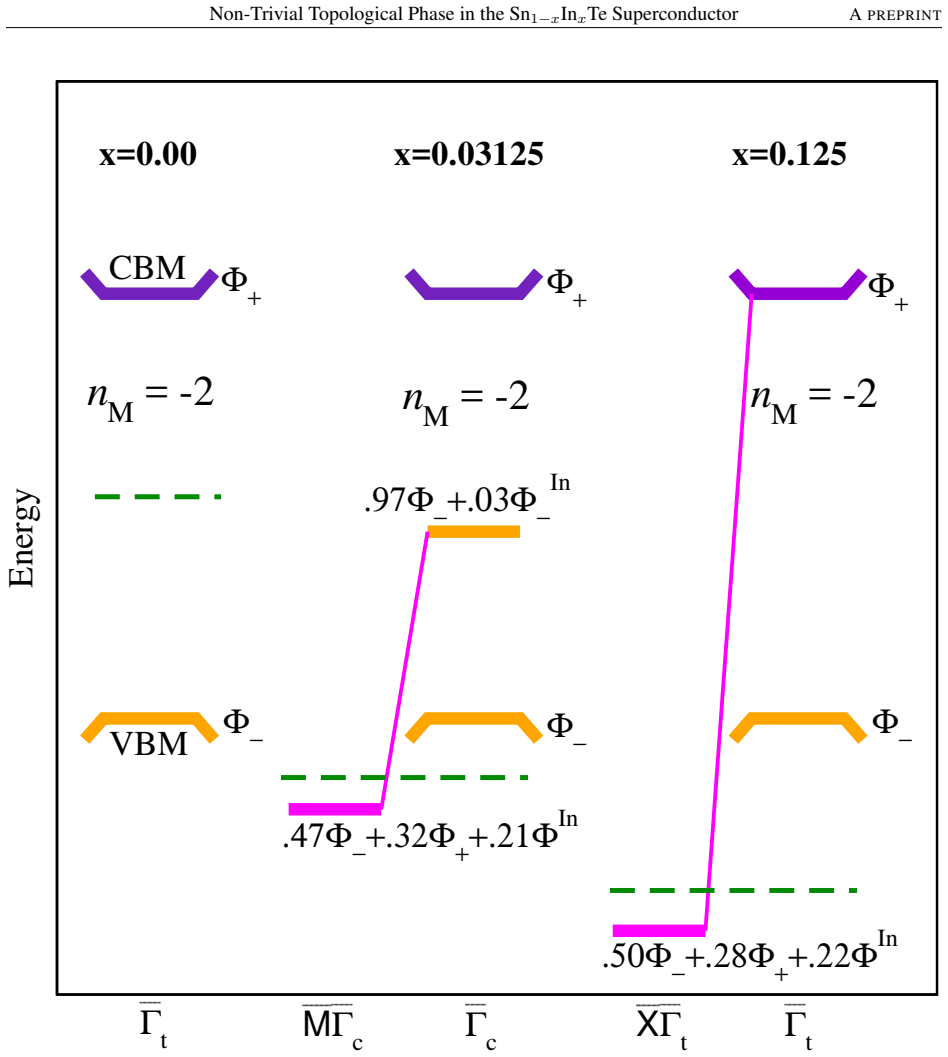
The load-bearing method is the mirror Chern number $n_M$ computed with hybrid Wannier charge centers: the Wannier functions are built from first-principles band structures, and their charge-center winding on a mirror-invariant plane counts the net number of protected surface-state branches in each mirror subspace. The physical mechanism is band inversion at the fcc L point, where spin-orbit coupling swaps the p-anion and s-cation characters of the valence and conduction edges. The In-5s-derived state sits in or near the band gap, keeps the same [111]-oriented p character as the valence band maximum, and is used to explain why the inversion and the $n_M = -2$ invariant persist despite doping.
What would settle it
Repeat the Wannier-center calculation separately for the two mirror eigenvalue classes at $x = 0.125$ and $x = 0.25$. If either class of Wannier bands closes or cannot be followed continuously across the Brillouin zone, the winding that gives $n_M = -2$ is undefined, and those concentrations would be band-inverted metals rather than topological phases.
Extended reading notes
Core claim
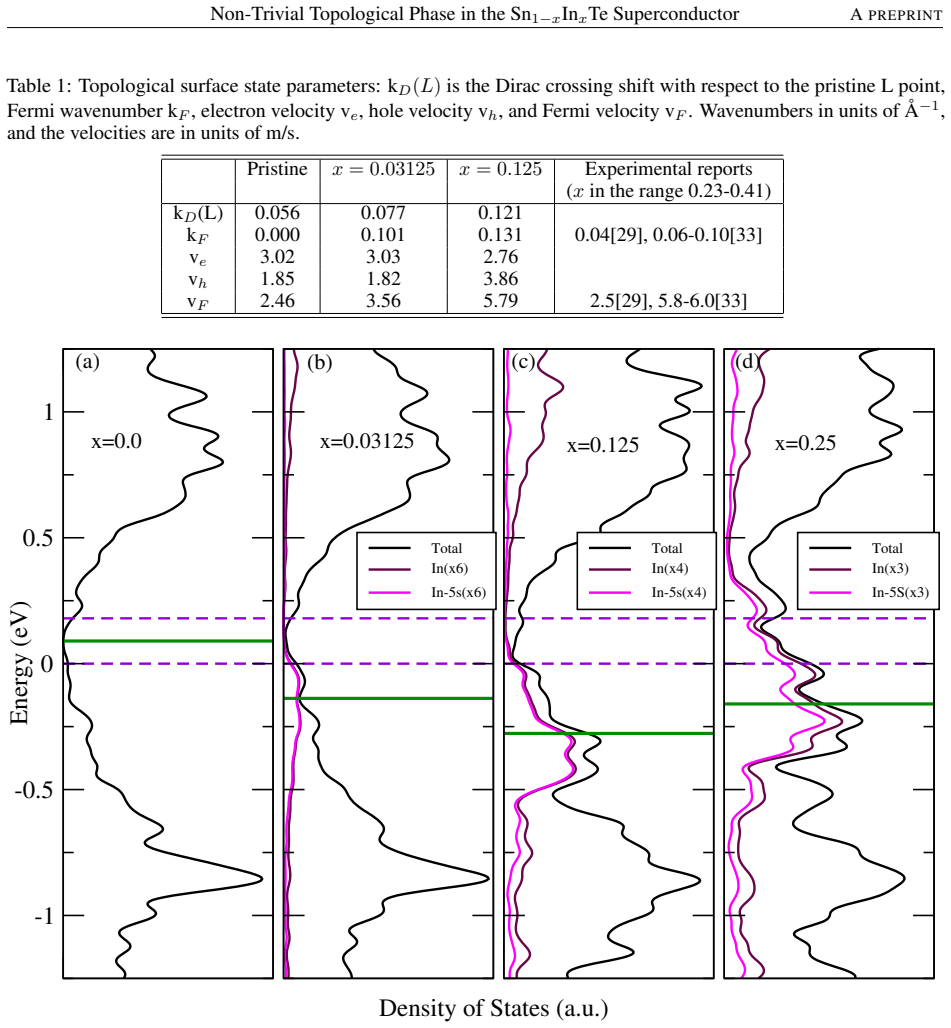
On its own terms, the paper's central discovery is that the topological character of SnTe survives indium substitution. Spin-orbit coupling keeps the valence and conduction bands inverted at the L point for $x = 0.03125$, $0.125$, and $0.25$, even though the alloy becomes metallic for $x > 0.1$. The computed mirror Chern number is $n_M = -2$ for all three concentrations, and slab calculations show pairs of topological surface states on the (001) surface with mirror eigenvalues $+i$ and $-i$. The paper further finds that the In-5s impurity state sits near the Fermi level, its depopulation explains the experimentally observed transition from hole-like to electron-like carriers, and the near-Fermi density of states is dominated by In-5s, which the authors read as support for s-wave superconductivity.
Load-bearing premise
The results assume that the topological invariant used here remains well defined for the concentrations at which the alloy becomes a metal, even though no gap in the states the invariant counts is demonstrated for those concentrations.
Editorial extensions
If this is right
- For $x = 0.03125$ the alloy remains a gapped p-type semiconductor with an In state inside the gap, so its $n_M = -2$ mirrors pristine SnTe and the surface Dirac states should be observable in the (001) gap.
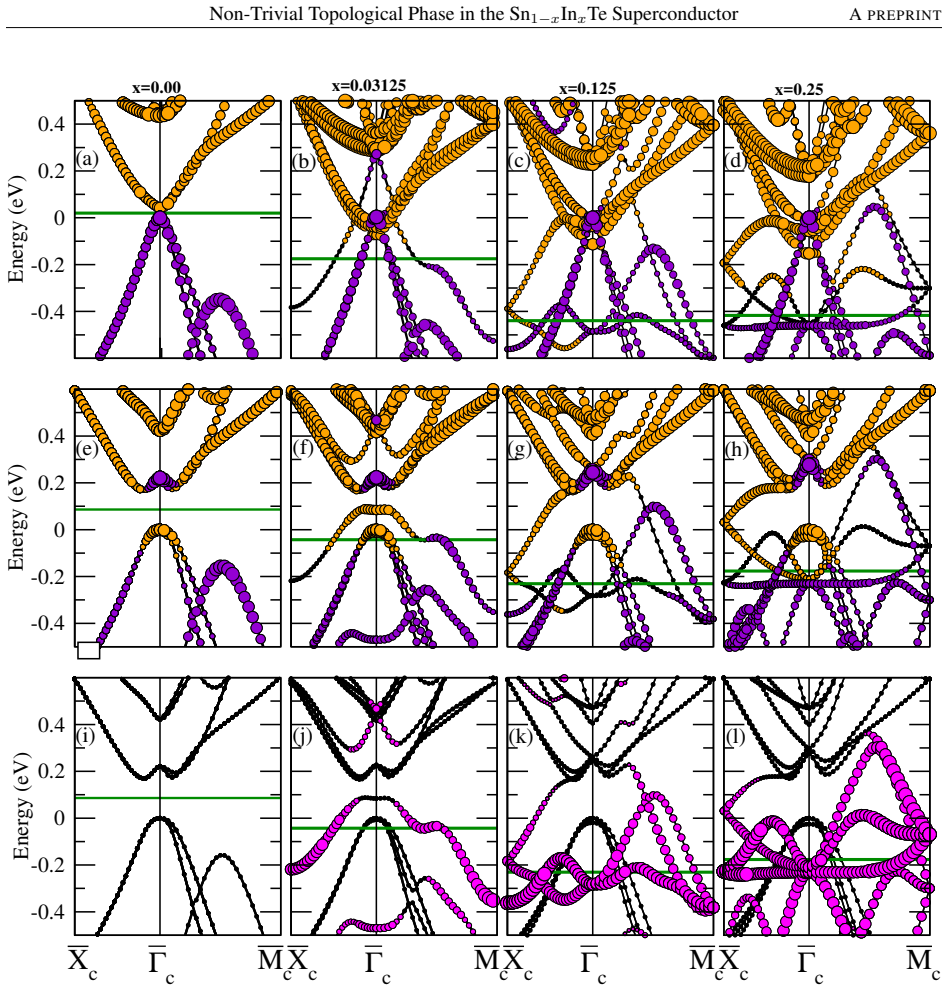
- For $x = 0.125$ and $x = 0.25$ the bulk is gapless, yet the paper still reports $n_M = -2$, implying that the non-trivial invariant is claimed to survive into the metallic regime.
- As $x$ increases, the surface Dirac crossing moves farther from the projected L point and the hole Fermi velocity rises substantially, matching the trend seen in ARPES experiments on heavily doped samples.
- The dominance of In-5s states at the Fermi level supports s-wave BCS pairing and explains the experimentally observed hole-to-electron crossover as the In-5s level depopulates.
Reading between the lines
- If $n_M = -2$ truly survives in the metallic regime, the paper's Wannier-center calculation implicitly assumes the mirror subspaces stay gapped even when the total bulk is gapless; checking that subspace gap directly for $x = 0.125$ and $x = 0.25$ would separate a protected topological metal from a merely band-inverted one.
- The monotonic increase in Fermi velocity with $x$ gives a quantitative prediction: ARPES on (001) surfaces at intermediate concentrations should find the Dirac crossing shifted away from the L point by roughly the paper's computed $k_D$ values.
- The paper argues for s-wave pairing, but its own topological invariant suggests a natural next question the authors do not ask: whether the mirror symmetry protecting the surface states also protects a topological superconducting phase once the bulk becomes superconducting.
- Because the In-5s state is both the main source of Fermi-level density of states and the cause of the carrier-sign change, doping that tunes the In-5s occupation should move $T_c$ in step with the density of states; correlating those two quantities experimentally would test the pairing picture.
Signed reviews
Editorial analysis
A structured set of objections, weighed in public.
Referee Report
Summary. The manuscript reports first-principles DFT calculations of the topological phase in Sn_{1-x}In_xTe for x=0, 0.03125, 0.125, and 0.25. The authors find that band inversion at the L point is preserved for all doped concentrations, and they compute a mirror Chern number n_M=-2 for x=0.03125, 0.125, and 0.25, despite the system becoming metallic for x>0.1. Slab calculations reveal surface states with +/- i mirror eigenvalues for x=0.03125 and x=0.125, with the Dirac point shifting away from L and the Fermi velocity increasing with x. The paper further argues, from the density of states at the Fermi level being dominated by In-5s states, that the superconductivity is s-wave.
Significance. If correct, the central claim would establish that the superconducting alloy Sn_{1-x}In_xTe retains non-trivial mirror-protected topology across the experimentally relevant doping range, strengthening the case for topological superconductivity in this material. The work combines ab initio band structure with Wannier-based topological invariants and makes quantitative contact with ARPES Fermi velocities. Strengths are the use of standard first-principles methods with no free parameters tuned to force the topological result, and explicit comparisons with experiment. However, the claim for the metallic concentrations requires additional justification, as detailed below.
major comments (3)
- [Sec. 3.1 (and Sec. 2)] The mirror Chern number is reported as n_M=-2 for x=0.125 and x=0.25, but the text states that the system 'becomes a metal for x>0.1' and shows gapless band structures (Fig. 2(g),(h)). The hybrid Wannier charge center method [34,35] defines the mirror Chern number through the evolution of Wannier centers in each mirror eigensector, which requires a spectral gap on the mirror-invariant plane to quantize the integer. The manuscript does not provide a mirror-resolved gap check on any {110}-type plane for these concentrations, nor does it show the WCC evolution curves. Without this, the values n_M=-2 for the metallic phases are not established. The authors should either demonstrate that the mirror subspaces are gapped at E_F and provide the WCC evolution, or clearly define and justify an alternative invariant for metallic systems.
- [Sec. 3.1, last paragraph] The sentence 'Using the same procedure as described above the computed mirror Chern number for each of x = 0.03125 and 0.25 is n_M = -2' omits x=0.125, whereas the abstract and conclusion claim n_M = -2 for x=0.03125, x=0.125, and x=0.25. This is a direct inconsistency between the central claim and the reported computation. The computation for x=0.125 must either be shown or the claim must be revised.
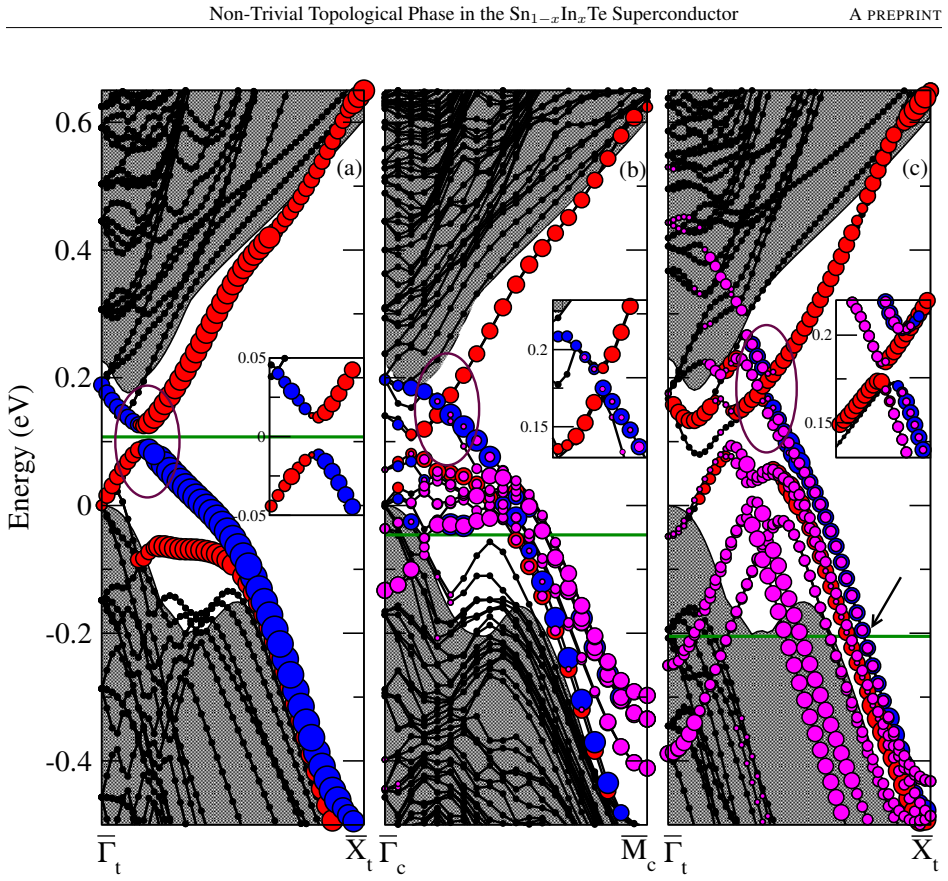
- [Sec. 3.2, Fig. 4] For x=0.125, the slab calculation is performed in a metallic regime, and the displayed surface bands cross the Fermi level together with bulk states. The paper does not demonstrate that the surface states are still topologically protected when the bulk is metallic. The argument for protection of the surface states relies on a bulk gap on the mirror plane, which is not established. To support the claim of topological surface states at x=0.125, the authors should present the mirror-resolved surface spectral function and discuss the role of metallic bulk states.
minor comments (8)
- [Sec. 1 and throughout] Typos include 'asbence' (Sec. 2), 'compunds' (Sec. 2), 'wheather' (Sec. 3.1), and 'Supressed' in Ref. [47]. These should be corrected.
- [Fig. 2 caption] The third panel label 'Sn0.175In0.875Te' appears to be a typo for 'Sn0.875In0.125Te' (i.e., x=0.125).
- [Sec. 3.3] The text refers to 'Sn xIn1−xTe'; the intended formula is Sn1−xInxTe.
- [Sec. 3.1] The statement that x=0.03125 is 'a gapped p-type doped semiconductor' while the Fermi level 'lies slightly below the valence band maximum' is confusing: a Fermi level below the VBM usually indicates a degenerate (metallic) state. Please clarify the position of the Fermi level and the meaning of 'gapped' in this context.
- [Sec. 2] The lattice parameters used for each In concentration are not listed. Since the paper states a linear reduction based on Refs. [22,26], the actual values should be provided for reproducibility.
- [Sec. 2] The k-point sampling is reported as 10x10x10 for all bulk calculations, but for metallic concentrations a denser mesh or at least a convergence test against a finer k-point grid should be reported.
- [Table 1] The units of kD(L) are given in Å^{-1}, but the shift from the L point should be a momentum difference; please specify the reciprocal lattice direction and define the reference clearly.
- [Sec. 3.3] The conclusion that 'This confirms the s-wave nature of the superconducting state' is an overstatement, since the normal-state DOS alone does not determine the pairing symmetry. Rephrase to 'consistent with s-wave pairing' or provide additional justification.
Circularity Check
No circularity: topological invariants and surface states are computed from first-principles DFT/Wannier calculations with no fit to the target result.
full rationale
The central claim — mirror Chern number nM=-2 for Sn1-xInxTe at x=0.03125, 0.125, and 0.25 — is obtained from hybrid Wannier charge centers constructed from first-principles DFT wavefunctions (Sec. 2). No parameter is fitted to the target invariant; experimental lattice constants and standard GGA/PBE functionals are the only external inputs, and the reported Fermi velocities and DOS values are compared with ARPES/magnetization data only after the fact. The band-inversion analysis (orbital characters Φ±) is an independent characterization, not an input to the invariant calculation. The paper does cite prior work by the authors (Refs. [46,47]) for monolayer topology and slab-thickness behavior, but those citations are not load-bearing for the alloy's nM or surface-state existence, which are computed here from first principles and checked against independent experimental ARPES results [21,33]. A reported gap in support — the WCC invariant for the metallic x=0.125 case is claimed in the abstract but the text only explicitly reports computed values for x=0.03125 and x=0.25 — is an omission/consistency issue, not a circular reduction; the required mirror-plane gap is not shown, but neither is the claim derived from an input. No equation or definition equates the predicted invariant to an assumed input, so no circular step can be exhibited.
Assumptions & free parameters
assumptions (4)
- domain assumption PBE-GGA DFT with fully relativistic PAW pseudopotentials correctly captures the band inversion and topological properties of SnTe and its alloys.
- domain assumption The hybrid Wannier charge center scheme yields a well-defined mirror Chern number for the doped systems, including metallic ones.
- domain assumption A single ordered In distribution in a 64-atom supercell is representative of the random alloy Sn1-xInxTe.
- domain assumption The linear reduction of the experimental lattice parameter for In content follows Vegard's law and does not affect the topological invariant.
Cite this review
Pith. "Pith review of Non-Trivial Topological Phase in the Sn_{1-x}In_xTe Superconductor." pith.science (2026). https://pith.science/paper/3J4O3BAX
@misc{pith2026190805967,
  author       = {Pith},
  title        = {Pith review of: Non-Trivial Topological Phase in the Sn_1-xIn_xTe Superconductor},
  year         = {2026},
  howpublished = {\url{https://pith.science/paper/3J4O3BAX}},
  note         = {Machine review of arXiv:1908.05967}
}
read the original abstract
Whereas SnTe is a inverted band gap topological crystalline insulator, the topological phase of the alloy Sn_{1-x}In_xTe, a topological superconductor candidate, has not been clearly studied so far. Our calculations show that the Sn_{1-x}In_xTe band gap reduces by increasing the In content, becoming a metal for x>0.1. However, the band inversion at the fcc L point for both gapped and gapless phases has been maintained. Furthermore, the computed topological invariant shows a non-trivial phase with a mirror Chern number n_M = -2 for In concentrations of x=0.03125, x=0.125, and x=0.25. We also identify pairs of topologically protected states on the (001) surface of Sn_{1-x}In_xTe with +/- i mirror eigenvalues. The character of these topological states is affected by In dopant. As the In content x increases, the Dirac crossing point moves further away from the L point, and the Fermi velocity of the topological states increases significantly. Our results demonstrate a non-trivial topological phase for the superconductor Sn_{1-x}In_xTe, and provide a detailed description of the topological state properties.
Figures
Figures from the paper (2 more)
Reference graph
Works this paper leans on
-
[1]
M. Z. Hasan and C. L. Kane. Colloquium: Topological insulators. Rev. Mod. Phys., 82:3045–3067, Nov 2010
work page 2010
-
[2]
Topological insulator materials
Yoichi Ando. Topological insulator materials. J. Phys. Soc. Jap., 82(10):102001, 2013
work page 2013
-
[3]
Topological insulators and superconductors
Xiao-Liang Qi and Shou-Cheng Zhang. Topological insulators and superconductors. Rev. Mod. Phys., 83:1057– 1110, Oct 2011
work page 2011
-
[4]
Topological crystalline insulators and topological superconductors: From concepts to materials
Yoichi Ando and Liang Fu. Topological crystalline insulators and topological superconductors: From concepts to materials. Annu. Rev. Condens. Matter Phys., 6(1):361–381, 2015
work page 2015
-
[5]
Topological superconductors: a review
Masatoshi Sato and Yoichi Ando. Topological superconductors: a review. Rep. Prog. Phys., 80(1):076501, 2017
work page 2017
-
[6]
Z2 topological order and the quantum spin Hall effect
Charles L Kane and Eugene J Mele. Z2 topological order and the quantum spin Hall effect. Phys. Rev. Lett., 95(14):146802, 2005
work page 2005
-
[7]
Topological crystalline insulators
Liang Fu. Topological crystalline insulators. Phys. Rev. Lett., 106(10):106802, 2011
work page 2011
-
[8]
Liang Fu and C. L. Kane. Superconducting proximity effect and majorana fermions at the surface of a topological insulator. Phys. Rev. Lett., 100:096407, Mar 2008
work page 2008
Show all 48 references
-
[9]
S.-Y . Xu, N. Alidoust, I. Belopolski, A. Richardella, C. Liu, M. Newpane, G. Bian, S. H. Huang, R. Sankar, C. Fang, B. Dellabetta, W. Dai, Q. Li, M. J. Gilbert, F. Chou, N. Samarth, and M. Hasan. Momentum-space imaging of Cooper pairing in a half-Dirac-gas topological superco...
2014
-
[10]
Y . S. Hor, A. J. Williams, J. G. Checkelsky, P. Roushan, J. Seo, Q. Xu, H. W. Zandbergen, A. Yazdani, N. P. Ong, and R. J. Cava. Superconductivity in cuxbi2se3 and its implications for pairing in the undoped topological insulator. Phys. Rev. Lett., 104:057001, Feb 2010
2010
-
[11]
Kriener, Kouji Segawa, Zhi Ren, Satoshi Sasaki, and Yoichi Ando
M. Kriener, Kouji Segawa, Zhi Ren, Satoshi Sasaki, and Yoichi Ando. Bulk superconducting phase with a full energy gap in the doped topological insulator cuxbi2se3. Phys. Rev. Lett., 106:127004, Mar 2011
2011
-
[12]
Kriener, Kouji Segawa, Zhi Ren, Satoshi Sasaki, Shohei Wada, Susumu Kuwabata, and Yoichi Ando
M. Kriener, Kouji Segawa, Zhi Ren, Satoshi Sasaki, Shohei Wada, Susumu Kuwabata, and Yoichi Ando. Electro- chemical synthesis and superconducting phase diagram of cuxbi2se3. Phys. Rev. B, 84:054513, Aug 2011
2011
-
[13]
Spin-triplet vortex state in the topological superconductor cuxbi2se3
Pradip Das, Yusuke Suzuki, Masashi Tachiki, and Kazuo Kadowaki. Spin-triplet vortex state in the topological superconductor cuxbi2se3. Phys. Rev. B, 83:220513(R), Jun 2011
2011
-
[14]
Superconductivity with topological surface state in srxbi2se3
Zhongheng Liu, Xiong Yao, Jifeng Shao, Ming Zuo, Li Pi, Shun Tan, Changjin Zhang, and Yuheng Zhang. Superconductivity with topological surface state in srxbi2se3. J. Am. Chem. Soc., 137(33):10512–10515, 2015
2015
-
[15]
Shruti, V . K. Maurya, P. Neha, P. Srivastava, and S. Patnaik. Superconductivity by sr intercalation in the layered topological insulator bi2se3. Phys. Rev. B, 92:020506(R), Jul 2015
2015
-
[16]
J. A. Schneeloch, R. D. Zhong, Z. J. Xu, G. D. Gu, and J. M. Tranquada. Dependence of superconductivity in cuxbi2se3 on quenching conditions. Phys. Rev. B, 91:144506, Apr 2015
2015
-
[17]
M. P. Smylie, H. Claus, U. Welp, W.-K. Kwok, Y . Qiu, Y . S. Hor, and A. Snezhko. Evidence of nodes in the order parameter of the superconducting doped topological insulator nbxbi2se3 via penetration depth measurements. Phys. Rev. B, 94:180510(R), Nov 2016
2016
-
[18]
Zhiwei Wang, A. A. Taskin, Tobias Frölich, Markus Braden, and Yoichi Ando. Superconductivity in tl0.6bi2te3 derived from a topological insulator. Chem. Mat., 28(3):779–784, 2016
2016
-
[19]
Satoshi Sasaki, Zhi Ren, A. A. Taskin, Kouji Segawa, Liang Fu, and Yoichi Ando. Odd-parity pairing and topological superconductivity in a strongly spin-orbit coupled semiconductor. Phys. Rev. Lett., 109:217004, Nov 2012. 9 Non-Trivial Topological Phase in the Sn1−xInxTe Superc...
2012
-
[20]
A. S. Erickson, J.-H. Chu, M. F. Toney, T. H. Geballe, and I. R. Fisher. Enhanced superconducting pairing interaction in indium-doped tin telluride. Phys. Rev. B, 79:024520, Jan 2009
2009
-
[21]
T. Sato, Y . Tanaka, K. Nakayama, S. Souma, T. Takahashi, S. Sasaki, Z. Ren, A. A. Taskin, Kouji Segawa, and Yoichi Ando. Fermiology of the strongly spin-orbit coupled superconductor sn1−xinxTe: Implications for topological superconductivity. Phys. Rev. Lett., 110:206804, May 2013
2013
-
[22]
Balakrishnan, L
G. Balakrishnan, L. Bawden, S. Cavendish, and M. R. Lees. Superconducting properties of the in-substituted topological crystalline insulator snte. Phys. Rev. B, 87:140507(R), Apr 2013
2013
-
[23]
V . K. Maurya, Shruti, P. Srivastava, and S. Patnaik. Superconducting properties of indium-doped topological crystalline insulator snte. Europhys. Lett.), 108(3):37010, 2014
2014
-
[24]
Saghir, J
M. Saghir, J. A. T. Barker, G. Balakrishnan, A. D. Hillier, and M. R. Lees. Superconducting properties of sn1−xinxTe (x = 0.38−− 0.45) studied using muon-spin spectroscopy. Phys. Rev. B, 90:064508, Aug 2014
2014
-
[25]
Jie Shen, Yujun Xie, and Judy J. Cha. Revealing surface states in in-doped snte nanoplates with low bulk mobility. Nano Lett., 15(6):3827–3832, 2015
2015
-
[26]
Neel Haldolaarachchige, Quinn Gibson, Weiwei Xie, Morten Bormann Nielsen, Satya Kushwaha, and R. J. Cava. Anomalous composition dependence of the superconductivity in in-doped snte. Phys. Rev. B, 93:024520, Jan 2016
2016
-
[27]
Spin-singlet superconductivity in the doped topological crystalline insulator sn0.96in0.04Te
Satoki Maeda, Ryohei Hirose, Kazuaki Matano, Mario Novak, Yoichi Ando, and Guo-qing Zheng. Spin-singlet superconductivity in the doped topological crystalline insulator sn0.96in0.04Te. Phys. Rev. B, 96:104502, Sep 2017
2017
-
[28]
M. P. Smylie, H. Claus, W.-K. Kwok, E. R. Louden, M. R. Eskildsen, A. S. Sefat, R. D. Zhong, J. Schneeloch, G. D. Gu, E. Bokari, P. M. Niraula, A. Kayani, C. D. Dewhurst, A. Snezhko, and U. Welp. Superconductivity, pairing symmetry, and disorder in the doped topological insula...
-
[29]
Cheng Zhang, Xu-Gang He, Hang Chi, Ruidan Zhong, Wei Ku, Genda Gu, J. M. Tranquada, and Qiang Li. Electron and hole contributions to normal-state transport in the superconducting system sn1−xinxTe. Phys. Rev. B, 98:054503, Aug 2018
2018
-
[30]
Kejing Ran, Ruidan Zhong, Tong Chen, Yuan Gan, Jinghui Wang, B. L. Winn, A. D. Christianson, Shichao Li, Zhen Ma, Song Bao, Zhengwei Cai, Guangyong Xu, J. M. Tranquada, Genda Gu, Jian Sun, and Jinsheng Wen. Unusual phonon density of states and response to the superconducting t...
2018
-
[31]
Topological crystalline insulators in the SnTe material class
Timothy H Hsieh, Hsin Lin, Junwei Liu, Wenhui Duan, Arun Bansil, and Liang Fu. Topological crystalline insulators in the SnTe material class. Nature communications, 3:982, 2012
2012
-
[32]
Experimental realization of a topological crystalline insulator in SnTe
Y Tanaka, Zhi Ren, T Sato, K Nakayama, S Souma, T Takahashi, Kouji Segawa, and Yoichi Ando. Experimental realization of a topological crystalline insulator in SnTe. Nature Physics, 8(11):800–803, 2012
2012
-
[33]
C. M. Polley, V . Jovic, T.-Y . Su, M. Saghir, D. Newby, B. J. Kowalski, R. Jakiela, A. Barcz, M. Guziewicz, T. Balasubramanian, G. Balakrishnan, J. Laverock, and K. E. Smith. Observation of surface states on heavily indium-doped snte(111), a superconducting topological crysta...
2016
-
[34]
Soluyanov and David Vanderbilt
Alexey A. Soluyanov and David Vanderbilt. Computing topological invariants without inversion symmetry. Phys. Rev. B, 83:235401, Jun 2011
2011
-
[35]
Yazyev, Matthias Troyer, David Vanderbilt, B
Dominik Gresch, Gabriel Autès, Oleg V . Yazyev, Matthias Troyer, David Vanderbilt, B. Andrei Bernevig, and Alexey A. Soluyanov. Z2pack: Numerical implementation of hybrid wannier centers for identifying topological materials. Phys. Rev. B, 95:075146, Feb 2017
2017
-
[36]
Perdew, Kieron Burke, and Matthias Ernzerhof
John P. Perdew, Kieron Burke, and Matthias Ernzerhof. Generalized gradient approximation made simple. Phys. Rev. Lett., 77:3865–3868, Oct 1996
1996
-
[37]
P. E. Blöchl. Projector augmented-wave method. Phys. Rev. B, 50:17953–17979, Dec 1994
1994
-
[38]
Kresse and J
G. Kresse and J. Furthmüller. Efficiency of ab-initio total energy calculations for metals and semiconductors using a plane-wave basis set. Comp. Mat. Sci., 6(1):15 – 50, 1996
1996
-
[39]
Kresse and J
G. Kresse and J. Furthmüller. Efficient iterative schemes for ab initio total-energy calculations using a plane-wave basis set. Phys. Rev. B, 54:11169–11186, Oct 1996
1996
-
[40]
Quantum espresso: a modular and open-source software project for quantum simulations of materials
Paolo Giannozzi, Stefano Baroni, Nicola Bonini, Matteo Calandra, Roberto Car, Carlo Cavazzoni, Davide Ceresoli, Guido L Chiarotti, Matteo Cococcioni, Ismaila Dabo, Andrea Dal Corso, Stefano de Gironcoli, Stefano Fabris, Guido Fratesi, Ralph Gebauer, Uwe Gerstmann, Christos Gou...
2009
-
[41]
Monkhorst and James D
Hendrik J. Monkhorst and James D. Pack. Special points for brillouin-zone integrations. Phys. Rev. B, 13:5188– 5192, Jun 1976
1976
-
[42]
Y . W. Tsang and Marvin L. Cohen. Calculation of the temperature dependence of the energy gaps in pbte and snte. Phys. Rev. B, 3:1254–1261, Feb 1971
1971
-
[43]
Walter and Marvin L
John P. Walter and Marvin L. Cohen. Pseudopotential calculations of electronic charge densities in seven semiconductors. Phys. Rev. B, 4:1877–1892, Sep 1971
1971
-
[44]
T. P. Humphreys and G. P. Srivastava. Nonlocal pseudopotential calculations for two isoelectronic series: Ge-gaas- znse andα-sn-insb-cdte. physica status solidi (b) , 112(2):581–597, 1982
1982
-
[45]
Maximally localized generalized wannier functions for composite energy bands
Nicola Marzari and David Vanderbilt. Maximally localized generalized wannier functions for composite energy bands. Phys. Rev. B, 56:12847–12865, Nov 1997
1997
-
[46]
Araújo, Ernesto O
Augusto L. Araújo, Ernesto O. Wrasse, Gerson J. Ferreira, and Tome M. Schmidt. Topological nonsymmorphic ribbons out of symmorphic bulk. Phys. Rev. B, 93:161101(R), Apr 2016
2016
-
[47]
Araújo, Gerson J
Augusto L. Araújo, Gerson J. Ferreira, and Tome M. Schmidt. Supressed topological phase transitions due to nonsymmorphism in snte stacking. Sci. Rep., 8:9452, Jun 2018
2018
-
[48]
J. M. Ziman. Principles of the theory of solids . Cambridge University Press, 1964. 11
1964
Reviewed August 14, 2026 · model on record in the stance chip above.
Discussion (0). Continue with ORCID to comment.