In situ synchrotron X-ray diffraction study of flash austenitization and process design insights in medium-Manganese steels for energy applications
Pith reviewed 2026-06-29 03:56 UTC · model grok-4.3
The pith
Full austenitization in medium-Mn steel needs 2-8 s of hold time after rapid heating, with shorter times at higher temperatures.
A machine-rendered reading of the paper's core claim, the machinery that carries it, and where it could break.
Core claim
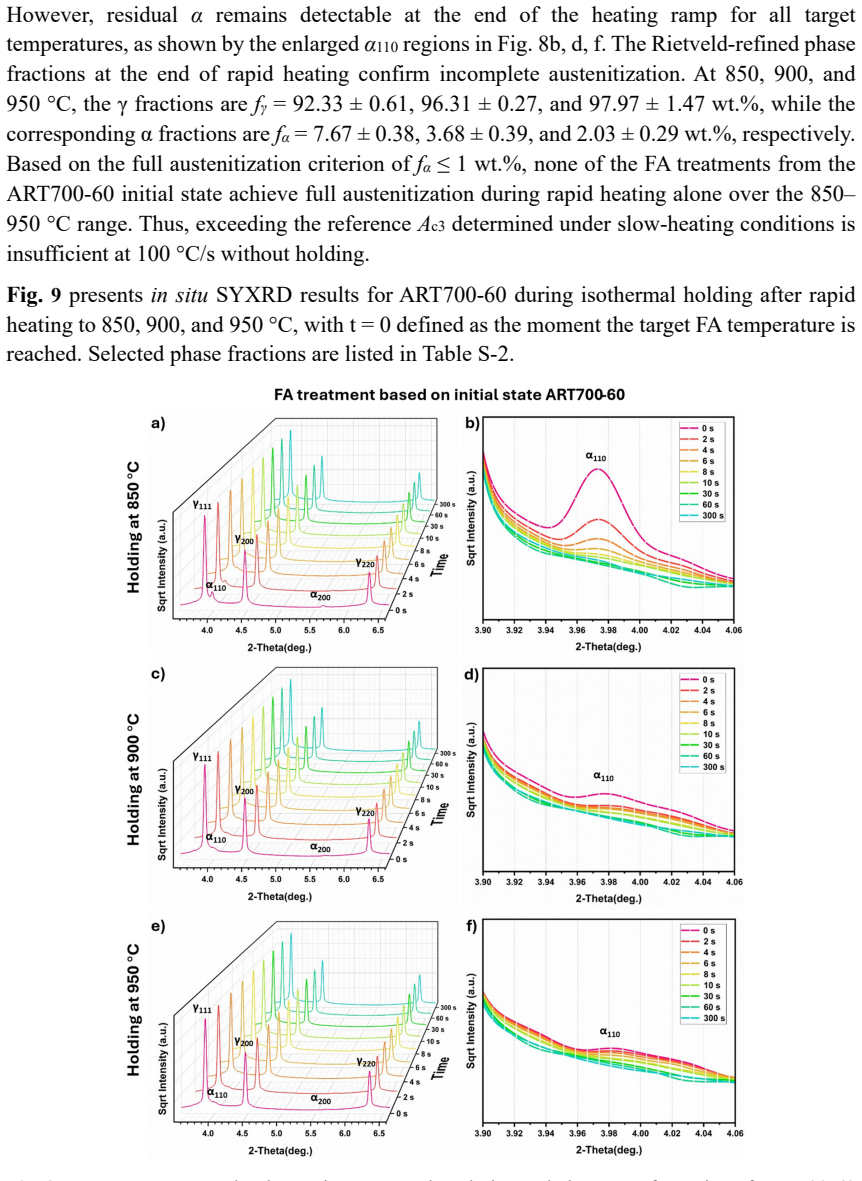
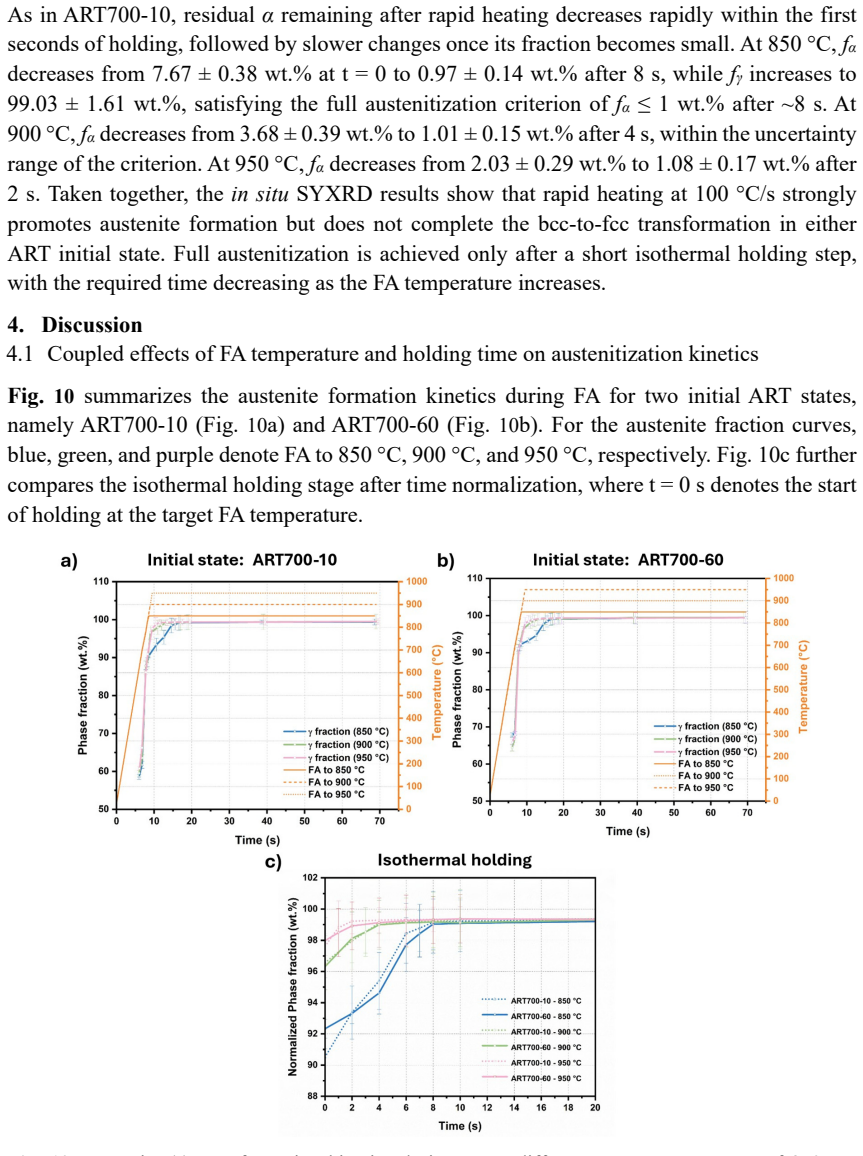
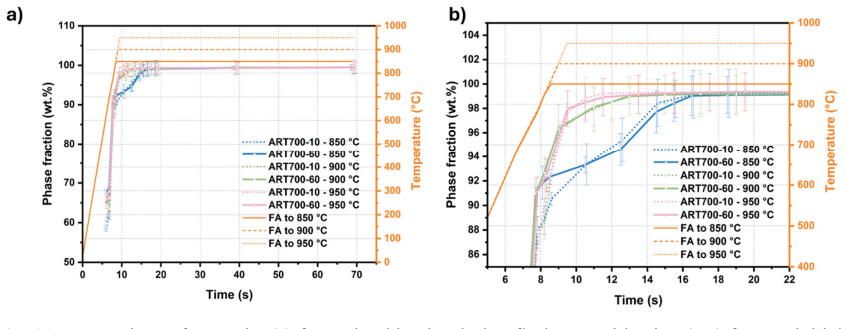
Dilatometry-integrated in situ synchrotron X-ray diffraction on an Fe-6Mn-1.5Si-1Cr-0.3Mo-0.05Nb-0.2C steel reveals that full austenitization, defined as bcc fraction f_alpha <= 1 wt.%, is not achieved by rapid heating alone. Short isothermal holding is required, decreasing from about 8 s at 850 C to about 2 s at 950 C. The final stage of austenitization shows weaker temperature dependence than the early holding stage. Initial microstructures produced by austenite reversion treatment shift the starting austenite fraction but yield comparable kinetic trends at higher flash-austenitization temperatures.
What carries the argument
In situ synchrotron X-ray diffraction measurement of bcc fraction (f_alpha) during 100 C/s heating and short isothermal holds, used to quantify completion of austenitization.
If this is right
- Flash austenitization cycles can be designed with holds of only a few seconds while still reaching full austenite.
- Higher flash temperatures allow shorter total process times and reduce prior austenite grain growth.
- The initial microstructure mainly sets the austenite starting fraction; later kinetics are similar at 900-950 C.
- Process windows exist where the final transformation stage is relatively insensitive to small temperature variations.
- Rapid heating to above the slow-heating Ac3 is not sufficient by itself for complete transformation.
Where Pith is reading between the lines
- These short hold times could be integrated into continuous annealing lines for energy-related steel products without major equipment changes.
- The temperature dependence pattern suggests the early stage is interface-controlled while the final stage is diffusion-limited.
- Similar in-situ measurements on other Mn levels or heating rates would test whether the 2-8 s window generalizes.
- Combining the kinetics data with grain-growth models could predict optimal flash parameters for target toughness.
Load-bearing premise
The synchrotron X-ray diffraction signal for bcc fraction accurately reflects the bulk phase change without major distortion from sample surface, geometry, or the rapid heating rate.
What would settle it
Metallographic or magnetic measurement showing more than 1 wt.% ferrite remaining after the reported hold times at each temperature would show the transformation is not complete.
Figures
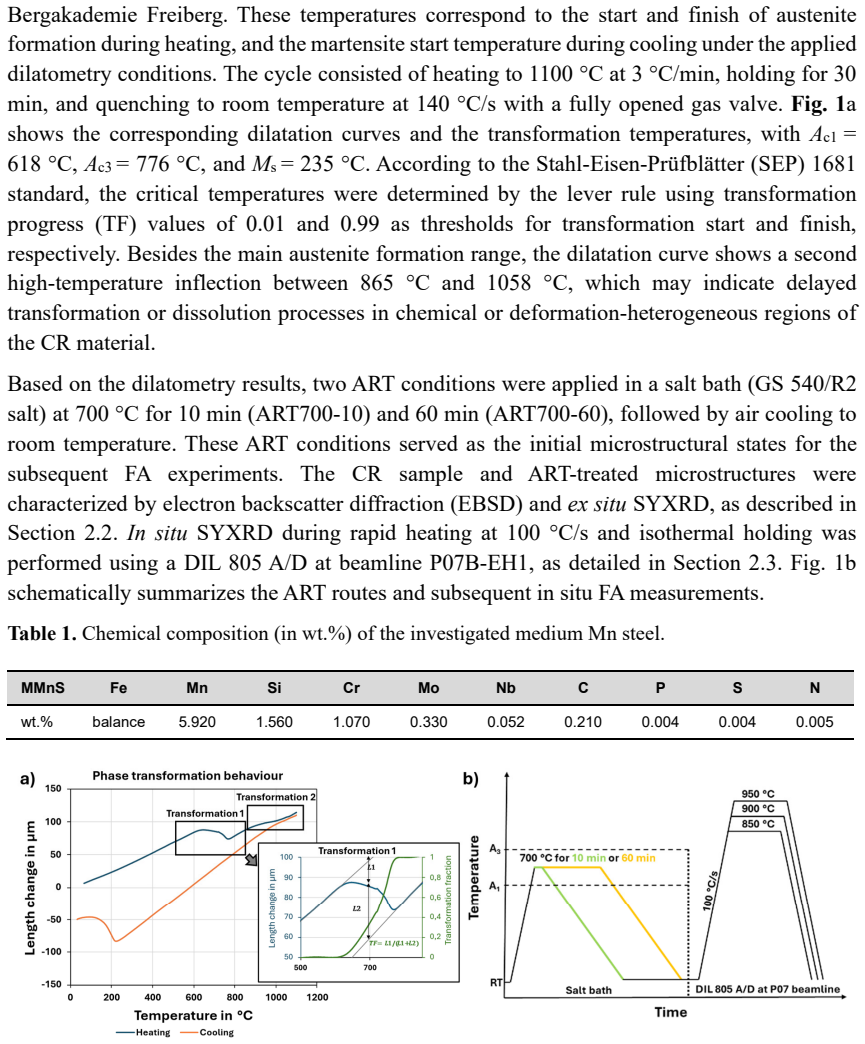
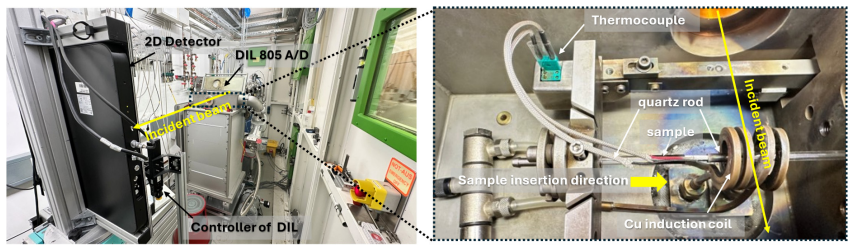
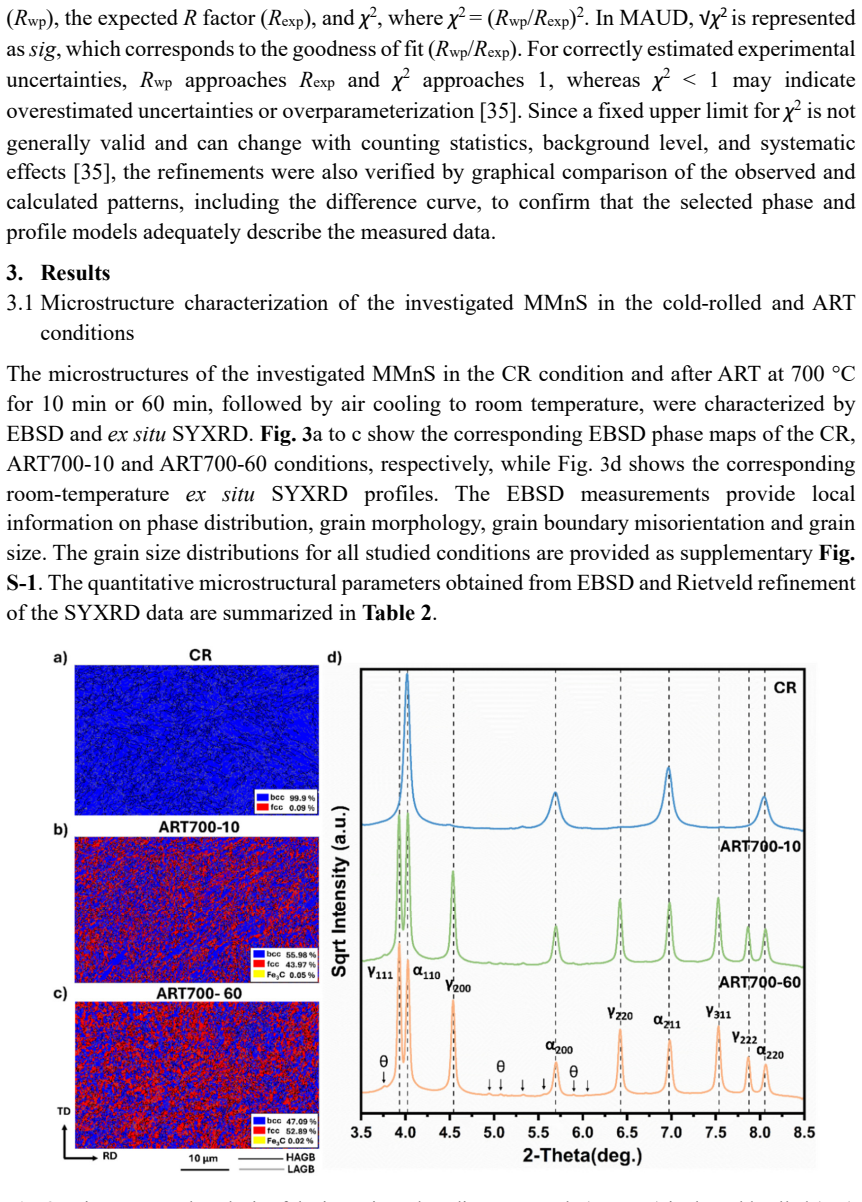
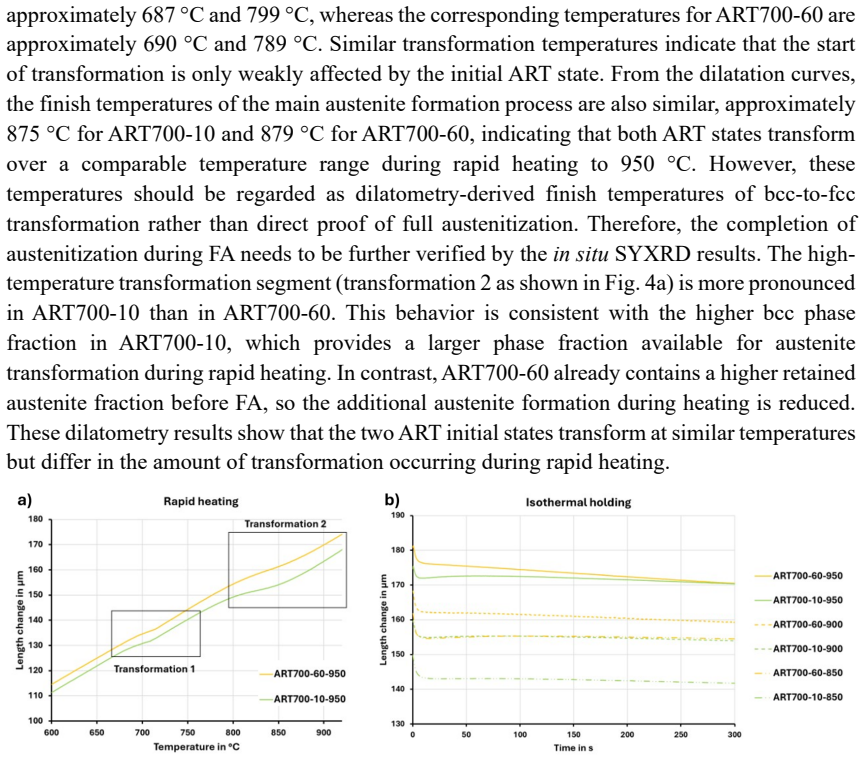
read the original abstract
Medium Mn steels (MMnSs) are promising candidates for energy-related infrastructure because their multiphase microstructures and austenite stability can be tailored to improve failure resistance under demanding service conditions. Flash austenitization (FA) provides a rapid route to form austenite while limiting prior austenite grain coarsening and substitutional solute homogenization, but the related short-time transformation kinetics remain insufficiently quantified. In the present work, the effects of FA temperature and initial microstructure on austenitization kinetics were investigated in an Fe-6Mn-1.5Si-1Cr-0.3Mo-0.05Nb-0.2C (wt.%) MMnS using dilatometry-integrated in situ synchrotron X-ray diffraction. Two initial microstructures produced by austenite reversion treatment (ART) were heated at 100 degrees C/s to 850 degrees C, 900 degrees C, or 950 degrees C and then held isothermally. Rapid heating alone is insufficient for full austenitization, even above the reference Ac3 temperature determined under slow heating. Full austenitization, defined by bcc fraction (f_alpha) <= 1 wt.%, requires short holding, decreasing from about 8 s at 850 degrees C to about 2 s at 950 degrees C. The final stage of austenitization is less sensitive to FA temperature than the early holding stage. The initial ART state mainly shifts the starting austenite fraction, whereas both states show comparable kinetic trends at higher FA temperatures.
Editorial analysis
A structured set of objections, weighed in public.
Referee Report
Summary. The manuscript reports an in situ synchrotron XRD study (integrated with dilatometry) of flash austenitization kinetics in an Fe-6Mn-1.5Si-1Cr-0.3Mo-0.05Nb-0.2C medium-Mn steel. Two initial ART microstructures are heated at 100 °C/s to 850, 900 or 950 °C and held isothermally; the central experimental result is that full austenitization (defined as bcc fraction f_α ≤ 1 wt.%) requires short isothermal holds whose duration decreases from ~8 s at 850 °C to ~2 s at 950 °C, with the final stage of transformation less temperature-sensitive than the early stage and with initial microstructure mainly affecting the starting austenite fraction.
Significance. If the reported phase-fraction time series are free of significant measurement artifacts, the work supplies quantitative, temperature-dependent holding-time data for flash austenitization that are directly relevant to process design for medium-Mn steels in energy applications. The combination of 100 °C/s heating with synchrotron XRD time resolution is a methodological strength that enables access to the short-time regime not easily captured by conventional dilatometry or ex-situ methods.
major comments (2)
- [Methods / Results (phase-fraction extraction)] The central claim equates full austenitization with f_α ≤ 1 wt.% extracted from in-situ synchrotron XRD. The manuscript provides no description of the data-reduction procedure (peak integration, Rietveld parameters, or intensity-ratio calibration), no error bars on the reported holding times, and no validation that the diffracted intensities represent bulk volume fractions rather than surface or texture effects under the 100 °C/s ramp (see skeptic concern on thermal gradients and penetration depth).
- [Experimental section and Figure 1–3] The abstract states that rapid heating alone is insufficient even above the slow-heating Ac3, yet no quantitative comparison is given between the in-situ f_α evolution and the dilatometric signal or between transmission versus reflection geometry to bound possible surface-oxidation or gradient artifacts that could shift the apparent 1 wt.% threshold by a few percent.
minor comments (2)
- [Abstract and Results] Notation for the bcc fraction is introduced as f_alpha in the abstract but should be defined consistently with any equation or table that reports the time series.
- [Materials and Methods] The two initial ART microstructures are described only qualitatively; a table or supplementary figure showing their starting f_α values and grain sizes would clarify the statement that they “mainly shift the starting austenite fraction.”
Simulated Author's Rebuttal
We thank the referee for the constructive comments and for recognizing the methodological strengths of the combined dilatometry-synchrotron approach. We address each major comment below and have prepared a revised manuscript that incorporates the requested clarifications and comparisons.
read point-by-point responses
-
Referee: [Methods / Results (phase-fraction extraction)] The central claim equates full austenitization with f_α ≤ 1 wt.% extracted from in-situ synchrotron XRD. The manuscript provides no description of the data-reduction procedure (peak integration, Rietveld parameters, or intensity-ratio calibration), no error bars on the reported holding times, and no validation that the diffracted intensities represent bulk volume fractions rather than surface or texture effects under the 100 °C/s ramp (see skeptic concern on thermal gradients and penetration depth).
Authors: We agree that the original manuscript omitted a detailed account of the phase-fraction extraction workflow. In the revised version we have added a dedicated subsection in the Methods that specifies the peak-integration routine, the Rietveld refinement parameters (including background model, peak-shape function, and lattice-parameter constraints), and the intensity-ratio calibration against known standards. Error bars derived from the least-squares covariance matrix and from replicate runs have been added to all f_α(t) curves and to the tabulated holding times. To address bulk-representativeness concerns, we now include a quantitative estimate of beam penetration depth at the employed energy together with a direct comparison of transmission XRD results against reflection-geometry data collected on the same samples; the two geometries yield f_α values within 1 wt.% at the 1 wt.% threshold, supporting that surface or texture artifacts do not shift the reported holding times appreciably. revision: yes
-
Referee: [Experimental section and Figure 1–3] The abstract states that rapid heating alone is insufficient even above the slow-heating Ac3, yet no quantitative comparison is given between the in-situ f_α evolution and the dilatometric signal or between transmission versus reflection geometry to bound possible surface-oxidation or gradient artifacts that could shift the apparent 1 wt.% threshold by a few percent.
Authors: We accept that the original text lacked an explicit side-by-side comparison. The revised manuscript now overlays the dilatometric length-change signal (converted to an equivalent f_α via the lever rule calibrated on the same alloy) directly on the synchrotron f_α(t) traces in the updated Figures 1–3; the two independent measurements agree to within ~2 wt.% throughout the isothermal hold, confirming that the 1 wt.% threshold is not an artifact of the XRD geometry. We have also added a short paragraph estimating the maximum thermal gradient across the 1 mm sample thickness under the 100 °C/s ramp (using finite-element heat-transfer calculations) and discussing the absence of detectable surface-oxide peaks in the diffraction patterns, thereby bounding any possible shift in the reported holding times. revision: yes
Circularity Check
No circularity: direct experimental measurement campaign
full rationale
The paper reports results from an in situ synchrotron XRD experimental study of austenitization kinetics under rapid heating (100 °C/s) and short isothermal holds. Full austenitization is defined directly by the measured bcc fraction threshold (f_alpha ≤ 1 wt.%) and the required holding times (∼8 s at 850 °C to ∼2 s at 950 °C) are stated as observed outcomes from the diffraction data. No models, equations, fitted parameters, or predictions are introduced that reduce by construction to subsets of the same measurements. No self-citations are used to justify uniqueness theorems, ansatzes, or load-bearing premises. The work is therefore self-contained as a measurement report with no derivation chain to inspect for circularity.
Axiom & Free-Parameter Ledger
Reference graph
Works this paper leans on
-
[1]
Introduction The infrastructure required for safe energy storage and transportation places strict demands on structural steels, because they must resist fa ilure in hydrogen-containing environments and at low temperatures. In hydrogen energy systems, steels used for pipelines and pressure vessels are exposed to environments where hydrogen i ngress can red...
-
[2]
Nb and Mo were added to refine the prior austenite grain size and retard austenite grain growth during subse quent heat treatments [30]
Materials and methods 2.1 Materials and processing A MMnS with a nominal composition of Fe-6Mn-1.5Si-1Cr-0.3Mo-0.05Nb-0.2C (wt.%) was produced by vacuum induction melting and cast in to a 75 kg ingot with dimensions of ~140 mm × 140 mm × 450 mm. Nb and Mo were added to refine the prior austenite grain size and retard austenite grain growth during subse qu...
-
[3]
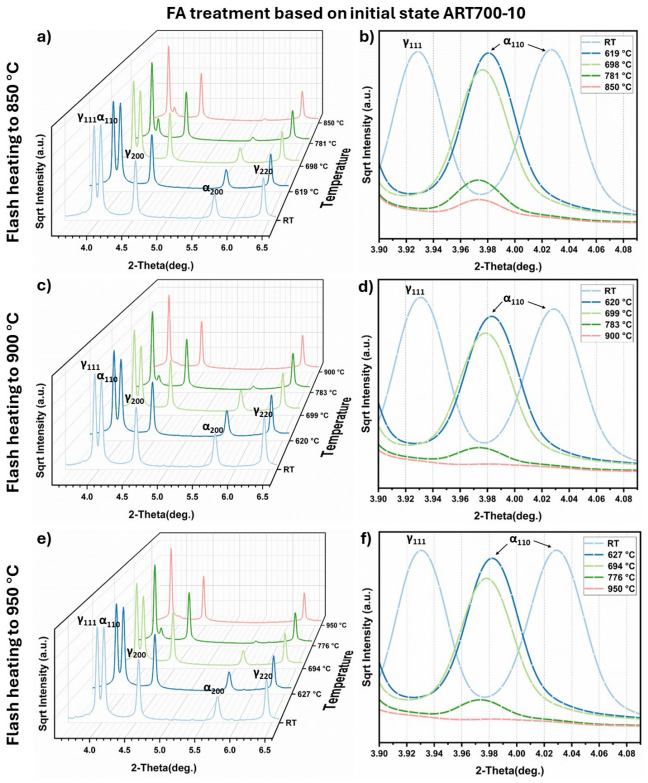
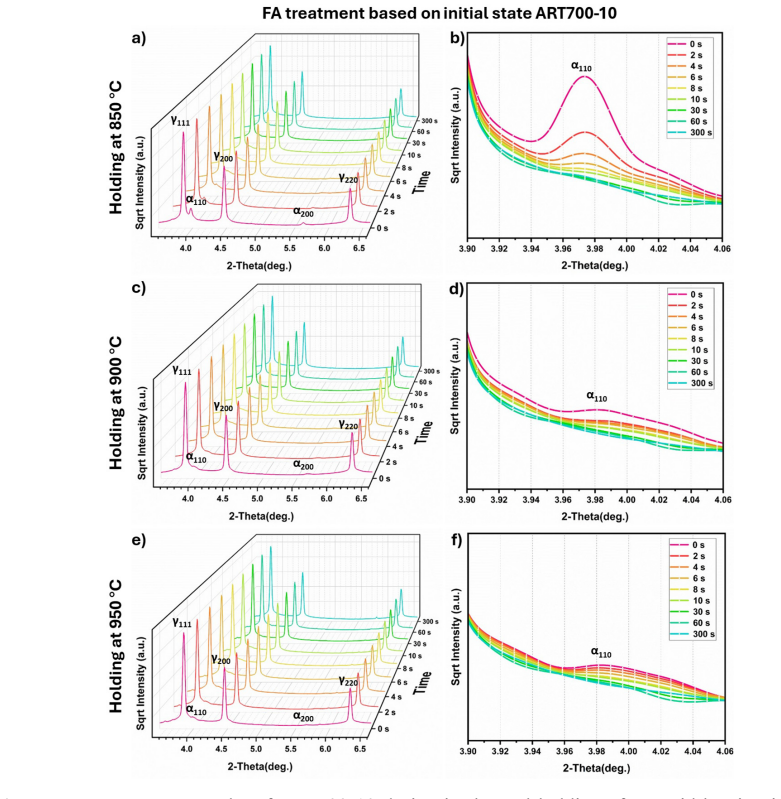
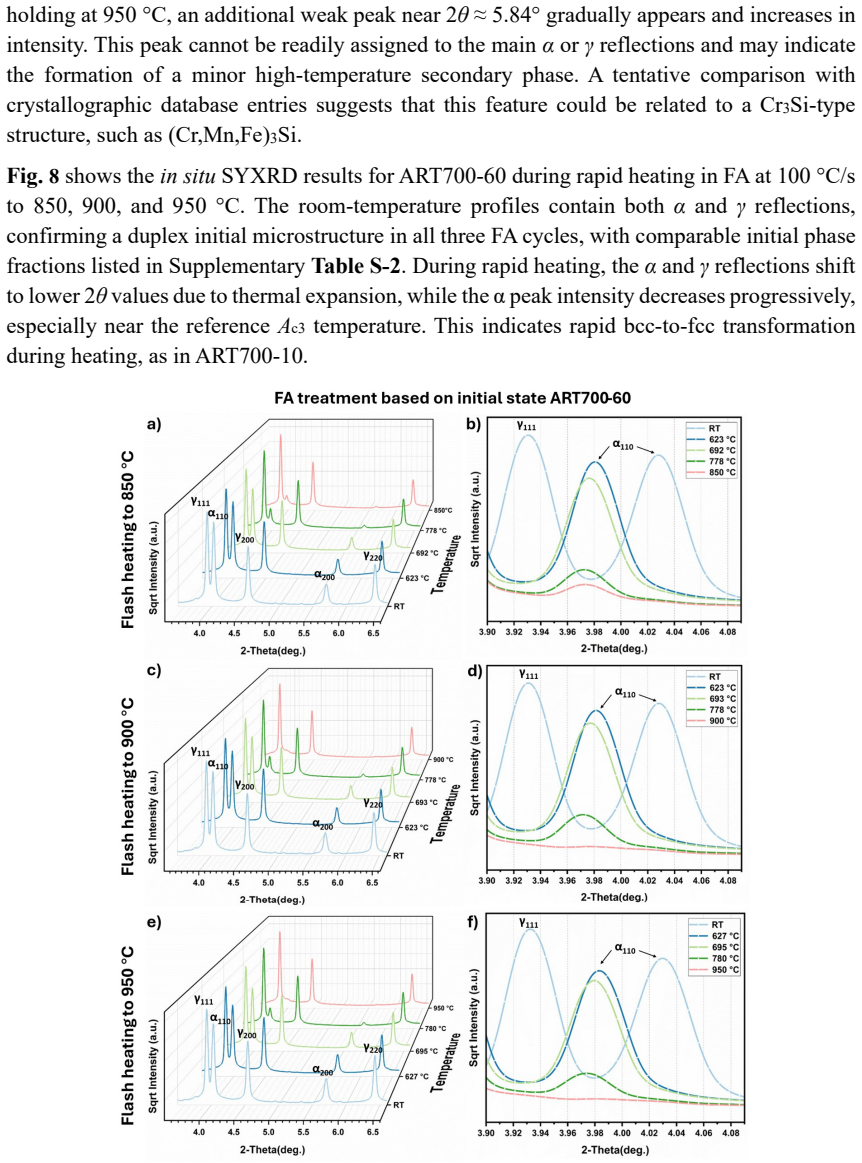
Results 3.1 Microstructure characterization of the investigated MMnS in the cold-rolled and ART conditions The microstructures of the investigated MMnS in the CR condition and after ART at 700 °C for 10 min or 60 min, followed by air cooling to room temperature, were characterized by EBSD and ex situ SYXRD. Fig. 3a to c show the corresponding EBSD phase m...
-
[4]
10 summarizes the austenite formation kineti cs during FA for two initial ART states, namely ART700-10 (Fig
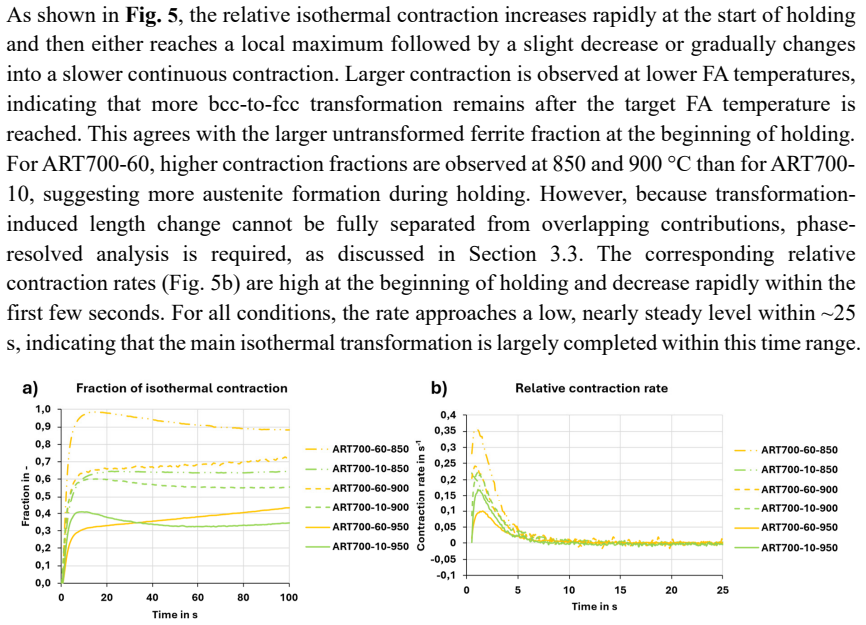
Discussion 4.1 Coupled effects of FA temperature and holding time on austenitization kinetics Fig. 10 summarizes the austenite formation kineti cs during FA for two initial ART states, namely ART700-10 (Fig. 10a) and ART700-60 (Fig. 10b). For the austenite fraction curves, blue, green, and purple denote FA to 850 °C, 900 °C, and 950 °C, respectively. Fig....
-
[5]
FA was conducted at 100 °C/s to 850 °C, 900 °C, or 950 °C, followed by isothermal holding
Conclusions This study quantified austenite formation during FA of a MMnS after ART using dilatometry- integrated in situ SYXRD. FA was conducted at 100 °C/s to 850 °C, 900 °C, or 950 °C, followed by isothermal holding. Two initia l ART states, ART700-10 and ART700-60, were compared. Full austenitization was evaluated using the criterion of f α ≤ 1 wt.%. ...
-
[6]
M.F.W. Chowdhury, C.V . Tapia-Bastidas, J. Hoschke, J. Venezuela, and A. Atrens, Int. J. Hydrog. Energy, 102, 181 (2025). https://doi.org/10.1016/j.ijhydene.2025.01.018
-
[7]
F. Konert, F. Wieder, J. Nietzk e, D. Meinel, T. Böllinghaus, and O. Sobol, Int. J. Hydrogen Energy, 59, 874 (2024). https://doi.org/10.1016/j.ijhydene.2024.02.005
-
[8]
S. Rahimi, K. Verbeken, T. Depover, and E. Proverbio, Eng. Fail. Anal., 167, 108956 (2025). https://doi.org/10.1016/j.engfailanal.2024.108956
-
[9]
A.K. Boddorff, Choosing the Right Stuff: Material Se lection for Liquid Hydrogen Aircraft Cryotanks, NASA/TM-20250007133 (National Aeronautics and Space Administration, Hampton, V A, 2025). https://ntrs.nasa.gov/api/cita tions/20250007133/downloads/NASA-TM- 20250007133.pdf
arXiv 2025
-
[10]
Y . Kim, S.-H. Lee, M. Park, H. Shim, J.-Y . Kang, and J.-Y . Kim, Mater. Sci. Eng. A, 914, 147167 (2024). https://doi.org/10.1016/j.msea.2024.147167
-
[11]
C. Reppin, K. Treutler, O. Brätz, A. Gericke, and K.-M. Henkel, Weld. World, (2025). https://doi.org/10.1007/s40194-025-01973-z
-
[12]
J. Han, J.-H. Nam, and Y .-K. Lee, Acta Mater., 113, 1 (2016). https://doi.org/10.1016/j.actamat.2016.04.038
-
[13]
X. Shen, W. Song, S. Sevsek, Y . Ma, C. Hüter, R. Spatschek, and W. Bleck, Metals, 9, 929 (2019). https://doi.org/10.3390/met9090929
-
[14]
B. Sun, W. Krieger, M. Rohwerder, D. Ponge, and D. Raabe, Acta Mater., 183, 313 (2020). https://doi.org/10.1016/j.actamat.2019.11.029
-
[15]
L. Cho, Y . Kong, J.G. Speer, and K.O. Findley, Metals, 11, 358 (2021). https://doi.org/10.3390/met11020358
-
[16]
M. Stadler, R. Schnitzer, M. Gruber, K. Steineder, and C. Hofer, Materials, 14, 3362 (2021). https://doi.org/10.3390/ma14123362
-
[17]
G. Park, K. Kim, S. Uhm, and C. Lee, Mater. Sci. Eng. A, 766, 138401 (2019). https://doi.org/10.1016/j.msea.2019.138401
-
[18]
Y . Cao, C. Luo, L. Zhao, Y . Peng, L. Song, C. Ma, Z. Tian, M. Zhong, and Y . Wang, J. Iron Steel Res. Int., 27, 75 (2020). https://doi.org/10.1007/s42243-019-00293-z
-
[19]
X. Shen, H. Qiao, W. Song, and W. Bleck, Steel Res. Int., 94, 2300145 (2023). https://doi.org/10.1002/srin.202300145
-
[20]
B. Hu, X. Shen, Q. Guo, Q. Wen, X. Tu, C. Ding, F. Ding, and W. Song, J. Mater. Sci. Technol., 126, 60 (2022). https://doi.org/10.1016/j.jmst.2022.04.003
-
[21]
Z.J. Xie, C.J. Shang, S.V . Subramanian, X.P. Ma, and R.D.K. Misra, Scr. Mater., 137, 36 (2017). https://doi.org/10.1016/j.scriptamat.2017.05.002
-
[23]
B. Sun, W. Lu, B. Gault, R. Ding, S.K. Makineni, D. Wan, C.-H. Wu, H. Chen, D. Ponge, and D. Raabe, Nat. Mater., 20, 1629 (2021). https://doi.org/10.1038/s41563-021-01050-y
-
[24]
X.T. Deng, X.L. Li, L. Huang, and Z.D. Wang, Mater. Sci. Forum, 993, 520 (2020). https://doi.org/10.4028/www.scientific.net/MSF.993.520
-
[25]
R.A. Grange, Metall. Tr ans., 2, 65 (1971). https://doi.org/10.1007/BF02662639
-
[26]
Y . Liu, M. Zhang, H. Li, X. Zhang, S. Qu, B. Fernandez Hernandez, and X. Han, Mater. Sci. Eng. A, 947, 149213 (2025). https://doi.org/10.1016/j.msea.2025.149213. 23
-
[27]
V . Sinha, M. Gonzales, and E.J. Payton, Metallogr. Microstruct. Anal., 14, 404 (2025). https://doi.org/10.1007/s13632-024-01162-2
-
[28]
P . Wen, B. Hu, J. Han, and H. Luo, J. Mater. Sci. Technol., 97, 54 (2022). https://doi.org/10.1016/j.jmst.2021.04.035
-
[29]
M. Wang, J. Chang, H. Wu, Z. Mi, Y . Wu, and Q. Zhang, Metals, 14, 1006 (2024). https://doi.org/10.3390/met14091006
-
[30]
S. Huang, L. Li, H. Ye, X. Xing, J. Ouyang, Z. Li, X. Zhang, S. Chen, and Z. Peng, Materials, 18, 2488 (2025). https://doi.org/10.3390/ma18112488
-
[31]
M. Gaggiotti, L. Albini, P. Di Nunzio, A. Di Schino, G. Stornelli, and G. Tiracorrendo, Metals, 12, 1313 (2022). https://doi.org/10.3390/met12081313
-
[33]
X. Wan, G. Liu, Z. Yang, and H. Chen, Scr. Mater., 198, 113819 (2021). https://doi.org/10.1016/j.scriptamat.2021.113819
-
[34]
V .A. Esin, B. Denand, Qu. Le Bihan, M. Dehmas, J. Teixeira, G. Geandier, S. Denis, T. Sourmail, and E. Aeby-Gautier, Acta Mater., 80, 118 (2014). https://doi.org/10.1016/j.actamat.2014.07.042
-
[35]
Fonstein, Candidates to AHSS of Third Generation: Steels with Carbide-Free Bainite, in Advanced High Strength Sheet Steels (Springer International Publishing, Cham, 2015), pp
N. Fonstein, Candidates to AHSS of Third Generation: Steels with Carbide-Free Bainite, in Advanced High Strength Sheet Steels (Springer International Publishing, Cham, 2015), pp. 275–
2015
-
[36]
https://doi.org/10.1007/978-3-319-19165-2_8
-
[37]
M. Storm, P. Staron, and C. Krywka, J. Appl. Crystallogr., 58, 1476 (2025). https://doi.org/10.1107/S160057672500398X
-
[38]
N. Schell, A. King, F. Beckmann, T. Fischer, M. Müller, and A. Schreyer, Mater. Sci. Forum, 772, 57 (2013). https://doi.org/10.4028/www.scientific.net/MSF.772.57
-
[39]
D.K. Smith, J. Fiala, and E. Ryba, Powder Diffr., 8, 252 (1993). https://doi.org/10.1017/S0885715600019497
-
[40]
L. Lutterotti, Acta Crystallogr. A, 56, S54 (2000). https://doi.org/10.1107/S0108767300021954
-
[41]
Toby, Powder Diffr., 21, 67 (2006)
B.H. Toby, Powder Diffr., 21, 67 (2006). https://doi.org/10.1154/1.2179804
-
[42]
L. Yang, X. Wang, C. Du, N. Lu, C. Li, and H. Zhang, J. Mater. Res. Technol., 39, 9308 (2025). https://doi.org/10.1016/j.jmrt.2025.11.220
-
[43]
T. Tanaka, N. Maruyama, N. Nakamura, and A.J. Wilkinson, Acta Mater., 195, 728 (2020). https://doi.org/10.1016/j.actamat.2020.06.017
-
[44]
Q. Luo, J. Mater. Eng. Perform., 25, 2170 (2016). https://doi.org/10.1007/s11665-016-2053-0
-
[45]
F. Forouzan, R. Surki Aliabad, A. Hedayati, N. Hosseini, E. Maawad, N. Blasco, and E. Vuorinen, Materials, 16, 1557 (2023). https://doi.org/10.3390/ma16041557
-
[46]
H. Nasr El-Din, E.A. Showaib, N. Zaafarani, and H. Refaiy, Int. J. Mech. Mater. Eng., 12, 3 (2017). https://doi.org/10.1186/s40712-017-0071-9
-
[48]
I.R. Souza Filho, A. Kwiatkowski Da Silva, M.J.R. Sandim, D. Ponge, B. Gault, H.R.Z. Sandim, and D. Raabe, Acta Mater., 166, 178 (2019). https://doi.org/10.1016/j.actamat.2018.12.046
-
[49]
Q. Guo, H.-W. Yen, H. Luo, and S.P. Ringer, Acta Mater., 225, 117601 (2022). https://doi.org/10.1016/j.actamat.2021.117601
-
[50]
S. Pashangeh, H.R. Karimi Zarchi, S.S. Ghasemi Banadkouki, and M.C. Somani, Metals, 9, 492 (2019). https://doi.org/10.3390/met9050492. [ 4 5 ] Y . Z h a n g , P . L a i , H . J i a , X . J u , a n d G . C u i , M e t a l s , 9 , 9 4 ( 2 0 1 9 ) . https://doi.org/10.3390/met9010094
-
[52]
Y . Ma, Mater. Sci. Technol., 33, 1713 (2017). https://doi.org/10.1080/02670836.2017.1312208
-
[53]
A. Skowronek, A. Grajcar, C. Garcia-Mateo, J.A. Jiménez, and R.H. Petrov, Metall. Mater. Trans. A, 54A, 1443 (2023). https://doi.org/10.1007/s11661-023-06998-x
-
[54]
P. Mayr, T.A. Palmer, J.W. Elmer, E.D. Specht, and S.M. Allen, Metall. Mater. Trans. A, 41A, 2462 (2010). https://doi.org/10.1007/s11661-010-0371-7. 24
-
[55]
L. León-Reina, M. García-Maté, G. Álvarez-Pinazo, I. Santacruz, O. Vallcorba, A.G. De La Torre, and M.A.G. Aranda, J. Appl. Crystallogr., 49, 722 (2016). https://doi.org/10.1107/S1600576716003873
-
[56]
M.A. Mohtadi-Bonab, E.A. Ariza, R.C.P. Loureiro, D. Centeno, F.M. Carvalho, J.A. Avila, and M. Masoumi, J. Mater. Res. Technol., 23, 845 (2023). https://doi.org/10.1016/j.jmrt.2023.01.066
-
[57]
J.T. Benzing, A. Kwiatkowski Da Silva, L. Morsdorf, J. Bentley, D. Ponge, A. Dutta, J. Han, J.R. McBride, B. Van Leer, B. Gault, D. Raabe, and J.E. Wittig, Acta Ma ter., 166, 512 (2019). https://doi.org/10.1016/j.actamat.2019.01.003
-
[58]
G.R. Speich, V .A. Demarest, and R.L. Miller, Metall. Trans. A, 12A, 1419 (1981). https://doi.org/10.1007/BF02643686
-
[59]
F.G. Caballero, C. Capdevila, and C.G. de Andrés, Metall. Mater. Trans. A, 32A, 1283 (2001). https://doi.org/10.1007/s11661-001-0218-3
-
[60]
D.K. Matlock, S. Kang, E. De Moor, and J.G. Speer, Mater. Charact., 166, 110397 (2020). https://doi.org/10.1016/j.matchar.2020.110397
-
[61]
Y . Wang, R. Ding, C. Franke, T. Li, X. Rong, P. Wen, Z. Yang, and H. Chen, Scr. Mater., 242, 115923 (2024). https://doi.org/10.1016/j.scriptamat.2023.115923
-
[62]
E.I. Suvorova, N.A. Arkharova, A.G. Ivanova, F.Yu. Solomkin, and P.A. Buffat, Inorganics, 11, 73 (2023). https://doi.org/10.3390/inorganics11020073
-
[63]
S. Papaefthymiou, M. Bouzouni, and R.H. Petrov, Metals, 8, 646 (2018). https://doi.org/10.3390/met8080646
-
[64]
J. Moravec, I. Nováková, and J. V ondrá ček, Manuf. Technol., 20, 217 (2020). https://doi.org/10.21062/mft.2020.024
-
[65]
A. Eggbauer, M. Lukas, G. Ressel, P. Prevedel, F. Mendez-Martin, J. Keckes, A. Stark, and R. Ebner, J. Mater. Sci., 54, 9197 (2019). https://doi.org/10.1007/s10853-019-03527-3
-
[66]
J.J. Mueller, X. Hu, X. Sun, Y . Ren, K. Choi, E. Barker, J.G. Speer, D.K. Matlock, and E. De Moor, Mater. Des., 203, 109598 (2021). https://doi.org/10.1016/j.matdes.2021.109598
-
[67]
E.D. Schmidt, E.B. Damm, and S. Sridhar, Metall. Mater. Trans. A, 38A, 244 (2007). https://doi.org/10.1007/s11661-006-9029-x
-
[68]
X. Hu, J.J. Mueller, X. Sun, E. De Moor, J.G. Speer, D.K. Matlock, and Y . Ren, Front. Mater., 8, 621784 (2021). https://doi.org/10.3389/fmats.2021.621784
-
[69]
A. Mehrabi, H. Zurob, I.-E. Benrabah, and J.R. McDermid, J. Mater. Res. Technol., 30, 2158 (2024). https://doi.org/10.1016/j.jmrt.2024.03.241
-
[70]
D.-W. Suh, C.-S. Oh, H.N. Han, and S.-J. Kim, Acta Mater., 55, 2659 (2007). https://doi.org/10.1016/j.actamat.2006.12.007
-
[71]
G. Liu, J. Li, S. Zhang, J. Wang, and Q. Meng, J. Alloys Compd., 666, 309 (2016). https://doi.org/10.1016/j.jallcom.2016.01.137
-
[72]
D. Kaiser, B. De Graaff, S. Dietrich, and V . Schulze, Thermochim. Acta, 646, 8 (2016). https://doi.org/10.1016/j.tca.2016.10.014. Conflict of Interest The authors declare that they have no conflict of interest. Data Availability Statement The data that support the findings of this study are available from the corresponding author upon reasonable request. ...
discussion (0)
Sign in with ORCID, Apple, or X to comment. Anyone can read and Pith papers without signing in.