Making Failure Safe: A Constrained, Verifiable Agent Framework for Open-Web Data Collection
Pith reviewed 2026-07-02 20:53 UTC · model grok-4.3
The pith
The constrained framework converts natural-language web collection requirements into typed JSON configurations executed without further LLM calls.
A machine-rendered reading of the paper's core claim, the machinery that carries it, and where it could break.
Core claim
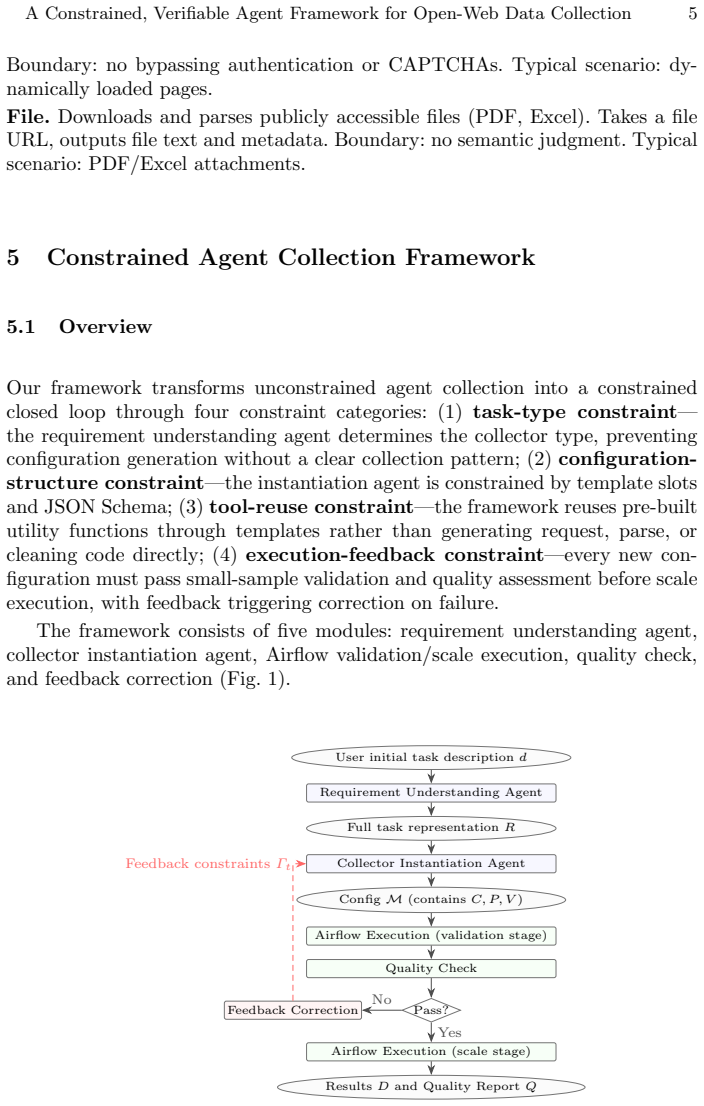
The framework shifts LLM output from free-form code to typed JSON collector configurations by combining a six-type collector taxonomy, template and utility-function constraints, static Airflow DAG execution, rule-based quality checking, and structured feedback correction, resulting in stable instantiation when source, field, and execution details are supplied and enabling zero LLM tokens at execution stage on verified tasks.
What carries the argument
Six-type collector taxonomy with typed JSON collector configurations that replace free-form code and enforce template plus utility-function constraints.
If this is right
- The taxonomy supports description-based requirement typing.
- Stable instantiation requires completing source, field, and execution constraints beyond the initial description.
- The framework runs with zero execution-stage LLM tokens on 80 independently source-verified tasks.
- It achieves the lowest average wall-clock time among compared methods.
- It trades moderate one-shot quality for a reusable, deterministic, and verifiable execution path for repeated scheduled collection.
Where Pith is reading between the lines
- The zero-token execution path could lower per-run costs for high-frequency scheduled scraping pipelines.
- Structured JSON outputs may simplify integration with downstream data validation or provenance tracking systems.
- The constraint set could be extended to cover additional collection patterns without changing the overall execution model.
- Feedback correction might be driven by rule-based scripts alone in many cases, further reducing LLM dependence.
Load-bearing premise
The six-type collector taxonomy together with template and utility-function constraints is sufficient to support stable instantiation of collectors from natural-language requirements once source, field, and execution details are supplied.
What would settle it
A collection of natural-language requirements where, even after source, field, and execution details are added, the generated JSON configurations still require LLM intervention to execute correctly on more than a small fraction of cases.
Figures
read the original abstract
LLMs and agents can generate web scrapers from natural-language requirements, but direct generation remains unreliable because of dependency errors, broken selectors, schema mismatches, and heterogeneous page structures. We propose a constrained, verifiable agent framework that shifts LLM output from free-form code to typed JSON collector configurations, combining a six-type collector taxonomy, template and utility-function constraints, static Airflow DAG execution, rule-based quality checking, and structured feedback correction. Experiments on 138 tasks show that the taxonomy supports description-based requirement typing, while confirming that stable instantiation requires completing source, field, and execution constraints beyond the initial description. On 80 independently source-verified tasks, the framework runs with zero execution-stage LLM tokens and the lowest average wall-clock time, trading moderate one-shot quality for a reusable, deterministic, and verifiable execution path suited to repeated scheduled collection. These results position the framework as a reusable, low-cost, and verifiable execution path for repeated open-web data collection.
Editorial analysis
A structured set of objections, weighed in public.
Referee Report
Summary. The manuscript proposes a constrained, verifiable agent framework for open-web data collection. It shifts LLM output from free-form code to typed JSON collector configurations using a six-type taxonomy, template and utility-function constraints, static Airflow DAG execution, rule-based quality checking, and structured feedback. Experiments on 138 tasks indicate the taxonomy supports description-based requirement typing (with stable instantiation requiring explicit source/field/execution constraints), while on 80 independently source-verified tasks the framework achieves zero execution-stage LLM tokens and the lowest average wall-clock time, trading one-shot quality for reusability and verifiability in repeated collection.
Significance. If the empirical results hold under proper validation, the work demonstrates a practical, low-cost, deterministic path for repeated open-web data collection that minimizes LLM usage during execution while enabling verification, which could be valuable for scheduled scraping pipelines in data engineering and AI agent applications.
major comments (1)
- [Abstract] Abstract: The central performance claims (zero execution-stage LLM tokens and lowest wall-clock time on 80 tasks; taxonomy support on 138 tasks) are stated without any reference to experimental protocol, baselines, statistical tests, or exclusion criteria. This directly affects the load-bearing empirical support for the framework's advantages over direct generation.
minor comments (1)
- The mapping from natural-language requirements to the six-type taxonomy is described at a high level; adding one or two concrete examples of requirement-to-type instantiation would improve clarity without altering the core argument.
Simulated Author's Rebuttal
We thank the referee for the feedback on the abstract. We address the concern point-by-point below and will revise the abstract to better situate the empirical claims while preserving its conciseness.
read point-by-point responses
-
Referee: [Abstract] Abstract: The central performance claims (zero execution-stage LLM tokens and lowest wall-clock time on 80 tasks; taxonomy support on 138 tasks) are stated without any reference to experimental protocol, baselines, statistical tests, or exclusion criteria. This directly affects the load-bearing empirical support for the framework's advantages over direct generation.
Authors: We agree the abstract omits explicit references to protocol details, which are provided in the full Experiments section. The 138 tasks evaluated taxonomy support for description-based requirement typing, confirming that stable instantiation requires explicit source, field, and execution constraints. The 80 tasks were independently source-verified for performance metrics against direct-generation baselines, with the framework achieving zero execution-stage LLM tokens due to static DAG execution. No statistical tests were performed because execution is deterministic (rule-based checking and typed JSON configs eliminate stochastic LLM calls at runtime) and wall-clock times are directly measured averages. Exclusion criteria for the 80 tasks (independent source verification) and task selection process are described in Section 4. To address the referee's point, we will revise the abstract to briefly reference the task counts, verification process, and baseline comparison. revision: yes
Circularity Check
No significant circularity identified
full rationale
The paper describes an empirical agent framework for web scraping that uses a six-type collector taxonomy, typed JSON configurations, Airflow DAGs, and rule-based checks. Central performance claims (zero execution-stage LLM tokens, lowest wall-clock time on 80 verified tasks) are presented as direct experimental outcomes on 138/80 tasks rather than quantities derived from fitted parameters or self-referential definitions. No equations appear; the taxonomy is introduced as a design choice whose sufficiency for stable instantiation is explicitly tested and confirmed experimentally. No self-citations, uniqueness theorems, or ansatzes are invoked as load-bearing premises. The derivation chain consists of design decisions followed by independent benchmark measurements, satisfying the default expectation of a self-contained empirical result.
Axiom & Free-Parameter Ledger
axioms (1)
- domain assumption The six-type collector taxonomy adequately covers common web scraping requirements to enable stable instantiation once additional constraints are supplied
Reference graph
Works this paper leans on
-
[1]
arXiv preprint arXiv:2501.11425 (2025)
Agent-r: Training language model agents to reflect via iterative self-training. arXiv preprint arXiv:2501.11425 (2025)
-
[2]
arXiv preprint arXiv:2504.12682 (2025)
BardeenAgent: A record-then-replay paradigm for reliable web data extraction. arXiv preprint arXiv:2504.12682 (2025)
-
[3]
In: Findings of the Association for Computational Linguistics: EMNLP (2025)
Berkane, T., Charpignon, M.L., Majumder, M.S.: LLM-based web data collection for research dataset creation. In: Findings of the Association for Computational Linguistics: EMNLP (2025)
2025
-
[4]
Evaluating Large Language Models Trained on Code
Chen, M., Tworek, J., Jun, H., et al.: Evaluating large language models trained on code. arXiv preprint arXiv:2107.03374 (2021)
work page internal anchor Pith review Pith/arXiv arXiv 2021
-
[5]
com/unclecode/crawl4ai(2024)
Crawl4AI: Open-source LLM-friendly web crawler & scraper.https://github. com/unclecode/crawl4ai(2024)
2024
-
[6]
In: IEEE CSITSS (2025)
CyberScribe: Scalable autonomous web crawling with LLMs and vision transform- ers. In: IEEE CSITSS (2025)
2025
-
[7]
Knowledge-Based Systems70, 301–323 (2014)
Ferrara, E., De Meo, P., Fiumara, G., Baumgartner, R.: Web data extraction, ap- plications and techniques: A survey. Knowledge-Based Systems70, 301–323 (2014)
2014
-
[8]
In: Proceedings of ACL (2024)
He, H., et al.: WebVoyager: Building an end-to-end web agent with large multi- modal models. In: Proceedings of ACL (2024)
2024
-
[9]
arXiv preprint arXiv:2603.29161 (2026)
Huang, J., Joung, S.: Webscraper: Leverage multimodal LLMs for index-content web scraping. arXiv preprint arXiv:2603.29161 (2026)
-
[10]
In: Proceedings of EMNLP (2024)
Huang, W., et al.: AutoScraper: A progressive understanding web agent for web scraper generation. In: Proceedings of EMNLP (2024)
2024
-
[11]
In: International Joint Conference on Artificial Intelligence (1997)
Kushmerick, N., Weld, D.S., Doorenbos, R.B.: Wrapper induction for information extraction. In: International Joint Conference on Artificial Intelligence (1997)
1997
-
[12]
Computing (2026)
Landeta-L´ opez, P., et al.: LLMs applied to web scraping and web crawling: A systematic review. Computing (2026)
2026
-
[13]
llm-scraper: Schema-constrained LLM-based web scraping.https://github.com/ mishushakov/llm-scraper(2024)
2024
-
[14]
In: Advances in Neural Information Processing Systems (NeurIPS) (2025)
Ma, T., Qian, Y., Zhang, Z., Wang, Z., Qian, X., Bai, F., Ding, Y., Luo, X., Zhang, S., Murugesan, K., Zhang, C., Ye, Y.: AutoData: A multi-agent system for open web data collection. In: Advances in Neural Information Processing Systems (NeurIPS) (2025)
2025
-
[15]
In: NeurIPS Workshop (2025)
MacroBench: A testbed for web automation via large language models. In: NeurIPS Workshop (2025)
2025
-
[16]
In: Advances in Neural Information Processing Systems (2023)
Madaan, A., Tandon, N., Gupta, P., et al.: Self-refine: Iterative refinement with self-feedback. In: Advances in Neural Information Processing Systems (2023)
2023
-
[17]
CodeGen: An Open Large Language Model for Code with Multi-Turn Program Synthesis
Nijkamp, E., Pang, B., Hayashi, H., et al.: CodeGen: An open large language model for code with multi-turn program synthesis. arXiv preprint arXiv:2203.13474 (2022)
work page internal anchor Pith review Pith/arXiv arXiv 2022
-
[18]
In: EMNLP Industry Track (2025)
PARSE: LLM-driven schema optimization for reliable entity extraction. In: EMNLP Industry Track (2025)
2025
-
[19]
Communications of the ACM45(4), 211–218 (2002) A Constrained, Verifiable Agent Framework for Open-Web Data Collection 15
Pipino, L.L., Lee, Y.W., Wang, R.Y.: Data quality assessment. Communications of the ACM45(4), 211–218 (2002) A Constrained, Verifiable Agent Framework for Open-Web Data Collection 15
2002
-
[20]
Code Llama: Open Foundation Models for Code
Roziere, B., Gehring, J., Gloeckle, F., et al.: Code Llama: Open foundation models for code. arXiv preprint arXiv:2308.12950 (2023)
work page internal anchor Pith review Pith/arXiv arXiv 2023
-
[21]
ScrapeGraphAI: You only scrape once.https://github.com/ScrapeGraphAI/ Scrapegraph-ai(2024)
2024
-
[22]
In: Advances in Neural Information Processing Systems (2023)
Shinn, N., Cassano, F., Gopinath, A., Narasimhan, K., Yao, S.: Reflexion: Language agents with verbal reinforcement learning. In: Advances in Neural Information Processing Systems (2023)
2023
-
[23]
arXiv preprint arXiv:2512.21481 (2025)
Vallabhaneni, S., et al.: The AI committee: A multi-agent framework for automated validation and remediation of web-sourced data. arXiv preprint arXiv:2512.21481 (2025)
-
[24]
Journal of Management Information Systems12(4), 5–33 (1996)
Wang, R.Y., Strong, D.M.: Beyond accuracy: What data quality means to data consumers. Journal of Management Information Systems12(4), 5–33 (1996)
1996
-
[25]
In: International Conference on Learning Representations (2023)
Yao, S., Zhao, J., Yu, D., Du, N., Shafran, I., Narasimhan, K., Cao, Y.: ReAct: Synergizing reasoning and acting in language models. In: International Conference on Learning Representations (2023)
2023
-
[26]
Yu, Z., et al.: Fight fire with fire: How much can we trust ChatGPT on source code-related tasks? IEEE Transactions on Software Engineering (2024)
2024
-
[27]
In: International Conference on Learning Representations (2024)
Zhou, S., et al.: WebArena: A realistic web environment for building autonomous agents. In: International Conference on Learning Representations (2024)
2024
discussion (0)
Sign in with ORCID, Apple, or X to comment. Anyone can read and Pith papers without signing in.