REVIEW 4 major objections 4 minor 10 references
Linearized Diffusion Map
T0 review · 4 major / 4 minor · reviewed 2026-08-06 · deepseek-v4-flash
Pith's one-line read Linearizing the diffusion-map kernel yields a linear dimensionality reduction method, LDM, that runs at PCA speed and preserves manifold geometry better than PCA when the data has explicit curved or spherical structure.
desk verdict The linearization is sound, but the hypersphere advantage over PCA looks like a centering artifact rather than diffusion geometry. read the letter →
The pith
A machine-rendered reading of the paper's core claim, the machinery that carries it, and where it could break.
The reading
What carries the argument
The carrying object is the linearized diffusion kernel operator of equation (12), $L^{\mathrm{LDM}}_i(v_j) = N_i (1_i - R^2_i/\varepsilon) N_j v_j - N_i R^2_j (N_j v_j)/\varepsilon + (2/\varepsilon) N_i R_{iX} (R^\dagger_{Xj} (N_j v_j))$, with $N_i$ the inverse square root of the kernel row sums. This is the Gaussian RBF kernel expanded to first order and then symmetrically degree-normalized, so it remains a linear map on vectors even though it encodes the diffusion-map normalization. Repeated application of this operator feeds the Lanczos algorithm, producing a spectral embedding in $\mathcal{O}(ND)$ time. The asymmetric variant, LDM-A, uses row-only normalization; both variants share the parameter set $\{N_i, 1_i, R^2_i, R_{iX}, \varepsilon\}$.
What would settle it
On a noisy high-dimensional hypersphere, compute the exact diffusion-map embedding and compare its pairwise distances with LDM's embedded distances; if LDM distances correlate with PCA distances more than with diffusion distances in the regime where LDM claims superiority, or if the second-order term $\frac{1}{2}(D_{ij}^2/\varepsilon)^2$ is non-negligible relative to the retained first-order term for the chosen $\varepsilon$, the central assumption is refuted.
Extended reading notes
Core claim
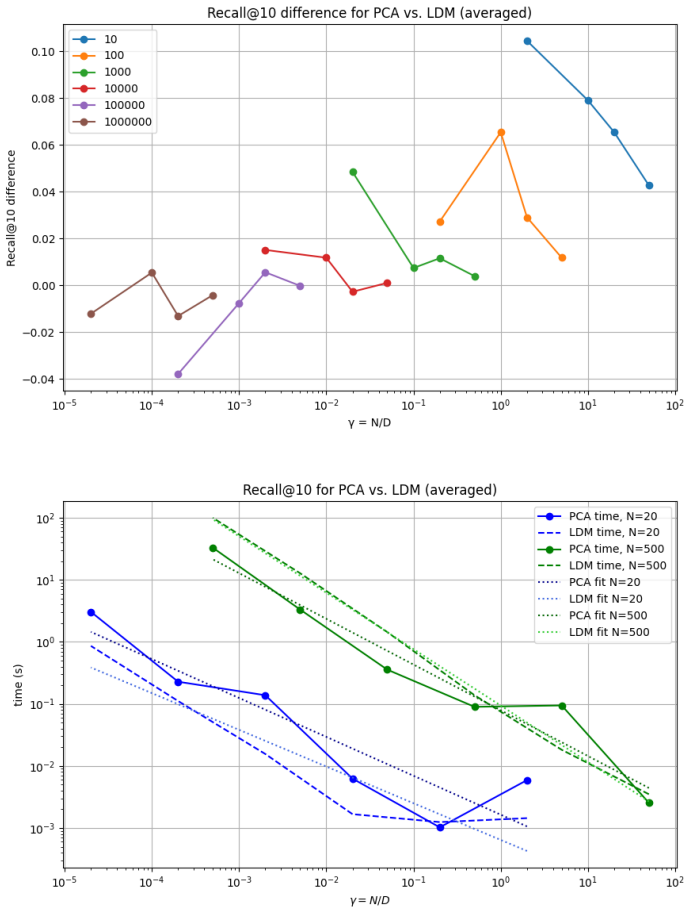
The central claim is that a first-order Taylor expansion of the RBF kernel, $\exp(-D^2_{ij}/\varepsilon) \approx 1 - D^2_{ij}/\varepsilon$ with $\varepsilon = 4R^2_{\max}$, can be inserted into the diffusion-map construction without destroying the geometric information that diffusion maps are known to carry. After row-sum degree normalization, the linearized kernel becomes a genuine linear operator, so its top eigenvectors can be computed by repeated application with the Lanczos algorithm, at the same $\mathcal{O}(ND)$ complexity as PCA. The paper reports that LDM embeddings differ perceptibly from PCA embeddings: on the Swiss roll LDM partially unrolls the sheet whereas PCA produces a spiral, and on uniformly sampled hyperspheres LDM's recall@10 exceeds PCA's when the ratio $\gamma = N/D$ is small. It also reports that on MNIST and COIL-20, PCA stays superior for approximate-nearest-neighbor retrieval; the stated conclusion is complementarity, not dominance. A further claim is that because the linearized kernel matrix is completely positive (all entries nonnegative), the kernel can be fed directly into non-negative matrix factorization for interpretable latent-factor discovery.
Load-bearing premise
The load-bearing premise is that the first-order Taylor approximation $\exp(-d^2/\varepsilon) \approx 1 - d^2/\varepsilon$ with $\varepsilon = 4R^2_{\max}$ is accurate enough that the degree-normalized linear operator still reproduces diffusion-map geometry; the paper uses this approximation without proving that diffusion distances survive linearization or quantifying the Taylor remainder.
Editorial extensions
If this is right
- For data lying on an explicit manifold in high ambient dimension—such as a hypersphere with small $\gamma = N/D$—LDM is the better linear method for approximate-nearest-neighbor retrieval, so practitioners in that regime can replace PCA with LDM at no extra cost.
- Because LDM's kernel matrix is completely positive, the kernel can be passed directly to NMF, enabling diffusion-geometry-aware, interpretable factorizations.
- On noisy or variance-dominated datasets such as MNIST and COIL-20, PCA remains preferable, so LDM should be treated as an additional embedding in a portfolio rather than a universal replacement.
- A natural two-stage pipeline follows: use PCA to quickly narrow candidate neighborhoods, then use LDM to refine those neighborhoods, exploiting the reported complementarity of the two embeddings.
- Since both methods are linear and cost $\mathcal{O}(ND)$, adding LDM to an existing PCA-based ANN pipeline does not change the asymptotic complexity.
Reading between the lines
- A testable extension the paper leaves implicit is to rewrite the LDM operator as a weighted covariance eigenproblem and compare its loadings to PCA's on the same data, which would clarify whether the gain comes from the degree normalization or from the kernel linearization itself.
- Because the approximation discards terms beyond first order, the paper's comparison suggests LDM should interpolate between PCA and full diffusion maps; measuring the Taylor remainder on real datasets would show where in that spectrum LDM lands.
- The NMF route is stated as a suggestion; a concrete validation would be to apply NMF to the LDM kernel on a parts-based synthetic dataset and measure recovery of the known generative parts.
Editorial analysis
A structured set of objections, weighed in public.
Referee Report
Summary. The paper introduces Linearized Diffusion Map (LDM), a linear dimensionality reduction method obtained by first-order Taylor expansion of the Gaussian RBF kernel with scale ε = 4R²_max, followed by diffusion-map-style row normalization. The authors derive that linearized kPCA reduces to PCA, then define symmetric and asymmetric LDM operators. Experiments compare LDM with PCA on the Swiss roll, MNIST, COIL-20, and random hyperspheres, reporting that LDM outperforms PCA in high-dimensional regimes with explicit manifold structure, while PCA is better on noisy or less structured data. The paper also claims that the linearized kernel is completely positive, making it amenable to NMF.
Significance. If the central claims were correct, LDM would be a computationally efficient linear embedding method that retains some diffusion-geometry benefits, with O(ND) cost and simple interpretability. The derivation in Section 2.3 that linearized kPCA equals PCA is correct, and the linear-operator formulation is a clean way to present both PCA and the proposed variants. However, the paper provides no convergence or approximation theorem relating LDM to diffusion maps, and the flagship experimental evidence on hyperspheres is theoretically fragile. The complete positivity claim is unproved and likely false. As a result, the significance of the contribution is currently not established.
major comments (4)
- [Section 4.3] On the unit hypersphere dataset, every point has R_i^2 = 1, so ε = 4R²_max = 4 and the linearized kernel becomes k_ij = 1 - ||x_i - x_j||²/4 = 1/2 + (1/2) x_i·x_j, an affine function of the Gram matrix. When the empirical mean is zero, the row sums k_i are constant, so the normalization factors N_i in Eqs. (10)-(11) are constant and the nonconstant eigenvectors of the LDM operators (12)-(13) are exactly the PCA eigenvectors. Consequently, in the centered or large-N limit, LDM and PCA produce identical embeddings. The recall advantage attributed to LDM in Fig. 3 at small γ = N/D can then only arise from finite-sample fluctuations of the empirical mean entering the row sums, not from diffusion geometry. The authors should derive the spectrum of the LDM operator for this case, re-run the hypersphere experiment with explicitly centered data and with data forced to have zero empirical mean, and report error bars; I expect the claimed advantage to disappear. This is load-bearing for the abstract's claim that LDM outperforms PCA on explicit manifold structures.
- [Section 3.2] The paper asserts that ε = 4R²_max gives a 'successful linearization' of the RBF kernel, but no error analysis is provided. At the maximum normalized distance D²_ij/ε = 1, the true kernel value is e^{-1} ≈ 0.368 while the linearization gives 0, so the approximation is not quantitatively accurate at the scale used. More importantly, the paper never proves that the degree-normalized linearized operator approximates the diffusion-map operator or preserves diffusion distances. The LDM operators in Eqs. (12)-(13) are defined by analogy with diffusion maps, but no spectral perturbation bound or consistency result is stated. The geometric interpretation of LDM embeddings is therefore an assertion, not a demonstrated property.
- [Conclusion] The statement that 'the linearized kernel is completely positive' is unproved and, as stated, unjustified. Entrywise nonnegativity of k_ij follows from ε = 4R²_max, but complete positivity requires the existence of a nonnegative matrix V such that K = V V^T, which is a much stronger condition. No such factorization is exhibited, and no argument is given. Since the abstract and conclusion use this claim to motivate NMF applicability, this is a load-bearing assertion that needs either a proof or a clear statement of the precise positivity property that actually holds.
- [Section 4.2] The experimental evaluation lacks the statistical detail needed to support the comparative claims. Figures 2 and 3 plot recall differences without error bars, standard deviations, or numbers of repeated trials. It is also unclear whether the data were centered before applying PCA and LDM, how ε = 4R²_max was computed for MNIST and COIL-20, how many eigenvectors were retained, and whether the reported differences are stable across random subsamples. Given that the hypersphere experiment is the main quantitative evidence for the paper's central claim, the absence of such details is a serious omission.
minor comments (4)
- [Section 1.0.1] The notation RiX with mixed-case indices is unusual and is frequently garbled in the text; for example, 'matrix RiX ∈ RN ×D, where indices i = 1, . . . , Nlabel the samples' is missing spaces and the word 'label' is run together with 'N'. The notation should be cleaned up and defined more carefully.
- [Section 2.3] The sentence 'Therefore, the Bessel correction used in PCA becomes ε = 2(N − 1), i.e. kPCA’s ε absorbs this when N is large' is confusing: the Bessel correction is a factor of 1/(N−1), not a value of ε. Clarify that setting ε = 2(N−1) makes the linearized kPCA matrix equal to the PCA covariance matrix up to the usual normalization.
- [Section 2.4] The statement 'this is proportional to PCA and LkPCA with ε = 2' uses the undefined abbreviation LkPCA and an unexplained value of ε. Please define the notation and specify the proportionality constant.
- [Throughout] There are several typos and formatting issues, e.g., 'This algorithms', 'Johnsonet al.' in the references, and 'V . d.' in the Tenenbaum reference. A careful proofreading pass is needed.
Circularity Check
No significant circularity: LDM is a defined linearization of the RBF kernel; the experimental comparisons are evaluations rather than predictions, and the hypersphere/PCA equivalence is a correctness concern, not a circular input.
full rationale
The derivation chain is self-contained. LDM is obtained by a first-order Taylor expansion of the RBF kernel (Eqs. 5-7) with a fixed data-dependent scale ε=4R^2max; this is a modeling choice, not a parameter fitted to the recall benchmarks, and the downstream spectral embeddings are defined by the resulting linear operator (Eqs. 9-13) without using PCA or MDS as an input. The experimental comparisons are evaluations: no subset is used to fit ε and then a closely related quantity is predicted; recall@k is measured on the same embedding, which is standard unsupervised evaluation, not circular prediction. The paper's own algebra does show that on exactly unit-norm, empirically centered data LDM reduces to PCA (Eq. 7 becomes 1/2 + (1/2) x_i·x_j and row sums are constant), which is a serious correctness threat to the hypersphere claims, but it is a mathematical equivalence discovered from the construction, not an assumption fed into the method. The complete-positivity/NMF remark is unsupported and arguably definitional, but it is confined to the conclusion and not load-bearing for the main results. No load-bearing self-citation, uniqueness import, or ansatz-via-citation appears. Score 0.
Assumptions & free parameters
free parameters (1)
- ε (kernel scale) =
4R^2_max
assumptions (3)
- ad hoc to paper The first-order Taylor expansion of the exponential kernel is a valid approximation for ε = 4R^2_max.
- domain assumption The diffusion-map normalization applied to the linearized kernel yields an embedding that approximates diffusion distances.
- ad hoc to paper The linearized kernel matrix is completely positive.
Cite this review
Pith. "Pith review of Linearized Diffusion Map." pith.science (2026). https://pith.science/paper/3JFZNVP6
@misc{pith2026250714257,
  author       = {Pith},
  title        = {Pith review of: Linearized Diffusion Map},
  year         = {2026},
  howpublished = {\url{https://pith.science/paper/3JFZNVP6}},
  note         = {Machine review of arXiv:2507.14257}
}
read the original abstract
We introduce the Linearized Diffusion Map (LDM), a novel linear dimensionality reduction method constructed via a linear approximation of the diffusion-map kernel. LDM integrates the geometric intuition of diffusion-based nonlinear methods with the computational simplicity, efficiency, and interpretability inherent in linear embeddings such as PCA and classical MDS. Through comprehensive experiments on synthetic datasets (Swiss roll and hyperspheres) and real-world benchmarks (MNIST and COIL-20), we illustrate that LDM captures distinct geometric features of datasets compared to PCA, offering complementary advantages. Specifically, LDM embeddings outperform PCA in datasets exhibiting explicit manifold structures, particularly in high-dimensional regimes, whereas PCA remains preferable in scenarios dominated by variance or noise. Furthermore, the complete positivity of LDM's kernel matrix allows direct applicability of Non-negative Matrix Factorization (NMF), suggesting opportunities for interpretable latent-structure discovery. Our analysis positions LDM as a valuable new linear dimensionality reduction technique with promising theoretical and practical extensions.
Figures


Reference graph
Works this paper leans on
-
[1]
" write newline "" before.all 'output.state := FUNCTION fin.entry add.period write newline FUNCTION new.block output.state before.all = 'skip after.block 'output.state := if FUNCTION new.sentence output.state after.block = 'skip output.state before.all = 'skip after.sentence 'output.state := if if FUNCTION not #0 #1 if FUNCTION and 'skip pop #0 if FUNCTIO...
-
[2]
Coifman, R. R. and Lafon, S. (2006). ACHA https://www.sciencedirect.com/science/article/pii/S1063520306000546 , 21(1):5--30
work page 2006
-
[3]
Cunningham, J. P. and Ghahramani, Z. (2015). JMLR https://jmlr.org/papers/volume16/cunningham15a/cunningham15a.pdf , 16(1):2859--2900
work page 2015
-
[4]
Hinton, G. E. and Salakhutdinov, R. R. (2006). Science https://www.science.org/doi/10.1126/science.1127647 , 313(5786):504--507
-
[5]
Johnson, J., Douze, M., and J \' e gou, H. (2017). CoRR . arXiv:1702.08734 http://arxiv.org/abs/1702.08734
arXiv 2017
-
[6]
Maaten, L. v. d. and Hinton, G. (2008). JMLR https://www.jmlr.org/papers/volume9/vandermaaten08a/vandermaaten08a.pdf , 9(Nov):2579--2605
work page 2008
-
[7]
McInnes, L., Healy, J., and Melville, J. (2020). arXiv:1802.03426 https://arxiv.org/abs/1802.03426
arXiv 2020
-
[8]
Pearson, K. (1901). Lond. Edinb. Dubl. Phil. Mag. , 2(11):559--572
work page 1901
Show all 10 references
-
[9]
B., Silva, V
Tenenbaum, J. B., Silva, V. d., and Langford, J. C. (2000). Science https://www.science.org/doi/10.1126/science.290.5500.2319 , 290(5500):2319--2323
2000
-
[10]
Torgerson, W. S. (1952). Psychometrika , 17(4):401--419
1952
Reviewed August 6, 2026 · model on record in the stance chip above.
Discussion (0). Continue with ORCID to comment.