REVIEW 3 major objections 5 minor 84 references
Laser cooling Rydberg molecules -- a detailed study of the helium dimer
T0 review · 3 major / 5 minor · reviewed 2026-08-07 · deepseek-v4-flash
Pith's one-line read The metastable helium dimer could be the first laser-cooled homonuclear molecule.
desk verdict Careful, mostly transparent feasibility study; the photon budget is close enough that the d-state predissociation guess carries the weight of the proposal. read the letter →
The pith
A machine-rendered reading of the paper's core claim, the machinery that carries it, and where it could break.
The reading
What carries the argument
The central object is the Rydberg-electron structure of He2*: the outer electron in orbitals such as 3sσ or 3pπ does not participate in the chemical bond, so the excited-state potential curves nearly follow the ion-core potential and the Franck-Condon matrix is nearly diagonal. That near-diagonal character is what makes a closed optical cycle possible with only a few laser frequencies. The quantitative workhorse is a multilevel rate-equation model that tracks populations in lower and upper vibronic states, with excitation rates set by saturation parameters and decay rates built from Einstein A coefficients, electronic transition moments, and Hönl-London factors; rotational dark-state losses are estimated from the mean number of scattered photons. Fermi's Golden Rule with the pure precession approximation and nonadiabatic couplings borrowed from H2 is used to bound predissociation, and the Coulomb approximation supplies the missing electronic transition moments.
What would settle it
Measure the decay rate and dissociation products of He2* after exciting e(v=0,J=0) and d(v=0) in a beam or trap, using time-resolved fluorescence and fragment detection: if the total decay rate of e(v=0,J=0) significantly exceeds the predicted radiative rate, or if the e-to-d branching ratio is much larger than 0.7%, the a–e cycling loop does not close.
Extended reading notes
Core claim
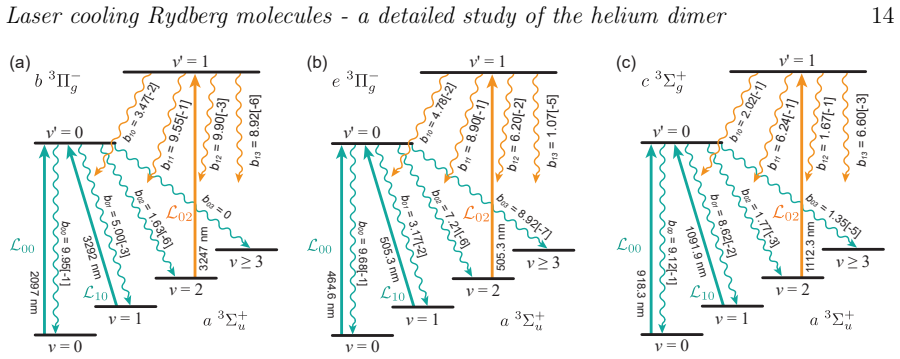
The paper's central claim is that the metastable triplet state of the helium dimer can be laser-cooled. It identifies three electric-dipole cycling transitions—a–b near 2097 nm, a–c near 918 nm, and a–e near 465 nm—and computes their lifetimes, electronic and vibrational branching ratios, fine structure, and line strengths. The a–e transition is singled out for slowing: with one vibrational repumper and rotational repumping, the simulations give about 4,090 scattered photons on average, climbing past the roughly 4,850 photons needed to slow the beam from 530 m/s to 10 m/s, and the a–c scheme can scatter more than $10^{4}$ photons. The paper estimates that spin-forbidden decay, predissociation, and two-photon ionization do not seriously limit the cycling, and it calculates how vibrational levels of He2+ respond to a 1 ppm change in the helium polarizability, connecting the proposed ultracold sample to a quantum pressure standard.
Load-bearing premise
The entire cycling scheme relies on the assumption that the e and d excited states decay radiatively far faster than they predissociate, a rate estimated only to order of magnitude and partly using couplings borrowed from H2; if the true predissociation rate of e(v=0) were comparable to its radiative decay, the required thousands of scattered photons would not be reached.
Editorial extensions
If this is right
- A supersonic He2* beam can be slowed from 530 m/s to the magneto-optical trap capture velocity using the a–e transition with repumping, and the a–b transition offers narrow-line cooling to lower temperatures afterwards.
- Ultracold He2* would allow Rydberg spectroscopy of He2 and He2+ with strongly reduced Doppler broadening, testing QED calculations for three- and four-electron molecules.
- Vibrational levels of He2+ near dissociation shift by about 1.6 MHz per 1 ppm change in the static polarizability of atomic helium, so sub-100 kHz interval measurements would test the calculated polarizability at its theoretical uncertainty.
- The same analysis gives criteria for screening other Rydberg molecules, such as heavier rare-gas dimers and H3, for optical cycling, though their shorter metastable lifetimes and stronger spin-orbit coupling are likely obstacles.
Reading between the lines
- The predicted d-state lifetime of 52.7 ns is roughly twice the gas-cell value of 25 ns; a beam or trap measurement without collisional quenching would test whether an unmodeled decay channel exists.
- The spectator-Rydberg-electron logic likely extends to other homonuclear Rydberg molecules, but heavier species would need more repumpers because smaller vibrational spacings spread the branching ratios; the same rate equations could quantify that scaling.
- If Penning ionization between a-state molecules can be suppressed by preparing spin-stretched states, the low mass and reduced rotational level density of He2* might allow further evaporative or sympathetic cooling, which the paper does not simulate.
- The quantum-pressure-standard path could also be pursued with a single trapped He2+ ion sympathetically cooled by the ultracold He2* gas, using the same calculated polarizability shifts without Rydberg extrapolation.
Signed reviews
Editorial analysis
A structured set of objections, weighed in public.
Referee Report
Summary. The paper proposes laser cooling of the metastable triplet helium dimer He2* (a 3Σu+), arguing that its Rydberg character yields near-diagonal Franck-Condon factors and that the metastable state is effectively the ground state for experiment. It characterizes the spin-rovibronic level structure of the a, b, c, d, and e states, computes transition moments, lifetimes, and branching ratios, and simulates rate-equation optical cycling for three candidate transitions (a-b, a-c, and a-e) with various repumping schemes. It also estimates loss channels: spin-forbidden decay, predissociation, and two-photon ionization, concluding that none poses a fundamental obstacle. The central quantitative claim is that sufficient cycling efficiency can be achieved to scatter ~10^4 photons, enabling laser slowing from 530 m/s to a MOT capture velocity of 10 m/s. The paper closes with an outlook on precision measurements of the He polarizability through Rydberg spectroscopy of He2+.
Significance. If the feasibility claim survives scrutiny, this would be a notable advance: the first proposed laser-cooling scheme for a homonuclear molecule, with a concrete path to a molecular MOT and potential for precision QED tests in few-electron systems. The paper's strengths are its detailed and mostly benchmarked level-structure machinery, the explicit identification of vibrational and rotational repumping schemes, and the transparent rate-equation framework. The authors are commendably explicit about the order-of-magnitude character of some loss estimates. However, the central quantitative claim is not yet fully supported: the photon budget for the preferred fast-slowing a-e scheme is internally inconsistent with the simulated mean number of scattered photons, and the d-state predissociation estimate, though labeled as an upper limit, can break the cycling loop if it is realized.
major comments (3)
- [§6.3] The d(3sσ) predissociation estimate is load-bearing for the a-e cooling scheme, yet it is only an order-of-magnitude guess. The quoted upper limit of 6×10^5 s^-1 corresponds to a ~3% loss per d decay, and with 0.7% of e(v'=0) decays going to d, this yields ~2×10^-4 loss per scattered photon. Over the required 4,850 photons, this removes roughly 65% of the molecules. The paper's statement that the real value is expected to be 'significantly smaller' is not substantiated by any He2-specific calculation, and the experimental d lifetime of 25±5 ns (Ref. [58]) versus the calculated 52.68 ns is attributed to collisional quenching without excluding an intrinsic nonradiative channel. Because the a-e transition is presented as the preferred fast-slowing scheme, the authors should either provide an independent estimate of the d-state predissociation rate for He2, quantify the maximum acceptable rate and show that their estimate lies safely below it, or demonstrate that an alternative cycling scheme (e.g., a-c) closes the loop with comparable efficiency.
- [§5.2] There is an internal inconsistency in the photon budget. The paper states that ~4,850 photons are required to slow from 530 m/s to 10 m/s using the a-e transition, but then reports that adding rotational repumpers for v=0 raises the mean number of scattered photons to 4,090 and concludes that this 'makes the use of the a−e transition feasible for cooling.' For a geometric distribution with mean 4,090, only roughly 30% of molecules would scatter at least 4,850 photons. The authors do not report the slowing fraction or otherwise justify that a mean below the requirement is acceptable. They should present the distribution of scattered photons, the predicted fraction of molecules that reach 10 m/s, or revise the feasibility claim accordingly.
- [§5 (text around '4 850 photons')] The MOT capture velocity of 10 m/s is a critical input to the photon budget, but it is referenced to a paper in preparation (Ref. [70]). An unpublished reference is not verifiable for a load-bearing parameter. The authors should include the calculation of the capture velocity in the manuscript or cite a published source, and they should discuss how the photon requirement scales if the capture velocity differs from 10 m/s.
minor comments (5)
- [§7] Typo: 'bechnmark' should be 'benchmark'.
- [Appendix B] Typo: 'R-depedence' should be 'R-dependence'.
- [Table 3] The bracket notation for powers of ten (e.g., '2.48[-1]') is not defined; state the units or use standard scientific notation.
- [Figure 3] The diagram is dense and the meaning of the various symmetry labels and coupling pathways is hard to follow; a short explanatory paragraph in the caption or text would improve readability.
- [§3.2] The discrepancy between the experimental d-state lifetime (25±5 ns) and the calculated value (52.68 ns) deserves more discussion; the brief attribution to collisional quenching is not fully convincing given the large factor of two.
Circularity Check
No circular derivation: the cycling simulation rests on independent transition moments, Franck-Condon factors, and lifetimes; the only self-referential input is an in-preparation MOT capture velocity.
full rationale
Walking the derivation chain: branching ratios and lifetimes entering the rate equations come from Eq. (4)-(9), with vibronic transition moments from Yarkony [5] and the Coulomb approximation (Appendix B), and PECs taken from independent ab initio and quantum-defect work [5, 82], shifted only to reproduce known band origins (Appendix A). Those shifts are calibrations to known energies, not fitted outputs presented as predictions, so no fitted-input-called-prediction step occurs. The scattered-photon numbers in Figure 7 are outputs of the rate-equation model (10)-(13), not reinsertions of the target photon number. The e and d predissociation estimates in Section 6.3 are explicitly labeled as order-of-magnitude estimates, borrowed from H2 [74], and the paper concludes with a call for experimental verification; they are therefore unverified assumptions rather than circular reductions. The only self-referential input is the 10 m/s MOT capture velocity from ref. [70] (Zeng, Verdegay, and Beyer, in preparation), used to set the 4,850-photon slowing requirement. That is a dependency on an unpublished companion paper, but it is not a construction in which the conclusion equals an input; no equation reduces to [70]. A separate non-circular concern is that Section 5.2 reports 4,090 mean scattered photons after rotational repumping, below the 4,850 required, while the conclusion states >10^4; this is an internal-consistency and correctness risk, not a circularity. Score 2 reflects the single minor self-citation [70], with the central cycling calculation retaining independent content.
Assumptions & free parameters
free parameters (3)
- Vertical potential energy curve offsets for a, b, c, d, e states =
Shifted to reproduce IE(He2)=34301.207 cm^-1 and 0-0 band origins from [52,53,54]
- Saturation parameters I_p/I_sat in rate-equation simulations =
C(a-c)=200, C(a-e)=100, repump lasers 1 or 100 depending on transition
- Fine-structure constants for d and e states =
Scaled from a and b in the same Rydberg series using n^-3 for lambda, ASO, o; gamma kept n-independent
assumptions (8)
- domain assumption Born-Oppenheimer potential curves and Hund's case (b) coupling scheme apply to the low Rydberg states of He2*
- ad hoc to paper R-independent electronic transition moment for a-e from the Coulomb approximation is accurate enough
- ad hoc to paper Pure precession approximation gives the e-state predissociation matrix element
- ad hoc to paper Nonadiabatic coupling elements for the 2s-3s states of H2 approximate the d-state coupling in He2*
- ad hoc to paper Hydrogenic photoionization cross section formula, multiplied by the e-X+ Franck-Condon factor, applies to the molecular Rydberg state
- domain assumption Rate equations with Gamma independent of vibrational level and no spin-rotational structure capture the slowing dynamics
- ad hoc to paper MOT capture velocity of He2* is 10 m/s
- ad hoc to paper Production of 10^9 rovibrational ground-state molecules per pulse is feasible
Cite this review
Pith. "Pith review of Laser cooling Rydberg molecules -- a detailed study of the helium dimer." pith.science (2026). https://pith.science/paper/3JGXHRWK
@misc{pith2026250514798,
  author       = {Pith},
  title        = {Pith review of: Laser cooling Rydberg molecules -- a detailed study of the helium dimer},
  year         = {2026},
  howpublished = {\url{https://pith.science/paper/3JGXHRWK}},
  note         = {Machine review of arXiv:2505.14798}
}
abstract
The helium dimer in its metastable triplet state is a promising candidate to be the first laser-cooled homonuclear molecule. An ultracold gas of He$_2^*$ would enable a new generation of precision measurements to test quantum electrodynamics for three- and four-electron molecules through Rydberg spectroscopy. Nearly diagonal Franck-Condon factors are obtained because the electron employed for optical cycling occupies a Rydberg orbital that does not take part in the chemical bond. Three possible laser cooling transitions are identified and the spin-rovibronic energy-level structure of the relevant states as well as electronic transition moments, linestrengths, and lifetimes are determined. The production of He$_2^*$ molecules in a supersonic beam is discussed, and a laser slowing scheme to load a magneto-optical trap under such conditions is simulated using a rate equation approach. Various repumping schemes involving one or two upper electronic states are compared to maximize the radiative force. Loss mechanisms such as spin-forbidden transitions, predissociation, and ionization processes are studied and found to not introduce significant challenges for laser cooling and trapping He$_2^*$. The sensitivity of the vibrational levels of He$_2^+$ with respect to the static polarizability of atomic helium is determined and its implications for a new quantum pressure standard are discussed.
Figures


Figures from the paper (8 more)




Reference graph
Works this paper leans on
- [58]
- [70]
-
[1]
Salumbides, Kjeld S
Nicolas H¨ olsch, Maximilian Beyer, Edcel J. Salumbides, Kjeld S. E. Eikema, Wim Ubachs, Christian Jungen, and Fr´ ed´ eric Merkt. Benchmarking theory with an improved measurement of the ionization and dissociation energies of H 2. Phys. Rev. Lett., 122(10):103002, 2019
2019
-
[2]
Very accurate potential energy curve of the He + 2 ion
Wei-Cheng Tung, Michele Pavanello, and Ludwik Adamowicz. Very accurate potential energy curve of the He + 2 ion. J. Chem. Phys., 136(10):104309, 2012
2012
-
[3]
Non-adiabatic mass-correction functions and rovibrational states of4He+ 2 (X 2Σu+)
Edit M´ atyus. Non-adiabatic mass-correction functions and rovibrational states of4He+ 2 (X 2Σu+). J. Chem. Phys., 149(19):194112, 2018
2018
-
[4]
Korobov, and Edit M´ atyus
D´ avid Ferenc, Vladimir I. Korobov, and Edit M´ atyus. Nonadiabatic, relativistic, and leading-order QED corrections for rovibrational intervals of 4He+ 2 (X2Σu+). Phys. Rev. Lett., 125(21):213001, 2020
2020
-
[5]
David R. Yarkony. On the quenching of helium 2 3S: Potential energy curves for, and nonadiabatic, relativistic, and radiative couplings between, the a 3Σu+, A 1Σu+, b 3Πg, B 1Πg, c 3Σg+, and C1Σg+ states of He 2. J. Chem. Phys., 90(12):7164–7175, 1989
work page 1989
-
[6]
Theoretical study of the A state of helium dimer
Jacek Komasa. Theoretical study of the A state of helium dimer. Mol. Phys., 104(13-14):2193– 2202, 2006
work page 2006
Show all 84 references
-
[7]
Accurate Born– Oppenheimer calculations of the low-lying c 3Σg+ and a 3Σu+ excited states of helium dimer
Michele Pavanello, Mauricio Cafiero, Sergiy Bubin, and Ludwik Adamowicz. Accurate Born– Oppenheimer calculations of the low-lying c 3Σg+ and a 3Σu+ excited states of helium dimer. Int. J. Quant. Chem., 108(12):2291–2298, 2008
2008
-
[8]
Mehl, Bogumi l Jeziorski, and Krzysztof Szalewicz
Wojciech Cencek, Micha l Przybytek, Jacek Komasa, James B. Mehl, Bogumi l Jeziorski, and Krzysztof Szalewicz. Effects of adiabatic, relativistic, and quantum electrodynamics interactions on the pair potential and thermophysical properties of helium. J. Chem. Phys., 136(22):224...
2012
-
[9]
Precision measurements in few-electron molecules: The ionization energy of metastable 4He2 and the first rotational interval of 4He+ 2
Luca Semeria, Paul Jansen, Gian-Marco Camenisch, Federico Mellini, Hansj¨ urg Schmutz, and Fr´ ed´ eric Merkt. Precision measurements in few-electron molecules: The ionization energy of metastable 4He2 and the first rotational interval of 4He+ 2 . Phys. Rev. Lett., 124(21):213...
2020
-
[10]
Determination of the spin-rotation fine structure of He+ 2
Paul Jansen, Luca Semeria, and Fr´ ed´ eric Merkt. Determination of the spin-rotation fine structure of He+ 2 . Phys. Rev. Lett., 120(4):043001, 2018
2018
-
[11]
Fundamental vibration frequency and rotational structure of the first excited vibrational level of the molecular helium ion (He + 2 )
Paul Jansen, Luca Semeria, and Fr´ ed´ eric Merkt. Fundamental vibration frequency and rotational structure of the first excited vibrational level of the molecular helium ion (He + 2 ). J. Chem. Phys., 149(15):154302, 2018
2018
-
[12]
Primary gas-pressure standard from electrical measurements and thermophysical ab initio calculations
Christof Gaiser, Bernd Fellmuth, and Wladimir Sabuga. Primary gas-pressure standard from electrical measurements and thermophysical ab initio calculations. Nat. Phys., 16(2):177–180, February 2020
2020
-
[13]
Theoretical determination of the polarizability dispersion and the refractive index of helium
Mariusz Puchalski, Konrad Piszczatowski, Jacek Komasa, Bogumi l Jeziorski, and Krzysztof Szalewicz. Theoretical determination of the polarizability dispersion and the refractive index of helium. Phys. Rev. A, 93(3):032515, 2016
2016
-
[14]
QED calculation of the dipole polarizability of helium atom
Mariusz Puchalski, Krzysztof Szalewicz, Micha l Lesiuk, and Bogumi l Jeziorski. QED calculation of the dipole polarizability of helium atom. Phys. Rev. A, 101(2):022505, 2020
2020
-
[15]
Polarizability of helium, neon, and argon: New perspectives for gas metrology
Christof Gaiser and Bernd Fellmuth. Polarizability of helium, neon, and argon: New perspectives for gas metrology. Phys. Rev. Lett., 120(12):123203, 2018
2018
-
[16]
Seiler, S
Ch. Seiler, S. D. Hogan, and F. Merkt. Trapping cold molecular hydrogen. Phys. Chem. Chem. Phys., 13(42):19000–19012, 2011
2011
-
[17]
Agner, Hansj¨ urg Schmutz, and Fr´ ed´ eric Merkt
Michael Motsch, Paul Jansen, Josef A. Agner, Hansj¨ urg Schmutz, and Fr´ ed´ eric Merkt. Slow and velocity-tunable beams of metastable He 2 by multistage Zeeman deceleration. Phys. Rev. A, 89(4):043420, 2014
2014
-
[18]
E. S. Shuman, J. F. Barry, and D. DeMille. Laser cooling of a diatomic molecule. Nature, 467(7317):820–823, 2010
2010
-
[19]
J. F. Barry, D. J. McCarron, E. B. Norrgard, M. H. Steinecker, and D. DeMille. Magneto-optical Laser cooling Rydberg molecules - a detailed study of the helium dimer 30 trapping of a diatomic molecule. Nature, 512(7514):286–289, August 2014
2014
-
[20]
Zhelyazkova, A
V. Zhelyazkova, A. Cournol, T. E. Wall, A. Matsushima, J. J. Hudson, E. A. Hinds, M. R. Tarbutt, and B. E. Sauer. Laser cooling and slowing of CaF molecules. Phys. Rev. A, 89(5):053416, 2014
2014
-
[21]
Truppe, H
S. Truppe, H. J. Williams, M. Hambach, L. Caldwell, N. J. Fitch, E. A. Hinds, B. E. Sauer, and M. R. Tarbutt. Molecules cooled below the Doppler limit. Nat. Phys., 13(12):1173–1176, 2017
2017
-
[22]
Augenbraun, Eunmi Chae, Boerge Hemmerling, Nicholas R
Lo ¨ ıc Anderegg, Benjamin L. Augenbraun, Eunmi Chae, Boerge Hemmerling, Nicholas R. Hutzler, Aakash Ravi, Alejandra Collopy, Jun Ye, Wolfgang Ketterle, and John M. Doyle. Radio Frequency Magneto-Optical Trapping of CaF with High Density. Phys. Rev. Lett., 119(10):103201, Sept...
2017
-
[23]
Collopy, Shiqian Ding, Yewei Wu, Ian A
Alejandra L. Collopy, Shiqian Ding, Yewei Wu, Ian A. Finneran, Lo ¨ ıc Anderegg, Benjamin L. Augenbraun, John M. Doyle, and Jun Ye. 3D Magneto-Optical Trap of Yttrium Monoxide. Phys. Rev. Lett., 121(21):213201, November 2018
2018
-
[24]
Three-Dimensional Magneto-Optical Trapping of Barium Monofluoride
Zixuan Zeng, Shuhua Deng, Shoukang Yang, and Bo Yan. Three-Dimensional Magneto-Optical Trapping of Barium Monofluoride. Phys. Rev. Lett., 133(14), October 2024
2024
-
[25]
Cheuk, Lo ¨ ıc Anderegg, Benjamin L
Lawrence W. Cheuk, Lo ¨ ıc Anderegg, Benjamin L. Augenbraun, Yicheng Bao, Sean Burchesky, Wolfgang Ketterle, and John M. Doyle. Λ -Enhanced Imaging of Molecules in an Optical Trap. Phys. Rev. Lett., 121(8):083201, August 2018
2018
-
[26]
Caldwell, J
L. Caldwell, J. A. Devlin, H. J. Williams, N. J. Fitch, E. A. Hinds, B. E. Sauer, and M. R. Tarbutt. Deep laser cooling and efficient magnetic compression of molecules. Phys. Rev. Lett., 123(3):033202, 2019
2019
-
[27]
Finneran, Justin J
Shiqian Ding, Yewei Wu, Ian A. Finneran, Justin J. Burau, and Jun Ye. Sub-doppler cooling and compressed trapping of YO molecules at µK temperatures. Phys. Rev. X, 10(2):021049, 2020
2020
-
[28]
Burau, Kameron Mehling, Jun Ye, and Shiqian Ding
Yewei Wu, Justin J. Burau, Kameron Mehling, Jun Ye, and Shiqian Ding. High phase-space density of laser-cooled molecules in an optical lattice. Phys. Rev. Lett., 127(26):263201, 2021
2021
-
[29]
Fitch and M.R
N.J. Fitch and M.R. Tarbutt. Laser-cooled molecules. Advances In Atomic, Molecular, and Optical Physics, pages 157–262, 2021
2021
-
[30]
Laser cooling of molecules
Eunmi Chae. Laser cooling of molecules. J. Korean Phys. Soc., 82(9):851–863, May 2023
2023
-
[31]
Gregory, Jacob A
Philip D. Gregory, Jacob A. Blackmore, Sarah L. Bromley, and Simon L. Cornish. Loss of ultracold 87Rb133Cs molecules via optical excitation of long-lived two-body collision complexes.Phys. Rev. Lett., 124(16):163402, 2020
2020
-
[32]
Collisions of ultracold molecules in bright and dark optical dipole traps
Roman Bause, Andreas Schindewolf, Renhao Tao, Marcel Duda, Xing-Yan Chen, Goulven Qu´ em´ ener, Tijs Karman, Arthur Christianen, Immanuel Bloch, and Xin-Yu Luo. Collisions of ultracold molecules in bright and dark optical dipole traps. Phys. Rev. Research, 3(3):033013, July 2021
2021
-
[33]
Langin, Qian Wang, Geoffrey Zheng, and David DeMille
Varun Jorapur, Thomas K. Langin, Qian Wang, Geoffrey Zheng, and David DeMille. High Density Loading and Collisional Loss of Laser-Cooled Molecules in an Optical Trap. Phys. Rev. Lett., 132(16):163403, April 2024
2024
-
[34]
Ruzic, and John L
Michael Mayle, Goulven Qu´ em´ ener, Brandon P. Ruzic, and John L. Bohn. Scattering of ultracold molecules in the highly resonant regime. Phys. Rev. A, 87(1):012709, 2013
2013
-
[35]
Zwierlein, Gerrit C
Arthur Christianen, Martin W. Zwierlein, Gerrit C. Groenenboom, and Tijs Karman. Photoinduced two-body loss of ultracold molecules. Phys. Rev. Lett., 123(12):123402, 2019
2019
-
[36]
Groenenboom
Arthur Christianen, Tijs Karman, and Gerrit C. Groenenboom. Quasiclassical method for calculating the density of states of ultracold collision complexes. Phys. Rev. A, 100(3):032708, 2019
2019
-
[37]
Park, Wolfgang Ketterle, and Alan O
Hyungmok Son, Juliana J. Park, Wolfgang Ketterle, and Alan O. Jamison. Collisional cooling of ultracold molecules. Nature, 580(7802):197–200, 2020
2020
-
[38]
Jurgilas, A
S. Jurgilas, A. Chakraborty, C. J. H. Rich, L. Caldwell, H. J. Williams, N. J. Fitch, B. E. Sauer, Matthew D. Frye, Jeremy M. Hutson, and M. R. Tarbutt. Collisions between ultracold molecules and atoms in a magnetic trap. Phys. Rev. Lett., 126(15):153401, 2021
2021
-
[39]
Observation of Bose–Einstein condensation of dipolar molecules
Niccol` o Bigagli, Weijun Yuan, Siwei Zhang, Boris Bulatovic, Tijs Karman, Ian Stevenson, and Sebastian Will. Observation of Bose–Einstein condensation of dipolar molecules. Nature, Laser cooling Rydberg molecules - a detailed study of the helium dimer 31 631(8020):289–293, July 2024
2024
-
[40]
McBane, Geunsik Kim, Clayton F
Fei Luo, George C. McBane, Geunsik Kim, Clayton F. Giese, and W. Ronald Gentry. The weakest bond: Experimental observation of helium dimer. J. Chem. Phys., 98(4):3564–3567, 1993
1993
-
[41]
W. E. Curtis. A new band spectrum associated with helium. Proc. R. Soc. London A, 89(608):146– 149, 1913
1913
-
[42]
W. Weizel. Analyse des Bandenspektrums des Heliums. Z. Physik, 54(5-6):321–340, May 1929
1929
-
[43]
Rydberg molecules
Gerhard Herzberg. Rydberg molecules. Ann. Rev. Phys. Chem., 38(1):27–56, 1987
1987
-
[44]
Chabalowski, James O
Cary F. Chabalowski, James O. Jensen, David R. Yarkony, and Byron H. Lengsfield III. Theoretical study of the radiative lifetime for the spin-forbidden transition a 3Σu+ →X1Σg+ in He2. J. Chem. Phys., 90(4):2504–2512, 1989
1989
-
[45]
S. A. Astashkevich and B. P. Lavrov. Lifetimes of vibro-rotational levels in excited electronic states of diatomic hydrogen isotopologues. J. Phys. Chem. Ref. Data, 44(2):023105, 2015
2015
-
[46]
T. Oka, K. V. S. Rama Rao, J. L. Redpath, and R. F. Firestone. Mechanism for decay and spontaneous radiative decay constants of the lowest-lying attractive excited states of Ne 2, Ar2, and Kr2. J. Chem. Phys., 61(11):4740–4746, 1974
1974
-
[47]
D. N. McKinsey, C. R. Brome, J. S. Butterworth, S. N. Dzhosyuk, P. R. Huffman, C. E. H. Mattoni, J. M. Doyle, R. Golub, and K. Habicht. Radiative decay of the metastable He2 (a3Σu+) molecule in liquid helium. Phys. Rev. A, 59(1):200–204, 1999
1999
-
[48]
W. G. Rellergert, S. B. Cahn, A. Garvan, J. C. Hanson, W. H. Lippincott, J. A. Nikkel, and D. N. McKinsey. Detection and imaging of He 2 molecules in superfluid helium. Phys. Rev. Lett., 100(2):025301, January 2008
2008
-
[49]
Herzberg
G. Herzberg. Molecular Spectra and Molecular Structure, Volume I, Spectra of Diatomic Molecules. Van Nostrand Reinhold Company, New York, 1950
1950
-
[50]
Mulliken
Robert S. Mulliken. Potential curves of diatomic rare-gas molecules and their ions, with particular reference to Xe 2. J. Chem. Phys., 52(10):5170–5180, 1970
1970
-
[51]
Brown and Alan Carrington
John M. Brown and Alan Carrington. Rotational Spectroscopy of Diatomic Molecules. Cambridge University Press, Cambridge, 2003
2003
-
[52]
Focsa, P
C. Focsa, P. F. Bernath, and R. Colin. The low-lying states of He 2. J. Mol. Spectrosc., 191(1):209– 214, 1998
1998
-
[53]
Marshall L. Ginter. The spectrum and structure of the He 2 molecule. Part III. Characterization of the triplet states associated with the UAO’s 3s and 2p π. J. Mol. Spectrosc., 18(3):321–343, 1965
1965
-
[54]
C. M. Brown and M. L. Ginter. Spectrum and structure of the He 2 molecule. VI. Characterization of the states associated with the UAO’s 3p π and 2s. J. Mol. Spectrosc., 40(2):302–316, 1971
1971
-
[55]
Precision measurement of the rotational energy- level structure of the three-electron molecule He + 2
Luca Semeria, Paul Jansen, and Fr´ ed´ eric Merkt. Precision measurement of the rotational energy- level structure of the three-electron molecule He + 2 . J. Chem. Phys., 145(20):204301, 2016
2016
-
[56]
M. Larsson. Conversion formulas between radiative lifetimes and other dynamical variables for spin-allowed electronic transitions in diatomic molecules. Astron. Astrophys., 128:291–298, December 1983
1983
-
[57]
Ellis E. Whiting. Rotational Line Intensity Factors for Dipole Transitions in Diatomic Molecules. PhD thesis, York University, Toronto, 1972
1972
-
[59]
Miller and V.E
Terry A. Miller and V.E. Bondybey. Laser excitation spectra of He2. J. Mol. Spectrosc., 78(1):120– 124, 1979
1979
-
[60]
Laser cooling of molecules: A sequential scheme for rotation, translation, and vibration
J T Bahns, W C Stwalley, and P L Gould. Laser cooling of molecules: A sequential scheme for rotation, translation, and vibration. J. Chem. Phys., 104(24):9689–9697, 1996
1996
-
[61]
Ronny Barnea, Edvardas Narevicius, Julia Narevicius, Michael Vinetsky, and Uzi Even
A. Ronny Barnea, Edvardas Narevicius, Julia Narevicius, Michael Vinetsky, and Uzi Even. Improved design for a highly efficient pulsed-valve supersonic source with extended operating frequency range. Rev. Sci. Instr., 92(1):015110, 2021
2021
-
[62]
Augenbraun, Alexander Frenett, Hiromitsu Sawaoka, Christian Hallas, Nathaniel B
Benjamin L. Augenbraun, Alexander Frenett, Hiromitsu Sawaoka, Christian Hallas, Nathaniel B. Laser cooling Rydberg molecules - a detailed study of the helium dimer 32 Vilas, Abdullah Nasir, Zack D. Lasner, and John M. Doyle. Zeeman-sisyphus deceleration of molecular beams. Phy...
2021
-
[63]
Coursey, D.J
J.S. Coursey, D.J. Schwab, J.J. Tsai, and R.A. Dragoset. Atomic Weights and Isotopic Compositions with Relative Atomic Masses - NIST Physical Measurement Laboratory, 2013
2013
-
[64]
Laser cooling to quantum degeneracy
Simon Stellmer, Benjamin Pasquiou, Rudolf Grimm, and Florian Schreck. Laser cooling to quantum degeneracy. Phys. Rev. Lett., 110(26):263003, 2013
2013
-
[65]
Saskin, J
S. Saskin, J. T. Wilson, B. Grinkemeyer, and J. D. Thompson. Narrow-Line Cooling and Imaging of Ytterbium Atoms in an Optical Tweezer Array. Phys. Rev. Lett., 122(14):143002, April 2019
2019
-
[66]
Burau, Logan E
Kameron Mehling, Justin J. Burau, Logan E. Hillberry, Mengjie Chen, Parul Aggarwal, Lan Cheng, Jun Ye, and Simon Scheidegger. Narrowline Laser Cooling and Spectroscopy of Molecules via Stark States, March 2025
2025
-
[67]
Magneto-optical trapping forces for atoms and molecules with complex level structures
M R Tarbutt. Magneto-optical trapping forces for atoms and molecules with complex level structures. New J. Phys., 17(1):015007, January 2015
2015
-
[68]
M. D. Di Rosa. Laser-cooling molecules: Concept, candidates, and supporting hyperfine-resolved measurements of rotational lines in the A-X(0,0) band of CaH. Eur. Phys. J. D, 31(2):395–402, November 2004
2004
-
[69]
Optical cycling of AlF molecules
S Hofs¨ ass, M Doppelbauer, S C Wright, S Kray, B G Sartakov, J P´ erez-R ´ ıos, G Meijer, and S Truppe. Optical cycling of AlF molecules. New J. Phys., 23(7):075001, July 2021
2021
-
[71]
D. J. Berkeland and M. G. Boshier. Destabilization of dark states and optical spectroscopy in Zeeman-degenerate atomic systems. Phys. Rev. A, 65(3):033413, February 2002
2002
-
[72]
Lorents, Søren Keiding, and Nis Bjerre
Donald C. Lorents, Søren Keiding, and Nis Bjerre. Barrier tunneling in the He 2 c3Σg+ state. J. Chem. Phys., 90(6):3096–3101, 1989
1989
-
[73]
Field.The Spectra and Dynamics of Diatomic Molecules
H´ el` ene Lefebvre-Brion and Robert W. Field.The Spectra and Dynamics of Diatomic Molecules. Elsevier, Amsterdam, 2004
2004
-
[74]
Quadrelli, K
P. Quadrelli, K. Dressler, and L. Wolniewicz. Weak predissociation of the EF, GK, and H 1Σg+ states of the H 2 molecule by nonadiabatic coupling with the electronic ground state. J. Chem. Phys., 93(7):4958–4964, 1990
1990
-
[75]
William A. Chupka. Photoionization of molecular Rydberg states: H 2, C 1Πu and its doubly excited states. J. Chem. Phys., 87(3):1488–1498, August 1987
1987
-
[76]
V. B. Eltsov, A. Ya. Parshin, and I. A. Todoshchenko. Optical spectra of the triplet molecules 4He2* in superfluid helium in a magnetic field. Sov. Phys. JETP, 81(5):909, 1995
1995
-
[77]
I. G. Kaplan. Intermolecular Interactions: Physical Picture, Computational Methods, Model Potentials. Wiley, Hoboken, NJ, 2006
2006
-
[78]
Meath and Joseph O
William J. Meath and Joseph O. Hirschfelder. Relativistic Intermolecular Forces, Moderately Long Range. J. Chem. Phys., 44(9):3197–3209, May 1966
1966
-
[79]
Junkai Xie, Bill Poirier, and Gregory I. Gellene. Accurate, two-state ab initio study of the ground and first-excited states of He + 2 , including exact treatment of all Born–Oppenheimer correction terms. J. Chem. Phys., 122(18):184310, 2005
2005
-
[80]
Dielectric-constant gas thermometry
Christof Gaiser, Thorsten Zandt, and Bernd Fellmuth. Dielectric-constant gas thermometry. Metrologia, 52(5):S217–S226, 2015
2015
-
[81]
Colbert and William H
Daniel T. Colbert and William H. Miller. A novel discrete variable representation for quantum mechanical reactive scattering via the S-matrix Kohn method. J. Chem. Phys., 96(3):1982–1991, 1992
1982
-
[82]
Sprecher, J
D. Sprecher, J. Liu, T. Kr¨ ahenmann, M. Sch¨ afer, and F. Merkt. High-resolution spectroscopy and quantum-defect model for the gerade triplet np and nf Rydberg states of He 2. J. Chem. Phys., 140(6):064304, 2014
2014
-
[83]
Application of the Coulomb approximation to molecular transitions
D R Bates and W H Fink. Application of the Coulomb approximation to molecular transitions. J. Phys. B: At. Mol. Phys., 2(1):65–70, January 1969
1969
-
[84]
Mohr, David B
Eite Tiesinga, Peter J. Mohr, David B. Newell, and Barry N. Taylor. CODATA recommended values of the fundamental physical constants: 2018. Rev. Mod. Phys., 93(2):025010, 2021
2018
Reviewed August 7, 2026 · model on record in the stance chip above.
Discussion (0). Continue with ORCID to comment.