REVIEW 2 major objections 6 minor 153 references
Planet-disc interactions around eccentric binaries and misaligned ring formation
T0 review · 2 major / 6 minor · reviewed 2026-08-06 · deepseek-v4-flash
Pith's one-line read A giant planet's final tilt around a binary star is set by the mass of its birth disc and the binary's eccentricity, not by the disc's original misalignment.
desk verdict Solid secular extension with a new critical-mass analysis, but the high-mass branch of the central claim needs a self-gravity check before it can be called robust. read the letter →
The pith
A machine-rendered reading of the paper's core claim, the machinery that carries it, and where it could break.
The reading
What carries the argument
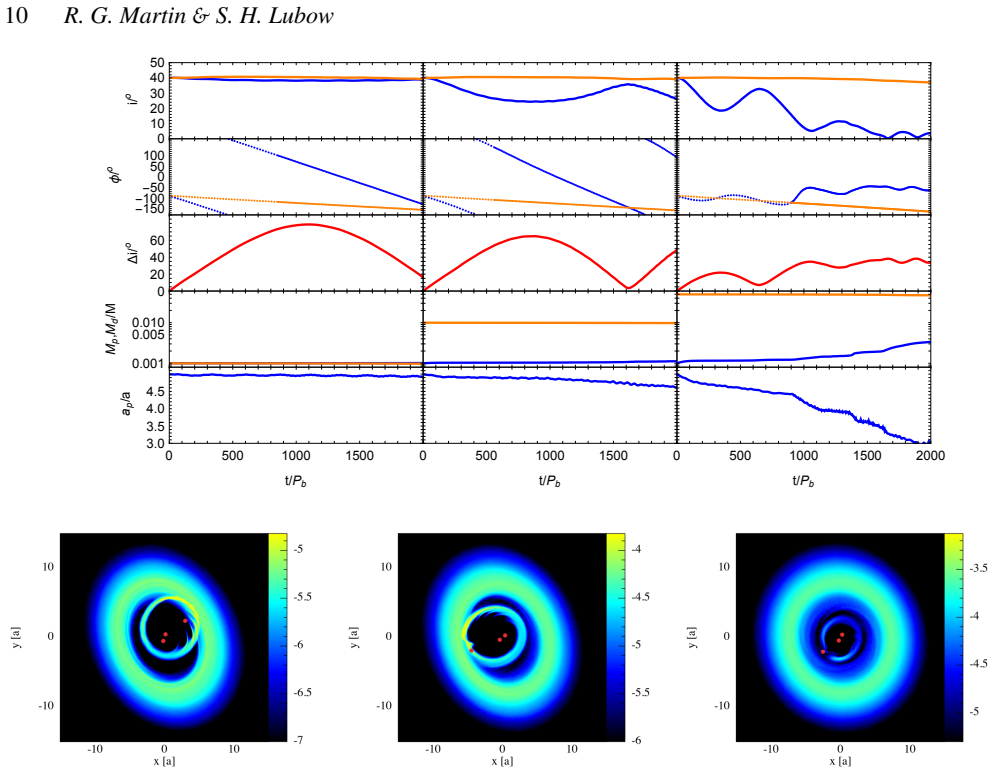
The load-bearing object is the linear secular system for the planet and disc tilt vectors $\boldsymbol{\ell}_p(t)$ and $\boldsymbol{\ell}_d(t)$, coupled by the coefficient $C_{pd}$ (an integral over the disc of a planet-disc kernel) and torqued by the binary through the Farago-Laskar quadrupole potential. The key threshold is the critical disc mass $M_{d,\rm cr}$ at which $\min_t[i_p(t)]=0$; above it the planet and disc transition from mutual nodal circulation to mutual libration. Around eccentric binaries the attractors are the coplanar state and the generalized polar state, whose stability is set by the critical inclination criteria given in the paper. In high-mass, highly inclined systems, the outer disc can excite Kozai-Lidov oscillations of the planet.
What would settle it
A repeat of the high-mass disc simulations ($M_d=0.05\,M$) with disc self-gravity included; if the planet no longer moves to coplanar or polar alignment (or is no longer ejected at high initial tilt), the paper's main claim would be contradicted.
Extended reading notes
Core claim
The paper shows that a gap-opening giant planet and its circumbinary disc do not remain coplanar: their mutual gravitational coupling produces mutual tilt oscillations whose character changes with disc mass. For a disc below a critical mass, the planet and disc undergo mutual nodal circulation, and the binary controls the planet, which can therefore end up at a wide range of inclinations. Above that critical mass the pair librates about a common precession, and a heavy disc takes over the planet's dynamical evolution: the planet's inclination is driven toward coplanar alignment for a circular binary, and toward either coplanar or polar alignment for an eccentric binary, depending on the initial inclination and on $e_b$. In the most massive, most inclined cases the planet can undergo Kozai-Lidov oscillations and be ejected from the system, and when the planet and disc become strongly mutually misaligned, a long-lived misaligned inner disc ring can form and grow eccentric.
Load-bearing premise
The central predictions rest on treating the disc's self-gravity as negligible even for the heaviest simulated disc, which is about fifty times the planet's mass.
Editorial extensions
If this is right
- Around eccentric binaries with massive discs, circumbinary planets should pile up at two inclination states, near coplanar and near polar, rather than filling the full range of initial disc tilts.
- The near-coplanarity of the Kepler circumbinary planets is consistent with the model: their short-period, low-eccentricity binaries are expected to produce mostly coplanar outcomes.
- For high-mass, initially highly misaligned discs, some giant planets will be ejected through Kozai-Lidov oscillations, potentially depleting giant planets around the most eccentric binaries.
- Planet-driven misaligned inner rings can survive for long times and become eccentric, offering an explanation for shadowed protoplanetary discs around binaries.
Reading between the lines
- The same circulation-libration threshold should apply to lower-mass planets that only partially clear a gap, but with a shifted critical disc mass; this is directly testable in simulations.
- If disc self-gravity modifies the high-mass-disc dynamics, the binary eccentricity window for polar alignment may widen or narrow; this could be checked by including self-gravity in the hydrodynamic runs.
- A statistical test of the bimodal prediction could come from future astrometric or radial-velocity catalogues of circumbinary planets, once formation-time disc masses are inferred from stellar accretion history.
- The Kozai-Lidov ejection channel implies that some misaligned giant planets may be lost after the gas disc has mostly dissipated, so the surviving inclination distribution could be even more bimodal than the in-disc outcome.
Editorial analysis
A structured set of objections, weighed in public.
Referee Report
Summary. This paper studies the secular evolution of a giant planet embedded in a circumbinary disc around an eccentric binary. The authors develop a linear secular model (Section 2) for the coupled tilts of the planet and disc, solve it as a four-eigenmode problem, and identify a critical disc mass separating mutual circulation from libration. They benchmark the model against a test-particle orbit integration (Fig. 1) and against 3D SPH simulations (Phantom) for binary eccentricities 0 and 0.5 and initial inclinations from 10 to 88.5 degrees (Table 1). The main claims are that for low-mass discs the binary dominates and leaves a wide range of planet inclinations; for high-mass discs (Md about 50 Mp) the disc dominates and drives the planet toward coplanar or polar alignment depending on initial disc inclination and binary eccentricity; in one high-inclination run the planet is ejected via Kozai-Lidov oscillations; and strongly misaligned systems form long-lived inner misaligned disc rings. The paper emphasizes that even isotropic initial disc misalignments can produce a bimodal final planet inclination distribution.
Significance. The result is potentially significant for the interpretation of circumbinary planet statistics: it identifies disc mass and binary eccentricity, rather than the initial disc misalignment, as the main determinants of final giant-planet inclinations, and it makes a falsifiable prediction (the circulation-libration boundary and the critical disc mass Md,cr) that is derived from the eigenmode solution rather than fitted. The paper has notable strengths: the analytic model is internally consistent, the test-particle limit is checked against direct orbit integration (Fig. 1), and the SPH comparisons cover both circular and eccentric binaries with clear phase-space diagnostics. The main weakness is that the high-mass branch of the central claim is computed without disc self-gravity, which is not negligible for the adopted Md = 0.05 M discs.
major comments (2)
- [Section 2, first paragraph; Section 3; Table 1 (circ3, circ6, ecc3, ecc6, ecc9)] The neglect of disc self-gravity is load-bearing for the high-mass branch of the central claim. The paper states in Section 2 'We neglect effects of disc self-gravity', and the SPH setup in Section 3 does not state that self-gravity is enabled. For the Md = 0.05 M runs, using the stated parameters (Sigma proportional to R^-3/2, Rin = 6a, Rout = 10a, H/R = 0.02), the Toomre parameter is Q ~ 0.4, so the disc is gravitationally unstable; the local self-gravity precession rate pi G Sigma / (R Omega) is comparable to or larger than the binary-induced precession rate. Since the coplanar/polar dichotomy, the KL-driven ejection (ecc9), and the inner-ring evolution all rely on the Md = 0.05 M runs, the high-mass branch of the abstract is not established. Please add a self-gravity check (e.g., the Q profile and the ratio of self-gravity to binary-induced precession rates) or explicitly restrict the conclusions to the non-self-gravitating regime.
- [Section 5.5 and Fig. 13] The Kozai-Lidov ejection in run ecc9 is a single trajectory, and it occurs in the same high-mass regime where self-gravity is neglected. The abstract's statement that a high-mass, high-inclination disc 'can result in the planet being ejected' should be presented as a single realization of one parameter set, not as a robust outcome, unless additional runs or a parameter study are provided. This is closely tied to the self-gravity concern above, because the disc potential that drives the KL oscillations is modeled without self-gravity in the very case where Q ~ 0.4.
minor comments (6)
- [Section 2.1 and Fig. 9 caption] The analytic model in Fig. 9 is evaluated with Rin = 6.5a and Rout = 12a, while the SPH discs in Section 3 are initialized with Rin = 6a and Rout = 10a; please justify this difference or use the same radii so the critical-mass comparison is transparent.
- [Section 2, first paragraph; Figs. 10, 12-14] Because the secular equations are linearized about the binary plane, the quantitative results at i0 = 40, 60, and ~90 degrees should be described as heuristic; please add an explicit statement of the model's validity range when applied to these runs.
- [Section 5.6, footnote 2] The caveat that the polar stationary inclinations differ between the planet and disc when their mutual interaction is included should appear in the main text near Eq. (23), since the initial inclinations in Fig. 14 are chosen using Eq. (23).
- [Conclusions, last paragraph] The claim of 'long-lived' inner misaligned rings is not quantified; the runs last only ~1500-2000 binary orbits, so 'long-lived' should either be defined with respect to a physical timescale (e.g., the disc viscous timescale) or softened.
- [Fig. 8 caption] The caption says 'Upper panel' but describes two panels; the text should refer to the surface density panel and the column-density panel separately.
- [Section 3] The choice of 200 binary orbits for the initial gap-opening run, followed by re-scaling the disc mass, is described in one sentence; it would help to specify the mapping from the initial low-mass surface density to the final Md values.
Circularity Check
No circularity identified: the derived critical mass and alignment outcomes follow from solving the stated secular equations, with SPH simulations as independent checks rather than fitted inputs.
full rationale
The paper's central derivation is self-contained and does not reduce any 'prediction' to its own inputs by construction. Section 2 sets out the linear secular equations (6)-(9) with explicit torques from the binary (Farago & Laskar 2010) and the planet-disc coupling coefficient C_pd, then solves the eigenvalue problem analytically. The critical disc mass M_d,cr is obtained from the condition min_t[i_p(t)] = 0, which is a mathematical consequence of the eigenmodes, not a fitted parameter. The SPH simulations independently evolve the system with the same physical parameters and are compared to the analytic solution without adjusting any parameter to force agreement; the matching is qualitative and quantitative for the cases shown. Self-citations (e.g., Martin & Lubow 2019 for the generalized polar state and critical inclination formulas) are analytic, parameter-free results with stated assumptions that do not themselves include the final coplanar/polar outcome of the present paper; they are used as inputs to set initial conditions or to interpret the simulations, which independently exhibit the claimed librating or circulating behaviour. The explicit neglect of disc self-gravity (Section 2: 'We neglect effects of disc self-gravity') is a physical approximation that affects robustness, especially for the M_d=0.05 M runs, but it is a stated limitation rather than a circular step: the derivation chain does not equate the prediction with an assumed input. No equation is shown to be equivalent to its own output, no fitted value is renamed as a prediction, and no load-bearing assertion is justified only by a self-citation that itself lacks external or independent verification.
Assumptions & free parameters
free parameters (7)
- Planet mass ratio M_p/M =
0.001
- Initial disc mass ratio M_d/M =
0.001, 0.01, 0.05
- Binary eccentricity e_b =
0, 0.5 (analytic also 0.9)
- Initial disc/planet inclination i_0 =
10, 40, 60, 88.5, 81.2 degrees
- Disc aspect ratio H/R =
0.02
- Shakura-Sunyaev alpha viscosity =
0.01
- Disc outer radius R_out =
10a in SPH; analytic up to 30a
assumptions (7)
- standard math Quadrupole secular binary torque from Farago & Laskar (2010)
- standard math Linearized small-tilt evolution equations from Lubow & Ogilvie (2000) and Lubow & Martin (2016)
- domain assumption Disc treated as a flat rigid precessing body with a single tilt vector
- domain assumption Disc self-gravity is negligible
- domain assumption Planet and disc initially mutually coplanar and disc lies outside planet orbit after gap clearing
- domain assumption General relativity and tidal effects on the binary are neglected
- domain assumption Disc thermodynamics fixed as locally isothermal with H/R = 0.02
Cite this review
Pith. "Pith review of Planet-disc interactions around eccentric binaries and misaligned ring formation." pith.science (2026). https://pith.science/paper/3JIRBLZS
@misc{pith2026250706675,
  author       = {Pith},
  title        = {Pith review of: Planet-disc interactions around eccentric binaries and misaligned ring formation},
  year         = {2026},
  howpublished = {\url{https://pith.science/paper/3JIRBLZS}},
  note         = {Machine review of arXiv:2507.06675}
}
abstract
We explore the evolution of a giant planet that interacts with a circumbinary disc that orbits a misaligned binary by means of analytic models and hydrodynamical simulations. Planet-disc interactions lead to mutual tilt oscillations between the planet and the disc. Even if circumbinary gas discs form with an isotropic mutual misalignment to the binary, planet-disc interactions can cause giant planets to evolve towards coplanar or polar alignment. For a low-mass disc, the binary dominates the dynamical evolution of the planet leading to a wide range of circumbinary planet inclinations. For a high-mass disc, the disc dominates the dynamical evolution of the planet and planet inclinations move towards coplanar or polar alignment to the binary orbit, depending upon the initial disc inclination and the binary eccentricity. In addition, for a high-mass disc ($\sim 50\, M_{\rm p}$) and a high initial disc inclination, the planet can undergo Kozai-Lidov oscillations that can result in the planet being ejected from the system. For initially highly misaligned systems, the non-coplanarity of the planet and the disc can lead to long-lived inner misaligned disc rings that can become highly eccentric.
Figures


Figures from the paper (9 more)




Reference graph
Works this paper leans on
-
[1]
write newline
" write newline "" before.all 'output.state := FUNCTION fin.entry write newline FUNCTION new.block output.state before.all = 'skip after.block 'output.state := if FUNCTION new.sentence output.state after.block = 'skip output.state before.all = 'skip after.sentence 'output.state := if if FUNCTION not #0 #1 if FUNCTION and 'skip pop #0 if FUNCTION or pop #1...
-
[2]
P., Chen C., Smallwood J., Rabago I., Martin R
Abod C. P., Chen C., Smallwood J., Rabago I., Martin R. G., Lubow S. H., 2022, @doi [ ] 10.1093/mnras/stac2601 , https://ui.adsabs.harvard.edu/abs/2022MNRAS.517..732A 517, 732
-
[3]
Aly H., Dehnen W., Nixon C., King A., 2015, @doi [MNRAS] 10.1093/mnras/stv128 , http://adsabs.harvard.edu/abs/2015MNRAS.449...65A 449, 65
-
[4]
Aly H., Lodato G., Cazzoletti P., 2018, @doi [ ] 10.1093/mnras/sty2179 , http://adsabs.harvard.edu/abs/2018MNRAS.480.4738A 480, 4738
-
[5]
Armstrong D. J., Osborn H. P., Brown D. J. A., Faedi F., G \'o mez Maqueo Chew Y., Martin D. V., Pollacco D., Udry S., 2014, @doi [ ] 10.1093/mnras/stu1570 , https://ui.adsabs.harvard.edu/abs/2014MNRAS.444.1873A 444, 1873
-
[6]
Arzamasskiy L., Zhu Z., Stone J. M., 2018, @doi [ ] 10.1093/mnras/sty001 , https://ui.adsabs.harvard.edu/abs/2018MNRAS.475.3201A 475, 3201
-
[7]
Bate M. R., 2018, @doi [ ] 10.1093/mnras/sty169 , http://adsabs.harvard.edu/abs/2018MNRAS.475.5618B 475, 5618
-
[11]
Progress report on the BEBOP search for circumbinary planets with radial velocities
Baycroft T. A., Triaud A. H. M. J., Lai D., 2024, @doi [arXiv e-prints] 10.48550/arXiv.2409.04191 , https://ui.adsabs.harvard.edu/abs/2024arXiv240904191B p. arXiv:2409.04191
work page Pith review arXiv doi:10.48550/arxiv.2409.04191 2024
Show all 153 references
-
[12]
A., Sairam L., Triaud A
Baycroft T. A., Sairam L., Triaud A. H. M. J., Correia A. C. M., 2025, @doi [Science Advances] 10.1126/sciadv.adu0627 , https://ui.adsabs.harvard.edu/abs/2025SciA...11..627B 11, eadu0627
2025 doi
-
[13]
Benisty M., et al., 2017, @doi [ ] 10.1051/0004-6361/201629798 , https://ui.adsabs.harvard.edu/abs/2017A&A...597A..42B 597, A42
2017 doi
-
[14]
P., et al., 2016, @doi [ ] 10.3847/0004-6256/152/5/125 , https://ui.adsabs.harvard.edu/abs/2016AJ....152..125B 152, 125
Bennett D. P., et al., 2016, @doi [ ] 10.3847/0004-6256/152/5/125 , https://ui.adsabs.harvard.edu/abs/2016AJ....152..125B 152, 125
2016 doi
-
[15]
P., 2006, @doi [ ] 10.1086/500530 , http://adsabs.harvard.edu/abs/2006ApJ...641.1148B 641, 1148
Boss A. P., 2006, @doi [ ] 10.1086/500530 , http://adsabs.harvard.edu/abs/2006ApJ...641.1148B 641, 1148
2006 doi
-
[16]
K., Hogerheijde M
Brinch C., J rgensen J. K., Hogerheijde M. R., Nelson R. P., Gressel O., 2016, @doi [ ] 10.3847/2041-8205/830/1/L16 , http://adsabs.harvard.edu/abs/2016ApJ...830L..16B 830, L16
2016 doi
-
[17]
L., Herbst W., Leggett S
Capelo H. L., Herbst W., Leggett S. K., Hamilton C. M., Johnson J. A., 2012, @doi [ ] 10.1088/2041-8205/757/1/L18 , http://adsabs.harvard.edu/abs/2012ApJ...757L..18C 757, L18
2012 doi
-
[18]
H., 2023, @doi [ ] 10.1093/mnras/stad444 , https://ui.adsabs.harvard.edu/abs/2023MNRAS.520.5817C 520, 5817
Ceppi S., Longarini C., Lodato G., Cuello N., Lubow S. H., 2023, @doi [ ] 10.1093/mnras/stad444 , https://ui.adsabs.harvard.edu/abs/2023MNRAS.520.5817C 520, 5817
2023 doi
-
[19]
J., Elsender D., Bate M
Ceppi S., Cuello N., Lodato G., Longarini C., Price D. J., Elsender D., Bate M. R., 2024, @doi [ ] 10.1051/0004-6361/202348375 , https://ui.adsabs.harvard.edu/abs/2024A&A...682A.104C 682, A104
2024 doi
-
[20]
H., Martin R
Chen C., Franchini A., Lubow S. H., Martin R. G., 2019, @doi [ ] 10.1093/mnras/stz2948 , https://ui.adsabs.harvard.edu/abs/2019MNRAS.490.5634C 490, 5634
2019 doi
-
[21]
H., Martin R
Chen C., Lubow S. H., Martin R. G., 2020, @doi [ ] 10.1093/mnras/staa1037 , https://ui.adsabs.harvard.edu/abs/2020MNRAS.494.4645C 494, 4645
2020 doi
-
[22]
H., Martin R
Chen C., Lubow S. H., Martin R. G., 2022, @doi [ ] 10.1093/mnras/stab3488 , https://ui.adsabs.harvard.edu/abs/2022MNRAS.510..351C 510, 351
2022 doi
-
[23]
H., Martin R
Chen C., Lubow S. H., Martin R. G., Nixon C. J., 2023a, @doi [ ] 10.1093/mnras/stad739 , https://ui.adsabs.harvard.edu/abs/2023MNRAS.521.5033C 521, 5033
-
[24]
G., Nixon C
Chen C., Martin R. G., Nixon C. J., 2023b, @doi [ ] 10.1093/mnras/stad2543 , https://ui.adsabs.harvard.edu/abs/2023MNRAS.525.3781C 525, 3781
-
[25]
A., Nixon C
Chen C., Baronett S. A., Nixon C. J., Martin R. G., 2024a, @doi [ ] 10.1093/mnrasl/slae058 , https://ui.adsabs.harvard.edu/abs/2024MNRAS.533L..37C 533, L37
-
[26]
G., Lubow S
Chen C., Martin R. G., Lubow S. H., Nixon C. J., 2024b, @doi [ ] 10.3847/2041-8213/ad17c5 , https://ui.adsabs.harvard.edu/abs/2024ApJ...961L...5C 961, L5
-
[27]
I., Murray-Clay R
Chiang E. I., Murray-Clay R. A., 2004, @doi [ ] 10.1086/383522 , http://adsabs.harvard.edu/abs/2004ApJ...607..913C 607, 913
2004 doi
-
[28]
C., Martin R
Childs A. C., Martin R. G., 2021a, @doi [ ] 10.1093/mnras/stab2419 , https://ui.adsabs.harvard.edu/abs/2021MNRAS.507.3461C 507, 3461
-
[29]
C., Martin R
Childs A. C., Martin R. G., 2021b, @doi [ ] 10.3847/2041-8213/ac2957 , https://ui.adsabs.harvard.edu/abs/2021ApJ...920L...8C 920, L8
-
[30]
C., Martin R
Childs A. C., Martin R. G., Lepp S., Lubow S. H., Geller A. M., 2023, @doi [ ] 10.3847/2041-8213/acbcc9 , https://ui.adsabs.harvard.edu/abs/2023ApJ...945L..11C 945, L11
2023 doi
-
[31]
C., Martin R
Childs A. C., Martin R. G., Nixon C. J., Geller A. M., Lubow S. H., Zhu Z., Lepp S., 2024, @doi [ ] 10.3847/1538-4357/ad1a11 , https://ui.adsabs.harvard.edu/abs/2024ApJ...962...77C 962, 77
2024 doi
-
[32]
J., Gendrin A., Sotomayor M., 2001, @doi [MNRAS] 10.1046/j.1365-8711.2001.04891.x , http://adsabs.harvard.edu/abs/2001MNRAS.328..485C 328, 485
Clarke C. J., Gendrin A., Sotomayor M., 2001, @doi [MNRAS] 10.1046/j.1365-8711.2001.04891.x , http://adsabs.harvard.edu/abs/2001MNRAS.328..485C 328, 485
2001
-
[33]
A., 2019, @doi [ ] 10.1051/0004-6361/201833976 , https://ui.adsabs.harvard.edu/abs/2019A&A...628A.119C 628, A119
Cuello N., Giuppone C. A., 2019, @doi [ ] 10.1051/0004-6361/201833976 , https://ui.adsabs.harvard.edu/abs/2019A&A...628A.119C 628, A119
2019 doi
-
[34]
Cuello N., et al., 2019, @doi [ ] 10.1093/mnras/sty3325 , https://ui.adsabs.harvard.edu/abs/2019MNRAS.483.4114C 483, 4114
2019 doi
-
[35]
M., Jensen E
Czekala I., Chiang E., Andrews S. M., Jensen E. L. N., Torres G., Wilner D. J., Stassun K. G., Macintosh B., 2019, @doi [ ] 10.3847/1538-4357/ab287b , https://ui.adsabs.harvard.edu/abs/2019ApJ...883...22C 883, 22
2019 doi
-
[36]
M., 2011, @doi [ ] 10.1111/j.1365-2966.2011.19657.x , http://adsabs.harvard.edu/abs/2011MNRAS.418.2656D 418, 2656
Doolin S., Blundell K. M., 2011, @doi [ ] 10.1111/j.1365-2966.2011.19657.x , http://adsabs.harvard.edu/abs/2011MNRAS.418.2656D 418, 2656
2011
-
[37]
R., Carter J
Doyle L. R., Carter J. A., Fabrycky D. C., Slawson R. W., Howell S. B., Winn J. N., Orosz J. A., et al. 2011, @doi [Science] 10.1126/science.1210923 , http://adsabs.harvard.edu/abs/2011Sci...333.1602D 333, 1602
2011 doi
-
[38]
R., Lakeland B
Elsender D., Bate M. R., Lakeland B. S., Jensen E. L. N., Lubow S. H., 2023, @doi [ ] 10.1093/mnras/stad1695 , https://ui.adsabs.harvard.edu/abs/2023MNRAS.523.4353E 523, 4353
2023 doi
-
[39]
J., 2013, @doi [MNRAS] 10.1093/mnras/stt877 , http://adsabs.harvard.edu/abs/2013MNRAS.433.2142F 433, 2142
Facchini S., Lodato G., Price D. J., 2013, @doi [MNRAS] 10.1093/mnras/stt877 , http://adsabs.harvard.edu/abs/2013MNRAS.433.2142F 433, 2142
2013 doi
-
[41]
Foucart F., Lai D., 2013, @doi [ ] 10.1088/0004-637X/764/1/106 , http://adsabs.harvard.edu/abs/2013ApJ...764..106F 764, 106
2013 doi
-
[42]
Foucart F., Lai D., 2014, @doi [ ] 10.1093/mnras/stu1869 , http://adsabs.harvard.edu/abs/2014MNRAS.445.1731F 445, 1731
2014 doi
-
[43]
G., Lubow S
Franchini A., Martin R. G., Lubow S. H., 2019a, @doi [ ] 10.1093/mnras/stz424 , http://adsabs.harvard.edu/abs/2019MNRAS.485..315F 485, 315
-
[44]
H., Martin R
Franchini A., Lubow S. H., Martin R. G., 2019b, @doi [ ] 10.3847/2041-8213/ab2fd8 , https://ui.adsabs.harvard.edu/abs/2019ApJ...880L..18F 880, L18
-
[45]
G., Lubow S
Franchini A., Martin R. G., Lubow S. H., 2020, @doi [ ] 10.1093/mnras/stz3175 , https://ui.adsabs.harvard.edu/abs/2020MNRAS.491.5351F 491, 5351
2020 doi
-
[46]
H., Martin R
Fu W., Lubow S. H., Martin R. G., 2015a, @doi [ ] 10.1088/0004-637X/807/1/75 , http://adsabs.harvard.edu/abs/2015ApJ...807...75F 807, 75
-
[47]
H., Martin R
Fu W., Lubow S. H., Martin R. G., 2015b, @doi [ApJ] 10.1088/0004-637X/813/2/105 , http://adsabs.harvard.edu/abs/2015ApJ...813..105F 813, 105
-
[48]
H., Martin R
Fu W., Lubow S. H., Martin R. G., 2017, @doi [ ] 10.3847/2041-8213/835/2/L29 , http://adsabs.harvard.edu/abs/2017ApJ...835L..29F 835, L29
2017 doi
-
[49]
K., Carter B., King R., O'Toole S., 2017, @doi [ ] 10.1093/mnras/stx604 , https://ui.adsabs.harvard.edu/abs/2017MNRAS.468.2932G 468, 2932
Getley A. K., Carter B., King R., O'Toole S., 2017, @doi [ ] 10.1093/mnras/stx604 , https://ui.adsabs.harvard.edu/abs/2017MNRAS.468.2932G 468, 2932
2017 doi
-
[50]
J., Wiegert P
Holman M. J., Wiegert P. A., 1999, @doi [ ] 10.1086/300695 , http://adsabs.harvard.edu/abs/1999AJ....117..621H 117, 621
1999 doi
-
[51]
A., 2019, @doi [ ] 10.3847/1538-3881/ab2127 , https://ui.adsabs.harvard.edu/abs/2019AJ....158....8H 158, 8
Hong Z., Quarles B., Li G., Orosz J. A., 2019, @doi [ ] 10.3847/1538-3881/ab2127 , https://ui.adsabs.harvard.edu/abs/2019AJ....158....8H 158, 8
2019 doi
-
[52]
G., Lubow S
Huang S., Martin R. G., Lubow S. H., 2025, @doi [ ] 10.3847/1538-4357/adcf1f , https://ui.adsabs.harvard.edu/abs/2025ApJ...985...65H 985, 65
2025 doi
- [53]
-
[55]
M., et al., 2019, @doi [Nature Astronomy] 10.1038/s41550-018-0667-x , http://adsabs.harvard.edu/abs/2019NatAs.tmp..189K
Kennedy G. M., et al., 2019, @doi [Nature Astronomy] 10.1038/s41550-018-0667-x , http://adsabs.harvard.edu/abs/2019NatAs.tmp..189K
2019 doi
-
[56]
R., Livio M., Lubow S
King A. R., Livio M., Lubow S. H., Pringle J. E., 2013, @doi [MNRAS] 10.1093/mnras/stt364 , http://adsabs.harvard.edu/abs/2013MNRAS.431.2655K 431, 2655
2013 doi
-
[57]
Kley W., Haghighipour N., 2014, @doi [ ] 10.1051/0004-6361/201323235 , https://ui.adsabs.harvard.edu/abs/2014A&A...564A..72K 564, A72
2014 doi
-
[58]
Kley W., Haghighipour N., 2015, @doi [ ] 10.1051/0004-6361/201526648 , https://ui.adsabs.harvard.edu/abs/2015A&A...581A..20K 581, A20
2015 doi
-
[59]
Kley W., Thun D., Penzlin A. B. T., 2019, @doi [ ] 10.1051/0004-6361/201935503 , https://ui.adsabs.harvard.edu/abs/2019A&A...627A..91K 627, A91
2019 doi
-
[60]
B., et al., 2014, @doi [ ] 10.1088/0004-637X/784/1/14 , http://adsabs.harvard.edu/abs/2014ApJ...784...14K 784, 14
Kostov V. B., et al., 2014, @doi [ ] 10.1088/0004-637X/784/1/14 , http://adsabs.harvard.edu/abs/2014ApJ...784...14K 784, 14
2014 doi
-
[61]
B., et al., 2016, @doi [ ] 10.3847/0004-637X/827/1/86 , http://adsabs.harvard.edu/abs/2016ApJ...827...86K 827, 86
Kostov V. B., et al., 2016, @doi [ ] 10.3847/0004-637X/827/1/86 , http://adsabs.harvard.edu/abs/2016ApJ...827...86K 827, 86
2016 doi
-
[62]
Kozai Y., 1962, @doi [AJ] 10.1086/108790 , http://adsabs.harvard.edu/abs/1962AJ.....67..591K 67, 591
1962 doi
-
[63]
M., et al., 2010, @doi [Science] 10.1126/science.1187187 , https://ui.adsabs.harvard.edu/abs/2010Sci...329...57L 329, 57
Lagrange A. M., et al., 2010, @doi [Science] 10.1126/science.1187187 , https://ui.adsabs.harvard.edu/abs/2010Sci...329...57L 329, 57
2010 doi
-
[64]
D., Papaloizou J
Larwood J. D., Papaloizou J. C. B., 1997, MNRAS, http://adsabs.harvard.edu/abs/1997MNRAS.285..288L 285, 288
1997
-
[65]
D., Nelson R
Larwood J. D., Nelson R. P., Papaloizou J. C. B., Terquem C., 1996, MNRAS, http://adsabs.harvard.edu/abs/1996MNRAS.282..597L 282, 597
1996
-
[66]
G., Childs A
Lepp S., Martin R. G., Childs A. C., 2022, @doi [ ] 10.3847/2041-8213/ac61e1 , https://ui.adsabs.harvard.edu/abs/2022ApJ...929L...5L 929, L5
2022 doi
-
[67]
G., Lubow S
Lepp S., Martin R. G., Lubow S. H., 2023, @doi [ ] 10.3847/2041-8213/acaf6d , https://ui.adsabs.harvard.edu/abs/2023ApJ...943L...4L 943, L4
2023 doi
-
[68]
G., Lubow S
Lepp S., Martin R. G., Lubow S. H., 2025, @doi [ ] 10.3847/1538-4357/adc111 , https://ui.adsabs.harvard.edu/abs/2025ApJ...983..167L 983, 167
2025 doi
-
[69]
J., Tao M., 2016, @doi [ ] 10.3847/0004-637X/831/1/96 , http://adsabs.harvard.edu/abs/2016ApJ...831...96L 831, 96
Li G., Holman M. J., Tao M., 2016, @doi [ ] 10.3847/0004-637X/831/1/96 , http://adsabs.harvard.edu/abs/2016ApJ...831...96L 831, 96
2016 doi
-
[70]
L., 1962, @doi [Planet
Lidov M. L., 1962, @doi [Planet. Space Sci.] 10.1016/0032-0633(62)90129-0 , http://adsabs.harvard.edu/abs/1962P
1962 doi
-
[71]
M., Paardekooper S., Baruteau C., Thebault P., 2014, @doi [ ] 10.1088/2041-8205/782/1/L11 , https://ui.adsabs.harvard.edu/abs/2014ApJ...782L..11L 782, L11
Lines S., Leinhardt Z. M., Paardekooper S., Baruteau C., Thebault P., 2014, @doi [ ] 10.1088/2041-8205/782/1/L11 , https://ui.adsabs.harvard.edu/abs/2014ApJ...782L..11L 782, L11
2014 doi
-
[72]
Lodato G., Facchini S., 2013, @doi [ ] 10.1093/mnras/stt878 , http://adsabs.harvard.edu/abs/2013MNRAS.433.2157L 433, 2157
2013 doi
-
[74]
E., 2007, @doi [MNRAS] 10.1111/j.1365-2966.2007.12332.x , http://adsabs.harvard.edu/abs/2007MNRAS.381.1287L 381, 1287
Lodato G., Pringle J. E., 2007, @doi [MNRAS] 10.1111/j.1365-2966.2007.12332.x , http://adsabs.harvard.edu/abs/2007MNRAS.381.1287L 381, 1287
2007
-
[75]
H., 2022, @doi [ ] 10.1093/mnras/stac2636 , https://ui.adsabs.harvard.edu/abs/2022MNRAS.516.5446L 516, 5446
Lubow S. H., 2022, @doi [ ] 10.1093/mnras/stac2636 , https://ui.adsabs.harvard.edu/abs/2022MNRAS.516.5446L 516, 5446
2022 doi
-
[76]
H., Martin R
Lubow S. H., Martin R. G., 2016, @doi [ ] 10.3847/0004-637X/817/1/30 , http://adsabs.harvard.edu/abs/2016ApJ...817...30L 817, 30
2016 doi
-
[77]
H., Martin R
Lubow S. H., Martin R. G., 2018, @doi [ ] 10.1093/mnras/stx2643 , http://adsabs.harvard.edu/abs/2018MNRAS.473.3733L 473, 3733
2018 doi
-
[78]
H., Ogilvie G
Lubow S. H., Ogilvie G. I., 2000, @doi [ ] 10.1086/309101 , http://adsabs.harvard.edu/abs/2000ApJ...538..326L 538, 326
2000 doi
-
[79]
H., Childs A
Lubow S. H., Childs A. C., Martin R. G., 2024, @doi [ ] 10.1093/mnras/stae1040 , https://ui.adsabs.harvard.edu/abs/2024MNRAS.530.2852L 530, 2852
2024 doi
-
[80]
K., Penny M
Luhn J. K., Penny M. T., Gaudi B. S., 2016, @doi [ ] 10.3847/0004-637X/827/1/61 , https://ui.adsabs.harvard.edu/abs/2016ApJ...827...61L 827, 61
2016 doi
-
[81]
Marino S., Perez S., Casassus S., 2015, @doi [ ] 10.1088/2041-8205/798/2/L44 , http://adsabs.harvard.edu/abs/2015ApJ...798L..44M 798, L44
2015 doi
-
[82]
V., 2017, @doi [ ] 10.1093/mnras/stw2851 , https://ui.adsabs.harvard.edu/abs/2017MNRAS.465.3235M 465, 3235
Martin D. V., 2017, @doi [ ] 10.1093/mnras/stw2851 , https://ui.adsabs.harvard.edu/abs/2017MNRAS.465.3235M 465, 3235
2017 doi
-
[83]
V., 2019, @doi [ ] 10.1093/mnras/stz959 , https://ui.adsabs.harvard.edu/abs/2019MNRAS.488.3482M 488, 3482
Martin D. V., 2019, @doi [ ] 10.1093/mnras/stz959 , https://ui.adsabs.harvard.edu/abs/2019MNRAS.488.3482M 488, 3482
2019 doi
-
[84]
G., Lubow S
Martin R. G., Lubow S. H., 2017, @doi [ ] 10.3847/2041-8213/835/2/L28 , http://adsabs.harvard.edu/abs/2017ApJ...835L..28M 835, L28
2017 doi
-
[85]
G., Lubow S
Martin R. G., Lubow S. H., 2018, @doi [ ] 10.1093/mnras/sty1648 , http://adsabs.harvard.edu/abs/2018MNRAS.479.1297M 479, 1297
2018 doi
-
[86]
G., Lubow S
Martin R. G., Lubow S. H., 2019, @doi [ ] 10.1093/mnras/stz2670 , https://ui.adsabs.harvard.edu/abs/2019MNRAS.490.1332M 490, 1332
2019 doi
-
[87]
V., Triaud A
Martin D. V., Triaud A. H. M. J., 2014, @doi [ ] 10.1051/0004-6361/201323112 , https://ui.adsabs.harvard.edu/abs/2014A&A...570A..91M 570, A91
2014 doi
-
[88]
V., Triaud A
Martin D. V., Triaud A. H. M. J., 2015, @doi [ ] 10.1093/mnras/stv121 , https://ui.adsabs.harvard.edu/abs/2015MNRAS.449..781M 449, 781
2015 doi
-
[89]
G., Armitage P
Martin R. G., Armitage P. J., Alexander R. D., 2013, @doi [ ] 10.1088/0004-637X/773/1/74 , https://ui.adsabs.harvard.edu/abs/2013ApJ...773...74M 773, 74
2013 doi
-
[90]
G., Nixon C., Armitage P
Martin R. G., Nixon C., Armitage P. J., Lubow S. H., Price D. J., 2014a, @doi [ApJL] 10.1088/2041-8205/790/2/L34 , http://adsabs.harvard.edu/abs/2014ApJ...790L..34M 790, L34
-
[91]
G., Nixon C., Lubow S
Martin R. G., Nixon C., Lubow S. H., Armitage P. J., Price D. J., Do g an S., King A., 2014b, @doi [ApJL] 10.1088/2041-8205/792/2/L33 , http://adsabs.harvard.edu/abs/2014ApJ...792L..33M 792, L33
-
[92]
G., Lubow S
Martin R. G., Lubow S. H., Nixon C., Armitage P. J., 2016, @doi [ ] 10.1093/mnras/stw605 , http://adsabs.harvard.edu/abs/2016MNRAS.458.4345M 458, 4345
2016 doi
-
[93]
G., Nixon C
Martin R. G., Nixon C. J., Pringle J. E., Livio M., 2019a, @doi [New Astronomy] 10.1016/j.newast.2019.01.001 , http://adsabs.harvard.edu/abs/2019NewA...70....7M 70, 7
2019 doi
-
[94]
V., et al., 2019b, @doi [ ] 10.1051/0004-6361/201833669 , https://ui.adsabs.harvard.edu/abs/2019A&A...624A..68M 624, A68
Martin D. V., et al., 2019b, @doi [ ] 10.1051/0004-6361/201833669 , https://ui.adsabs.harvard.edu/abs/2019A&A...624A..68M 624, A68
-
[95]
G., Lepp S., Lubow S
Martin R. G., Lepp S., Lubow S. H., Kenworthy M. A., Kennedy G. M., Vallet D., 2022, @doi [ ] 10.3847/2041-8213/ac54b4 , https://ui.adsabs.harvard.edu/abs/2022ApJ...927L..26M 927, L26
2022 doi
-
[96]
Matsakos T., K \"o nigl A., 2017, @doi [ ] 10.3847/1538-3881/153/2/60 , https://ui.adsabs.harvard.edu/abs/2017AJ....153...60M 153, 60
2017 doi
-
[97]
Mayer L., Wadsley J., Quinn T., Stadel J., 2005, @doi [ ] 10.1111/j.1365-2966.2005.09468.x , http://adsabs.harvard.edu/abs/2005MNRAS.363..641M 363, 641
2005
-
[98]
F., Ostriker E
McKee C. F., Ostriker E. C., 2007, @doi [ ] 10.1146/annurev.astro.45.051806.110602 , http://adsabs.harvard.edu/abs/2007ARA
2007 arXiv
-
[99]
Meschiari S., 2012, @doi [ ] 10.1088/0004-637X/752/1/71 , https://ui.adsabs.harvard.edu/abs/2012ApJ...752...71M 752, 71
2012 doi
-
[100]
Meschiari S., 2014, @doi [ ] 10.1088/0004-637X/790/1/41 , https://ui.adsabs.harvard.edu/abs/2014ApJ...790...41M 790, 41
2014 doi
-
[101]
J., Prato L., McCabe C., 2007, Protostars and Planets V, http://adsabs.harvard.edu/abs/2007prpl.conf..395M pp 395--409
Monin J.-L., Clarke C. J., Prato L., McCabe C., 2007, Protostars and Planets V, http://adsabs.harvard.edu/abs/2007prpl.conf..395M pp 395--409
2007
-
[102]
J., Lithwick Y., 2020, @doi [ ] 10.3847/1538-4357/abc74c , https://ui.adsabs.harvard.edu/abs/2020ApJ...905..106M 905, 106
Mu \ n oz D. J., Lithwick Y., 2020, @doi [ ] 10.3847/1538-4357/abc74c , https://ui.adsabs.harvard.edu/abs/2020ApJ...905..106M 905, 106
2020 doi
-
[103]
M., Pierens A., Nelson R
Mutter M. M., Pierens A., Nelson R. P., 2017, @doi [ ] 10.1093/mnras/stx1113 , https://ui.adsabs.harvard.edu/abs/2017MNRAS.469.4504M 469, 4504
2017 doi
-
[104]
C., Di Sisto R
Naoz S., Li G., Zanardi M., de El \' a G. C., Di Sisto R. P., 2017, @doi [ ] 10.3847/1538-3881/aa6fb0 , https://ui.adsabs.harvard.edu/abs/2017AJ....154...18N 154, 18
2017 doi
-
[105]
G., Nixon C., 2018, @doi [ ] 10.1093/mnras/sty2267 , http://adsabs.harvard.edu/abs/2018MNRAS.481...20N 481, 20
Nealon R., Dipierro G., Alexander R., Martin R. G., Nixon C., 2018, @doi [ ] 10.1093/mnras/sty2267 , http://adsabs.harvard.edu/abs/2018MNRAS.481...20N 481, 20
2018 doi
-
[106]
Nealon R., Cuello N., Alexander R., 2019a, @doi [ ] 10.1093/mnras/stz3186 , https://ui.adsabs.harvard.edu/abs/2019MNRAS.tmp.2783N p. 2783
-
[107]
Nealon R., Pinte C., Alexander R., Mentiplay D., Dipierro G., 2019b, @doi [ ] 10.1093/mnras/stz346 , https://ui.adsabs.harvard.edu/abs/2019MNRAS.484.4951N 484, 4951
-
[108]
F., 2000, @doi [ ] 10.1086/312752 , http://adsabs.harvard.edu/abs/2000ApJ...537L..65N 537, L65
Nelson A. F., 2000, @doi [ ] 10.1086/312752 , http://adsabs.harvard.edu/abs/2000ApJ...537L..65N 537, L65
2000 doi
-
[109]
P., 2003, @doi [ ] 10.1046/j.1365-8711.2003.06929.x , https://ui.adsabs.harvard.edu/abs/2003MNRAS.345..233N 345, 233
Nelson R. P., 2003, @doi [ ] 10.1046/j.1365-8711.2003.06929.x , https://ui.adsabs.harvard.edu/abs/2003MNRAS.345..233N 345, 233
2003
-
[110]
J., 2012, @doi [MNRAS] 10.1111/j.1365-2966.2012.21072.x , http://adsabs.harvard.edu/abs/2012MNRAS.423.2597N 423, 2597
Nixon C. J., 2012, @doi [MNRAS] 10.1111/j.1365-2966.2012.21072.x , http://adsabs.harvard.edu/abs/2012MNRAS.423.2597N 423, 2597
2012
-
[111]
J., King A
Nixon C. J., King A. R., Pringle J. E., 2011, @doi [MNRAS] 10.1111/j.1745-3933.2011.01121.x , http://adsabs.harvard.edu/abs/2011MNRAS.417L..66N 417, L66
2011
-
[112]
Nixon C., King A., Price D., 2013, @doi [MNRAS] 10.1093/mnras/stt1136 , http://adsabs.harvard.edu/abs/2013MNRAS.434.1946N 434, 1946
2013 doi
-
[113]
Offner S. S. R., Kratter K. M., Matzner C. D., Krumholz M. R., Klein R. I., 2010, @doi [ApJ] 10.1088/0004-637X/725/2/1485 , http://adsabs.harvard.edu/abs/2010ApJ...725.1485O 725, 1485
2010 doi
-
[114]
A., et al., 2012a, @doi [Science] 10.1126/science.1228380 , http://adsabs.harvard.edu/abs/2012Sci...337.1511O 337, 1511
Orosz J. A., et al., 2012a, @doi [Science] 10.1126/science.1228380 , http://adsabs.harvard.edu/abs/2012Sci...337.1511O 337, 1511
-
[115]
A., et al., 2012b, @doi [ ] 10.1088/0004-637X/758/2/87 , http://adsabs.harvard.edu/abs/2012ApJ...758...87O 758, 87
Orosz J. A., et al., 2012b, @doi [ ] 10.1088/0004-637X/758/2/87 , http://adsabs.harvard.edu/abs/2012ApJ...758...87O 758, 87
-
[116]
M., Th \'e bault P., Baruteau C., 2012, @doi [ ] 10.1088/2041-8205/754/1/L16 , https://ui.adsabs.harvard.edu/abs/2012ApJ...754L..16P 754, L16
Paardekooper S.-J., Leinhardt Z. M., Th \'e bault P., Baruteau C., 2012, @doi [ ] 10.1088/2041-8205/754/1/L16 , https://ui.adsabs.harvard.edu/abs/2012ApJ...754L..16P 754, L16
2012 doi
-
[117]
Papaloizou J. C. B., Lin D. N. C., 1995, @doi [ApJ] 10.1086/175127 , http://adsabs.harvard.edu/abs/1995ApJ...438..841P 438, 841
1995 doi
-
[118]
Papaloizou J. C. B., Terquem C., 1995, MNRAS, http://adsabs.harvard.edu/abs/1995MNRAS.274..987P 274, 987
1995
-
[119]
Picogna G., Marzari F., 2015, @doi [ ] 10.1051/0004-6361/201526162 , http://adsabs.harvard.edu/abs/2015A
2015 doi
-
[120]
P., 2007, @doi [ ] 10.1051/0004-6361:20077659 , https://ui.adsabs.harvard.edu/abs/2007A&A...472..993P 472, 993
Pierens A., Nelson R. P., 2007, @doi [ ] 10.1051/0004-6361:20077659 , https://ui.adsabs.harvard.edu/abs/2007A&A...472..993P 472, 993
2007 doi
-
[121]
P., 2008, @doi [ ] 10.1051/0004-6361:200809453 , https://ui.adsabs.harvard.edu/abs/2008A&A...483..633P 483, 633
Pierens A., Nelson R. P., 2008, @doi [ ] 10.1051/0004-6361:200809453 , https://ui.adsabs.harvard.edu/abs/2008A&A...483..633P 483, 633
2008 doi
-
[122]
P., 2013, @doi [ ] 10.1051/0004-6361/201321777 , https://ui.adsabs.harvard.edu/abs/2013A&A...556A.134P 556, A134
Pierens A., Nelson R. P., 2013, @doi [ ] 10.1051/0004-6361/201321777 , https://ui.adsabs.harvard.edu/abs/2013A&A...556A.134P 556, A134
2013 doi
-
[123]
P., 2018, @doi [ ] 10.1093/mnras/sty780 , http://adsabs.harvard.edu/abs/2018MNRAS.477.2547P 477, 2547
Pierens A., Nelson R. P., 2018, @doi [ ] 10.1093/mnras/sty780 , http://adsabs.harvard.edu/abs/2018MNRAS.477.2547P 477, 2547
2018 doi
-
[124]
J., 2007, @doi [Pasa] 10.1071/AS07022 , http://adsabs.harvard.edu/abs/2007PASA...24..159P 24, 159
Price D. J., 2007, @doi [Pasa] 10.1071/AS07022 , http://adsabs.harvard.edu/abs/2007PASA...24..159P 24, 159
2007 doi
-
[125]
J., 2012, @doi [Journal of Computational Physics] 10.1016/j.jcp.2010.12.011 , http://adsabs.harvard.edu/abs/2012JCoPh.231..759P 231, 759
Price D. J., 2012, @doi [Journal of Computational Physics] 10.1016/j.jcp.2010.12.011 , http://adsabs.harvard.edu/abs/2012JCoPh.231..759P 231, 759
2012 doi
-
[127]
J., et al., 2018a, @doi [ ] 10.1017/pasa.2018.25 , http://adsabs.harvard.edu/abs/2018PASA...35...31P 35, e031
Price D. J., et al., 2018a, @doi [ ] 10.1017/pasa.2018.25 , http://adsabs.harvard.edu/abs/2018PASA...35...31P 35, e031
2018 doi
-
[128]
J., et al., 2018b, @doi [ ] 10.1093/mnras/sty647 , https://ui.adsabs.harvard.edu/abs/2018MNRAS.477.1270P 477, 1270
Price D. J., et al., 2018b, @doi [ ] 10.1093/mnras/sty647 , https://ui.adsabs.harvard.edu/abs/2018MNRAS.477.1270P 477, 1270
-
[129]
J., 2016, @doi [ ] 10.3847/0004-6256/151/5/111 , https://ui.adsabs.harvard.edu/abs/2016AJ....151..111Q 151, 111
Quarles B., Lissauer J. J., 2016, @doi [ ] 10.3847/0004-6256/151/5/111 , https://ui.adsabs.harvard.edu/abs/2016AJ....151..111Q 151, 111
2016 doi
-
[130]
Quarles B., Satyal S., Kostov V., Kaib N., Haghighipour N., 2018, @doi [ ] 10.3847/1538-4357/aab264 , https://ui.adsabs.harvard.edu/abs/2018ApJ...856..150Q 856, 150
2018 doi
-
[131]
G., Lubow S
Rabago I., Zhu Z., Martin R. G., Lubow S. H., 2023, @doi [ ] 10.1093/mnras/stad242 , https://ui.adsabs.harvard.edu/abs/2023MNRAS.520.2138R 520, 2138
2023 doi
-
[132]
G., 2024, @doi [ ] 10.1093/mnras/stae1787 , https://ui.adsabs.harvard.edu/abs/2024MNRAS.533..360R 533, 360
Rabago I., Zhu Z., Lubow S., Martin R. G., 2024, @doi [ ] 10.1093/mnras/stae1787 , https://ui.adsabs.harvard.edu/abs/2024MNRAS.533..360R 533, 360
2024 doi
-
[133]
R., 2013, @doi [ ] 10.1088/2041-8205/764/1/L16 , https://ui.adsabs.harvard.edu/abs/2013ApJ...764L..16R 764, L16
Rafikov R. R., 2013, @doi [ ] 10.1088/2041-8205/764/1/L16 , https://ui.adsabs.harvard.edu/abs/2013ApJ...764L..16R 764, L16
2013 doi
-
[134]
Raghavan D., et al., 2010, @doi [ ] 10.1088/0067-0049/190/1/1 , http://adsabs.harvard.edu/abs/2010ApJS..190....1R 190, 1
2010 doi
-
[135]
Sahlmann J., Triaud A. H. M. J., Martin D. V., 2015, @doi [ ] 10.1093/mnras/stu2428 , https://ui.adsabs.harvard.edu/abs/2015MNRAS.447..287S 447, 287
2015 doi
-
[136]
I., Sunyaev R
Shakura N. I., Sunyaev R. A., 1973, A&A, http://adsabs.harvard.edu/abs/1973A
1973
-
[137]
H., Lubow S
Shi J.-M., Krolik J. H., Lubow S. H., Hawley J. F., 2012, @doi [ApJ] 10.1088/0004-637X/749/2/118 , http://adsabs.harvard.edu/abs/2012ApJ...749..118S 749, 118
2012 doi
-
[138]
R., 2015, @doi [ ] 10.1088/0004-637X/808/1/58 , https://ui.adsabs.harvard.edu/abs/2015ApJ...808...58S 808, 58
Silsbee K., Rafikov R. R., 2015, @doi [ ] 10.1088/0004-637X/808/1/58 , https://ui.adsabs.harvard.edu/abs/2015ApJ...808...58S 808, 58
2015 doi
-
[139]
L., Lubow S
Smallwood J. L., Lubow S. H., Franchini A., Martin R. G., 2019, @doi [ ] 10.1093/mnras/stz994 , https://ui.adsabs.harvard.edu/abs/2019MNRAS.486.2919S 486, 2919
2019 doi
-
[140]
L., Franchini A., Chen C., Becerril E., Lubow S
Smallwood J. L., Franchini A., Chen C., Becerril E., Lubow S. H., Yang C.-C., Martin R. G., 2020, @doi [ ] 10.1093/mnras/staa654 , https://ui.adsabs.harvard.edu/abs/2020MNRAS.494..487S 494, 487
2020 doi
-
[141]
L., Nealon R., Chen C., Martin R
Smallwood J. L., Nealon R., Chen C., Martin R. G., Bi J., Dong R., Pinte C., 2021, @doi [ ] 10.1093/mnras/stab2624 , https://ui.adsabs.harvard.edu/abs/2021MNRAS.508..392S 508, 392
2021 doi
-
[142]
L., Yang C.-C., Zhu Z., Martin R
Smallwood J. L., Yang C.-C., Zhu Z., Martin R. G., Dong R., Cuello N., Isella A., 2023, @doi [ ] 10.1093/mnras/stad742 , https://ui.adsabs.harvard.edu/abs/2023MNRAS.521.3500S 521, 3500
2023 doi
-
[143]
J., et al., 2020, @doi [ ] 10.3847/1538-3881/ab665b , https://ui.adsabs.harvard.edu/abs/2020AJ....159...94S 159, 94
Socia Q. J., et al., 2020, @doi [ ] 10.3847/1538-3881/ab665b , https://ui.adsabs.harvard.edu/abs/2020AJ....159...94S 159, 94
2020 doi
-
[144]
R., et al., 2023, @doi [Nature Astronomy] 10.1038/s41550-023-01948-4 , https://ui.adsabs.harvard.edu/abs/2023NatAs...7..702S 7, 702
Standing M. R., et al., 2023, @doi [Nature Astronomy] 10.1038/s41550-023-01948-4 , https://ui.adsabs.harvard.edu/abs/2023NatAs...7..702S 7, 702
2023 doi
-
[145]
P., Fabrycky D
Sutherland A. P., Fabrycky D. C., 2016, @doi [The Astrophysical Journal] 10.3847/0004-637x/818/1/6 , 818, 6
2016 doi
-
[146]
Terquem C., Ajmia A., 2010, @doi [ ] 10.1111/j.1365-2966.2010.16295.x , https://ui.adsabs.harvard.edu/abs/2010MNRAS.404..409T 404, 409
2010
-
[147]
Thun D., Kley W., Picogna G., 2017, @doi [ ] 10.1051/0004-6361/201730666 , https://ui.adsabs.harvard.edu/abs/2017A&A...604A.102T 604, A102
2017 doi
-
[148]
Tokuda K., et al., 2014, @doi [ApJL] 10.1088/2041-8205/789/1/L4 , http://adsabs.harvard.edu/abs/2014ApJ...789L...4T 789, L4
2014 doi
-
[149]
Triaud A. H. M. J., et al., 2022, @doi [ ] 10.1093/mnras/stab3712 , https://ui.adsabs.harvard.edu/abs/2022MNRAS.511.3561T 511, 3561
2022 doi
-
[150]
E., Evans N
Verrier P. E., Evans N. W., 2009, @doi [ ] 10.1111/j.1365-2966.2009.14446.x , http://adsabs.harvard.edu/abs/2009MNRAS.394.1721V 394, 1721
2009
-
[151]
F., et al., 2012, @doi [ ] 10.1038/nature10768 , http://adsabs.harvard.edu/abs/2012Natur.481..475W 481, 475
Welsh W. F., et al., 2012, @doi [ ] 10.1038/nature10768 , http://adsabs.harvard.edu/abs/2012Natur.481..475W 481, 475
2012 doi
-
[152]
F., et al., 2015, @doi [ ] 10.1088/0004-637X/809/1/26 , http://adsabs.harvard.edu/abs/2015ApJ...809...26W 809, 26
Welsh W. F., et al., 2015, @doi [ ] 10.1088/0004-637X/809/1/26 , http://adsabs.harvard.edu/abs/2015ApJ...809...26W 809, 26
2015 doi
-
[153]
B., Haghighipour N., Orosz J
Windemuth D., Agol E., Carter J., Ford E. B., Haghighipour N., Orosz J. A., Welsh W. F., 2019, @doi [ ] 10.1093/mnras/stz2637 , https://ui.adsabs.harvard.edu/abs/2019MNRAS.490.1313W 490, 1313
2019 doi
-
[154]
N., Holman M
Winn J. N., Holman M. J., Johnson J. A., Stanek K. Z., Garnavich P. M., 2004, @doi [ ] 10.1086/383089 , http://adsabs.harvard.edu/abs/2004ApJ...603L..45W 603, L45
2004 doi
-
[155]
Yamanaka A., Sasaki T., 2019, @doi [Earth, Planets, and Space] 10.1186/s40623-019-1064-0 , https://ui.adsabs.harvard.edu/abs/2019EP&S...71...82Y 71, 82
2019 doi
-
[156]
K., Stevenson S., Nixon C
Young A. K., Stevenson S., Nixon C. J., Rice K., 2023, @doi [ ] 10.1093/mnras/stad2451 , https://ui.adsabs.harvard.edu/abs/2023MNRAS.525.2616Y 525, 2616
2023 doi
-
[157]
J., Lai D., 2018, @doi [ ] 10.1093/mnras/stx2375 , http://adsabs.harvard.edu/abs/2018MNRAS.473..603Z 473, 603
Zanazzi J. J., Lai D., 2018, @doi [ ] 10.1093/mnras/stx2375 , http://adsabs.harvard.edu/abs/2018MNRAS.473..603Z 473, 603
2018 doi
-
[158]
C., 2019, @doi [ ] 10.3847/1538-4357/ab24d5 , https://ui.adsabs.harvard.edu/abs/2019ApJ...879...92Z 879, 92
Zhang Z., Fabrycky D. C., 2019, @doi [ ] 10.3847/1538-4357/ab24d5 , https://ui.adsabs.harvard.edu/abs/2019ApJ...879...92Z 879, 92
2019 doi
-
[159]
Zhu Z., 2019, @doi [ ] 10.1093/mnras/sty3358 , https://ui.adsabs.harvard.edu/abs/2019MNRAS.483.4221Z 483, 4221
2019 doi
-
[160]
von Zeipel H., 1910, @doi [Astronomische Nachrichten] 10.1002/asna.19091832202 , https://ui.adsabs.harvard.edu/abs/1910AN....183..345V 183, 345
1910 doi
Reviewed August 6, 2026 · model on record in the stance chip above.
Discussion (0). Sign in to comment.