REVIEW 4 major objections 5 minor 2 cited by
Helicity Fluxes and Hemispheric Helicity Rule of Active Regions Emerging from the Convection Zone Dynamo
T0 review · 4 major / 5 minor · reviewed 2026-08-06 · deepseek-v4-flash
Pith's one-line read A solar dynamo model shows emerging active regions carry helicity in two phases: tilt/twist first, differential rotation last.
desk verdict Novel helicity-flux budget from a 3D dynamo with BMR emergence; early phase partly prescribed, late-phase differential-rotation dominance is the stronger claim, and the paper deserves referee time despite missing null-run and sensitivity tests. read the letter →
The pith
A machine-rendered reading of the paper's core claim, the machinery that carries it, and where it could break.
The reading
What carries the argument
The central mechanism is the extended mean-field induction equation in which the electromotive force contains a dedicated BMR source term, $\mathbf{E}^{(\mathrm{BMR})}$, whose $\alpha$-like part $\alpha^{\mathrm{BMR}}_\beta \langle\mathbf{B}\rangle$ with $\alpha^{\mathrm{BMR}}_\beta = C_{\alpha\beta}\cos\theta\, V_\beta\, \psi_\alpha(\beta)$ imprints the tilt and twist on the rising toroidal field, while the buoyancy term $V_\beta(\hat r \times \langle\mathbf{B}\rangle)$ carries the region upward. The helicity budget is then decomposed into fluxes $F_\Omega$ (differential rotation), $F_U$ (meridional circulation), $F_{\alpha\beta}$ (BMR tilt/twist and rise), $F_{\eta}$ (turbulent diffusion of the mean field), and $F^{\langle ab\rangle}$ (diffusion of small-scale helicity), allowing the model to attribute the surface helicity flux to each source separately over the BMR's lifetime.
What would settle it
A statistical study of vector magnetograms of many emerging active regions measuring the time evolution of the injected helicity flux, separated into the contribution from polarity rotation (tilt/twist proxy) and the contribution from differential rotation, would settle the claim: the paper predicts that the tilt/twist contribution should dominate in the first few days after emergence and the differential-rotation contribution should dominate afterward, with the sign of the initial contribution often violating the hemispheric rule.
Extended reading notes
Core claim
The paper argues that the magnetic helicity flux of an emerging bipolar magnetic region has a two-stage origin. At the beginning of emergence, the helicity flux is dominated by the BMR's tilt and twist, which the model represents through an added mean electromotive force $\mathbf{E}^{(\mathrm{BMR})} = \alpha^{\mathrm{BMR}}_\beta \langle\mathbf{B}\rangle + V_\beta (\hat{r} \times \langle\mathbf{B}\rangle)$, where the first term generates the poloidal field that tilts and twists the configuration and the second models the buoyant rise. At the final stage of the BMR's evolution, the differential rotation becomes the main source of helicity flux, and the model's hemispheric helicity rule is then determined by that rotation rather than by the initial twist. The paper also reports that the radial gradient of magnetic helicity produces a turbulent-diffusion helicity flux orders of magnitude larger than the horizontal contribution, and that the twist parameters $\alpha_{\mathrm{avr}}$, $\alpha_{\mathrm{av}}$, and $\alpha_{\mathrm{ff}}$ quickly relax after emergence, with differential rotation acting to keep the final twist small and consistent with the hemispheric rule.
Load-bearing premise
The tilt and twist of each emerging region are inserted by hand through the prescribed electromotive force term $E^{(\mathrm{BMR})}$ with a chosen amplitude $C_{\alpha\beta}$ and a chosen timing relative to the buoyant rise, so the early dominance of the tilt/twist helicity flux and the initial hemispheric sign are imposed by the model setup rather than derived from the convection itself.
Editorial extensions
If this is right
- If the two-phase picture is correct, observations of early emergence should routinely show sign violations of the hemispheric helicity rule, because the initial tilt/twist contribution can have either sign until differential rotation takes over.
- The hemispheric helicity rule of mature active regions would be a differential-rotation effect rather than a direct fossil of the deep dynamo's twist, meaning surface flux-transport models and full dynamo models could converge on the same explanation.
- The radial turbulent-diffusion helicity flux, found here to dominate its horizontal counterpart, should be included in future estimates of helicity transport from active regions to the corona.
- The model's prediction that the total helicity transported scales roughly as $\Delta H \sim 0.02\Phi^2$, with the linkage parameter increasing with flux, gives a quantitative relation that can be checked against vector magnetogram measurements.
Reading between the lines
- The paper's division into an early tilt/twist phase and a late differential-rotation phase suggests a natural observational test: tracking the time derivative of the force-free parameter $\alpha$ for many emerging regions should show a systematic flip in sign or slope at roughly the emergence timescale (days), a pattern the author's model predicts but does not itself extract from data.
- Because the model finds the hemispheric rule is set by differential rotation in the final state, one could extend the claim to predict that the rule should weaken or reverse in epochs of anomalous rotation profiles, such as during grand minima, though the paper does not run such cases.
- The prescribed timing of the $\alpha$-effect relative to buoyancy (functions $\xi_1, \xi_2$) is the lever that controls whether regions emerge twisted, tilted, or both; varying this timing in a parameter scan would map the model's predictions onto the observed diversity of active-region rotation and tilt behavior.
Editorial analysis
A structured set of objections, weighed in public.
Referee Report
Summary. The paper uses a 3D non-linear mean-field solar dynamo model to study magnetic helicity fluxes, twist, and tilt of bipolar magnetic regions (BMRs) emerging through magnetic buoyancy. The model describes BMR emergence by adding a prescribed electromotive force E^(BMR) (Eq. 15) whose twist/tilt part is controlled by a hand-set coefficient C_alpha_beta (Eq. 18). From this, the authors compute the surface helicity flux and its decomposition into contributions from the BMR tilt/twist, differential rotation, meridional circulation, turbulent diffusion, and small-scale helicity diffusion (Eqs. 19-23). Their central claims are that the BMR tilt/twist helicity flux dominates at the beginning of emergence, that the differential rotation dominates at the end, and that the final-state hemispheric helicity rule is determined by differential rotation. One control run (E4') with the differential rotation switched off supports the latter claim for a single latitude. The paper also reports a Delta H ~ 0.02 Phi^2 relation and a latitudinal dependence of twist parameters for two setups, E5 and E6.
Significance. If upheld, the two-phase picture (prescribed twist/tilt dominating early, differential rotation dominating late) would provide a concrete connection between dynamo-generated twist and the observed hemispheric helicity rule, and would bridge mean-field and surface flux-transport interpretations. The paper contains a careful derivation of the helicity budget, a clear treatment of gauge issues, a decomposition of all flux contributions, and comparisons with observations and with the recent simulations of Toriumi et al. (2024). It also includes a genuine nontrivial test: in run E4, where the initial tilt sign is reversed, the final helicity sign still becomes HHR-compatible, indicating that the final-state result is not trivially identical to the input. However, the central conclusions rest on a small set of runs and on hand-set parameters, especially C_alpha_beta, the harmonic boundary-condition parameters (kR, eta_T^+/eta_T), and the timing of the injected EMF. The paper itself acknowledges in Section 5 that its BMR modeling is 'rather simple'.
major comments (4)
- [§3, Eq. (18), Table 1] The early-phase dominance of the tilt/twist helicity flux is, at least in part, imposed by construction. In Eq. (18), alpha_BMR = C_alpha_beta cos(theta) V_beta psi_alpha(beta), and in Table 1 the northern-hemisphere runs E1, E5, and E6 set C_alpha_beta=+1, which directly produces the HHR-compatible sign at emergence. Since F_alpha_beta in Eq. (22) is linear in alpha_BMR, the statement in Section 4.1 that the BMR tilt/twist flux 'is the dominant contribution ... at the beginning' is not an emergent dynamo result but a consequence of the chosen parameterization. The paper itself notes in Section 5 that 'our approach to modeling the evolution of the photospheric BMR is rather simple.' To separate prescription from dynamics, the authors should add a null run with C_alpha_beta=0 and latitude-swept runs with both signs of C_alpha_beta. Without these, the initial HHR-compatible sign is not derived from the model but inserted through the input parameters.
- [§4.2, Figs. 6–7] The final-state claim that 'the hemispheric rule is determined by the effect of the differential rotation' is supported by only one single-latitude control run, E4', where the differential rotation is switched off for a BMR at 20 degrees, plus the latitudinal plots for E5 and E6, all of which use C_alpha_beta=+1. The sign-reversal behavior of E4 is encouraging, but it does not establish robustness to the sign of the injected twist at other latitudes, to cycle phase, or to the presence of a pre-existing axisymmetric poloidal field. In Section 5 the authors explicitly state that cycle-phase dependence is not considered. A systematic set of runs with C_alpha_beta=0 and C_alpha_beta=±1 at several latitudes, and ideally at two cycle phases, is required before the 'final state determined by differential rotation' conclusion can be accepted as a general model result.
- [§4.1, Eqs. (27)–(29)] The model's twist parameters are stated to be 'by an order of magnitude larger than alpha_best in observations,' and no run is presented in which the input alpha_BMR amplitude is calibrated to observed twist values, for example by reducing C_alpha_beta. Because F_alpha_beta in Eq. (22) is linear in alpha_BMR, the early dominance of this flux over the differential-rotation flux in Figures 4 and 5 may be an artifact of the over-large twist amplitude. A sensitivity run with a lower C_alpha_beta, chosen so that the simulated alpha_av matches observed values, is needed to show that the two-phase evolution and the final domination by differential rotation survive at observationally realistic twist levels.
- [Appendix B and §4.1, Fig. 3] The early dominance of F_alpha_beta is not robust across the model's boundary-condition choices. Appendix B states that for the potential (vacuum) boundary condition, the contribution F_alpha_beta is approximately zero at the top boundary, and Figure 3 shows that the harmonic-boundary-condition runs (E5, E6) have much larger F_alpha_beta than the potential-boundary run E1. The main conclusions therefore depend on the harmonic boundary condition with hand-set parameters kR=0.1 and eta_T^+/eta_T=200, and the latter is acknowledged to yield a surface axisymmetric toroidal field of about 10 G, an order of magnitude above the roughly 1 G inferred for Cycle 24. The robustness of the two-phase picture to these boundary-condition parameters should be documented with additional runs before the abstract's 'beginning of BMR evolution' claim is presented as a general result.
minor comments (5)
- [§3, after Eq. (21)] The sentence 'where the small-scale helicity density is estimated from Eq.(18)' appears to reference the wrong equation; Eq. (18) defines alpha_BMR, whereas the small-scale helicity density is obtained from the evolution equation in Section 2 or Appendix A.
- [§4.1, paragraph after Eq. (26)] The sentence 'the turbulent diffusion of the magnetic field is by an order of magnitude larger than the turbulent diffusion' is unclear; it should read '... than the turbulent diffusion of the small-scale magnetic helicity.'
- [Fig. 7 caption] The caption's statement that 'the vertical scale in panel (d) is linear in the range of ±10° and logarithmic outside this range' is confusing for a tilt-angle plot; please specify which quantity in panel (d) uses this mixed scale.
- [§4.1, after Eq. (29)] The term 'alpha_best in observations' is not defined; presumably this is a typo for the observed best-fit force-free parameter or for alpha_av from observations, and it should be stated explicitly.
- [Abstract and §3] There are several typographical issues, including missing spaces between 'magnetic helicity flux and magnetic twist, and tilt' in the abstract, and 'alpha-affect' instead of 'alpha-effect' in Section 3; these should be corrected.
Circularity Check
Early tilt/twist helicity-flux dominance is built into the E^(BMR) parameterization; the late differential-rotation result is independently tested and not circular.
-
self definitional
[Section 3, Eqs. (15)-(18); Section 4.1, Fig. 4 discussion]
"E (BMR) = αBMR β ⟨B⟩ + Vβ (ˆr × ⟨B⟩) , where the first term takes into account the BMR’s tilt/twist ... αBMR β = Cαβ cos θVβψα(β). ... The total helicity flux in cases E2, E4, E5, and E6 sharply increases at the beginning of the BMR emergence because of the helicity transport by the twisted magnetic field rising from the convection zone."
The diagnostic Fαβ (Eq. 22) is constructed from exactly the same prescribed terms: it contains 2(αϕϕ + αBMRβ)(⟨Bϕ⟩⟨Aθ⟩ − ⟨Bθ⟩⟨Aϕ⟩) − 2Vβ(...), and the ξ1,2 functions of Appendix C switch E^(BMR) on only during the emergence interval 0 < t < δt. Therefore the abstract's claim that the helicity flux associated with the BMR's tilt/twist is the dominant contribution at the beginning of BMR evolution is a restatement of the model setup rather than an emergent result: the prescribed αBMRβ and Vβ are the only BMR-specific sources active at early times, so their associated flux necessarily dominates then. Table 1 fixes the sign of Cαβ by hand, so the initial HHR-compatible sign in runs E5/E6 is imposed rather than derived.
full rationale
The paper is a forward mean-field simulation, and most of its integrals and flux decompositions are internally consistent diagnostics rather than disguised fits. The central novel claim — that in the final state the hemispheric helicity rule is determined by differential rotation — is supported by a genuine control: run E4 reverses the sign of the prescribed tilt/twist parameter Cαβ, yet the helicity sign still inverts to the HHR-compatible sign by the end, and run E4′ with differential rotation suppressed isolates the mechanism. That part of the conclusion is not circular. However, the other half of the two-phase conclusion — that the tilt/twist helicity flux dominates at the beginning — reduces to construction: Fαβ is defined from the same E^(BMR) = αBMRβ⟨B⟩ + Vβ(r̂ × ⟨B⟩) terms that are switched on at the start, with Cαβ chosen by hand in Table 1. The observed early sharp increase in helicity flux is therefore the model's input acting, not a derived prediction about how turbulent convection twists emerging flux tubes. This is a partial circularity confined to the early-phase claim; the final-state differential-rotation conclusion has independent content, so the overall score is moderate rather than high.
Assumptions & free parameters
free parameters (6)
- C_alpha_beta =
1 (E1, E3, E5, E6), -1 (E4)
- C_beta =
250
- eta_T^+/eta_T =
200
- kR =
0.1
- BMR timing parameters =
delta_t = 5 days, t1 = delta_t/3, tau0 = 1 day
- Rm (turbulent magnetic Reynolds number) =
Not stated explicitly, calibrated in Pipin et al. (2023)
assumptions (5)
- domain assumption Mean-field decomposition and closure of the electromotive force E = alpha B - eta grad x B + gamma x B with alpha quenching by magnetic helicity.
- domain assumption Isotropic expressions for small-scale magnetic helicity dissipation and diffusion: 2 eta <b.j> = <a.b>/(Rm tau_c), and F^<ab> = -eta_chi grad <a.b> with eta_chi = eta_T/10.
- domain assumption Harmonic (not potential) exterior magnetic field boundary condition of Bonanno (2016), with source surface at 2.5R_sun and kR = 0.1.
- ad hoc to paper The BMR emergence is parameterized by E^(BMR) in Eq. (15) with prescribed alpha_BMR and buoyancy velocity V_beta, acting during a brief window defined by xi_1 and xi_2.
- domain assumption Parker magnetic buoyancy instability criterion selects the radial and latitudinal positions of BMR initiation.
Cite this review
Pith. "Pith review of Helicity Fluxes and Hemispheric Helicity Rule of Active Regions Emerging from the Convection Zone Dynamo." pith.science (2026). https://pith.science/paper/3JTL4TVN
@misc{pith2026250800309,
  author       = {Pith},
  title        = {Pith review of: Helicity Fluxes and Hemispheric Helicity Rule of Active Regions Emerging from the Convection Zone Dynamo},
  year         = {2026},
  howpublished = {\url{https://pith.science/paper/3JTL4TVN}},
  note         = {Machine review of arXiv:2508.00309}
}
read the original abstract
Using a 3D non-linear mean-field solar dynamo model, we investigate the magnetic helicity flux and magnetic twist, and tilt parameters of bipolar magnetic regions (BMRs) emerging from the solar convection zone due to the magnetic buoyancy instability. The twist and tilt of the BMR magnetic field are modeled as a result of an effective electromotive force along the rising part of the toroidal magnetic field. This force generates the poloidal field that tilts the whole magnetic configuration. We find that variations of BMR's twist and tilt determine the magnitude and the sign of the magnetic helicity flux on the solar surface. The model shows that the helicity flux associated with the BMR's tilt/twist is the dominant contribution to the BMR helicity at the beginning of the BMR's evolution, while the effect of differential rotation is the main source of the helicity flux at the final stage of the BMR's evolution. We discuss the implications of these effects on the basic properties and variations of the hemispheric helicity rule of active regions on the solar surface.
Figures

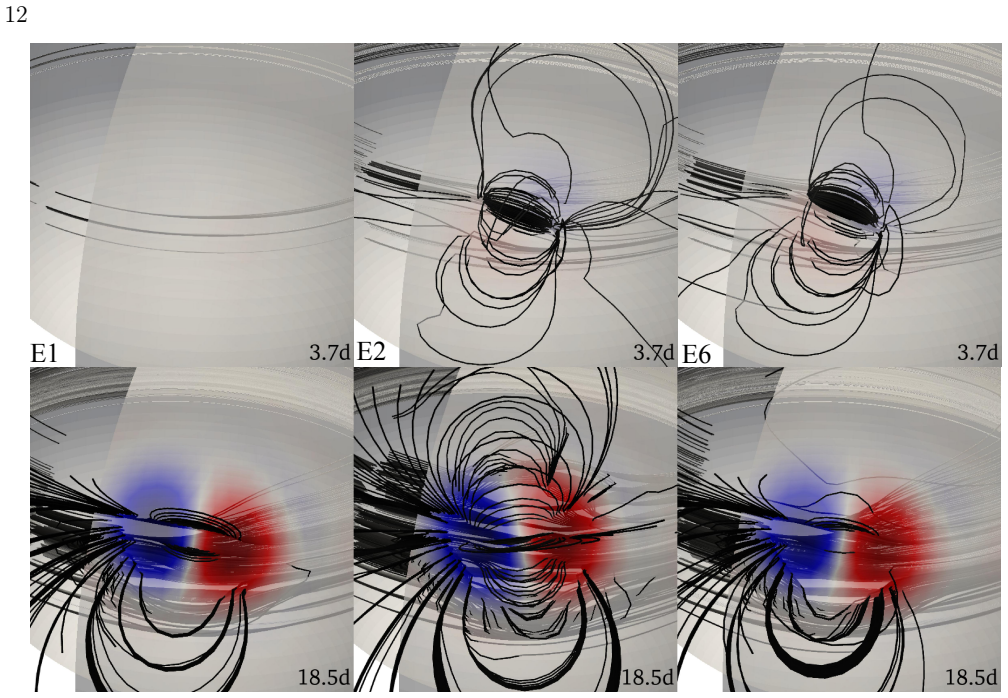

Figures from the paper (5 more)


Forward citations
Cited by 2 Pith papers
-
Effects of harmonic magnetic field boundary conditions in mean-field solar dynamo
The dynamo threshold, cycle period, and surface toroidal field depend on the coronal-to-convective turbulent diffusivity jump, with a large jump restoring vacuum-like boundary conditions.
-
Distribution of magnetic helicity and energy with height in solar atmosphere
Using 150 active regions, the paper finds helicity and energy are concentrated low in the corona and proposes an 81 Mm extrapolation cutoff for 97% retention.
Reference graph
Works this paper leans on
-
[1]
Zhukova, A. V. 2023, MNRAS, 518, 4746, doi: 10.1093/mnras/stac3338
-
[2]
1998, ApJ, 496, L43, doi: 10.1086/311232
Bao, S., & Zhang, H. 1998, ApJ, 496, L43, doi: 10.1086/311232
doi:10.1086/311232 1998
-
[3]
Berger, M. A., & Hornig, G. 2018, Journal of Physics A Mathematical General, 51, 495501, doi: 10.1088/1751-8121/aaea88
-
[4]
Berger, M. A., & Ruzmaikin, A. 2000, J. Geophys. Res., 105, 10481, doi: 10.1029/1999JA900392
-
[5]
Blackman, E. G., & Brandenburg, A. 2003, ApJL, 584, L99, doi: 10.1086/368374
doi:10.1086/368374 2003
-
[6]
2016, ApJL, 833, L22, doi: 10.3847/2041-8213/833/2/L22
Bonanno, A. 2016, ApJL, 833, L22, doi: 10.3847/2041-8213/833/2/L22
-
[7]
Bourdin, P., Singh, N. K., & Brandenburg, A. 2018, ApJ, 869, 2, doi: 10.3847/1538-4357/aae97a
-
[8]
Brandenburg, A. 2018, Astron. Nachr., 339, 631, doi: 10.1002/asna.201913604
Show all 74 references
-
[9]
2023, SSRv, 219, 55, doi: 10.1007/s11214-023-00999-3
Pipin, V. 2023, SSRv, 219, 55, doi: 10.1007/s11214-023-00999-3
2023 doi
-
[10]
2005, PhR, 417, 1, doi: 10.1016/j.physrep.2005.06.005
Brandenburg, A., & Subramanian, K. 2005, PhR, 417, 1, doi: 10.1016/j.physrep.2005.06.005
2005 doi
-
[11]
Goldstein, M. L. 2011, ApJ, 734, 9, doi: 10.1088/0004-637X/734/1/9
2011 doi
-
[12]
Chandrasekhar, S., & Kendall, P. C. 1957, ApJ, 126, 457, doi: 10.1086/146413
1957 doi
-
[13]
Choudhuri, A. R. 1992, A&A, 253, 277 Del Sordo, F., Guerrero, G., & Brandenburg, A. 2013, MNRAS, 429, 1686, doi: 10.1093/mnras/sts398
1992 doi
-
[14]
2001, ApJL, 554, L111, doi: 10.1086/320935
Fan, Y. 2001, ApJL, 554, L111, doi: 10.1086/320935
2001 doi
-
[15]
1994, A&A, 289, 949
Ferriz-Mas, A., Schmitt, D., & Schuessler, M. 1994, A&A, 289, 949
1994
-
[16]
Frisch, U., Pouquet, A., Léorat, J., & A., M. 1975, J. Fluid Mech., 68, 769
1975
-
[17]
N., & Kuzanyan, K
Bernasconi, P. N., & Kuzanyan, K. M. 2009, ApJL, 705, L48, doi: 10.1088/0004-637X/705/1/L48
2009 doi
-
[18]
V., & Kosovichev, A
Getling, A. V., & Kosovichev, A. G. 2025, Astronomy Reports, 69, 144, doi: 10.1134/S1063772925701562
2025 doi
-
[19]
V., Kosovichev, A
Getling, A. V., Kosovichev, A. G., & Zhao, J. 2021, ApJL, 908, L50, doi: 10.3847/2041-8213/abe45a 33
2021 doi
-
[20]
2023, ApJ, 943, 66, doi: 10.3847/1538-4357/aca808
Gopalakrishnan, K., & Subramanian, K. 2023, ApJ, 943, 66, doi: 10.3847/1538-4357/aca808
2023 doi
-
[21]
2025, Solar-Terrestrial Physics, 1, 5, doi: 10.12737/stp-111202501
Grigoryev, V., & Ermakova, L. 2025, Solar-Terrestrial Physics, 1, 5, doi: 10.12737/stp-111202501
2025 doi
-
[22]
2010, MNRAS, 409, 1619, doi: 10.1111/j.1365-2966.2010.17408.x
Guerrero, G., Chatterjee, P., & Brandenburg, A. 2010, MNRAS, 409, 1619, doi: 10.1111/j.1365-2966.2010.17408.x
2010
-
[23]
2004, Publ
Hagino, M., & Sakurai, T. 2004, Publ. Astron. Soc. Japan, 56, 831
2004
-
[24]
Hawkes, G., & Yeates, A. R. 2019, A&A, 631, A138, doi: 10.1051/0004-6361/201936475
2019 doi
-
[25]
2012, ApJ, 748, 51, doi: 10.1088/0004-637X/748/1/51
Hubbard, A., & Brandenburg, A. 2012, ApJ, 748, 51, doi: 10.1088/0004-637X/748/1/51
2012 doi
-
[26]
2021, A&A, 647, A18, doi: 10.1051/0004-6361/202038564
Jakab, P., & Brandenburg, A. 2021, A&A, 647, A18, doi: 10.1051/0004-6361/202038564
2021 doi
-
[27]
L., & Pipin, V
Kitchatinov, L. L., & Pipin, V. V. 1993, A&A, 274, 647
1993
-
[28]
2000, A&A, 361, L5
Sokoloff, D. 2000, A&A, 361, L5
2000
-
[29]
1999, Phys
Kleeorin, N., & Rogachevskii, I. 1999, Phys. Rev.E, 59, 6724
1999
-
[30]
2022, MNRAS, 515, 5437, doi: 10.1093/mnras/stac2141
Kleeorin, N., & Rogachevskii, I. 2022, MNRAS, 515, 5437, doi: 10.1093/mnras/stac2141
2022 doi
-
[31]
I., & Ruzmaikin, A
Kleeorin, N. I., & Ruzmaikin, A. A. 1982, Magnetohydrodynamics, 18, 116
1982
-
[32]
2018, SoPh, 293, 145, doi: 10.1007/s11207-018-1365-7
Komm, R., Howe, R., & Hill, F. 2018, SoPh, 293, 145, doi: 10.1007/s11207-018-1365-7
2018 doi
-
[33]
G., & Pipin, V
Kosovichev, A. G., & Pipin, V. V. 2019, ApJ, 871, L20, doi: 10.3847/2041-8213/aafe82
2019 doi
-
[34]
1980, Mean-Field Magnetohydrodynamics and Dynamo Theory (Berlin: Akademie-Verlag), 271
Krause, F., & Rädler, K.-H. 1980, Mean-Field Magnetohydrodynamics and Dynamo Theory (Berlin: Akademie-Verlag), 271
1980
-
[35]
S., Abramenko, V
Kutsenko, A. S., Abramenko, V. I., & Pevtsov, A. A. 2019, MNRAS, 484, 4393, doi: 10.1093/mnras/stz308
2019 doi
-
[36]
2024, Helicities in
Stepanov, R., eds. 2024, Helicities in
2024
-
[37]
283, doi: 10.1002/9781119841715
Geophysics, Astrophysics, and Beyond, Vol. 283, doi: 10.1002/9781119841715
-
[38]
M., Pipin, V
Kuzanyan, K. M., Pipin, V. V., & Seehafer, N. 2006, Sol.Phys., 233, 185
2006
-
[39]
D., Canfield, R
Leka, K. D., Canfield, R. C., McClymont, A. N., & van Driel-Gesztelyi, L. 1996, ApJ, 462, 547, doi: 10.1086/177171
1996 doi
-
[40]
T., Bobra, M., et al
Liu, Y., Hoeksema, J. T., Bobra, M., et al. 2014, ApJ, 785, 13, doi: 10.1088/0004-637X/785/1/13
2014 doi
-
[41]
G., & Pipin, V
Mandal, K., Kosovichev, A. G., & Pipin, V. V. 2024, ApJ, 973, 36, doi: 10.3847/1538-4357/ad5f2c
2024 doi
-
[42]
2010, Astronomische Nachrichten, 331, 130, doi: 10.1002/asna.200911308
Mitra, D., Candelaresi, S., Chatterjee, P., Tavakol, R., & Brandenburg, A. 2010, Astronomische Nachrichten, 331, 130, doi: 10.1002/asna.200911308
2010 doi
-
[43]
2011, A&A, 526, A138+, doi: 10.1051/0004-6361/201015637
Mitra, D., Moss, D., Tavakol, R., & Brandenburg, A. 2011, A&A, 526, A138+, doi: 10.1051/0004-6361/201015637
2011 doi
-
[44]
A., Tlatov, A
Nagovitsyn, Y. A., Tlatov, A. G., & Nagovitsyna, E. Y. 2016, Astronomy Reports, 60, 831, doi: 10.1134/S1063772916090055 34
2016 doi
-
[45]
2023, SSRv, 219, 64, doi: 10.1007/s11214-023-01008-3
Norton, A., Howe, R., Upton, L., & Usoskin, I. 2023, SSRv, 219, 64, doi: 10.1007/s11214-023-01008-3
2023 doi
-
[46]
K., & DeVore, C
Pariat, E., Antiochos, S. K., & DeVore, C. R. 2009, ApJ, 691, 61, doi: 10.1088/0004-637X/691/1/61
2009 doi
-
[47]
Pariat, E., Démoulin, P., & Berger, M. A. 2005, A&A, 439, 1191, doi: 10.1051/0004-6361:20052663
2005 doi
-
[48]
1955, Astrophys
Parker, E. 1955, Astrophys. J., 122, 293
1955
-
[49]
2011, ApJS, 192, 3, doi: 10.1088/0067-0049/192/1/3
Paxton, B., Bildsten, L., Dotter, A., et al. 2011, ApJS, 192, 3, doi: 10.1088/0067-0049/192/1/3
2011 doi
-
[50]
S., Strugarek, A., & Réville, V
Perri, B., Brun, A. S., Strugarek, A., & Réville, V. 2021, ApJ, 910, 50, doi: 10.3847/1538-4357/abe2ac
2021 doi
-
[51]
G., & Pipin, V
Tlatov, A. G., & Pipin, V. V. 2021, Journal of Space Weather and Space Climate, 11, 4, doi: 10.1051/swsc/2020069
2021
-
[52]
A., Canfield, R
Pevtsov, A. A., Canfield, R. C., & Metcalf, T. R. 1994, ApJL, 425, L117, doi: 10.1086/187324
1994 doi
-
[53]
2024, SoPh, 299, 111, doi: 10.1007/s11207-024-02357-0
Pipin, V. 2024, SoPh, 299, 111, doi: 10.1007/s11207-024-02357-0
2024 doi
-
[54]
2024, ApJ, 962, 25, doi: 10.3847/1538-4357/ad1590
Pipin, V., & Kosovichev, A. 2024, ApJ, 962, 25, doi: 10.3847/1538-4357/ad1590
2024 doi
-
[55]
Pipin, V. V. 2008, Geophysical and Astrophysical Fluid Dynamics, 102, 21 —. 2022, MNRAS, 514, 1522, doi: 10.1093/mnras/stac1434
2008 doi
-
[56]
V., & Kosovichev, A
Pipin, V. V., & Kosovichev, A. G. 2019, ApJ, 887, 215, doi: 10.3847/1538-4357/ab5952 —. 2020, ApJ, 900, 26, doi: 10.3847/1538-4357/aba4ad
2019 doi
-
[57]
V., Kosovichev, A
Pipin, V. V., Kosovichev, A. G., & Tomin, V. E. 2023, ApJ, 949, 7, doi: 10.3847/1538-4357/acaf69
2023 doi
-
[58]
Kuzanyan, K. M. 2013, ApJ, 768, 46, doi: 10.1088/0004-637X/768/1/46
2013 doi
-
[59]
2019, Journal of Plasma Physics, 85, 775850201, doi: 10.1017/S0022377819000229
Prior, C., & MacTaggart, D. 2019, Journal of Plasma Physics, 85, 775850201, doi: 10.1017/S0022377819000229
2019 doi
-
[60]
Prior, C., & Yeates, A. R. 2014, ApJ, 787, 100, doi: 10.1088/0004-637X/787/2/100
2014 doi
-
[61]
2013, Geochemistry, Geophysics, Geosystems, 14, 751, doi: 10.1002/ggge.20071
Schaeffer, N. 2013, Geochemistry, Geophysics, Geosystems, 14, 751, doi: 10.1002/ggge.20071
2013 doi
-
[62]
1990, SoPh, 125, 219, doi: 10.1007/BF00158402
Seehafer, N. 1990, SoPh, 125, 219, doi: 10.1007/BF00158402
1990 doi
-
[63]
D., Kleeorin, N., et al
Sokoloff, D., Bao, S. D., Kleeorin, N., et al. 2006, Astron. Nachr., 327, 876
2006
-
[64]
McNeill, C. M. 2015, A&A, 582, A76, doi: 10.1051/0004-6361/201526521
2015 doi
-
[65]
2024, A&A, 686, A148, doi: 10.1051/0004-6361/202348734
Sun, Z., Li, T., Wang, Q., et al. 2024, A&A, 686, A148, doi: 10.1051/0004-6361/202348734
2024 doi
-
[66]
2005, SoPh, 229, 237, doi: 10.1007/s11207-005-6884-3
Tian, L., Liu, Y., Yang, J., & Alexander, D. 2005, SoPh, 229, 237, doi: 10.1007/s11207-005-6884-3
2005 doi
-
[67]
2024, ApJ, 975, 209, doi: 10.3847/1538-4357/ad7e1d
Toriumi, S., Hotta, H., & Kusano, K. 2024, ApJ, 975, 209, doi: 10.3847/1538-4357/ad7e1d
2024 doi
-
[68]
2019, Living Reviews in Solar Physics, 16, 3, doi: 10.1007/s41116-019-0019-7
Toriumi, S., & Wang, H. 2019, Living Reviews in Solar Physics, 16, 3, doi: 10.1007/s41116-019-0019-7
2019 doi
-
[69]
Pevtsov, A. A. 2018, MNRAS, 480, 477, doi: 10.1093/mnras/sty1926 35
2018 doi
-
[70]
2011, A&A, 534, A11, doi: 10.1051/0004-6361/201117023
Warnecke, J., Brandenburg, A., & Mitra, D. 2011, A&A, 534, A11, doi: 10.1051/0004-6361/201117023
2011 doi
-
[71]
Yamamoto, T. T. 2011, PASJ, 63, 279, doi: 10.1093/pasj/63.1.279
2011 doi
-
[72]
M., Jiang, J., Petrovay, K., & Wang, Y.-M
Yeates, A., Cheung, M. M., Jiang, J., Petrovay, K., & Wang, Y.-M. 2023, SSRv, 219, 31, doi: 10.1007/s11214-023-00978-8
2023 doi
-
[73]
2010, MNRAS, 402, L30, doi: 10.1111/j.1745-3933.2009.00793.x
Zhang, H., Sakurai, T., Pevtsov, A., et al. 2010, MNRAS, 402, L30, doi: 10.1111/j.1745-3933.2009.00793.x
2010
-
[74]
2024, in Helicities in Geophysics, Astrophysics, and Beyond, ed
Zhang, H., Yang, S., Xu, H., et al. 2024, in Helicities in Geophysics, Astrophysics, and Beyond, ed. K. Kuzanyan, N. Yokoi, M. K. Georgoulis, & R. Stepanov, Vol. 283, 51–73, doi: 10.1002/9781119841715.ch4
2024 doi
Reviewed August 6, 2026 · model on record in the stance chip above.
Discussion (0). Continue with ORCID to comment.