REVIEW 4 major objections 5 minor 45 references
Analyzing Collective Motion with Machine Learning and Topology
T0 review · 4 major / 5 minor · reviewed 2026-08-14 · deepseek-v4-flash
Pith's one-line read Topological shape summaries, not hand-designed order parameters, best recover the parameters behind collective motion.
desk verdict First real attempt to turn crockers into machine-learning features for parameter recovery, with a mostly fair comparison—but the headline accuracy numbers need a nested-CV rerun before the topological advantage is trusted. read the letter →
The pith
A machine-rendered reading of the paper's core claim, the machinery that carries it, and where it could break.
The reading
What carries the argument
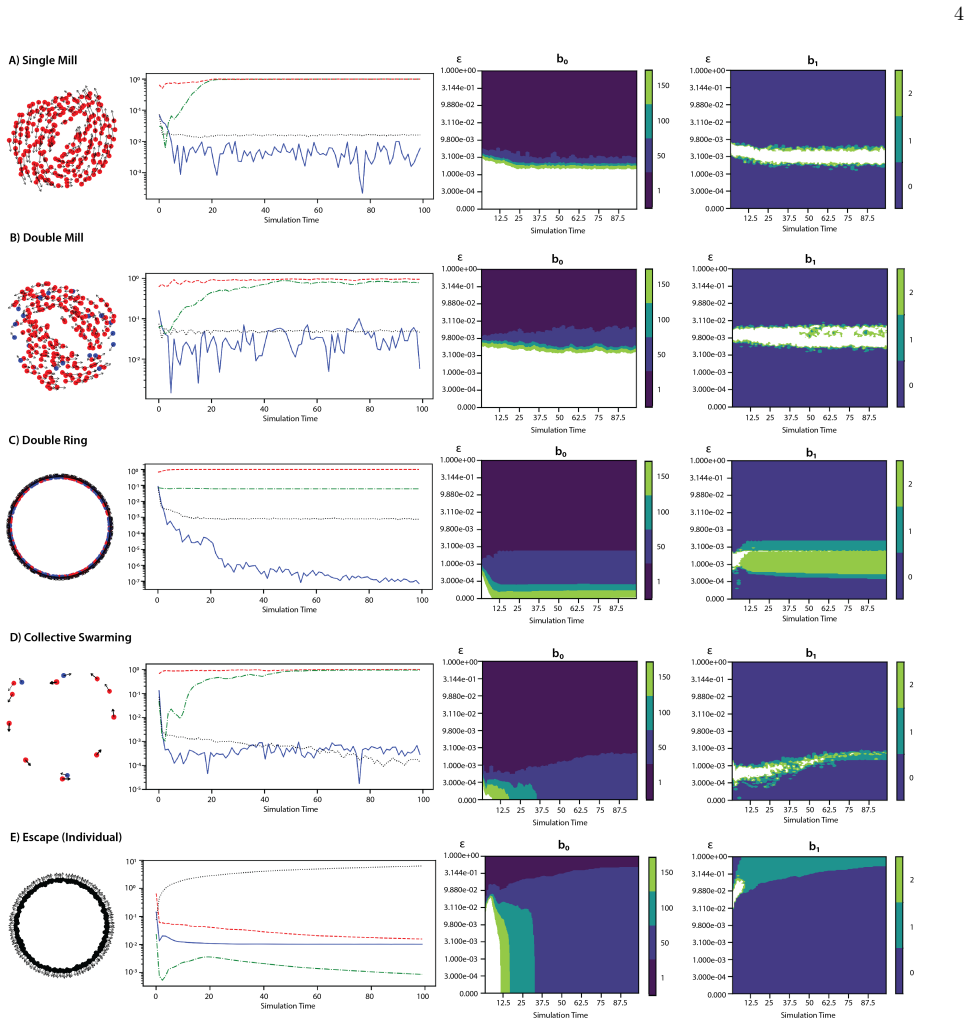
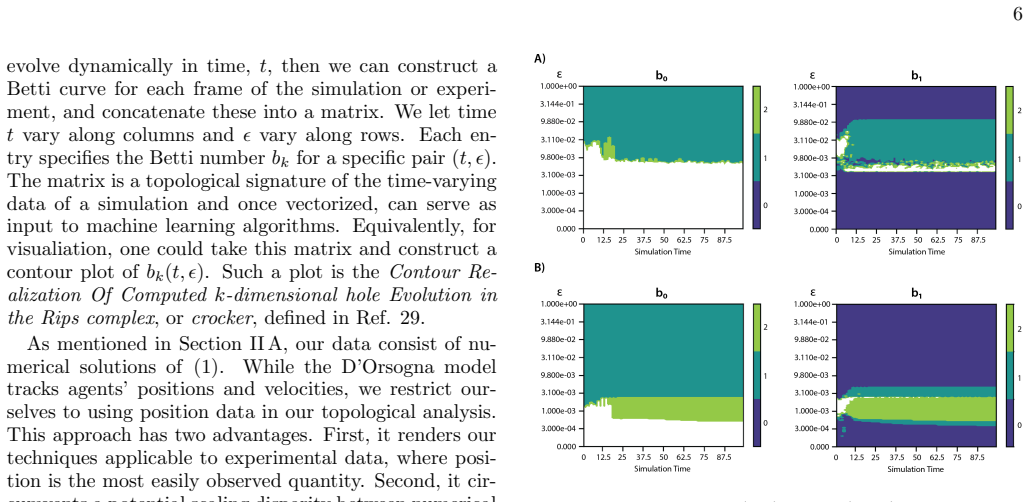
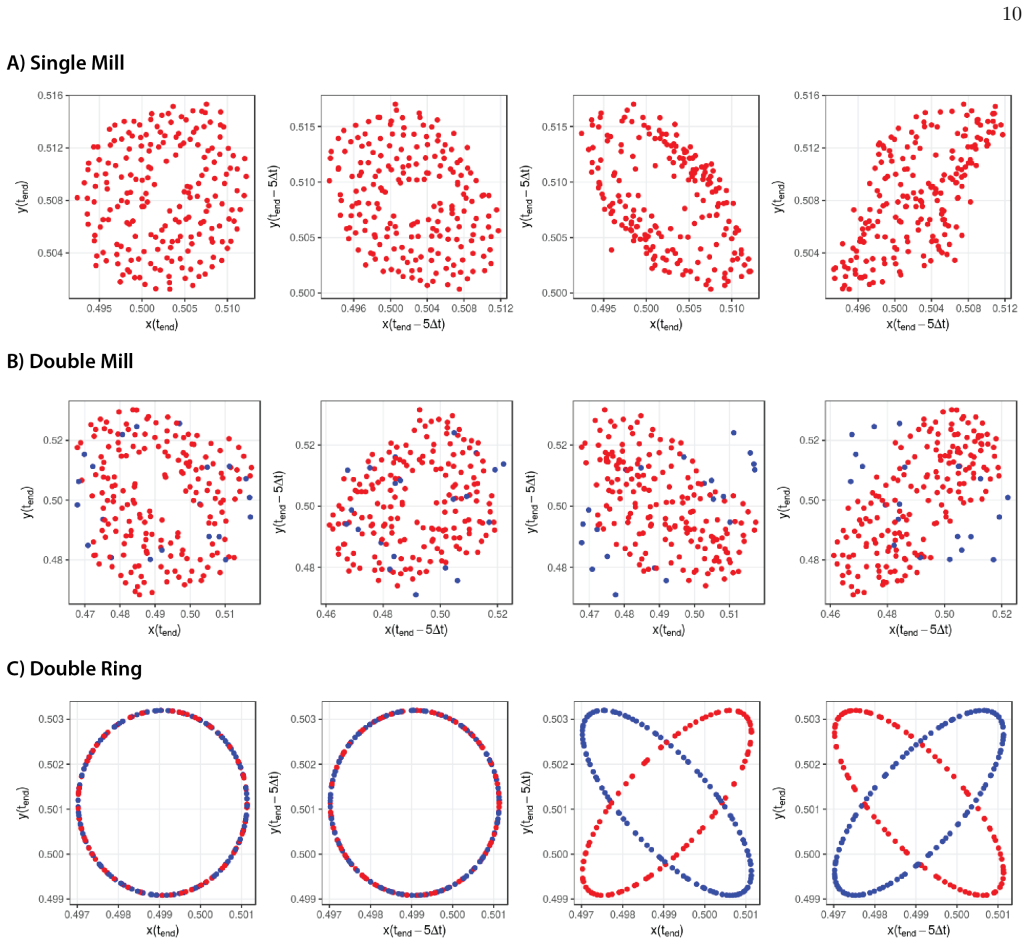
The central object is the crocker, Contour Realization Of Computed k-dimensional hole Evolution in the Rips complex, a contour plot of the Betti number $b_k$ as a function of time $t$ and persistence scale $\epsilon$. It is computed by building Vietoris-Rips complexes on agent positions, sometimes embedded as time-delayed 4-dimensional points $(x_i(t_j), x_i(t_{j-5\Delta t}))$, and tracking how many connected components ($b_0$) and loops ($b_1$) persist across scales. Vectorizing the crocker produces the feature vector that feeds the machine learning algorithms, providing a shape-based summary that needs no knowledge of which patterns are expected.
What would settle it
Re-run the 100-simulation protocol for a parameter pair that produces a collective swarm, such as $(C,\ell)=(0.1,0.5)$, but draw initial positions and velocities from several different distributions; if the phenotype varies across initial-condition sets, the ground-truth labels are ambiguous and the reported accuracies overstate method performance.
Extended reading notes
Core claim
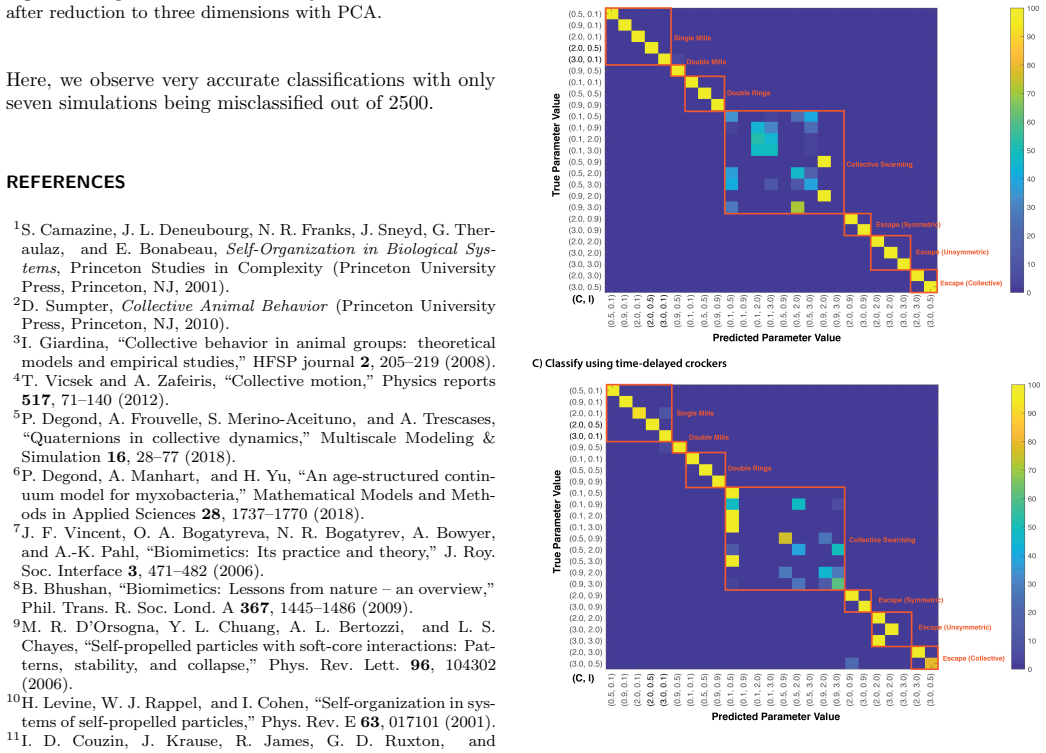
The paper's discovery is that crocker feature vectors carry more discriminative information for classification and parameter recovery than order parameters, without being designed around the expected patterns. For unsupervised k-medoids clustering into 25 groups, concatenated $b_0$ and $b_1$ crockers from position data recover parameters with 76.6% accuracy and phenotypes with 99.8% accuracy, compared with 49.9% and 97.4% for concatenated order parameters. For supervised linear support vector machines, the best crocker input, a time-delayed $b_1$ crocker reduced by PCA to 87 dimensions, recovers parameters with 99.9% accuracy, while the best order parameter $D_{NN}(t)$ achieves 91.1% at the same dimension; a 200-fold compression of crockers costs less than one percentage point of accuracy. The authors conclude that topology-based summaries are a problem-independent alternative to hand-designed order parameters for analyzing collective motion.
Load-bearing premise
Every simulation is labeled with the parameter pair that supposedly generated it, which assumes the model's long-term behavior does not depend on initial conditions; the paper says this is 'typically' true but does not quantify the exceptions.
Editorial extensions
If this is right
- Supervised parameter recovery from position-derived trajectory summaries can be nearly perfect, so a trained classifier offers a way to read model parameters off observed trajectories without fitting a differential-equation model by hand.
- Crockers survive aggressive dimension reduction: compressing them roughly 200-fold to 87 dimensions costs less than one percentage point of accuracy, whereas the same compression cuts the concatenated order-parameter accuracy by about 20 points.
- Because crockers require no prior expectation of the phenotypes, the same feature construction can be carried to other agent-based models or to experimental position data without redesign.
- $b_0$ information alone nearly suffices for parameter recovery, and adding $b_1$ mostly lengthens the feature vector, so simple connectivity summaries may be enough for many classification tasks.
Reading between the lines
- This suggests crocker PCA coordinates could serve as empirical coordinates for a phase diagram of the model, letting transitions between phenotypes be detected automatically instead of by inspecting individual simulations.
- A natural stress test is to add measurement noise to positions and watch how classification accuracy degrades; the stability of crockers to such noise would determine whether the method transfers to field observations of real groups.
- Running the same comparison on the three-dimensional version of the model, where phenotype transitions differ, would test whether the advantage of crockers over order parameters is robust beyond the two-dimensional setting studied here.
Signed reviews
Editorial analysis
A structured set of objections, weighed in public.
Referee Report
Summary. The manuscript presents a methodology for recovering model parameters and classifying collective motion phenotypes in the D'Orsogna self-propelled particle model by applying machine learning to two classes of features: traditional order parameters (polarization, angular momentum, absolute angular momentum, and mean nearest-neighbor distance) and topological summaries (persistent homology crockers, including time-delayed versions). The authors simulate 2500 trajectories across 25 parameter combinations, compute features, and apply k-medoids clustering and linear SVMs with 5-fold cross-validation, using PCA to match feature dimensionality. The central claim is that topological crockers outperform order parameters in both unsupervised parameter recovery (76.6% vs 49.9% for concatenated features) and supervised parameter recovery (99.9% vs 91.1% after PCA to 87 dimensions).
Significance. If the claims hold, the paper makes a useful methodological contribution by demonstrating that problem-agnostic topological summaries can outperform hand-crafted order parameters for inverse problems in collective motion, and it provides a careful comparison protocol (dimensionality matching via PCA, multiple phenotypes, and both unsupervised and supervised settings). The paper's strengths are its clean simulation library, the direct comparison on a canonical model, and the explicit use of PCA to equalize feature dimension. However, the headline comparison depends on a leakage-free cross-validation protocol; as written, the PCA and global normalization steps are ambiguous and may inflate the topological accuracy. The empirical claims are also point estimates without uncertainty quantification, and the initial-condition independence is asserted rather than quantified.
major comments (4)
- [Section II E / Section III B] The PCA dimensionality reduction appears to be applied before the 5-fold cross-validation split: Section III B says 'we use principal component analysis (PCA) to reduce the dimensionality of our input feature vectors' but does not state that PCA is fit on the training folds only. If the PCA transformation is computed on all 2500 simulations, the held-out test simulations contribute to the principal axes used to project their own features, which is test-set leakage and can inflate the reported 99.9% accuracy for time-delayed b1 crockers in Table III. Because the central claim is that crockers outperform order parameters after matching dimensions, this protocol detail is load-bearing. The authors should either clarify that PCA was fit inside each training fold (for example, via a pipeline or nested cross-validation) or rerun the comparison with a leakage-free protocol; as written, the 87-dimensional crocker results in Table III are not directly comparable to the 87-dimensional DNN(t) results.
- [Section II C] The global normalization of position data is described as performed 'across all simulations,' meaning the scaling constant is estimated from the full dataset including the test simulations. If this constant is not computed from training data only, the scale information from the test set enters the training features, constituting a second, independent path for information leakage. This could bias the comparison, especially for escape phenotypes where distances are clamped at 10 before normalization. Please state whether the normalization constant and the escape clamping threshold are determined from training data alone or justify that they are fixed physical constants independent of the dataset.
- [Section II A] The statement that 'the D'Orsogna model is typically independent of initial conditions' is unquantified. Because all 100 simulations per parameter pair are labeled with the same (C,l) values, and Table I assigns phenotypes deterministically to parameter pairs, any parameter values for which initial conditions affect the asymptotic state would make the labels ambiguous and would overstate both parameter-recovery and phenotype-classification accuracies. Please quantify the sensitivity to initial conditions, for example by reporting the distribution of terminal phenotypes over the 100 realizations per parameter pair, or by excluding or separately analyzing parameter sets with mixed phenotypes.
- [Tables II and III] All reported accuracies are point estimates without error bars or confidence intervals, and the 5-fold cross-validation is described only as a single procedure rather than a repeated or stratified resampling with variance estimates. For the central comparison (99.9% vs 91.1%) the conclusion is likely robust, but smaller differences, such as 97.0% vs 96.2% for b0 crockers before and after PCA, need uncertainty quantification to support the claim that the topological advantage is systematic rather than noise.
minor comments (5)
- [Section III B] The sentence reporting 'a 0.8% drop in accuracy for position-only information and a 0.1% increase for time-delayed topological information' is ambiguous because the preceding sentence highlights the b1 time-delayed PCA result at 99.9%, while the cited numbers correspond to the b0 rows (97.0% to 96.2% and 99.6% to 99.7%). Please clarify which feature rows are being compared.
- [Section II C] The epsilon grid for persistent homology (200 log-spaced values between 10^-4 and 1), the escape clamping threshold (||xi||∞ = 10), the order-parameter downsampling factor (23), and the time delay (5Δt) are hand-chosen. A brief robustness check or a statement that the qualitative conclusions are insensitive to these choices would strengthen the paper.
- [Section II D] In the unsupervised setting, the number of clusters k is set to 25 because there are 25 parameter combinations, which uses label information in an otherwise unsupervised procedure. This is stated, but the paper should also discuss the extent to which this choice helps the k-medoids results and whether the comparison with a 'problem-independent' approach is compromised by this prior knowledge.
- [General] No statement is provided about code or data availability. Given the methodological nature of the paper and the explicit reproducibility goals of machine learning studies, a repository with simulation and analysis scripts would be valuable for verifying the protocol, especially the cross-validation and PCA steps.
- [Appendix B / Fig. 8] In the caption of Fig. 8, the phrase 'the 10 × 10 bin in the top left corner represents 100 simulations' is slightly confusing because the bins represent parameter pairs on a 5×5 grid; please check whether the bin dimensions should refer to the simulated realizations within each parameter pair rather than the parameter grid.
Circularity Check
No circularity: the central comparison is an independent empirical benchmark on D'Orsogna-model simulations, with no fitted parameter renamed as a prediction.
full rationale
The paper's central claim is a comparative empirical result: topological crockers versus traditional order parameters are both computed from the same 2,500 D'Orsogna-model simulations, and neither feature family is fitted to the ground-truth labels (C, l) or phenotype. The crocker summarization is adopted from the authors' prior work (Refs. 29 and 30), but that citation supplies only the definition of the summary statistic; the claim that crockers outperform order parameters is tested here on independent simulations from a model due to D'Orsogna et al., with accuracy measured by held-out 5-fold cross-validation. No parameter is fitted to the labels and then reported as a prediction, no uniqueness theorem is imported from the authors' earlier papers to rule out alternatives, and no ansatz is smuggled in via citation: the time-delayed position embedding and the log-spaced epsilon grid are explicit modeling choices stated in the paper. The paper does not state whether PCA is fitted inside each training fold; if PCA is computed on all data before the split, the reported accuracies could be inflated by information leakage. That is a methodological correctness concern, not circularity, because the unsupervised PCA projection does not encode the label being predicted. Similarly, choosing k=25 for k-medoids because there are 25 parameter combinations is an evaluation convention, not a definitional identity between the input features and the recovered parameters. The assumption that the model is 'typically independent of initial conditions' is an unquantified modeling assumption that could affect label validity, but it is not a circular reduction of the derivation to its inputs. No equation in the paper defines a feature in terms of the target label, and no reported accuracy is forced by construction.
Assumptions & free parameters
free parameters (7)
- Self-propulsion and drag strengths (α, β) =
α=1.5, β=0.5
- Parameter grid for C and l =
C, l ∈ {0.1, 0.5, 0.9, 2.0, 3.0}
- Epsilon grid for persistent homology =
10^-4 to 1, 200 log-spaced points
- Order-parameter downsampling factor =
23
- Time delay for delayed crockers =
5Δt = 0.25 time units
- Escape clamping threshold =
L-infinity norm threshold of 10
- Number of k-medoids clusters =
k = 25
assumptions (4)
- domain assumption The D'Orsogna model (1) is an adequate representation of collective motion for testing feature representations.
- standard math Persistent homology and Betti numbers are stable and meaningful summaries of point-cloud shape.
- domain assumption The model dynamics are effectively independent of initial conditions for the chosen parameter grid.
- domain assumption Table I's assignment of parameter pairs to phenotypes is correct ground truth.
Cite this review
Pith. "Pith review of Analyzing Collective Motion with Machine Learning and Topology." pith.science (2026). https://pith.science/paper/3K4GSFYB
@misc{pith2026190809081,
  author       = {Pith},
  title        = {Pith review of: Analyzing Collective Motion with Machine Learning and Topology},
  year         = {2026},
  howpublished = {\url{https://pith.science/paper/3K4GSFYB}},
  note         = {Machine review of arXiv:1908.09081}
}
read the original abstract
We use topological data analysis and machine learning to study a seminal model of collective motion in biology [D'Orsogna et al., Phys. Rev. Lett. 96 (2006)]. This model describes agents interacting nonlinearly via attractive-repulsive social forces and gives rise to collective behaviors such as flocking and milling. To classify the emergent collective motion in a large library of numerical simulations and to recover model parameters from the simulation data, we apply machine learning techniques to two different types of input. First, we input time series of order parameters traditionally used in studies of collective motion. Second, we input measures based in topology that summarize the time-varying persistent homology of simulation data over multiple scales. This topological approach does not require prior knowledge of the expected patterns. For both unsupervised and supervised machine learning methods, the topological approach outperforms the one that is based on traditional order parameters.
Figures
Figures from the paper (5 more)



Reference graph
Works this paper leans on
-
[1]
author author S. Camazine , author J. L. \ Deneubourg , author N. R. \ Franks , author J. Sneyd , author G. Theraulaz , \ and\ author E. Bonabeau ,\ @noop title Self-Organization in Biological Systems ,\ Princeton Studies in Complexity\ ( publisher Princeton University Press ,\ address Princeton, NJ ,\ year 2001 ) NoStop
work page 2001
-
[2]
author author D. Sumpter ,\ @noop title Collective Animal Behavior \ ( publisher Princeton University Press ,\ address Princeton, NJ ,\ year 2010 ) NoStop
work page 2010
-
[3]
author author I. Giardina ,\ title title Collective behavior in animal groups: theoretical models and empirical studies , \ @noop journal journal HFSP journal \ volume 2 ,\ pages 205--219 ( year 2008 ) NoStop
work page 2008
-
[4]
author author T. Vicsek \ and\ author A. Zafeiris ,\ title title Collective motion , \ @noop journal journal Physics reports \ volume 517 ,\ pages 71--140 ( year 2012 ) NoStop
work page 2012
-
[5]
author author P. Degond , author A. Frouvelle , author S. Merino-Aceituno , \ and\ author A. Trescases ,\ title title Quaternions in collective dynamics , \ @noop journal journal Multiscale Modeling & Simulation \ volume 16 ,\ pages 28--77 ( year 2018 ) NoStop
work page 2018
-
[6]
author author P. Degond , author A. Manhart , \ and\ author H. Yu ,\ title title An age-structured continuum model for myxobacteria , \ @noop journal journal Mathematical Models and Methods in Applied Sciences \ volume 28 ,\ pages 1737--1770 ( year 2018 ) NoStop
work page 2018
-
[7]
author author J. F. \ Vincent , author O. A. \ Bogatyreva , author N. R. \ Bogatyrev , author A. Bowyer , \ and\ author A.-K. \ Pahl ,\ title title Biomimetics: Its practice and theory , \ @noop journal journal J. Roy. Soc. Interface \ volume 3 ,\ pages 471--482 ( year 2006 ) NoStop
work page 2006
-
[8]
author author B. Bhushan ,\ title title Biomimetics: L essons from nature -- an overview , \ @noop journal journal Phil. Trans. R. Soc. Lond. A \ volume 367 ,\ pages 1445--1486 ( year 2009 ) NoStop
work page 2009
Show all 45 references
-
[9]
author author M. R. \ D'Orsogna , author Y. L. \ Chuang , author A. L. \ Bertozzi , \ and\ author L. S. \ Chayes ,\ title title Self-propelled particles with soft-core interactions: P atterns, stability, and collapse , \ @noop journal journal Phys. Rev. Lett. \ volume 96 ,\ pa...
2006
-
[10]
Levine , author W
author author H. Levine , author W. J. \ Rappel , \ and\ author I. Cohen ,\ title title Self-organization in systems of self-propelled particles , \ @noop journal journal Phys. Rev. E \ volume 63 ,\ pages 017101 ( year 2001 ) NoStop
2001
-
[11]
author author I. D. \ Couzin , author J. Krause , author R. James , author G. D. \ Ruxton , \ and\ author N. R. \ Franks ,\ title title Collective memory and spatial sorting in animal groups , \ @noop journal journal J. Theor. Biol. \ volume 218 ,\ pages 1--11 ( year 2002 ) NoStop
2002
-
[12]
author author J. K. \ Parrish \ and\ author L. Edelstein-Keshet ,\ title title Complexity, pattern, and evolutionary trade-offs in animal aggregation , \ @noop journal journal Science \ volume 284 ,\ pages 99--101 ( year 1999 ) NoStop
1999
-
[13]
Heppner ,\ title title Three-dimensional structure and dynamics of bird flocks , \ in\ @noop booktitle Animal Groups in Three Dimensions ,\ editor edited by\ editor J
author author F. Heppner ,\ title title Three-dimensional structure and dynamics of bird flocks , \ in\ @noop booktitle Animal Groups in Three Dimensions ,\ editor edited by\ editor J. K. \ Parrish \ and\ editor W. M. \ Hamner \ ( publisher Cambridge University Press ,\ addres...
1997
-
[14]
Ni \ and\ author N
author author R. Ni \ and\ author N. Ouellette ,\ title title Velocity correlations in laboratory insect swarms , \ @noop journal journal Euro. Phys. J. ST \ volume 224 ,\ pages 3271--3277 ( year 2015 ) NoStop
2015
-
[15]
Lukeman , author Y.-X
author author R. Lukeman , author Y.-X. \ Li , \ and\ author L. Edelstein-Keshet ,\ title title Inferring individual rules from collective behavior , \ @noop journal journal Proceedings of the National Academy of Sciences \ volume 107 ,\ pages 12576--12580 ( year 2010 ) NoStop
2010
-
[16]
Manhart , author S
author author A. Manhart , author S. Windner , author M. Baylies , \ and\ author A. Mogilner ,\ title title Mechanical positioning of multiple nuclei in muscle cells , \ @noop journal journal PLoS computational biology \ volume 14 ,\ pages e1006208 ( year 2018 ) NoStop
2018
-
[17]
author author A. M. \ Stuart ,\ title title Inverse problems: A Bayesian perspective , \ http://dx.doi.org/10.1017/S0962492910000061 journal journal Acta Numerica; Cambridge \ volume 19 ,\ pages 451--559 ( year 2010 ) NoStop
2010 doi
-
[18]
author author H. T. \ Banks \ and\ author P. Kareiva ,\ title title Parameter estimation techniques for transport equations with application to population dispersal and tissue bulk flow models , \ 10.1007/BF00276516 journal journal J. Math. Biology \ volume 17 ,\ pages 253--27...
-
[19]
author author R. E. \ Baker , author J.-M. \ Pe\ na , author J. Jayamohan , \ and\ author A. J\'erusalem ,\ title title Mechanistic models versus machine learning: A fight worth fighting for the biological community? \ http://doi.org/10.1098/rsbl.2017.0660 journal journal Biol...
-
[20]
Lu , author M
author author F. Lu , author M. Zhong , author S. Tang , \ and\ author M. Maggioni ,\ title title Nonparametric inference of interaction laws in systems of agents from trajectory data , \ 10.1073/pnas.1822012116 journal journal PNAS \ volume 116 ,\ pages 14424--14433 ( year 20...
-
[21]
author author J. E. \ Jones \ and\ author S. Chapman ,\ title title On the determination of molecular fields.— I . From the variation of the viscosity of a gas with temperature , \ 10.1098/rspa.1924.0081 journal journal Proceedings of the Royal Society of London. Series A, Con...
1924
-
[22]
author author I. D. \ Couzin , author J. Krause , author N. R. \ Franks , \ and\ author S. A. \ Levin ,\ title title Effective leadership and decision-making in animal groups on the move , \ 10.1038/nature03236 journal journal Nature \ volume 433 ,\ pages 513--516 ( year 2005 ) NoStop
-
[23]
Chen \ and\ author T
author author Y. Chen \ and\ author T. Kolokolnikov ,\ title title A minimal model of predator–swarm interactions , \ 10.1098/rsif.2013.1208 journal journal Journal of The Royal Society Interface \ volume 11 ,\ pages 20131208 ( year 2014 ) NoStop
2013
-
[24]
\ Ha \ and\ author D
author author S.-Y. \ Ha \ and\ author D. Levy ,\ title title Particle, kinetic and fluid models for phototaxis , \ 10.3934/dcdsb.2009.12.77 journal journal Discrete & Continuous Dynamical Systems - B \ volume 12 ,\ pages 77 ( year 2009 ) NoStop
2009 doi
-
[25]
Wasserman ,\ title title Topological data analysis , \ @noop journal journal Ann
author author L. Wasserman ,\ title title Topological data analysis , \ @noop journal journal Ann. Rev. Stat. Appl. \ volume 5 ,\ pages 501--532 ( year 2018 ) NoStop
2018
-
[26]
Nicolau , author A
author author M. Nicolau , author A. J. \ Levine , \ and\ author G. Carlsson ,\ title title Topology based data analysis identifies a subgroup of breast cancers with a unique mutational profile and excellent survival , \ @noop journal journal Proc. Natl. Acad. Sci. \ ,\ pages ...
2011
-
[27]
author author J. L. \ Nielson , author J. Paquette , author A. W. \ Liu , author C. F. \ Guandique , author C. A. \ Tovar , author T. Inoue , author K.-A. \ Irvine , author J. C. \ Gensel , author J. Kloke , author T. C. \ Petrossian , author P. Y. \ Lum , author G. E. \ Carls...
2015
-
[28]
Taylor , author F
author author D. Taylor , author F. Klimm , author H. A. \ Harrington , author M. Kramár , author K. Mischaikow , author M. A. \ Porter , \ and\ author P. J. \ Mucha ,\ title title Topological data analysis of contagion maps for examining spreading processes on networks , \ @n...
2015
-
[29]
author author C. M. \ Topaz , author L. Ziegelmeier , \ and\ author T. Halverson ,\ title title Topological data analysis of biological aggregation models , \ @noop journal journal PLoS One \ volume 10 ,\ pages e0126383 ( year 2015 ) NoStop
2015
-
[30]
Ulmer , author L
author author M. Ulmer , author L. Ziegelmeier , \ and\ author C. M. \ Topaz ,\ title title A topological approach to selecting models of biological experiments , \ @noop journal journal PLoS One \ volume 14 ,\ pages 1--18 ( year 2019 ) NoStop
2019
-
[31]
author author Y. L. \ Chuang , author M. R. \ D'Orsogna , author D. Marthaler , author A. L. \ Bertozzi , \ and\ author L. S. \ Chayes ,\ title title State transitions and the continuum limit for a 2 D interacting, self-propelled particle system , \ @noop journal journal Physi...
2007
-
[32]
\ Chuang , author T
author author Y.-L. \ Chuang , author T. Chou , \ and\ author M. R. \ D'Orsogna ,\ title title Swarming in viscous fluids: Three -dimensional patterns in swimmer- and force-induced flows , \ @noop journal journal Phys. Rev. E \ volume 93 ,\ pages 043112 ( year 2016 ) NoStop
2016
-
[33]
Huepe \ and\ author M
author author C. Huepe \ and\ author M. Aldana ,\ title title New tools for characterizing swarming systems: A comparison of minimal models , \ @noop journal journal Physica A \ volume 387 ,\ pages 2809--2822 ( year 2008 ) NoStop
2008
-
[34]
Hatcher ,\ @noop title Algebraic Topology \ ( publisher Cambridge University Press ,\ year 2002 ) NoStop
author author A. Hatcher ,\ @noop title Algebraic Topology \ ( publisher Cambridge University Press ,\ year 2002 ) NoStop
2002
-
[35]
Otter , author M
author author N. Otter , author M. A. \ Porter , author U. Tillmann , author P. Grindrod , \ and\ author H. A. \ Harrington ,\ title title A roadmap for the computation of persistent homology , \ @noop journal journal Euro. Phys. J. Data Sci. \ volume 6 ,\ pages 17 ( year 2017...
2017
-
[36]
author author C. M. \ Topaz ,\ @noop title Self-help homology tutorial for the simple(x)-minded , \ ( year 2015 ),\ note available at http://www.chadtopaz.com/publications NoStop
2015
-
[37]
Tralie , author N
author author C. Tralie , author N. Saul , \ and\ author R. Bar-On ,\ title title Ripser.py : A lean persistent homology library for python , \ @noop journal journal J. Open Source Softw. \ volume 3 ,\ pages 925 ( year 2018 ) NoStop
2018
-
[38]
Cohen-Steiner , author H
author author D. Cohen-Steiner , author H. Edelsbrunner , \ and\ author J. Harer ,\ title title Stability of persistence diagrams , \ 10.1007/s00454-006-1276-5 journal journal Discrete & Computational Geometry \ volume 37 ,\ pages 103--120 ( year 2007 ) NoStop
-
[39]
Chazal , author D
author author F. Chazal , author D. Cohen-Steiner , \ and\ author Q. M \'e rigot ,\ title title Geometric inference for probability measures , \ 10.1007/s10208-011-9098-0 journal journal Foundations of Computational Mathematics \ volume 11 ,\ pages 733--751 ( year 2011 ) NoStop
-
[40]
author author B. T. \ Fasy , author F. Lecci , author A. Rinaldo , author L. Wasserman , author S. Balakrishnan , \ and\ author A. Singh ,\ title title Confidence sets for persistence diagrams , \ @noop journal journal The Annals of Statistics \ volume 42 ,\ pages 2301--2339 (...
2014
-
[41]
Chazal , author B
author author F. Chazal , author B. Fasy , author F. Lecci , author Bertr , author Michel , author Aless , author ro Rinaldo , \ and\ author L. Wasserman ,\ title title Robust topological inference: Distance to a measure and kernel distance , \ @noop journal journal Journal of...
2018
-
[42]
Diky \ and\ author R
author author A. Diky \ and\ author R. Haralick ,\ title title Topological structure of linear manifold clustering , \ @noop journal journal 15th International Conference on Machine Learning and Data Mining \ volume II ,\ pages 860--874 ( year 2019 ) NoStop
2019
-
[43]
Cortes \ and\ author V
author author C. Cortes \ and\ author V. Vapnik ,\ title title Support- Vector Networks , \ 10.1023/A:1022627411411 journal journal Machine Learning \ volume 20 ,\ pages 273--297 ( year 1995 ) NoStop
1995 doi
-
[44]
Jolliffe ,\ @noop title Principal Component Analysis \ ( publisher Springer Verlag ,\ year 1986 ) NoStop
author author I. Jolliffe ,\ @noop title Principal Component Analysis \ ( publisher Springer Verlag ,\ year 1986 ) NoStop
1986
-
[45]
Giusti , author E
author author C. Giusti , author E. Pastalkova , author C. Curto , \ and\ author V. Itskov ,\ title title Clique topology reveals intrinsic geometric structure in neural correlations , \ https://doi.org/10.1073/pnas.1506407112 journal journal Proc. Natl. Acad. Sci. \ volume 11...
Reviewed August 14, 2026 · model on record in the stance chip above.
Discussion (0). Continue with ORCID to comment.