Stress-energy tensor of quantized scalar fields in thermal states on a zero-tidal wormhole
Pith reviewed 2026-06-28 13:37 UTC · model grok-4.3
The pith
The stress-energy tensor of a massive scalar field in thermal states on a zero-tidal wormhole satisfies the Morris-Thorne conditions only for masses in a bounded interval and below a critical temperature.
A machine-rendered reading of the paper's core claim, the machinery that carries it, and where it could break.
Core claim
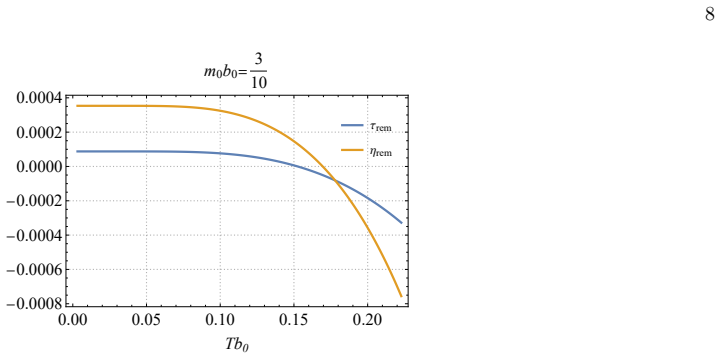
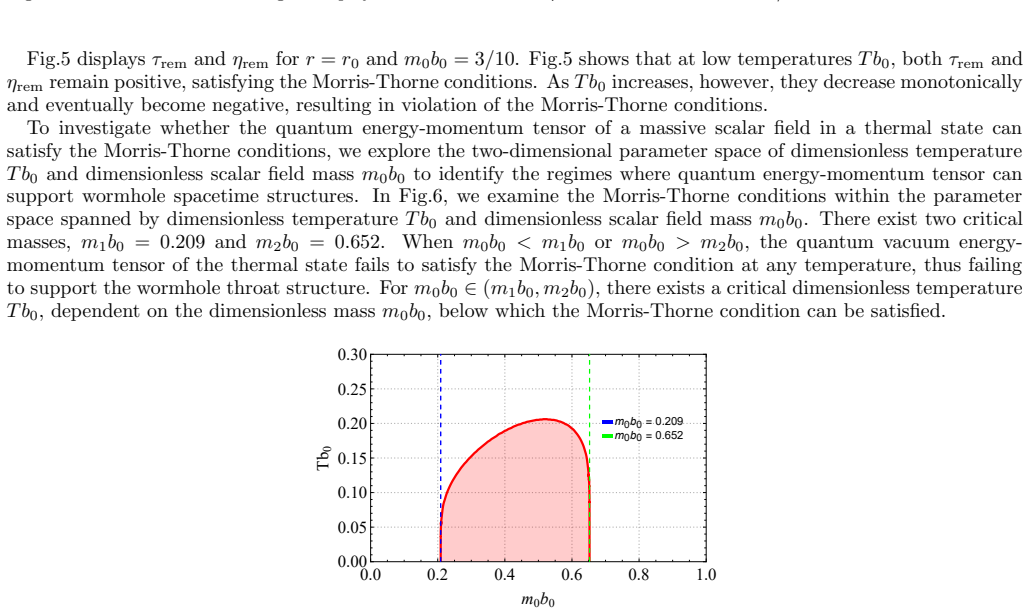
We present the first calculation of the stress-energy tensor for a quantum massive scalar field in thermal states localized on the throat of a zero-tidal-force wormhole. By varying the dimensionless temperature and dimensionless mass of the scalar field, the Morris-Thorne conditions can only be satisfied when the scalar field mass falls within a specific bounded interval. For any scalar field mass within this interval there always exists a mass-dependent dimensionless critical temperature such that the conditions are fulfilled only if the temperature remains below this threshold.
What carries the argument
The renormalized stress-energy tensor of the quantized massive scalar field in a thermal state, whose components at the wormhole throat are compared against the Morris-Thorne requirements.
If this is right
- Wormhole throats can be supported by the scalar-field stress-energy tensor only when the field mass lies inside the identified interval.
- For any mass inside the interval the temperature must stay below the mass-dependent critical value.
- Outside the mass interval or above the critical temperature the tensor violates the Morris-Thorne conditions at every temperature.
- The critical temperature is a continuous function of the mass inside the allowed interval.
Where Pith is reading between the lines
- The temperature dependence implies that any practical construction using such fields would require active cooling to remain traversable.
- The same regularization procedure could be applied to other static wormhole metrics to map out their allowable mass-temperature windows.
- Analog laboratory systems that simulate curved-space thermal states might be used to check the predicted critical temperatures.
Load-bearing premise
The stress-energy tensor has been correctly computed, regularized, and renormalized for the quantized massive scalar field in a thermal state on the given zero-tidal-force wormhole metric.
What would settle it
A direct computation of the renormalized stress-energy tensor for a scalar-field mass lying outside the reported bounded interval that nevertheless satisfies the Morris-Thorne conditions at some temperature would falsify the claimed restriction to that interval.
Figures
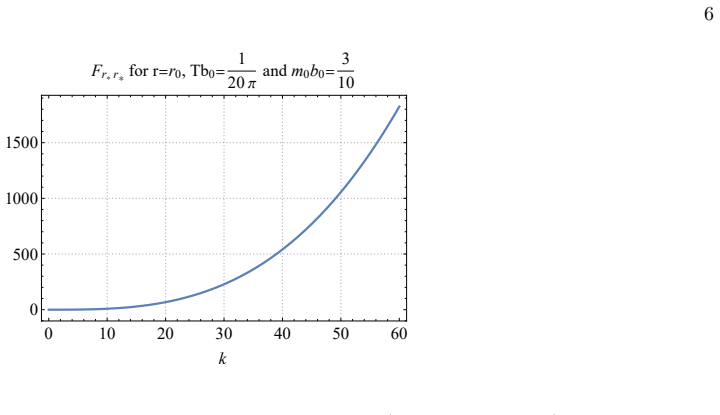
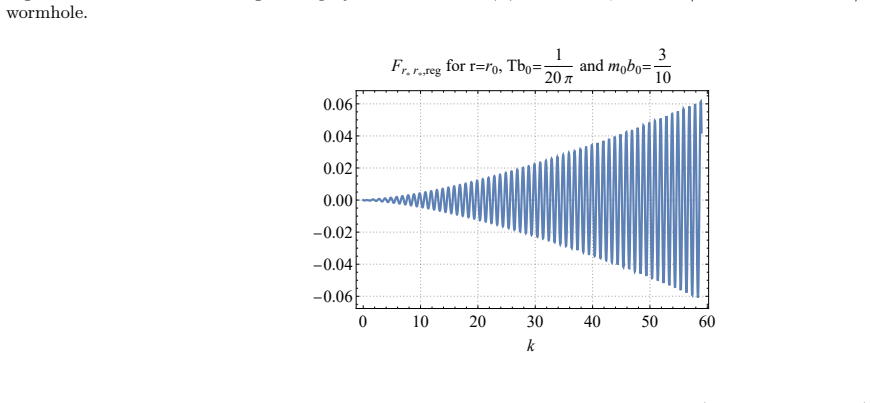
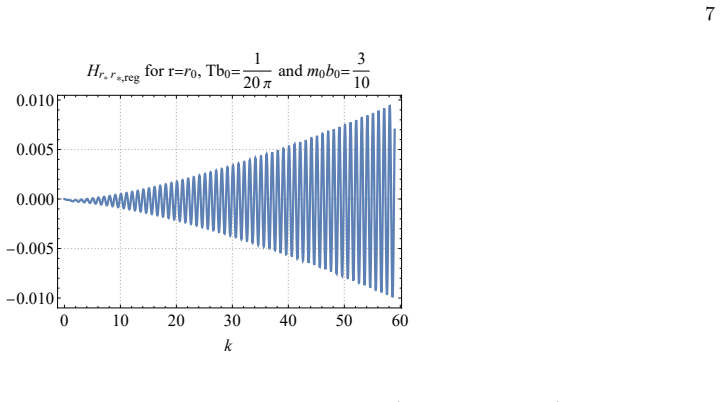
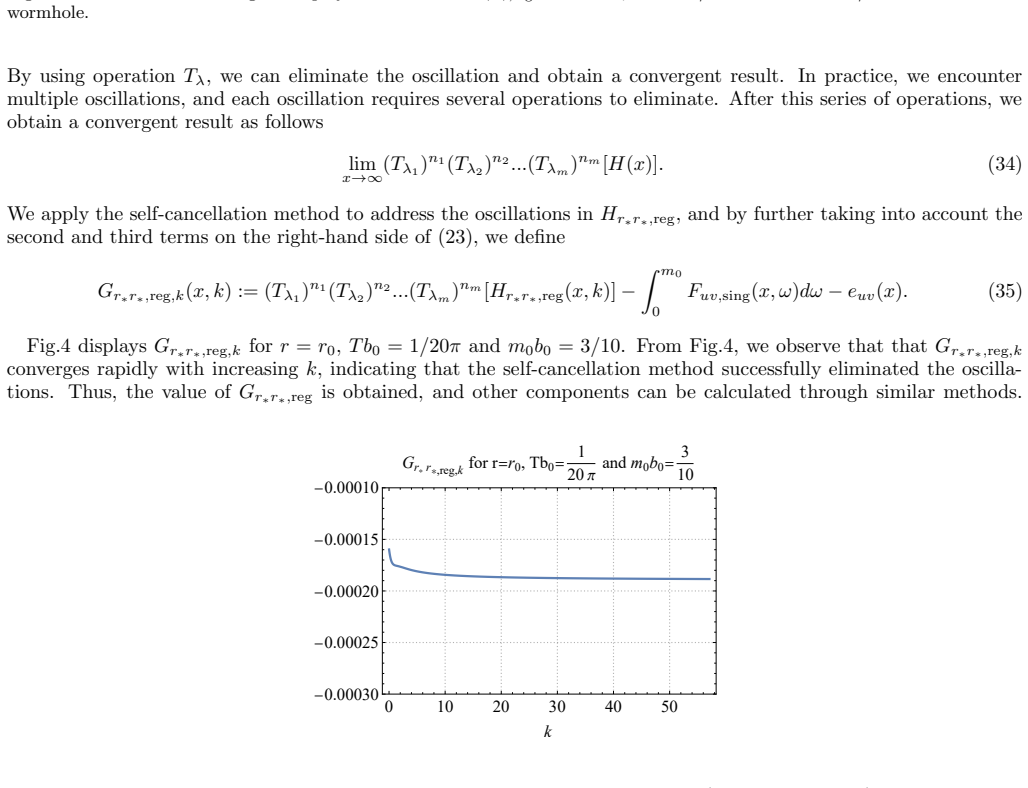
read the original abstract
The construction of a static traversable wormhole requires exotic matter that satisfies the Morris-Thorne conditions. Quantum energy-momentum tensors have long been considered the most promising candidate for such exotic matter. In this paper, we present the first calculation of the stress-energy tensor for a quantum massive scalar field in thermal states localized on the throat of a zero-tidal-force wormhole. By varying the dimensionless temperature and dimensionless mass of the scalar field, we find that the Morris-Thorne conditions can only be satisfied when the scalar field mass falls within a specific bounded interval. Furthermore, for any scalar field mass within this interval, there always exists a mass-dependent dimensionless critical temperature: the Morris-Thorne conditions are fulfilled only if the temperature remains below this critical threshold.
Editorial analysis
A structured set of objections, weighed in public.
Referee Report
Summary. The paper computes the renormalized stress-energy tensor of a massive quantized scalar field in thermal states at the throat of a zero-tidal-force wormhole (ds² = -dt² + dl² + r(l)² dΩ²). It reports that the Morris-Thorne conditions hold only for scalar-field masses in a bounded interval and, within that interval, only below a mass-dependent critical dimensionless temperature.
Significance. If the regularization and mode-sum procedure are correct, the result supplies concrete, falsifiable bounds on mass and temperature for which a thermal quantum scalar field can violate the null energy condition at the throat. This would be a notable advance over generic statements that quantum fields can support wormholes, as it identifies restricted parameter windows rather than open sets.
major comments (2)
- [Computation of <T_{\mu\nu}> (likely §3 or §4)] The central claim (bounded mass interval and critical temperature) rests entirely on the sign of the renormalized ρ + p_r at the throat. The manuscript must therefore supply the explicit regularization procedure (Hadamard parametrix for the massive Klein-Gordon operator, subtraction of the divergent terms, and retention of the finite thermal and mass-dependent pieces) together with the mode expansion or Green's function used on the given metric. Without these steps, the reported intervals cannot be verified and the result is not reproducible.
- [Thermal-state construction and Matsubara sum] The thermal state is defined via a Matsubara sum with respect to the static Killing vector. The manuscript should state the precise frequency spacing, the value of the curvature coupling ξ, and how the zero-mode or infrared contributions are handled for the massive field; any inconsistency here directly alters the temperature dependence of the critical threshold.
minor comments (2)
- [Abstract] The abstract states the headline intervals but supplies no numerical values or functional form for the mass bounds or critical temperature; these should appear in the main text or a table for immediate reference.
- [Introduction and parameter definitions] Notation for the dimensionless temperature and dimensionless mass should be defined once at first use and used consistently thereafter.
Simulated Author's Rebuttal
We thank the referee for their detailed reading and for identifying the need for greater explicitness in the computational sections. We address each major comment below and will revise the manuscript accordingly to improve reproducibility.
read point-by-point responses
-
Referee: [Computation of <T_{\mu\nu}> (likely §3 or §4)] The central claim (bounded mass interval and critical temperature) rests entirely on the sign of the renormalized ρ + p_r at the throat. The manuscript must therefore supply the explicit regularization procedure (Hadamard parametrix for the massive Klein-Gordon operator, subtraction of the divergent terms, and retention of the finite thermal and mass-dependent pieces) together with the mode expansion or Green's function used on the given metric. Without these steps, the reported intervals cannot be verified and the result is not reproducible.
Authors: We agree that the current presentation does not supply the full regularization details at the level required for independent verification. In the revised manuscript we will expand the relevant section to include the explicit Hadamard parametrix for the massive scalar, the precise subtraction of the divergent geometric terms, and the mode-sum expression for the Green's function adapted to the zero-tidal wormhole metric. This addition will make the sign of ρ + p_r at the throat directly traceable to the stated procedure. revision: yes
-
Referee: [Thermal-state construction and Matsubara sum] The thermal state is defined via a Matsubara sum with respect to the static Killing vector. The manuscript should state the precise frequency spacing, the value of the curvature coupling ξ, and how the zero-mode or infrared contributions are handled for the massive field; any inconsistency here directly alters the temperature dependence of the critical threshold.
Authors: We will add an explicit statement of the Matsubara frequencies (ω_n = 2π n T), the value of the non-minimal coupling ξ employed in the calculation, and the regularization of the zero-mode contribution for the massive field. These clarifications will be inserted in the section describing the thermal state so that the mass-dependent critical temperature can be reproduced without ambiguity. revision: yes
Circularity Check
Direct numerical evaluation of renormalized stress-energy tensor yields mass and temperature bounds
full rationale
The paper's central result is obtained by explicit computation of the mode-sum or Green's function for the massive Klein-Gordon field in a thermal state on the given static metric, followed by regularization, renormalization, and direct evaluation of the NEC-violating combinations at the throat. No equation is defined in terms of its own output, no fitted parameter is relabeled as a prediction, and no load-bearing uniqueness theorem or ansatz is imported via self-citation. The bounded mass interval and critical temperature are outputs of the calculation rather than inputs by construction.
Axiom & Free-Parameter Ledger
axioms (1)
- domain assumption Validity of renormalization procedures for the stress-energy tensor of a massive scalar field in a static curved spacetime.
Reference graph
Works this paper leans on
-
[1]
This is because the singular structure of the two-point correlation function is described by the Hadamard condition [30]
Here the presence of a coth factor indicates that the system is in a state of thermal equilibrium and {X(x), Y(x ′)}= 1 2 (X(x)Y(x ′) +Y(x)X(x ′)).(14) To compute the expectation value of the energy-momentum tensor, we need to take the limitx→x ′ but this leads to a divergence in (13). This is because the singular structure of the two-point correlation fu...
1900
-
[2]
The particle problem in the general theory of relativity
A. Einstein and N. Rosen, The Particle Problem in the General Theory of Relativity, Phys. Rev.48, 73-77 (1935) doi:10.1103/PhysRev.48.73
-
[3]
M. S. Morris and K. S. Thorne, Wormholes in space-time and their use for interstellar travel: A tool for teaching general relativity, Am. J. Phys.56, 395-412 (1988) doi:10.1119/1.15620
-
[4]
M. S. Morris, K. S. Thorne and U. Yurtsever, Wormholes, Time Machines, and the Weak Energy Condition, Phys. Rev. Lett.61, 1446-1449 (1988) doi:10.1103/PhysRevLett.61.1446
-
[5]
S. M. Christensen, Vacuum Expectation Value of the Stress Tensor in an Arbitrary Curved Background: The Covariant Point Separation Method, Phys. Rev. D14, 2490-2501 (1976) doi:10.1103/PhysRevD.14.2490
-
[6]
P. R. Anderson, W. A. Hiscock and D. A. Samuel, Stress-energy tensor of quantized scalar fields in static spherically symmetric space-times, Phys. Rev. D51, 4337-4358 (1995) doi:10.1103/PhysRevD.51.4337
-
[7]
P. R. Anderson, W. A. Hiscock and D. A. Samuel, Stress energy tensor of quantized scalar fields in static black hole space-times, Phys. Rev. Lett.70, 1739-1742 (1993) doi:10.1103/PhysRevLett.70.1739
-
[8]
B. E. Taylor, W. A. Hiscock and P. R. Anderson, Stress energy of a quantized scalar field in static wormhole space-times, Phys. Rev. D55, 6116-6122 (1997) doi:10.1103/PhysRevD.55.6116 [arXiv:gr-qc/9608036 [gr-qc]]
work page internal anchor Pith review Pith/arXiv arXiv doi:10.1103/physrevd.55.6116 1997
-
[9]
A. A. Popov, Long throat of a wormhole created from vacuum fluctuations, Class. Quant. Grav.22, 5223-5230 (2005) doi:10.1088/0264-9381/22/24/002
-
[10]
Stress-energy tensor of quantized massive fields in static wormhole spacetimes
E. Kocuper, J. Matyjasek and K. Zwierzchowska, Stress-energy tensor of quantized massive fields in static wormhole spacetimes, Phys. Rev. D96, no.10, 104057 (2017) doi:10.1103/PhysRevD.96.104057 [arXiv:1709.09034 [gr-qc]]
work page internal anchor Pith review Pith/arXiv arXiv doi:10.1103/physrevd.96.104057 2017
-
[11]
A. A. Popov, Semiclassical long wormhole throats, Grav. Cosmol.20, 203-207 (2014) doi:10.1134/S0202289314030128 [arXiv:1809.06202 [hep-th]]
work page internal anchor Pith review Pith/arXiv arXiv doi:10.1134/s0202289314030128 2014
-
[12]
J. Matyjasek, Stress-energy of the quantized fields in the spacetime of the Damour-Solodukhin wormhole, Phys. Rev. D 102, no.2, 024082 (2020) doi:10.1103/PhysRevD.102.024082 [arXiv:2005.07077 [gr-qc]]
-
[13]
A. A. Popov, Stress energy of a quantized scalar field in static wormhole space-times, Phys. Rev. D64, 104005 (2001) doi:10.1103/PhysRevD.64.104005 [arXiv:hep-th/0109166 [hep-th]]
work page internal anchor Pith review Pith/arXiv arXiv doi:10.1103/physrevd.64.104005 2001
-
[14]
N. R. Khusnutdinov, Semiclassical wormholes, Phys. Rev. D67, 124020 (2003) doi:10.1103/PhysRevD.67.124020 [arXiv:hep-th/0304176 [hep-th]]
work page internal anchor Pith review Pith/arXiv arXiv doi:10.1103/physrevd.67.124020 2003
-
[15]
Self-consistent Wormhole Solutions of Semiclassical Gravity
D. Hochberg, A. Popov and S. V. Sushkov, Selfconsistent wormhole solutions of semiclassical gravity, Phys. Rev. Lett.78, 2050-2053 (1997) doi:10.1103/PhysRevLett.78.2050 [arXiv:gr-qc/9701064 [gr-qc]]
work page internal anchor Pith review Pith/arXiv arXiv doi:10.1103/physrevlett.78.2050 2050
-
[16]
V. B. Bezerra, E. R. Bezerra de Mello, N. R. Khusnutdinov and S. V. Sushkov, Vacuum polarization of a massive scalar field in a wormhole spacetime, Phys. Rev. D81, 084034 (2010) doi:10.1103/PhysRevD.81.084034 [arXiv:1003.0344 [gr-qc]]
work page internal anchor Pith review Pith/arXiv arXiv doi:10.1103/physrevd.81.084034 2010
-
[17]
Pragmatic mode-sum regularization method for semiclassical black-hole spacetimes
A. Levi and A. Ori, Pragmatic mode-sum regularization method for semiclassical black-hole spacetimes, Phys. Rev. D91, 104028 (2015) doi:10.1103/PhysRevD.91.104028 [arXiv:1503.02810 [gr-qc]]
work page internal anchor Pith review Pith/arXiv arXiv doi:10.1103/physrevd.91.104028 2015
-
[18]
Renormalized stress-energy tensor for stationary black holes
A. Levi, Renormalized stress-energy tensor for stationary black holes, Phys. Rev. D95, no.2, 025007 (2017) doi:10.1103/PhysRevD.95.025007 [arXiv:1611.05889 [gr-qc]]
work page internal anchor Pith review Pith/arXiv arXiv doi:10.1103/physrevd.95.025007 2017
-
[19]
Mode-sum regularization of $\left\langle \phi^{2} \right\rangle$ in the angular-splitting method
A. Levi and A. Ori, Mode-sum regularization of ϕ2 in the angular-splitting method, Phys. Rev. D94, no.4, 044054 (2016) doi:10.1103/PhysRevD.94.044054 [arXiv:1606.08451 [gr-qc]]
work page internal anchor Pith review Pith/arXiv arXiv doi:10.1103/physrevd.94.044054 2016
-
[20]
Versatile method for renormalized stress-energy computation in black-hole spacetimes
A. Levi and A. Ori, Versatile method for renormalized stress-energy computation in black-hole spacetimes, Phys. Rev. Lett.117, no.23, 231101 (2016) doi:10.1103/PhysRevLett.117.231101 [arXiv:1608.03806 [gr-qc]]
work page internal anchor Pith review Pith/arXiv arXiv doi:10.1103/physrevlett.117.231101 2016
-
[21]
A. Levi, E. Eilon, A. Ori and M. van de Meent, Renormalized stress-energy tensor of an evaporating spinning black hole, Phys. Rev. Lett.118, no.14, 141102 (2017) doi:10.1103/PhysRevLett.118.141102 [arXiv:1610.04848 [gr-qc]]
work page internal anchor Pith review Pith/arXiv arXiv doi:10.1103/physrevlett.118.141102 2017
-
[22]
N. Zilberman, A. Levi and A. Ori, Quantum fluxes at the inner horizon of a spherical charged black hole, Phys. Rev. Lett. 124, no.17, 171302 (2020) doi:10.1103/PhysRevLett.124.171302 [arXiv:1906.11303 [gr-qc]]. 10
-
[23]
N. Zilberman, M. Casals, A. Ori and A. C. Ottewill, Quantum Fluxes at the Inner Horizon of a Spinning Black Hole, Phys. Rev. Lett.129, no.26, 261102 (2022) doi:10.1103/PhysRevLett.129.261102 [arXiv:2203.08502 [gr-qc]]
-
[24]
A. Ori and N. Zilberman, Computation of the Semiclassical Outflux Emerging from a Collapsing Spherical Null Shell, Phys. Rev. Lett.135, no.2, 021401 (2025) doi:10.1103/p4bk-qg3n [arXiv:2503.00622 [gr-qc]]
-
[25]
W. G. Unruh, Notes on black hole evaporation, Phys. Rev. D14, 870 (1976) doi:10.1103/PhysRevD.14.870
-
[26]
Passivity and microlocal spectrum condition
H. Sahlmann and R. Verch, Passivity and microlocal spectrum condition, Commun. Math. Phys.214, 705-731 (2000) doi:10.1007/s002200000297 [arXiv:math-ph/0002021 [math-ph]]
work page internal anchor Pith review Pith/arXiv arXiv doi:10.1007/s002200000297 2000
-
[27]
Y. Decanini and A. Folacci, Hadamard renormalization of the stress-energy tensor for a quantized scalar field in a general spacetime of arbitrary dimension, Phys. Rev. D78, 044025 (2008) doi:10.1103/PhysRevD.78.044025 [arXiv:gr-qc/0512118 [gr-qc]]
work page internal anchor Pith review Pith/arXiv arXiv doi:10.1103/physrevd.78.044025 2008
-
[28]
R. M. Wald, Trace Anomaly of a Conformally Invariant Quantum Field in Curved Space-Time, Phys. Rev. D17, 1477-1484 (1978) doi:10.1103/PhysRevD.17.1477
-
[29]
A. Lanir, A. Levi, A. Ori and O. Sela, Two-point function of a quantum scalar field in the interior region of a Reissner- Nordstrom black hole, Phys. Rev. D97, no.2, 024033 (2018) doi:10.1103/PhysRevD.97.024033 [arXiv:1710.07267 [gr-qc]]
work page internal anchor Pith review Pith/arXiv arXiv doi:10.1103/physrevd.97.024033 2018
-
[30]
V. Balakumar, R. P. Bernar and E. Winstanley, Quantization of a charged scalar field on a charged black hole background, Phys. Rev. D106, no.12, 125013 (2022) doi:10.1103/PhysRevD.106.125013 [arXiv:2205.14483 [hep-th]]
-
[31]
B. S. Kay and R. M. Wald, Theorems on the Uniqueness and Thermal Properties of Stationary, Nonsingular, Quasifree States on Space-Times with a Bifurcate Killing Horizon, Phys. Rept.207, 49-136 (1991) doi:10.1016/0370-1573(91)90015-E
discussion (0)
Sign in with ORCID, Apple, or X to comment. Anyone can read and Pith papers without signing in.