REVIEW 2 major objections 4 minor 56 references
Dark-State Optical Potential Barriers with Nanoscale Spacing
T0 review · 2 major / 4 minor · reviewed 2026-08-14 · deepseek-v4-flash
Pith's one-line read Three-level atoms with shaped laser intensities can feel nanoscale-spaced potential barriers that bind atoms for seconds.
desk verdict The paper's multi-barrier construction is genuinely new and mostly sound, but its two headline numbers—13 nm spacing and seconds lifetimes—come from parameter ranges where the paper's own Born-Oppenheimer validity condition fails. read the letter →
The pith
A machine-rendered reading of the paper's core claim, the machinery that carries it, and where it could break.
The reading
What carries the argument
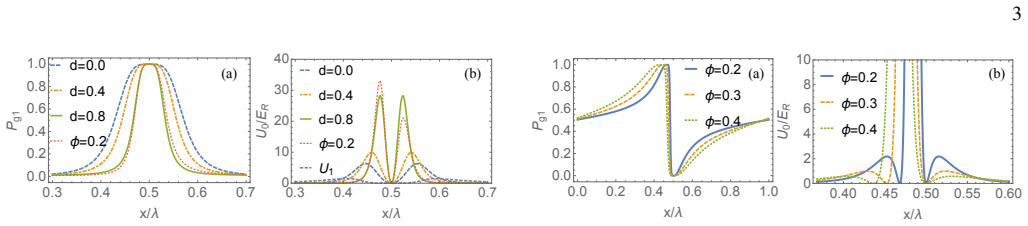
The central object is the position-dependent dark state $|D(x)\rangle=[-\Omega_p(x)|g_1\rangle+\Omega_c(x)|g_2\rangle]/\Omega(x)$ of the $\Lambda$ system. When the atomic kinetic energy is written in this position-dependent internal basis, the Born-Oppenheimer approximation produces a purely geometric potential $U_0(x)=\frac{\hbar^2}{2m}[\alpha'(x)]^2$, where $\alpha(x)=\arctan[\Omega_c(x)/\Omega_p(x)]$. All barrier shapes in the paper come from choosing the Rabi-frequency ratio $f(x)=\tan\alpha(x)$ so that $\alpha'(x)$ is small at one point and large over a subwavelength neighbourhood; the off-diagonal couplings between the dark and bright states are then checked to remain small so that atoms are not scattered out of the dark state.
What would settle it
With an ultracold gas of $^{171}$Yb atoms in the proposed $\Lambda$ configuration, measure the location and height of the two barrier peaks for the intensity ratio $f(x)=\frac{1+\cos kx}{\epsilon(1+d\cos kx)}$; the claim fails if the peaks are not found at $x=\pi/k\pm(4/3)^{1/4}\sqrt{\epsilon(1-d)}/k$ with height $\frac{\hbar^2k^2}{2m}\sqrt{27/[8\epsilon(1-d)]}$ and well width $\Delta x\approx0.2\sqrt{\epsilon(1-d)}\,\lambda$.
Extended reading notes
Core claim
The central discovery is that the non-adiabatic potential felt by an atom in a $\Lambda$ dark state, $U_0(x)=\frac{\hbar^2}{2m}[\alpha'(x)]^2$, can be sculpted into multiple subwavelength barriers by choosing the ratio $f(x)=\Omega_c(x)/\Omega_p(x)=\tan[\alpha(x)]$ to have a vanishing derivative at one point but a very large derivative just outside. With $f(x)=\frac{1+\cos kx}{\epsilon(1+d\cos(kx+\phi))}$, the potential has two peaks separated by $2(4/3)^{1/4}\sqrt{\epsilon(1-d)}/k$, a well of width $\Delta x\approx 0.2\sqrt{\epsilon(1-d)}\,\lambda$, and peak height $\frac{\hbar^2k^2}{2m}\sqrt{27/[8\epsilon(1-d)]}$; with $f(x)=\frac{1+\cos kx}{1+\cos(kx+\phi)}$, a central peak and two lower side peaks appear. The paper argues that these barriers are purely geometric (proportional to $\hbar$), require no time-dependent lattice modulation, and yield a landscape in which magnetic dipolar interactions can bind atoms for seconds.
Load-bearing premise
The atoms must stay almost perfectly in the dark state, never getting kicked up to the short-lived bright states, and the exact spatial intensity pattern assumed in the design must be achievable in the laboratory.
Editorial extensions
If this is right
- Spatially patterned $\Lambda$ systems give a modulation-free route to subwavelength barrier arrays, with double-barrier spacings estimated at about 13 nm for the example parameters.
- The double-barrier landscape is a cold-atom analogue of resonant tunneling and quasi-bound states in semiconductor heterostructures.
- Shifting the phase $\varphi$ makes the two barrier heights unequal, providing a tunable asymmetry for transport or bound-state experiments.
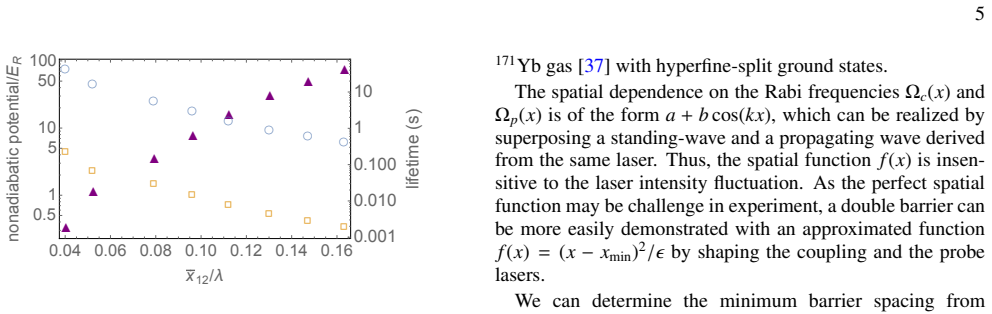
- Magnetic dipole-dipole interactions inside the wells can bind two or three atoms, with lifetimes estimated on the order of seconds.
- The general formula for $U_0(x)$ means any spatial laser-intensity function can be scanned for barrier structure, opening more complex multi-peak superlattices.
Reading between the lines
- Beyond the paper, the scaling of the well width with $\sqrt{\epsilon(1-d)}$ implies the product of barrier height and width is fixed by $\hbar^2k^2/m$, a signature that could be tested to confirm the potential is geometric.
- Beyond the paper, the same intensity-ratio recipe could be extended to two-dimensional patterns, turning the one-dimensional barrier array into subwavelength potential boxes or sheets.
- Beyond the paper, recording dark-state loss as the barrier height approaches $\hbar|\Omega(x)|$ would provide a direct quantitative probe of the Born-Oppenheimer regime on which the claimed second-long lifetimes depend.
Signed reviews
Editorial analysis
A structured set of objections, weighed in public.
Referee Report
Summary. This paper proposes a scheme for creating multiple subwavelength optical potential barriers using non-adiabatic (geometric) corrections to spatially varying dark states in a Λ-type three-level atom. By engineering the ratio f(x) = Ωc(x)/Ωp(x) of two position-dependent Rabi frequencies, the authors derive the dark-state potential U0(x) = (ℏ²/2m)[α'(x)]² and obtain closed-form expressions for double and triple barrier configurations with nanoscale spacing. They further apply the double-barrier potential to two-body magnetic dipole-dipole interactions, numerically identifying bound states and estimating lifetimes on the order of seconds. The manuscript also discusses the Born-Oppenheimer validity condition, experimental implementation using standing-wave and propagating-wave superpositions, and imperfections.
Significance. The paper's analytic construction is clean: U0 is derived from first principles with no fitted parameters, and the barrier positions and heights are given in closed form, which is a strength. The proposed double- and triple-barrier landscapes extend previous single-barrier subwavelength-potential proposals and avoid time-dependent Floquet engineering. If the quantitative claims are correct, the scheme would provide a new platform for enhanced dipole-dipole interactions and long-lived bound states at tens of nanometers. However, the headline numbers (13 nm double-barrier spacing and the associated lifetime estimates) are obtained in a parameter regime where the paper's own Born-Oppenheimer validity condition, Eq. (7), is violated. The practical significance is therefore conditional on correcting this inconsistency or restricting the claims to the regime where the perturbation theory is valid.
major comments (2)
- [Sec. V, Eq. (7) and Eq. (10)] The quoted double-barrier minimum spacing of 13 nm is inconsistent with the validity condition stated earlier in the paper. Using the Sec. V parameters Ω0 = 2π×100 MHz, λ = 532 nm, and E_R/h ≈ 4.1 kHz, the peak height from Eq. (10) is U0,max = E_R · 3√3/[8ε(1−d)]. The minimum Rabi frequency in the double-barrier case is ℏΩ_min ≈ ℏΩ0 ε(1−d), so the condition U0 ≤ ℏ|Ω|/5 reduces to ε(1−d) ≥ [5·0.6495 E_R/(ℏΩ0)]^{1/2} ≈ 0.0115. This corresponds to a peak separation of about 20 nm, not 13 nm. At ε(1−d) = 0.005, the value implied by 13 nm, one finds U0,max/(ℏΩ_min) ≈ 1.06, so U0 is comparable to the internal energy scale and the perturbative barrier picture is not valid. Consequently, the associated estimates P_B ≈ 4% and the scattering rate of about 2π×7 kHz are not supported by the manuscript's own assumptions. This estimate should be redone under the stated constraint, or Ω0 should be increased accordingly.
- [Sec. IV, Fig. 5 and Eq. (7)] The long-lifetime claim relies on the perturbative loss-rate formula γd ≈ γ V±D²/Ω², which is derived under the condition U0 ≪ ℏ|Ω| (Eq. (7)). The small-ε endpoint in Fig. 5, ε = 1/120 at d = 0, has ε(1−d) = 0.00833 and gives U0,max/(ℏΩ_min) ≈ 0.38, exceeding the 1/5 margin used in Sec. V by nearly a factor of two. The same point also appears in Fig. 4(a). The lifetime curve in Fig. 5 therefore includes a data point where the perturbative decay estimate is not justified. The authors should either restrict the reported lifetimes and the claimed minimum spacings to the regime satisfying Eq. (7) with the stated margin, or provide a non-perturbative treatment of the decay in the small-ε regime.
minor comments (4)
- [Sec. IV] The two-body calculation is described only as 'numerically solving the Schrödinger equation (12)'; the manuscript should specify the numerical method, grid truncation, handling of the 1/|x1−x2|³ singularity, and convergence checks, since Fig. 4(a) is a quantitative result.
- [Sec. III.A, Eq. (10)] The expansion leading to Eq. (10) neglects the O(d δx²) term in the denominator of f(x); the authors should state the parameter ranges in ε and d for which Eq. (10) is quantitatively accurate.
- [Throughout] There are typographical and formatting errors: 'Schr¨ordinger' appears in Sec. IV, and several references duplicate journal names (e.g., Refs. [11], [12], [43], [49]).
- [Sec. V] The statement that f(x) is insensitive to laser intensity fluctuations would be more precise if it noted that common-mode intensity noise cancels in the ratio; wavefront and pointing noise are not canceled in the same way.
Circularity Check
No significant circularity: the geometric potentials and lifetime estimates follow from the stated Hamiltonian and chosen intensity profiles, with no fitted parameter renamed as a prediction.
full rationale
The derivation chain is self-contained. The paper starts from the three-level Hamiltonian in Eq. (1), diagonalizes the internal part, applies the unitary transformation to obtain Eq. (4), and derives the dark-state geometric potential U0(x) = (ℏ^2/2m)[α′(x)]^2 in Eq. (5). No quantity entering U0 is fitted to the later predictions; the double- and triple-barrier structures are obtained by inserting the analytic choices f(x) of Eqs. (9) and (11) into α′ and expanding, so the peak positions, barrier heights, and subwavelength widths are consequences rather than inputs. The bound-state analysis then solves the two-body Schrödinger equation (12) with the derived U0 and a standard dipolar interaction; the critical dipolar length a_min_dd is found by an eigenvalue condition, and the lifetime is computed from a perturbative loss formula using stated experimental parameters (Ω0 = 2π×100 MHz, λ = 532 nm, γ = 2π×182 kHz). None of these outputs is equivalent by construction to an input, and no parameter is fitted to reproduce the claimed barrier spacing or lifetime. Citations to Refs. [34]-[37] supply the background BO/geometric-potential method and the 171Yb experiment; they are external results and are not used as a self-citation chain to force the central claims. The skeptic’s concern that the BO validity condition Eq. (7) may fail in the smallest-spacing regime is a legitimate parameter-regime/correctness objection, not a circularity: it questions whether the assumptions hold, not whether the derivation reduces to its inputs.
Assumptions & free parameters
free parameters (3)
- ε (small parameter in f(x)) =
1/10 to 1/120 (scanned)
- d (amplitude ratio in f(x)) =
0, 0.4, 0.8 (examples)
- φ (phase shift between the two intensity modulations) =
0.2, 0.3, 0.4 (examples)
assumptions (4)
- domain assumption Born-Oppenheimer approximation: internal dynamics are faster than external motion, and off-diagonal coupling V is small (Eq. 7)
- domain assumption The dark state |D(x)⟩ is lossless to leading order; decay occurs only via off-diagonal coupling with rate γ_d ~ γ V²/Ω²
- domain assumption Magnetic dipole-dipole interaction with position-dependent moments µ(x) = µ_m[2P_g1(x)-1], and s-wave contact interaction is neglected
- domain assumption Transverse confinement is Gaussian with width l_T
Cite this review
Pith. "Pith review of Dark-State Optical Potential Barriers with Nanoscale Spacing." pith.science (2026). https://pith.science/paper/3KHOQFTZ
@misc{pith2026190804368,
  author       = {Pith},
  title        = {Pith review of: Dark-State Optical Potential Barriers with Nanoscale Spacing},
  year         = {2026},
  howpublished = {\url{https://pith.science/paper/3KHOQFTZ}},
  note         = {Machine review of arXiv:1908.04368}
}
abstract
Optical potentials have been a versatile tool for the study of atomic motions and many-body interactions in cold atoms. Recently, optical subwavelength single barriers were proposed to enhance the atomic interaction energy scale, which is based on non-adiabatic corrections to Born-Oppenheimer potentials. Here we present a study for creating a new landscape of non-adiabatic potentials--multiple barriers with subwavelength spacing at tens of nanometers. To realize these potentials, spatially rapid-varying dark states of atomic $\Lambda$-configurations are formed by controlling the spatial intensities of the driving lasers. As an application, we show that bound states of very long lifetimes on the order of seconds can be realized. Imperfections and experimental realizations of the multiple barriers are also discussed.
Figures


Figures from the paper (1 more)
Reference graph
Works this paper leans on
-
[1]
Bloch, Nature Physics 1, 23 (2005)
I. Bloch, Nature Physics 1, 23 (2005). [2] I. Bloch, J. Dalibard, and W. Zwerger, Reviews of Modern 6 Physics 80, 885 (2008)
work page 2005
-
[3]
Optical dipole traps for neutral atoms,
R. Grimm, M. Weidem ¨uller, Y . B. Ovchinnikov, B. Bederson, and H. Walther, “Optical dipole traps for neutral atoms,” in Advances In Atomic, Molecular , and Optical Physics , V ol. 42 (Academic Press, 2000) pp. 95–170
work page 2000
-
[4]
D. E. Chang, J. D. Thompson, H. Park, V . Vuleti ´c, A. S. Zi- brov, P. Zoller, and M. D. Lukin, Physical Review Letters 103, 123004 (2009)
work page 2009
-
[5]
M. Gullans, T. G. Tiecke, D. E. Chang, J. Feist, J. D. Thompson, J. I. Cirac, P. Zoller, and M. D. Lukin, Physical Review Letters 109, 235309 (2012)
work page 2012
-
[6]
O. Romero-Isart, C. Navau, A. Sanchez, P. Zoller, and J. I. Cirac, Physical Review Letters 111, 145304 (2013)
work page 2013
-
[7]
J. D. Thompson, T. G. Tiecke, N. P. de Leon, J. Feist, A. V . Akimov, M. Gullans, A. S. Zibrov, V . Vuleti´c, and M. D. Lukin, Science 340, 1202 (2013)
work page 2013
- [8]
-
[9]
A. Gonz ´alez-Tudela, C. L. Hung, D. E. Chang, J. I. Cirac, and H. J. Kimble, Nature Photonics 9, 320 EP (2015)
work page 2015
Show all 56 references
-
[10]
Brezger, T
B. Brezger, T. Schulze, P. O. Schmidt, R. M. T. Pfau, and J. Mlynek, Europhysics Letters (EPL), 46, 148 (1999)
1999
-
[11]
F. M. Huang and N. I. Zheludev, Nano Letters, Nano Letters 9, 1249 (2009)
2009
-
[12]
J. R. Gardner, M. L. Marable, G. R. Welch, and J. E. Thomas, Physical Review Letters 70, 3404 (1993)
1993
-
[13]
Y . Qi, F. Zhou, T. Huang, Y . Niu, and S. Gong, Journal of Modern Optics, Journal of Modern Optics 59, 1092 (2012)
2012
-
[14]
D. D. Yavuz, N. A. Proite, and J. T. Green, Physical Review A 79, 055401 (2009)
2009
-
[15]
Z. Liao, M. Al-Amri, and M. Suhail Zubairy, Physical Review Letters 105, 183601 (2010)
2010
-
[16]
Q. Sun, M. Al-Amri, M. O. Scully, and M. S. Zubairy, Physical Review A 83, 063818 (2011)
2011
-
[17]
Nascimbene, N
S. Nascimbene, N. Goldman, N. R. Cooper, and J. Dalibard, Physical Review Letters 115, 140401 (2015)
2015
-
[18]
W. Yi, A. J. Daley, G. Pupillo, and P. Zoller, New Journal of Physics, 10, 073015 (2008)
2008
-
[19]
Lundblad, P
N. Lundblad, P. J. Lee, I. B. Spielman, B. L. Brown, W. D. Phillips, and J. V . Porto, Physical Review Letters 100, 150401 (2008)
2008
-
[20]
Shotter, D
M. Shotter, D. Trypogeorgos, and C. Foot, Physical Review A 78, 051602 (2008)
2008
-
[21]
P. R. Berman, B. Dubetsky, and J. L. Cohen, Physical Review A 58, 4801 (1998)
1998
-
[22]
Weitz, G
M. Weitz, G. Cennini, G. Ritt, and C. Geckeler, Physical Re- view A 70, 043414 (2004)
2004
-
[23]
Salger, C
T. Salger, C. Geckeler, S. Kling, and M. Weitz, Physical Re- view Letters 99, 190405 (2007)
2007
-
[24]
W. Ge, P. R. Hemmer, and M. S. Zubairy, Physical Review A 87, 023818 (2013)
2013
-
[25]
Sahrai, H
M. Sahrai, H. Tajalli, K. T. Kapale, and M. S. Zubairy, Physical Review A 72, 013820 (2005)
2005
-
[26]
G. S. Agarwal and K. T. Kapale, Journal of Physics B: Atomic, Molecular and Optical Physics , 39, 3437 (2006)
2006
-
[27]
D. D. Yavuz and N. A. Proite, Physical Review A 76, 041802 (2007)
2007
-
[28]
A. V . Gorshkov, L. Jiang, M. Greiner, P. Zoller, and M. D. Lukin, Physical Review Letters 100, 093005 (2008)
2008
-
[29]
Ki ffner, J
M. Ki ffner, J. Evers, and M. S. Zubairy, Physical Review Let- ters 100, 073602 (2008)
2008
-
[30]
H. Li, V . A. Sautenkov, M. M. Kash, A. V . Sokolov, G. R. Welch, Y . V . Rostovtsev, M. S. Zubairy, and M. O. Scully, Physical Review A 78, 013803 (2008)
2008
-
[31]
Mompart, V
J. Mompart, V . Ahufinger, and G. Birkl, Physical Review A79, 053638 (2009)
2009
-
[32]
Viscor, J
D. Viscor, J. L. Rubio, G. Birkl, J. Mompart, and V . Ahufinger, Physical Review A 86, 063409 (2012)
2012
-
[33]
J. A. Miles, Z. J. Simmons, and D. D. Yavuz, Physical Review X 3, 031014 (2013)
2013
-
[34]
A subwavelength potential barrier arises when the kinetic energy of an atom experiences a rapid change of its internal state in a subwavelength region
to the spatially varying dark states in the Λ configura- tions [35, 36]. A subwavelength potential barrier arises when the kinetic energy of an atom experiences a rapid change of its internal state in a subwavelength region. This new type of optical potentials is drastically di...
1908 arXiv
-
[35]
Lacki, M
M. Lacki, M. A. Baranov, H. Pichler, and P. Zoller, Physical Review Letters 117, 233001 (2016)
2016
-
[36]
In general, f (x) can be made periodic, e.g
U0(x) = ℏ2k2 2mϵ2/[1 + (kx/ϵ)2]2, which shows a single po- tential barrier located at x = 0 with U0(0) = ℏ2k2 2mϵ2 and a width ∆x∼ ϵ/k. In general, f (x) can be made periodic, e.g. f (x) = sin(kx)/ϵ [35, 37], so the separation between two bar- riers is λ/2. Recent studies show...
-
[37]
Dum and M
R. Dum and M. Olshanii, Physical Review Letters 76, 1788 (1996)
1996
-
[38]
Jendrzejewski, S
F. Jendrzejewski, S. Eckel, T. G. Tiecke, G. Juzeli ¯unas, G. K. Campbell, L. Jiang, and A. V . Gorshkov, Physical Review A 94, 063422 (2016)
2016
-
[39]
Y . Wang, S. Subhankar, P. Bienias, M. Lacki, T.-C. Tsui, M. A. Baranov, A. V . Gorshkov, P. Zoller, J. V . Porto, and S. L. Rol- ston, Physical Review Letters 120, 083601 (2018)
2018
-
[40]
Subhankar, P
S. Subhankar, P. Bienias, P. Titum, T. Tsui, Y . Wang, A. Gorshkov, S. Rolston, and J. Porto, arXiv preprint arXiv:1906.07646 (2019)
2019 arXiv
- [41]
-
[42]
T. Tsui, Y . Wang, S. Subhankar, J. Porto, and S. Rolston, arXiv preprint arXiv:1911.00394 (2019)
2019 arXiv
-
[43]
V . J. Goldman, D. C. Tsui, and J. E. Cunningham, Physical Review B 36, 7635 (1987)
1987
-
[44]
A. G. Petukhov, A. N. Chantis, and D. O. Demchenko, Physical Review Letters 89, 107205 (2002)
2002
-
[45]
Songmuang, G
R. Songmuang, G. Katsaros, E. Monroy, P. Spathis, C. Bougerol, M. Mongillo, and S. De Franceschi, Nano Let- ters, Nano Letters 10, 3545 (2010)
2010
-
[46]
H. C. Nguyen, M. T. Hoang, and V . L. Nguyen, Physical Re- view B 79, 035411 (2009)
2009
-
[47]
Fleischhauer, A
M. Fleischhauer, A. Imamoglu, and J. P. Marangos, Reviews of Modern Physics 77, 633 (2005)
2005
-
[48]
M. O. Scully and M. S. Zubairy, Quantum optics (Cambridge University Press, 1999)
1999
-
[49]
Bienias, S
P. Bienias, S. Subhankar, Y . Wang, T. Tsui, F. Jendrzejewski, T. Tiecke, G. Juzeliunas, L. Jiang, S. Rolston, J. Porto, et al. , arXiv preprint arXiv:1808.02487 (2018)
2018 arXiv
-
[50]
A more rigorous determination of amin dd can be obtained by numerically solving the Sch ¨ordinger equation (12) to have at least one negative eigenvalue
is on the order of the typical subwavelength spacing, i.e., amin dd ∼ 0.2√ϵ(1− d)λ∼ ∆x. A more rigorous determination of amin dd can be obtained by numerically solving the Sch ¨ordinger equation (12) to have at least one negative eigenvalue. In practice, the dipole-dipole inte...
-
[51]
Modinos and N
A. Modinos and N. Nicolaou, Surface Science 17, 359 (1969)
1969
-
[52]
Dutt and S
A. Dutt and S. Kar, American Journal of Physics , American Journal of Physics 78, 1352 (2010)
2010
-
[53]
Lahaye, C
T. Lahaye, C. Menotti, L. Santos, M. Lewenstein, and T. Pfau, Reports on Progress in Physics, 72, 126401 (2009)
2009
-
[54]
H. P. B ¨uchler, E. Demler, M. Lukin, A. Micheli, N. Prokof’ev, G. Pupillo, and P. Zoller, Phys. Rev. Lett. 98, 060404 (2007)
2007
-
[55]
Bergmann, H
K. Bergmann, H. Theuer, and B. W. Shore, Reviews of Modern Physics 70, 1003 (1998)
1998
-
[56]
McDonald, J
M. McDonald, J. Trisnadi, K.-X. Yao, and C. Chin, Physical Review X 9, 021001 (2019)
2019
-
[57]
Subhankar, Y
S. Subhankar, Y . Wang, T.-C. Tsui, S. L. Rolston, and J. V . Porto, Physical Review X 9, 021002 (2019)
2019
Reviewed August 14, 2026 · model on record in the stance chip above.
Discussion (0). Continue with ORCID to comment.