REVIEW 3 major objections 5 minor 69 references
On Gaussian weak-lensing mocks, explicit-likelihood inference goes miscalibrated when its assumptions fail; likelihood-free inference stays calibrated, making the CNN's factor-of-two edge an artifact.
Reviewed by Pith at T0; open to challenge. T0 means a machine referee read the full paper against a public rubric. the ladder, T0–T4 →
T0 review · deepseek-v4-flash
2026-08-01 16:34 UTC pith:3KKEBDBT
load-bearing objection Careful matched ELI-vs-LFI benchmark with a useful calibration protocol; the main conclusion holds, but the CNN null test is cleaner in the text than in the actual forward model, and the 'within 1σ' phrasing is contradicted by their own numbers. the 3 major comments →
Comparing explicit likelihood and likelihood-free simulation-based inference for weak lensing cosmic shear
The pith
A machine-rendered reading of the paper's core claim, the machinery that carries it, and where it could break.
Core claim
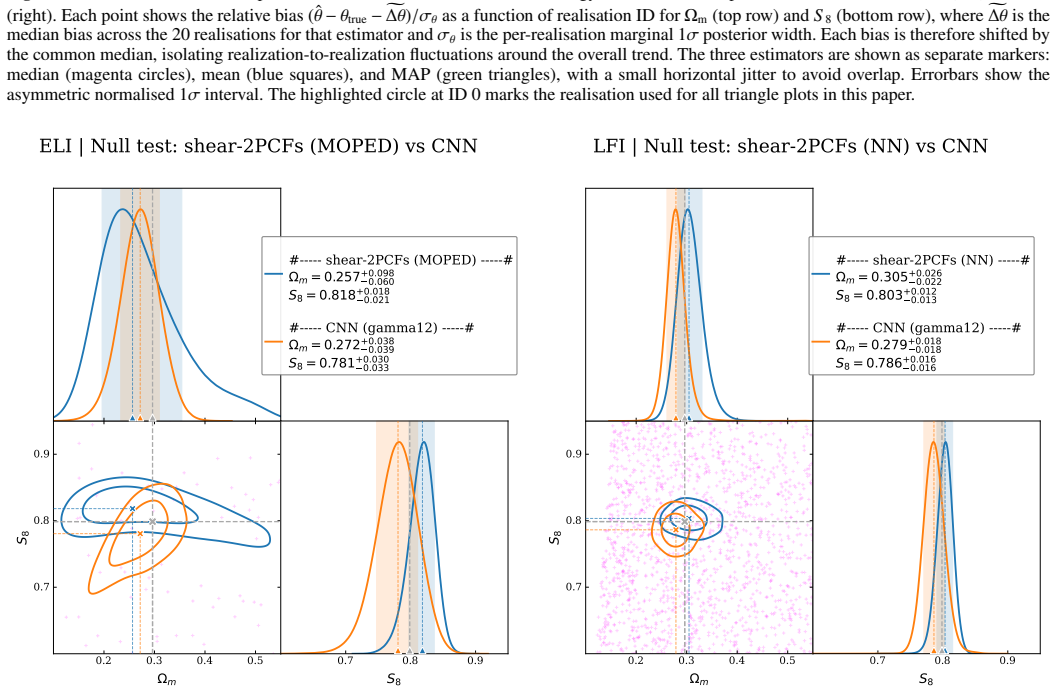
The central claim is that the observed disagreements between ELI and LFI—up to a factor of two on Ωm and S8 constraints from shear-2PCFs, and between shear-2PCFs and a CNN—are not intrinsic to the algorithms but follow from ELI's two working assumptions: an accurate Gaussian-process emulator and a Gaussian likelihood for the compressed summaries. Using LFI retrained on a synthetic dataset built from the emulator's predictions plus Gaussian covariance noise, the authors reproduce the ELI posterior, and restricting to the single accurately emulated, near-Gaussian bin brings the two frameworks into agreement. LFI, which learns the likelihood shape directly, is unaffected by non-linear NN compre
What carries the argument
The decisive mechanism is the matched-assumption test: feeding the GP emulator's predicted means and the Gaussian covariance into LFI reproduces the ELI posterior exactly, isolating emulator inaccuracy and likelihood non-Gaussianity as the sole drivers of the discrepancy. Alongside this, the Test of Accuracy with Random Points (TARP)—a joint posterior calibration diagnostic that compares expected coverage against credibility level—is applied to ELI as well as LFI, exposing miscalibration that standard per-bin KS and χ² Gaussianity tests miss. These two tools together convert a seemingly large cosmological discrepancy into a clean statement about which inference assumptions are actually viola
Load-bearing premise
The null-test conclusion rests on the premise that the simulated shear fields are exactly Gaussian random fields, so the two-point correlation functions carry all the information; if residual non-Gaussianity sneaks in through the power-spectrum model, noise injection, or map making, the CNN-versus-two-point comparison is no longer a clean test of the inference framework.
What would settle it
Replace the Gaussian random-field simulations with N-body mocks at matched resolution and noise, keeping everything else identical. If under LFI the CNN then beats shear-2PCFs by substantially more than ~30%, the 'CNN-versus-2PCFs discrepancy is an ELI artifact' reading fails; if under ELI the factor-of-two persists even after replacing the GP emulator with the true simulation mean and using a non-Gaussian likelihood, then the attribution to emulator and likelihood assumptions is wrong.
If this is right
- When ELI's emulator is inaccurate or the compressed likelihood is non-Gaussian, ELI posteriors become miscalibrated and can disagree with a map-level CNN by up to a factor of two on Ωm, even on Gaussian fields where two-point statistics should be optimal.
- Repairing both assumptions—by using an accurately emulated bin or by feeding the emulator mapping and Gaussian noise into LFI—restores agreement between ELI and LFI, showing the discrepancy is an ELI artifact.
- LFI remains well calibrated under both linear (MOPED) and non-linear (NN) compression, and NN compression modestly improves LFI's Ωm precision, whereas for ELI the same non-linear compression broadens Ωm errors by ≈1.3× and S8 errors by ≈2.2×.
- Posterior calibration diagnostics developed for LFI (TARP, marginal coverage, PIT) applied to ELI reveal miscalibration that standard KS and χ² Gaussianity tests miss.
- For future Stage-IV analyses the paper recommends running ELI and LFI in parallel, using these calibration diagnostics, and investing in non-Gaussian likelihood models for ELI.
Where Pith is reading between the lines
- If the simulated fields carry even mild non-Gaussianity from the power-spectrum emulator, noise injection, or the Kaiser–Squires inversion, the CNN-versus-two-point null test is not perfectly clean, so part of the residual ~30% LFI discrepancy could be genuine higher-order information captured by the CNN.
- The same calibration audit could be applied to ELI analyses on real survey data as a sanity check: a failing TARP curve would flag unreliable error bars even when marginal Gaussianity tests pass.
- The paper's controlled setup suggests a testable ordering for non-Gaussian mocks: ELI's miscalibration should grow as the likelihood becomes more non-Gaussian, while LFI should remain calibrated; checking this on N-body mocks would extend the result.
Editorial analysis
A structured set of objections, weighed in public.
Referee Report
Summary. Using GLASS Gaussian random-field weak-lensing mocks tailored to Euclid DR3, the paper compares explicit likelihood inference (ELI: GP emulator + Gaussian likelihood + simulation covariance) with likelihood-free inference (LFI: NDEs) on shear 2PCFs under MOPED/NN compression and on a map-level CNN summary, focusing on Ωm and S8. It reports that ELI and LFI agree when ELI's assumptions are met; that ELI is miscalibrated when emulation is inaccurate or the compressed likelihood is non-Gaussian; that compression choice affects ELI but not LFI; and that in the Gaussian-field null test the CNN-vs-2PCF discrepancy is up to a factor of two for ELI but only ≈30% for LFI. It concludes that LFI is more robust and advocates calibration diagnostics for ELI.
Significance. The paper is a carefully controlled empirical benchmark with real methodological value. It shows good train/validation/test hygiene (GP on 250 nodes, NDE on 3,687 nodes, diagnostics on 692 held-out nodes, mock observation reserved), and it extends calibration diagnostics (TARP, PIT, coverage) to ELI. The synthetic-LFI test and bin-0-only control are convincing internal-consistency checks. If the central claim survives the null-test caveat below, it would be a useful reference for future Stage-IV WL analyses choosing between ELI and LFI.
major comments (3)
- [§3, §8, Eq. (4), §3.1] The null-test interpretation is not clean. The paper's central claim—that the factor-of-two CNN-vs-2PCF discrepancy under ELI is an ELI artifact—rests on the assertion that ξ± captures all information in Gaussian fields. However, the simulated observable is not Gaussian: the observed ellipticity is formed via the reduced-shear composition of Eq. (4), which is nonlinear in the Gaussian shear and in a phase-only noise field whose fixed amplitude makes the two noise components non-Gaussian; and ξ± is binned into 8 logarithmic angular bins, which is lossy, while the CNN sees the full 64×64 map. Each of these effects can make the CNN genuinely more informative. The LFI comparison itself shows a ~30% residual difference with asymmetric Ωm/S8 constraining power, exactly what genuine extra information in the CNN would look like. I recommend (i) repeating the comparison on maps constructed to be
- [§5.1 vs §6.1, Appendix A] The ELI and LFI frameworks are trained with very different amounts of data: the GP emulator uses 250 nodes, the NDE uses 3,687 nodes. The ELI-LFI discrepancy under MOPED is traced to poor emulation of bin 1 (Appendix A: slope a=0.710, WARN). The paper states in §5.1 that increasing beyond 250 nodes yields consistent posterior constraints, but no evidence is shown; if emulator accuracy improves with training-set size, the 'emulation inaccuracy' failure may be an artifact of the 250-node cap rather than an intrinsic ELI limitation. Please provide an emulator accuracy vs training-size test (e.g., slope/intercept for bin 1 at 500/1000/3687 nodes) or otherwise justify that the 250-node choice is not responsible for the ELI-LFI gap.
- [Abstract, §9, Fig. 4] The abstract and conclusions state that ELI becomes 'strongly miscalibrated' under emulation inaccuracies or likelihood non-Gaussianity. However, the headline TARP curves in Fig. 4 show only a mild departure from the diagonal, mostly at low credibility levels; the larger departures appear in the marginal coverage and PIT diagnostics (Appendix C). Please either temper the wording or quantify the miscalibration (e.g., maximum ECP deviation, fraction of nodes outside the bootstrap band, or a combined statistic) so the strength of the claim is commensurate with the evidence. As written, the summary overstates the calibration difference shown in the main diagnostic.
minor comments (5)
- [§7.1] The statement that 'Both frameworks well recover (Ωm^fid,S8^fid) within 1σ' is not supported for LFI S8: the reported median is S8=0.801+0.015−0.016, while the fiducial is 0.823, an offset of ~1.4σ given the lower error. Please correct or qualify this claim.
- [§2.3] The text first says shape noise is 'independent Gaussian noise' and then introduces the phase-only fixed-amplitude draw. Clarify that the nominal noise model is not Gaussian per component, since this is relevant to the Gaussianity discussion in §5.2.
- [Appendix A, Fig. A.1] The flag label 'W ARN' appears to be a typo for 'WARN'. Also, the 'cbar: Omega_m' / 'cbar: sigma8' labels in the panels are cryptic; use 'colored by Ωm' / 'colored by σ8' in the caption.
- [References] There are duplicate reference entries for LeCun et al. 1998 ('Lecun' and 'LeCun'). Unify the spelling and merge the entries.
- [§4.1] The 102 flat-sky patches are described as 'quasi-independent'. A brief quantitative statement (e.g., typical correlation between adjacent patches or effective number of independent samples) would help assess the covariance estimation and the KS-test critical values.
Circularity Check
No significant circularity: the ELI-LFI comparison is an empirical benchmark with held-out test nodes and forward consistency controls, not a derivation that reduces to its inputs.
full rationale
The paper's central comparison is empirical, not definitional. ELI and LFI are distinct algorithms: ELI couples a GP emulator with an explicit Gaussian likelihood and an estimated covariance, while LFI trains neural density estimators on simulated data. Calibration is assessed with TARP, marginal coverage, and PIT/rank diagnostics on 692 held-out LHS1 nodes (TARP on 50 nodes) that were not used for training the NDEs or the GP emulators. The synthetic-LFI test (MDN trained on GP-predicted means plus Gaussian noise from the covariance) is explicitly a consistency control: it reproduces the ELI posterior when the same effective statistical model is fed to LFI, isolating whether the frameworks agree under matched assumptions rather than being a fitted quantity relabeled as a prediction. The null-test premise that shear-2PCFs are sufficient in Gaussian random fields is an external theoretical statement, and the paper explicitly qualifies it as holding 'up to numerical effects' and lists the Gaussian idealization as a limitation. Self-citations to Euclid Collaboration papers supply standard inputs (n(z), shape noise, HOS references) and are not load-bearing for the core inference comparison. The skeptic concern about residual non-Gaussianity in the forward model (reduced shear, phase-only noise, lossy binning) is a correctness risk for the null-test interpretation, not a circular reduction of the analysis to its own inputs. No equation in the paper is equivalent to its inputs by construction.
Axiom & Free-Parameter Ledger
free parameters (4)
- GP emulator kernel hyperparameters (C, ℓ_Ωm, ℓ_σ8, σ_n)
- GP emulator training subset size =
250 nodes
- Finite-difference derivative step =
±16% of fiducial (ΔΩm=0.0465, Δσ8=0.134)
- CNN/MLP/NDE architecture hyperparameters
axioms (5)
- domain assumption Shear two-point correlation functions are information-sufficient statistics for Gaussian random fields.
- domain assumption GLASS produces statistically unbiased Gaussian shear and convergence maps from input angular power spectra.
- standard math MOPED compression is lossless under a Gaussian likelihood with parameter-independent covariance.
- standard math TARP, PIT, and marginal-coverage diagnostics are valid for detecting miscalibration of 2D posteriors.
- domain assumption The pixel-level Gaussian shape-noise model (phase-only draw) represents Euclid DR3 noise faithfully.
Cite this review
Pith. "Pith review of Comparing explicit likelihood and likelihood-free simulation-based inference for weak lensing cosmic shear." pith.science (2026). https://pith.science/paper/3KKEBDBT
@misc{pith2026260717942,
  author       = {Pith},
  title        = {Pith review of: Comparing explicit likelihood and likelihood-free simulation-based inference for weak lensing cosmic shear},
  year         = {2026},
  howpublished = {\url{https://pith.science/paper/3KKEBDBT}},
  note         = {Machine review of arXiv:2607.17942}
}
read the original abstract
Simulation-based inference (SBI) has become a major tool for extracting cosmological information from weak-lensing (WL) surveys, particularly from non-Gaussian observables. We compare its two main paradigms: explicit likelihood inference (ELI), based on a Gaussian likelihood built from an emulator and covariance matrix, and likelihood-free inference (LFI), which learns the likelihood directly from simulations using neural density estimators. Using Gaussian random field mocks representative of the non-tomographic final Euclid data release, we analyse shear two-point correlation functions (shear-2PCFs), compressed with linear or non-linear methods, together with a fundamentally different map-level convolutional neural network (CNN) statistic, focusing on $\Omega_{\rm m}$ and $S_8$. We deploy posterior calibration diagnostics developed for LFI, including the test of accuracy with random points (TARP), showing that ELI becomes strongly miscalibrated under emulation inaccuracies or likelihood non-Gaussianity, whereas LFI remains well calibrated. These effects drive substantial disagreement between ELI and LFI, which largely vanishes once addressed. We further show that the compression scheme can significantly degrade ELI while leaving LFI largely unaffected. Although shear-2PCFs should capture all the information in Gaussian fields, finite compression and non-Gaussian likelihoods cause ELI constraints to differ by up to a factor of two from those inferred with the CNN, while the discrepancy drops to $\approx 30\%$ for LFI, underscoring the robustness of the deep-learning probe. Overall, our results indicate that in our simple setup, which neglects systematic biases, LFI provides a more robust and better-calibrated framework, while highlighting accurate non-Gaussian likelihood modelling and posterior calibration diagnostics as essential for future ELI analyses.
Figures


Reference graph
Works this paper leans on
-
[1]
Alsing, Justin and Wandelt, Benjamin and Feeney, Stephen , year=. Massive optimal data compression and density estimation for scalable, likelihood-free inference in cosmology , volume=. Monthly Notices of the Royal Astronomical Society , publisher=. doi:10.1093/mnras/sty819 , number=
-
[2]
Armijo, Joaquin and Marques, Gabriela A and Novaes, Camila P and Thiele, Leander and Cowell, Jessica A and Grand. Cosmological constraints using Minkowski functionals from the first year data of the Hyper Suprime-Cam , volume=. Monthly Notices of the Royal Astronomical Society , publisher=. 2025 , month=Feb, pages=. doi:10.1093/mnras/staf257 , number=
-
[3]
Forecasts for ten different higher-order weak lensing statistics , volume=
<i>Euclid</i>preparation: XXVIII. Forecasts for ten different higher-order weak lensing statistics , volume=. 2023 , month=jul, pages=. doi:10.1051/0004-6361/202346017 , journal=
-
[4]
2026 , eprint=
Dark Energy Survey Year 6 Results: Cosmological Constraints from Galaxy Clustering and Weak Lensing , author=. 2026 , eprint=
2026
-
[5]
Cosmology and fundamental physics with the Euclid satellite , volume=
Amendola, Luca and Appleby, Stephen and Avgoustidis, Anastasios and Bacon, David and Baker, Tessa and Baldi, Marco and Bartolo, Nicola and Blanchard, Alain and Bonvin, Camille and Borgani, Stefano and Branchini, Enzo and Burrage, Clare and Camera, Stefano and Carbone, Carmelita and Casarini, Luciano and Cropper, Mark and de Rham, Claudia and Dietrich, J. ...
-
[6]
2009 , eprint=
LSST Science Book, Version 2.0 , author=. 2009 , eprint=
2009
-
[7]
2019 , eprint=
Optuna: A Next-generation Hyperparameter Optimization Framework , author=. 2019 , eprint=
2019
-
[8]
Bishop , title =
Christopher M. Bishop , title =. Technical Report NCRG/94/004 , year =
-
[9]
Czado, Claudia and Gneiting, Tilmann and Held, Leonhard , title =. Biometrics , volume =. 2009 , month =. doi:10.1111/j.1541-0420.2009.01191.x , url =
arXiv 2009
-
[10]
Charnock, Tom and Lavaux, Guilhem and Wandelt, Benjamin D. , year=. Automatic physical inference with information maximizing neural networks , volume=. Physical Review D , publisher=. doi:10.1103/physrevd.97.083004 , number=
-
[11]
The frontier of simulation-based inference , volume=
Cranmer, Kyle and Brehmer, Johann and Louppe, Gilles , year=. The frontier of simulation-based inference , volume=. Proceedings of the National Academy of Sciences , publisher=. doi:10.1073/pnas.1912789117 , number=
-
[12]
Carron, J. , year=. On the assumption of Gaussianity for cosmological two-point statistics and parameter dependent covariance matrices , volume=. doi:10.1051/0004-6361/201220538 , journal=
-
[13]
2024 , eprint=
KiDS-1000 and DES-Y1 combined: Cosmology from peak count statistics , author=. 2024 , eprint=
2024
-
[14]
2019 , eprint=
Neural Spline Flows , author=. 2019 , eprint=
2019
-
[15]
Cosmic shear covariance matrix in <i>w</i>CDM: Cosmology matters , volume=
Harnois-D. Cosmic shear covariance matrix in <i>w</i>CDM: Cosmology matters , volume=. 2019 , month=Nov, pages=. doi:10.1051/0004-6361/201935912 , journal=
-
[16]
Eifler, T. and Schneider, P. and Hartlap, J. , year=. Dependence of cosmic shear covariances on cosmology: Impact on parameter estimation , volume=. Astronomy & Astrophysics , publisher=. doi:10.1051/0004-6361/200811276 , number=
-
[17]
and Semboloni, E
Fu, L. and Semboloni, E. and Hoekstra, H. and Kilbinger, M. and van Waerbeke, L. and Tereno, I. and Mellier, Y. and Heymans, C. and Coupon, J. and Benabed, K. and Benjamin, J. and Bertin, E. and Dor. Very weak lensing in the CFHTLS wide: cosmology from cosmic shear in the linear regime , journal =. 2008 , doi =
2008
-
[18]
Fluri, Janis and Kacprzak, Tomasz and Lucchi, Aurelien and Schneider, Aurel and Refregier, Alexandre and Hofmann, Thomas , year=. Full <mml:math xmlns:mml=``http://www.w3.org/1998/Math/MathML'' display=``inline''><mml:mrow><mml:mi>w</mml:mi><mml:mi>CDM</mml:mi></mml:mrow></mml:math> analysis of KiDS-1000 weak lensing maps using deep learning , volume=. Ph...
-
[19]
emcee: The MCMC Hammer. , keywords =. doi:10.1086/670067 , archivePrefix =. 1202.3665 , primaryClass =
-
[20]
2022 , eprint=
Dark Energy Survey Year 3 results: cosmology with moments of weak lensing mass maps , author=. 2022 , eprint=
2022
-
[21]
2023 , eprint=
Detection of the significant impact of source clustering on higher-order statistics with DES Year 3 weak gravitational lensing data , author=. 2023 , eprint=
2023
-
[22]
Gomes, R. C. H. and Sugiyama, S. and Jain, B. and Jarvis, M. and Anbajagane, D. and Halder, A. and Marques, G. A. and Pandey, S. and Marshall, J. and Alarcon, A. and Amon, A. and Bechtol, K. and Becker, M. and Bernstein, G. and Campos, A. and Cawthon, R. and Chang, C. and Chen, R. and Choi, A. and Cordero, J. and Davis, C. and Derose, J. and Dodelson, S. ...
-
[23]
Rubin , title =
Andrew Gelman and Donald B. Rubin , title =. Statistical Science , number =. 1992 , doi =
1992
-
[24]
Deep Learning , author=
-
[25]
HEALPix: A Framework for High-Resolution Discretization and Fast Analysis of Data Distributed on the Sphere. , keywords =. doi:10.1086/427976 , archivePrefix =. astro-ph/0409513 , primaryClass =
-
[26]
and Sellentin, Elena and de Mijolla, Damien and Vianello, Alvise , year=
Heavens, Alan F. and Sellentin, Elena and de Mijolla, Damien and Vianello, Alvise , year=. Massive data compression for parameter-dependent covariance matrices , volume=. Monthly Notices of the Royal Astronomical Society , publisher=. doi:10.1093/mnras/stx2326 , number=
-
[27]
Hartlap, J. and Simon, P. and Schneider, P. , year=. Why your model parameter confidences might be too optimistic. Unbiased estimation of the inverse covariance matrix , volume=. Astronomy & Astrophysics , publisher=. doi:10.1051/0004-6361:20066170 , number=
-
[28]
Proceedings of the IEEE Conference on Computer Vision and Pattern Recognition (CVPR) , month = jun, year =
He, Kaiming and Zhang, Xiangyu and Ren, Shaoqing and Sun, Jian , title =. Proceedings of the IEEE Conference on Computer Vision and Pattern Recognition (CVPR) , month = jun, year =
-
[29]
Heavens, A. F. and Jimenez, R. and Lahav, O. , year=. Massive lossless data compression and multiple parameter estimation from galaxy spectra , volume=. Monthly Notices of the Royal Astronomical Society , publisher=. doi:10.1046/j.1365-8711.2000.03692.x , number=
arXiv 2000
-
[30]
Ho, Matthew and Bartlett, Deaglan J. and Chartier, Nicolas and Cuesta-Lazaro, Carolina and Ding, Simon and Lapel, Axel and Lemos, Pablo and Lovell, Christopher C. and Makinen, T. Lucas and Modi, Chirag and Pandya, Viraj and Pandey, Shivam and Perez, Lucia A. and Wandelt, Benjamin and Bryan, Greg L. , year=. LtU-ILI: An All-in-One Framework for Implicit In...
-
[31]
2024 , eprint=
Dark Energy Survey Year 3 results: likelihood-free, simulation-based w CDM inference with neural compression of weak-lensing map statistics , author=. 2024 , eprint=
2024
-
[32]
TreeCorr: Two-point correlation functions
-
[33]
Cosmology with cosmic shear observations: a review , volume=
Kilbinger, Martin , year=. Cosmology with cosmic shear observations: a review , volume=. Reports on Progress in Physics , publisher=. doi:10.1088/0034-4885/78/8/086901 , number=
-
[34]
Mapping the Dark Matter with Weak Gravitational Lensing. , keywords =. doi:10.1086/172297 , adsurl =
-
[35]
and Bottou, L
Lecun, Y. and Bottou, L. and Bengio, Y. and Haffner, P. , journal=. Gradient-based learning applied to document recognition , year=
-
[36]
2023 , eprint=
Sampling-Based Accuracy Testing of Posterior Estimators for General Inference , author=. 2023 , eprint=
2023
-
[37]
2023 , eprint=
Hyper Suprime-Cam Year 3 Results: Cosmology from Cosmic Shear Two-point Correlation Functions , author=. 2023 , eprint=
2023
-
[38]
Linder, Eric V. , year=. Exploring the Expansion History of the Universe , volume=. Physical Review Letters , publisher=. doi:10.1103/physrevlett.90.091301 , number=
-
[39]
2011 , eprint=
Euclid Definition Study Report , author=. 2011 , eprint=
2011
-
[40]
Proceedings of the IEEE , year =
LeCun, Yann and Bottou, L. Proceedings of the IEEE , year =
-
[41]
Lewis, Antony and Challinor, Anthony and Lasenby, Anthony , year=. Efficient Computation of Cosmic Microwave Background Anisotropies in Closed Friedmann-Robertson-Walker Models , volume=. The Astrophysical Journal , publisher=. doi:10.1086/309179 , number=
-
[42]
2019 , eprint=
Decoupled Weight Decay Regularization , author=. 2019 , eprint=
2019
-
[43]
KiDS-450: cosmological constraints from weak-lensing peak statistics - II: Inference from shear peaks using N-body simulations. , keywords =. doi:10.1093/mnras/stx2793 , archivePrefix =. 1709.07678 , primaryClass =
-
[44]
The Shear Testing Programme 2: Factors affecting high-precision weak-lensing analyses , journal =
Massey, Richard and Heymans, Catherine and Berg. The Shear Testing Programme 2: Factors affecting high-precision weak-lensing analyses , journal =. 2007 , month =. doi:10.1111/j.1365-2966.2006.11315.x , url =
arXiv 2007
-
[45]
2025 , eprint=
Hybrid Summary Statistics , author=. 2025 , eprint=
2025
-
[46]
Overview of the <i>Euclid</i> mission , volume=
<i>Euclid</i>: I. Overview of the <i>Euclid</i> mission , volume=. 2025 , month=Apr, pages=. doi:10.1051/0004-6361/202450810 , journal=
-
[47]
Impact of undetected galaxies on weak-lensing shear measurements , volume=
<i>Euclid</i> preparation: IV. Impact of undetected galaxies on weak-lensing shear measurements , volume=. 2019 , month=jul, pages=. doi:10.1051/0004-6361/201935187 , journal=
-
[48]
2024 , eprint=
Cosmology from HSC Y1 Weak Lensing with Combined Higher-Order Statistics and Simulation-based Inference , author=. 2024 , eprint=
2024
-
[49]
Oehl, Veronika and Tr. The Non-Gaussian Weak-Lensing Likelihood: A Multivariate Copula Construction and Impact on Cosmological Constraints , volume=. doi:10.33232/001c.163550 , journal=
-
[50]
Percival, Will J and Friedrich, Oliver and Sellentin, Elena and Heavens, Alan , year=. Matching Bayesian and frequentist coverage probabilities when using an approximate data covariance matrix , volume=. Monthly Notices of the Royal Astronomical Society , publisher=. doi:10.1093/mnras/stab3540 , number=
-
[51]
Lifting weak lensing degeneracies with a field-based likelihood , volume=
Porqueres, Natalia and Heavens, Alan and Mortlock, Daniel and Lavaux, Guilhem , year=. Lifting weak lensing degeneracies with a field-based likelihood , volume=. Monthly Notices of the Royal Astronomical Society , publisher=. doi:10.1093/mnras/stab3234 , number=
-
[52]
Perraudin, N. and Defferrard, M. and Kacprzak, T. and Sgier, R. , year=. DeepSphere: Efficient spherical convolutional neural network with HEALPix sampling for cosmological applications , volume=. doi:10.1016/j.ascom.2019.03.004 , journal=
-
[53]
2019 , eprint=
Neural Density Estimation and Likelihood-free Inference , author=. 2019 , eprint=
2019
-
[54]
2018 , eprint=
Masked Autoregressive Flow for Density Estimation , author=. 2018 , eprint=
2018
-
[55]
2018 , eprint=
Scikit-learn: Machine Learning in Python , author=. 2018 , eprint=
2018
-
[56]
Multilayer perceptron and neural networks , volume =
Popescu, Marius-Constantin and Balas, Valentina and Perescu-Popescu, Liliana and Mastorakis, Nikos , year =. Multilayer perceptron and neural networks , volume =
-
[57]
Rumelhart, David E. and Hinton, Geoffrey E. and Williams, Ronald J. , title =. Nature , volume =. 1986 , month =. doi:10.1038/323533a0 , url =
doi:10.1038/323533a0 1986
-
[58]
Weak lensing cosmology with convolutional neural networks on noisy data , volume=
Ribli, Dezs. Weak lensing cosmology with convolutional neural networks on noisy data , volume=. Monthly Notices of the Royal Astronomical Society , publisher=. 2019 , month=sep, pages=. doi:10.1093/mnras/stz2610 , number=
-
[59]
Semboloni, Elisabetta and Hoekstra, Henk and Schaye, Joop and van Daalen, Marcel P. and McCarthy, Ian G. , year=. Quantifying the effect of baryon physics on weak lensing tomography: Baryon physics and weak lensing tomography , volume=. Monthly Notices of the Royal Astronomical Society , publisher=. doi:10.1111/j.1365-2966.2011.19385.x , number=
arXiv 2011
-
[60]
Sellentin, Elena and Heavens, Alan F. , year=. Parameter inference with estimated covariance matrices , volume=. Monthly Notices of the Royal Astronomical Society: Letters , publisher=. doi:10.1093/mnrasl/slv190 , number=
-
[61]
Schneider, P. , year=. Detection of (dark) matter concentrations via weak gravitational lensing , volume=. Monthly Notices of the Royal Astronomical Society , publisher=. doi:10.1093/mnras/283.3.837 , number=
-
[62]
Troxel, M.A. and Ishak, Mustapha , year=. The intrinsic alignment of galaxies and its impact on weak gravitational lensing in an era of precision cosmology , volume=. doi:10.1016/j.physrep.2014.11.001 , journal=
-
[63]
2020 , eprint=
Validating Bayesian Inference Algorithms with Simulation-Based Calibration , author=. 2020 , eprint=
2020
-
[64]
sbi: A toolkit for simulation-based inference , journal =
Tejero-Cantero, Alvaro and Boelts, Jan and Deistler, Michael and Lueckmann, Jan-Matthis and Durkan, Conor and Gon. sbi: A toolkit for simulation-based inference , journal =. 2020 , publisher =. doi:10.21105/joss.02505 , url =
-
[65]
GLASS: Generator for Large Scale Structure , volume=
Tessore, Nicolas and Loureiro, Arthur and Joachimi, Benjamin and von Wietersheim-Kramsta, Maximilian and Jeffrey, Niall , year=. GLASS: Generator for Large Scale Structure , volume=. doi:10.21105/astro.2302.01942 , journal=
-
[66]
Toward a DR1 application of higher-order weak lensing statistics , volume=
<i>Euclid</i> preparation: LXXXV. Toward a DR1 application of higher-order weak lensing statistics , volume=. 2026 , month=Mar, pages=. doi:10.1051/0004-6361/202557573 , journal=
-
[67]
Wright, Angus H. and St. KiDS-Legacy: Cosmological constraints from cosmic shear with the complete Kilo-Degree Survey , volume=. 2025 , month=Nov, pages=. doi:10.1051/0004-6361/202554908 , journal=
-
[68]
Simulation-based inference benchmark for weak lensing cosmology. , keywords =. doi:10.1051/0004-6361/202452410 , archivePrefix =. 2409.17975 , primaryClass =
-
[69]
Dark energy survey year 3 results: Cosmology with peaks using an emulator approach , volume=
Z. Dark energy survey year 3 results: Cosmology with peaks using an emulator approach , volume=. Monthly Notices of the Royal Astronomical Society , publisher=. 2022 , month=Jan, pages=. doi:10.1093/mnras/stac078 , number=
discussion (0)
Sign in with ORCID, Apple, or X to comment. Anyone can read and Pith papers without signing in.