Accelerating Speculative Diffusions via Block Verification
Pith reviewed 2026-06-27 06:58 UTC · model grok-4.3
The pith
An efficient residual sampler lets diffusion models use block verification to raise draft acceptance rates.
A machine-rendered reading of the paper's core claim, the machinery that carries it, and where it could break.
Core claim
By introducing an efficient implementation of residual-distribution sampling in continuous space, the original speculative sampling mechanism can be applied to diffusion models. This enables block verification, which improves acceptance rates, and when combined with the Free Drafter yields up to 6.3 percent speedup over existing speculative methods with no additional training and negligible overhead beyond the parallel verification pass.
What carries the argument
The residual-distribution sampler, which draws the correction term needed to match the target distribution after draft rejection in continuous space, thereby restoring the full speculative sampling algorithm and permitting block verification.
If this is right
- Block verification becomes feasible for diffusions and raises acceptance rates in a provable way.
- The Free Drafter supplies a training-free self-speculative method for diffusions.
- Speedups reach up to 6.3 percent over prior speculative diffusion approaches.
- Overhead stays limited to the existing parallel verification pass.
Where Pith is reading between the lines
- The same residual-sampling construction may transfer to other continuous generative models such as flow matching.
- Experiments with larger block sizes could test whether acceptance-rate gains continue to scale.
- Pairing the Free Drafter with a trained draft model might produce additive speedups.
Load-bearing premise
The residual-distribution sampler adds negligible extra computation relative to the parallel verification pass.
What would settle it
A timing measurement showing that the residual sampler's runtime exceeds a small fraction of the verification pass time would prevent the theoretical acceptance-rate gain from producing wall-clock speedup.
Figures
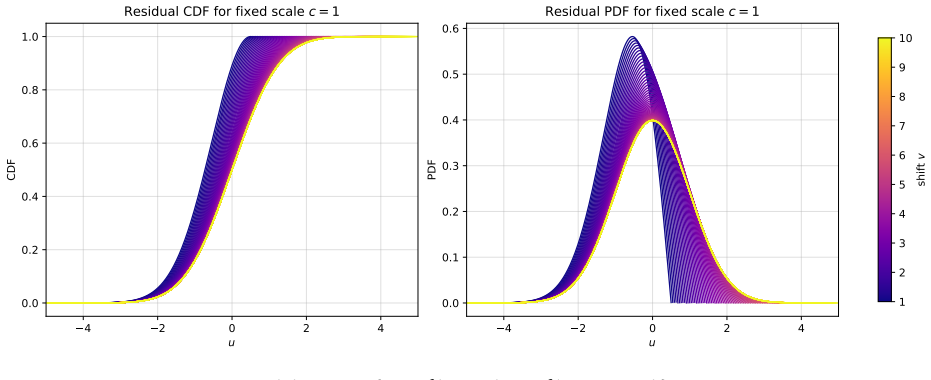
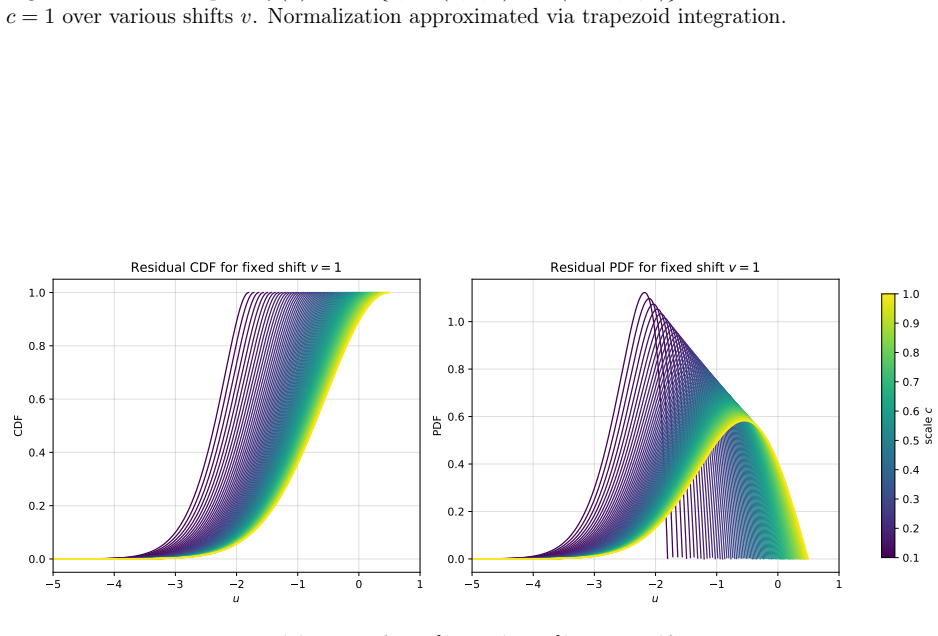
read the original abstract
Speculative decoding speeds up LLM inference by using a draft model to generate tokens, with an acceptance-rejection scheme that ensures that the output matches the target distribution. Adapting this to continuous diffusions is difficult because speculative sampling requires drawing from a residual distribution. While straightforward in discrete spaces, efficiently sampling this residual in continuous space is non-trivial. Consequently, existing diffusion adaptations either use computationally inefficient sampling techniques or rely on an alternative scheme. In this work, we introduce a novel scheme that efficiently implements the original speculative sampling mechanism for diffusion models. Our approach offers a critical advantage over current methods: it enables us to adapt block verification from LLMs to diffusions -- which provably improves the acceptance rate of drafts. Furthermore, we formalize and analyze the Free Drafter, a heuristic self-speculative drafter for diffusions that requires no training. By enabling block verification, our Free Drafter yields up to a 6.3% speedup over existing speculative methods with no additional training and negligible overhead beyond the existing parallel verification pass.
Editorial analysis
A structured set of objections, weighed in public.
Referee Report
Summary. The paper claims to introduce an efficient residual-distribution sampler for speculative sampling in continuous diffusion models, enabling the adaptation of block verification from LLMs. This is asserted to provably improve draft acceptance rates. It also formalizes the Free Drafter, a training-free heuristic self-speculative drafter, and reports that this combination yields up to a 6.3% wall-clock speedup over existing speculative methods with negligible overhead beyond the parallel verification pass.
Significance. If the residual sampler's overhead is indeed negligible and the acceptance-rate improvement translates to measured latency gains, the work would offer a useful extension of speculative decoding to diffusion models without requiring extra training. The explicit formalization of the Free Drafter and the emphasis on block verification as a provable improvement are positive elements that could influence follow-up work on continuous-domain acceleration techniques.
major comments (2)
- [Abstract] Abstract: the central claim that the novel residual-distribution sampler enables block verification while incurring only 'negligible overhead beyond the existing parallel verification pass' is load-bearing for converting the asserted acceptance-rate gain into the reported 6.3% end-to-end speedup, yet no derivation of the sampler, complexity analysis, or ablation isolating its cost versus verification time is supplied.
- [Abstract] Abstract: the statement that block verification 'provably improves the acceptance rate of drafts' is presented without reference to a specific theorem, proof sketch, or equation showing how the residual sampler preserves the exact target distribution while allowing block-level acceptance.
minor comments (1)
- The experimental protocol (number of diffusion steps, draft lengths, hardware, and baseline implementations) is not described even at a high level, making the 6.3% figure difficult to interpret or reproduce.
Simulated Author's Rebuttal
We thank the referee for the detailed feedback on the abstract. We will revise the abstract to include explicit references to the relevant sections and theorems. Point-by-point responses to the major comments are provided below.
read point-by-point responses
-
Referee: [Abstract] Abstract: the central claim that the novel residual-distribution sampler enables block verification while incurring only 'negligible overhead beyond the existing parallel verification pass' is load-bearing for converting the asserted acceptance-rate gain into the reported 6.3% end-to-end speedup, yet no derivation of the sampler, complexity analysis, or ablation isolating its cost versus verification time is supplied.
Authors: We agree the abstract would be strengthened by direct references. The residual sampler derivation appears in Section 3, with the efficient continuous-space sampling procedure and its equivalence to the target distribution. Section 3.3 contains the complexity analysis establishing that the sampler adds only constant-time overhead per block (leveraging the same parallel forward passes as verification). Appendix B provides the requested ablation isolating sampler cost versus verification time, confirming negligibility. We will update the abstract to cite Section 3 and Appendix B. revision: yes
-
Referee: [Abstract] Abstract: the statement that block verification 'provably improves the acceptance rate of drafts' is presented without reference to a specific theorem, proof sketch, or equation showing how the residual sampler preserves the exact target distribution while allowing block-level acceptance.
Authors: The preservation of the exact target distribution under the residual sampler, together with the proof that block verification strictly raises acceptance probability relative to per-token verification, is stated and proved in Theorem 3.4 (Section 3.4). The proof proceeds by showing that the block-level acceptance condition is a valid rejection sampler for the joint residual and that the marginal over blocks matches the target. We will revise the abstract to reference Theorem 3.4. revision: yes
Circularity Check
No circularity: claims rest on novel implementation and empirical measurement, not reduction to inputs
full rationale
The abstract and provided text introduce a novel residual-distribution sampler for exact speculative sampling in continuous diffusion spaces, then report an empirical 6.3% speedup from enabling block verification with the Free Drafter. No equations, fitted parameters, or self-citations are exhibited that would make the acceptance-rate gain or wall-clock claim equivalent to the inputs by construction. The 'negligible overhead' statement is an implementation claim, not a definitional reduction. The derivation chain therefore remains independent of the patterns that trigger circularity scores above 2.
Axiom & Free-Parameter Ledger
Reference graph
Works this paper leans on
-
[1]
S piffy: Multiplying diffusion LLM acceleration via lossless speculative decoding
Sudhanshu Agrawal, Risheek Garrepalli, Raghavv Goel, Mingu Lee, Christopher Lott, and Fatih Porikli. S piffy: Multiplying diffusion LLM acceleration via lossless speculative decoding. arXiv preprint arXiv:2509.18085, 2025
Pith/arXiv arXiv 2025
-
[2]
Stochastic interpolants: A unifying framework for flows and diffusions
Michael S Albergo, Nicholas M Boffi, and Eric Vanden-Eijnden. Stochastic interpolants: A unifying framework for flows and diffusions. Journal of Machine Learning Research, 26 0 (209): 0 1--80, 2025
2025
-
[3]
Parallel sampling via autospeculation
Nima Anari, Carlo Baronio, CJ Chen, Alireza Haqi, Frederic Koehler, Anqi Li, and Thuy-Duong Vuong. Parallel sampling via autospeculation. In Proceedings of the 58th Annual ACM Symposium on Theory of Computing, STOC '26, page 1168–1179. Association for Computing Machinery, 2026
2026
-
[4]
Judge decoding: Faster speculative sampling requires going beyond model alignment
Gregor Bachmann, Sotiris Anagnostidis, Albert Pumarola, Markos Georgopoulos, Artsiom Sanakoyeu, Yuming Du, Edgar Sch \"o nfeld, Ali Thabet, and Jonas Kohler. Judge decoding: Faster speculative sampling requires going beyond model alignment. In The Thirteenth International Conference on Learning Representations, 2025
2025
-
[5]
TRACT : Denoising diffusion models with transitive closure time-distillation
David Berthelot, Arnaud Autef, Jierui Lin, Dian Ang Yap, Shuangfei Zhai, Siyuan Hu, Daniel Zheng, Walter Talbott, and Eric Gu. TRACT : Denoising diffusion models with transitive closure time-distillation. arXiv preprint arXiv:2303.04248, 2023
arXiv 2023
-
[6]
How to build a consistency model: Learning flow maps via self-distillation
Nicholas M Boffi, Michael S Albergo, and Eric Vanden-Eijnden. How to build a consistency model: Learning flow maps via self-distillation. In Advances in Neural Information Processing Systems, 2025
2025
-
[7]
Coupling and convergence for H amiltonian M onte C arlo
Nawaf Bou-Rabee, Andreas Eberle, and Raphael Zimmer. Coupling and convergence for H amiltonian M onte C arlo. The Annals of Applied Probability, 30 0 (3): 0 1209--1250, 2020
2020
-
[8]
Self-speculative masked diffusions
Andrew Campbell, Valentin De Bortoli, Jiaxin Shi, and Arnaud Doucet. Self-speculative masked diffusions. In International Conference on Learning Representations, 2026
2026
-
[9]
Accelerating large language model decoding with speculative sampling
Charlie Chen, Sebastian Borgeaud, Geoffrey Irving, Jean-Baptiste Lespiau, Laurent Sifre, and John Jumper. Accelerating large language model decoding with speculative sampling. arXiv preprint arXiv:2302.01318, 2023
Pith/arXiv arXiv 2023
-
[10]
Accelerating diffusion models with parallel sampling: Inference at sub-linear time complexity
Haoxuan Chen, Yinuo Ren, Lexing Ying, and Grant M Rotskoff. Accelerating diffusion models with parallel sampling: Inference at sub-linear time complexity. In Advances in Neural Information Processing Systems, 2024
2024
-
[11]
Localization schemes: A framework for proving mixing bounds for markov chains
Yuansi Chen and Ronen Eldan. Localization schemes: A framework for proving mixing bounds for markov chains. In IEEE 63rd Annual Symposium on Foundations of Computer Science (FOCS), pages 110--122, 2022
2022
-
[12]
Speculative diffusion decoding: Accelerating language generation through diffusion
Jacob K Christopher, Brian R Bartoldson, Tal Ben-Nun, Michael Cardei, Bhavya Kailkhura, and Ferdinando Fioretto. Speculative diffusion decoding: Accelerating language generation through diffusion. In Proceedings of the 2025 Conference of the Nations of the Americas Chapter of the Association for Computational Linguistics: Human Language Technologies (Volu...
2025
-
[13]
Accelerated diffusion models via speculative sampling
Valentin De Bortoli , Alexandre Galashov, Arthur Gretton, and Arnaud Doucet. Accelerated diffusion models via speculative sampling. In International Conference on Machine Learning, 2025
2025
-
[14]
The paradox of diffusion distillation, 2024
Sander Dieleman. The paradox of diffusion distillation, 2024. URL https://sander.ai/2024/02/28/paradox.html
2024
-
[15]
Genie: Higher-order denoising diffusion solvers
Tim Dockhorn, Arash Vahdat, and Karsten Kreis. Genie: Higher-order denoising diffusion solvers. In Advances in Neural Information Processing Systems, 2022
2022
-
[16]
An information-theoretic view of stochastic localization
Ahmed El Alaoui and Andrea Montanari. An information-theoretic view of stochastic localization. IEEE Transactions on Information Theory, 68 0 (11): 0 7423--7426, 2022
2022
-
[17]
Thin shell implies spectral gap up to polylog via a stochastic localization scheme
Ronen Eldan. Thin shell implies spectral gap up to polylog via a stochastic localization scheme. Geometric and Functional Analysis, 23 0 (2): 0 532--569, 2013
2013
-
[18]
Self speculative decoding for diffusion large language models
Yifeng Gao, Ziang Ji, Yuxuan Wang, Biqing Qi, Hanlin Xu, and Linfeng Zhang. Self speculative decoding for diffusion large language models. arXiv preprint arXiv:2510.04147, 2025
arXiv 2025
-
[19]
GANs trained by a two time-scale update rule converge to a local N ash equilibrium
Martin Heusel, Hubert Ramsauer, Thomas Unterthiner, Bernhard Nessler, and Sepp Hochreiter. GANs trained by a two time-scale update rule converge to a local N ash equilibrium. In Advances in Neural Information Processing Systems, 2017
2017
-
[20]
Denoising diffusion probabilistic models
Jonathan Ho, Ajay Jain, and Pieter Abbeel. Denoising diffusion probabilistic models. In Advances in Neural Information Processing Systems, 2020
2020
-
[21]
Diffusion models are secretly exchangeable: Parallelizing DDPM s via auto speculation
Hengyuan Hu, Aniket Das, Dorsa Sadigh, and Nima Anari. Diffusion models are secretly exchangeable: Parallelizing DDPM s via auto speculation. In International Conference on Machine Learning, 2025
2025
-
[22]
MoESD : Unveil speculative decoding's potential for accelerating sparse MoE
Zongle Huang, Lei Zhu, Zongyuan Zhan, Ting Hu, Weikai Mao, Xianzhi Yu, Yongpan Liu, and Tianyu Zhang. MoESD : Unveil speculative decoding's potential for accelerating sparse MoE . Advances in Neural Information Processing Systems, 38: 0 125276--125311, 2025
2025
-
[23]
Lectures on C ouplings and M onte C arlo
Pierre Jacob. Lectures on C ouplings and M onte C arlo. https://sites.google.com/site/pierrejacob/cmclectures, 2021
2021
-
[24]
Elucidating the design space of diffusion-based generative models
Tero Karras, Miika Aittala, Timo Aila, and Samuli Laine. Elucidating the design space of diffusion-based generative models. In Advances in Neural Information Processing Systems, 2022
2022
-
[25]
Noise-free score distillation
Oren Katzir, Or Patashnik, Daniel Cohen-Or, and Dani Lischinski. Noise-free score distillation. In International Conference on Learning Representations, 2024
2024
-
[26]
Consistency trajectory models: Learning probability flow ODE trajectory of diffusion
Dongjun Kim, Chieh-Hsin Lai, Wei-Hsiang Liao, Naoki Murata, Yuhta Takida, Toshimitsu Uesaka, Yutong He, Yuki Mitsufuji, and Stefano Ermon. Consistency trajectory models: Learning probability flow ODE trajectory of diffusion. In International Conference on Learning Representations, 2024
2024
-
[27]
Two notes on notation
Donald E Knuth. Two notes on notation. The American Mathematical Monthly, 99 0 (5): 0 403--422, 1992
1992
-
[28]
Speculative sampling for faster molecular dynamics
Arthur Kosmala, Stephan G\" u nnemann, Meng Gao, and Brandon Wood. Speculative sampling for faster molecular dynamics. In International Conference on Machine Learning, 2026
2026
-
[29]
Analyzing Complex Survey Data
Eun Sul Lee and Ronald N Forthofer. Analyzing Complex Survey Data. Sage Publications, 2005
2005
-
[30]
Molecular Dynamics with Deterministic and Stochastic Numerical Methods
Ben Leimkuhler and Charles Matthews. Molecular Dynamics with Deterministic and Stochastic Numerical Methods. Springer, 2016
2016
-
[31]
Fast inference from transformers via speculative decoding
Yaniv Leviathan, Matan Kalman, and Yossi Matias. Fast inference from transformers via speculative decoding. In International Conference on Machine Learning, 2023
2023
-
[32]
DiffuSpec : Unlocking diffusion language models for speculative decoding
Guanghao Li, Zhihui Fu, Min Fang, Qibin Zhao, Ming Tang, Chun Yuan, and Jun Wang. DiffuSpec : Unlocking diffusion language models for speculative decoding. arXiv preprint arXiv:2510.02358, 2025 a
arXiv 2025
-
[33]
DistriFusion : Distributed parallel inference for high-resolution diffusion models
Muyang Li, Tianle Cai, Jiaxin Cao, Qinsheng Zhang, Han Cai, Junjie Bai, Yangqing Jia, Kai Li, and Song Han. DistriFusion : Distributed parallel inference for high-resolution diffusion models. In Proceedings of the IEEE/CVF Conference on Computer Vision and Pattern Recognition, 2024 a
2024
-
[34]
Autoregressive image generation without vector quantization
Tianhong Li, Yonglong Tian, He Li, Mingyang Deng, and Kaiming He. Autoregressive image generation without vector quantization. In Advances in Neural Information Processing Systems, 2024 b
2024
-
[35]
TS-DP : Reinforcement speculative decoding for temporal adaptive diffusion policy acceleration
Ye Li, Jiahe Feng, Yuan Meng, Kangye Ji, Chen Tang, Xinwan Wen, Shutao Xia, Zhi Wang, and Wenwu Zhu. TS-DP : Reinforcement speculative decoding for temporal adaptive diffusion policy acceleration. arXiv preprint arXiv:2512.15773, 2025 b
arXiv 2025
-
[36]
Lectures on the Coupling Method
Torgny Lindvall. Lectures on the Coupling Method. John Wiley & Sons, New York, 1992
1992
-
[37]
Pseudo numerical methods for diffusion models on manifolds
Luping Liu, Yi Ren, Zhijie Lin, and Zhou Zhao. Pseudo numerical methods for diffusion models on manifolds. In International Conference on Learning Representations, 2022 a
2022
-
[38]
Flow straight and fast: Learning to generate and transfer data with rectified flow
Xingchao Liu, Chengyue Gong, and Qiang Liu. Flow straight and fast: Learning to generate and transfer data with rectified flow. In International Conference on Learning Representations, 2022 b
2022
-
[39]
InstaFlow : One step is enough for high-quality diffusion-based text-to-image generation
Xingchao Liu, Xiwen Zhang, Jianzhu Ma, Jian Peng, and Qiang Liu. InstaFlow : One step is enough for high-quality diffusion-based text-to-image generation. In International Conference on Learning Representations, 2023
2023
-
[40]
DPM-Solver : A fast ODE solver for diffusion probabilistic model sampling in around 10 steps
Cheng Lu, Yuhao Zhou, Fan Bao, Jianfei Chen, Chongxuan Li, and Jun Zhu. DPM-Solver : A fast ODE solver for diffusion probabilistic model sampling in around 10 steps. In Advances in Neural Information Processing Systems, 2022
2022
-
[41]
Knowledge distillation in iterative generative models for improved sampling speed
Eric Luhman and Troy Luhman. Knowledge distillation in iterative generative models for improved sampling speed. arXiv preprint arXiv:2101.02388, 2021
Pith/arXiv arXiv 2021
-
[42]
A comprehensive survey on knowledge distillation of diffusion models
Weijian Luo. A comprehensive survey on knowledge distillation of diffusion models. arXiv preprint arXiv:2304.04262, 2023
arXiv 2023
-
[43]
DeepCache : Accelerating diffusion models for free
Xinyin Ma, Gongfan Fang, and Xinchao Wang. DeepCache : Accelerating diffusion models for free. In Proceedings of the IEEE/CVF Conference on Computer Vision and Pattern Recognition, 2024
2024
-
[44]
On distillation of guided diffusion models
Chenlin Meng, Robin Rombach, Ruiqi Gao, Diederik Kingma, Stefano Ermon, Jonathan Ho, and Tim Salimans. On distillation of guided diffusion models. In Proceedings of the IEEE/CVF Conference on Computer Vision and Pattern Recognition, 2023
2023
-
[45]
Iterative Solution of Nonlinear Equations in Several Variables
James M Ortega and Werner C Rheinboldt. Iterative Solution of Nonlinear Equations in Several Variables. SIAM, 2000
2000
-
[46]
Deep equilibrium approaches to diffusion models
Ashwini Pokle, Zhengyang Geng, and J Zico Kolter. Deep equilibrium approaches to diffusion models. In Advances in Neural Information Processing Systems, 2022
2022
-
[47]
High-resolution image synthesis with latent diffusion models
Robin Rombach, Andreas Blattmann, Dominik Lorenz, Patrick Esser, and Bj \"o rn Ommer. High-resolution image synthesis with latent diffusion models. In IEEE/CVF Conference on Computer Vision and Pattern Recognition, 2022
2022
-
[48]
U-Net : Convolutional networks for biomedical image segmentation
Olaf Ronneberger, Philipp Fischer, and Thomas Brox. U-Net : Convolutional networks for biomedical image segmentation. In International Conference on Medical image computing and computer-assisted intervention, pages 234--241. Springer, 2015
2015
-
[49]
Progressive distillation for fast sampling of diffusion models
Tim Salimans and Jonathan Ho. Progressive distillation for fast sampling of diffusion models. In International Conference on Learning Representations, 2022
2022
-
[50]
Adversarial diffusion distillation
Axel Sauer, Dominik Lorenz, Andreas Blattmann, and Robin Rombach. Adversarial diffusion distillation. In European Conference on Computer Vision, pages 87--103. Springer, 2024
2024
-
[51]
Parallel sampling of diffusion models
Andy Shih, Suneel Belkhale, Stefano Ermon, Dorsa Sadigh, and Nima Anari. Parallel sampling of diffusion models. In Advances in Neural Information Processing Systems, 2023
2023
-
[52]
Deep unsupervised learning using nonequilibrium thermodynamics
Jascha Sohl-Dickstein, Eric Weiss, Niru Maheswaranathan, and Surya Ganguli. Deep unsupervised learning using nonequilibrium thermodynamics. In International Conference on Machine Learning, 2015
2015
-
[53]
Accelerating feedforward computation via parallel nonlinear equation solving
Yang Song, Chenlin Meng, Renjie Liao, and Stefano Ermon. Accelerating feedforward computation via parallel nonlinear equation solving. In International Conference on Machine Learning, 2021 a
2021
-
[54]
Score-based generative modeling through stochastic differential equations
Yang Song, Jascha Sohl-Dickstein, Diederik P Kingma, Abhishek Kumar, Stefano Ermon, and Ben Poole. Score-based generative modeling through stochastic differential equations. In International Conference on Learning Representations, 2021 b
2021
-
[55]
Consistency models
Yang Song, Prafulla Dhariwal, Mark Chen, and Ilya Sutskever. Consistency models. In International Conference on Machine Learning, 2023
2023
-
[56]
Accelerating time series foundation models with speculative decoding
Pranav Subbaraman, Fang Sun, Yue Yao, Huacong Tang, Xiao Luo, and Yizhou Sun. Accelerating time series foundation models with speculative decoding. arXiv preprint arXiv:2511.18191, 2025
arXiv 2025
-
[57]
SpecTr : Fast speculative decoding via optimal transport
Ziteng Sun, Ananda Theertha Suresh, Jae Hun Ro, Ahmad Beirami, Himanshu Jain, and Felix Yu. SpecTr : Fast speculative decoding via optimal transport. In Advances in Neural Information Processing Systems, 2023
2023
-
[58]
Block verification accelerates speculative decoding
Ziteng Sun, Uri Mendlovic, Yaniv Leviathan, Asaf Aharoni, Jae Hun Ro, Ahmad Beirami, and Ananda Theertha Suresh. Block verification accelerates speculative decoding. In International Conference on Learning Representations, 2025
2025
-
[59]
Accelerating parallel sampling of diffusion models
Zhiwei Tang, Jiasheng Tang, Hao Luo, Fan Wang, and Tsung-Hui Chang. Accelerating parallel sampling of diffusion models. In International Conference on Machine Learning, 2024
2024
-
[60]
Accelerating auto-regressive text-to-image generation with training-free speculative J acobi decoding
Yao Teng, Han Shi, Xian Liu, Xuefei Ning, Guohao Dai, Yu Wang, Zhenguo Li, and Xihui Liu. Accelerating auto-regressive text-to-image generation with training-free speculative J acobi decoding. In International Conference on Learning Representations, 2025
2025
-
[61]
An optimal lossy variant of speculative decoding, 2023
Vivien Tran-Thien. An optimal lossy variant of speculative decoding, 2023. URL https://vivien000.github.io/blog/journal/a-provably-optimal-lossy-variant-of-speculative-decoding.html
2023
-
[62]
Continuous speculative decoding for autoregressive image generation
Zili Wang, Robert Zhang, Kun Ding, Qi Yang, Fei Li, and Shiming Xiang. Continuous speculative decoding for autoregressive image generation. In Advances in Neural Information Processing Systems, 2024
2024
-
[63]
FREE : Uncertainty-aware autoregression for parallel diffusion transformers
Xinwan Wen, Bowen Li, Jiajun Luo, Ye Li, and Zhi Wang. FREE : Uncertainty-aware autoregression for parallel diffusion transformers. arXiv preprint arXiv:2511.20390, 2025
arXiv 2025
-
[64]
Tackling the generative learning trilemma with denoising diffusion gans
Zhisheng Xiao, Karsten Kreis, and Arash Vahdat. Tackling the generative learning trilemma with denoising diffusion gans. In International Conference on Learning Representations, 2022
2022
-
[65]
UFOgen : You forward once large scale text-to-image generation via diffusion GAN s
Yanwu Xu, Yang Zhao, Zhisheng Xiao, and Tingbo Hou. UFOgen : You forward once large scale text-to-image generation via diffusion GAN s. In Proceedings of the IEEE/CVF Conference on Computer Vision and Pattern Recognition, 2024
2024
-
[66]
One-step diffusion models with f -divergence distribution matching
Yilun Xu, Weili Nie, and Arash Vahdat. One-step diffusion models with f -divergence distribution matching. arXiv preprint arXiv:2502.15681, 2025
arXiv 2025
-
[67]
A theoretical perspective for speculative decoding algorithm
Ming Yin, Minshuo Chen, Kaixuan Huang, and Mengdi Wang. A theoretical perspective for speculative decoding algorithm. In Advances in Neural Information Processing Systems, 2024 a
2024
-
[68]
One-step diffusion with distribution matching distillation
Tianwei Yin, Micha \"e l Gharbi, Richard Zhang, Eli Shechtman, Fredo Durand, William T Freeman, and Taesung Park. One-step diffusion with distribution matching distillation. In Proceedings of the IEEE/CVF Conference on Computer Vision and Pattern Recognition, 2024 b
2024
-
[69]
Fast sampling of diffusion models with exponential integrator
Qinsheng Zhang and Yongxin Chen. Fast sampling of diffusion models with exponential integrator. In International Conference on Learning Representations, 2023
2023
-
[70]
Speeding up speculative decoding via sequential approximate verification
Meiyu Zhong, Noel Teku, and Ravi Tandon. Speeding up speculative decoding via sequential approximate verification. In ES-FoMo III: 3rd Workshop on Efficient Systems for Foundation Models, 2025
2025
-
[71]
Zhen Zou, Xiaoxiao Ma, Jie Huang, Zichao Yu, and Feng Zhao. Fast-ARDiff : An entropy-informed acceleration framework for continuous space autoregressive generation. arXiv preprint arXiv:2512.08537, 2025
arXiv 2025
discussion (0)
Sign in with ORCID, Apple, or X to comment. Anyone can read and Pith papers without signing in.