REVIEW 5 minor 19 references
Learning Probabilistic Prompt for Continual Learning
T0 review · 0 major / 5 minor · reviewed 2026-07-11 · grok-4.5
Pith's one-line read Prompt-based continual learning collapses when prompts become nearly identical; modeling them as Gaussians and sampling from a query-conditioned mixture restores diversity and lifts accuracy.
desk verdict Clean empirical fix for a real, previously unreported failure mode (prompt collapse) in rehearsal-free prompt-based CIL; solid multi-seed gains, no load-bearing holes. read the letter →
The pith
A machine-rendered reading of the paper's core claim, the machinery that carries it, and where it could break.
The reading
What carries the argument
Query-conditioned Gaussian mixture of prompt distributions (Eqs. 1–10): each of M×N prompts is a diagonal Gaussian; relevance scores form a mixture by moment matching; Ns samples are drawn by the reparameterization trick and re-weighted by cosine similarity to the query before prefix-tuning.
What would settle it
Train the same architecture on ImageNet-R 10-task but replace the learned Gaussians with deterministic vectors that are forced to the same pairwise cosine similarities as the probabilistic model; if final average accuracy remains unchanged, the collapse diagnosis is false.
Extended reading notes
Core claim
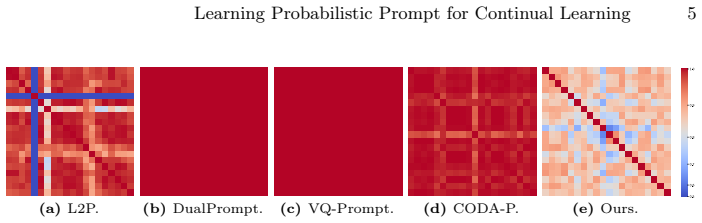
Existing prompt-based continual learners suffer from prompt collapse: pairwise cosine similarities among learned prompts approach 1.0, so the prompts cannot capture the diverse query-feature distributions that arise across tasks. Parameterizing each prompt as a diagonal Gaussian, building a soft mixture via Mahalanobis relevance scores, sampling multiple prompts and aggregating them by query similarity, together with a KL distribution-regularization loss, eliminates the collapse and yields higher final and cumulative average accuracy.
Load-bearing premise
That the high pairwise similarity among deterministic prompts is the main reason accuracy stalls, and that replacing those vectors by diagonal Gaussians whose mixture is formed by Mahalanobis scores is enough to restore useful diversity.
Signed reviews
Editorial analysis
A structured set of objections, weighed in public.
Referee Report
Summary. The paper identifies a 'prompt collapse' problem in existing prompt-based class-incremental learning methods (L2P, DualPrompt, CODA-P, VQ-Prompt), where learned prompt tokens become highly correlated (pairwise cosine similarities near 1.0) and fail to capture diverse query-feature distributions across tasks. To address this, the authors model each prompt component as a diagonal Gaussian, form a query-conditioned mixture via Mahalanobis relevance scores and moment matching (Eqs. 2–7), sample Ns prompts via the reparameterization trick, aggregate them by cosine similarity to the query (Eqs. 9–10), and add a KL distribution-regularization loss (Eqs. 13–14) that penalizes abrupt changes between successive training steps. The resulting framework is evaluated on ImageNet-R (5/10/20-task), CIFAR-100 and CUB-200 under frozen ViT-B/16 backbones, reporting consistent gains in final average accuracy (FAA) and cumulative average accuracy (CAA) over strong prompt-based baselines, with supporting ablations, per-task forgetting curves, and hyper-parameter studies.
Significance. If the empirical claims hold, the work supplies a clean, practically usable diagnosis and remedy for a previously under-appreciated failure mode of prompt pools in continual learning. The multi-seed tables, component-wise ablations (Table 4), comparisons under three pre-training regimes (Table 3), and supplementary checks against output-level probabilistic modeling, isotropic perturbation and explicit diversity losses constitute a solid evidence chain. The method adds only negligible memory and compute (Table 7) while remaining rehearsal-free and backbone-frozen, making it immediately relevant to the growing literature on efficient continual adaptation of large vision transformers. The distribution-regularization term is a simple, well-motivated online regularizer that further reduces forgetting without restricting plasticity.
minor comments (5)
- Several places in the provided manuscript text exhibit missing spaces (e.g., 'Continuallearningaimsto', 'promptcollapseproblem'). These are almost certainly formatting artifacts, but should be cleaned for the camera-ready version.
- Figure 1(a) caption and the corresponding t-SNE plots in the supplement would benefit from a brief note on how the query features were extracted (frozen ViT-B/16, which layer) so that the diversity claim can be reproduced exactly.
- In Sec. 3.3 the notation for the mixture covariance (Eqs. 6–7) is correct under the diagonal assumption, yet a one-sentence reminder that the between-component term is the law of total variance would help readers less familiar with moment matching.
- Table 5 (effect of top-K) is useful; adding the corresponding CAA numbers would make the soft-mixture versus hard-selection comparison fully consistent with the rest of the paper.
- The hyper-parameter table in the supplement lists Ns=30 and λ=1e-6 for all datasets; a short remark that these values were selected on a held-out split of ImageNet-R (and then frozen) would strengthen the claim of robustness.
Circularity Check
No significant circularity; purely empirical method with independent ablations and held-out metrics.
full rationale
The paper's central chain is observational and constructive rather than definitional: Sec. 3.1 and Fig. 2 document high pairwise cosine similarities among deterministic prompts of prior methods (L2P, DualPrompt, VQ-Prompt, CODA-P); the authors then introduce diagonal-Gaussian prompt distributions (Eq. 1), form a query-conditioned mixture by moment matching (Eqs. 4–7), sample via reparameterization (Eq. 8), re-weight by cosine similarity to the query (Eqs. 9–10), and add a KL term to a cached previous-step distribution (Eqs. 13–14). None of these steps defines a quantity in terms of the quantity later claimed as a result. Ablations (Table 4) isolate the contribution of each component; comparisons to output-level probabilistic modeling, isotropic perturbation, and an explicit diversity loss (Supp. Tables G/H) show that those alternatives leave both similarity and FAA essentially unchanged. All accuracy numbers (FAA/CAA) are measured on held-out test splits of standard benchmarks. There are no fitted parameters re-labeled as predictions, no uniqueness theorems imported from the authors' prior work, and no self-citation that is load-bearing for the derivation. The method is therefore self-contained against external benchmarks.
Assumptions & free parameters
free parameters (3)
- Ns (number of samples per mixture) =
30
- λ (weight of distribution-regularization loss) =
1e-6
- M (number of prompt tokens) and N (distributions per pool) =
M=8, N=10
assumptions (3)
- domain assumption A frozen ImageNet-pretrained ViT-B/16 already extracts features sufficiently rich for class-incremental learning when only prompts and a linear head are trained.
- ad hoc to paper Diagonal covariance matrices are expressive enough to model prompt uncertainty.
- standard math Moment matching of a Gaussian mixture yields a single Gaussian that preserves the diversity needed for sampling.
invented entities (2)
-
Query-conditioned mixture of prompt Gaussians
-
Distribution-regularization loss LDR (KL between successive prompt Gaussians)
Cite this review
Pith. "Pith review of Learning Probabilistic Prompt for Continual Learning." pith.science (2026). https://pith.science/paper/3KTL2A6Y
@misc{pith2026260704711,
  author       = {Pith},
  title        = {Pith review of: Learning Probabilistic Prompt for Continual Learning},
  year         = {2026},
  howpublished = {\url{https://pith.science/paper/3KTL2A6Y}},
  note         = {Machine review of arXiv:2607.04711}
}
read the original abstract
Continual learning aims to progressively learn from a sequence of tasks, each containing a disjoint subset of classes, while preserving previously learned knowledge. Prompt-based continual learning methods propose to learn a small set of parameters, i.e., prompts, by associating them with a query feature of an input image. These methods optimize the prompts, attempting to represent diverse patterns of images. However, we have observed that existing prompt-based methods suffer from a prompt collapse problem, that is, the prompts tend to be highly similar to each other, thereby failing to capture the diverse data distributions in continual learning scenarios. To address this issue, we propose in this paper a novel prompt-based continual learning framework that captures diverse patterns of images across a sequence of tasks. To this end, we model each prompt as a probabilistic distribution and construct a mixture of these distributions, from which we sample diverse prompts. This enables our model to effectively capture highly diverse image distributions in the continual learning process. We also present a distribution regularization loss to prevent abrupt changes in the prompt distributions throughout the training process. We show extensive experimental results for continual learning on standard benchmarks, including ImageNet-R, CIFAR-100, and CUB-200, demonstrating the effectiveness of our framework.
Figures


Figures from the paper (1 more)

Reference graph
Works this paper leans on
-
[1]
In: CVPR (2009) 4, 5
Deng, J., Dong, W., Socher, R., Li, L.J., Li, K., Fei-Fei, L.: Imagenet: A large-scale hierarchical image database. In: CVPR (2009) 4, 5
2009
-
[2]
In: ICLR (2021) 2, 4, 5
Dosovitskiy, A., Beyer, L., Kolesnikov, A., Weissenborn, D., Zhai, X., Unterthiner, T., Dehghani, M., Minderer, M., Heigold, G., Gelly, S., et al.: An image is worth 16x16 words: Transformers for image recognition at scale. In: ICLR (2021) 2, 4, 5
2021
-
[3]
arXiv (2023) 9
Gabbur, P.: Improved ddim sampling with moment matching gaussian mixtures. arXiv (2023) 9
2023
-
[4]
In: ICCV (2021) 2, 3, 4, 5, 6, 7
Hendrycks, D., Basart, S., Mu, N., Kadavath, S., Wang, F., Dorundo, E., Desai, R., Zhu, T., Parajuli, S., Guo, M., et al.: The many faces of robustness: A critical analysis of out-of-distribution generalization. In: ICCV (2021) 2, 3, 4, 5, 6, 7
2021
-
[5]
In: ICML (2015) 9
Hernández-Lobato, J.M., Adams, R.: Probabilistic backpropagation for scalable learning of bayesian neural networks. In: ICML (2015) 9
2015
-
[6]
In: ICLR (2017) 9
Jang, E., Gu, S., Poole, B.: Categorical reparameterization with gumbel-softmax. In: ICLR (2017) 9
2017
-
[7]
In: NeurIPS (2024) 1, 2, 3, 6
Jiao, L., Lai, Q., Li, Y., Xu, Q.: Vector quantization prompting for continual learning. In: NeurIPS (2024) 1, 2, 3, 6
2024
-
[8]
NeurIPS (2015) 10
Kingma, D.P., Salimans, T., Welling, M.: Variational dropout and the local repa- rameterization trick. NeurIPS (2015) 10
2015
Show all 19 references
-
[9]
Technical report (2009) 2
Krizhevsky, A., Hinton, G., et al.: Learning multiple layers of features from tiny images. Technical report (2009) 2
2009
-
[10]
In: CVPR (2023) 7
Kwon, H., Song, T., Jeong, S., Kim, J., Jang, J., Sohn, K.: Probabilistic prompt learning for dense prediction. In: CVPR (2023) 7
2023
-
[11]
In: CVPR (2022) 7
Lu, Y., Liu, J., Zhang, Y., Liu, Y., Tian, X.: Prompt distribution learning. In: CVPR (2022) 7
2022
-
[12]
arXiv (2013) 9
Minka, T.P.: Expectation propagation for approximate bayesian inference. arXiv (2013) 9
2013
-
[13]
In: Signal and Data Processing of Small Targets (1990) 9
Salmond, D.J.: Mixture reduction algorithms for target tracking in clutter. In: Signal and Data Processing of Small Targets (1990) 9
1990
-
[14]
In: CVPR (2023) 3, 6
Smith, J.S., Karlinsky, L., Gutta, V., Cascante-Bonilla, P., Kim, D., Arbelle, A., Panda, R., Feris, R., Kira, Z.: Coda-prompt: Continual decomposed attention-based prompting for rehearsal-free continual learning. In: CVPR (2023) 3, 6
2023
-
[15]
Wah, C., Branson, S., Welinder, P., Perona, P., Belongie, S.: The caltech-ucsd birds-200-2011 dataset (2011) 2
2011
-
[16]
NeurIPS (2023) 1
Wang, L., Xie, J., Zhang, X., Huang, M., Su, H., Zhu, J.: Hierarchical decomposition of prompt-based continual learning: Rethinking obscured sub-optimality. NeurIPS (2023) 1
2023
-
[17]
In: ECCV (2022) 1, 3, 6
Wang, Z., Zhang, Z., Ebrahimi, S., Sun, R., Zhang, H., Lee, C.Y., Ren, X., Su, G., Perot, V., Dy, J., et al.: Dualprompt: Complementary prompting for rehearsal-free continual learning. In: ECCV (2022) 1, 3, 6
2022
-
[18]
In: CVPR (2022) 3, 6
Wang, Z., Zhang, Z., Lee, C.Y., Zhang, H., Sun, R., Ren, X., Su, G., Perot, V., Dy, J., Pfister, T.: Learning to prompt for continual learning. In: CVPR (2022) 3, 6
2022
-
[19]
In: ICCV (2023) 1
Zhang, G., Wang, L., Kang, G., Chen, L., Wei, Y.: Slca: Slow learner with classifier alignment for continual learning on a pre-trained model. In: ICCV (2023) 1
2023
Reviewed July 11, 2026 · model on record in the stance chip above.
Discussion (0). Continue with ORCID to comment.