REVIEW 3 major objections 3 minor 1 cited by
Neural Importance Sampling of Many Lights
T0 review · 3 major / 3 minor · reviewed 2026-08-15 · deepseek-v4-flash
Pith's one-line read A small neural network can learn which lights most affect each shading point, and this learned distribution outperforms standard tree-based samplers in many-light rendering.
desk verdict A genuinely new neural light-sampling method whose empirical claims are weakened by in-sample hyperparameter tuning and an inconsistent ablation table; still worth a serious referee, with revision. read the letter →
The pith
A machine-rendered reading of the paper's core claim, the machinery that carries it, and where it could break.
The reading
What carries the argument
The load-bearing object is the learned cluster PMF $p_\theta(c) = \exp(\log w_c + f_\theta(\mathbf{x}, \omega_o)[c]) / \sum_s \exp(\log w_s + f_\theta(\mathbf{x}, \omega_o)[s])$, a log-domain residual combination of an existing sampler's importance weights $w$ and the network output $f_\theta$. This identity keeps probabilities positive and normalized while letting a randomly initialized network start as the baseline, since $f_\theta \approx 0$ initially. The training signal is the Monte Carlo estimate of the KL gradient, Eq. 11, which weights log-probability gradients by $F(\mathbf{x}, \mathbf{Z}_j, \omega_o) / (p(\mathbf{Z}_j \mid Y_j) p(Y_j \mid C_j) p_\theta(C_j))$; that ratio is what converts path-tracing samples into updates that raise the probability of contributing clusters.
What would settle it
On a two-light scene with known ground truth, compute full-gradient updates that include $L_o$ and compare them with the simplified Eq. 10 updates over many paths; if the parameter trajectories diverge substantially, the omission is not harmless. Alternatively, render a scene where the important light is hidden behind an occluder that local inputs (position, normal, outgoing direction) cannot distinguish, and check whether the learned PMF actually assigns it low probability.
Extended reading notes
Core claim
The central claim is that the light-selection PMF $p(y \mid \mathbf{x}, \omega_o)$ can be estimated by a neural network $p_\theta$ trained online to minimize the KL divergence $D_{\mathrm{KL}}(q, p_\theta)$ against the contribution-proportional target $q(y) = L_y / L_o$. Because the normalization constant $L_o$ is unknown and expensive, the authors drop it from the gradient, relying on Adam's scale-invariance to make the omission harmless. For many lights, the network predicts cluster probabilities $p_\theta(c)$ at a fixed level of a light hierarchy, with within-cluster sampling delegated to existing stochastic traversal, and the final PMF is a log-domain blend of a fixed baseline weight $w$ and the network residual. The authors report that this method attains the lowest FLIP error among ATS, SLCRT, ReSTIR, and VARL across all eight test scenes in both equal-time and equal-sample comparisons.
Load-bearing premise
The method's training signal drops the unknown total reflected radiance $L_o$ from the gradient and assumes Adam makes that omission harmless; if that assumption is wrong, the learned light-selection distribution can drift toward a biased target.
Editorial extensions
If this is right
- Replacing hand-designed cluster importance with a learned, spatially varying PMF removes the need for spatial data structures that track a single distribution per region, because per-shading-point distributions can be queried directly from the network.
- Because the network trains online from the same samples used for rendering, no preprocessing pass is required, and the residual initialization makes the first frames no worse than the baseline sampler.
- The learned distribution can serve as a proposal for resampled importance sampling (RIS/ReSTIR), potentially improving candidate selection in many-light real-time rendering.
- In the paper's equal-sample tests, the method remained best at 128 samples per pixel with only 15% of samples used for training, implying that the overhead of neural training is small relative to the variance reduction it provides.
Reading between the lines
- Editorial inference: because the network outputs a PMF over clusters rather than individual lights, the same architecture should transfer to scenes where lights are added, moved, or removed at runtime, since the hierarchy and baseline weights can be rebuilt while the residual network continues learning online.
- Editorial inference: the gradient derivation suggests a direct testable extension—keep the full normalization $L_o$ in the target using a secondary estimate, and compare FLIP to the simplified version; if the full version improves, the paper's Adam-based omission is a source of bias rather than just a speedup.
- Editorial inference: the method learns selection distributions only, so learning the conditional point-on-light distribution $p(\mathbf{z} \mid y)$ is the natural next lever, since the paper itself notes that variance from larger light sources remains significant.
- Editorial inference: using this learned PMF as the proposal for ReSTIR-style resampling could compound the gains, because better candidates reduce the number of reservoirs needed to reach a given error level.
Signed reviews
Editorial analysis
A structured set of objections, weighed in public.
Referee Report
Summary. The paper proposes an online neural method for many-light importance sampling. A small MLP predicts the discrete probability of choosing each light, or each cluster in a light hierarchy, conditioned on shading point position, normal, and outgoing direction. The network is trained during rendering by minimizing an MC-estimated KL-divergence gradient, with a residual term that adds the baseline cluster distribution from existing tree-based methods. The authors report FLIP comparisons against ATS, SLCRT, ReSTIR, and VARL on eight scenes in equal-time and equal-sample settings, claiming superior performance in all scenes.
Significance. If the empirical claims are reliable, the method would be a practical contribution to many-light rendering: it extends neural path guiding ideas to discrete light selection, avoids per-region spatial data structures, and offers a residual-learning warm start. The gradient derivation (Eqs. 5-11) is standard, and the evaluation covers multiple scenes and four baselines. However, the paper's central claim is currently supported only by single-run, in-sample comparisons, and one ablation table contradicts its own text, so the significance cannot be fully assessed without corrected and statistically grounded evidence.
major comments (3)
- [Sec. 5.2, Table 3 (left)] The left block of Table 3 reports Discrete FLIP values that are lower (better) than Ours in every scene (e.g., Bathroom 0.1090 vs 0.1138; Living Room 0.0689 vs 0.0778), yet the text states that "our method benefits from continuous input in all scenes." This is a direct internal contradiction. If the columns are mislabeled or the comparison was run under mismatched settings, the numbers in Tables 1 and 2 cannot be trusted as-is. The authors must correct this table or its interpretation and revisit all subsequent claims.
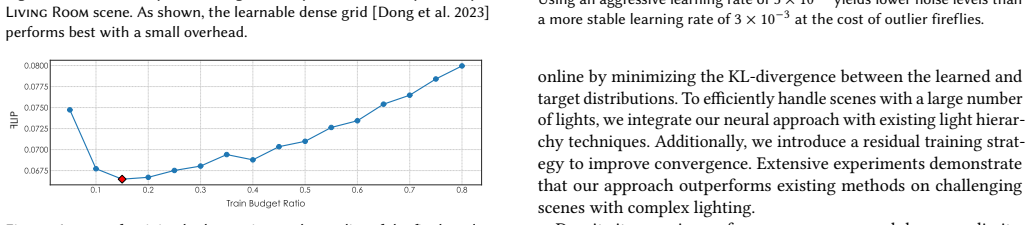
- [Sec. 5.1 and Sec. 5.2 (Figs. 10-11, Table 3)] The central claim of superiority is an empirical comparison, but the reported evaluation uses a single run per method per scene, with no variance estimates, and the method's key hyperparameters—training budget 15%, learning rate 3e-2, cluster level k=6, and the dense grid encoding—are selected on the same eight test scenes using the same FLIP metric. This makes the comparison in-sample rather than predictive. Please provide a held-out validation (additional scenes not used for tuning), multiple seeds with confidence intervals, or a clearly stated protocol that separates tuning from evaluation, and adjust the strength of the claim accordingly.
- [Sec. 3.1, Eqs. (9)-(10)] The derivation minimizes KL(q||p_theta), but the gradient estimator in Eq. (10) omits the normalization term L_o(x,omega_o) from q(y)=L_y/L_o. Strictly, the objective becomes a weighted negative log-likelihood with unnormalized weights L_y, not the KL divergence claimed. The paper justifies the omission by the use of Adam, citing prior path-guiding works, but offers no formal argument or experiment showing that the learned PMF is not biased. Please include an ablation that compares against a normalized target (e.g., using a running estimate of L_o) or otherwise demonstrate that this approximation does not shift the optimum.
minor comments (3)
- [Figs. 6-8, 10-11] The word "FLIP" is misspelled as "LIPF" (and "LiPF" in Fig. 6/7) in the figure text; please correct.
- [Eq. (12)] The denominator's sum has the exponent "f_theta(x,omega_o)[c]" in every term; the index should be [s] to match the summation variable s.
- [Sec. 5.1] The scene enumeration lists seven named scenes before discussing San Miguel; please make explicit that eight scenes are used overall.
Circularity Check
No significant circularity: the method's training objective and empirical comparisons are self-contained and do not reduce to fitted parameters or self-citations.
full rationale
The paper's central derivation is the online KL-divergence training objective for a neural light-selection PMF. The target distribution in Eq. 9, q(y) = L_y / L_o, is defined from the physical light contribution, not from the network's own output. The omission of the normalization term L_o in the gradient estimator (Eq. 10) is explicitly presented as a heuristic justified by Adam's gradient normalization and by citations to external neural path guiding works (Dong et al. 2023; Mueller et al. 2019); this is an approximation with potential bias, but it is not a case where a fitted parameter is later renamed as a prediction. The cluster-level gradient (Eq. 11) follows by substituting p(y|c)p_theta(c) into Eq. 10, which is a straightforward factorization rather than an equivalence to the method's inputs. Residual learning (Eq. 12) combines a fixed baseline hierarchy PMF w with a learned residual, and the baseline is used only as an initialization aid, not as the source of the claimed improvement. The main comparative claims rest on external baselines (ATS, SLCRT, ReSTIR, VARL) measured with FLIP, which are not fitted to the method's parameters. Coauthor citations (Bako et al. 2019; Zhu et al. 2021a) appear only in related work and future work and are not load-bearing for the derivation. Concerns about single-seed comparisons, in-sample hyperparameter selection, and the inconsistency in Table 3 are validity or experimental rigor issues, not circularity: they cannot be exhibited as an equation-level reduction of the claimed result to its inputs. Under the hard rule requiring a quoted reduction, no circular step is found, so the appropriate score is 0.
Assumptions & free parameters
free parameters (6)
- learning rate =
3e-2
- training budget ratio =
15%
- cluster level k =
6
- network hidden layers and width =
3 layers x 64 neurons
- spherical harmonics degree =
4
- one-blob bins =
32
assumptions (5)
- standard math Monte Carlo integration and importance sampling theory provide unbiased estimators and valid PMFs.
- standard math The target distribution q(y) = L_y / L_o is a valid PMF and approximating it reduces variance.
- domain assumption Omitting L_o in the KL gradient is harmless because Adam normalizes by historical gradient magnitude.
- domain assumption The existing light hierarchy methods (ATS, SLC, SLCRT) provide unbiased conditional sampling distributions within clusters.
- domain assumption Light selection distributions are well approximated by a function of position, normal, and outgoing direction.
Cite this review
Pith. "Pith review of Neural Importance Sampling of Many Lights." pith.science (2026). https://pith.science/paper/3KU4GEUR
@misc{pith2026250511729,
  author       = {Pith},
  title        = {Pith review of: Neural Importance Sampling of Many Lights},
  year         = {2026},
  howpublished = {\url{https://pith.science/paper/3KU4GEUR}},
  note         = {Machine review of arXiv:2505.11729}
}
read the original abstract
We propose a neural approach for estimating spatially varying light selection distributions to improve importance sampling in Monte Carlo rendering, particularly for complex scenes with many light sources. Our method uses a neural network to predict the light selection distribution at each shading point based on local information, trained by minimizing the KL-divergence between the learned and target distributions in an online manner. To efficiently manage hundreds or thousands of lights, we integrate our neural approach with light hierarchy techniques, where the network predicts cluster-level distributions and existing methods sample lights within clusters. Additionally, we introduce a residual learning strategy that leverages initial distributions from existing techniques, accelerating convergence during training. Our method achieves superior performance across diverse and challenging scenes.
Figures


Figures from the paper (7 more)


Forward citations
Cited by 1 Pith paper
-
Neural Visibility Cache for Real-Time Light Sampling
A real-time renderer learns a visibility cache with a small neural network and uses it to sample lights, lowering noise versus ReSTIR at comparable cost on tested scenes.
Reference graph
Works this paper leans on
-
[3]
In SIGGRAPH Asia 2024 Conference Papers (SA ’24)
Hierarchical Light Sampling with Accurate Spherical Gaussian Lighting. In SIGGRAPH Asia 2024 Conference Papers (SA ’24) . Associa- tion for Computing Machinery, New York, NY, USA, Article 82, 11 pages. doi:10.1145/3680528.3687647 Petr Vévoda, Ivo Kondapaneni, and Jaroslav Křivánek. 2018. Bayesian online regression for adaptive direct illumination sampling...
arXiv 2013
-
[2019]
The Eurographics Association, 27–32
(Strasbourg, France). The Eurographics Association, 27–32. doi:10. 2312/hpg.20191192 Junqiu Zhu, Yaoyi Bai, Zilin Xu, Steve Bako, Edgar Velázquez-Armendáriz, Lu Wang, Pradeep Sen, Miloš Hašan, and Ling-Qi Yan. 2021a. Neural complex luminaires: representation and rendering. ACM Trans. Graph. 40, 4, Article 57 (July 2021), 12 pages. Shilin Zhu, Zexiang Xu, ...
-
[2020]
Adaptive Incident Radiance Field Sampling and Reconstruction Using Deep Reinforcement Learning. ACM Trans. Graph. 39, 1, Article 6 (jan 2020), 17 pages. Diederik Kingma and Jimmy Ba. 2015. Adam: A method for stochastic optimization. In International Conference on Learning Representations (ICLR) . Arjan J. F. Kok and Frederik W. Jansen. 1994. Source Select...
arXiv 2020
-
[2024]
Online Neural Path Guiding with Normalized Anisotropic Spherical Gaussians. ACM Trans. Graph. 43, 3, Article 26 (April 2024), 18 pages. Yuchi Huo, Rui Wang, Shihao Jin, Xinguo Liu, and Hujun Bao. 2015. A matrix sampling- and-recovery approach for many-lights rendering. ACM Trans. Graph. 34, 6, Article 210 (Nov. 2015), 12 pages. doi:10.1145/2816795.2818120...
arXiv 2024
Reviewed August 15, 2026 · model on record in the stance chip above.
Discussion (0). Continue with ORCID to comment.