REVIEW 2 major objections 3 minor 52 references
Three Generations of Healthcare IT: From the Digital Record to the Computable Care Process
T0 review · 2 major / 3 minor · reviewed 2026-08-14 · deepseek-v4-flash
Pith's one-line read Patient-specific clinical intent can be made computable by recovering intended actions from ordinary clinical communication as structured, executable records.
desk verdict Worth engaging: a clear conceptual framework for computable clinical intent, with a load-bearing gap about what counts as a faithful recovery of intent that a good review can help close. read the letter →
The pith
A machine-rendered reading of the paper's core claim, the machinery that carries it, and where it could break.
The reading
What carries the argument
The central object is the Actionable Clinical Record (ACR), a source-grounded representation of one patient-specific intended clinical action, defined as the tuple above. It carries the argument by giving recovery a precise target: an action is not fully recovered until it can be executed, monitored, and audited, not merely indexed. Supporting machinery includes the five markers that define a computational layer (a new atomic unit, an external driver, an enabling technology, a new class of computation, and a residual limitation), the distinction among prescribed, observed, and intended process, the readiness ladder from mentioned through interpreted and actionable to executable, and an evaluation framework built on executable-correctness measures rather than text overlap. The paper also specifies a hybrid architecture in which learned components extract candidate actions and arguments while deterministic components compute times, due dates, and dependency ordering, with selective prediction routing uncertain cases to clinicians.
What would settle it
Take a set of de-identified outpatient notes with independently labeled intended actions, run the proposed hybrid recovery pipeline, and ask clinicians whether each output ACR is executable and faithful to the original instruction; if a large fraction of actions require correction or the deterministic time reasoning cannot populate temporal constraints, the paper's central claim about recovering executable intent is not supported.
Extended reading notes
Core claim
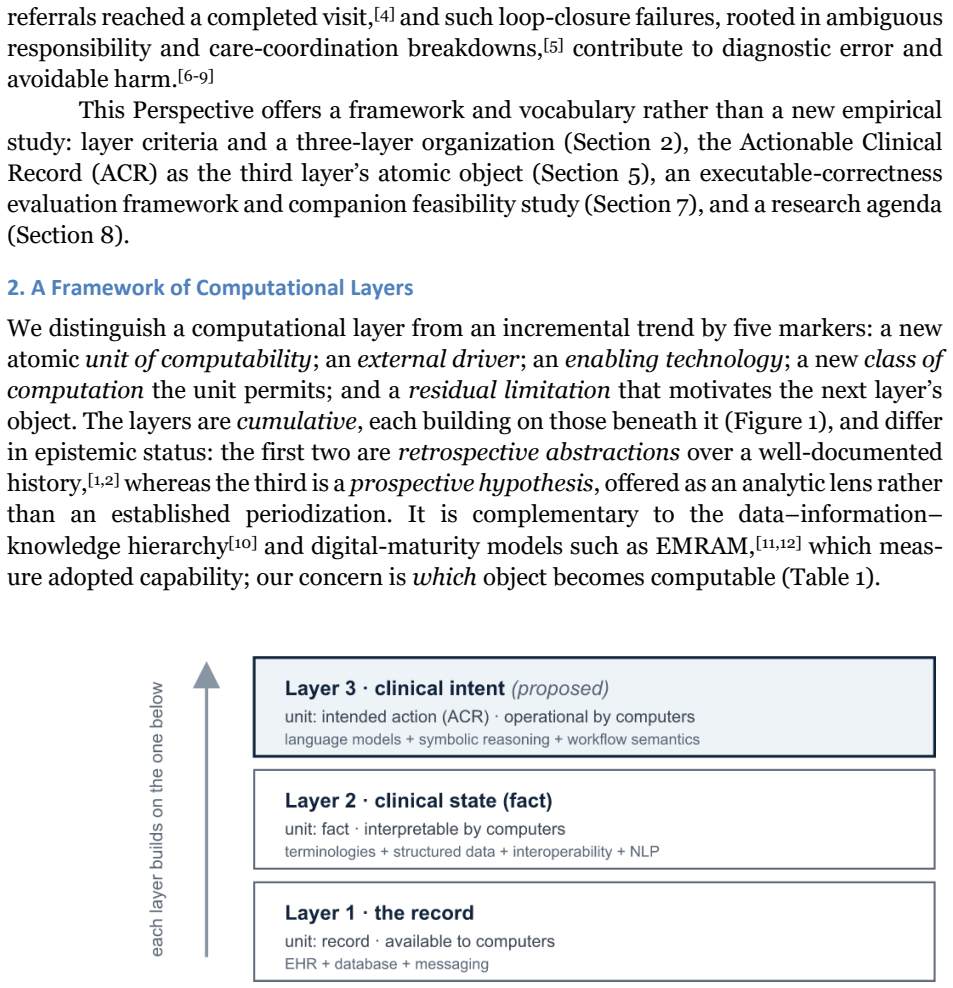
The paper's discovery, stated on its own terms, is that after a first generation made the clinical record computable and a second made the clinical fact computable, a third generation can make patient-specific clinical intent computable by recovering it from communication as a structured, executable representation. The atomic object of that layer is the ACR, a source-grounded tuple $ACR = \langle \text{action}, \text{target}, \text{actor}, \text{temporal constraint}, \text{condition}, \text{dependency}, \text{status}, \text{provenance}, \text{confidence} \rangle$, in which action, status, and provenance are required and the remaining attributes are populated when communicated or explicitly inferred. The paper locates the gap that motivates the layer: existing workflow standards such as FHIR represent intended process once it has been structured, but they do not recover it from natural communication, and it is that recovery and conversion into executable form that the third layer supplies. The paper frames the third layer as a prospective hypothesis and analytic lens rather than an established periodization, and it separates representational readiness (mentioned, interpreted, actionable, executable) from the operational lifecycle captured by the status attribute.
Load-bearing premise
The load-bearing assumption is that the intended actions expressed in clinical communication contain enough explicit or reliably inferable detail about what should happen, when, under what condition, and by whom for a recovered ACR to be executable and to match what the clinician meant.
Editorial extensions
If this is right
- A working third layer would let a follow-up instruction like 'repeat the complete blood count in two weeks' be scheduled automatically, with responsibility assigned and completion tracked, reducing missed-result and referral loop-closure failures.
- ACRs are designed to sit upstream of existing workflow infrastructure: they map onto FHIR resources such as CarePlan, ServiceRequest, and Task, so the proposal does not require replacing current systems.
- Evaluation of intent recovery would shift from text-overlap scores to executable-correctness measures, including action-time linking error, unsupported-action and omitted-action rates, and calibration of confidence.
- The framework predicts that machine-actionable use of workflow resources will grow relative to free-text follow-up, that ambient documentation will extend from notes to tasks and orders, and that reliable systems will expose source-linked, auditable records with selective human review.
- Reliability would depend on a hybrid design: language models propose candidate actions, deterministic reasoning resolves times and dependencies, and the system abstains or alerts a clinician on uncertain cases rather than acting automatically.
Reading between the lines
- The ACR schema is presented for follow-up instructions, but the paper names a broader class of communication-derived process objects; one extension is to develop the same tuple for conditional escalations, medication transitions, handoffs, and pending-result responsibility, where the dependency and condition attributes would do most of the work.
- If ACR recovery matures, a natural testable extension is a randomized comparison of ACR-driven closed-loop task management against usual care on referral completion and test-result follow-up; the paper itself stops at executable-correctness evaluation, so this outcome study is an inference, not a claim.
- The readiness ladder implies a staged adoption path: start with human confirmation of recovered actions, then automate only low-risk, well-calibrated actions; this could make regulatory approval incremental, though the paper does not say so.
- Because the ACR separates speaker from responsible actor, it could support accountability and audit use; making that work would require solving role ambiguity, which the paper lists as open research rather than a solved problem.
Signed reviews
Editorial analysis
A structured set of objections, weighed in public.
Referee Report
Summary. This Perspective paper proposes an organizing framework for healthcare IT based on the unit of information made computable, distinguishing three layers: clinical record (Layer 1), clinical state (Layer 2), and clinical intent (Layer 3, proposed). It introduces the Actionable Clinical Record (ACR) as the atomic object of Layer 3, defined as a nine-attribute tuple (action, target, actor, temporal constraint, condition, dependency, status, provenance, confidence), and describes a readiness ladder from mentioned to executable, a hybrid architecture of learned extraction with deterministic reasoning, and an evaluation framework centered on executable correctness rather than text overlap. The paper is explicitly a conceptual contribution, not an empirical study; the companion feasibility study [51] addresses one narrow subproblem. The authors position the proposal as a research program with falsifiable predictions, including tests of whether the ACR representation is redundant if direct FHIR mapping suffices.
Significance. The paper's main contribution is conceptual: it offers a crisp vocabulary for the problem of computable clinical intent and introduces constructs—the ACR and the executable-correctness evaluation framework—that could be reused and extended by the community. The explicit falsifiability conditions in Section 8 are a notable strength, distinguishing this proposal from unfalsifiable visions. The readiness ladder (mentioned → interpreted → actionable → executable) usefully separates representational status from operational lifecycle. The companion feasibility study, although narrow, provides an existence proof for one subproblem. If the framework gains traction, it could help align clinical NLP research with downstream workflow execution, potentially reducing loop-closure failures that the paper documents. These strengths are real, and the stated scope is appropriately careful.
major comments (2)
- [Section 5.1 and Section 7] The central claim that Layer 3 makes patient-specific clinical intent computable requires a precise criterion for when a recovered ACR faithfully represents the clinician's intended action. Definition 1 specifies the tuple's attributes but does not define what constitutes faithful recovery; the evaluation framework in Section 7 measures action detection, argument extraction, time normalization, and provenance, but none of these measures establishes that executing the recovered ACR would satisfy the original intent. Please add an explicit equivalence criterion—for example, an ACR is correct for a source communication if executing it under the relevant workflow semantics produces the effect the communicator intended—and specify how the proposed evaluation benchmarks are annotated to reflect that criterion (e.g., gold-standard ACRs built by clinicians with adjudication). Without such a criterion, the term 'executable correctness' remains ambiguous and the framework cannot be used to falsify the core claim.
- [Section 5.1, Definition 1] The phrase 'populated when communicated or explicitly inferred' is underspecified. It does not state what kinds of inference are permissible or what evidence is required for an attribute to be 'explicitly inferred' rather than guessed. For example, for the actor attribute, can the responsible performer be inferred from the speaker role, from institutional conventions, or only when explicitly mentioned? This boundary directly affects the design of the recovery pipeline and the meaning of the confidence map, which is described only as 'calibrated recovery-system uncertainty.' Please provide an explicit taxonomy of inference types (e.g., from co-reference, from semantic role, from institutional knowledge) and state how calibration is achieved or tested. Without this, the operational semantics of the ACR--and the reader's ability to assess the feasibility evidence--are incomplete.
minor comments (3)
- [Section 5.1 vs. Table 1] The 'Class of computation' for Layer 3 in Table 1 is 'Schedule, coordinate, monitor, close,' while Definition 1 in Section 5.1 states that the ACR's attributes are 'required to interpret, execute, monitor, or audit' the action. Please align the wording across these two places so the markers are consistent.
- [Reference 49] Reference [49] lists the venue as 'Pac Symp Biocomput 2026;31:144–157' but the DOI (10.1101/2025.08.14.25332837) points to a 2025 preprint server. Please provide the correct publication DOI or update the reference to note the preprint.
- [Sections 7–8] Section 8 states that 'moving from synthetic corpora to de-identified real-world notes is the central empirical risk,' but Section 7 describes the companion study [51] only as a 'controlled benchmark.' It is unclear whether that benchmark uses synthetic corpora or real-world notes; please clarify, as this affects the interpretation of the risk statement.
Circularity Check
No circularity found: the third-layer framework is a self-described prospective hypothesis with no fitted inputs, and its only overlapping-author citation is explicitly disclaimed as non-evidence.
full rationale
The paper is a conceptual Perspective, not an empirical derivation. Section 2 defines five markers for a 'computational layer' and applies them retrospectively to layers 1 and 2 and prospectively to layer 3, with the caveat that the third is 'a prospective hypothesis, offered as an analytic lens rather than an established periodization.' Section 5.1 defines the Actionable Clinical Record as a tuple of semantic attributes; this is a representational specification, not a quantity fitted to any subset of data. The claimed capability 'recover it from natural communication' is localized as a gap in Section 4 based on external literature, and Section 8 makes the framework explicitly falsifiable: 'The ACR representation is redundant if direct mapping into existing workflow standards, with generic recovery metadata, captures the required action, actor, temporal, conditional, dependency, provenance, and uncertainty semantics without ACR-specific distinctions.' The only overlapping-author citation is the companion feasibility study [51]; Section 7 explicitly calls it 'a controlled feasibility demonstration for one narrow subproblem, not evidence for the framework, whose value rests on its constructs,' so the self-citation is not load-bearing. The skeptic's concern that equivalence between a recovered ACR and clinician intent is unspecified is a correctness or completeness risk, not circularity: no part of the paper defines the ACR or the framework in terms of that equivalence, and no equation reduces to another. No fitted parameter is renamed as a prediction, no uniqueness theorem is imported from prior author work, and no known result is renamed as a new one. The paper is self-contained as an analytic proposal, so the circularity score is 0.
Assumptions & free parameters
assumptions (3)
- domain assumption Patient-specific clinical intent is expressed in natural clinical communication and is recoverable into structured, executable form.
- ad hoc to paper The nine-attribute ACR tuple is sufficient to interpret, execute, monitor, or audit an intended clinical action.
- domain assumption Existing standards such as FHIR, computer-interpretable guidelines, and process mining can represent intended process only after it has been structured, but do not recover it from unstructured communication.
invented entities (2)
-
Actionable Clinical Record (ACR)
-
Third computational layer of clinical intent
Cite this review
Pith. "Pith review of Three Generations of Healthcare IT: From the Digital Record to the Computable Care Process." pith.science (2026). https://pith.science/paper/3KY5YT2S
@misc{pith2026260808806,
  author       = {Pith},
  title        = {Pith review of: Three Generations of Healthcare IT: From the Digital Record to the Computable Care Process},
  year         = {2026},
  howpublished = {\url{https://pith.science/paper/3KY5YT2S}},
  note         = {Machine review of arXiv:2608.08806}
}
read the original abstract
Objective. Healthcare IT is usually organized by the technologies it adopts. We instead organize it by the unit of information a system makes computable, and describe a computational layer whose object is patient-specific clinical intent. Approach. We give criteria for a computational layer, derive three (record, clinical state, and a proposed layer of intent), and formalize the Actionable Clinical Record (ACR) as the atomic object of the third layer. Discussion. The framework distinguishes prescribed, observed, and intended process; existing standards represent intent once it is structured but do not recover it from natural communication, the capability we localize. The ACR is complementary to FHIR workflow resources, guidelines, and process mining; a companion feasibility study illustrates tractability for one narrow subproblem. Conclusion. Computable clinical intent is a coherent research direction; the ACR, its readiness ladder, and an executable-correctness evaluation framework are reusable constructs for subsequent work to extend, evaluate, or falsify.
Figures


Reference graph
Works this paper leans on
-
[51]
Reliable Extraction of Clinical Follow -Up Instructions: A Hybrid Neural-Symbolic Pipeline
Laufer M, Aperstein Y, Apartsin A. Reliable Extraction of Clinical Follow -Up Instructions: A Hybrid Neural-Symbolic Pipeline. arXiv; 2026. arXiv:2605.26560
arXiv 2026
-
[1]
Shen Y, Yu J, Zhou J, et al. Twenty-Five Years of Evolution and Hurdles in Electronic Health Records and Interoperability in Medical Research: Comprehensive Review. J Med Internet Res 2025;27:e59024. doi:10.2196/59024
-
[2]
Electronic Health Records: Then, Now, and in the Future
Evans RS. Electronic Health Records: Then, Now, and in the Future. Yearb Med Inform 2016;25(Suppl 1):S48–S61. doi:10.15265/IYS-2016-s006
-
[3]
Failure to follow -up test results for ambulatory patients: a systematic review
Callen JL, Westbrook JI, Georgiou A, et al. Failure to follow -up test results for ambulatory patients: a systematic review. J Gen Intern Med 2012;27(10):1334–1348. doi:10.1007/s11606-011-1949-5. 9
-
[4]
Patel MP, Schettini P, O'Leary CP, et al. Closing the Referral Loop: an Analysis of Primary Care Referrals to Specialists in a Large Health System. J Gen Intern Med 2018;33(5):715–721. doi:10.1007/s11606- 018-4392-z
doi:10.1007/s11606- 2018
-
[5]
Assigning responsibility to close the loop on radiology test results
Kwan JL, Singh H. Assigning responsibility to close the loop on radiology test results. Diagnosis (Berl) 2017;4(3):173–177. doi:10.1515/dx-2017-0019
-
[6]
The frequency of diagnostic errors in outpatient care
Singh H, Meyer AND, Thomas EJ. The frequency of diagnostic errors in outpatient care. BMJ Qual Saf 2014;23(9):727–731. doi:10.1136/bmjqs-2013-002627
-
[7]
The economics of diagnostic safety
Slawomirski L, Kelly D, de Bienassis K, et al. The economics of diagnostic safety. OECD Health Working Papers 2025. doi:10.1787/fc61057a-en
Show all 52 references
-
[8]
Closing the loop on test results to reduce communication failures: a rapid review of evidence, practice and patient perspectives
Wright B, Lennox A, Graber ML, et al. Closing the loop on test results to reduce communication failures: a rapid review of evidence, practice and patient perspectives. BMC Health Serv Res 2020;20:897. doi:10.1186/s12913-020-05737-x
2020 doi
-
[9]
Care Coordination Models and Tools: Systematic Review and Key Informant Interviews
Duan-Porter W, Ullman K, Majeski B, et al. Care Coordination Models and Tools: Systematic Review and Key Informant Interviews. J Gen Intern Med 2022;37(6):1367–1379. doi:10.1007/s11606-021-07158- w
2022 doi
-
[10]
The wisdom hierarchy: representations of the DIKW hierarchy
Rowley J. The wisdom hierarchy: representations of the DIKW hierarchy. J Inf Sci 2007;33(2):163–180. doi:10.1177/0165551506070706
2007 doi
-
[11]
Using Electronic Medical Record Data for Research in a HIMSS Analytics EMRAM Stage 7 Hospital in Beijing: Cross -sectional Study
Li R, Niu Y, Scott SR, et al. Using Electronic Medical Record Data for Research in a HIMSS Analytics EMRAM Stage 7 Hospital in Beijing: Cross -sectional Study. JMIR Med Inform 2021;9(8):e24405. doi:10.2196/24405
2021 doi
-
[12]
Synthesizing Dimensions of Digital Maturity in Hospitals: Systematic Review
Duncan R, Eden R, Woods L, et al. Synthesizing Dimensions of Digital Maturity in Hospitals: Systematic Review. J Med Internet Res 2022;24(3):e32994. doi:10.2196/32994
2022 doi
-
[13]
Meaningful Use
Blumenthal D, Tavenner M. The “Meaningful Use” Regulation for Electronic Health Records. N Engl J Med 2010;363:501–504. doi:10.1056/NEJMp1006114
2010 doi
-
[14]
Electronic Health Record Adoption In US Hospitals: Progress Continues, But Challenges Persist
Adler-Milstein J, DesRoches CM, Kralovec P, et al. Electronic Health Record Adoption In US Hospitals: Progress Continues, But Challenges Persist. Health Aff 2015;34(12):2174–2180. doi:10.1377/hlthaff.2015.0992
2015
-
[15]
Medical Records That Guide and Teach
Weed LL. Medical Records That Guide and Teach. N Engl J Med 1968;278:593–600. doi:10.1056/NEJM196803212781204
1968 doi
-
[16]
Recent Developments in Clinical Terminologies: SNOMED CT, LOINC, and RxNorm
Bodenreider O, Cornet R, Vreeman DJ. Recent Developments in Clinical Terminologies: SNOMED CT, LOINC, and RxNorm. Yearb Med Inform 2018;27(1):129–139. doi:10.1055/s-0038-1667077
2018 doi
-
[17]
HL7 FHIR: An Agile and RESTful Approach to Healthcare Information Exchange
Bender D, Sartipi K. HL7 FHIR: An Agile and RESTful Approach to Healthcare Information Exchange. IEEE CBMS 2013:326–331. doi:10.1109/CBMS.2013.6627810
2013
-
[19]
A general natural -language text processor for clinical ra- diology (MedLEE)
Friedman C, Alderson PO, Austin JHM, et al. A general natural -language text processor for clinical ra- diology (MedLEE). J Am Med Inform Assoc 1994;1(2):161–174. doi:10.1136/jamia.1994.95236146
1994
-
[20]
Mayo clinical Text Analysis and Knowledge Extraction System (cTAKES)
Savova GK, Masanz JJ, Ogren PV, et al. Mayo clinical Text Analysis and Knowledge Extraction System (cTAKES). J Am Med Inform Assoc 2010;17(5):507–513. doi:10.1136/jamia.2009.001560
2010 arXiv
-
[21]
Toward a National Framework for the Secondary Use of Health Data: An AMIA White Paper
Safran C, Bloomrosen M, Hammond WE, et al. Toward a National Framework for the Secondary Use of Health Data: An AMIA White Paper. J Am Med Inform Assoc 2007;14(1):1–9. doi:10.1197/ja- mia.M2273. 10
2007 doi
-
[22]
Data from clinical notes: a perspective on the tension between structure and flexible documentation
Rosenbloom ST, Denny JC, Xu H, et al. Data from clinical notes: a perspective on the tension between structure and flexible documentation. J Am Med Inform Assoc 2011;18(2):181–186. doi:10.1136/ja- mia.2010.007237
2011 arXiv
-
[23]
Health Level Seven International; 2023
HL7 FHIR Release 5: Workflow. Health Level Seven International; 2023. https://hl7.org/fhir/R5/workflow.html (accessed 9 Aug 2026)
2023
-
[24]
Computer -interpretable clinical guidelines: a methodological review
Peleg M. Computer -interpretable clinical guidelines: a methodological review. J Biomed Inform 2013;46(4):744–763. doi:10.1016/j.jbi.2013.06.009
2013 doi
-
[25]
IT support for healthcare processes – premises, challenges, perspectives
Lenz R, Reichert M. IT support for healthcare processes – premises, challenges, perspectives. Data Knowl Eng 2007;61(1):39–58. doi:10.1016/j.datak.2006.04.007
2007 doi
-
[26]
Clinical pathway modelling: a literature review
Aspland E, Gartner D, Harper P. Clinical pathway modelling: a literature review. Health Syst 2021;10(1):1–23. doi:10.1080/20476965.2019.1652547
2021
-
[27]
Process Mining: Data Science in Action
van der Aalst W. Process Mining: Data Science in Action. 2nd ed. Berlin: Springer; 2016. doi:10.1007/978-3-662-49851-4
2016 doi
-
[28]
Process mining in healthcare: A literature review
Rojas E, Munoz-Gama J, Sepúlveda M, et al. Process mining in healthcare: A literature review. J Biomed Inform 2016;61:224–236. doi:10.1016/j.jbi.2016.04.007
2016 doi
-
[29]
Overview of the MEDIQA-OE 2025 Shared Task on Medical Order Extraction from Doctor-Patient Consultations
Corbeil JP, Ben Abacha A, Tremblay J, et al. Overview of the MEDIQA-OE 2025 Shared Task on Medical Order Extraction from Doctor-Patient Consultations. arXiv; 2025. arXiv:2510.26974
2025
-
[30]
Real-World Evidence Synthesis of Digital Scribes Using Ambient Listening and Generative Artificial Intelligence for Clinician Documentation Workflows: Rapid Re- view
Kanaparthy NS, Bakare T, Diao Z, et al. Real-World Evidence Synthesis of Digital Scribes Using Ambient Listening and Generative Artificial Intelligence for Clinician Documentation Workflows: Rapid Re- view. JMIR AI 2025;4:e76743. doi:10.2196/76743
2025 doi
-
[31]
CLAMP: a toolkit for efficiently building customized clinical NLP pipe- lines
Soysal E, Wang J, Jiang M, et al. CLAMP: a toolkit for efficiently building customized clinical NLP pipe- lines. J Am Med Inform Assoc 2018;25(3):331–336. doi:10.1093/jamia/ocx132
2018 doi
-
[32]
A text processing pipeline to extract recommendations from radiology reports
Yetisgen-Yildiz M, Gunn ML, Xia F, et al. A text processing pipeline to extract recommendations from radiology reports. J Biomed Inform 2013;46(2):354–362. doi:10.1016/j.jbi.2012.12.005
2013 doi
-
[33]
A scoping review of large language model based approaches for information extraction from radiology reports
Reichenpfader D, Müller H, Denecke K. A scoping review of large language model based approaches for information extraction from radiology reports. npj Digit Med 2024;7:222. doi:10.1038/s41746-024- 01219-0
2024 doi
-
[34]
2018 n2c2 shared task on adverse drug events and medication extraction in electronic health records
Henry S, Buchan K, Filannino M, et al. 2018 n2c2 shared task on adverse drug events and medication extraction in electronic health records. J Am Med Inform Assoc 2020;27(1):3–12. doi:10.1093/ja- mia/ocz166
2018 doi
-
[35]
Large language models are few -shot clinical information ex- tractors
Agrawal M, Hegselmann S, Lang H, et al. Large language models are few -shot clinical information ex- tractors. Proc. EMNLP 2022:1998–2022. doi:10.18653/v1/2022.emnlp-main.130
2022 doi
-
[36]
SemEval -2017 Task 12: Clinical TempEval
Bethard S, Savova G, Palmer M, et al. SemEval -2017 Task 12: Clinical TempEval. Proc. 11th Int Work- shop Semantic Eval (SemEval-2017) 2017:565–572. doi:10.18653/v1/S17-2093
2017 doi
-
[37]
CLIP: A Dataset for Extracting Action Items for Physi- cians from Hospital Discharge Notes
Mullenbach J, Pruksachatkun Y, Adler S, et al. CLIP: A Dataset for Extracting Action Items for Physi- cians from Hospital Discharge Notes. Proc. 59th Annu Meet Assoc Comput Linguist (ACL -IJCNLP) 2021:1365–1378. doi:10.18653/v1/2021.acl-long.109
2021 doi
-
[38]
MedDec: A Dataset for Extracting Medical Decisions from Discharge Summaries
Elgaar M, Cheng J, Vakil N, et al. MedDec: A Dataset for Extracting Medical Decisions from Discharge Summaries. Findings Assoc Comput Linguist: ACL 2024 2024:16442–16455. doi:10.18653/v1/2024.findings-acl.975
2024 doi
-
[39]
Capabilities of GPT -4 on Medical Challenge Problems
Nori H, King N, McKinney SM, et al. Capabilities of GPT -4 on Medical Challenge Problems. arXiv 2023:2303.13375. 11
2023 arXiv
-
[40]
Survey of Hallucination in Natural Language Generation
Ji Z, Lee N, Frieske R, et al. Survey of Hallucination in Natural Language Generation. ACM Comput Surv 2023;55(12):248. doi:10.1145/3571730
2023 doi
-
[41]
TimeBench: A Comprehensive Evaluation of Temporal Reasoning Abilities in Large Language Models
Chu Z, Chen J, Chen Q, et al. TimeBench: A Comprehensive Evaluation of Temporal Reasoning Abilities in Large Language Models. Proc. 62nd Annu Meet Assoc Comput Linguist (ACL) 2024:1204–1228. doi:10.18653/v1/2024.acl-long.66
2024 doi
-
[42]
Neurosymbolic AI: the 3rd wave
Garcez A, Lamb LC. Neurosymbolic AI: the 3rd wave. Artif Intell Rev 2023;56:12387–12406. doi:10.1007/s10462-023-10448-w
2023 doi
-
[43]
Neuro-symbolic AI for auditable cognitive information extrac- tion from medical reports
Prenosil GA, Weitzel TK, Bello SC, et al. Neuro-symbolic AI for auditable cognitive information extrac- tion from medical reports. Commun Med 2025;5(1):491. doi:10.1038/s43856-025-01194-x
2025 doi
-
[44]
2010 i2b2/VA challenge on concepts, assertions, and relations in clinical text
Uzuner O, South BR, Shen S, et al. 2010 i2b2/VA challenge on concepts, assertions, and relations in clinical text. J Am Med Inform Assoc 2011;18(5):552–556. doi:10.1136/amiajnl-2011-000203
2010 doi
-
[45]
Evaluating temporal relations in clinical text: 2012 i2b2 Challenge
Sun W, Rumshisky A, Uzuner O. Evaluating temporal relations in clinical text: 2012 i2b2 Challenge. J Am Med Inform Assoc 2013;20(5):806–813. doi:10.1136/amiajnl-2013-001628
2012 doi
-
[46]
Multilingual and cross-domain temporal tagging (HeidelTime)
Strötgen J, Gertz M. Multilingual and cross-domain temporal tagging (HeidelTime). Lang Resour Eval 2013;47(2):269–298. doi:10.1007/s10579-012-9179-y
2013 doi
-
[47]
SUTime: A library for recognizing and normalizing time expressions
Chang AX, Manning CD. SUTime: A library for recognizing and normalizing time expressions. Proc. LREC 2012:3735–3740
2012
-
[48]
Multimodal learning for temporal relation extraction in clinical texts
Knez T, Žitnik S. Multimodal learning for temporal relation extraction in clinical texts. J Am Med In- form Assoc 2024;31(6):1380–1387. doi:10.1093/jamia/ocae059
2024 doi
-
[49]
Speaker Role Identification in Clinical Conversations
Zolensky A, Jang KJ, Sabin J, et al. Speaker Role Identification in Clinical Conversations. Pac Symp Biocomput 2026;31:144–157. doi:10.1101/2025.08.14.25332837
2026 doi
-
[50]
Automation bias: a systematic review of frequency, effect mediators, and mitigators
Goddard K, Roudsari A, Wyatt JC. Automation bias: a systematic review of frequency, effect mediators, and mitigators. J Am Med Inform Assoc 2012;19(1):121–127. doi:10.1136/amiajnl-2011-000089
2012 doi
-
[52]
Listening to the note: clinician perspectives on ambient artificial intelligence scribes in medical documentation
Van Tiem J, Cramer E, Iverson C, et al. Listening to the note: clinician perspectives on ambient artificial intelligence scribes in medical documentation. J Am Med Inform Assoc 2026;33(2):255–262. doi:10.1093/jamia/ocaf214
2026 doi
-
[53]
Large language models in real-world clinical workflows: a system- atic review of applications and implementation
Artsi Y, Sorin V, Glicksberg BS, et al. Large language models in real-world clinical workflows: a system- atic review of applications and implementation. Front Digit Health 2025;7:1659134. doi:10.3389/fdgth.2025.1659134
2025
Reviewed August 14, 2026 · model on record in the stance chip above.
Discussion (0). Continue with ORCID to comment.