REVIEW 104 references
Beauty Hadron Spectrum in a Screened Potential Model
T0 review · reviewed 2026-08-07 · deepseek-v4-flash
Pith's one-line read A six-parameter screened-potential model fitted to eight bottomonium states predicts excited bottomonium, diquark, and triply-bottom-baryon masses, with Upsilon(10753) assigned as a D-wave state.
The pith
A machine-rendered reading of the paper's core claim, the machinery that carries it, and where it could break.
The reading
Six parameters (bottom quark mass, string strength, screening length, two O(1/m) constants, and the width of the spin-spin smearing) are fit to the masses of eight well-measured bottomonium states. The resulting model reproduces those states and gives predictions for higher S, P, and D states. The paper assigns Upsilon(10753) to the 3D1 bottomonium level, and Upsilon(10860) and Upsilon(11020) to the 5S1 and 6S1 levels, though the predicted masses sit 50-70 MeV away from the measured values, which the authors attribute to S-D mixing and coupled-channel effects they do not include.
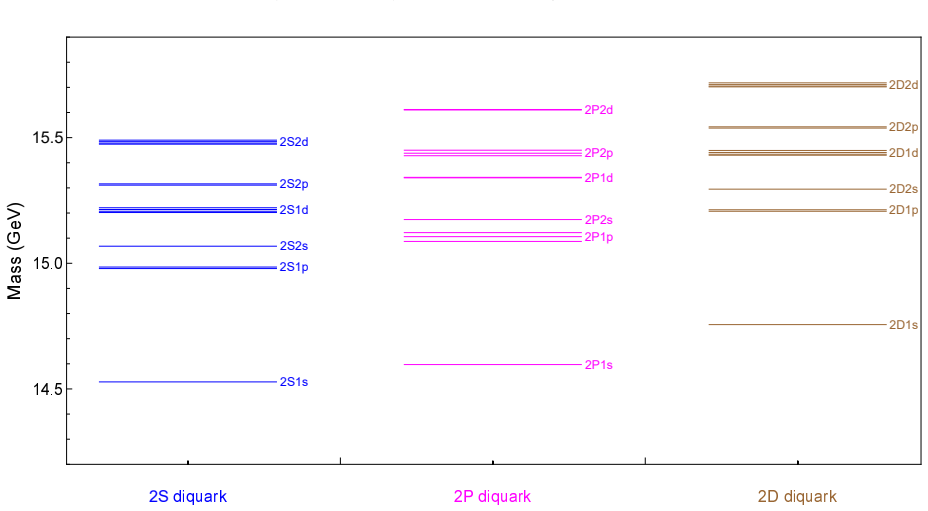
For triply bottom baryons, the paper uses the diquark-quark model: the two bottom quarks form a diquark, treated as a point particle, which then binds to a third bottom quark. It predicts a ground state mass of 14.243 GeV and a ladder of excited states. No such baryon has been observed yet, so these numbers are untested predictions.
Extended reading notes
Core claim
The mass spectrum of beauty hadrons (bb and bbb baryons) and bb-diquarks are computed, and the paper states: 'We interpret Upsilon(10753) as D-wave bottomonium state and Upsilon(10860) and Upsilon(11020) as S-wave bottomonium states.' Additionally, the ground state mass of the triply bottom baryon is given as 14.243 GeV. If the model is correct, these are the masses of the corresponding physical states.
Load-bearing premise
The diquark-quark model treats the bb diquark as a point-like color source whose interaction with the third quark is identical to the quark-antiquark interaction (color factor halved) and uses the same O(1/m) correction terms and the same fitted parameters as bottomonium (Section II.3, Eqs 17-20). The validity of this mapping is load-bearing for every bbb baryon mass, and it is adopted from Refs [70,76] rather than derived.
Editorial analysis
A structured set of objections, weighed in public.
Assumptions & free parameters
free parameters (8)
- mb (bottom quark mass) =
4.680 GeV
- lambda (string strength) =
0.241 GeV^2
- nu (screening parameter) =
0.078 GeV
- C (O(1/m) logarithmic coefficient) =
0.100 GeV
- a (scale in logarithmic correction) =
0.430 GeV
- sigma (spin-spin smearing width) =
3.920 GeV
- Lambda_QCD =
0.130 GeV
- Delta M_exp (constant experimental uncertainty in fit) =
5 MeV
assumptions (7)
- domain assumption The non-relativistic Schrodinger equation (Eq 1) with a reduced-mass two-body Hamiltonian is adequate for bottomonium and bbb systems.
- domain assumption The potential (Eq 9) is the sum of a one-gluon Coulomb term, a screened confinement term, and O(1/m) corrections taken from quenched LQCD/pNRQCD (Refs [28,60]).
- domain assumption Spin-spin interaction is included nonperturbatively as a smeared Gaussian delta, while spin-orbit and tensor are treated as first-order perturbations (Eqs 11-13).
- ad hoc to paper The scalar confinement potential entering the spin-orbit operator is V_S = lambda(1-e^{-nu r})/r (Eq 15), even though the static confinement in Eq 9 and 11 is lambda(1-e^{-nu r})/nu.
- domain assumption For bb diquarks, the full static potential is half the quark-antiquark potential (color factor kappa=-2/3) (Eq 17).
- ad hoc to paper The diquark-quark potential for bbb baryons is the same as the quark-antiquark potential with masses m_d and m_b and the same parameters (Eqs 20-22).
- standard math Pauli principle restricts the bb diquark S-wave state to J_d=1 (since the color antitriplet diquark is antisymmetric).
Cite this review
Pith. "Pith review of Beauty Hadron Spectrum in a Screened Potential Model." pith.science (2026). https://pith.science/paper/3KZNLKSW
@misc{pith2026250513987,
  author       = {Pith},
  title        = {Pith review of: Beauty Hadron Spectrum in a Screened Potential Model},
  year         = {2026},
  howpublished = {\url{https://pith.science/paper/3KZNLKSW}},
  note         = {Machine review of arXiv:2505.13987}
}
abstract
The mass spectrum of beauty hadrons ($b\overline{b}$ and $bbb$ baryons) and $bb$-diquarks are computed in a non-relativistic phenomenological potential model. The potential comprises of a short-range Coulomb potential, a screened confinement potential, and $O(1/m)$ corrections predicted from lattice and pNRQCD studies. Among the spin-dependent interactions, spin-spin interaction is considered non-perturbatively, whereas spin-orbit and tensor interactions are considered perturbatively. The Matrix-Numerov method is used to numerically solve the non-relativistic Schrodinger equation to evaluate the mass spectra. We interpret $\Upsilon(10753)$ as $D$-wave bottomonium state and $\Upsilon(10860)$ and $\Upsilon(11020)$ as $S$-wave bottomonium states. The mass spectrum of $bbb$ baryons are evaluated under the diquark-quark model. The excited masses are computed by considering various radial and orbital excitations of the diquark as well as the diquark-quark system.
Figures


Figures from the paper (3 more)


Reference graph
Works this paper leans on
-
[1]
Brambilla, S
N. Brambilla, S. Eidelman, B. Heltsley, R. Vogt, G. Bodwi n, E. Eichten, A. Frawley, A. Meyer, R. Mitchell, V. Papadim- itriou, et al. , Eur. Phys. J. C 71, 1 (2011)
2011
-
[2]
Mandal, B
R. Mandal, B. Ananthanarayan, and D. Wyler, Eur. Phys. J. Spec. Top. , 1 (2024)
2024
-
[3]
Cabibbo, Phys
N. Cabibbo, Phys. Rev. Lett. 10, 531 (1963)
1963
-
[4]
680 0 . 241 0 . 078 0 . 100 0 . 430 3 . 920 II.1. Bottomonium: The color factor in equation (9) for bottomonium, which is a bound st ate of bottom and anti-bottom quarks will be κ = − 4 3 . Hence, the potential (9) for bottomonium takes the form, V (r) = − 4 3 α s(m2 b ) r + λ(1 −e− νr ) ν + ( 1 mb + 1 mb ) (−9α 2 8r2 +C ln(ar) ) + 32πα s(m2 b ) 9m2 b ( σ...
-
[5]
4: Mass spectra of triply bottom baryons corresponding to d ifferent diquark states with nd = 1
543 12 1S1s 1S2s 1S1d 1S2d 1S1p 1S2p 1P1p 1P2p 1P1s 1P2s 1P1d 1P2d 1D1s 1D2s 1D1d 1D2d 1D1p 1D2p 1S d 1 d 1D d 1 1 1 15.5 M ( G ) FIG. 4: Mass spectra of triply bottom baryons corresponding to d ifferent diquark states with nd = 1. 2S1s 2S2s 2S1d 2S2d 2S1p 2S2p 2P1p 2P2p 2P1s 2P2s 2P1d 2P2d 2D1s 2D2s 2D1d 2D2d 2D1p 2D2p 2S 2 2 15.5 ( ! " # ) FIG. 5: Mass s...
-
[6]
243 14 . 468 14 . 396 14 . 496 14 . 834 14 . 432 5 2 +
-
[7]
915 14 . 895 14 . 894 15 . 293 15 . 101 14 . 981 7 2 +
-
[8]
936 14 . 909 14 . 894 15 . 286 15 . 101 14 . 988 1 2 −
Show all 104 references
-
[9]
390 14 . 698 14 . 688 14 . 944 14 . 975 14 . 773 3 2 −
-
[10]
700 14 . 702 14 . 688 14 . 937 14 . 976 14 . 779 5 2 −
-
[11]
135 15 . 081 15 . 038 14 . 931 other models. For J P = 3 2 − , the lowest state mass obtained from our model is 14 . 700 GeV (1 S1p state) which is close to the mass obtained in Refs [17, 35, 41]. For J P = 5 2 − , the lowest mass obtained from our model is 15 . 135 GeV (1P 1d...
-
[12]
Mizuk, D
R. Mizuk, D. Asner, A. Bondar, T. Pedlar, I. Adachi, H. Ai hara, K. Arinstein, V. Aulchenko, T. Aushev, T. Aziz, et al. , Phys. Rev. Lett 109, 232002 (2012)
2012
-
[13]
Bondar, A
A. Bondar, A. Garmash, R. Mizuk, D. Santel, K. Kinoshita , I. Adachi, H. Aihara, K. Arinstein, D. Asner, T. Aushev, et al. , Phys. Rev. Lett 108, 122001 (2012)
2012
-
[14]
880 14 . 877 14 . 894 15 . 306 15 . 097 14 . 959 3 2 +
-
[15]
State J P Mass State J P Mass State J P Mass State J P Mass 1S1p 1 2 −
718 TABLE IX: Mass Spectra of bbb baryon in GeV (negative parity). State J P Mass State J P Mass State J P Mass State J P Mass 1S1p 1 2 −
-
[16]
Kobayashi and T
M. Kobayashi and T. Maskawa, Prog. Theor. Phys. 49, 652 (1973)
1973
-
[17]
S. Herb, D. Hom, L. Lederman, J. Sens, H. Snyder, J. Yoh, J. Appel, B. Brown, C. Brown, W. Innes, et al. , Phys. Rev. Lett. 39, 252 (1977)
1977
-
[18]
W. R. Innes, J. Appel, B. Brown, C. Brown, K. Ueno, T. Yaman ouchi, S. Herb, D. Hom, L. Lederman, J. Sens, et al. , Phys. Rev. Lett. 39, 1240 (1977)
1977
-
[19]
Skwarnicki, D
T. Skwarnicki, D. Antreasyan, D. Besset, J. Bienlein, E. Bloom, I. Brock, R. Cabenda, A. Cartacci, M. Cavalli-Sforza , R. Clare, et al. , Phys. Rev. Lett 58, 972 (1987)
1987
-
[20]
Bonvicini, D
G. Bonvicini, D. Cinabro, M. Dubrovin, A. Bornheim, E. Li peles, S. Pappas, A. Shapiro, A. Weinstein, R. A. Briere, G. Chen, et al. , Phys. Rev. D 70, 032001 (2004)
2004
-
[21]
Dobbs, Z
S. Dobbs, Z. Metreveli, A. Tomaradze, T. Xiao, and K. K. Se th, Phys. Rev. Lett 109, 082001 (2012)
2012
-
[22]
Dobbs and C
S. Dobbs and C. Collaboration, in AIP Conference Proceedings, Vol. 1257 (American Institute of Physics, 2010) pp. 408– 412
2010
-
[23]
Artuso, C
M. Artuso, C. Boulahouache, S. Blusk, J. Butt, E. Dambas uren, O. Dorjkhaidav, J. Li, N. Menaa, R. Mountain, H. Mu- ramatsu, et al. , Phys. Rev. Lett 94, 032001 (2005)
2005
-
[24]
M. G. Nobary, Phys. Lett. B 559, 239 (2003)
2003
-
[25]
Mizuk, A
R. Mizuk, A. Bondar, I. Adachi, H. Aihara, D. Asner, V. Au lchenko, T. Aushev, R. Ayad, I. Badhrees, S. Bahinipati, et al. , J. High Energy Phys. 2019 (10), 1
2019
-
[26]
Aubert, M
B. Aubert, M. Bona, Y. Karyotakis, J. Lees, V. Poireau, E . Prencipe, X. Prudent, V. Tisserand, J. Garra Tico, E. Graug es, et al. , Phys. Rev. Lett 102, 012001 (2009)
2009
-
[27]
Aubert, R
B. Aubert, R. Barate, D. Boutigny, F. Couderc, J.-M. Gai llard, A. Hicheur, Y. Karyotakis, J. Lees, V. Tisserand, A. Zghiche, et al. , Phys. Rev. D 72, 032005 (2005)
2005
-
[28]
J. Lees, V. Poireau, V. Tisserand, E. Grauges, A. Palano , G. Eigen, B. Stugu, D. N. Brown, L. Kerth, Y. G. Kolomensky, et al. , Phys. Rev. D 90, 112010 (2014). 15
2014
-
[29]
J. Lees, V. Poireau, V. Tisserand, J. Garra Tico, E. Grau ges, M. Martinelli, D. Milanes, A. Palano, M. Pappagallo, G. Eigen, et al. , Phys. Rev. D 84, 011104 (2011)
2011
-
[30]
G. Aad, B. Abbott, J. Abdallah, A. A. Abdelalim, A. Abdes selam, O. Abdinov, B. Abi, M. Abolins, O. Abouzeid, H. Abramowicz, et al. , Phys. Rev. Lett 108, 152001 (2012)
2012
-
[31]
A. M. Sirunyan, A. Tumasyan, W. Adam, F. Ambrogi, E. Asil ar, T. Bergauer, J. Brandstetter, M. Dragicevic, J. Er¨ o, A. Escalante Del Valle, et al. , Phys. Rev. Lett 121, 092002 (2018)
2018
-
[32]
R. Aaij, B. Adeva, M. Adinolfi, A. Affolder, Z. Ajaltouni, S. Akar, J. Albrecht, F. Alessio, M. Alexander, S. Ali, et al. , J. High Energy Phys. 2014 (10), 1
2014
-
[33]
Aaltonen, A
T. Aaltonen, A. Abulencia, J. Adelman, T. Affolder, T. Ak imoto, M. G. Albrow, S. Amerio, D. Amidei, A. Anastassov, K. Anikeev, et al. , Phys. Rev. Lett. 99, 202001 (2007)
2007
-
[34]
Navas, C
S. Navas, C. Amsler, T. Gutsche, C. Hanhart, J. Hern´ and ez-Rey, C. Louren¸ co, A. Masoni, M. Mikhasenko, R. Mitchell , C. Patrignani, et al. , Phys. Rev. D 110, 030001 (2024)
2024
-
[35]
Faustov and V
R. Faustov and V. Galkin, Phys. Rev. D 105, 014013 (2022)
2022
-
[36]
Chen and S.-Z
Y.-Q. Chen and S.-Z. Wu, J. High Energy Phys. 2011 (8), 1
2011
-
[37]
Neubert, Proceedings, Summer School in Particle Phy sics , 244 (2000)
M. Neubert, Proceedings, Summer School in Particle Phy sics , 244 (2000)
2000
-
[38]
collaboration, arXiv preprint arXiv:2211.02491 10 .48550/arXiv.2211.02491 (2022)
A. collaboration, arXiv preprint arXiv:2211.02491 10 .48550/arXiv.2211.02491 (2022)
2022 arXiv
-
[39]
Koma and M
Y. Koma and M. Koma, Few-Body Syst. 54, 1027 (2013)
2013
-
[40]
Brambilla, A
N. Brambilla, A. Pineda, J. Soto, and A. Vairo, Rev. Mod. Phys. 77, 1423 (2005)
2005
-
[41]
Brambilla, M
N. Brambilla, M. A. Escobedo, J. Soto, and A. Vairo, Phys . Rev. D 97, 074009 (2018)
2018
-
[42]
Y. Yan, Y. Wu, and W. Wang, Int. J. Mod. Phys. A 15, 2735 (2000)
2000
-
[43]
Meinel, Phys
S. Meinel, Phys. Rev. D 79, 094501 (2009)
2009
-
[44]
Onogi, Int
T. Onogi, Int. J. Mod. Phys. A 24, 4607 (2009)
2009
-
[45]
Meinel, Phys
S. Meinel, Phys. Rev. D 85, 114510 (2012)
2012
-
[46]
P.-L. Yin, C. Chen, G. Krein, C. D. Roberts, J. Segovia, a nd S.-S. Xu, Phys. Rev. D 100, 034008 (2019)
2019
-
[47]
Ebert, R
D. Ebert, R. Faustov, V. Galkin, and A. Martynenko, Phys . Rev. D 66, 014008 (2002)
2002
-
[48]
Chaturvedi, A
R. Chaturvedi, A. K. Rai, N. R. Soni, and J. N. Pandya, J. P hys. G 47, 115003 (2020)
2020
-
[49]
Bai-Qing and C
L. Bai-Qing and C. Kuang-Ta, Commun. Theor. Phys. 52, 653 (2009)
2009
-
[50]
G. Yang, J. Ping, P. G. Ortega, and J. Segovia, Chin. Phys . C 44, 023102 (2020)
2020
-
[51]
Vijande, A
J. Vijande, A. Valcarce, and H. Garcilazo, Phys. Rev. D 91, 054011 (2015)
2015
-
[52]
Liu, Q.-F
M.-S. Liu, Q.-F. L¨ u, and X.-H. Zhong, Phys. Rev. D 101, 074031 (2020)
2020
-
[53]
Roberts and M
W. Roberts and M. Pervin, Int. J. Mod. Phys. A 23, 2817 (2008)
2008
-
[54]
Zhang and M.-Q
J.-R. Zhang and M.-Q. Huang, Phys. Lett. B 674, 28 (2009)
2009
-
[55]
T. M. Aliev, K. Azizi, and M. Savcı, J. Phys. G 41, 065003 (2014)
2014
-
[56]
Wang, AAPPS Bulletin 31, 5 (2021)
Z.-G. Wang, AAPPS Bulletin 31, 5 (2021)
2021
-
[57]
G. S. Bali, C. Schlichter, and K. Schilling, Phys. Rev. D 51, 5165 (1995)
1995
-
[58]
Z. S. Brown, W. Detmold, S. Meinel, and K. Orginos, Phys. Rev. D 90, 094507 (2014)
2014
-
[59]
Shah and A
Z. Shah and A. K. Rai, Eur. Phys. J. A 53, 1 (2017)
2017
-
[60]
Patel, A
B. Patel, A. Majethiya, and P. Vinodkumar, Pramana 72, 679 (2009)
2009
-
[61]
Klempt and J.-M
E. Klempt and J.-M. Richard, Rev. Mod. Phys. 82, 1095 (2010)
2010
-
[62]
Capstick and W
S. Capstick and W. Roberts, Prog. Part. Nucl. Phys. 45, S241 (2000)
2000
-
[63]
M. Y. Barabanov, M. Bedolla, W. Brooks, G. Cates, C. Chen , Y. Chen, E. Cisbani, M. Ding, G. Eichmann, R. Ent, et al. , Prog. Part. Nucl. Phys. 116, 103835 (2021)
2021
-
[64]
Gell-Mann, Phys
M. Gell-Mann, Phys. Lett 8, 214 (1964)
1964
-
[65]
Anselmino, E
M. Anselmino, E. Predazzi, S. Ekelin, S. Fredriksson, a nd D. Lichtenberg, Rev. Mod. Phys. 65, 1199 (1993)
1993
-
[66]
Mutuk, Eur
H. Mutuk, Eur. Phys. J. Plus 137, 1 (2022)
2022
-
[67]
G. S. Bali, Phys. Rep. 343, 1 (2001)
2001
-
[68]
Mutuk, Can
H. Mutuk, Can. J. Phys. 97, 1342 (2019)
2019
-
[69]
Sreelakshmi and A
M. Sreelakshmi and A. Ranjan, J. Phys. G 50, 073001 (2023)
2023
-
[70]
Ding, K.-T
Y.-B. Ding, K.-T. Chao, and D.-H. Qin, Phys. Rev. D 51, 5064 (1995)
1995
-
[71]
Y. Koma, M. Koma, and H. Wittig, Phys. Rev. Lett 97, 122003 (2006)
2006
-
[72]
Bhaghyesh, Adv
A. Bhaghyesh, Adv. High Energy Phys. 2021, 1 (2021)
2021
-
[73]
S. M. Ikhdair, Eur. Phys. J. A 39, 307 (2009)
2009
-
[74]
Lucha and F
W. Lucha and F. F. Sch¨ oberl, Int. J. Mod. Phys. C 10, 607 (1999)
1999
-
[75]
Pillai, J
M. Pillai, J. Goglio, and T. G. Walker, Am. J. Phys. 80, 1017 (2012)
2012
-
[76]
Brau and C
F. Brau and C. Semay, J. Comput. Phys. 139, 127 (1998)
1998
-
[77]
Vega and J
A. Vega and J. Flores, Pramana 87, 1 (2016)
2016
-
[78]
Esposito and P
G. Esposito and P. Santorelli, Eur. Phys. J. Plus 137, 642 (2022)
2022
-
[79]
Jakhad, J
P. Jakhad, J. Oudichhya, K. Gandhi, and A. K. Rai, Phys. R ev. D 108, 014011 (2023)
2023
-
[80]
Nayana and A
T. Nayana and A. Bhaghyesh, Int. J. Mod. Phys. A 39, 2450101 (2024)
2024
-
[81]
V. R. Debastiani and F. S. Navarra, Chin. Phys. C 43, 013105 (2019)
2019
-
[82]
Barnes, S
T. Barnes, S. Godfrey, and E. Swanson, Phys. Rev. D 72, 054026 (2005)
2005
-
[83]
N. Soni, B. Joshi, R. Shah, H. Chauhan, and J. Pandya, Eur . Phys. J. C 78, 1 (2018)
2018
-
[84]
Wang, Z.-F
J.-Z. Wang, Z.-F. Sun, X. Liu, and T. Matsuki, Eur. Phys. J. C 78, 1 (2018)
2018
-
[85]
Lucha, F
W. Lucha, F. F. Sch¨ oberl, and D. Gromes, Physics report s 200, 127 (1991)
1991
-
[86]
It is found in Ref
above BB threshold, that can be responsible for these observed deviations . It is found in Ref. [83] that the difference in mass between nD state and (n + 1)S state is small and that the mass difference decreases with increase in n. This can be found in Table VI, where we have t...
-
[87]
Griffiths, Introduction to elementary particles (John Wiley & Sons, 2020)
D. Griffiths, Introduction to elementary particles (John Wiley & Sons, 2020). 16
2020
-
[88]
Mutuk, Eur
H. Mutuk, Eur. Phys. J. C 81, 367 (2021)
2021
-
[89]
Eichten and F
E. Eichten and F. Feinberg, Phys. Rev. D 23, 2724 (1981)
1981
-
[90]
Gromes, Z
D. Gromes, Z. Phys. C 26, 401 (1984)
1984
-
[91]
V. Kher, R. Chaturvedi, N. Devlani, and A. Rai, Eur. Phys . J. Plus 137, 357 (2022)
2022
-
[92]
Pandya, M
B. Pandya, M. Shah, and P. Vinodkumar, Eur. Phys. J. C 81, 1 (2021)
2021
-
[93]
Asghar and N
I. Asghar and N. Akbar, Eur. Phys. J. A 60, 58 (2024)
2024
-
[94]
Badalian, B
A. Badalian, B. Bakker, and I. Danilkin, Phys. Rev. D 79, 037505 (2009)
2009
-
[95]
Z. Zhao, K. Xu, A. Limphirat, W. Sreethawong, N. Tagsins it, A. Kaewsnod, X. Liu, K. Khosonthongkee, S. Cheedket, and Y. Yan, Phys. Rev. D 109, 016012 (2024)
2024
-
[96]
C. A. Bokade and B. Azhothkaran, Chin. Phys. C 10.1088/1 674-1137/adc084 (2025)
2025 doi
-
[97]
Y. A. Simonov and A. Veselov, Phys. Rev. D 79, 034024 (2009)
2009
-
[98]
Giannuzzi, Phys
F. Giannuzzi, Phys. Rev. D 79, 094002 (2009)
2009
-
[99]
Eakins and W
B. Eakins and W. Roberts, Int. J. Mod. Phys. A 27, 1250039 (2012)
2012
-
[100]
R. Dhir, C. Kim, and R. Verma, Phys. Rev. D 88, 094002 (2013)
2013
-
[101]
Martynenko, Phys
A. Martynenko, Phys. Lett. B 663, 317 (2008)
2008
-
[102]
S.-X. Qin, C. D. Roberts, and S. M. Schmidt, Few-Body Sys t. 60, 1 (2019)
2019
-
[103]
Oudichhya, K
J. Oudichhya, K. Gandhi, and A. K. Rai, Phys. Rev. D 104, 114027 (2021)
2021
-
[104]
Thakkar, A
K. Thakkar, A. Majethiya, and P. Vinodkumar, Eur. Phys. J. Plus 131, 339 (2016)
2016
Reviewed August 7, 2026 · model on record in the stance chip above.
Discussion (0). Continue with ORCID to comment.