REVIEW 4 major objections 4 minor 24 references
Applying Adversarial Auto-encoder for Estimating Human Walking Gait Abnormality Index
T0 review · 4 major / 4 minor · reviewed 2026-08-14 · deepseek-v4-flash
Pith's one-line read An adversarial auto-encoder trained only on normal walking can score gait abnormality from 3D point clouds, reaching a 4.6% equal error rate in leave-one-out evaluation.
desk verdict A solid, modest gait-index paper whose headline comparison is undermined by test-set-tuned hyperparameters and a missing AE baseline, but it deserves a careful review rather than a desk reject. read the letter →
The pith
A machine-rendered reading of the paper's core claim, the machinery that carries it, and where it could break.
The reading
What carries the argument
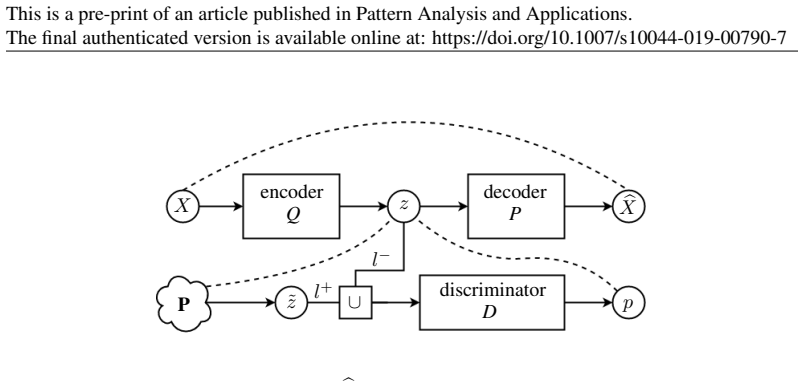
The central object is the cylindrical histogram: each 3D point cloud is wrapped in a cylinder split into 16x16 equal-volume sectors, flattened to a 2D array, scaled to [0,1], and quantized to 256 levels. This fixed-size representation feeds a three-part AAE: an encoder, a decoder, and a discriminator trained with a GAN-style minimax loss. Abnormality is detected as deviation from normal training postures: high reconstruction error, low prior density, or low discriminator output. The final index is a weighted sum of the three normalized measures, where each weight is inversely proportional to the average training value of that measure, and the prior-density term is raised to a small exponent (u = 1/8) to avoid degrading the combination.
What would settle it
Collect a dataset where every single frame of an abnormal walk is posturally identical to a normal frame but the sequence has an abnormal rhythm, such as asymmetric step timing; if the AAE's per-frame scores, averaged over segments, cannot separate it from normal gait, the per-frame scoring assumption fails.
Extended reading notes
Core claim
The central claim is that the reconstruction-oriented parts of an AAE, rather than its generation ability, carry a usable signal of walking gait abnormality. Trained only on normal gait postures, the AAE yields three measures: the reconstruction error between input and output, the normalized prior density of the latent code, and the discriminator's probability that the latent code is normal. Combining these as a weighted sum with weights derived from training values gives a per-frame abnormality index, and averaging over frames gives segment and sequence indices. The best combination, using all three measures, has an EER of 0.063 in the 5:4 split and 0.046 in leave-one-out for whole-sequence assessment, the lowest among the compared approaches.
Load-bearing premise
The paper scores each individual posture point cloud independently and then averages those scores, so it assumes gait abnormality shows up in individual postures rather than only in the timing or rhythm of the walk.
Editorial extensions
If this is right
- A markerless, single-camera gait monitor becomes feasible: the depth-plus-mirrors setup avoids body-worn sensors and camera synchronization.
- GAN-family models can be repurposed from sample generators to input-oriented anomaly scorers by combining partial-network outputs.
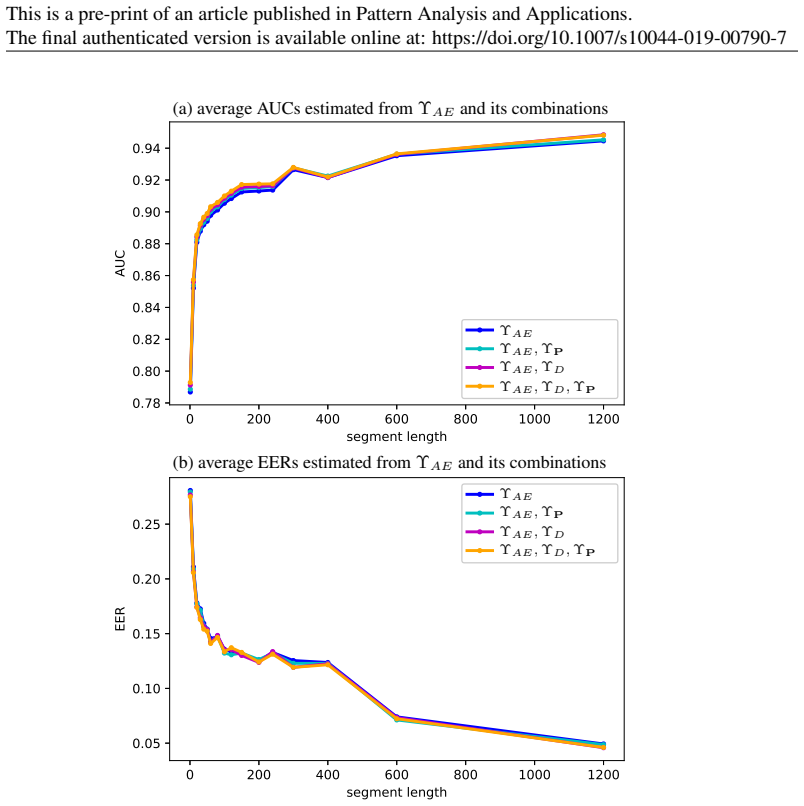
- Longer observation windows improve the index: the reported curves show EER decreasing as segment length grows.
- The method generalizes across subjects under leave-one-out evaluation, with whole-sequence EER dropping to 0.046.
Reading between the lines
- Because the method is unsupervised and needs only normal samples, the same cylinder-histogram-plus-AAE scoring could transfer to other one-class posture assessments such as fall-risk screening or rehabilitation monitoring; the paper does not test these, but nothing in the pipeline is gait-specific.
- The temporal dimension is deliberately left out of the model; an AAE consuming short stacks of histograms might capture cadence and symmetry abnormalities that the current averaging cannot, but that would be an extension beyond the paper.
- The heuristic weight rule and the manually chosen exponent for the prior-density term suggest that a validation-based calibration of the combination could change the relative ranking of the three measures; the paper reports only the ad hoc choice.
Signed reviews
Editorial analysis
A structured set of objections, weighed in public.
Referee Report
Summary. The paper proposes an unsupervised method for estimating a human walking gait quality index from depth point clouds using an adversarial auto-encoder (AAE). Each point cloud is converted into a 16×16 cylindrical histogram, which is fed to an AAE trained only on normal gait postures. Three measures are extracted: reconstruction error (Υ_AE), the probability that the latent code is drawn from the prior (Υ_P), and the discriminator output (Υ_D). These are combined via a weighted sum with weights computed from the training set. The method is evaluated on a dataset of 9 subjects and 9 gait types (normal plus artificially induced abnormalities), using a 5:4 subject split and leave-one-out cross-validation. The authors report EERs for per-frame, per-segment, and per-sequence assessment, and compare with reimplemented silhouette-, skeleton-, and depth-based methods. They claim the AAE-based indices, especially the combination Υ_AE+Υ_P+Υ_D, achieve the lowest EER.
Significance. If the results are validated, the paper would make a useful contribution: a simple, one-class, unsupervised system that produces a usable gait quality index from 3D point clouds, without requiring manual labels or multi-camera calibration. The strengths include the large dataset (nearly 100,000 point clouds), the use of a standard reconstruction-error anomaly score, the clear pipeline from raw depth to cylindrical histogram, and the consistent observation that averaging over longer segments improves performance. The paper also honestly notes several limitations, such as the arbitrary histogram size and the lack of a principled stopping criterion. However, the central comparative claim - that the proposed combination outperforms related approaches - is weakened by post-hoc hyperparameter selection on the test set and by the absence of a plain auto-encoder baseline.
major comments (4)
- [Section 3.3, Eq. (5), Fig. 6, Table 2] The exponent u=1/8 in Eq. (5) was selected 'after considering some small values' directly on the 5:4 test split whose EERs are reported in Table 2. Because the improvement of Υ_AE+Υ_P+Υ_D over Υ_AE alone is small (0.081 to 0.063 per-sequence in the 5:4 split and 0.049 to 0.046 in leave-one-out), the reported margin could plausibly be an artifact of test-set-driven model selection rather than a genuine property of the combination. Please re-evaluate with u chosen on a validation fold, or report EER as a function of u on a truly held-out test set.
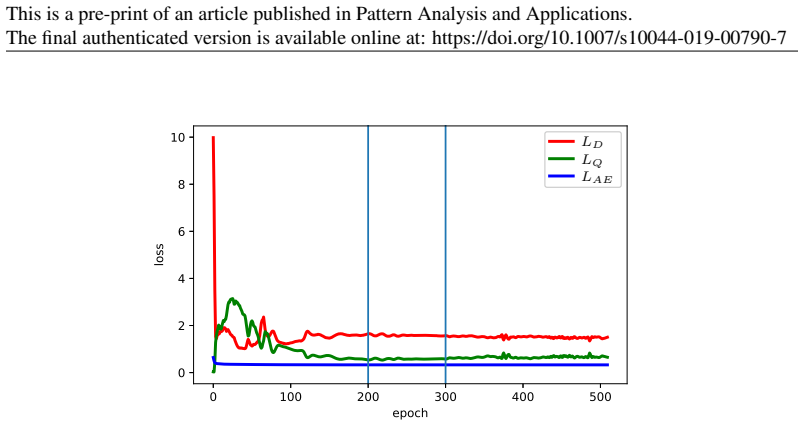
- [Section 3.2, Fig. 4] The training-stopping criterion is also selected post hoc: the text states that the losses were unstable after epoch 370 and 'a range of 200-300 was thus selected,' and each of the nine leave-one-out models uses a different stability-based epoch range. This means the reported EERs are averages over epoch ranges chosen after inspecting the same data used for evaluation. In addition, no variance or error bars are reported for Fig. 5-7 or Table 2, so it is impossible to tell whether the small EER differences between combinations are statistically meaningful. Please report standard deviations over training runs and over folds, and justify the epoch-selection procedure without reference to test performance.
- [Table 2] No plain auto-encoder baseline is reported. Since Υ_AE alone already achieves low EER (0.081 and 0.049 per-sequence) and the adversarial losses are known to be unstable, the comparison in Table 2 cannot establish that the adversarial components (Υ_P, Υ_D, and the GAN training) provide any benefit over a standard AE trained with the same architecture and reconstruction loss. Please include an AE-only baseline trained with the same encoder/decoder but without the discriminator or prior loss.
- [Section 2 (Gait Index Estimation)] The proposed index is measured per point-cloud frame and then averaged over segments, so the method only captures posture-based deviations from the training distribution. Temporal gait characteristics such as cadence, left-right asymmetry in swing phase, and step-length variability are not modeled. Since the paper claims a general 'walking gait quality index' but evaluates only on abnormalities that alter instantaneous posture (sole thickness and ankle weight), the generalization of the method to temporal gait disorders remains unsubstantiated. Please state this limitation explicitly and, ideally, evaluate on a dataset with temporal abnormalities.
minor comments (4)
- [Abstract and Section 1] The terms 'Gait Abnormality Index' and 'Gait Quality Index' are used interchangeably across the abstract and the main text; please align the terminology for consistency.
- [Eq. (5)] The notation Υ_X is used for the combined index, but the individual terms Υ_AE, Υ_P, and Υ_D are defined in prose rather than in the equation; please add explicit definitions or a notational glossary.
- [Table 2] The per-frame entries for HMM-based methods are shown as dashes without explanation; a footnote clarifying why those methods cannot be evaluated per frame would help the reader compare fairly.
- [Figures 5-7] Adding error bars or shaded confidence intervals would greatly improve interpretability, since the differences between combinations in Fig. 6 are small and no measure of variance is provided.
Circularity Check
Headline EERs partly reflect test-set selection: the 3-measure combination and u=1/8 were chosen after seeing Fig. 6 on the same 5:4 split, then reported as the predicted winner in Table 2.
-
fitted input called prediction
[Section 3.3 'Experimental Results', paragraph after Fig. 6; Table 2 (5:4 separation rows)]
"According to Fig. 6 (where u = 1/8 after considering some small values), improving ΥAE by both ΥD and ΥP is recommended since its results were the best compared with the other combinations."
The paper first evaluates all combinations of ΥAE, ΥP, ΥD on the 5:4 test split (Fig. 6) and, after seeing those test-based EER/AUC curves, fixes the exponent u=1/8 and decides that adding ΥP and ΥD is 'recommended.' The same test split then produces the headline per-sequence EERs in Table 2 (ΥAE+ΥP+ΥD: 0.063). Thus the reported 'best' result is the argmin of the same test EERs that were used to select the configuration; the claimed prediction is selected on the data used to verify it, so the headline comparison is not an out-of-sample prediction. The gain over ΥAE alone (0.081 to 0.063) is small, making the selection responsible for the margin.
full rationale
The core index is not circular: ΥAE is a standard reconstruction RMSE from an AAE trained only on normal gait point clouds, and the per-subject split evaluation is an honest test of an unsupervised anomaly score. The weights in Eq. (5) are computed from training statistics, not labels. The self-citations ([12], [14]) supply dataset, reconstruction method, and a combination weighting idea, but the formula is restated in the paper and is not load-bearing. However, the central comparative claim -- that ΥAE+ΥP+ΥD is the best index -- is partially circular: the exponent u=1/8 and the decision to include both ΥP and ΥD were made after inspecting EER curves computed on the same 5:4 test set that is later used to report the winning EERs in Table 2. Because the improvement over ΥAE alone is small, test-set-driven model selection could account for the reported advantage. The leave-one-out results inherit u=1/8 from the 5:4 selection, so they are not fully independent either, although they are less directly circular. This is a partial circularity/selection artifact affecting the headline result, not a fully circular derivation; score 6.
Assumptions & free parameters
free parameters (4)
- Cylindrical histogram grid size =
16 x 16 (256 bins)
- Hidden layer width =
96 units
- Latent dimension =
16
- Exponent u on the prior-probability measure =
1/8
assumptions (4)
- ad hoc to paper The 16x16 cylindrical histogram is a sufficient representation of gait posture for abnormality detection.
- domain assumption An AAE trained only on normal gaits produces larger reconstruction errors, lower prior probabilities, and lower discriminator outputs for abnormal gaits.
- domain assumption The prior distribution P is a multivariate normal with zero mean and scalar covariance, and the normalized density f_s is a meaningful anomaly score.
- domain assumption The dataset labels are correct, the 8 abnormal conditions are representative of gait abnormality, and the training split contains only normal gaits.
Cite this review
Pith. "Pith review of Applying Adversarial Auto-encoder for Estimating Human Walking Gait Abnormality Index." pith.science (2026). https://pith.science/paper/3LDL2SCP
@misc{pith2026190806188,
  author       = {Pith},
  title        = {Pith review of: Applying Adversarial Auto-encoder for Estimating Human Walking Gait Abnormality Index},
  year         = {2026},
  howpublished = {\url{https://pith.science/paper/3LDL2SCP}},
  note         = {Machine review of arXiv:1908.06188}
}
read the original abstract
This paper proposes an approach that estimates human walking gait quality index using an adversarial auto-encoder (AAE), i.e. a combination of auto-encoder and generative adversarial network (GAN). Since most GAN-based models have been employed as data generators, our work introduces another perspective of their application. This method directly works on a sequence of 3D point clouds representing the walking postures of a subject. By fitting a cylinder onto each point cloud and feeding obtained histograms to an appropriate AAE, our system is able to provide different measures that may be used as gait quality indices. The combinations of such quantities are also investigated to obtain improved indicators. The ability of our method is demonstrated by experimenting on a large dataset of nearly 100 thousands point clouds and the results outperform related approaches that employ different input data types.
Figures

Figures from the paper (5 more)



Reference graph
Works this paper leans on
-
[1]
E. Auvinet, J. Meunier, and F. Multon. Multiple depth cameras calibration and body vol- ume reconstruction for gait analysis. In Information Science, Signal Processing and their Applications (ISSPA), 2012 11th International Conference on , pp. 478–483, July 2012. doi: 10.1109/ISSPA.2012.6310598
arXiv 2012
-
[2]
Automatic detection of abnormal gait
Christian Bauckhage, John K Tsotsos, and Frank E Bunn. Automatic detection of abnormal gait. Image and Vision Computing, 27(1):108–115, 2009
2009
-
[3]
Amini Maghsoud Bigy, K
A. Amini Maghsoud Bigy, K. Banitsas, A. Badii, and J. Cosmas. Recognition of postures and freezing of gait in parkinson’s disease patients using microsoft kinect sensor. In 2015 7th International IEEE/EMBS Conference on Neural Engineering (NER) , pp. 731–734, April
2015
-
[4]
Hierarchical motion history images for recognizing human motion
James W Davis. Hierarchical motion history images for recognizing human motion. In Detec- tion and Recognition of Events in Video, 2001. Proceedings. IEEE Workshop on , pp. 39–46. IEEE, 2001
2001
-
[5]
Ian Goodfellow, Jean Pouget-Abadie, Mehdi Mirza, Bing Xu, David Warde-Farley, Sherjil Ozair, Aaron Courville, and Yoshua Bengio. Generative adversarial nets. In Z. Ghahramani, M. Welling, C. Cortes, N. D. Lawrence, and K. Q. Weinberger (eds.), Advances in Neural In- formation Processing Systems 27, pp. 2672–2680. Curran Associates, Inc., 2014. URLhttp: //...
work page 2014
-
[6]
Individual recognition using gait energy image
Ju Han and Bir Bhanu. Individual recognition using gait energy image. IEEE Transactions on Pattern Analysis and Machine Intelligence , 28(2):316–322, Feb 2006. ISSN 0162-8828. doi: 10.1109/TPAMI.2006.38
-
[7]
Real Time Gait Recognition System Based on Kinect Skeleton Feature, pp
Shuming Jiang, Yufei Wang, Yuanyuan Zhang, and Jiande Sun. Real Time Gait Recognition System Based on Kinect Skeleton Feature, pp. 46–57. Springer International Publishing, Cham,
-
[8]
Adam: A method for stochastic optimization
Diederik P Kingma and Jimmy Ba. Adam: A method for stochastic optimization. arXiv preprint arXiv:1412.6980, 2014
arXiv 2014
Show all 24 references
-
[9]
doi: 10.1007/978-3-319-16628-5 4
ISBN 978-3-319-16628-5. doi: 10.1007/978-3-319-16628-5 4. 11 This is a pre-print of an article published in Pattern Analysis and Applications. The final authenticated version is available online at: https://doi.org/10.1007/s10044-019-00790-7
-
[10]
Adversarial au- toencoders
Alireza Makhzani, Jonathon Shlens, Navdeep Jaitly, and Ian Goodfellow. Adversarial au- toencoders. In International Conference on Learning Representations , 2016. URL http: //arxiv.org/abs/1511.05644
2016 arXiv
-
[11]
L ´opez-Fern´andez, F.J
D. L ´opez-Fern´andez, F.J. Madrid-Cuevas, A. Carmona-Poyato, R. Mu noz Salinas, and R. Medina-Carnicer. A new approach for multi-view gait recognition on unconstrained paths. Journal of Visual Communication and Image Representation , 38:396 – 406, 2016. ISSN 1047-3203. doi: h...
2016 doi
-
[12]
T. N. Nguyen, H. H. Huynh, and J. Meunier. Assessment of gait normality using a depth camera and mirrors. In 2018 IEEE EMBS International Conference on Biomedical Health Informatics (BHI), pp. 37–41, Las Vegas, NV , USA, March 2018. doi: 10.1109/BHI.2018.8333364
2018
-
[13]
Electric power system anomaly detection using neural networks
Marco Martinelli, Enrico Tronci, Giovanni Dipoppa, and Claudio Balducelli. Electric power system anomaly detection using neural networks. In Mircea Gh. Negoita, Robert J. Howlett, and Lakhmi C. Jain (eds.), Knowledge-Based Intelligent Information and Engineering Sys- tems, pp....
2004
-
[14]
Walking gait dataset: point clouds, skeletons and silhouettes
Trong-Nguyen Nguyen and Jean Meunier. Walking gait dataset: point clouds, skeletons and silhouettes. Technical Report 1379, DIRO, University of Montreal, April 2018. URL http: //www.iro.umontreal.ca/˜labimage/GaitDataset/dataset.pdf
2018
-
[15]
T. N. Nguyen, H. H. Huynh, and J. Meunier. 3d reconstruction with time-of-flight depth camera and multiple mirrors. IEEE Access , 6:38106–38114, 2018. ISSN 2169-3536. doi: 10.1109/ACCESS.2018.2854262
2018
-
[16]
Skeleton-based abnormal gait detection
Trong-Nguyen Nguyen, Huu-Hung Huynh, and Jean Meunier. Skeleton-based abnormal gait detection. Sensors, 16(11):1792, 2016. ISSN 1424-8220. doi: 10.3390/s16111792. URL http://www.mdpi.com/1424-8220/16/11/1792
2016 doi
-
[17]
Extracting silhouette-based characteristics for human gait analysis using one camera
Trong-Nguyen Nguyen, Huu-Hung Huynh, and Jean Meunier. Extracting silhouette-based characteristics for human gait analysis using one camera. In Proceedings of the Fifth Sym- posium on Information and Communication Technology , SoICT ’14, pp. 171–177, New York, NY , USA, 2014. ...
2014
-
[18]
Stabilizing train- ing of generative adversarial networks through regularization
Kevin Roth, Aurelien Lucchi, Sebastian Nowozin, and Thomas Hofmann. Stabilizing train- ing of generative adversarial networks through regularization. In I. Guyon, U. V . Luxburg, S. Bengio, H. Wallach, R. Fergus, S. Vishwanathan, and R. Garnett (eds.),Advances in Neural Inform...
2018
-
[19]
Using tof camera and two mirrors for 3d reconstruction of dynamic objects
Trong-Nguyen Nguyen, Huu-Hung Huynh, and Jean Meunier. Using tof camera and two mirrors for 3d reconstruction of dynamic objects. Technical Report 1380, DIRO, Univer- sity of Montreal, April 2018. URL http://www.iro.umontreal.ca/˜labimage/ GaitDataset/reconstruct3D.pdf
2018
-
[20]
Shotton, A
J. Shotton, A. Fitzgibbon, M. Cook, T. Sharp, M. Finocchio, R. Moore, A. Kipman, and A. Blake. Real-time human pose recognition in parts from single depth images. In CVPR 2011, pp. 1297–1304, June 2011. doi: 10.1109/CVPR.2011.5995316
2011
-
[21]
Anomaly detection using autoencoders with nonlinear dimensionality reduction
Mayu Sakurada and Takehisa Yairi. Anomaly detection using autoencoders with nonlinear dimensionality reduction. In Proceedings of the MLSDA 2014 2Nd Workshop on Machine Learning for Sensory Data Analysis , MLSDA’14, pp. 4:4–4:11, New York, NY , USA, 2014. ACM. ISBN 978-1-4503-...
2014
-
[22]
Real-time action recognition by spatiotem- poral semantic and structural forest
Tsz-Ho Yu, Tae-Kyun Kim, and Roberto Cipolla. Real-time action recognition by spatiotem- poral semantic and structural forest. In Proceedings of the British Machine Vision Conference, pp. 52.1–52.12. BMV A Press, 2010. ISBN 1-901725-40-5. doi:10.5244/C.24.52. 12
2010 doi
-
[23]
Shotton, R
J. Shotton, R. Girshick, A. Fitzgibbon, T. Sharp, M. Cook, M. Finocchio, R. Moore, P. Kohli, A. Criminisi, A. Kipman, and A. Blake. Efficient human pose estimation from single depth images. IEEE Transactions on Pattern Analysis and Machine Intelligence, 35(12):2821–2840, Dec 20...
2013 doi
-
[2015]
doi: 10.1109/NER.2015.7146727
2015
Reviewed August 14, 2026 · model on record in the stance chip above.
Discussion (0). Continue with ORCID to comment.