REVIEW 4 major objections 5 minor 36 references
High-Level Surface Code Decoding via Parallel FFNNs on CIM Platforms
T0 review · 4 major / 5 minor · reviewed 2026-08-12 · deepseek-v4-flash
Pith's one-line read A fully feedforward high-level surface-code decoder can run both modules in parallel on compute-in-memory hardware, reaching a 14.22% decoding threshold and sub-440-nanosecond latencies for distances 3 through 9.
desk verdict Useful engineering result on CIM-based parallel FFNN decoding, but the headline threshold is inherited from PED and needs stability checks at larger distances. read the letter →
The pith
A machine-rendered reading of the paper's core claim, the machinery that carries it, and where it could break.
The reading
What carries the argument
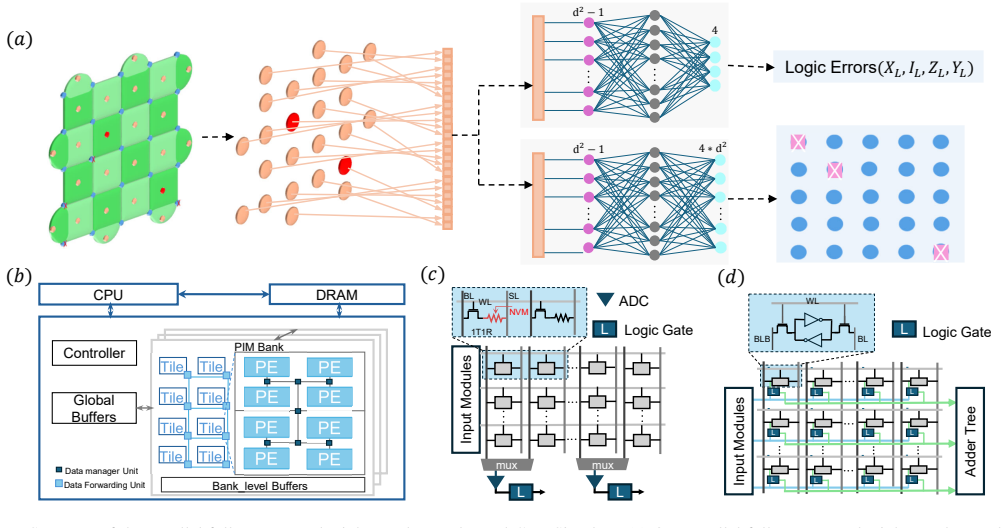
The load-bearing object is a pair of two-layer feedforward neural networks—a simple decoder and a classifier—each mapping the error syndrome to a fixed-category output, executed in parallel as matrix-vector multiplications on NVM-based compute-in-memory crossbars. A Pure Error Decoder (PED) is used only offline to generate training labels, converting syndrome-to-correction into a one-to-one classification task; the FFNN simple decoder learns to reproduce PED's output, so the decoder keeps PED-level accuracy while dropping PED from the latency path. Parallelism is what breaks the serial bottleneck: latency is max(t_simple, t_classifier), not t_simple + t_classifier. The CIM simulation supplies the hardware parameters—digital frequency, buffer bitwidth, inter-tile and intra-tile bandwidth, and number of ADC/DACs—and captures non-idealities such as stuck-at-faults, finite on/off ratio, and resistance variation.
What would settle it
Measure the distance-9 decoder on an actual NVM-based CIM accelerator at 4 K with a 0.4 V supply: if end-to-end latency is above 221 ns, or if total power cannot be removed by the cryostat at 4 K, the cryogenic latency claim fails. Simpler still, rerun the same simulation with any one hardware parameter moved from its maximum to a conservative typical value, such as 1 GHz digital frequency or 64 GB/s inter-tile bandwidth, and check whether latency crosses 440 ns.
Extended reading notes
Core claim
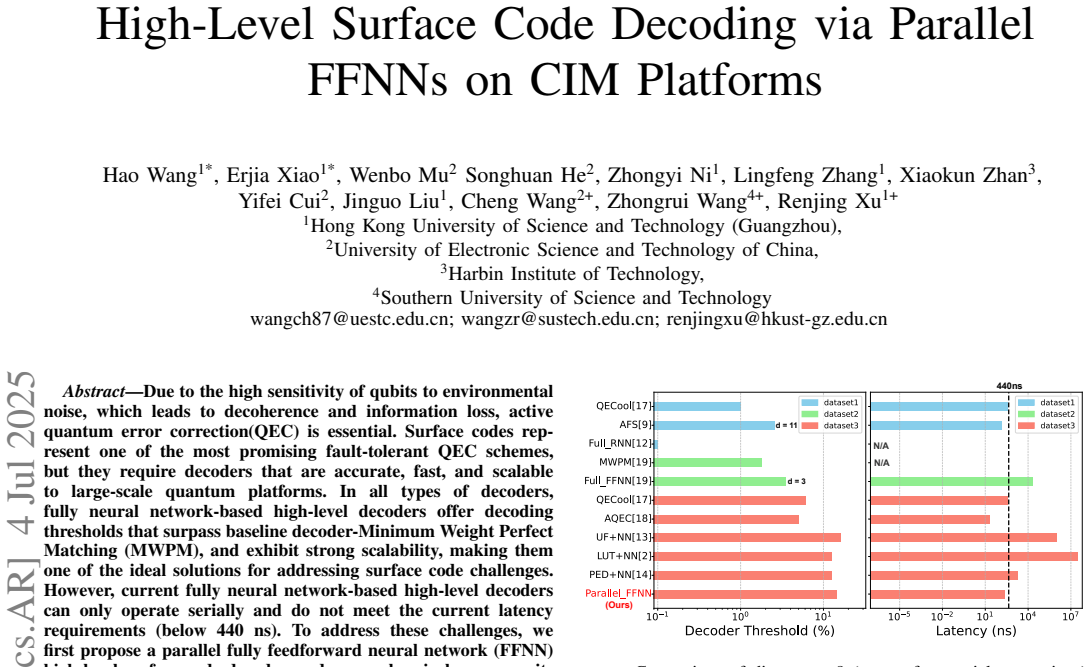
The paper establishes that replacing the non-neural simple decoder in a high-level decoder with an FFNN trained on labels generated by a Pure Error Decoder (PED) preserves the PED's decoding accuracy while making the whole decoder parallel and hardware-mappable. The classifier and simple decoder both take the same error syndrome as input and emit respectively the logical error and the data-qubit correction; because neither depends on the other's output, they can run concurrently. On an NVM-based CIM simulator configured with maximum currently available hardware parameters, the decoder achieves a threshold of 14.22% under depolarizing noise and pseudo-thresholds of 10.4%, 11.3%, 12%, and 11.6% at distances 3, 5, 7, and 9. The simulated latencies are 197.03 ns, 234.87 ns, 243.73 ns, and 251.65 ns at 300K, all below the 440 ns real-time decoding budget; applying cryogenic scaling from a published CIM study at 4K and 0.4 V gives 221.07 ns at distance 9 with 3.98W power. Hardware non-idealities modeled by the simulator change the results by less than 0.5% at the chosen network sizes.
Load-bearing premise
The central assumption is that a single real CIM chip can simultaneously run at the maximum values assumed for every hardware parameter (about 2 GHz digital clock, 256 GB/s inter-tile bandwidth, 19,600-bit buffers, and up to 256 ADC/DACs) and that the published 300K-to-4K scaling of a smaller cryogenic CIM chip transfers unchanged to a decoder that dissipates about 4 W at distance 9.
Editorial extensions
If this is right
- Distance-3 to distance-9 decoders all complete in under 440 ns at 300K simulation, so a fully neural high-level decoder can meet the real-time QEC pace instead of only offline analysis.
- The 14.22% decoding threshold exceeds the 10.3% MWPM baseline under depolarizing noise, and pseudo-thresholds stay above 10% for every tested distance.
- Because PED is removed from the runtime path, latency growth with code distance is governed by the FFNN and CIM array sizes, not by exponential lookup or matching growth.
- At 4K and 0.4V, the distance-9 latency drops to 221.07 ns and power to 3.98W, supporting the idea that such a decoder could sit inside a cryogenic quantum control stack.
Reading between the lines
- The decoder's logical accuracy is inherited from the PED rule used to label training data; the FFNN contribution is hardware acceleration and parallelization, so the 14.22% threshold should be read as 'PED accuracy, made fast,' not as a new decoding algorithm.
- The room-temperature and 4K latency numbers assume a single chip simultaneously sustains the maximum values of all five hardware parameters; a real system will likely trade some of them off, so the 440 ns margin should be tested under parameter sweeps rather than only at the maxima.
- If the same parallelization is applied to larger distances, the classifier and simple-decoder network widths would grow roughly with distance; whether the 4K cooling budget of a few watts can absorb that growth is an open question the paper does not answer.
Editorial analysis
A structured set of objections, weighed in public.
Referee Report
Summary. The paper proposes a parallel fully feedforward neural network (FFNN) high-level decoder for surface codes, in which both the simple decoder and the classifier are two-layer FFNNs trained on labels generated by the Pure Error Decoder (PED). The decoder is evaluated under a depolarizing noise model for distances 3, 5, 7, and 9, and its latency is simulated with the MNSIM 2.0 computing-in-memory (CIM) platform. The authors claim a decoding threshold of 14.22%, pseudo-thresholds of 10.4%, 11.3%, 12%, and 11.6% for d=3, 5, 7, and 9, and sub-440 ns latencies on an NVM-based CIM architecture, with results extrapolated to a 4 K cryogenic environment.
Significance. If the threshold and latency claims are substantiated, the architectural contribution is significant: it would be the first demonstration of a fully neural-network high-level surface code decoder whose two modules run in parallel, and the first CIM-based evaluation of such a decoder with sub-440 ns latency. The use of MNSIM 2.0 to analyze hardware non-idealities and the discussion of hardware parameter impacts are useful for the quantum error correction architecture community. However, the headline accuracy numbers are inherited from the PED teacher rather than derived from the FFNN itself, and the threshold estimate relies on a small range of code distances; the significance is therefore conditional on additional validation.
major comments (4)
- [IV-C, Fig. 6(a)] The claimed 14.22% decoding threshold is determined from only four distances (3, 5, 7, 9) and a single training physical error rate p_train=0.15. The claimed threshold lies only 0.8 percentage points from p_train, and the pseudo-thresholds are non-monotonic (12% at d=7 vs. 11.6% at d=9), so the crossing in Fig. 6(a) has not been shown to be stable against finite-size effects. A genuine decoding threshold should persist to larger distances; the authors should add d=11 and d=13 results (even with reduced sample counts) and a sensitivity check over p_train in, say, [0.12, 0.18]. Without such evidence, the statement that the decoder 'surpasses MWPM' at threshold is not supported by the data presented.
- [Table III] Table III mixes decoder thresholds with pseudo-thresholds. The column labeled Dth lists 14.22% for Ours next to '>12.49%' for PED+NN [14] and '>12.45%' for LUT+NN [2], which are pseudo-thresholds, while the MWPM entries 1.81% and 2.90% are thresholds under different noise models (self-modified and circuit-level, respectively). The 10.3% MWPM baseline quoted in the abstract appears nowhere in the table. A credible comparison requires a single noise model, a single metric, and separate columns for threshold and pseudo-threshold.
- [III-C] The paper states that 'the actual decoding rules match the PED-based high-level decoder', which means the 14.22% threshold is inherited from the PED teacher, not independently established by the FFNN. To substantiate the headline threshold as an FFNN property, the authors should quantify the FFNN-versus-PED output disagreement as a function of physical error rate across the full test range [0.03, 0.3], especially for p>0.15 where high-weight syndromes are rare in training. The '<0.5%' non-ideality impact reported in Fig. 6(e) is a hardware non-ideality measure and does not address this student-teacher divergence.
- [IV-C, 4K Cryogenic Environment; Table I] The 4K extrapolation applies the cooling-derived latency reduction of [36] to the entire decoder, but Table III reports 3.98W total power at d=9 and 0.4V, and the paper does not explain how this power is managed at 4K given the limited cooling power typical of cryostats for quantum processors. Moreover, Table I sets each of the five main hardware parameters to maxima taken from different sources (2GHz digital frequency, 256 GB/s inter-tile bandwidth, 19600-bit buffer, 256 ADC/DACs); no evidence is given that these values can be co-satisfied in a single CIM system. The sub-440ns latency claim should be presented as an optimistic upper-bound configuration and supplemented with an analysis of a realistic combined configuration.
minor comments (5)
- [Abstract] The abstract in the submission metadata includes the phrase 'surpassing the MWPM baseline of 10.3%', but the abstract in the paper body omits it; please reconcile the two versions.
- [Fig. 1] Figure 1 is difficult to read: the 'd=3' annotation and the Chinese characters appear to be artifacts of the source, and the legend is not self-contained. Please clean up the figure.
- [Throughout] There are several typos, including 'Suface code' in the Section III heading, 'it is easy to implement' in the Introduction, 'constructe' in Section III-C, and 'Larency' in the Fig. 6 legend.
- [Table II] For d=9, the simple decoder has larger area and power (479.34 mm^2, 4.23 W) than the classifier (296.93 mm^2, 2.94 W) despite the classifier having a larger hidden-layer multiplier (n=80 vs. n=35). A sentence explaining this in terms of the output layer size (4*d^2 vs. 4 neurons) would help the reader.
- [IV-A] The authors state that open-source code is provided in [14], but it is not clear whether the training and testing code of this paper will be released; please clarify the code availability statement.
Circularity Check
No significant circularity: the FFNN is a disclosed distillation of the external PED decoder, and the reported threshold and latency are measured outputs rather than fitted inputs.
full rationale
The paper's only apparent circularity risk is that the FFNN simple decoder and classifier are trained to reproduce the outputs of the PED-based high-level decoder of [14]. The text is explicit: 'we employed the PED-based simple decoder from [14] to generate training data for our NN-Based simple decoder' and 'Since the actual decoding rules match the PED-based high-level decoder, our decoder maintains the superior decoding performance of the PED-based high-level decoder.' This means the 14.22% threshold is inherited from PED rather than independently derived from the FFNN architecture. However, this is not circular in the analyzer's sense. PED is an external, open-source reference decoder, not a claim of the present paper. The network weights are fitted to syndrome-to-error labels, not to the threshold value; the threshold is obtained from logical-error-rate simulations across p in [0.03, 0.3], and no equation defines the threshold in terms of the training labels. The latency and energy numbers come from MNSIM 2.0 with explicitly listed hardware parameters and are not self-referential. No load-bearing self-citation chain exists: [14] is by other authors, and MNSIM 2.0 is an external simulator whose non-ideality defaults are validated against real chips. The paper also discloses its own limitation, stating in the conclusion that 'Future research could explore the decoder's performance at greater distances,' which is a generalization concern rather than a circularity. The finite-distance threshold stability at d=3 to 9 is a correctness risk, not a circularity risk.
Assumptions & free parameters
free parameters (8)
- NN-Based classifier hidden layer multiplier n =
20 (d=3), 40 (d=5), 60 (d=7), 80 (d=9)
- NN-Based simple decoder hidden layer multiplier n =
5 (d=3), 15 (d=5), 25 (d=7), 35 (d=9)
- Training physical error rate =
0.15
- Digital Frequency =
1500 MHz (max 2000 MHz)
- Inter-Tile Bandwidth =
1000-1500 Gbps
- Intra-Tile Bandwidth =
600-1000 Gbps
- Buffer Bitwidth =
2000-11000 bits
- Number of ADC/DAC =
64-256
assumptions (4)
- domain assumption Depolarizing noise model with physical error rates 0.03-0.3
- domain assumption PED decoder from [14] provides the correct target mapping for the simple decoder
- domain assumption MNSIM 2.0 faithfully models CIM hardware including non-idealities (stuck-at-faults, on/off ratio, resistance variations)
- domain assumption Cryogenic scaling from [36] extrapolates to the proposed CIM decoder
Cite this review
Pith. "Pith review of High-Level Surface Code Decoding via Parallel FFNNs on CIM Platforms." pith.science (2026). https://pith.science/paper/3LGWQOCW
@misc{pith2026241118090,
  author       = {Pith},
  title        = {Pith review of: High-Level Surface Code Decoding via Parallel FFNNs on CIM Platforms},
  year         = {2026},
  howpublished = {\url{https://pith.science/paper/3LGWQOCW}},
  note         = {Machine review of arXiv:2411.18090}
}
read the original abstract
Due to the high sensitivity of qubits to environmental noise, which leads to decoherence and information loss, active quantum error correction(QEC) is essential. Surface codes represent one of the most promising fault-tolerant QEC schemes, but they require decoders that are accurate, fast, and scalable to large-scale quantum platforms. In all types of decoders, fully neural network-based high-level decoders offer decoding thresholds that surpass baseline decoder-Minimum Weight Perfect Matching (MWPM), and exhibit strong scalability, making them one of the ideal solutions for addressing surface code challenges. However, current fully neural network-based high-level decoders can only operate serially and do not meet the current latency requirements (below 440 ns). To address these challenges, we first propose a parallel fully feedforward neural network (FFNN) high-level surface code decoder, and comprehensively measure its decoding performance on a computing-in-memory (CIM) hardware simulation platform. With the currently available hardware specifications, our work achieves a decoding threshold of 14.22%, surpassing the MWPM baseline of 10.3%, and achieves high pseudo-thresholds of 10.4%, 11.3%, 12%, and 11.6% with decoding latencies of 197.03 ns, 234.87 ns, 243.73 ns, and 251.65 ns for distances of 3, 5, 7 and 9, respectively. The impact of hardware parameters and non-idealities on these results is discussed, and the hardware simulation results are extrapolated to a 4K quantum cryogenic environment.
Figures


Figures from the paper (3 more)


Reference graph
Works this paper leans on
-
[14]
R. W. Overwater, M. Babaie, and F. Sebastiano, “Neural-network de- coders for quantum error correction using surface codes: A space explo- ration of the hardware cost-performance tradeoffs,” IEEE Transactions on Quantum Engineering , vol. 3, pp. 1–19, 2022
work page 2022
-
[2]
Comparing neural network based decoders for the surface code,
S. Varsamopoulos, K. Bertels, and C. G. Almudever, “Comparing neural network based decoders for the surface code,” IEEE Transactions on Computers, vol. 69, no. 2, pp. 300–311, 2019
work page 2019
-
[36]
Cryo- genic performance for compute-in-memory based deep neural network accelerator,
P. Wang, X. Peng, W. Chakraborty, A. Khan, S. Datta, and S. Yu, “Cryo- genic performance for compute-in-memory based deep neural network accelerator,” in 2021 IEEE International Symposium on Circuits and Systems (ISCAS) . IEEE, 2021, pp. 1–4
work page 2021
-
[1]
Quantum computational supremacy,
A. W. Harrow and A. Montanaro, “Quantum computational supremacy,” Nature, vol. 549, no. 7671, pp. 203–209, 2017
work page 2017
-
[3]
Foliated quantum error-correcting codes,
A. Bolt, G. Duclos-Cianci, D. Poulin, and T. Stace, “Foliated quantum error-correcting codes,” Physical review letters, vol. 117, no. 7, p. 070501, 2016
work page 2016
-
[4]
Quantum error correction for quantum memories,
B. M. Terhal, “Quantum error correction for quantum memories,” Reviews of Modern Physics , vol. 87, no. 2, pp. 307–346, 2015
2015
-
[5]
Realiza- tion of real-time fault-tolerant quantum error correction,
C. Ryan-Anderson, J. G. Bohnet, K. Lee, D. Gresh, A. Hankin, J. Gaebler, D. Francois, A. Chernoguzov, D. Lucchetti, N. C. Brown et al., “Realiza- tion of real-time fault-tolerant quantum error correction,” Physical Review X, vol. 11, no. 4, p. 041058, 2021
work page 2021
-
[6]
Surface codes: Towards practical large-scale quantum computation,
A. G. Fowler, M. Mariantoni, J. M. Martinis, and A. N. Cleland, “Surface codes: Towards practical large-scale quantum computation,” Physical Review A—Atomic, Molecular , and Optical Physics , vol. 86, no. 3, p. 032324, 2012
work page 2012
Show all 36 references
-
[7]
Real-time decoding for fault-tolerant quantum computing: Progress, challenges and outlook,
F. Battistel, C. Chamberland, K. Johar, R. W. Overwater, F. Sebastiano, L. Skoric, Y . Ueno, and M. Usman, “Real-time decoding for fault-tolerant quantum computing: Progress, challenges and outlook,” Nano Futures , vol. 7, no. 3, p. 032003, 2023
2023
-
[8]
How to factor 2048 bit rsa integers in 8 hours using 20 million noisy qubits,
C. Gidney and M. Eker ˚a, “How to factor 2048 bit rsa integers in 8 hours using 20 million noisy qubits,” Quantum, vol. 5, p. 433, 2021
-
[9]
Afs: Accurate, fast, and scalable error- decoding for fault-tolerant quantum computers,
P. Das, C. A. Pattison, S. Manne, D. M. Carmean, K. M. Svore, M. Qureshi, and N. Delfosse, “Afs: Accurate, fast, and scalable error- decoding for fault-tolerant quantum computers,” in 2022 IEEE Interna- tional Symposium on High-Performance Computer Architecture (HPCA) . IEEE, ...
2022
-
[10]
Lilliput: a lightweight low-latency lookup-table decoder for near-term quantum error correction,
P. Das, A. Locharla, and C. Jones, “Lilliput: a lightweight low-latency lookup-table decoder for near-term quantum error correction,” inProceed- ings of the 27th ACM International Conference on Architectural Support for Programming Languages and Operating Systems , 2022, pp. 541–553
2022
-
[11]
Machine-learning-assisted correction of correlated qubit errors in a topological code,
P. Baireuther, T. E. O’Brien, B. Tarasinski, and C. W. Beenakker, “Machine-learning-assisted correction of correlated qubit errors in a topological code,” Quantum, vol. 2, p. 48, 2018
2018
-
[12]
A cryogenic memristive neural decoder for fault-tolerant quantum error correction,
F. Marcotte, P.-A. Mouny, V . Yon, G. A. Dagnew, B. Kulchytskyy, S. Rochette, Y . Beilliard, D. Drouin, and P. Ronagh, “A cryogenic memristive neural decoder for fault-tolerant quantum error correction,” arXiv preprint arXiv:2307.09463 , 2023
2023 arXiv
-
[13]
Scalable neural decoder for topological surface codes,
K. Meinerz, C.-Y . Park, and S. Trebst, “Scalable neural decoder for topological surface codes,” Physical Review Letters , vol. 128, no. 8, p. 080505, 2022
2022
-
[15]
qecgpt: decoding quantum error- correcting codes with generative pre-trained transformers,
H. Cao, F. Pan, Y . Wang, and P. Zhang, “qecgpt: decoding quantum error- correcting codes with generative pre-trained transformers,” arXiv preprint arXiv:2307.09025, 2023
2023 arXiv
-
[16]
Suppressing quantum errors by scaling a surface code logical qubit,
“Suppressing quantum errors by scaling a surface code logical qubit,” Nature, vol. 614, no. 7949, pp. 676–681, 2023
2023
-
[17]
Qecool: On- line quantum error correction with a superconducting decoder for surface code,
Y . Ueno, M. Kondo, M. Tanaka, Y . Suzuki, and Y . Tabuchi, “Qecool: On- line quantum error correction with a superconducting decoder for surface code,” in 2021 58th ACM/IEEE Design Automation Conference (DAC) . IEEE, 2021, pp. 451–456
2021
-
[18]
Nisq+: Boosting quantum computing power by approximating quantum error correction,
A. Holmes, M. R. Jokar, G. Pasandi, Y . Ding, M. Pedram, and F. T. Chong, “Nisq+: Boosting quantum computing power by approximating quantum error correction,” in 2020 ACM/IEEE 47th annual international symposium on computer architecture (ISCA) . IEEE, 2020, pp. 556–569
2020
-
[19]
Efficient decoding of surface code syndromes for error correction in quantum computing,
D. Bhoumik, P. Sen, R. Majumdar, S. Sur-Kolay, S. S. Iyengar et al. , “Efficient decoding of surface code syndromes for error correction in quantum computing,” arXiv preprint arXiv:2110.10896 , 2021
2021 arXiv
-
[20]
Mnsim 2.0: A behavior-level modeling tool for processing- in-memory architectures,
Z. Zhu, H. Sun, T. Xie, Y . Zhu, G. Dai, L. Xia, D. Niu, X. Chen, X. S. Hu, Y . Caoet al., “Mnsim 2.0: A behavior-level modeling tool for processing- in-memory architectures,” IEEE Transactions on Computer-Aided Design of Integrated Circuits and Systems , vol. 42, no. 11, pp. ...
2023
-
[21]
A scalable and fast artificial neural network syndrome decoder for surface codes,
S. Gicev, L. C. Hollenberg, and M. Usman, “A scalable and fast artificial neural network syndrome decoder for surface codes,” Quantum, vol. 7, p. 1058, 2023
2023
-
[22]
Exponential suppression of bit or phase errors with cyclic error correc- tion,
“Exponential suppression of bit or phase errors with cyclic error correc- tion,” Nature, vol. 595, no. 7867, pp. 383–387, 2021
2021
-
[23]
Realizing repeated quantum error correction in a distance-three surface code,
S. Krinner, N. Lacroix, A. Remm, A. Di Paolo, E. Genois, C. Leroux, C. Hellings, S. Lazar, F. Swiadek, J. Herrmann et al., “Realizing repeated quantum error correction in a distance-three surface code,” Nature, vol. 605, no. 7911, pp. 669–674, 2022
2022
-
[24]
Mnsim: Simulation platform for memristor-based neuromorphic computing system,
L. Xia, B. Li, T. Tang, P. Gu, P.-Y . Chen, S. Yu, Y . Cao, Y . Wang, Y . Xie, and H. Yang, “Mnsim: Simulation platform for memristor-based neuromorphic computing system,” IEEE Transactions on Computer-Aided Design of Integrated Circuits and Systems , vol. 37, no. 5, pp. 1009–...
2017
-
[25]
Dypim: Dynamic-inference-enabled processing-in-memory accelerator,
T. Xie, T. Zhao, Z. Zhu, X. Ning, B. Li, G. Dai, H. Yang, and Y . Wang, “Dypim: Dynamic-inference-enabled processing-in-memory accelerator,” in 2024 Design, Automation & Test in Europe Conference & Exhibition (DATE). IEEE, 2024, pp. 1–6
2024
-
[26]
Fully memristive elementary motion detectors for a maneuver prediction,
H. Song, M. G. Lee, G. Kim, D. H. Kim, G. Kim, W. Park, H. Rhee, J. H. In, and K. M. Kim, “Fully memristive elementary motion detectors for a maneuver prediction,” Advanced Materials , vol. 36, no. 18, p. 2309708, 2024
2024
-
[27]
A memristive all-inclusive hypernetwork for parallel analog deployment of full search space architectures,
B. Lyu, Y . Yang, Y . Cao, T. Shi, Y . Chen, T. Huang, and S. Wen, “A memristive all-inclusive hypernetwork for parallel analog deployment of full search space architectures,” Neural Networks , vol. 175, p. 106312, 2024
2024
-
[28]
A 10gs/s 8b 25fj/cs 2850um 2 two-step time-domain adc using delay-tracking pipelined-sar tdc with 500fs time step in 14nm cmos technology,
J. Liu, M. Hassanpourghadi, and M. S.-W. Chen, “A 10gs/s 8b 25fj/cs 2850um 2 two-step time-domain adc using delay-tracking pipelined-sar tdc with 500fs time step in 14nm cmos technology,” in 2022 IEEE International Solid-State Circuits Conference (ISSCC) , vol. 65. IEEE, 2022,...
2022
-
[29]
A 2 × time- interleaved 28-gs/s 8-bit 0.03-mm 2 switched-capacitor dac in 16-nm finfet cmos,
P. Caragiulo, O. E. Mattia, A. Arbabian, and B. Murmann, “A 2 × time- interleaved 28-gs/s 8-bit 0.03-mm 2 switched-capacitor dac in 16-nm finfet cmos,” IEEE Journal of Solid-State Circuits , vol. 56, no. 8, pp. 2335–2346, 2021
2021
-
[30]
Dojo: The microarchitecture of tesla’s exa-scale computer,
E. Talpes, D. Williams, and D. D. Sarma, “Dojo: The microarchitecture of tesla’s exa-scale computer,” in 2022 IEEE Hot Chips 34 Symposium (HCS). IEEE Computer Society, 2022, pp. 1–28
2022
-
[31]
Nvidia grace hopper superchip architecture,
NVIDIA, “Nvidia grace hopper superchip architecture,” [Online]. Avail- able: https://resources.nvidia.com/en-us-grace-cpu/nvidia-grace-hopper, 2020
2020
-
[32]
A 1.041-mb/mm 2 27.38-tops/w signed-int8 dynamic-logic-based adc-less sram compute-in-memory macro in 28nm with reconfigurable bitwise operation for ai and embedded applications,
B. Yan, J.-L. Hsu, P.-C. Yu, C.-C. Lee, Y . Zhang, W. Yue, G. Mei, Y . Yang, Y . Yang, H. Li et al. , “A 1.041-mb/mm 2 27.38-tops/w signed-int8 dynamic-logic-based adc-less sram compute-in-memory macro in 28nm with reconfigurable bitwise operation for ai and embedded applicati...
2022
-
[33]
33.2 a fully integrated analog reram based 78.4 tops/w compute-in-memory chip with fully parallel mac computing,
Q. Liu, B. Gao, P. Yao, D. Wu, J. Chen, Y . Pang, W. Zhang, Y . Liao, C.-X. Xue, W.-H. Chen et al., “33.2 a fully integrated analog reram based 78.4 tops/w compute-in-memory chip with fully parallel mac computing,” in 2020 IEEE International Solid-State Circuits Conference-(IS...
2020
-
[34]
Cryogenic electronics for the read-out of quantum proces- sors,
H. Homulle, “Cryogenic electronics for the read-out of quantum proces- sors,” 2019
2019
-
[35]
Cryo- cmos for analog/mixed-signal circuits and systems,
J. Van Dijk, G. Kiene, R. Overwater, P. Padalia, J. Van Staveren, M. Babaie, A. Vladimirescu, E. Charbon, F. Sebastiano et al. , “Cryo- cmos for analog/mixed-signal circuits and systems,” in2020 IEEE Custom Integrated Circuits Conference (CICC) . IEEE, 2020, pp. 1–8
2020
Reviewed August 12, 2026 · model on record in the stance chip above.
Discussion (0). Continue with ORCID to comment.