REVIEW 3 major objections 6 minor 1 cited by
Approximate Top-$k$ for Increased Parallelism
T0 review · 3 major / 6 minor · reviewed 2026-08-11 · deepseek-v4-flash
Pith's one-line read This paper argues that replacing exact top-k with a two-stage bucketed approximation unlocks substantial parallelism on ML accelerators, yielding 2-4x speed-ups (over 4x in sparse attention) with little to no downstream task degradation.
desk verdict A transparent, useful evaluation of bucketed approximate top-k that earns its design rules, with a real but narrow robustness gap around periodic input structure. read the letter →
The pith
A machine-rendered reading of the paper's core claim, the machinery that carries it, and where it could break.
The reading
What carries the argument
The object that carries the argument is the two-stage bucketed top-$k$: split the $n$ inputs into $b$ interleaved buckets, perform an exact top-$k_b$ within each bucket in parallel, and if the concatenated $b \cdot k_b$ candidates exceed $k$, run a final exact top-$k$ to select the $k$ largest. The quality model is the binomial recall bound of Equation (1), $\mathbb{E}[R(k,b,k_b)] = \frac{1}{k}\left(k_b + \sum_{i=k_b}^{k-1} F(k_b-1; i, 1/b)\right)$, which assumes top values are uniformly spread across buckets; Equation (2) gives the worst case when all top values concentrate in $\lceil bk/n\rceil$ buckets. The implementation keeps per-thread priority queues of size $k_b \le 4$ in registers, so buckets can be processed with no or minimal inter-thread communication.
What would settle it
Take a vector of length $n$ where the top $k$ entries are placed exclusively in positions congruent to one residue class modulo $b$ (so all top values fall in a single interleaved bucket), run the bucketed top-$k$ with given $b$ and $k_b$, and compare recall to Equation (1)'s prediction; the observed recall should drop to the worst-case level of Equation (2) if the uniform assumption is doing the work.
Extended reading notes
Core claim
The central claim is that bucketed approximate top-$k$ is a practical drop-in replacement for exact top-$k$ in the sparsity methods that machine learning accelerators actually run. The paper establishes this by characterising the algorithm's two design parameters—$b$, the number of buckets, and $k_b$, the number of candidates kept per bucket—through a binomial recall model that upper-bounds expected recall error, and through serial and parallel cost models that show large speed-ups are theoretically available. Empirically, on sparse attention in a large language model with $k = n/16$ to $n/8$, using $k_b = 2$ and $b \cdot k_b = k$ reduces top-$k$ cost by more than 4× with almost no degradation in task performance. On small-$k$ tasks, vocabulary sampling with $n = 128{,}256$, $k = 256$ and knowledge-graph link prediction with $n \approx 2.65$M, $k = 100$, speed-ups between 2× and 4× are achieved while recall error stays low. The paper's main caveat is that the bucket assignment must be interleaved, because real data are correlated along the sequence and contiguous assignment degrades recall.
Load-bearing premise
The whole quality story rests on the assumption that, once buckets are interleaved, each bucket receives about the same number of the true top-$k$ values, so the uniform-distribution recall bound of Equation (1) applies; if the largest values line up in a periodic or positional pattern that matches the bucket stride, recall degrades toward the worst-case bound and the reported 'little degradation' would break.
Editorial extensions
If this is right
- For sparsity methods with $k$ proportional to $n$, a small per-bucket top-$k_b$ with $b \cdot k_b = k$ can cut top-$k$ cost by more than 4× while preserving downstream accuracy.
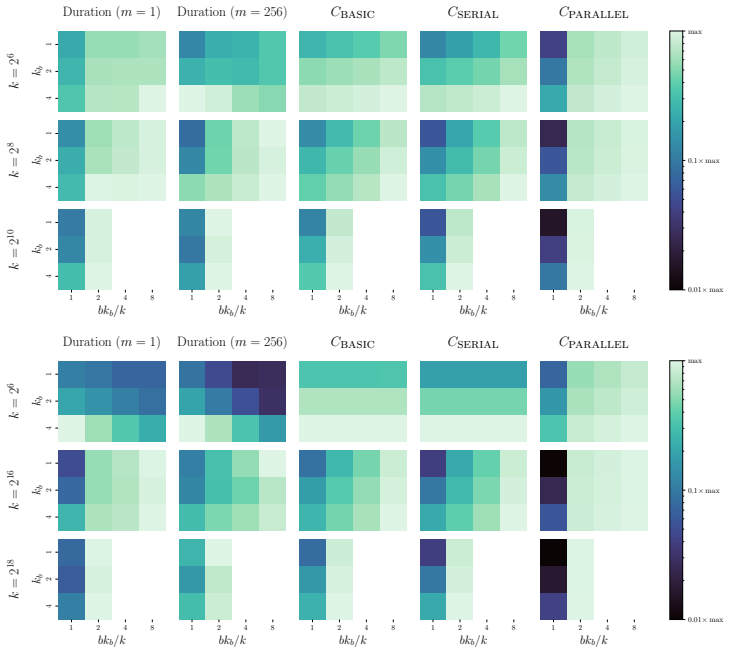
- For small-$k$ settings such as vocabulary sampling and knowledge-graph link prediction, increasing the number of buckets $b$ (with $k_b = 1$) delivers 2–4× speed-ups with low recall error.
- Using the bucketed approximation in place of exact top-$k$ inside sparse attention adds a further ~10% end-to-end generation speed-up at 40,000-token prompts, moving from 1.9× to 2.1× over dense attention.
- The recall and cost models give practitioners a way to pick $b$ and $k_b$ for a target accuracy–speed trade-off, without rerunning the downstream task.
Reading between the lines
- If interleaved bucket assignment breaks positional correlation as thoroughly as the correlated-Gaussian experiments suggest, the same bucketing trick could apply to other reduction primitives—argmax, top-$p$ sampling quantiles, or threshold selection—wherever accelerators need more parallelism.
- The uniform-recall model predicts a concrete failure mode that the paper does not stress-test: inputs whose top values concentrate in one residue class modulo $b$ would fall toward the worst-case bound of Equation (2), so adversarial or periodic data is the regime to probe before deploying bucketed top-$k$.
- Replacing exact top-$k$ with an approximation during training (as opposed to inference) may compound error across optimisation steps; the paper evaluates inference-time sparsity, so training-time use would need its own stability check.
- In distributed settings, where exact top-$k$ requires cross-device communication, bucketing could have a larger advantage than the single-accelerator numbers here show; the paper itself flags this as future work.
Signed reviews
Editorial analysis
A structured set of objections, weighed in public.
Referee Report
Summary. The paper studies bucketed approximate top-k algorithms, in which the input is divided into interleaved buckets, a small top-kb is computed per bucket in parallel, and an optional exact top-k merges the candidates. It analyzes the recall/cost trade-off with a binomial model of recall (Appendix C) and abstract cost models (Appendix D), then validates the approach on SparQ attention for LLM inference, LLM vocabulary sampling, and knowledge-graph link prediction, reporting 2-4x speedups of the top-k operation with little downstream degradation. The authors release a CUDA/PyTorch implementation and provide end-to-end Llama 2 generation results.
Significance. If the central claim holds, the paper offers a practical and well-motivated alternative to exact top-k for sparsity workloads on parallel accelerators, with a clear design dichotomy (increase b for k << n, increase kb for k proportional to n). The release of a working PyTorch implementation is a concrete contribution, and the theoretical recall derivation is self-contained and machine-checkable in structure. The empirical coverage is respectable: three downstream tasks plus an end-to-end LLM experiment. The main weakness is that the 'little to no degradation' half of the claim rests on an implicit distributional assumption (top-k values spread across buckets) that is only tested on AR(1) correlated Gaussian data and on three real-world tasks, not on adversarial or periodic concentration patterns that the paper's own worst-case bound describes.
major comments (3)
- [Appendix A.1 and Appendix C] The claim that interleaved bucket assignment 'works very well in retaining recall, no matter the degree of correlation' is supported only by an AR(1) multivariate-normal simulation (Figure 6). Interleaving does not decorrelate inputs with periodic structure aligned with the bucket stride: if high scores occur at positions i ≡ r (mod b), the top-k values concentrate in few buckets and recall degrades toward the worst-case bound of Equation (2). Since the central claim of 'little to no degradation' depends on the uniform-spread assumption behind Equation (1), the paper should add stress tests with periodic or adversarially concentrated inputs (e.g., scores peaking at a fixed residue class) or explicitly restrict the claim to inputs without such alignment.
- [Appendix D and Figure 17] The cost-model comparison is not parameter-free: Figure 15 states the serial and parallel cost models 'have been aligned to match PyTorch at n = 2^10', and Figure 16 indicates the priority-queue models were 'shifted vertically for sake of visual tracking'. Consequently, the theoretical trade-off curves in Figure 3 and Appendix E are fits to a single hardware/software point, not first-principles predictions. The design conclusions are also tested empirically, so this is not fatal, but the paper should describe the theoretical contribution as model-based guidance and disclose which constants are fitted.
- [Section 4.1 and Appendix A] The runtime benchmark in Figure 1 selects, for each configuration of n, k, b, kb, the better of the two implementation modes ('we always select the mode... giving the best performance'). This is an oracle selection that ignores the cost and possible misprediction of the mode-selection heuristic described in Appendix A. Reported speedups therefore represent an upper bound on what a deployed implementation would achieve. The end-to-end result in Figure 5 mitigates this concern, but the paper should state clearly that Figure 1 is an oracle-mode benchmark.
minor comments (6)
- [Appendix B.1] The text says 'using PyTorch 3.12 and CUDA 12.1'; PyTorch version numbers are 2.x, so this is presumably Python 3.12 with a PyTorch 2.x release. Please clarify.
- [Figure 8] The y-axis label 'Contiguous assignment speedup' is ambiguous; it should state the baseline (presumably speedup over interleaved assignment) in the caption.
- [Appendix C, Equation (2)] The expression involves n/b, which is not necessarily an integer; the floor and modulo operations should be defined with explicit rounding or the analysis restricted to cases where b divides n.
- [Appendix D.2] The assumption 'If statements are free, but all branches are taken' is confusing, since a free if statement cannot simultaneously have a cost for taking a branch; please rephrase to clarify the intended accounting.
- [Abstract and Section 1] The statement that exact top-k requires aggregating 'the k largest values must be aggregated along the vector' is too absolute, since radix-select and other parallel exact algorithms exist (as the paper itself discusses). Suggest softening the motivation.
- [Appendix C] The sentence 'differently from the previous analysis where all buckets were always considered equiprobable... Equation (1) can still be seen as a upper bound' conflates the uniform-input assumption with the small-kb/n assumption; separating these two conditions would improve readability.
Circularity Check
No circularity: the recall and cost analyses are derived from stated assumptions, and the design conclusions are validated by independent empirical benchmarks rather than by construction.
full rationale
The derivation chain is self-contained. The recall model in Appendix C starts from an explicit uniform-distribution assumption ('As top values are equally likely to be contained in any of the buckets'), derives Equation (1) as a probability calculation, and separately gives the worst-case bound Equation (2) when that assumption is dropped. The statement that real-world recall 'is always sufficiently closely aligned with Equation (1)' is an empirical observation, not a fitted parameter used to produce the prediction. The cost models in Appendix D use operation counts with stated assumptions; Figure 15 notes the serial and parallel models 'have been aligned to match PyTorch at n = 2^10', which is a constant-scale calibration, not a fit of the design conclusion itself. The design guidance (prefer kb>1 for k proportional to n, prefer more buckets for k much smaller than n) is then checked against GPU benchmarks and downstream tasks, so it is not forced by construction. The authors' use of SparQ Attention (Ribar et al. 2024) is a same-group self-citation, but SparQ is a downstream application under test rather than the source of the bucketed top-k derivation; the central speed and quality claims are evaluated against exact torch.topk, PyTorch/RAFT baselines, SQuAD, a repetition task, LLM vocabulary sampling, and PharMeBINet. No equation or fitted quantity is renamed as a prediction, and no uniqueness theorem or prior-work ansatz is invoked to make the design choice forced. Therefore no significant circularity is present.
Assumptions & free parameters
free parameters (3)
- Cost-model alignment constants =
matched to PyTorch at n = 2^10; vertically shifted in Figure 16
- Operation cost weights =
1 for simple ops, 2 for read-modify-write
- Mode-selection heuristic thresholds =
use mode 1 if threads >= lanes or buckets < 64
assumptions (4)
- domain assumption Input values are uniformly distributed across buckets so each bucket contains approximately the same number of top-k values.
- domain assumption Interleaved bucket assignment breaks positional correlations in real inputs.
- domain assumption Stage 1 and Stage 2 costs are additive in the cost model.
- domain assumption The abstract execution model's free operations do not change algorithmic rankings.
Cite this review
Pith. "Pith review of Approximate Top-$k$ for Increased Parallelism." pith.science (2026). https://pith.science/paper/3MCNUBXJ
@misc{pith2026241204358,
  author       = {Pith},
  title        = {Pith review of: Approximate Top-$k$ for Increased Parallelism},
  year         = {2026},
  howpublished = {\url{https://pith.science/paper/3MCNUBXJ}},
  note         = {Machine review of arXiv:2412.04358}
}
abstract
We present an evaluation of bucketed approximate top-$k$ algorithms. Computing top-$k$ exactly suffers from limited parallelism, because the $k$ largest values must be aggregated along the vector, thus is not well suited to computation on highly-parallel machine learning accelerators. By relaxing the requirement that the top-$k$ is exact, bucketed algorithms can dramatically increase the parallelism available by independently computing many smaller top-$k$ operations. We explore the design choices of this class of algorithms using both theoretical analysis and empirical evaluation on downstream tasks. Our motivating examples are sparsity algorithms for language models, which often use top-$k$ to select the most important parameters or activations. We also release a fast bucketed top-$k$ implementation for PyTorch.
Figures


Figures from the paper (17 more)




Forward citations
Cited by 1 Pith paper
-
Accelerating Linear Recurrent Neural Networks for the Edge with Unstructured Sparsity
Sparse, 8-bit quantized S5 linear RNNs match dense model audio denoising accuracy with 2x less compute and 36% less memory, and run 42x faster with 149x lower energy on Loihi 2 than a dense FP32 model on Jetson Orin Nano.
Reference graph
Works this paper leans on
-
[1]
Define tensor x of shape (m, n)
-
[2]
values from a unit normal distribution (b) Launch top- k kernel
Warmup loop ( 16 iterations): (a) Fill x with i.i.d. values from a unit normal distribution (b) Launch top- k kernel
-
[3]
gpt-fast
Timing loop ( 512 iterations): (a) Fill x with i.i.d. values from a unit normal distribution (b) Launch sleep kernel (c) Record start CUDA event (d) Launch top- k kernel (e) Record stop CUDA event By launching the sleep kernel within the timing loop we ensure the start/stop events and the top-k kernel have all been queued before the first start event is e...
2017
Reviewed August 11, 2026 · model on record in the stance chip above.
Discussion (0). Continue with ORCID to comment.