REVIEW 3 major objections 4 minor 31 references
Discovery of ST2 centers in natural and CVD diamond
T0 review · 3 major / 4 minor · reviewed 2026-08-10 · deepseek-v4-flash
Pith's one-line read The ST2 center in diamond is an optically addressable defect whose metastable spin triplet keeps high ODMR contrast for strong magnetic fields pointed in nearly any direction, unlike the NV center.
desk verdict Useful first characterization of ST2, but the headline wide-angle sensing claim rests on internally inconsistent model parameters. read the letter →
The pith
A machine-rendered reading of the paper's core claim, the machinery that carries it, and where it could break.
The reading
What carries the argument
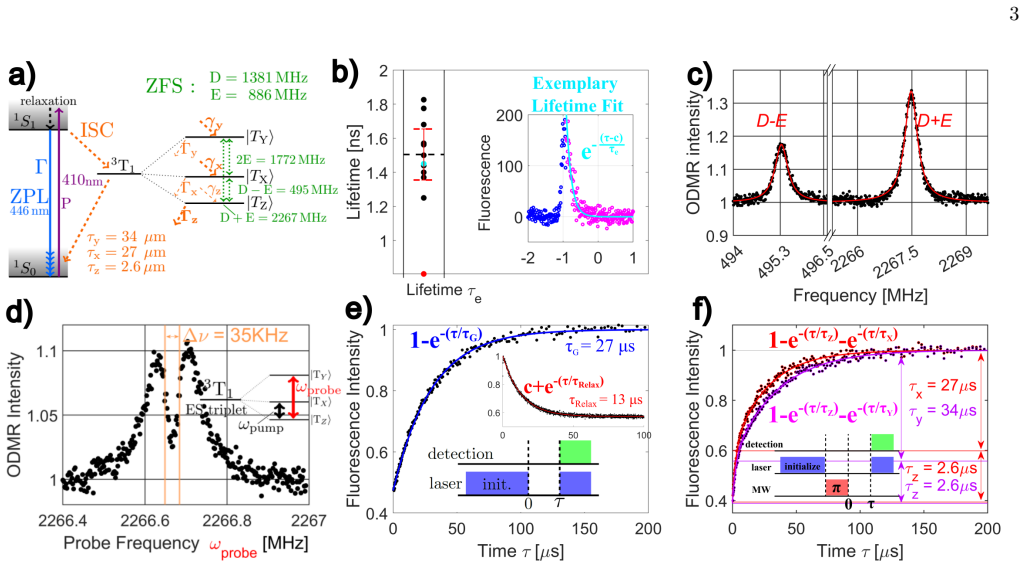
The load-bearing object is the assumed electronic level structure: a singlet ground state, a singlet excited state, and a metastable triplet with zero-field splitting parameters D = 1636.6 MHz and E = 896.6 MHz. All dynamics, including brightness, ODMR contrast, magnetic maps, and the wide-angle sensing claim, are computed from a non-equilibrium steady-state rate model on these five levels, with intersystem crossing rates into and out of the triplet as fitted parameters. The mechanism that carries the wide-angle claim is magnetic-field-induced mixing of the triplet sublevels: in strong fields with arbitrary orientation, the triplet eigenstates become superpositions whose transition rates are weighted mixtures of the zero-field rates, so the population redistribution that produces ODMR contrast survives across nearly all field directions. A second key element is the convention that practical vector magnetometry uses the second-highest ODMR contrast among the three transitions, since reconstructing a field requires at least two transition frequencies.
What would settle it
Place a single ST2 center in a calibrated three-axis vector magnet, hold the field magnitude fixed at 30 mT, rotate the field direction over the full sphere, and measure the second-highest ODMR contrast at each orientation; if the contrast collapses in any substantial region of the sphere, the Figure 3d prediction fails. A sharper check is to drive the missing Tx-Ty ODMR transition with two microwave tones and confirm that its frequency matches the spin Hamiltonian built from D = 1636.6 MHz and E = 896.6 MHz.
Extended reading notes
Core claim
On the paper's own terms, the central discovery is that the ST2 center has a level structure consisting of a singlet ground state, a singlet excited state, and a metastable spin-1 triplet, and that this scheme yields optically detected magnetic resonance contrast across nearly the entire 4pi unit sphere at 30 mT. The authors show that ST2 centers appear naturally in diamond and can be deliberately produced by implanting carbon-12 ions and annealing at about 1200 degrees Celsius, with formation yield proportional to the implantation-induced vacancy profile, indicating an intrinsic defect that likely involves both vacancies and interstitial carbon. They extract zero-field splitting parameters D = 1636.6 MHz and E = 896.6 MHz, metastable sublevel lifetimes of 27, 34, and 2.6 microseconds, and two ODMR transitions at 495.3 and 2267.5 MHz. They further identify twelve inequivalent orientations consistent with inversion symmetry C_i, observe coherent population trapping, find no electric-field response up to 2 times $10^{6}$ V/m, and measure temperature shifts of 9 and -30 kHz/K, about two to three times weaker than the NV center's response. The chemical structure of the center remains unknown, and the authors state explicitly that they assume the five-level model is correct while using their data as consistency checks.
Load-bearing premise
The whole wide-angle sensing claim rests on the assumed five-level energy scheme of ground singlet, excited singlet, and metastable triplet, together with fitted intersystem crossing rates; the paper explicitly says it assumes this model is correct and uses the data only as a consistency check.
Editorial extensions
If this is right
- If the central claim holds, ST2 centers could serve as single-defect magnetometers in strong magnetic fields of tens of millitesla with arbitrary orientation, where NV centers lose contrast.
- ST2 and NV centers are complementary: NV covers weak fields and ST2 covers strong fields, so a combined sensing platform could address both regimes.
- The established production protocol of carbon implantation followed by annealing at 1200 degrees Celsius creates ST2 centers reproducibly in CVD diamond, but the yield is capped near 6 times 10^4 centers per cubic micron, limiting high-density arrays.
- The measured temperature dependence of the zero-field splitting means ST2 can act as a local thermometer when convenient, though with lower sensitivity than NV centers.
- The twelve inequivalent orientations and the assignment of the triplet z-axis to the [111] diamond direction provide the geometric information needed to interpret single-center magnetic measurements, though the paper notes that ODMR alone yields only a combination of angles, not the full field orientation.
Reading between the lines
- Editorial inference: if the metastable-triplet picture is right, the wide-angle sensing property should persist or even improve at fields beyond 30 mT, because the Zeeman mixing that preserves contrast grows with field strength; a natural test is to extend the simulation to 100 mT and look for contrast loss in any direction.
- Editorial inference: the absence of electric-field sensitivity, attributed to inversion symmetry, implies ST2 could operate in electrically noisy environments without crosstalk, an advantage the paper mentions only indirectly.
- Editorial inference: because the intersystem crossing rates gamma_x and gamma_y are fitted rather than measured directly, a decisive check would be time-resolved population measurements after a calibrated microwave pulse, which the current continuous-wave data do not fully constrain.
- Editorial inference: the failed attempts with helium and lead implantation suggest that interstitial carbon itself, not just lattice damage, is required for ST2 formation; a search for lower-damage routes such as electron irradiation could test this and potentially lift the yield bottleneck.
Editorial analysis
A structured set of objections, weighed in public.
Referee Report
Summary. The manuscript reports the discovery and controlled creation of ST2 centers in natural and CVD diamond, characterizes their optical and spin properties at the single-defect level, assigns twelve inequivalent orientations in the diamond lattice, and presents a simulated ODMR-contrast surface at 30 mT claimed to show usable contrast over nearly the entire 4π sphere. On this basis the authors propose ST2 centers as a complement to NV centers for sensing strong, arbitrarily oriented magnetic fields. The paper also reports temperature sensitivity and an absence of first-order electric-field sensitivity.
Significance. If the central sensing claim were established, ST2 centers would be a genuinely useful addition to the quantum-sensing toolbox, since NV centers lose contrast for strong misaligned fields. The paper has clear strengths: a reproducible creation protocol by 12C implantation and annealing, careful single-defect spectroscopy, direct lifetime measurements of all three triplet sublevels, and a systematic comparison of measured and simulated magnetic maps. The simulated 4π acceptance-angle surface is a falsifiable prediction in principle, and the paper explicitly admits the key model assumption. However, the simulation-based central claim currently rests on internally inconsistent input parameters, and the validation offered for the 30 mT surface is indirect. These issues are load-bearing, so the significance cannot be assessed until they are resolved.
major comments (3)
- [§II.B and Supplementary Note 8] The reported zero-field ODMR resonances at 495.3 MHz and 2267.5 MHz are incompatible with the stated values D = 1636.6 MHz and E = 896.6 MHz. Using the Hamiltonian in Eq. (9) of Supplementary Note 8, with eigenvalues -2D/3, D/3−E, D/3+E, the allowed zero-field transition energies are |D−E| = 740.0 MHz, D+E = 2533.2 MHz, and 2E = 1793.2 MHz; none of these equals the observed pair. The observed pair instead yields D = (495.3+2267.5)/2 = 1381.4 MHz and E = (2267.5−495.3)/2 = 886.1 MHz. Since the zero-field parameters are used for the sublevel assignments in §II.C and feed directly into the simulation that generates Fig. 3d, this is more than a typographical issue: the manuscript must either correct D and E or the reported resonance frequencies, and then re-run the orientation and contrast simulations.
- [§II.B and Supplementary Note 10] The explanation for the missing Tx–Ty ODMR line requires the condition γx/Γx = γy/Γy (Supplementary Note 10), while the same passage states that fits to the observed contrasts of the two existing lines require γx = γy. With the directly measured lifetimes τx = 27 μs and τy = 34 μs, these two constraints cannot both hold: γx = γy gives γx/Γx = 27 γx versus γy/Γy = 34 γy, while γx/Γx = γy/Γy forces γx/γy = 34/27 ≈ 1.26. The rates γi and Γi enter Eqs. (12)–(13) of Supplementary Note 8, which are used to compute the field-mixed rates that determine the ODMR contrast surface in Fig. 3d. Please provide a single explicit set of rates satisfying both constraints, or state clearly which constraint is being relaxed, and quantify how the simulated contrast surface depends on the allowed range of the fitted rates.
- [§II.D, Fig. 3d, and Supplementary Note 9] The central claim of wide-angle sensing at 30 mT is a simulation output, not a direct measurement: Fig. 3d shows the computed second-highest ODMR contrast, and the validation offered is that 'the simulation can reproduce the measured maps in Figure 3a.' That validation is indirect because the maps are fluorescence-brightness maps over a range of field strengths and orientations, and the same S=1 model and fitted parameters are used to produce both the maps and the contrast surface. Given the parameter inconsistencies noted above, the uniqueness and reliability of the Fig. 3d surface are not established. The authors should either perform direct ODMR contrast measurements at several controlled magnetic-field orientations at fixed 30 mT, or explicitly present Fig. 3d as a model prediction and analyze its sensitivity to the assumed triplet structure, the fitted γi, and the cross-term-averaging assumption in Supplementary Note 8.
minor comments (4)
- [References] Reference [20] is a placeholder ('Me-Myself and I, Placeholder for supplementary info'), yet the main text and supplementary notes repeatedly cite this entry for crucial details; it must be replaced with a proper citation to the actual supplementary material.
- [Introduction] The Introduction contains garbled text ('sfirst observed in a natural di- amondingle defects') and duplicates references [1] and [3]; please proofread and deduplicate.
- [§II.E and Fig. 3e] The text states 'shifts of 10.5 kHz/K for D and −19.5 kHz/K for E,' but the resonance shifts reported just above are +9 kHz/K and −30 kHz/K; with D = (f_high + f_low)/2 and E = (f_high − f_low)/2, the inferred temperature coefficients are ΔD = −10.5 kHz/K and ΔE = −19.5 kHz/K. Please correct the signs or the stated resonance shifts.
- [Throughout] Several citations in the reference list are malformed (for example, [17]), and the phrase 'in principal' in §II.E should be 'in principle'; a full copyedit is needed before publication.
Circularity Check
The wide-angle sensing claim is a simulation using rates fitted to the same ODMR data; the model assumption is explicit, so circularity is partial rather than total.
-
fitted input called prediction
[Section II.D, Figure 3d; Supplementary Note 10]
"The same model used to reproduce the measured maps in Figure 3a can also simulate the magnetic contrast of a single ST2 center. ... The result of such a simulation is shown in Figure 3d. At a magnetic field strength of 30 mT, a significant ODMR contrast is available across nearly the entire 4π unit sphere."
The model's intersystem-crossing rates γx, γy, γz are fit parameters: Supplementary Note 10 states 'Currently, these values are treated as fit parameters to match the overall ODMR contrast observed in measurements.' Those fitted contrasts are from the same zero-field ODMR data (Figure 2c) that the model is then said to reproduce, and Figure 3d is generated with that same parameter set. The angular acceptance map is not itself a fit, so the near-4π prediction is a nontrivial consequence of the spin Hamiltonian rather than an identity; but the headline sensing claim is not independently constrained because the paper also admits 'multiple combinations of different rates could explain the data.'
full rationale
The main derivation chain is an assumed level model, ODMR and lifetime measurements, fitted transition rates, and a spin-1 Hamiltonian simulation. The 4π contrast surface is not circular in the strongest sense: the orientation dependence follows from the Hamiltonian and field mixing, not from renaming the measured data, and the measured magnetic maps provide some constraint on the orientation assignment via NV comparison. However, the validation offered for the simulation is in-sample: the same measured ODMR contrasts that fix γx, γy, γz are used to 'confirm' the model, and the parameter set is underdetermined. Separately, and not a circularity: the quoted D = 1636.6 MHz and E = 896.6 MHz are inconsistent with the paper's own two measured zero-field resonances: under D±E these give 2533.2 and 740.0 MHz rather than 2267.5 and 495.3 MHz. The model assumption is also explicitly imported from prior work including the authors' TR12 study, but it is presented as an assumption with consistency checks, so it is not smuggled. Weighing these, the central claim retains independent physical content but is partly supported by fitting the same data it claims to predict; score 4.
Assumptions & free parameters
free parameters (5)
- D zero-field splitting =
1636.6 MHz
- E zero-field splitting =
896.6 MHz
- Intersystem crossing rates gamma_x, gamma_y, gamma_z =
Not uniquely determined; multiple solutions
- Formation proportionality constant a1 =
Approximately 2e-8 centers/ion
- x/y axis rotation angle relative to lattice =
Not stated; determined by fitting
assumptions (4)
- domain assumption ST2 has a ground singlet, excited singlet, and metastable triplet (Figure 2a).
- domain assumption The spin-1 Hamiltonian H = D(Sz^2 - S(S+1)/3) + E(Sx^2 - Sy^2) + g mu_B S dot B describes the metastable triplet.
- ad hoc to paper Cross terms between different triplet sublevels in the intersystem crossing matrix elements average to zero (Supp Note 8, Eqs. 12-13).
- domain assumption SRIM-TRIM simulations reproduce the implantation vacancy profile.
Cite this review
Pith. "Pith review of Discovery of ST2 centers in natural and CVD diamond." pith.science (2026). https://pith.science/paper/3MKGD2OG
@misc{pith2026250100570,
  author       = {Pith},
  title        = {Pith review of: Discovery of ST2 centers in natural and CVD diamond},
  year         = {2026},
  howpublished = {\url{https://pith.science/paper/3MKGD2OG}},
  note         = {Machine review of arXiv:2501.00570}
}
read the original abstract
The ST2 center is an optically addressable point defect in diamond that facilitates spin initialization and readout. However, while this study presents the discovery of ST2 centers first observed in a natural diamond and provides a reliable technique for artificially creating them, its chemical structure remains unknown. To assess the potential of ST2, we map out its basic optical characteristics, reveal its electronic level structure, and quantify the intrinsic transition rates. Furthermore, we investigate its response to microwaves, static magnetic fields, and the polarization of excitation laser light, revealing twelve inequivalent orientations of the ST2 center. Simultaneous exposure to microwaves and static magnetic fields also reveals an exceptionally wide acceptance angle for sensing strong magnetic fields, unlike the well-established NV center, which is sensitive only within a narrow cone aligned with its symmetry axis. This finding establishes the ST2 center as a highly promising candidate for nanoscale quantum sensing.
Figures


Reference graph
Works this paper leans on
-
[20]
Me-Myself and I, Placeholder for supplementary info
- [2]
-
[3]
P. Rembold, N. Oshnik, M. M. M¨ uller, S. Montangero, T. Calarco, and E. Neu, Introduction to quantum optimal control for quantum sensing with nitrogen-vacancy cen- ters in diamond, AVS Quantum Science2, 024701 (2020)
work page 2020
- [4]
-
[5]
J. Brossel and F. Bitter, A new ”double resonance” method for investigating atomic energy levels. applica- tion to Hg 3p1, Phys. Rev. 86, 308 (1952)
work page 1952
-
[6]
T. Staudacher, F. Shi, S. Pezzagna, J. Meijer, J. Du, C. A. Meriles, F. Reinhard, and J. Wrachtrup, Nuclear magnetic resonance spectroscopy on a (5-nanometer)3 sample volume, Science 339, 561 (2013)
work page 2013
-
[7]
Zaitsev, Optical Properties of Diamond , 1st ed
A. Zaitsev, Optical Properties of Diamond , 1st ed. (Springer, 2001)
work page 2001
-
[8]
V. M. Acosta, C. Santori, A. Faraon, Z. Huang, K.- M. C. Fu, A. Stacey, D. A. Simpson, K. Ganesan, S. Tomljenovic-Hanic, A. D. Greentree, S. Prawer, and R. G. Beausoleil, Dynamic stabilization of the optical res- onances of single nitrogen-vacancy centers in diamond, Phys. Rev. Lett. 108, 206401 (2012)
2012
Show all 31 references
-
[9]
G. D. Fuchs, V. V. Dobrovitski, D. M. Toyli, F. J. Here- mans, C. D. Weis, T. Schenkel, and D. D. Awschalom, Excited-state spin coherence of a single nitrogen–vacancy centre in diamond, Nature Physics 6, 668 (2010)
2010
-
[10]
Y. Shen, T. M. Sweeney, and H. Wang, Zero-phonon linewidth of single nitrogen vacancy centers in diamond nanocrystals, Phys. Rev. B 77, 033201 (2008)
2008
-
[12]
Dolde, H
F. Dolde, H. Fedder, M. W. Doherty, T. N¨ obauer, F. Rempp, G. Balasubramanian, T. Wolf, F. Reinhard, L. C. L. Hollenberg, F. Jelezko, and J. Wrachtrup, Electric-field sensing using single diamond spins, Nature Physics 7, 459 (2011)
2011
-
[13]
Kucsko, P
G. Kucsko, P. C. Maurer, N. Y. Yao, M. Kubo, H. J. Noh, P. K. Lo, H. Park, and M. D. Lukin, Nanometre- scale thermometry in a living cell, Nature 500, 54 (2013)
2013
-
[14]
Ren and S
Y. Ren and S. Takahashi, Detection of electron param- agnetic resonance of two electron spins using a single nv center in diamond, APL Quantum 1, 046108 (2024)
2024
-
[15]
Qnami, Quantum sensing leaders in nanoscale pre- cision, https://qnami.ch/wp-content/uploads/2021/ 03/Quantum-Foundry-Case-Study-16.03.2021.pdf . 8
2021
-
[16]
Tetienne1, L
J.-P. Tetienne1, L. Rondin, P. Spinicelli, M. Chipaux, T. Debuisschert, J.-F. Roch, and V. Jacques, Magnetic- field-dependent photodynamics of single nv defects in di- amond: an application to qualitative all-optical magnetic imaging, New Journal of Physics 14 (2012)
2012
-
[17]
the absorption spectra of natural and irradiated diamonds
C. C.D., R. Ditchburn, and H. Dyer, “the absorption spectra of natural and irradiated diamonds.”, Proceed- ings of the Royal Society of London. Series A, Mathe- matical and Physical Sciences 234, 363 (1956)
1956
-
[19]
J. F. Ziegler, M. D. Ziegler, and J. P. Biersack, Srim – the stopping and range of ions in matter (2010), Nuclear Instruments and Methods in Physics Research Section B: Beam Interactions with Materials and Atoms 268, 1818 (2010)
2010
-
[21]
Wrachtrup, C
J. Wrachtrup, C. von Borczyskowski, J. Bernard, M. Or- rit, and R. Brown, Optically detected spin coherence of single molecules, Phys. Rev. Lett. 71, 3565 (1993)
1993
-
[22]
S.-Y. Lee, M. Widmann, T. Rendler, M. W. Doherty, T. M. Babinec, S. Yang, M. Eyer, P. Siyushev, B. J. M. Hausmann, M. Loncar, Z. Bodrog, A. Gali, N. B. Man- son, H. Fedder, and J. Wrachtrup, Readout and control of a single nuclear spin with a metastable electron spin ancilla, ...
2013
-
[23]
S. A. Momenzadeh, R. J. St¨ ohr, F. F. de Oliveira, A. Brunner, A. Denisenko, S. Yang, F. Reinhard, and J. Wrachtrup, Nanoengineered diamond waveguide as a robust bright platform for nanomagnetometry using shallow nitrogen vacancy centers, Nano Letters 15, 165 (2015)
2015
-
[24]
Morigi, J
G. Morigi, J. Eschner, and C. H. Keitel, Ground state laser cooling using electromagnetically induced trans- parency, Phys. Rev. Lett. 85, 4458 (2000)
2000
-
[30]
R. M. Whitley and C. R. Stroud, Double optical reso- nance, Phys. Rev. A 14, 1498 (1976). Discovery of ST2 centers in natural and CVD diamond Jonas Foglszinger1, Andrej Denisenko 1, Georgy V. Astakhov 2, Lev Kazak 3, Petr Siyushev 4, Alexander M. Zaitsev 5, Roman Kolesov 1, an...
1976 arXiv
-
[32]
Foglszinger, A
J. Foglszinger, A. Denisenko, T. Kornher, M. Schreck, W. Knolle, B. Yavkin, R. Kolesov, and J. Wrachtrup, Tr12 centers in diamond as a room temperature atomic scale vector magnetometer, npj Quantum Information 8, 65 (2022)
2022
-
[33]
Y. I. Khanin and O. A. Kocharovskaya, Inversionless am- plification of ultrashort pulses and coherent population trapping in a three-level medium, J. Opt. Soc. Am. B 7, 2016 (1990)
1990
-
[34]
Arimondo and G
E. Arimondo and G. Orriols, Nonabsorbing atomic coher- ences by coherent two-photon transitions in a three-level optical pumping, Letter.e al nuovo cimento 17 (1976)
1976
-
[35]
H. R. Gray, R. M. Whitley, and C. R. Stroud, Coherent trapping of atomic populations, Opt. Lett. 3, 218 (1978)
1978
-
[36]
Yoo and J
H.-I. Yoo and J. Eberly, Dynamical theory of an atom with two or three levels interacting with quantized cavity fields, Physics Reports 118, 239 (1985)
1985
-
[37]
R. G. Brewer and E. L. Hahn, Coherent two-photon pro- cesses: Transient and steady-state cases, Phys. Rev. A 11, 1641 (1975)
1975
-
[38]
R. M. Whitley and C. R. Stroud, Double optical reso- nance, Phys. Rev. A 14, 1498 (1976)
1976
-
[39]
Balasubramanian, I
G. Balasubramanian, I. Y. Chan, R. Kolesov, M. Al- Hmoud, J. Tisler, C. Shin, C. Kim, A. Wojcik, P. R. Hem- mer, A. Krueger, T. Hanke, A. Leitenstorfer, R. Brats- chitsch, F. Jelezko, and J. Wrachtrup, Nanoscale imaging magnetometry with diamond spins under ambient condi- tion...
2008
-
[111]
orientation of diamond. Considering the four dis- tinct orientations of [111] in diamond, combined with the three-fold rotational symmetry of the diamond lattice, this immediately suggests the existence of twelve differ- ently oriented ST2 centers, which are organized into fou...
Reviewed August 10, 2026 · model on record in the stance chip above.
Discussion (0). Continue with ORCID to comment.