REVIEW 1 major objections 39 references
Verification and Performance Assessment of NuDEAL, a GPU-Accelerated Deterministic Transport Framework on Unstructured Meshes
T0 review · 1 major / 0 minor · reviewed 2026-07-03 · grok-4.3
Pith's one-line read GPU-accelerated deterministic solvers on unstructured meshes deliver accuracy and scalability for whole-core reactor simulations.
desk verdict NuDEAL gives a working unified GPU framework for three transport methods with solid benchmark numbers, but the whole-core scalability claim extrapolates from smaller test cases. read the letter →
The pith
A machine-rendered reading of the paper's core claim, the machinery that carries it, and where it could break.
The reading
What carries the argument
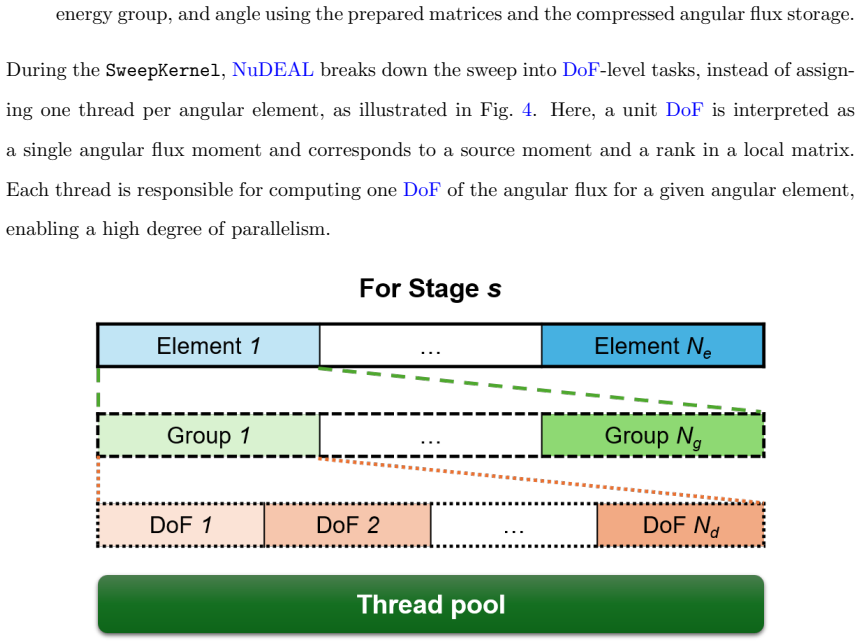
The NuDEAL unified framework that implements and selectively deploys MOC/HFEM, DGMOC, and DFEM-SN solvers, each optimized for GPU execution via memory alignment, compressed-flux storage, and sequential azimuthal sweeps to solve the multigroup transport equation consistently on unstructured meshes.
What would settle it
A run of the C5G7 or MSRE problem on the same hardware showing eigenvalue error above 50 pcm for DFEM-SN or single-GPU runtimes substantially exceeding the reported CPU-cluster equivalents for MOC/HFEM or DGMOC.
Extended reading notes
Core claim
NuDEAL unifies three complementary deterministic solvers—MOC/HFEM, DGMOC, and DFEM-SN—on unstructured meshes, all accelerated on GPUs through memory alignment, compressed-flux storage, and sequential azimuthal sweeps. Validation on C5G7 and application to ABTR, Empire, and MSRE show DFEM-SN achieving eigenvalue errors below 50 pcm while MOC/HFEM and DGMOC deliver single-GPU runtimes comparable to large CPU clusters, establishing that deterministic GPU solvers can enable practical whole-core simulations for heterogeneous advanced reactors.
Load-bearing premise
The benchmark results are taken as sufficient proof that the solvers contain no significant implementation or numerical errors and that the tested problems adequately represent real advanced reactor applications.
Editorial extensions
If this is right
- DFEM-SN supplies the highest accuracy among the three solvers with eigenvalue errors below 50 pcm.
- MOC/HFEM and DGMOC achieve the best computational efficiency, with single-GPU times matching large CPU clusters.
- The framework permits choosing among the three solvers to trade accuracy against memory and runtime cost for a given geometry.
- Whole-core simulations become practical for heterogeneous advanced reactors that require unstructured meshes.
- The same code base provides a direct path to transient and multiphysics extensions on large-scale GPU hardware.
Reading between the lines
- The same GPU optimizations could be applied to deterministic transport in other fields such as radiative transfer or charged-particle problems.
- Coupling the framework to existing multiphysics codes would allow testing whether the reported speedups persist under coupled iteration.
- Users facing memory-limited problems could systematically compare the three solvers on the same mesh to quantify the accuracy-efficiency frontier.
- Extension to multi-GPU or distributed GPU clusters would test whether the observed single-GPU scaling continues linearly with problem size.
Signed reviews
Editorial analysis
A structured set of objections, weighed in public.
Referee Report
Summary. The paper presents NuDEAL, a unified GPU-accelerated framework implementing three deterministic transport solvers (planar MOC/HFEM, DGMOC, and DFEM-SN) on unstructured meshes for solving the multigroup transport equation. It reports verification on the C5G7 benchmark (eigenvalue errors below 50 pcm for DFEM-SN) and applications to ABTR, Empire microreactor, and MSRE problems, with single-GPU runtimes claimed comparable to large CPU clusters, concluding that the methods enable practical whole-core simulations for heterogeneous advanced reactors.
Significance. If the reported accuracy and performance metrics hold under independent verification, the work demonstrates concrete GPU acceleration for unstructured-mesh deterministic transport, providing a foundation for efficient high-fidelity neutronic analysis of advanced reactors and extensions to multiphysics.
major comments (1)
- [Abstract] Abstract and results discussion: the central claim that the solvers 'enable practical whole-core simulations for heterogeneous advanced reactors' is load-bearing but rests on extrapolation; the tested cases (C5G7 plus ABTR, Empire microreactor, MSRE) are orders of magnitude smaller than commercial whole-core models, with no reported scaling studies, larger-domain timings, or heterogeneity metrics to support the assertion.
Simulated Author's Rebuttal
We thank the referee for the constructive feedback on our manuscript. We address the single major comment below and agree that revisions are warranted to moderate the central claim.
read point-by-point responses
-
Referee: [Abstract] Abstract and results discussion: the central claim that the solvers 'enable practical whole-core simulations for heterogeneous advanced reactors' is load-bearing but rests on extrapolation; the tested cases (C5G7 plus ABTR, Empire microreactor, MSRE) are orders of magnitude smaller than commercial whole-core models, with no reported scaling studies, larger-domain timings, or heterogeneity metrics to support the assertion.
Authors: We agree with the referee that the tested problems are substantially smaller than commercial whole-core models and that the manuscript contains no explicit strong-scaling studies, larger-domain timings, or quantitative heterogeneity metrics to directly support the assertion. The claim was intended to reflect the observed single-GPU performance relative to large CPU clusters on the reported benchmarks together with the unstructured-mesh capability, but we recognize that this constitutes an extrapolation. We will revise the abstract, introduction, and conclusions to replace the phrasing 'enabling practical whole-core simulations' with 'providing a foundation toward practical whole-core simulations' and will add an explicit statement noting the absence of scaling studies to larger domains and the need for future work in that direction. These changes will be made without altering the reported verification and timing results. revision: yes
Circularity Check
No circularity: claims rest on direct benchmark runs and runtime measurements
full rationale
The paper implements three transport solvers (MOC/HFEM, DGMOC, DFEM-SN) inside NuDEAL, verifies them on the external C5G7 benchmark, and reports wall-clock times and eigenvalue errors on ABTR, Empire, and MSRE. All performance numbers and accuracy statements are obtained by executing the code on those meshes and comparing against reference solutions or CPU baselines; no parameter is fitted to a subset of the target data and then re-labeled as a prediction, no equation is defined in terms of its own output, and no load-bearing uniqueness theorem is imported from prior self-citations. The central assertion that the solvers are accurate and scalable therefore reduces to the measured results on the reported cases rather than to any self-referential construction.
Assumptions & free parameters
Cite this review
Pith. "Pith review of Verification and Performance Assessment of NuDEAL, a GPU-Accelerated Deterministic Transport Framework on Unstructured Meshes." pith.science (2026). https://pith.science/paper/3NEGP5RX
@misc{pith2026260701591,
  author       = {Pith},
  title        = {Pith review of: Verification and Performance Assessment of NuDEAL, a GPU-Accelerated Deterministic Transport Framework on Unstructured Meshes},
  year         = {2026},
  howpublished = {\url{https://pith.science/paper/3NEGP5RX}},
  note         = {Machine review of arXiv:2607.01591}
}
read the original abstract
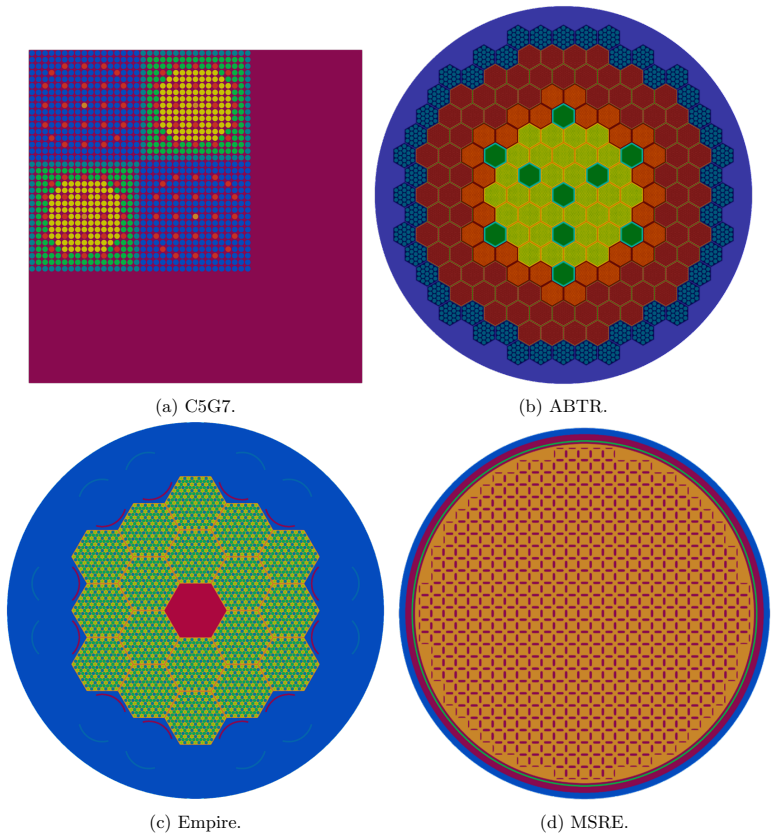
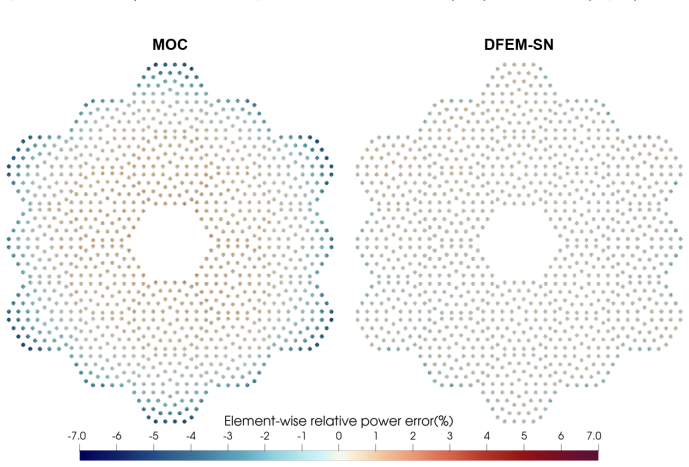
High-fidelity neutronic analyses of advanced reactors require deterministic transport solvers capable of handling complex unstructured geometries while maintaining computational efficiency. This work presents the development and verification of three GPU-accelerated deterministic solvers implemented within a unified framework, Neutronics using Deterministic Finite Element Algorithm (NuDEAL): the planar Method of Characteristics coupled with the Hybrid Finite Element Method (MOC/HFEM), the Discontinuous Galerkin Method of Characteristics (DGMOC), and the Discontinuous Finite Element discrete ordinate method (DFEM-SN). These solvers provide complementary capabilities for consistently solving the multigroup transport equation and can be selectively employed to balance accuracy, computational cost, and memory requirements for a given problem. All methods emphasize efficient GPU execution by leveraging memory alignment, compressed-flux storage, and sequential azimuthal sweeps. The solvers are validated on the C5G7 benchmark and applied to advanced reactor problems, including the ABTR, Empire microreactor, and MSRE. DFEM-SN achieved the highest accuracy, with eigenvalue errors below 50 pcm, while MOC/HFEM and DGMOC provided superior efficiency, with single-GPU runtimes comparable to those of large CPU clusters. The results demonstrate that deterministic GPU solvers on unstructured meshes can deliver both accuracy and scalability, enabling practical whole-core simulations for heterogeneous advanced reactors. The unified NuDEAL framework establishes a foundation for future extensions toward transient and multiphysics analyses on large-scale GPU architectures.
Figures


Figures from the paper (12 more)





Reference graph
Works this paper leans on
-
[1]
Allen, Kenneth and Knight, Travis and Bays, Samuel , year = 2011, journal =. Benchmark of. doi:10.1016/j.pnucene.2011.01.007 , abstract =
-
[2]
Blacker, T. D. and Bohnhoff, W. J. and Edwards, T. L. , year = 1994, journal =
work page 1994
-
[3]
Botsch, M and Steinberg, S and Bischoff, S and Kobbelt, L , year = 1999, journal =
work page 1999
-
[4]
Boyd, William and Shaner, Samuel and Li, Lulu and Forget, Benoit and Smith, Kord , year = 2014, journal =. The
work page 2014
-
[5]
Cho, Jin Young and Kim, Kang Seog and Lee, Chung Chan and Zee, Sung Quun and Joo, Han Gyu , year = 2007, journal =. Axial
work page 2007
-
[6]
Optimization of Neutron Tracking Algorithms for
Choi, Namjae and Kim, Kyung Min and Joo, Han Gyu , year = 2021, month = nov, journal =. Optimization of Neutron Tracking Algorithms for. doi:10.1016/j.anucene.2021.108508 , urldate =
-
[7]
Progress in Nuclear Energy , volume =
Practical Acceleration of Direct Whole-Core Calculation Employing Graphics Processing Units , author =. Progress in Nuclear Energy , volume =. doi:10.1016/j.pnucene.2021.103631 , urldate =
-
[8]
DeHart, Mark D and Ortensi, Javier and Laboure, Vincent M , year = 2020, journal =
work page 2020
Show all 39 references
-
[9]
Nuclear Science and Engineering , volume =
Variational Nodal Methods for Neutron Transport , author =. Nuclear Science and Engineering , volume =. doi:10.13182/NSE85-A27436 , file =. https://doi.org/10.13182/NSE85-A27436 , pages =
-
[10]
doi:10.1016/j.jcp.2011.04.010 , urldate =
Gong, Chunye and Liu, Jie and Chi, Lihua and Huang, Haowei and Fang, Jingyue and Gong, Zhenghu , year = 2011, month = jul, journal =. doi:10.1016/j.jcp.2011.04.010 , urldate =
2011 doi
-
[11]
and Brown, P
Hanebutte, U. and Brown, P. N. , year = 1999, number =
1999
-
[12]
Multiphysics
Im, Jaeuk and Jeong, Myung Jin and Choi, Namjae and Kim, Kyung Min and Cho, Hyoung Kyu and Joo, Han Gyu , year = 2023, journal =. Multiphysics
2023
-
[13]
Annals of Nuclear Energy , volume =
Practical Numerical Reactor Employing Direct Whole Core Neutron Transport and Subchannel Thermal/Hydraulic Solvers , author =. Annals of Nuclear Energy , volume =. doi:10.1016/j.anucene.2013.06.031 , urldate =
2013 doi
-
[14]
Kim, Kyung Min and Lee, Han Gyu and Im, Jaeuk and Shim, Hyung Jin , year = 2024, volume =. Joint
2024
-
[15]
Benchmark
Kim, Taek K , year = 2020, journal =. Benchmark
2020
-
[16]
International
Kim, Kyung Min and Lee, Han Gyu and Yoon, Jooil and Joo, Han Gyu , year = 2023, month = aug, address =. International
2023
-
[17]
, year = 2013, journal =
Kochunas, Brendan M. , year = 2013, journal =. A
2013
-
[18]
Kunen, A and Loffeld, J and Black, A and Chen, R and Nowak, P and Bailey, T and Brown, P and Rennich, S and Maginot, P , year = 2019, langid =. Porting. International
2019
-
[19]
Lewis, E. E. , year = 2004, journal =. Much Ado about Nothing:
2004
-
[20]
Performance Analysis of a Two-Step Calculation Procedure Based on
Lim, Changhyun and Kwon, Sung Joon and Yoon, Jooil , year = 2025, journal =. Performance Analysis of a Two-Step Calculation Procedure Based on
2025
-
[21]
Argonne National Laboratory , number =
Development. Argonne National Laboratory , number =
-
[22]
and Smith, M
Palmiotti, G. and Smith, M. and Rabiti, C. and Leclere, M. and Kaushik, D. and Siegel, A. and Smith, B. and Lewis, E. E. , year = 2007, abstract =. Joint
2007
-
[23]
and Gaston, Derek R
Permann, Cody J. and Gaston, Derek R. and Andr. SoftwareX , volume =. doi:10.1016/j.softx.2020.100430 , urldate =
2020 doi
-
[24]
and Gibson, Marc A
Poston, David I. and Gibson, Marc A. and Godfroy, Thomas and McClure, Patrick R. , year = 2020, journal =
2020
-
[25]
and Jung, Yeon Sang and Kumar, Shikhar and Wang, Yaqi and Hanophy, Joshua T
Prince, Zachary M. and Jung, Yeon Sang and Kumar, Shikhar and Wang, Yaqi and Hanophy, Joshua T. and Laboure, Vincent M. and Lee, Changho , year = 2022, journal =. Performance
2022
-
[26]
and Thomas, J
Raviart, P.A. and Thomas, J. M. , year = 1977, journal =. Primal
1977
-
[27]
Shen, Dan and Fratoni, Massimiliano and Ilas, Germina and Powers, Jeffrey , year = 2006, journal =
2006
-
[28]
Smith, Michael A and Lewis, E. E. and Na, Byung-Chan , year = 2005, journal =. Benchmark on Deterministic Transport Calculations without Spatial Homogenization (
2005
-
[29]
Smith, M. A. and Lewis, E. E. and Shemon, E. R. , year = 2014, journal =
2014
-
[30]
A Discrete-Ordinates Variational Nodal Method for Heterogeneous Neutron
Sun, Qizheng and Liu, Xiaojing and Chai, Xiang and He, Hui and Zhang, Tengfei , year = 2024, journal =. A Discrete-Ordinates Variational Nodal Method for Heterogeneous Neutron. doi:10.1016/j.camwa.2024.06.032 , abstract =
2024 doi
-
[31]
Vladimirov, V. S. , year = 1961, journal =. Mathematical
1961
-
[32]
Vladimirov, V S , langid =. A
-
[33]
and Park, Hansol and Calvin, Olin W
Wang, Yaqi and Prince, Zachary M. and Park, Hansol and Calvin, Olin W. and Choi, Namjae and Jung, Yeon Sang and Schunert, Sebastian and Kumar, Shikhar and Hanophy, Joshua T. and Labour. Griffin:. Annals of Nuclear Energy , volume =. doi:10.1016/j.anucene.2024.110917 , urldate =
2024 doi
-
[34]
Rattlesnake:
Wang, Yaqi and Schunert, Sebastian and Ortensi, Javier and Laboure, Vincent and DeHart, Mark and Prince, Zachary and Kong, Fande and Harter, Jackson and Balestra, Paolo and Gleicher, Frederick , year = 2021, month = jul, journal =. Rattlesnake:. doi:10.1080/00295450.2020.18433...
2021 doi
-
[35]
Rattlesnake
Wang, Yaqi and Schunert, Sebastian and Laboure, Vincent , year = 2018, month = apr, number =. Rattlesnake. doi:10.2172/1466687 , urldate =
2018 doi
-
[36]
Accelerating a Three-Dimensional
Zhang, ZhiZhu and Wang, Kan and Li, Qing , year = 2013, month = dec, journal =. Accelerating a Three-Dimensional. doi:10.1016/j.anucene.2013.06.039 , urldate =
2013 doi
-
[37]
doi:10.1016/j.net.2025.103597 , urldate =
Zhang, Ao and Hong, Ser Gi and Jeong, Seungil and Chen, Jingen , year = 2025, month = sep, journal =. doi:10.1016/j.net.2025.103597 , urldate =
2025 doi
-
[38]
Quadratic Axial Expansion Function with Sub-Plane Acceleration Scheme for the High-Fidelity Transport Code
Zhang, Guangchun and Yang, Won Sik , year = 2020, journal =. Quadratic Axial Expansion Function with Sub-Plane Acceleration Scheme for the High-Fidelity Transport Code
2020
-
[39]
Nuclear Engineering and Technology , volume =
Variational Nodal Methods for Neutron Transport: 40 Years in Review , author =. Nuclear Engineering and Technology , volume =. doi:10.1016/j.net.2022.04.012 , abstract =
2022 doi
Reviewed July 3, 2026 · model on record in the stance chip above.
Discussion (0). Continue with ORCID to comment.