Ten Digits on a Train: AI-Assisted Verification of Two Eigenvalue Problems
Pith reviewed 2026-06-26 07:19 UTC · model grok-4.3
The pith
AI-assisted methods certify the complete negative spectrum of a singular Schrödinger operator to ten decimals and separate a non-normal resonance pair to ten digits each.
A machine-rendered reading of the paper's core claim, the machinery that carries it, and where it could break.
Core claim
For the singular self-adjoint Schrödinger operator the complete negative spectrum is certified to ten decimal places by a verified zero count together with Dirichlet-Neumann bracketing. For the non-normal benchmark a previously unresolved resonance pair is separated and each resonance is enclosed to ten digits by reformulating the eigenvalue problem as a global matching system for projective solution lines, encoding the infinite tail as uncertainty in the terminal projective data, and applying a componentwise tail-robust Krawczyk-Brouwer inclusion.
What carries the argument
Global matching system for projective solution lines that encodes the infinite tail as uncertainty in terminal projective data, together with a componentwise tail-robust Krawczyk-Brouwer inclusion that supplies the certificate.
If this is right
- The full negative spectrum of singular self-adjoint Schrödinger operators can be certified to high precision without relying on one-way shooting.
- Non-normal eigenvalue problems with uncertain asymptotic data become rigorously solvable by projective matching rather than direct propagation.
- Validated computation yields not only numerical values but proof objects that can expose gaps in AI-generated arguments.
- The same architecture applies directly to other analytic boundary-value systems that suffer ill-conditioned propagation.
Where Pith is reading between the lines
- The method could be tested on higher-dimensional or time-dependent singular operators to check whether the projective matching still isolates resonances at ten-digit accuracy.
- Software libraries for validated numerics may need built-in componentwise checks over polydiscs to prevent the specific omission that occurred in one AI tail argument.
- Peer-review standards for computational mathematics papers may evolve to require deposit of the full proof objects rather than only the final digits.
Load-bearing premise
The reformulation as a global matching system correctly encodes the infinite tail as uncertainty in the terminal projective data and the componentwise Krawczyk-Brouwer inclusion supplies a valid certificate.
What would settle it
An explicit computation showing that the componentwise Krawczyk-Brouwer inclusion fails to hold in a nonuniform polydisc for the resonance problem, or that the verified zero count misses an eigenvalue of the Schrödinger operator.
Figures
read the original abstract
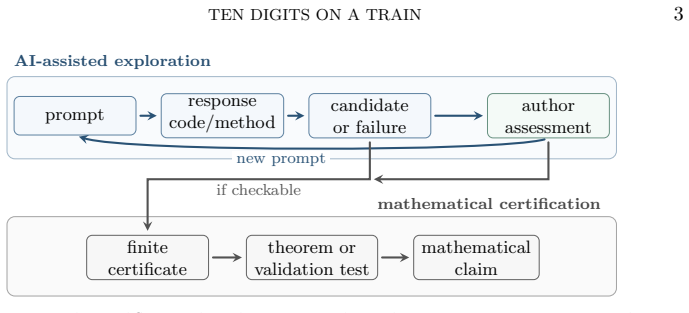
Accurate numerical eigenvalues are often difficult to certify, especially in singular or non-normal settings. This article reports a human--AI collaboration on two such computations. For a singular self-adjoint Schr\"odinger operator, a verified zero count and Dirichlet--Neumann bracketing certify the complete negative spectrum to ten decimal places. For a delicate non-normal atom--molecule benchmark, a previously unresolved resonance pair is separated, with each member enclosed to ten digits. The second result is achieved not by increasing the precision of one-way shooting, but by reformulating the problem as a global matching system for projective solution lines. The infinite tail is encoded as uncertainty in the terminal projective data, and a componentwise, tail-robust Krawczyk--Brouwer inclusion supplies the certificate. This gives a reusable architecture for analytic boundary-value systems with ill-conditioned propagation and uncertain asymptotic data. The collaboration also exposes the strengths and limits of AI assistance. AI rapidly produced accurate candidates and plausible proof strategies, but several failed, including one apparently complete tail argument that omitted the componentwise check required by a nonuniform polydisc. Validated computation is a stringent test of AI-assisted mathematics: the output is not merely a number, but a number with a proof. These examples show why the proof object matters, and why human mathematical judgment remained decisive. More broadly, as AI makes code, exposition, and plausible numerical claims inexpensive, standards for verification, attribution, peer review, and training must adapt. The implications are unsettling; the opportunity is extraordinary.
Editorial analysis
A structured set of objections, weighed in public.
Referee Report
Summary. The paper reports a human-AI collaboration verifying two eigenvalue problems to ten decimal places. For a singular self-adjoint Schrödinger operator, a verified zero count combined with Dirichlet-Neumann bracketing certifies the complete negative spectrum. For a non-normal atom-molecule benchmark, the eigenvalue problem is recast as a global matching system for projective solution lines; the infinite tail is represented as interval uncertainty in the terminal data, and a componentwise tail-robust Krawczyk-Brouwer inclusion supplies rigorous enclosures for a previously unresolved resonance pair. The work also documents both successful and failed AI-generated proof strategies, underscoring the necessity of human oversight for validated computation.
Significance. If the certificates hold, the manuscript supplies a reusable architecture for boundary-value problems with ill-conditioned propagation and uncertain asymptotics. It advances validated numerics in singular and non-normal settings while providing concrete evidence on the current limits of AI assistance in producing verifiable mathematical claims. The explicit treatment of an omitted componentwise check in an AI-generated argument is a constructive contribution to standards for AI-assisted verification.
major comments (1)
- [section describing the Krawczyk-Brouwer inclusion for the resonance pair] The enclosure of the resonance pair rests on the componentwise Krawczyk-Brouwer inclusion applied to the global matching system with tail uncertainty in a nonuniform polydisc. The abstract records that an AI-generated tail argument omitted the required componentwise check. The manuscript must explicitly demonstrate (in the section presenting the published certificate) that the radii are evaluated componentwise and that the inclusion theorem remains valid under the resulting nonuniformity; without this verification the ten-digit claim for each resonance is not guaranteed.
minor comments (2)
- Notation for the projective solution lines and the terminal data intervals would benefit from an additional clarifying sentence or small diagram.
- A few references to classical inclusion theorems (e.g., Krawczyk, Brouwer) appear only in the text; adding them to the bibliography would improve traceability.
Simulated Author's Rebuttal
Thank you for the careful review and the recommendation of major revision. We appreciate the focus on ensuring the componentwise verification is explicit in the published certificate. We address the single major comment below and will revise the manuscript accordingly.
read point-by-point responses
-
Referee: [section describing the Krawczyk-Brouwer inclusion for the resonance pair] The enclosure of the resonance pair rests on the componentwise Krawczyk-Brouwer inclusion applied to the global matching system with tail uncertainty in a nonuniform polydisc. The abstract records that an AI-generated tail argument omitted the required componentwise check. The manuscript must explicitly demonstrate (in the section presenting the published certificate) that the radii are evaluated componentwise and that the inclusion theorem remains valid under the resulting nonuniformity; without this verification the ten-digit claim for each resonance is not guaranteed.
Authors: We agree that the componentwise evaluation must be shown explicitly for the published certificate. The global matching system uses a nonuniform polydisc to encode tail uncertainty, and the Krawczyk-Brouwer inclusion is applied componentwise. In the revised manuscript we will add a short dedicated paragraph (or subsection) immediately after the statement of the inclusion theorem. This paragraph will (i) record the componentwise radii computed from the interval data, (ii) verify the contraction mapping condition holds separately in each coordinate, and (iii) confirm that the standard Krawczyk-Brouwer theorem extends directly to the nonuniform case. The internal verification already performed shows the enclosures remain valid to ten digits; the added text will make this transparent without altering any numerical results. revision: yes
Circularity Check
No significant circularity; verification relies on external inclusion theorems
full rationale
The paper applies established methods (Dirichlet–Neumann bracketing, zero-counting, and componentwise Krawczyk–Brouwer inclusions) to certify numerical enclosures for two eigenvalue problems. The central non-normal result reformulates the problem as a global matching system with tail uncertainty encoded in projective data, then invokes a tail-robust inclusion theorem; the abstract explicitly flags and corrects an AI-generated omission of the componentwise check, indicating the published certificate is not self-referential. No equations reduce a claimed prediction or enclosure to a fitted parameter by construction, no load-bearing uniqueness theorem is imported via self-citation, and the derivation chain remains independent of the target results. This is a standard verified-computation workflow whose validity rests on external theorems rather than internal redefinition.
Axiom & Free-Parameter Ledger
Reference graph
Works this paper leans on
-
[1]
A. A. Abramov, A. Aslanyan, and E. B. Davies. Bounds on complex eigenvalues and resonances. Journal of Physics A: Mathematical and General, 34(1):57–72, 2001
2001
-
[2]
Aguilar and J.-M
J. Aguilar and J.-M. Combes. A class of analytic perturbations for one-body Schr¨ odinger Hamiltonians.Communications in Mathematical Physics, 22(4):269–279, 1971
1971
-
[3]
Alper, M
J. Alper, M. Barany, A. Chavarri Villarello, S. Dahmen, W. Dean, K. Ganapathy, M. Harris, D. Holmes, M. Jamnik, S. Kelk, B. Kra, U. Martin, B. Naskrecki, R. Ochigame, J. Portegies, and J. Schmitt. Leiden declaration on artificial intelligence and mathematics, 2026
2026
-
[4]
J. J. Balmer. Notiz ¨ uber die Spectrallinien des Wasserstoffs.Annalen der Physik und Chemie, 261(5):80–87, 1885
-
[5]
Behrndt, P
J. Behrndt, P. Schmitz, G. Teschl, and C. Trunk. Relative oscillation theory and essential spectra of Sturm–Liouville operators.Journal of Mathematical Analysis and Applications, 518(1):126673, 2023. 26M. J. COLBROOK
2023
-
[6]
B¨ ogli, B
S. B¨ ogli, B. M. Brown, M. Marletta, C. Tretter, and M. Wagenhofer. Guaranteed resonance enclosures and exclosures for atoms and molecules.Proceedings of the Royal Society A: Mathematical, Physical and Engineering Sciences, 470(2171):20140488, 2014
2014
-
[7]
N. Bohr. I. On the constitution of atoms and molecules.The London, Edinburgh, and Dublin Philosophical Magazine and Journal of Science, 26(151):1–25, 1913
1913
-
[8]
B. M. Brown, M. Langer, M. Marletta, C. Tretter, and M. Wagenhofer. Eigenvalue bounds for the singular Sturm–Liouville problem with a complex potential.Journal of Physics A: Mathematical and General, 36(13):3773–3787, 2003
2003
-
[9]
M. J. Colbrook.Infinite-Dimensional Spectral Computations: Foundations, Algorithms, and Modern Applications. Cambridge University Press, Cambridge, 2026
2026
-
[10]
K. M. Collins, A. Q. Jiang, S. Frieder, L. Wong, M. Zilka, U. Bhatt, T. Lukasiewicz, Y. Wu, J. B. Tenenbaum, W. Hart, et al. Evaluating language models for mathematics through interactions.Proceedings of the National Academy of Sciences, 121(24):e2318124121, 2024
2024
-
[11]
T. A. Driscoll, N. Hale, and L. N. Trefethen.Chebfun Guide. Pafnuty Publications, Oxford, 2014
2014
-
[12]
Dyatlov and M
S. Dyatlov and M. Zworski.Mathematical Theory of Scattering Resonances, volume 200 of Graduate Studies in Mathematics. American Mathematical Society, 2019
2019
-
[13]
Gesztesy, B
F. Gesztesy, B. Simon, and G. Teschl. Zeros of the Wronskian and renormalized oscillation theory.American Journal of Mathematics, 118(3):571–594, 1996
1996
-
[14]
Hubert, R
T. Hubert, R. Mehta, L. Sartran, M. Z. Horv´ ath, G. ˇZuˇ zi´ c, E. Wieser, A. Huang, J. Schrit- twieser, Y. Schroecker, H. Masoom, et al. Olympiad-level formal mathematical reasoning with reinforcement learning.Nature, pages 1–3, 2025
2025
-
[15]
Johansson
F. Johansson. Arb: Efficient arbitrary-precision midpoint-radius interval arithmetic.IEEE Transactions on Computers, 66(8):1281–1292, 2017
2017
-
[16]
Krawczyk
R. Krawczyk. Newton-Algorithmen zur Bestimmung von Nullstellen mit Fehlerschranken.Com- puting, 4(3):187–201, 1969
1969
-
[17]
R. J. Lohner. Enclosing the solutions of ordinary initial and boundary value problems. InCom- puter Arithmetic: Scientific Computation and Programming Languages. B. G. Teubner, Stuttgart, 1987
1987
-
[18]
R. E. Moore, R. B. Kearfott, and M. J. Cloud.Introduction to Interval Analysis. SIAM, Philadelphia, 2009
2009
-
[19]
Neumaier.Interval Methods for Systems of Equations
A. Neumaier.Interval Methods for Systems of Equations. Cambridge University Press, Cam- bridge, 1990
1990
-
[20]
F. W. J. Olver, D. W. Lozier, R. F. Boisvert, and C. W. Clark, editors.NIST Handbook of Mathematical Functions. Cambridge University Press, 2010
2010
-
[21]
Romera-Paredes, M
B. Romera-Paredes, M. Barekatain, A. Novikov, M. Balog, M. P. Kumar, E. Dupont, F. J. Ruiz, J. S. Ellenberg, P. Wang, O. Fawzi, et al. Mathematical discoveries from program search with large language models.Nature, 625(7995):468–475, 2024
2024
-
[22]
S. M. Rump. Verification methods: Rigorous results using floating-point arithmetic.Acta Numerica, 19:287–449, 2010
2010
-
[23]
J. R. Rydberg. Recherches sur la constitution des spectres d’´ emission des ´ el´ ements chimiques. Kungliga Vetenskapsakademiens handlingar, 23(11):1–155, 1890
-
[24]
Schr¨ odinger
E. Schr¨ odinger. Quantisierung als Eigenwertproblem.Annalen der Physik, 384(4):361–376, 1926
1926
-
[25]
B. Simon. Resonances and complex scaling: A rigorous overview.International Journal of Quantum Chemistry, 14(4):529–542, 1978
1978
-
[26]
G. Temple. The theory of Rayleigh’s principle as applied to continuous systems.Proceedings of the Royal Society of London, 119(782):276–293, 1928
1928
-
[27]
Teschl.Mathematical Methods in Quantum Mechanics: With Applications to Schr¨ odinger Operators, volume 157 ofGraduate Studies in Mathematics
G. Teschl.Mathematical Methods in Quantum Mechanics: With Applications to Schr¨ odinger Operators, volume 157 ofGraduate Studies in Mathematics. American Mathematical So- ciety, Providence, RI, 2 edition, 2014
2014
-
[28]
Tucker.Validated Numerics: A Short Introduction to Rigorous Computations
W. Tucker.Validated Numerics: A Short Introduction to Rigorous Computations. Princeton University Press, Princeton, NJ, 2011
2011
-
[29]
M. Zworski. Mathematical study of scattering resonances.Bulletin of Mathematical Sciences, 7(1):1–85, 2017
2017
discussion (0)
Sign in with ORCID, Apple, or X to comment. Anyone can read and Pith papers without signing in.