REVIEW 3 major objections 5 minor 23 references
Stabilization Control for ItO Stochastic System with Indefinite State and Control Weight Costs
T0 review · 3 major / 5 minor · reviewed 2026-08-14 · deepseek-v4-flash
Pith's one-line read The paper proves a necessary and sufficient mean-square stabilization condition for an Itô stochastic linear system with indefinite state and control weights: if the LMI-defined set $\mathcal{P}$ is nonempty and an exact detectability…
desk verdict Solid indefinite stochastic LQ stabilization paper with a genuinely useful SARE/LMI decomposition, but two load-bearing proof gaps (maximality of the GARE solution and an imported exact-observability claim) need repair before I'd trust Theorem 2 as stated. read the letter →
The pith
A machine-rendered reading of the paper's core claim, the machinery that carries it, and where it could break.
The reading
What carries the argument
The central object is the generalized algebraic Riccati equation (5), whose defining feature is that $R+D'PD$ enters through the Moore–Penrose pseudo-inverse and is only required to be positive semidefinite; the companion object is the LMI-defined set $\mathcal{P}$ and the notion of maximal solution. The argument is carried by the decomposition $\bar{P}=\bar{Z}_{\hat{P}}+\hat{P}$, which connects the GARE to a singular algebraic Riccati equation (SARE) for $\bar{Z}_{\hat{P}}$; via the extended Schur lemma this produces a positive semidefinite matrix $\bar{Q}_{\hat{P}}$ and a block-triangular structure in a transformed basis. The Lyapunov candidate $V(t,x)=E[x'\bar{Z}_{\hat{P}}x]$, whose decay equals the optimal-cost integrand, then proves mean-square stability of the closed-loop system. Maximality of $\bar{P}$ is what upgrades stabilization to optimality and identifies the gain $K$ in (20).
What would settle it
Search for matrices $A,B,C,D,Q,R$ satisfying $\mathcal{P}\neq\emptyset$ and Assumption 1 for which the GARE has a maximal solution but the reduced subsystem is not exactly observable (equivalently, the matrix $\bar{F}(0,T)$ in (34) is singular for some $T>0$). If such a system fails to be mean-square stabilizable by the proposed gain, the theorem is false. If such a system is stabilizable, the exact-observability assumption is not needed and should be derivable from detectability.
Extended reading notes
Core claim
The central discovery is Theorem 2: for system (1) with indefinite $Q,R$, if $\mathcal{P}\neq\emptyset$ and $(A,C,Q_{\hat{P}}^{1/2})$ is exactly detectable, then the system is mean-square stabilizable if and only if the GARE (5) admits a solution $\bar{P}$ that is maximal in the partial order defined by $\mathcal{P}$. In that case the optimal stabilizing controller is $u(t)=Kx(t)$ with $K=-(R+D'\bar{P}D)^\dagger(B'\bar{P}+D'\bar{P}C)$, and the optimal cost is $J^*=E(x_0'\bar{P}x_0)$. The proof's key step is the decomposition $\bar{P}=\bar{Z}_{\hat{P}}+\hat{P}$ with $\hat{P}\in\mathcal{P}$ and $\bar{Z}_{\hat{P}}\ge0$ satisfying the singular algebraic Riccati equation (13); this equivalence reduces indefinite stabilization to the definite case, where the Lyapunov function $E(x'\bar{Z}_{\hat{P}}x)$ built from the optimal cost functional establishes mean-square stability of the closed-loop system.
Load-bearing premise
The sufficiency proof's load-bearing input is that a certain lower-dimensional subsystem is exactly observable, a stronger property than the exact detectability assumed, and the paper asserts this from a cited lemma rather than deriving it; if that property is not guaranteed, the strict positivity step and the stabilization conclusion collapse.
Editorial extensions
If this is right
- When the hypotheses hold, checking stabilizability reduces to verifying $\mathcal{P}\neq\emptyset$ and solving the GARE; no search over feedback gains is needed.
- The optimal stabilizing controller is explicit: $u=Kx$ with $K=-(R+D'\bar{P}D)^\dagger(B'\bar{P}+D'\bar{P}C)$, and every other admissible control pays the nonnegative excess $E\int_0^\infty (u-Kx)'(R+D'\bar{P}D)(u-Kx)\,dt$.
- In the finite-horizon problem, the GDRE solution $P(t,T)$ converges as $t\to-\infty$ (equivalently $T\to\infty$) to the maximal GARE solution whenever the system is stabilizable.
- Indefinite weights no longer block Lyapunov-based analysis: the GARE–SARE equivalence converts the indefinite problem into a definite one with nonnegative cost matrix, so the standard stabilization toolkit applies.
- A maximal GARE solution $\bar{P}\in\mathcal{P}$ is simultaneously a stabilizability certificate and the value matrix of the infinite-horizon optimal control problem.
Reading between the lines
- The proof's block-triangular form (30)–(31) leaves implicit a reduced-order design: the lower block evolves autonomously, so the controller only needs to shape the upper block; this follows from the proof's structure but is not stated.
- A natural next test is whether the exact-observability input can be weakened to detectability; Assumption 1 is detectability, while the sufficiency proof invokes observability of a reduced subsystem, so finding a counterexample or a substitute lemma would settle whether the stated hypotheses are minimal.
- Because $\mathcal{P}\neq\emptyset$ and GARE solvability are semidefinite-programming-checkable, the theorem supplies a computational certificate for indefinite LQ stabilization in applications such as portfolio selection, pollution control, and robust filtering.
- The decomposition $\bar{P}=\bar{Z}+\hat{P}$ suggests that the set of infinite-horizon optimal costs may be parameterized by choosing $\hat{P}\in\mathcal{P}$; the paper does not explore this, but it follows from the same GARE–SARE equivalence.
Signed reviews
Editorial analysis
A structured set of objections, weighed in public.
Referee Report
Summary. The paper studies infinite-horizon mean-square stabilization for linear Itô stochastic systems with indefinite state and control weighting matrices, described by (1) and cost (2). It introduces a generalized algebraic Riccati equation (GARE, eq. (5)) and an associated set P of matrices defined by an LMI plus a kernel condition. The main claims are Theorem 1, stating that under mean-square stabilizability and P nonempty the generalized differential Riccati equation converges as t → −∞ to a maximal solution of the GARE, and Theorem 2, giving a necessary and sufficient stabilization condition in terms of existence of a maximal solution, together with the optimal stabilizing controller (20) and optimal cost E[x0' Pbar x0]. The proof technique decomposes the GARE solution into a positive semidefinite SARE solution plus an element of P, thereby reducing the indefinite problem to a definite one. A two-dimensional numerical example illustrates the result.
Significance. If correct, the result extends earlier work by Rami et al. on indefinite stochastic LQ control by allowing the matrix R + D'PD to be singular and by providing a stabilization characterization, not just an optimal-control solvability condition. The decomposition of a GARE solution into an SARE solution plus an element of the LMI set P is a conceptually interesting device, and the paper is clearly structured. The main contributions are weakened regularity assumptions and a stabilization theorem in a setting where only exact detectability is assumed. However, the rigor of the proof is currently undermined by an under-derived maximality claim in Theorem 1 and by an imported exact-observability condition in the sufficiency proof of Theorem 2 that is stronger than the standing assumptions; these gaps are load-bearing for the central result.
major comments (3)
- [Section 3, proof of Theorem 1, final paragraph] The maximality claim is under-derived. The proof fixes an arbitrary P_hat in P, constructs Z_P_hat(t,T) and its limit bar Z_P_hat, and defines bar P = bar Z_P_hat + P_hat. This construction shows only that bar P ≥ P_hat for that particular P_hat. To satisfy Definition 1, one must show bar P ≥ P_tilde for every P_tilde in P. The sentence 'for arbitrary P_hat and bar Z_P_hat ≥ 0, it is easy to verify that bar P ≥ P_hat' merely restates the construction; it does not compare bar P with an arbitrary element of P. The proof needs an additional argument, such as showing that the limiting object is independent of the chosen P_hat, or a comparison argument that bar P dominates each P_tilde in P.
- [Section 3, proof of Theorem 2, after eq. (33)] The sufficiency proof imports exact observability of the reduced triple (bar A22, bar C22, bar Q_P22^{1/2}) from 'Lemma 3 in [Qi et al., 2017]' without stating or proving that lemma. Exact observability is strictly stronger than the exact detectability in Assumption 1, and the paper gives no derivation of this property from the standing assumptions. The step is load-bearing: the positivity of bar F_P(0,T) in (34)-(36) depends on exact observability, and without it the proof that (bar A22, bar C22) is mean-square stable collapses. Either this lemma must be stated and proved from Assumption 1, or an additional assumption must be introduced. The same concern applies to Lemma 2, whose proof is omitted with only a reference to [Zhang et al., 2004]; that lemma is used to transfer exact detectability to the transformed system and is not self-contained.
- [Section 3, proof of Theorem 2, first paragraph of sufficiency] The decomposition bar P = bar Z_P_hat + P_hat with bar Z_P_hat ≥ 0 is asserted for an arbitrary P_hat in P as soon as the GARE has a solution bar P. This assertion is not justified by the GARE alone; it requires the maximality of bar P, i.e., bar P ≥ P_hat, which is part of the theorem statement but is not used explicitly in the proof. Without maximality, bar Z_P_hat = bar P - P_hat need not be positive semidefinite, and the Lyapunov function candidate V(t,x(t)) = E[x'(t) bar Z_P_hat x(t)] in (22) may not be valid. The proof should explicitly write bar Z_P_hat = bar P - P_hat ≥ 0 by maximality and then verify that it satisfies the SARE (13). This is repairable, but as written the sufficiency proof rests on an unstated use of the maximality hypothesis.
minor comments (5)
- [Throughout] The title contains 'ItO' where 'Itô' is intended; the running text uses 'Itˆo', which should be typeset consistently.
- [Proof of Theorem 1, paragraph beginning 'Next, we mainly investigate'] There is a typo: 'whther' should read 'whether'.
- [Definition of the set P, Section 3] The notation 'Ker(R+D' P_hat D)⊆(KerB∩KerD)' should be written as 'Ker(R+D' P_hat D) ⊆ Ker(B) ∩ Ker(D)' for clarity, since KerB and KerD are not standard notation.
- [Proof of Theorem 2, after eq. (43)] The assertion that (38) implies both lim_{t→∞} E[bar u'(t)bar u(t)] = 0 and ∫_0^∞ E[bar u'(t)bar u(t)]dt < ∞ is not fully justified. Equation (38) only gives the limit zero; the integrability requires an additional argument using the positivity of bar F_P(0,T) and the observability of the reduced subsystem, and this step should be spelled out.
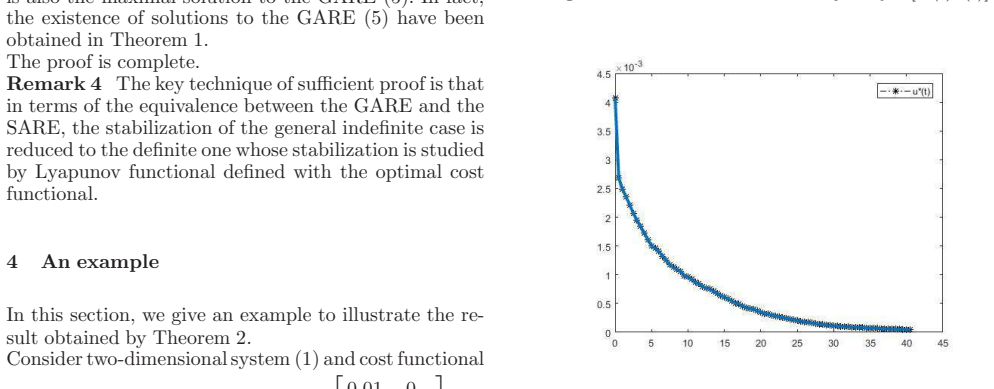
- [Example, Section 4] The text refers to Fig. 1, Fig. 2, and Fig. 3, but the figures are not included in the manuscript text provided; please ensure the figures are included with captions, and check the reference to 'x(t) (Fig. 3)' since Fig. 3 is labeled 'Optimal states' while Fig. 1 is the state-trajectory plot.
Circularity Check
No significant circularity: Theorem 2 is a genuine Riccati-equivalence and Lyapunov argument; cited prior lemmas are independent support rather than restatements of the target result.
full rationale
The paper's central claim, Theorem 2, asserts that mean-square stabilizability is equivalent to existence of a maximal solution to the GARE (5). This is not definitional: the GARE and the set P are defined independently of stabilizability, and the proof derives the equivalence by analyzing the convergence of the finite-horizon GDRE (Theorem 1) and by decomposing a GARE solution as Pbar = Zbar_Phat + Phat, where Zbar_Phat solves the SARE (13). The stabilization proof then uses a Lyapunov function E[x' Zbar_Phat x] and reduces the problem to stability of the (A22,C22) subsystem via equation (28), with the controller gain and optimal cost obtained by completing the square in equation (45). These are standard Riccati manipulations, not fitted inputs renamed as predictions. The main dependence on prior work is through Lemma 2, whose proof is omitted with a reference to [Zhang et al., 2004], and Lemma 3 in [Qi et al., 2017], which is invoked to assert exact observability of the reduced triple (A22,C22,Q22^{1/2}). The reader's flagged concern is legitimate as a correctness or completeness matter: exact observability is stronger than the exact detectability in Assumption 1, and the paper does not reproduce the lemma or its verification. However, that is a gap in the proof exposition, not circularity. The cited lemma is a separate prior theorem with its own hypotheses and is not identical to Theorem 2 or to the standing assumptions; it does not define the desired stabilization conclusion into the inputs. Likewise, the use of [Zhang et al., 2017] for existence of the limit of V(t,x(t)) is an appeal to a prior convergence result, not a reduction of the theorem to itself. Self-citation is present, but the load-bearing lemmas are parameter-free mathematical statements with stated assumptions, and under the review rules such citations count as real evidence rather than circularity. No equation in the paper is shown to be equivalent to its own input by construction, and no fitted parameter is relabeled as a prediction. Therefore the honest finding is no significant circularity.
Assumptions & free parameters
assumptions (5)
- domain assumption The set P is nonempty for the system under consideration.
- domain assumption Assumption 1: (A,C,Q_{\hat P}^{1/2}) is exact detectable.
- ad hoc to paper Lemma 2: exact detectability is preserved under the feedback defined by the SARE solution.
- ad hoc to paper The reduced subsystem (\bar A22,\bar C22,\bar Q22^{1/2}) is exactly observable when \bar Z2>0, cited from Lemma 3 of Qi et al. 2017.
- standard math Itô calculus, Schur complements with pseudo-inverses, and standard Lyapunov theory for stochastic systems.
Cite this review
Pith. "Pith review of Stabilization Control for ItO Stochastic System with Indefinite State and Control Weight Costs." pith.science (2026). https://pith.science/paper/3NRGTZ3B
@misc{pith2026190807684,
  author       = {Pith},
  title        = {Pith review of: Stabilization Control for ItO Stochastic System with Indefinite State and Control Weight Costs},
  year         = {2026},
  howpublished = {\url{https://pith.science/paper/3NRGTZ3B}},
  note         = {Machine review of arXiv:1908.07684}
}
read the original abstract
In standard linear quadratic (LQ) control, the first step in investigating infinite-horizon optimal control is to derive the stabilization condition with the optimal LQ controller. This paper focuses on the stabilization of an Ito stochastic system with indefinite control and state weighting matrices in the cost functional. A generalized algebraic Riccati equation (GARE) is obtained via the convergence of the generalized differential Riccati equation (GDRE) in the finite-horizon case. More importantly, the necessary and sufficient stabilization conditions for indefinite stochastic control are obtained. One of the key techniques is that the solution of the GARE is decomposed into a positive semi-definite matrix that satisfies the singular algebraic Riccati equation (SARE) and a constant matrix that is an element of the set satisfying certain linear matrix inequality conditions. Using the equivalence between the GARE and SARE, we reduce the stabilization of the general indefinite case to that of the definite case, in which the stabilization is studied using a Lyapunov functional defined by the optimal cost functional subject to the SARE.
Figures


Reference graph
Works this paper leans on
-
[1]
Bibitem after note You are using a bibitem after a note in a subbibitems environment; note should the last item in a subbibitems environment \@itemnote @bb@error [] @noitemnote \@tempa \@noitemnote \@noitemnote \@itemnote @bibitem\@bibitem @lbibitem\@lbibitem \@bibitem#1 \@itemnote @bibitem #1 \@tempa @noitemnote \@lbibitem[#1]#2 \@itemnote @lbibitem[#1] ...
-
[2]
@stdbsttrue @ctr \@lbibitem [ @ctr] \@bibitem##1 @ctr \@lbibitem[ @ctr] ##1 @bb@error\@mkbberr @filesw @natbibloaded \@auxout \@itemslabel @bibnum a-- @ctr \@auxout \@itemslabel :s @bibnum \@auxout \@itemslabel @bibnum a-- @ctr \@auxout \@itemslabel :s @bibnum @ctr @bibnum @citex\@citex \@tempcntc @citex[#1]#2 @filesw \@auxout #2 \@tempcnta @\@tempcntb @n...
work page 1991
-
[3]
R. E. Kalman (1960). Contribution to the Theory of Optimal Control. Boletin Sociedad Matematica Mexicana, 5(2), 102--119
work page 1960
-
[4]
W. M. Wonham (1968). On a matrix Riccati equation of stochastic control. SIAM Journal on Optimization and Control, 6(4), 681--697
work page 1968
-
[5]
M. H. A. Davis (1977). Linear Estimation and Stochastic Control. Chapman and Hall, London
work page 1977
-
[6]
H. Zhang and J. Xu, (2017). Control for It o stochastic systems with input delay. IEEE Transactions on Automatic Control, 62(1), 350--365
work page 2017
-
[7]
S. Chen, X. Li, and X. Zhou (1998). Stochastic linear quadratic regulators with indefinite control weight costs. SIAM Journal on Optimization and Control, 36(5), 1685--1702
work page 1998
-
[8]
M. A. Rami, J. B. Moore, and X. Zhou (2001). Indefinite stochastic linear quadratic control and generalized differential Riccati equation. SIAM Journal on Optimization and Control, 40, 1296--1311
work page 2001
Show all 23 references
-
[9]
Wu, and X
H. Wu, and X. Zhou (2002). Characterizing all optimal controls for an indefinite stochastic linear quadratic control problem. IEEE Transactions on Automatic Control , 47(7), 1119--1122
2002
-
[10]
Ferrante, and L
A. Ferrante, and L. Ntogramatzidis (2015). A note on finite-horizon LQ problems with indefinite cost. Automatica , 52, 290--293
2015
-
[11]
Bilardi and A
G. Bilardi and A. Ferrante (2007). The role of terminal cost/reward in finite-horizon discrete-time LQ optimal control. Linear Algebra and its Applications , 425, 323--344
2007
-
[12]
Y. Ni, C. K. F. Yiu, H. Zhang, and J. Zhang (2017). Delayed Optimal Control of Stochastic LQ Problem. SIAM Journal on Optimization and Control , 55(5), 3370--3407
2017
-
[13]
Zorzi (2017)
M. Zorzi (2017). On the Robustness of the Bayes and Wiener Estimators under Model Uncertainty. Automatica , 83(9), 133--140
2017
-
[14]
Zorzi (2017)
M. Zorzi (2017). Convergence analysis of a family of robust Kalman filters based on the contraction principle. SIAM Journal on Optimization and Control , 55(5), 3116-3131
2017
-
[15]
Zhang, Q
H. Zhang, Q. Qi, and M. Fu (2018). Optimal Stabilization Control for Discrete-time Mean-field Stochastic Systems. IEEE Transactions on Automatic Control , DOI 10.1109/TAC.2018.2813006
2018
-
[16]
Qi, and H
Q. Qi, and H. Zhang (2017). Stabilization Control for Linear Continuous-time Mean-field Systems. arXiv preprint arXiv: 1608.06475
2017 arXiv
-
[17]
M. A. Rami, and X. Zhou (2000). Linear matrix inequalities, Riccati equations, and indefinite stochastic linear quadratic control. IEEE Transactions on Automatic Control , 45(6), 1131--1142
2000
-
[18]
X. Li, X. Zhou, and M. A. Rami(2003). Indefinite stochastic linear quadratic control with Markovian jumps in infinite time horizon. Journal of Global Optimization , 27, 149--175
2003
-
[19]
M. A. Rami, X. Chen, J. B. Moore, and X. Zhou (2001). Solvability and asymptotic behavior of generalized Riccati equations arising in indefinite stochastic LQ controls. IEEE Transactions on Automatic Control , 46(3), 428--440
2001
-
[20]
Albert (1969)
A. Albert (1969). Conditions for positive and nonnegative definiteness in terms of pseudo-inverse. SIAM Journal on Optimization and Control , 17, 434--440
1969
-
[21]
Zhang, and B
W. Zhang, and B. S. Chen (2004). On stabilizability and exact observability of stochastic systems with their applications. Automatica , 40, 87--94
2004
-
[22]
Hinrichsen, and A
D. Hinrichsen, and A. J. Pritchard (1998). Stochastic H_ . SIAM Journal on Optimization and Control , 36(5), 1504--1538
1998
-
[23]
R. A. Horn, and C. R. Johnson (1990). Matrix Analysis. Cambridge University Press, Cambridge
1990
Reviewed August 14, 2026 · model on record in the stance chip above.
Discussion (0). Continue with ORCID to comment.