REVIEW 3 major objections 5 minor 37 references
MSQ: Memory-Efficient Bit Sparsification Quantization
T0 review · 3 major / 5 minor · reviewed 2026-08-06 · deepseek-v4-flash
Pith's one-line read MSQ computes and prunes least-significant bits directly from weights, achieving up to 8x fewer trainable parameters and 86% less training time at competitive accuracy.
desk verdict MSQ's empirical scope is broad, but the central LSB extraction equation is dimensionally wrong, so the mechanism as written does not do what it claims. read the letter →
The pith
A machine-rendered reading of the paper's core claim, the machinery that carries it, and where it could break.
The reading
What carries the argument
The load-bearing mechanism is the RoundClamp quantizer plus the LSB-extraction identity. The quantizer $q_r(W; n) = \frac{1}{2^n-1}\min(\lfloor 2^n W\rceil, 2^n-1)$ differs from the standard DoReFa-style quantizer by scaling the rounding input by $2^n$ instead of $2^n-1$ and clamping to $2^n-1$; this aligns the $(n-k)$-bit bin boundaries with the midpoints of the $n$-bit bins, so that sparsifying the computed LSB value $B_k = W - 2^k q_r(W; n-k)$ has both positive and negative gradient directions toward zero-LSB states. The Hessian-trace sensitivity $\Omega_l = \mathrm{Tr}(H_l)\|W_n^{(l)} - W^{(l)}\|_2$ is the second mechanism: it decides whether a layer is pruned by one bit or two bits per step, accelerating pruning of insensitive layers while protecting sensitive ones. Together they produce a mixed-precision bit assignment without ever instantiating a trainable variable per bit.
What would settle it
Compute $B_k = W - 2^k q_r(W; n-k)$ for every value in a full traversal of the $n$-bit quantization grid and check whether $B_k$ vanishes precisely on the values whose low $k$ bits are zero; any mismatch is a counterexample that falsifies the bit-extraction assumption.
Extended reading notes
Core claim
The central claim is that bit-level sparsity for mixed-precision quantization can be induced without explicit bit-level parameter splitting. The paper introduces a RoundClamp quantizer, defined as $q_r(W; n) = \frac{1}{2^n-1}\min(\lfloor 2^n W\rceil, 2^n-1)$, whose bin boundaries align so that a weight with nonzero low bits can be rounded either up or down to a neighboring zero-LSB value. From this quantizer the value of the least significant $k$ bits of the $n$-bit quantized weight is computed as $B_k = W - 2^k q_r(W; n-k)$, and applying $\ell^1$ regularization to $B_k$ gives a gradient direction that pushes weights toward LSB-zero configurations. A Hessian-trace sensitivity measure $\Omega_l$ then sets the pruning step $k \in \{1,2\}$ per layer, and layers are pruned when their LSB-nonzero rate falls below a threshold, repeating until a target compression ratio is reached. The paper argues this yields accuracy and compression on par with or better than BSQ and CSQ on ResNet-20/18/50, MobileNetV3-Large, DeiT-T/S, and Swin-T, with much lower training resource use.
Load-bearing premise
The core assumption is that the formula for $B_k$ really extracts the least significant bits of the quantized weight, so that driving $B_k$ to zero removes exactly those bits; if the formula and the true bit pattern come apart, the regularizer can push weights toward states that are not bit-sparse in the intended way.
Editorial extensions
If this is right
- Bit-level mixed-precision quantization-aware training can run with up to 8.00x fewer trainable parameters, because no per-bit variables are created.
- Training time drops by up to 86% relative to bit-splitting baselines, and the freed memory allows larger batch sizes before out-of-memory.
- The same method transfers from homogeneous CNNs to heterogeneous architectures (MobileNetV3) and to vision transformers (DeiT, Swin-T), extending bit-level QAT beyond standard ResNet-style models.
- Hessian-aware pruning lets insensitive layers lose two bits at a time, so the target compression ratio is reached in fewer epochs and with smaller accuracy dips at each pruning step.
- After the target compression ratio is reached, regularization and pruning stop and training continues as ordinary QAT, so the final mixed-precision scheme is stable and cleanly defined.
Reading between the lines
- If the round-clamp LSB extraction is mathematically sound, the same bipartite slicing idea could be applied to activation quantization or to higher-order bit groups (removing more than the least significant bits), potentially pushing average bit-width well below 2 bits.
- The Hessian-threshold rule (prune two bits when the layer sensitivity is below the mean) is a heuristic; a principled allocation based on the Hessian trace's magnitude could yield a better accuracy-compression frontier on the same pruning schedule.
- Because the method removes the per-bit parameter overhead, it points toward quantization-aware fine-tuning of large transformer models (and possibly LLMs) on a single GPU, where bit-splitting methods would be memory-prohibitive.
- The reported efficiency gains are measured against BSQ and CSQ; transferring the LSB-regularization view to post-training quantization could reduce the need for search-based mixed-precision schemes on deployment pipelines.
Editorial analysis
A structured set of objections, weighed in public.
Referee Report
Summary. The paper proposes MSQ, a bit-level mixed-precision quantization-aware training method. Instead of instantiating each bit as a trainable variable as in BSQ/CSQ, MSQ computes an LSB value B_k from the full-precision weight W via Eq. (5), applies L1 regularization to encourage LSB sparsity, and prunes bits when the LSB nonzero rate is low, with Hessian-aware control of how many bits are pruned per layer. MSQ is evaluated on ResNet-20/18/50, MobileNetV3-Large, DeiT-T/S, Swin-T, and a ViT-Base variant, reporting competitive accuracy/compression tradeoffs, up to 8x fewer trainable parameters, and up to 86% training-time reduction relative to BSQ/CSQ.
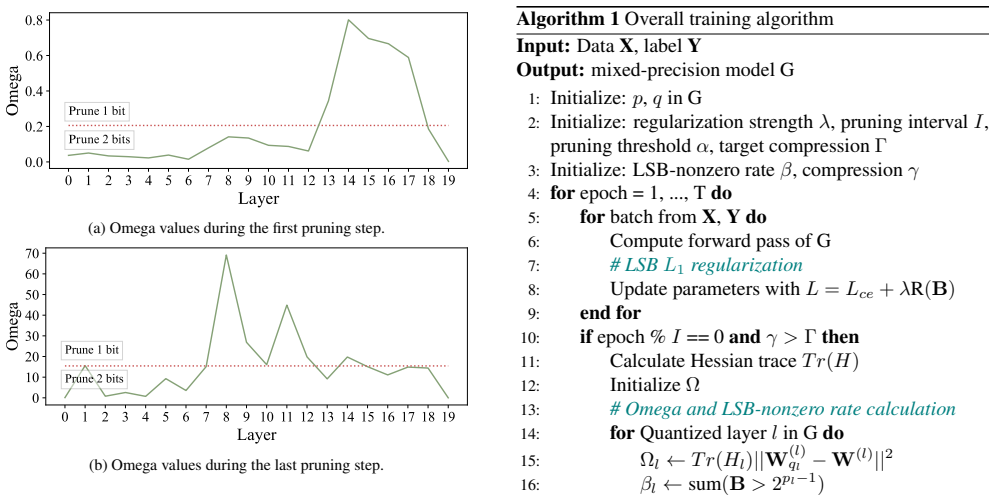
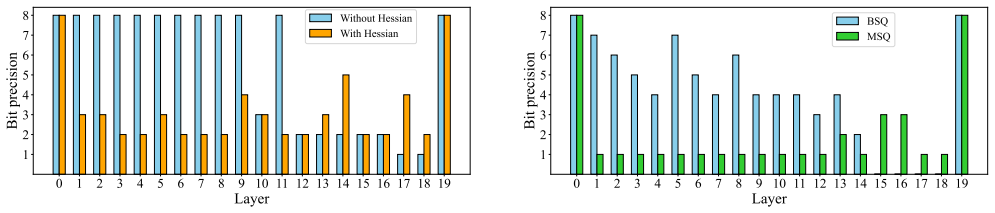
Significance. MSQ addresses a real bottleneck: bit-level sparsification methods such as BSQ/CSQ require bit-sliced trainable parameters and are memory/time hungry. The paper's scope is broader than many prior bit-level method papers, covering MobileNetV3 and ViTs, and it reports training-resource measurements on three networks. The Hessian-guided pruning schedule is a reasonable engineering idea that can be assessed independently. If the LSB computation were correct, the accuracy-compression results would make a useful contribution. The paper would be strengthened by reporting repeated runs/error bars; the current tables report single runs, and several accuracy differences among methods are within 0.1-0.2 percentage points.
major comments (3)
- [Section 3.1, Eq. (5)] The claimed LSB extraction is mathematically inconsistent as written. With qr(W; n-k) defined by Eq. (4), the output is a normalized value in [0,1] with levels j/(2^{n-k}-1). Substituting W - 2^k qr(W; n-k) mixes a continuous [0,1] value with a shifted normalized value, and the 2^k factor is dimensionally wrong for normalized representations. Example: W=0.5, n=3, k=1 gives qr(0.5;2)=2/3 and B_1 = 0.5 - 4/3 = -5/6, although 0.5 is exactly representable in the 2-bit grid used for the MSBs and its lower bit is zero. More generally, B_k=0 under Eq. (5) implies W = 2^k qr(W;n-k), which for k=1 has only W=0 as a solution on [0,1], not the set of weights whose lower bit is zero. The correct decomposition of the quantized weight is qr(W;n) - qr(W;n-k) (or an explicitly integer fixed-point identity), not Eq. (5). Because Eq. (8) penalizes this B_k, the central sparsification mechanism is not internally consistent as written. The authors should correct the identity, describe any STE or continuous relaxation used to make the L1 gradient meaningful, and confirm that all reported results are obtained with the corrected objective.
- [Algorithm 1, line 16] The pruning criterion beta_l is not reproducible as printed. In Algorithm 1, beta_l is computed as sum(B > 2^{p_l-1}); since B denotes the LSB value from Eq. (5) (bounded approximately in [-1,1] under the printed formula, or [0,1] under a corrected definition), the threshold 2^{p_l-1} is far outside the range of B for p_l >= 2, so beta_l would be identically zero for every layer that prunes 2 bits. This makes the pruning loop (lines 21-27) degenerate and prevents reproduction. The authors need to define beta_l precisely, e.g., as the fraction of weights whose |B_k| exceeds a fraction of the quantization step, and state the threshold used.
- [Tables 2-5 and Section 4.2] The main accuracy-compression claims are supported only by single runs with no seeds, standard deviations, or number of trials. Many comparisons that support the claim of competitive accuracy are within 0.01-0.2 percentage points (e.g., ResNet-18 69.74 vs. CSQ 69.73; ResNet-50 75.32 vs. CSQ 75.47). Without repeated runs, these differences are not sufficient to establish that MSQ maintains accuracy at the same level as prior methods. The authors should report at least means and standard deviations over multiple seeds for the main tables, and state which batches and pruning schedules were used for each run.
minor comments (5)
- [Section 3.1, Eqs. (3) and (5)] Equation (3) writes B_k = W_n - 2^k W_{n-k}, while Eq. (5) replaces W_n with the raw floating-point W; the relationship between the two is never explained and should be clarified.
- [Section 3.2, Eq. (9)] The Hessian trace is written Tr(H_i) in one place and Tr(H_l) in the next; please use consistent subscripts for the layer index.
- [Table 2] There are two rows labeled simply 'MSQ' with no distinguishing description; the reader cannot tell which configuration (activation bits, target compression, or other hyperparameters) produced each row.
- [Figure 3] The caption of Figure 3 does not define what is plotted (weight values, bin boundaries, or both); the comparison between DoReFa and RoundClamp would be much easier to follow with labeled axes and a precise statement of the bin edges.
- [Algorithm 1 and Table 1] Algorithm 1 initializes 'p, q in G' without defining the initial bit width or the initial pruning amount per layer; additionally, Table 1 reports peak memory for MSQ that is higher than BSQ/CSQ for ResNet-20 despite fewer parameters, and the table should annotate the batch sizes used to obtain the peak-memory numbers.
Circularity Check
No significant circularity: MSQ's core claims are benchmarked externally rather than derived from its inputs, and the same-group BSQ/CSQ comparisons are experimental, not load-bearing evidence.
full rationale
MSQ's derivation chain is self-contained. The core mechanism—computing B_k via Eq. (5) and applying L1 regularization in Eq. (8)—is defined inside the paper, and the efficiency claims (8x parameter reduction, 86% training-time reduction) are measured against external baselines on standard benchmarks (CIFAR-10, ImageNet), not derived from a fitted quantity. The Hessian sensitivity metric is imported from HAWQ-V2 [6], an external reference with no author overlap, so it is independent support. The self-citations to BSQ [27] and CSQ [26], both involving coauthor Huanrui Yang, serve as experimental comparison points and motivational context, not as an authority that forces the paper's conclusions; the reported timings, memory usage, accuracies, and compression ratios are externally falsifiable. The equations in Sec. 3.1 may be mathematically questionable as written—Eq. (5) does not in general equal the k-LSB contribution under the 2^m−1 denominator—but that is a correctness concern, not a circularity: the claimed results do not reduce to their inputs by construction. No fitted parameter is renamed as a prediction, no uniqueness theorem is imported from the authors' prior work, and no ansatz is smuggled in via citation.
Assumptions & free parameters
free parameters (6)
- lambda (LSB L1 regularization strength) =
5e-5 for ResNet/MobileNetV3; 8e-6 for DeiT-T; 5e-6 for DeiT-S/Swin-T
- alpha (pruning threshold) =
0.3 or 0.35 depending on network
- I (pruning interval) =
5, 8, 10, or 20 epochs depending on network
- target compression ratio Gamma =
e.g., 16.00, 10.67, 10.89, etc. per experiment
- prune bits per step for insensitive layers =
2 bits for insensitive layers, 1 bit for sensitive layers
- initial bit precision =
8 bits (from Fig. 7)
assumptions (5)
- domain assumption Straight-through estimator (STE) gradient approximation
- domain assumption Hessian trace is a reliable layer sensitivity metric
- ad hoc to paper B_k computed by Eq (5) represents the LSBs
- domain assumption Weights are normalized to [0,1] and use uniform fixed-point grids
- domain assumption Pretrained floating-point models are used for ImageNet experiments
Cite this review
Pith. "Pith review of MSQ: Memory-Efficient Bit Sparsification Quantization." pith.science (2026). https://pith.science/paper/3NUNWIRP
@misc{pith2026250722349,
  author       = {Pith},
  title        = {Pith review of: MSQ: Memory-Efficient Bit Sparsification Quantization},
  year         = {2026},
  howpublished = {\url{https://pith.science/paper/3NUNWIRP}},
  note         = {Machine review of arXiv:2507.22349}
}
read the original abstract
As deep neural networks (DNNs) see increased deployment on mobile and edge devices, optimizing model efficiency has become crucial. Mixed-precision quantization is widely favored, as it offers a superior balance between efficiency and accuracy compared to uniform quantization. However, finding the optimal precision for each layer is challenging. Recent studies utilizing bit-level sparsity have shown promise, yet they often introduce substantial training complexity and high GPU memory requirements. In this paper, we propose Memory-Efficient Bit Sparsification Quantization (MSQ), a novel approach that addresses these limitations. MSQ applies a round-clamp quantizer to enable differentiable computation of the least significant bits (LSBs) from model weights. It further employs regularization to induce sparsity in these LSBs, enabling effective precision reduction without explicit bit-level parameter splitting. Additionally, MSQ incorporates Hessian information, allowing the simultaneous pruning of multiple LSBs to further enhance training efficiency. Experimental results show that MSQ achieves up to 8.00x reduction in trainable parameters and up to 86% reduction in training time compared to previous bit-level quantization, while maintaining competitive accuracy and compression rates. This makes it a practical solution for training efficient DNNs on resource-constrained devices.
Figures


Figures from the paper (9 more)





Reference graph
Works this paper leans on
-
[1]
Post train- ing 4-bit quantization of convolutional networks for rapid- deployment
Ron Banner, Y ury Nahshan, and Daniel Soudry. Post train- ing 4-bit quantization of convolutional networks for rapid- deployment. Advances in Neural Information Processing Systems, 32, 2019. 1
work page 2019
-
[2]
Dory: Automatic end-to-end deployment of real-world dnns on low-cost iot mcus
Alessio Burrello, Angelo Garofalo, Nazareno Bruschi, Giuseppe Tagliavini, Davide Rossi, and Francesco Conti. Dory: Automatic end-to-end deployment of real-world dnns on low-cost iot mcus. IEEE Transactions on Computers , 70 (8):1253–1268, 2021. 1
work page 2021
-
[3]
Pact: Parameterized clipping activa- tion for quantized neural networks
Jungwook Choi, Zhuo Wang, Swagath V enkataramani, Pierce I-Jen Chuang, Vijayalakshmi Srinivasan, and Kailash Gopalakrishnan. Pact: Parameterized clipping activa- tion for quantized neural networks. arXiv preprint arXiv:1805.06085, 2018. 1, 2, 6, 7
arXiv 2018
-
[4]
Imagenet: A large-scale hierarchical image database
Jia Deng, Wei Dong, Richard Socher, Li-Jia Li, Kai Li, and Li Fei-Fei. Imagenet: A large-scale hierarchical image database. In 2009 IEEE conference on computer vision and pattern recognition, pages 248–255. Ieee, 2009. 6
2009
-
[5]
Hawq: Hessian aware quantization of neural networks with mixed-precision
Zhen Dong, Zhewei Y ao, Amir Gholami, Michael W Ma- honey, and Kurt Keutzer. Hawq: Hessian aware quantization of neural networks with mixed-precision. In Proceedings of the IEEE/CVF international conference on computer vision , pages 293–302, 2019. 1, 2
work page 2019
-
[6]
Hawq-v2: Hessian aware trace-weighted quantization of neural networks
Zhen Dong, Zhewei Y ao, Daiyaan Arfeen, Amir Gholami, Michael W Mahoney, and Kurt Keutzer. Hawq-v2: Hessian aware trace-weighted quantization of neural networks. Ad- vances in neural information processing systems , 33:18518– 18529, 2020. 1, 2, 5, 6
work page 2020
-
[7]
Steven K. Esser, John L. McKinstry, Dhruv Bablani, Raja Appuswamy, and Dharmendra S. Modha. Learned step size quantization. arXiv preprint arXiv:1902.08153, 2019. 6
arXiv 1902
-
[8]
Squant: On-the-fly data-free quantization via diagonal hes- sian approximation
Cong Guo, Y uxian Qiu, Jingwen Leng, Xiaotian Gao, Chen Zhang, Y unxin Liu, Fan Y ang, Y uhao Zhu, and Minyi Guo. Squant: On-the-fly data-free quantization via diagonal hes- sian approximation. arXiv preprint arXiv:2202.07471, 2022. 2
arXiv 2022
Show all 37 references
-
[9]
Deep residual learning for image recognition
Kaiming He, Xiangyu Zhang, Shaoqing Ren, and Jian Sun. Deep residual learning for image recognition. In Proceed- ings of the IEEE conference on computer vision and pattern recognition, pages 770–778, 2016. 6, 7
2016
-
[10]
1.1 computing’s energy problem (and what we can do about it)
Mark Horowitz. 1.1 computing’s energy problem (and what we can do about it). In 2014 IEEE international solid-state circuits conference digest of technical papers (ISSCC), pages 10–14. IEEE, 2014. 1
2014
-
[11]
Le, and Hartwig Adam
Andrew Howard, Mark Sandler, Grace Chu, Liang-Chieh Chen, Bo Chen, Mingxing Tan, Weijun Wang, Y ukun Zhu, Ruoming Pang, Vijay V asudevan, Quoc V . Le, and Hartwig Adam. Searching for mobilenetv3. arXiv preprint arXiv:1905.02244, 2019. 6
1905 arXiv
-
[12]
Squeeze-and-excitation net- works
Jie Hu, Li Shen, and Gang Sun. Squeeze-and-excitation net- works. In Proceedings of the IEEE conference on computer vision and pattern recognition , pages 7132–7141, 2018. 1
2018
-
[13]
Learning multiple layers of features from tiny images
Alex Krizhevsky, Geoffrey Hinton, et al. Learning multiple layers of features from tiny images. 2009. 6, 7
2009
-
[14]
Q-vit: Accurate and fully quantized low-bit vision transformer
Y anjing Li, Shuang Xu, Bowen Zhang, Xiangtai Cao, Peng Gao, and Guodong Guo. Q-vit: Accurate and fully quantized low-bit vision transformer. In Advances in Neural Informa- tion Processing Systems, pages 34451–34463, 2022. 6
2022
-
[15]
Oscillation-free quantization for low-bit vision transformers
Shih-Y ang Liu, Zechun Liu, and Kwang-Ting Cheng. Oscillation-free quantization for low-bit vision transformers. In International Conference on Machine Learning , pages 21813–21824. PMLR, 2023. 7
2023
-
[16]
Noisyquant: Noisy bias-enhanced post-training activation quantization for vision transformers
Yijiang Liu, Huanrui Y ang, Zhen Dong, Kurt Keutzer, Li Du, and Shanghang Zhang. Noisyquant: Noisy bias-enhanced post-training activation quantization for vision transformers. In Proceedings of the IEEE/CVF Conference on Computer Vision and Pattern Recognition , pages 20321–20...
2023
-
[17]
Swin transformer: Hierarchical vision transformer using shifted windows
Ze Liu, Y utong Lin, Y ue Cao, Han Hu, Yixuan Wei, Zheng Zhang, Stephen Lin, and Baining Guo. Swin transformer: Hierarchical vision transformer using shifted windows. In Proceedings of the IEEE/CVF international conference on computer vision, pages 10012–10022, 2021. 6, 7
2021
-
[18]
Up or down? adap- tive rounding for post-training quantization
Markus Nagel, Rana Ali Amjad, Mart V an Baalen, Chris- tos Louizos, and Tijmen Blankevoort. Up or down? adap- tive rounding for post-training quantization. In International conference on machine learning , pages 7197–7206. PMLR, 2020. 2
2020
-
[19]
Mix-qvit: Mixed- precision vision transformer quantization driven by layer importance and quantization sensitivity
Andreas Savakis Navin Ranjan. Mix-qvit: Mixed- precision vision transformer quantization driven by layer importance and quantization sensitivity. arXiv preprint arXiv:2501.06357, 2025. 6
2025 arXiv
-
[20]
Mobilenetv2: Inverted residuals and linear bottlenecks
Mark Sandler, Andrew Howard, Menglong Zhu, Andrey Zh- moginov, and Liang-Chieh Chen. Mobilenetv2: Inverted residuals and linear bottlenecks. In Proceedings of the IEEE conference on computer vision and pattern recogni- tion, pages 4510–4520, 2018. 1
2018
-
[21]
Winning the lottery with continuous sparsification
Pedro Savarese, Hugo Silva, and Michael Maire. Winning the lottery with continuous sparsification. Advances in neu- ral information processing systems , 33:11380–11390, 2020. 2
2020
-
[22]
Training data-efficient image transformers & distillation through at- tention
Hugo Touvron, Matthieu Cord, Matthijs Douze, Francisco Massa, Alexandre Sablayrolles, and Herv ´e J ´egou. Training data-efficient image transformers & distillation through at- tention. In International conference on machine learning , pages 10347–10357. PMLR, 2021. 6, 7
2021
-
[23]
Haq: Hardware-aware automated quantization with mixed precision
Kuan Wang, Zhijian Liu, Y ujun Lin, Ji Lin, and Song Han. Haq: Hardware-aware automated quantization with mixed precision. In Proceedings of the IEEE/CVF conference on computer vision and pattern recognition , pages 8612–8620, 2019. 1, 2, 7
2019
-
[24]
Fbnet: Hardware-aware efficient con- vnet design via differentiable neural architecture search
Bichen Wu, Xiaoliang Dai, Peizhao Zhang, Y anghan Wang, Fei Sun, Yiming Wu, Y uandong Tian, Peter V ajda, Y angqing Jia, and Kurt Keutzer. Fbnet: Hardware-aware efficient con- vnet design via differentiable neural architecture search. In Proceedings of the IEEE/CVF conference o...
2019
-
[25]
Smoothquant: Accurate and effi- cient post-training quantization for large language models
Guangxuan Xiao, Ji Lin, Mickael Seznec, Hao Wu, Julien Demouth, and Song Han. Smoothquant: Accurate and effi- cient post-training quantization for large language models. In International Conference on Machine Learning , pages 38087–38099. PMLR, 2023. 2
2023
-
[26]
Csq: Growing mixed-precision quantization scheme with bi-level continuous sparsification
Lirui Xiao, Huanrui Y ang, Zhen Dong, Kurt Keutzer, Li Du, and Shanghang Zhang. Csq: Growing mixed-precision quantization scheme with bi-level continuous sparsification. In 2023 60th ACM/IEEE Design Automation Conference (DAC), pages 1–6. IEEE, 2023. 1, 2, 3, 6, 7
2023
-
[27]
Bsq: Ex- ploring bit-level sparsity for mixed-precision neural network quantization
Huanrui Y ang, Lin Duan, Yiran Chen, and Hai Li. Bsq: Ex- ploring bit-level sparsity for mixed-precision neural network quantization. arXiv preprint arXiv:2102.10462 , 2021. 1, 2, 3, 6, 7
2021 arXiv
-
[28]
Quan- tization networks
Jiwei Y ang, Xu Shen, Jun Xing, Xinmei Tian, Houqiang Li, Bing Deng, Jianqiang Huang, and Xian-sheng Hua. Quan- tization networks. In Proceedings of the IEEE/CVF con- ference on computer vision and pattern recognition , pages 7308–7316, 2019. 1
2019
-
[29]
Hawq-v3: Dyadic neural net- work quantization
Zhewei Y ao, Zhen Dong, Zhangcheng Zheng, Amir Gho- lami, Jiali Y u, Eric Tan, Leyuan Wang, Qijing Huang, Yida Wang, Michael Mahoney, et al. Hawq-v3: Dyadic neural net- work quantization. In International Conference on Machine Learning, pages 11875–11886. PMLR, 2021. 6, 7
2021
-
[30]
Lq-nets: Learned quantization for highly accurate and compact deep neural networks
Dongqing Zhang, Jiaolong Y ang, Dongqiangzi Y e, and Gang Hua. Lq-nets: Learned quantization for highly accurate and compact deep neural networks. In Proceedings of the Eu- ropean conference on computer vision (ECCV) , pages 365– 382, 2018. 1, 7
2018
-
[31]
Dorefa-net: Training low bitwidth convo- lutional neural networks with low bitwidth gradients
Shuchang Zhou, Y uxin Wu, Zekun Ni, Xinyu Zhou, He Wen, and Y uheng Zou. Dorefa-net: Training low bitwidth convo- lutional neural networks with low bitwidth gradients. arXiv preprint arXiv:1606.06160, 2016. 1, 2, 3, 4, 6, 7 Supplementary Materials for: MSQ: Memory-Efficient Bit...
2016 arXiv
-
[32]
1 illustrates how Omega values and bit precision change across layers during the training process of ResNet-
Changes in Layer Precision During Training Fig. 1 illustrates how Omega values and bit precision change across layers during the training process of ResNet-
-
[33]
In the first pruning step Fig
Our Hessian Aware Aggressive Pruning method dynam- ically assigns prune bits as either 1-bit or 2-bit based on Omega values, enabling efficient bit reduction while main- taining model performance. In the first pruning step Fig. 1a, Hessian Aware Aggres- sive Pruning is not yet a...
-
[34]
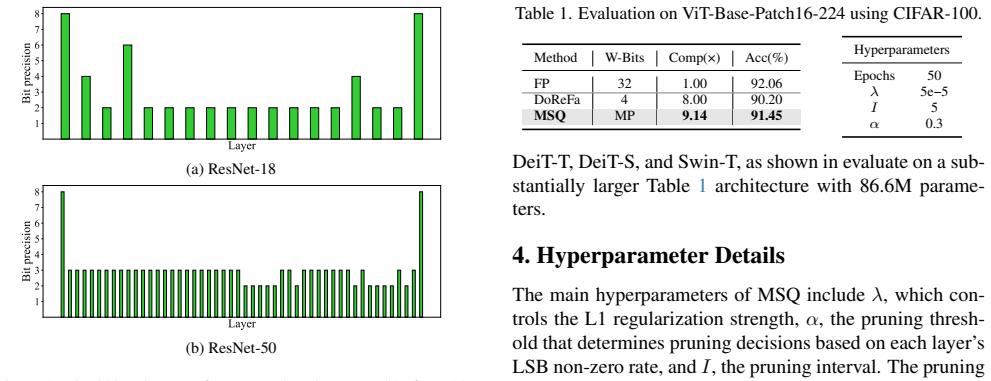
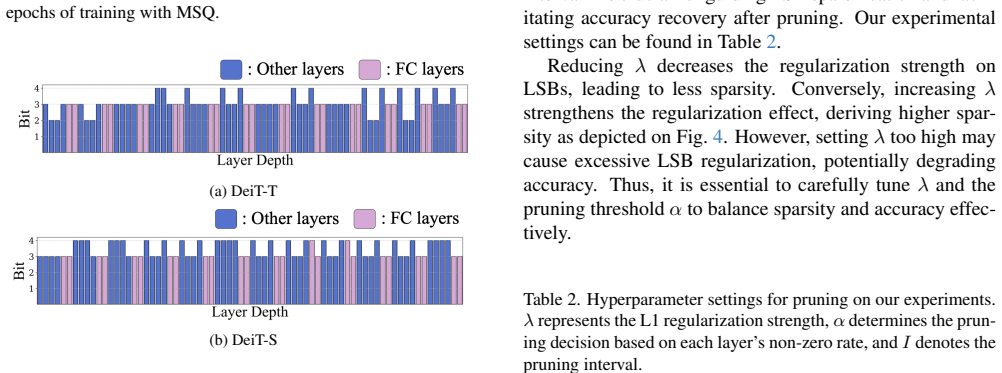
Final Bit Schemes The final bit schemes for ResNet-18, ResNet-50, and ViT models, which were not included in the main text, are pro- vided in this section. Fig. 2 presents the bit schemes for ResNet-18 and ResNet-50. Specifically, Fig. 2a achieves a compression ratio of 11.84×, ...
-
[35]
While the main pa- per presents results on compact vision transformers such as Table 1
Additional Experiments on ViT To further validate the scalability of our method on larger transformer-based models, we conduct supplementary ex- periments on ViT-Base-Patch16-224. While the main pa- per presents results on compact vision transformers such as Table 1. Evaluatio...
-
[36]
The pruning interval I is crucial for guiding LSB sparsification and facil- itating accuracy recovery after pruning
Hyperparameter Details The main hyperparameters of MSQ include λ, which con- trols the L1 regularization strength, α, the pruning thresh- old that determines pruning decisions based on each layer’s LSB non-zero rate, and I, the pruning interval. The pruning interval I is cruci...
-
[37]
Thus, it is essential to carefully tune λ and the pruning threshold α to balance sparsity and accuracy effec- tively
However, setting λ too high may cause excessive LSB regularization, potentially degrading accuracy. Thus, it is essential to carefully tune λ and the pruning threshold α to balance sparsity and accuracy effec- tively. Table 2. Hyperparameter settings for pruning on our experim...
Reviewed August 6, 2026 · model on record in the stance chip above.
Discussion (0). Sign in to comment.