REVIEW 4 major objections 5 minor 42 references
Rate-Independent Epigenetics: a thermodynamically consistent framework for modelling epigenetic response
T0 review · 4 major / 5 minor · reviewed 2026-08-02 · deepseek-v4-flash
Pith's one-line read Epigenetic change can be modelled as rate-independent dissipative evolution, with thresholds, memory, and hysteresis following from one variational principle.
desk verdict A mathematically careful transfer of rate-independent systems to epigenetics, with honest caveats, but the biological premise is untested and the BV uniqueness proof is sketched. read the letter →
The pith
A machine-rendered reading of the paper's core claim, the machinery that carries it, and where it could break.
The reading
What carries the argument
The central object is the rate-independent system triple (Q,E,Ψ): a closed convex state space, a stored energy E(q,S)=F(q)−q·ℓ(S) that splits into a configurational free energy and a coupling to the loading, and a positively 1-homogeneous dissipation potential Ψ whose subdifferential at zero defines an elastic domain E. The argument is carried by the energetic evolution principle (global stability (S) and energy balance (E)), the derived Biot inclusion 0∈∂Ψ(q̇)+∂E/∂q, and the saturation identity f·q̇=Ψ(q̇), which together encode exact energy conservation and minimal dissipation. Balanced-viscosity solutions, obtained as the vanishing-viscosity limit of a regularised inclusion, select the phy
What would settle it
Measure the epigenetic scar (residual mark) after applying a fixed-amplitude, intermittent stimulus at different frequencies. The rate-independent model predicts the scar is independent of frequency; an observed dependence of the scar on frequency would signal a genuine viscous (rate-dependent) contribution and refute the pure rate-independent description of epigenetic response. Alternatively, measuring the hysteresis-loop area under loading cycles of different speeds and finding that the area changes with sweep rate would similarly falsify the rate-independence hypothesis.
Extended reading notes
Core claim
The central claim is that an epigenetic system can be specified by a triple (Q,E,Ψ) — a state space of epigenetic configurations, a stored-energy functional E(q,S)=F(q)−q·ℓ(S) with a micro-environmental loading S, and a convex, 1-homogeneous dissipation potential Ψ encoding resistance to remodelling. Under the energetic evolution principle (Definition 2.1), the state evolves so that the energy is globally stable at each time and the energy balance holds exactly. From these two conditions alone, the governing subdifferential inclusion (the Biot equation) follows, and the saturation identity f·q̇=Ψ(q̇) forces dissipation to be non-negative and minimal. The laws of thermodynamics are therefore
Load-bearing premise
The load-bearing premise is that real epigenetic dynamics operates in the rate-independent (quasi-static) regime, where the chromatin state either equilibrates quickly relative to the variation of its micro-environment or stays effectively frozen except when a threshold is crossed; if chromatin-state change carries intrinsic rate dependence at the timescales of interest, the closed-form thresholds, hysteresis areas, and no-ratcheting predictions fail as biological statements.
Editorial extensions
If this is right
- Any model built on the triple (Q,E,Ψ) is thermodynamically consistent a priori: the first and second laws hold for every choice of landscape and dissipation, so no ad-hoc evolution laws are needed.
- Threshold activation, memory, and hysteresis—the defining phenomenology of epigenetic marks—emerge directly from the variational structure, and the energy dissipated over a closed loading cycle equals the area of the hysteresis loop regardless of how fast the cycle is traversed.
- In the scalar bistable case, the framework yields exact analytical predictions: the state jumps between wells at the threshold ℓ=ρ, and the mark is permanently locked in whenever the dissipation resistance exceeds ℓ_max/2.
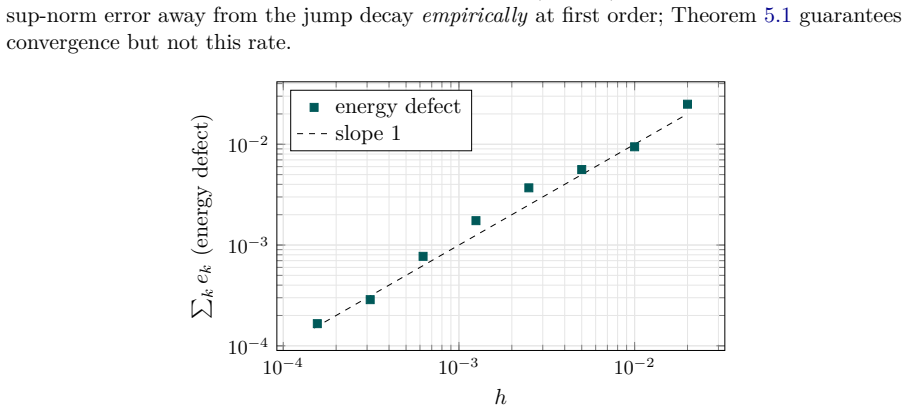
- The numerical integrator converges to energetic solutions and carries a proven global first-order energy-consistency estimate, so computed epigenetic trajectories come with a quantified energy-balance error.
- The model predicts the absence of ratcheting: repeating an identical loading cycle leaves the same residual state, and the maximal damage and residual scar depend only on the extreme values of the loading, not on its rhythm.
- If the paper's framework is correct, it provides a route to calibrating the effective energy and dissipation potentials from macroscopic loading-unloading experiments, making the ingredients identifiable rather than purely formal.
Reading between the lines
- Extension: The sharpest falsifiable prediction is frequency independence: an experiment that shows the epigenetic scar after an intermittent stimulus depends on stimulus frequency at fixed amplitude would directly indicate a viscous contribution beyond the rate-independent skeleton, exactly as the paper's own Section 7.1 states.
- Extension: The framework could be extended to vectorial epigenetic marks (n≥2), where the balanced-viscosity selection becomes genuinely path-dependent; such an extension would likely require additional numerical machinery for the jump construction.
- Extension: The rate-independent description may be the leading-order macroscopic reduction of a faster, stochastic gene-regulatory dynamics; if so, the potentials F, ℓ, and Ψ could be learned from fine-scale data rather than posited, connecting RIE to structure-preserving coarse-graining approaches.
- Extension: The exact bistable threshold ℓ=ρ suggests a direct experimental test: measure the loading level at which a reversible mark irreversibly flips between two phenotypes, and compare with the model's predicted dependence on the dissipation resistance ρ.
Signed reviews
Editorial analysis
A structured set of objections, weighed in public.
Referee Report
Summary. The paper proposes Rate-Independent Epigenetics (RIE), a variational framework in which an epigenetic system is specified by a triple (Q,E,Ψ): a configuration space, a stored energy E(q,S)=F(q)−q·ℓ(S), and a 1-homogeneous dissipation potential Ψ. From the energetic evolution principle (global stability (S) plus energy balance (E), Definition 2.1), the authors derive the Biot-type subdifferential inclusion (Proposition 2.2), read the energy balance and dissipation inequality as a first and second law, and prove existence of energetic solutions (Theorem 4.3), uniqueness under convexity (Theorem 4.4), and existence and scalar uniqueness of balanced-viscosity solutions (Theorems 4.6, 4.7). They construct an incremental-minimisation integrator, prove convergence (Theorem 5.1) and a first-order global energy-consistency estimate (Theorem 5.2), and test the method on the scalar play operator, a piecewise-quadratic double well, and a nonlinear convex example. The paper is explicit that rate independence is an idealisation (Section 7.1) and that the potentials and thermodynamic statements are effective (Section 7.5).
Significance. If the advertised results hold, this is a useful and largely rigorous transfer of rate-independent-system theory to epigenetics. The paper's main strengths are its honest delineation of what is proved versus what is assumed; the explicit falsifier in Section 7.1 (frequency-dependent scarring would signal viscous behaviour); the careful separation of the proven energy-consistency estimate (Theorem 5.2) from the merely empirical state-error rates (Proposition C.4, Remark 5.3); and the closed-form energetic jump threshold ℓ=ρ for the bistable benchmark (Proposition D.1). These components give the framework a solid applied-mathematics core even though its biological validation is deferred.
major comments (4)
- [Section 7.1 / Abstract] The biological claim is conditional on a premise that is not tested. The abstract says RIE 'models epigenetic change', but the only empirical content is the falsifiable prediction in Section 7.1 that frequency-dependent scarring would signal a viscous contribution; no frequency-resolved or otherwise discriminating experiment is reported. All quantitative outputs (Equation (27), Proposition D.1, Section 3.3) are rate-independent statements. The authors are honest about this, but the manuscript should either present/analyse such an experiment or explicitly restrict the claims in the abstract and title to a quasi-static mathematical skeleton rather than a validated model of epigenetic response.
- [Appendix B.3, Theorem 4.7] The proof of the scalar uniqueness theorem is not a proof. It asserts without derivation that the balanced-viscosity jump condition follows 'the path of steepest descent of q↦E(q,S(t∗))+ρ|q−q−|' and selects the 'first local minimiser of E(·,S(t∗))'. These two descriptions are inconsistent: stationary points of E+ρ|·| satisfy E_q=±ρ, not E_q=0. Since Theorem 4.7 is advertised in the abstract, the jump-selection mechanism needs a rigorous derivation from the vanishing-viscosity construction, or a precise reference to a theorem that covers this scalar setting; as written, the uniqueness claim is unsupported.
- [Appendix B.3, Theorem 4.6, Step 1] Existence of the ε-regularised viscous solution is attributed to Brézis [6], which concerns maximal monotone operators. For the bistable landscapes of central interest, ∂_q E is not monotone, so the cited theorem is not directly applicable. A finite-dimensional argument using the single-valued Lipschitz inverse of ∂Ψ+εI would close the gap, but as written the construction of BV solutions is not fully justified.
- [Section 6.2 / Remark 6.1] The bistable numerical benchmark does not validate the balanced-viscosity solution. The incremental scheme (20) minimises globally and therefore computes the energetic solution, with the energetic jump threshold ℓ=ρ (Proposition D.1), whereas the physically motivated BV solution would have the local threshold ℓ=ka+ρ (Remark 6.1). The paper explicitly does not carry out the BV construction numerically. Consequently Section 6.2 validates only the energetic-solution branch, not the uniqueness/selection mechanism of Theorem 4.7 that is central to the framework's physical interpretation. This limitation should be stated more prominently than a remark, and ideally a local/BV implementation should be added or the scope reduced.
minor comments (5)
- [Definition 4.2] The notation S(t) is used both for the loading path and for the stability set, which is confusing. Rename the stability set, e.g. Σ(t).
- [Section 5.3 / Abstract] The phrase 'global energy-consistency estimate' in the abstract is stronger than Theorem 5.2, which assumes q∈AC or q∈W^{1,∞}. Across jumps, the estimate is only observed numerically (Section 6.2.3). Please state this regularity restriction explicitly in the abstract or in the statement of Theorem 5.2.
- [Equation (26)] In the unloading branch, the formula q(t)=min{qmax, u(t)+r} suppresses the lock value at the turning point. The closed form is correct but the piecewise ranges could be written more transparently, especially for readers unfamiliar with the play operator.
- [Section 6.2.3] The sup-norm state error is reported only away from the jump; the full sup-norm error is O(1) because of the one-step jump location error. This is consistent with Proposition C.4, but should be stated in the caption of Figure 9 to avoid misreading.
- [General] The paper contains no data- or code-availability statement. Given the reproducible benchmarks and closed-form solutions, a small reproducibility remark would increase the value of the numerical sections.
Circularity Check
No significant circularity: governing equations and thermodynamic identities are entailments of the stated variational principle, with only a minor non-load-bearing self-citation.
full rationale
The derivation chain is self-contained. RIE takes the triple (Q,E,Ψ) and the energetic principle (Definition 2.1) as postulates; Proposition 2.2 derives the Biot inclusion from (S)–(E) and Lemma A.1, and the converse under convexity is also proved. The 'first law' (Eq. 14) is the energy balance (Eq. 10) rearranged, and the 'second law' (Prop. 3.1) follows from the saturation identity f·qdot=Ψ(qdot); the paper explicitly labels these as effective, structural thermodynamics (Sec. 7.5), not as a literal accounting of molecular energetics, so no external prediction is being disguised. Well-posedness and convergence results rely on external rate-independent-systems theory (Mielke–Roubíček, Mielke–Rossi–Savaré) and on self-contained proofs in the appendices; no load-bearing result is imported from the authors' own prior work. Closed-form thresholds such as Eq. (27) and Proposition D.1 are model-internal functions of constitutive parameters (ρ, k, ℓmax), not fitted to data, and the numerical benchmarks compare against exact solutions of the same model or manufactured solutions—validating the discretization, not claiming empirical prediction. The only author self-citation, [34] in the incremental-minimisation list of Section 5.1, is background and not load-bearing. The rate-independence premise is openly flagged as an idealisation with an explicit falsifier (frequency-dependent epigenetic scar, Sec. 7.1); that is an empirical limitation, not circularity.
Assumptions & free parameters
free parameters (3)
- ρ (dissipation threshold / resistance to remodelling) =
0.1, 0.3 (Sec 6.1); 0.10 (Sec 6.2); 0.3 (Sec 6.3)
- a (well separation in the bistable well) =
0.15
- k, ℓ∞, λ, Smax, T (benchmark constitutive and protocol constants) =
k=1, ℓ∞=0.5, λ=1, Smax=5, T=1
assumptions (6)
- domain assumption Energetic evolution principle: a trajectory is governed by global stability (S) and exact energy balance (E) (Definition 2.1)
- domain assumption Stored energy has the additive separable form E(q,S)=F(q)−q·ℓ(S) with linear loading coupling (Eq. 3)
- domain assumption Dissipation potential Ψ is convex, 1-homogeneous, symmetric (A4) with 0∈int E (A5)
- domain assumption Epigenetic dynamics sits in the quasi-static rate-independent regime (Sec 7.1)
- domain assumption Scalar (n=1) with finitely many local minima of E(·,S) for Theorem 4.7
- standard math Standard analysis results: Rademacher's theorem, Helly selection, Gronwall, Jensen, convex subdifferential calculus; cited theorems [28, Thm 2.1.6; 28, Thm 3.4.7; 28, Thm 3.3.2; 27]
invented entities (1)
-
Effective potentials (F, ℓ, Ψ) as 'resistance of the epigenetic machinery'
Cite this review
Pith. "Pith review of Rate-Independent Epigenetics: a thermodynamically consistent framework for modelling epigenetic response." pith.science (2026). https://pith.science/paper/3NVAA5TF
@misc{pith2026260714664,
  author       = {Pith},
  title        = {Pith review of: Rate-Independent Epigenetics: a thermodynamically consistent framework for modelling epigenetic response},
  year         = {2026},
  howpublished = {\url{https://pith.science/paper/3NVAA5TF}},
  note         = {Machine review of arXiv:2607.14664}
}
read the original abstract
Epigenetic changes -- heritable, long-lived, yet actively reversible modifications of the chromatin state -- display memory, threshold activation and hysteresis, features that are the hallmark of rate-independent dissipative evolution. We propose a mathematical framework, Rate-Independent Epigenetics, that models epigenetic change within the theory of rate-independent systems and is consistent with two fundamental principles identified with the laws of thermodynamics. In this framework, a model is specified by a state space of epigenetic configurations, a stored-energy functional depending on the state and on an external loading, and a 1-homogeneous dissipation potential encoding the resistance of the epigenetic machinery to change. Assuming an energetic evolution principle, the governing equations follow, with no further modelling hypotheses. The energy balance is exact energy conservation, and the 1-homogeneity of the dissipation potential forces a non-negative, minimal (economical) dissipation. Under natural coercivity and continuity assumptions we establish existence of energetic solutions and, via vanishing viscosity, of balanced-viscosity solutions that resolve the ambiguity of the energetic formulation at epigenetic switches; uniqueness holds under convexity and, in the scalar case, under a mild finite-multiplicity condition. We then build a variational time integrator, prove its convergence to energetic solutions and a global energy-consistency estimate. The framework is illustrated on the scalar linear play operator, on an example with a double-well energetic potential, showing the ability of the framework to study multi-stability scenarios and catastrophic switches and on a nonlinear problem, proving that the theoretical results hold. The presented framework can be seen as a skeleton for a richer thermodynamically-consistent theory incorporating viscous dissipation features.
Figures


Figures from the paper (11 more)




Reference graph
Works this paper leans on
-
[6]
North-Holland, Amsterdam, 1973
Haim Brézis.Opérateurs maximaux monotones et semi-groupes de contractions dans les espaces de Hilbert, volume 5 ofNorth-Holland Mathematics Studies. North-Holland, Amsterdam, 1973
1973
-
[1]
Oxford Mathematical Monographs
Luigi Ambrosio, Nicola Fusco, and Diego Pallara.Functions of Bounded Variation and Free Discontinuity Problems. Oxford Mathematical Monographs. Oxford University Press, 2000
2000
-
[2]
Fine phase mixtures as minimizers of energy.Archive for Rational Mechanics and Analysis, 100(1):13–52, 1987
John M Ball and Richard D James. Fine phase mixtures as minimizers of energy.Archive for Rational Mechanics and Analysis, 100(1):13–52, 1987
1987
-
[3]
American Elsevier, New York, 1972
Jacob Bear.Dynamics of Fluids in Porous Media. American Elsevier, New York, 1972
1972
-
[4]
Thermoelasticity and irreversible thermodynamics.Journal of applied physics, 27(3):240–253, 1956
Maurice Anthony Biot. Thermoelasticity and irreversible thermodynamics.Journal of applied physics, 27(3):240–253, 1956
1956
-
[5]
DNA methylation patterns and epigenetic memory.Genes & development, 16(1):6–21, 2002
Adrian Bird. DNA methylation patterns and epigenetic memory.Genes & development, 16(1):6–21, 2002
2002
-
[7]
Springer, 1996
Martin Brokate and Jürgen Sprekels.Hysteresis and Phase Transitions, volume 121 of Applied Mathematical Sciences. Springer, 1996
1996
-
[8]
Non-convex potentials and microstructures in finite-strain plasticity.Proceedings of the royal society of London
Carsten Carstensen, Klaus Hackl, and Alexander Mielke. Non-convex potentials and microstructures in finite-strain plasticity.Proceedings of the royal society of London. Series A: mathematical, physical and engineering sciences, 458(2018):299–317, 2002
2018
Show all 42 references
-
[9]
Hysteresis control of epithelial–mesenchymal transition dynamics conveys a distinct program with enhanced metastatic ability.Nature communications, 9(1):5005, 2018
Toni Celià-Terrassa, Caleb Bastian, Daniel D Liu, Brian Ell, Nicole M Aiello, Yong Wei, Jose Zamaolla, Andres M Blanco, Xiang Hang, Dmitriy Kunisky, Wenyang Li, Elizabeth D Williams, Herschel Rabitz, and Yibin Kang. Hysteresis control of epithelial–mesenchymal transition dynam...
2018
-
[10]
Minimum principles for the trajectories of systems governed by rate problems.Journal of the Mechanics and Physics of Solids, 56(5):1885–1904, 2008
Sergio Conti and Michael Ortiz. Minimum principles for the trajectories of systems governed by rate problems.Journal of the Mechanics and Physics of Solids, 56(5):1885–1904, 2008
1904
-
[11]
A reduced theory for thin-film micromagnetics.Communications on Pure and Applied Mathematics, 55(11):1408– 1460, 2002
Antonio DeSimone, Robert V Kohn, Stefan Müller, and Felix Otto. A reduced theory for thin-film micromagnetics.Communications on Pure and Applied Mathematics, 55(11):1408– 1460, 2002
2002
-
[12]
SIAM, 1999
Ivar Ekeland and Roger Temam.Convex Analysis and Variational Problems, volume 28 of Classics in Applied Mathematics. SIAM, 1999
1999
-
[13]
Bistability, bifurcations, and Waddington’s epigenetic landscape.Current biology, 22(11):R458–R466, 2012
James E Ferrell. Bistability, bifurcations, and Waddington’s epigenetic landscape.Current biology, 22(11):R458–R466, 2012
2012
-
[14]
Revisiting brittle fracture as an energy minimization problem.Journal of the Mechanics and Physics of Solids, 46(8):1319–1342, 1998
Gilles A Francfort and J-J Marigo. Revisiting brittle fracture as an energy minimization problem.Journal of the Mechanics and Physics of Solids, 46(8):1319–1342, 1998
1998
-
[15]
Continuum thermodynamics.Journal of applied mechanics, 50(4b):1010–1020, 1983
Paul Germain, Pierre Suquet, and Quoc Son Nguyen. Continuum thermodynamics.Journal of applied mechanics, 50(4b):1010–1020, 1983
1983
-
[16]
Sur les matériaux standard généralisés.Journal de Mécanique, 14(1):39–63, 1975
Bernard Halphen and Quoc Son Nguyen. Sur les matériaux standard généralisés.Journal de Mécanique, 14(1):39–63, 1975. 36
1975
-
[17]
Springer, 2 edition, 2013
Weimin Han and B Daya Reddy.Plasticity: Mathematical Theory and Numerical Analysis, volume 9 ofInterdisciplinary Applied Mathematics. Springer, 2 edition, 2013
2013
-
[18]
Quercus Hernández, Max Win, Thomas C O’Connor, Paulo E Arratia, and Nathaniel Trask. Data-driven particle dynamics: Structure-preserving coarse-graining for emergent behavior in nonequilibrium systems.Proceedings of the National Academy of Sciences, 123(20):e2519631123, 2026. ...
2026 doi
-
[19]
The molecular and mathematical basis of Waddington’s epigenetic landscape: A framework for post-Darwinian biology?BioEssays, 34(2):149–157, 2012
Sui Huang. The molecular and mathematical basis of Waddington’s epigenetic landscape: A framework for post-Darwinian biology?BioEssays, 34(2):149–157, 2012
2012
-
[20]
Bifurcation dynamics in lineage- commitment in bistable genetic regulatory networks.Developmental biology, 305(2):695–713, 2007
Sui Huang, Yan-Ping Guo, Gillian May, and Tariq Enver. Bifurcation dynamics in lineage- commitment in bistable genetic regulatory networks.Developmental biology, 305(2):695–713, 2007
2007
-
[21]
Springer, 1989
Mark A Krasnosel’skii and Aleksei V Pokrovskii.Systems with Hysteresis. Springer, 1989
1989
-
[22]
Springer, 2005
Jean Lemaitre and Rodrigue Desmorat.Engineering Damage Mechanics. Springer, 2005
2005
-
[23]
Courier Corporation, 2008
Jacob Lubliner.Plasticity theory. Courier Corporation, 2008
2008
-
[24]
Quasistatic evolution problems for linearly elastic–perfectly plastic materials.Archive for rational mechanics and analysis, 180(2):237–291, 2006
Gianni Dal Maso, Antonio DeSimone, and Maria Giovanna Mora. Quasistatic evolution problems for linearly elastic–perfectly plastic materials.Archive for rational mechanics and analysis, 180(2):237–291, 2006
2006
-
[25]
Evolution of rate-independent systems
Alexander Mielke. Evolution of rate-independent systems. InHandbook of differential equations: Evolutionary equations, volume 2, pages 461–559. Elsevier, 2005
2005
-
[26]
Alexander Mielke and Michael Ortiz. A class of minimum principles for characterizing the trajectories and the relaxation of dissipative systems.ESAIM: Control, Optimisation and Calculus of Variations, 14(3):494–516, 2008
2008
-
[27]
BV solutions and viscosity approximations of rate-independent systems.ESAIM Control Optim
Alexander Mielke, Riccarda Rossi, and Giuseppe Savaré. BV solutions and viscosity approximations of rate-independent systems.ESAIM Control Optim. Calc. Var., 18(1):36– 80, 2012
2012
-
[28]
Springer, 2015
Alexander Mielke and Thomas Roubíček.Rate-Independent Systems: Theory and Applica- tion, volume 193 ofApplied Mathematical Sciences. Springer, 2015
2015
-
[29]
On rate-independent hysteresis models.Nonlinear Differential Equations Applications, 11(2):151–190, 2004
Alexander Mielke and Florian Theil. On rate-independent hysteresis models.Nonlinear Differential Equations Applications, 11(2):151–190, 2004
2004
-
[30]
A variational formulation of rate- independent phase transformations using an extremum principle.Archive for rational mechanics and analysis, 162(2):137–177, 2002
Alexander Mielke, Florian Theil, and Valery I Levitas. A variational formulation of rate- independent phase transformations using an extremum principle.Archive for rational mechanics and analysis, 162(2):137–177, 2002
2002
-
[31]
Evolution problem associated with a moving convex set in a Hilbert space.Journal of Differential Equations, 26(3):347–374, 1977
Jean Jacques Moreau. Evolution problem associated with a moving convex set in a Hilbert space.Journal of Differential Equations, 26(3):347–374, 1977
1977
-
[32]
The variational formulation of viscoplastic constitutive updates.Computer methods in applied mechanics and engineering, 171(3-4):419–444, 1999
Michael Ortiz and Laurent Stainier. The variational formulation of viscoplastic constitutive updates.Computer methods in applied mechanics and engineering, 171(3-4):419–444, 1999
1999
-
[33]
Princeton University Press, Princeton, NJ, 1970
R Tyrrell Rockafellar.Convex Analysis, volume 28. Princeton University Press, Princeton, NJ, 1970
1970
-
[34]
Variational updates for general thermo–chemo–mechanical processes of inelastic solids.Computer Methods in Applied Mechanics and Engineering, 385:114013, 2021
Ignacio Romero, Eva M Andrés, and Ángel Ortiz-Toranzo. Variational updates for general thermo–chemo–mechanical processes of inelastic solids.Computer Methods in Applied Mechanics and Engineering, 385:114013, 2021. 37
2021
-
[35]
A return mapping algorithm for plane stress elasto- plasticity.International Journal for numerical methods in engineering, 22(3):649–670, 1986
Juan C Simo and Robert L Taylor. A return mapping algorithm for plane stress elasto- plasticity.International Journal for numerical methods in engineering, 22(3):649–670, 1986
1986
-
[36]
Kristensen, Kian Peng Koh, Massimiliano Mazzone, Mathew L
Bernard Thienpont, Jessica Steinbacher, Hui Zhao, Flora D’Anna, Anna Kuchnio, Athana- sios Ploumakis, Bart Ghesquière, Laurien Van Dyck, Bram Boeckx, Luc Schoonjans, Els Hermans, Frederic Amant, Vessela N. Kristensen, Kian Peng Koh, Massimiliano Mazzone, Mathew L. Coleman, Tho...
2016
-
[37]
Coupled reversible and irreversible bistable switches underlying TGFβ-induced epithelial to mesenchymal transition.Biophysical journal, 105(4):1079–1089, 2013
Xiao-Jun Tian, Hang Zhang, and Jianhua Xing. Coupled reversible and irreversible bistable switches underlying TGFβ-induced epithelial to mesenchymal transition.Biophysical journal, 105(4):1079–1089, 2013
2013
-
[38]
Springer, Berlin, 1989
Nicholas W Tschoegl.The Phenomenological Theory of Linear Viscoelastic Behavior: an introduction. Springer, Berlin, 1989
1989
-
[39]
Springer, 1994
Augusto Visintin.Differential Models of Hysteresis, volume 111 ofApplied Mathematical Sciences. Springer, 1994
1994
-
[40]
George Allen & Unwin, London, 1957
Conrad H Waddington.The Strategy of the Genes. George Allen & Unwin, London, 1957
1957
-
[41]
Potential landscape and flux framework of nonequi- librium networks: Robustness, dissipation, and coherence of biochemical oscillations
Jin Wang, Li Xu, and Erkang Wang. Potential landscape and flux framework of nonequi- librium networks: Robustness, dissipation, and coherence of biochemical oscillations. Proceedings of the National Academy of Sciences, 105(34):12271–12276, 2008
2008
-
[42]
Springer, 2 edition, 2006
Peter Wriggers and Tod A Laursen.Computational Contact Mechanics. Springer, 2 edition, 2006. 38
2006
Reviewed August 2, 2026 · model on record in the stance chip above.
Discussion (0). Continue with ORCID to comment.