REVIEW 2 major objections 5 minor 62 references
Resonant-state expansion for planar photonic-crystal structures
T0 review · 2 major / 5 minor · reviewed 2026-08-14 · deepseek-v4-flash
Pith's one-line read Expanding a photonic-crystal slab's resonances in the exact resonant states of a homogeneous slab yields a complete, asymptotically exact set with no missing or spurious modes.
desk verdict A genuine resonant-state expansion for periodic slabs with clean derivation and honest convergence tests, but the paper's own Appendix F shows it fails at full-thickness modulation, so the completeness claim is overbroad as stated. read the letter →
The pith
A machine-rendered reading of the paper's core claim, the machinery that carries it, and where it could break.
The reading
What carries the argument
The load-bearing object is the Mittag-Leffler expansion of the homogeneous-slab dyadic Green's function, written as a sum over resonant states and cut modes. From that expansion the wave function of any photonic-crystal slab state is built from basis functions $F_n(z;p+g)e^{i(p+g)x}$, and the perturbation matrix $V^{gg'}_{nn'}$ is formed from the Fourier coefficients of the periodic permittivity change. Substitution turns Maxwell's equations into the linear eigenvalue problem $\omega\sum(\delta+V)c = \omega^g_n c^g_n$. The same completeness that makes the Green's function series converge is what guarantees that the diagonalized matrix returns every perturbed state and no spurious ones; the vanishing diagonal elements for a purely periodic modulation with zero mean make first-order perturbation vanish and accelerate convergence.
What would settle it
For a slab with $\epsilon = 6$, $b = 0.95a$, $d = 2\pi/5$, $\beta = 1$, and $p = 0$, compute the resonant frequencies with a scattering-matrix code using more Bragg channels than $M = 5$; if the PC-RSE results near $\mathrm{Re}(\omega a) = 5$ do not keep moving toward those values as $N$ grows, or if the scattering-matrix calculation finds modes the PC-RSE's fixed-$N$ diagonalization misses, the claim of guaranteed completeness fails in practice.
Extended reading notes
Core claim
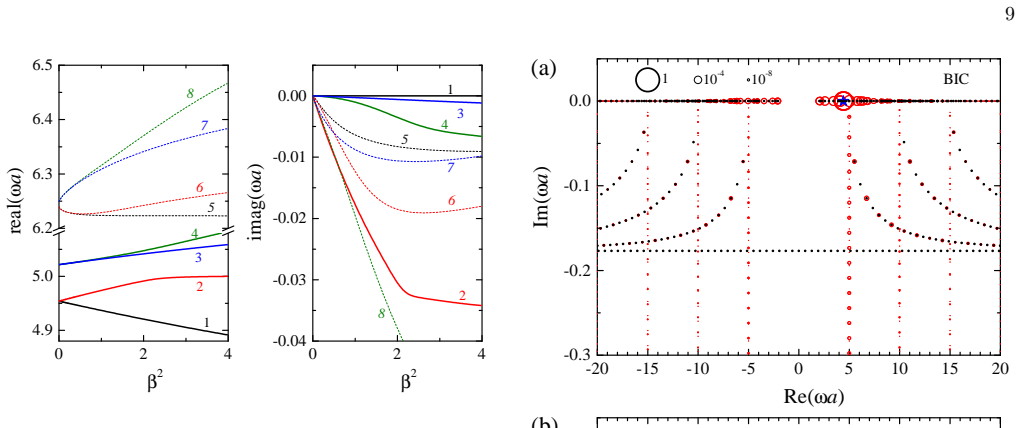
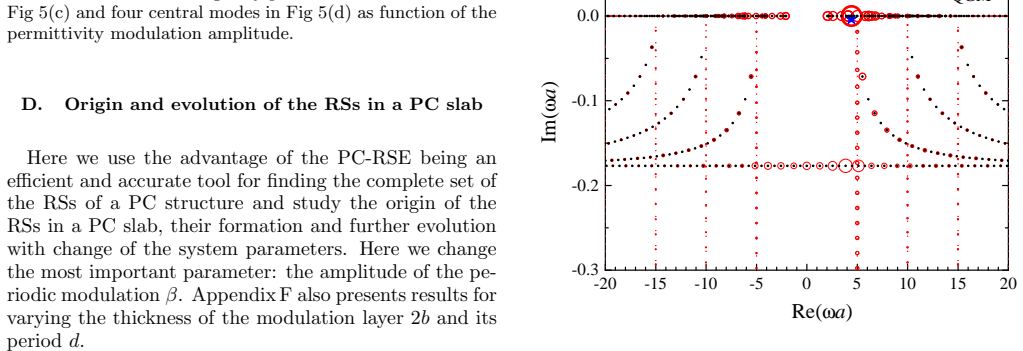
The central claim is that the resonant-state expansion, previously developed for finite resonators and inhomogeneous waveguides, can be extended to infinite planar photonic-crystal slabs by using the homogeneous slab as the basis and treating the periodic permittivity modulation as a perturbation. Because the slab is periodic in one direction, the basis must include resonant states from many Bragg channels, labelled by reciprocal-lattice vectors $g$, and the Green's function of the homogeneous slab acquires branch cuts in the complex-frequency plane; the paper handles these cuts by discretizing them into artificial cut modes included on the same footing as ordinary resonant states. The result is the linear eigenvalue problem (28), whose diagonalization yields a complete set of perturbed resonant states with no missing and no spurious modes, controlled by a single truncation frequency $\omega_{\mathrm{max}}$. Numerical verification against the scattering-matrix method for a dielectric slab with a harmonic periodic modulation shows agreement that improves as roughly $N^{-3}$ with basis size, and mode-expansion analysis shows that bound states in the continuum emerge from pairs of degenerate waveguide modes, while the companion quasi-guided modes differ by their coupling to leaky modes of the zeroth Bragg channel.
Load-bearing premise
The entire method rests on the premise that the resonant states of the unmodulated slab, supplemented by the discretized cut modes, form a complete basis for the modulated slab; the paper reports that convergence changes and deteriorates when the modulation layer reaches the slab boundary ($b = a$), so exactly that limiting case is not covered.
Editorial extensions
If this is right
- The complete, spurious-free mode set makes transmission, reflection, scattering, and extinction computable as superpositions of resonant states, without background fit parameters.
- Only one parameter ($\omega_{\mathrm{max}}$) controls accuracy, so parameter sweeps over modulation strength, period, and layer thickness become automated matrix diagonalizations, useful for optimizing photonic-crystal cavities.
- Bound states in the continuum are shown to be symmetry-protected states formed from waveguide modes, with quasi-guided partners distinguished by the presence of zeroth-channel leaky-mode components; calculations can now target BICs deliberately.
- Cut modes, representing Rayleigh-Wood anomalies, are not optional decoration: including about one cut mode per resonant state ($F\approx 1$) restores $1/N^3$ convergence for modes near the cuts.
- The same formalism carries over to TM polarization and, the paper argues, to oblique incidence and two-dimensional periodicity without changing its structure.
Reading between the lines
- If the completeness guarantee survives in two-dimensionally periodic structures, the method could become a workhorse for inverse design of metasurfaces, where current methods must painstakingly verify mode sets.
- The exact $b=a$ failure boundary suggests a natural independent test: profiles with the modulation reaching the slab surface should be checked with other methods to determine whether the slowdown is true incompleteness or only slower convergence fixable by enlarging the cut-mode set.
- Because vanishing diagonal elements speed convergence, designs that keep the periodic modulation at zero mean should converge faster than those with a uniform component; this is an implicit design rule one could test in cavity optimization.
- The BIC-QGM pair analysis implies that coupling to the zeroth Bragg channel's leaky modes is what turns a would-be BIC into a high-Q quasi-guided mode; engineering that coupling by symmetry breaking or by moving the modulation toward the boundary gives a tunable Q-factor knob.
Signed reviews
Editorial analysis
A structured set of objections, weighed in public.
Referee Report
Summary. The paper develops a photonic-crystal resonant-state expansion (PC-RSE) for planar photonic-crystal slabs. The method uses as a basis the resonant states and discretized branch-cut modes of a homogeneous planar slab, taken over all Bragg channels, and maps Maxwell's equations for a periodic permittivity perturbation onto a linear matrix eigenvalue problem, Eq. (23)/(28). The central results are the derivation of this eigenvalue problem, numerical verification against an analytic core-shell solution for homogeneous perturbations (Appendix D) and against the scattering-matrix method for a one-dimensionally periodic dielectric slab (Section III C), and an application tracing the formation of bound states in the continuum and quasi-guided modes as the periodic modulation amplitude increases.
Significance. If the stated claims hold, the PC-RSE would be a significant methodological contribution: it replaces a nonlinear eigenproblem for open photonic-crystal resonances by a linear matrix diagonalization, uses a basis that is constructed analytically from the homogeneous slab, involves no fitted parameters, and exhibits fast convergence (roughly 1/N^3) in the tested cases. The formal derivation from Maxwell's equations to Eqs. (21)-(23) is clean and is a genuine strength of the paper, as is the use of an analytic core-shell solution for independent verification. The numerical demonstrations of BIC formation and basis-mode contributions are also informative. The central claim of completeness and asymptotic exactness is, however, currently overstated relative to what is demonstrated, because the method is shown in Appendix F to fail in an important parameter regime (b = a).
major comments (2)
- [Appendix F; Sec. IV; Eq. (32)] The unqualified conclusion in Sec. IV that the PC-RSE is 'asymptotically exact' and 'guarantees completeness, i.e. has no missing or spurious modes' is not supported over the parameter range defined by Eq. (32). Appendix F explicitly states that the method cannot be used with exactly b = a, and that at b = 0.95a the relative errors are up to an order of magnitude larger than at b = a/2 (Fig. 16). Since b = a (modulation reaching the slab boundaries) is a standard geometry for etched photonic-crystal slabs and is included in the model via Eq. (32), this is not a peripheral corner of parameter space. The basis-completeness assumption underlying Eq. (23) is therefore unverified precisely when the perturbation extends to the slab boundary, and the paper itself notes that 'the ML series changing its convergence properties on the borders of the system ... requires a further study.' The authors should either extend the method to cover b = a, or explicitly qualify the abstract and conclusions so that the completeness claim is restricted to the demonstrated regime b < a. A concrete test for the b = a case would be a comparison with SMM at larger M, together with a study of convergence of the PC-RSE eigenvalues as N increases.
- [Section III C; Fig. 4] The quantitative verification of the PC-RSE against the SMM uses M = 5 Bragg channels as the 'exact' reference. The SMM at finite M is itself an approximation, and the observed discrepancies near the cuts (e.g., region 3 in Fig. 3) may be due to the limited SMM accuracy rather than to PC-RSE error. To make the accuracy claim quantitative, the paper should show convergence of the SMM reference with increasing M, report errors relative to a converged SMM result, or explicitly state that the comparison is at fixed, low M and that the quoted errors are upper bounds. Without this, the statement that the PC-RSE is 'unprecedentedly accurate' is not fully quantified.
minor comments (5)
- [Eq. (C8)] Equation (C8) appears to contain a sign typo: the expression B_n(e^{-iq_n z} + (-1)^n e^{-iq_n z}) has two identical exponential factors; presumably one of them should be e^{+iq_n z}, consistent with Eq. (29).
- [Sec. IV; Appendix D2] The conclusion that the method 'depends on a single parameter, the truncation frequency omega_max' is not quite accurate, because the basis also depends on the cut-mode fraction F, which is set to F = 1 based on a numerical optimization study in Appendix D2. The role of F should be acknowledged in the conclusions.
- [Abstract] The phrase 'unprecedented accuracy' in the abstract is a strong claim that is not directly compared with other numerical methods in the paper; it would be safer to describe the accuracy as 'high' and quantify it in the specific examples.
- [Fig. 4] In Fig. 4(b), the text states that N_tot ≈ 12000 is used as the reference, but the figure labels are not entirely clear; please ensure that the reported reference basis size is consistent between text, caption, and legend.
- [Sec. II; Eq. (23)] The notation in Eq. (23) uses an integral symbol to denote summation over the continuum of cut modes, but this is not defined explicitly at that point. Please add a sentence clarifying that the integral represents the discretized/continuum cut-mode contribution, as is done later in Appendix D2.
Circularity Check
No significant circularity: PC-RSE is derived from Maxwell's equations through a standard Mittag-Leffler expansion and verified against independent SMM and analytic benchmarks, with only a boundary-case limitation acknowledged in Appendix F.
full rationale
The central derivation is self-contained. The PC-RSE eigenvalue problem, Eq. (23), is obtained by substituting the Mittag-Leffler expansion of the homogeneous-slab Green's function, Eq. (18) and derived in Appendices A and B from Maxwell's equations with outgoing boundary conditions, into the periodic integral equation Eq. (12) and applying Bloch's theorem. The completeness of the basis is a property of the Mittag-Leffler representation, not an assumption equivalent to the target result; the paper separately verifies the ML series against the analytic Green's function (Figs. 9 and 10) and the RSE against the analytic core-shell secular equation (Eq. (D2), with errors shown in Figs. 11 and 13). The PC-RSE is then benchmarked against the independent scattering-matrix method (Figs. 3 and 4), with no fitted parameters used to match the resonant-state frequencies. The self-convergence checks (e.g., Fig. 4(b), Fig. 17) are not independent evidence, but they are supplementary rather than the sole validation, so they do not constitute a circular reduction. The structural limitation admitted in Appendix F, 'Presently, it prevents the PC-RSE from being used with exactly b = a,' narrows the claimed parameter range and is a substantive correctness caveat, but it is not a circularity: the admitted failure is a convergence-property change at the slab boundary, not a case where an output is equivalent to an input by construction. Self-citations to earlier RSE papers provide normalization conditions and cut-discretization procedures that are re-derived in the appendices or checked against analytic solutions, so they are not load-bearing in a circular manner.
Assumptions & free parameters
free parameters (2)
- Basis truncation frequency omega_max (or basis size N)
- Cut-mode fraction F =
1
assumptions (5)
- standard math The resonant states and cut modes of a homogeneous planar slab form a complete basis for expanding the Green's function via the Mittag-Leffler theorem (Eq. 18, Appendices A-B).
- domain assumption The branch-cut continuum of the periodic Green's function can be represented by a finite set of discretized cut modes (Appendix D2).
- domain assumption The perturbation expansion for the PC slab wavefunction converges with increasing basis size (Eq. 21).
- domain assumption TE and TM polarizations decouple when the y-component of the in-plane momentum is zero (Sec. II).
- standard math The homogeneous dielectric slab is analytically solvable, providing the RSs and cut modes used as basis input (Appendix C).
Cite this review
Pith. "Pith review of Resonant-state expansion for planar photonic-crystal structures." pith.science (2026). https://pith.science/paper/3NW7PPHY
@misc{pith2026190806916,
  author       = {Pith},
  title        = {Pith review of: Resonant-state expansion for planar photonic-crystal structures},
  year         = {2026},
  howpublished = {\url{https://pith.science/paper/3NW7PPHY}},
  note         = {Machine review of arXiv:1908.06916}
}
read the original abstract
We present a new paradigm in the field of photonic crystals and metamaterials, applying the resonant-state expansion (RSE) to planar photonic-crystal structures. The RSE allows us to understand and quantify optical resonances in photonic-crystal structures in terms of the analytic resonant states of a homogeneous planar waveguide. The RSE provides an efficient and reliable tool for accurate calculation of a complete set of the resonant states of a photonic-crystal slab, which is required for the correct description and a better understanding of its optical spectra. For the proof of principle, numerical verification of the RSE, and demonstration of its unprecedented accuracy and convergence, an infinite planar photonic crystal slab periodic in one dimension is taken as an example. To illustrate the power of the present approach, we consider the mode evolution with the amplitude of the periodic modulation, revealing the role of the guided modes in the formation of bound states in the continuum.
Figures


Figures from the paper (11 more)


Reference graph
Works this paper leans on
-
[1]
GF in k-representation Using the Newton-Raphson method, we have solved the secular equation Eq. (C7) and found all the RS wave numbers in a selected frequency range (within a circle of radius ωmax in the complex frequency plane). The RSs include four categories of modes: WG modes, anti-WG modes, FP modes, and a leaky mode (LM). The WG and anti-WG modes ar...
-
[2]
GF in ω-representation The GF can also be represented as a function of fre- quency. However, the square root in Eq. (B25) causes branch cuts at ω =±p, which separates the frequency plane into two Riemann sheets with modes split across both sheets. Only the modes found on one of the sheets are taken into account. This is chosen to be the “phys- ical” sheet...
-
[3]
RSE in k-representation In the k-representation, the RSE equation for treating planar homogeneous systems is given by Eq. (22) of [17], which we write here as k ∑ n′ (δnn′ +Vnn′)cn′ = ∑ n′ ( knδnn′ + p2 kn Vnn′ ) cn′, (D3) with the matrix elements Vnn′ = V 00 nn′ given by Eq. (33) for g =g′ = 0. Its application to the perturbation given by Eq. (D1) is sho...
-
[4]
RSE in ω-representation The RSE equation in this case is given by the general formula Eq. (23) of the PC-RSE, but since this is a homo- geneous perturbation, there is no mixing of channels, so we use again g =g′ = 0. Also, Eq. (23) includes the con- tribution of the cuts which need to be discretized, giving rise to cut modes to be used in the RSE on equal...
-
[5]
L. Liu, M. Pu, K. Yvind, and J. M. Hvam, Appl. Phys. Lett. 96, 051126 (2010)
work page 2010
-
[6]
S. J. Mcnab, N. Moll, and Y. A. Vlasov, Opt. Soc. 299, 358 (2003)
work page 2003
-
[7]
A. R. Mcgurn, Phys. Rev. B 61, 13235 (2000)
work page 2000
-
[8]
M. Bayindir, B. Temelkuran, and E. Ozbay, Appl. Phys. Lett. 77, 3902 (2000)
work page 2000
Show all 62 references
-
[9]
Yablonovitch, T
E. Yablonovitch, T. J. Gmitter, and K. M. Leung, Phys. Rev. Lett. 67, 2295 (1991)
1991
-
[10]
D. M. Whittaker and I. S. Culshaw, Phys. Rev. B 60, 2610 (1999)
1999
-
[11]
S. G. Tikhodeev et al., Phys. Rev. B 66, 045102 (2002)
2002
-
[12]
Fan and J
S. Fan and J. D. Joannopoulos, Phys. Rev. B 65, 235112 (2002)
2002
-
[13]
Zhou et al., Prog
W. Zhou et al., Prog. Quant. Electr. 38, 1 (2014)
2014
-
[14]
Gamow, Z
G. Gamow, Z. Phys. 51, 204 (1928)
1928
-
[15]
A. F. J. Siegert, Phys. Rev. 56, 750 (1939)
1939
-
[16]
L. A. Weinstein, Open resonators and open waveguides (Golden press, Boulder, Col., Boulder, 1969)
1969
-
[17]
R. W. Wood, Phil. Mag. 4, 396 (1902)
1902
-
[18]
S. V. Lobanov, G. Zoriniants, W. Langbein, and E. A. Muljarov, Phys. Rev. A 95, 053848 (2017)
2017
-
[19]
A. Gras, W. Yan, and P. Lalanne, Opt. Lett. 44, 3494 (2019)
2019
-
[20]
A. B. Akimov, N. A. Gippius, and S. G. Tikhodeev, JETP Lett. 93, 427 (2011)
2011
-
[21]
L. J. Armitage, M. B. Doost, W. Langbein, and E. A. Muljarov, Phys. Rev. A 89, 053832 (2014)
2014
-
[22]
A. O. Govorov et al., Nano Letters 10, 1374 (2010)
2010
-
[23]
Weiss et al., Phys
T. Weiss et al., Phys. Rev. Lett. 116, 237401 (2016)
2016
-
[24]
Weiss et al., Phys
T. Weiss et al., Phys. Rev. B 96, 045129 (2017)
2017
-
[25]
Vollmer and S
F. Vollmer and S. Arnold, Nat. Meth. 5, 591 (2008)
2008
-
[26]
Vollmer et al., Appl
F. Vollmer et al., Appl. Phys. Lett. 80, 4057 (2002)
2002
-
[27]
Rosenblit, P
M. Rosenblit, P. Horak, S. Helsby, and R. Folman, Phys. Rev. A 70, 053808 (2004)
2004
-
[28]
N. C. Frateschi and A. F. J. Levi, Appl. Phys. Lett. 66, 2932 (1995)
1995
-
[29]
Lalanne et al., Laser Phot
P. Lalanne et al., Laser Phot. Rev. 12, 1700113 (2018)
2018
-
[30]
Muljarov, W
A. Muljarov, W. Langbein, and R. Zimmermann, Euro- phys Lett. 92, 50010 (2010)
2010
-
[31]
M. B. Doost, W. Langbein, and E. A. Muljarov, Phys. Rev. A 90, 013834 (2014)
2014
-
[32]
Sauvan, J
C. Sauvan, J. P. Hugonin, I. S. Maksymov, and P. Lalanne, Phys. Rev. Lett. 110, 237401 (2013)
2013
-
[33]
Floess et al., Phys
D. Floess et al., Phys. Rev. X 7, 021048 (2017)
2017
-
[34]
M. B. Doost, W. Langbein, and E. A. Muljarov, Phys. Rev. A 85, 023835 (2012)
2012
-
[35]
M. B. Doost, W. Langbein, and E. A. Muljarov, Phys. Rev. A 87, 043827 (2013)
2013
-
[36]
L. J. Armitage, M. B. Doost, W. Langbein, and E. A. Muljarov, Phys. Rev. A 97, 049901 (2018)
2018
-
[37]
E. A. Muljarov and W. Langbein, Phys. Rev. B 93, 075417 (2016)
2016
-
[38]
E. A. Muljarov and T. Weiss, Opt. Lett. 43, 1978 (2018)
2018
-
[39]
N. W. Ashcroft and N. D. Mermin, Solid state physics (Saunders College, Philadelphia, 1976), Chap. 8, pp. 132–140
1976
-
[40]
L. C. Andreani and D. Gerace, Phys. Rev. B 73, 235114 (2006)
2006
-
[41]
Minkov and V
M. Minkov and V. Savona, Sci. Rep. 4, 5124 (2014), ar- ticle
2014
-
[42]
W. Yan, R. Faggiani, and P. Lalanne, Phys. Rev. B 97, 205422 (2018)
2018
-
[43]
S. V. Lobanov, W. Langbein, and E. A. Muljarov, Phys. Rev. A 98, 033820 (2018)
2018
-
[44]
Weiss and E
T. Weiss and E. A. Muljarov, Phys. Rev. B 98, 085433 (2018)
2018
-
[45]
Lalanne and E
P. Lalanne and E. Silberstein, Opt. Lett. 25, 1092 (2000)
2000
-
[46]
Silberstein, P
E. Silberstein, P. Lalanne, J.-P. Hugonin, and Q. Cao, J. Opt. Soc. Am. A 18, 2865 (2001)
2001
-
[47]
Li, Journal of Optics A: Pure and Applied Optics 5, 345 (2003)
L. Li, Journal of Optics A: Pure and Applied Optics 5, 345 (2003)
2003
-
[48]
Weiss et al., J
T. Weiss et al., J. Opt. 11, 114019 (2009)
2009
-
[49]
Gao et al., Sci
X. Gao et al., Sci. Rep. 6, 31908 (2016)
2016
-
[50]
von Neumann and E
J. von Neumann and E. Wigner, Phys. Z. 30, 467 (1929)
1929
-
[51]
D. C. Marinica and A. G. Borisov, Phys. Rev. Lett. 100, 183902 (2008)
2008
-
[52]
E. N. Bulgakov and A. F. Sadreev, Phys. Rev. B 78, 075105 (2008)
2008
-
[53]
Moiseyev, Phys
N. Moiseyev, Phys. Rev. Lett. 102, 167404 (2009)
2009
-
[54]
Plotnik et al., Phys
Y. Plotnik et al., Phys. Rev. Lett. 107, 28 (2011)
2011
-
[55]
G. B. Arfken and H. J. Weber, Mathematical Methods for Physicists, 5th edition (Academic Press, San Diego, 2001), p. 448
2001
-
[56]
D. A. Bykov and L. L. Doskolovich, J. Lightwave Tech. 31, 793 (2013)
2013
-
[57]
Taghizadeh and I.-S
A. Taghizadeh and I.-S. Chung, Appl. Phys. Lett. 111, 031114 (2017)
2017
-
[58]
E. N. Bulgakov and A. F. Sadreev, Phys. Rev. A 99, 033851 (2019)
2019
-
[59]
E. N. Bulgakov and A. F. Sadreev, Phys. Rev. A 90, 053801 (2014)
2014
-
[60]
B. Zhen, C. W. Hsu, L. Lu, and A. D. Stone, Phys. Rev. B 113, 1 (2014)
2014
-
[61]
C. W. Hsu et al., Nat. Rev. Mat. 1, 1 (2016)
2016
-
[62]
D. A. Bykov, E. A. Bezus, and L. L. Doskolovich, Phys. Rev. A 99, 063805 (2019)
2019
Reviewed August 14, 2026 · model on record in the stance chip above.
Discussion (0). Continue with ORCID to comment.