Translationally Covariant Modulated Symmetries: Classification and Goldstone
Pith reviewed 2026-06-27 19:28 UTC · model grok-4.3
The pith
Abelian translationally covariant modulated symmetries consist only of multipole, exponential and harmonic components, which produce distinct Goldstone modes when broken.
A machine-rendered reading of the paper's core claim, the machinery that carries it, and where it could break.
Core claim
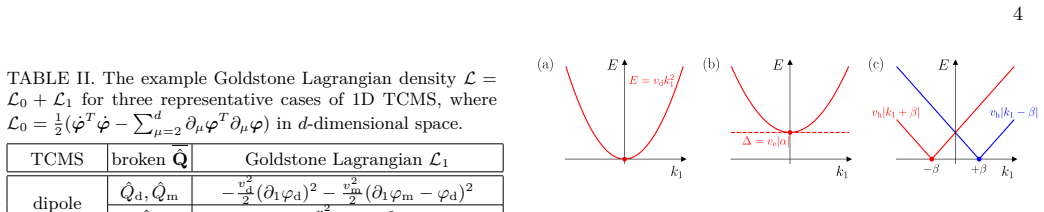
For Abelian TCMSs, their units of charge can only contain multipole, exponential and harmonic components. We classify all the one-dimensional TCMSs by real Jordan normal form blocks. We further derive the generic Goldstone action for SSB phases of continuous TCMSs, by which we show that a broken multipole symmetry gives higher-order gapless Goldstone modes, a broken harmonic symmetry gives gapless Goldstone modes at finite momenta, and a broken exponential symmetry gives no gapless Goldstone modes, modifying the conventional Goldstone theorem.
What carries the argument
The decomposition of the charge unit of a translationally covariant modulated symmetry (TCMS) into multipole, exponential and harmonic components, classified in one dimension by real Jordan normal form blocks.
If this is right
- A broken multipole symmetry produces higher-order gapless Goldstone modes.
- A broken harmonic symmetry produces gapless Goldstone modes at finite momenta.
- A broken exponential symmetry produces no gapless Goldstone modes.
- All one-dimensional Abelian TCMSs are classified by real Jordan normal form blocks.
Where Pith is reading between the lines
- The standard Goldstone theorem applies only when the symmetry is not modulated and must be adjusted for TCMS.
- Physical systems dominated by exponential modulated symmetries may show no low-energy gapless modes even after symmetry breaking.
- The component classification may extend to higher spatial dimensions with analogous restrictions on allowed charge units.
- The framework connects to existing work on dipole and multipole conserving phases in condensed matter.
Load-bearing premise
The generic condition that defines a modulated symmetry as translationally covariant correctly identifies all symmetries compatible with translationally symmetric Hamiltonians.
What would settle it
Observation in one dimension of an Abelian modulated symmetry compatible with a translationally invariant Hamiltonian whose charge unit contains a component outside the multipole, exponential and harmonic families.
Figures
read the original abstract
Modulated symmetries are global symmetries with a spatially dependent unit of charge, such as the dipole symmetry and the exponential symmetry. We give the generic condition for a modulated symmetry to be compatible with translationally symmetric Hamiltonians, which we define as a translationally covariant modulated symmetry (TCMS). For Abelian TCMSs, we prove that their units of charge can only contain multipole, exponential and harmonic components. Particularly, we classify all the one-dimensional TCMSs by real Jordan normal form blocks. We further derive the generic Goldstone action for SSB phases of continuous TCMSs, by which we show that a broken multipole symmetry gives higher-order gapless Goldstone modes, a broken harmonic symmetry gives gapless Goldstone modes at finite momenta, and a broken exponential symmetry gives no gapless Goldstone modes, modifying the conventional Goldstone theorem.
Editorial analysis
A structured set of objections, weighed in public.
Referee Report
Summary. The manuscript defines translationally covariant modulated symmetries (TCMS) as modulated symmetries compatible with translationally symmetric Hamiltonians. For Abelian TCMSs it proves that charge units contain only multipole, exponential and harmonic components, classifies all one-dimensional cases via real Jordan normal form blocks, and derives the generic Goldstone action for continuous TCMS spontaneous symmetry breaking, yielding higher-order gapless modes for broken multipole symmetries, finite-momentum gapless modes for broken harmonic symmetries, and no gapless modes for broken exponential symmetries.
Significance. If the classification and Goldstone-action derivation hold, the work supplies a systematic mathematical framework for modulated symmetries that extends the conventional Goldstone theorem in a controlled way. The explicit use of Jordan blocks for the one-dimensional classification is a clear technical strength that renders the result falsifiable and reproducible.
major comments (2)
- [§2] §2 (definition of TCMS): the generic compatibility condition is adopted as the axiomatic starting point for the entire classification and Goldstone analysis; an explicit derivation showing necessity and sufficiency for translationally invariant Hamiltonians is required, because this condition is load-bearing for the claim that only multipole/exponential/harmonic components appear.
- [§3] §3 (Jordan-block classification): the proof that Abelian TCMS units of charge are exhausted by the three listed components rests on the real Jordan form analysis; the manuscript should state the precise assumptions on the representation (e.g., finite-dimensionality, reality of the blocks) under which the exhaustion holds, as any relaxation would affect the completeness statement.
minor comments (2)
- [Abstract] The abstract and introduction would benefit from a single illustrative example (e.g., the dipole symmetry) showing how the TCMS condition is verified before the general classification is presented.
- Notation for the charge-unit operators and the translation operator should be unified across sections; currently the same symbol appears with slightly different meanings in the classification and Goldstone-action parts.
Simulated Author's Rebuttal
We thank the referee for the careful reading and constructive comments on our manuscript. We address each major comment below and indicate the planned revisions.
read point-by-point responses
-
Referee: [§2] §2 (definition of TCMS): the generic compatibility condition is adopted as the axiomatic starting point for the entire classification and Goldstone analysis; an explicit derivation showing necessity and sufficiency for translationally invariant Hamiltonians is required, because this condition is load-bearing for the claim that only multipole/exponential/harmonic components appear.
Authors: We agree that an explicit derivation of necessity and sufficiency strengthens the foundation. In the revised manuscript we will expand §2 with a dedicated derivation: starting from a modulated symmetry operator U and a translationally invariant Hamiltonian H, we show that [U,H]=0 for all such H if and only if the compatibility condition on the charge unit holds. The argument uses the translation operator T and the requirement that the commutator vanishes identically under lattice translations. revision: yes
-
Referee: [§3] §3 (Jordan-block classification): the proof that Abelian TCMS units of charge are exhausted by the three listed components rests on the real Jordan form analysis; the manuscript should state the precise assumptions on the representation (e.g., finite-dimensionality, reality of the blocks) under which the exhaustion holds, as any relaxation would affect the completeness statement.
Authors: We will add an explicit statement of assumptions at the opening of §3. The classification assumes a finite-dimensional real vector space on which the translation operator acts via a real matrix; the real Jordan canonical form is then applied to this matrix. Under these conditions (standard for lattice models with finitely many charge degrees of freedom per cell), the possible charge units are exhausted by the multipole, exponential, and harmonic blocks. We will note that infinite-dimensional or complex representations lie outside the present scope. revision: yes
Circularity Check
No significant circularity
full rationale
The paper defines TCMS via a compatibility condition with translationally symmetric Hamiltonians and then classifies Abelian cases using the real Jordan normal form of the associated linear operators. This is a direct mathematical consequence of the definition and standard linear algebra, with no reduction of outputs to inputs by construction, no fitted parameters relabeled as predictions, and no load-bearing self-citations or imported uniqueness theorems visible. The Goldstone action derivation follows from the classified symmetries without circular steps. The analysis is self-contained.
Axiom & Free-Parameter Ledger
axioms (2)
- standard math Real Jordan normal form classifies all linear operators on real vector spaces up to similarity.
- domain assumption A modulated symmetry is compatible with a translationally symmetric Hamiltonian only when its charge unit satisfies a covariance condition under translations.
Reference graph
Works this paper leans on
-
[1]
We set U >0in general, andU′>0only in the dipole symmetry Hamiltonian to ensure it is lower bounded
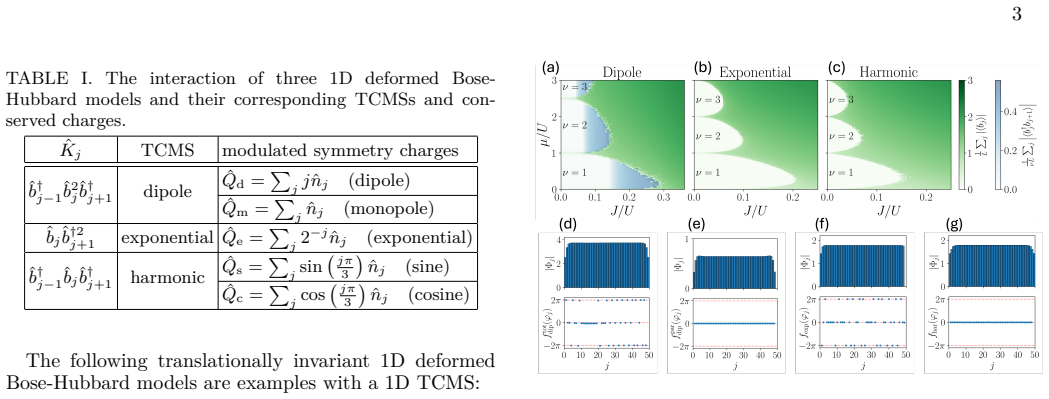
and harmonic symmetry [48], respectively, in which V(ˆnj) = U 2 ˆnj(ˆnj−1)+U′ 6 ˆnj(ˆnj−1)(ˆnj−2)−µˆnj. We set U >0in general, andU′>0only in the dipole symmetry Hamiltonian to ensure it is lower bounded. The modu- lated symmetry charges in Eq. (3) are reduced to lattice sitesx 1 =j∈Z, as shown in Tab. I, where the struc- ture constant matrix isA1 =J R 2 ...
-
[2]
Without loss of generality, we assume the ground state|Ω⟩has zero energy and zero momentum. Con- sider the spectral decomposition by inserting a complete set of energy-momentum eigenbasis{|n,k⟩}satisfying H|n,k⟩=En(k)|n,k⟩andˆPµ|n,k⟩=kµ|n,k⟩, with en- ergyE n(k)≥0and momentumk= (k 1,···,kd). It suffices to consider the charged local operator (order pa- ra...
-
[3]
Nambu, Axial vector current conservation in weak in- teractions, Phys
Y. Nambu, Axial vector current conservation in weak in- teractions, Phys. Rev. Lett.4, 380 (1960)
1960
-
[4]
Goldstone, Field theories with «superconductor »solu- tions, Il Nuovo Cimento (1955-1965)19, 154 (1961)
J. Goldstone, Field theories with «superconductor »solu- tions, Il Nuovo Cimento (1955-1965)19, 154 (1961)
1955
-
[6]
Y. Hidaka, Counting rule for nambu-goldstone modes in nonrelativistic systems, Physical Review Letters110, 10.1103/physrevlett.110.091601 (2013)
-
[7]
H. Watanabe and H. Murayama, Redundancies in nambu-goldstone bosons, Physical Review Letters110, 10.1103/physrevlett.110.181601 (2013)
-
[8]
Y. Hidaka, T. Noumi, and G. Shiu, Effective field theory for spacetime symmetry breaking, Physical Review D92, 10.1103/physrevd.92.045020 (2015)
-
[9]
H.Watanabe,Countingrulesofnambu–goldstonemodes, Annual Review of Condensed Matter Physics11, 169–187 (2020)
2020
-
[10]
D. Gaiotto, A. Kapustin, N. Seiberg, and B. Willett, Generalized global symmetries, Journal of High Energy Physics2015, 10.1007/jhep02(2015)172 (2015)
-
[11]
W. Ji and X.-G. Wen, Categorical symmetry and non- invertible anomaly in symmetry-breaking and topolog- ical phase transitions, Physical Review Research2, 10.1103/physrevresearch.2.033417 (2020)
-
[12]
A. Chatterjee, W. Ji, and X.-G. Wen, Emergent gener- 7 alized symmetry and maximal symmetry topological or- der, Phys. Rev. B112, 115142 (2025), arXiv:2212.14432 [cond-mat.str-el]
arXiv 2025
-
[13]
McGreevy, Generalized symmetries in condensed mat- ter, Annual Review of Condensed Matter Physics14, 57–82 (2023)
J. McGreevy, Generalized symmetries in condensed mat- ter, Annual Review of Condensed Matter Physics14, 57–82 (2023)
2023
-
[14]
C. Cordova, T. T. Dumitrescu, K. Intriligator, and S.-H. Shao, Snowmass white paper: Generalized sym- metries in quantum field theory and beyond (2022), arXiv:2205.09545 [hep-th]
Pith/arXiv arXiv 2022
-
[15]
L. Bhardwaj, L. E. Bottini, L. Fraser-Taliente, L. Gladden, D. S. W. Gould, A. Platschorre, and H. Tillim, Lectures on generalized symmetries (2023), arXiv:2307.07547 [hep-th]
Pith/arXiv arXiv 2023
-
[16]
S. Schafer-Nameki, Ictp lectures on (non-)invertible gen- eralized symmetries (2023), arXiv:2305.18296 [hep-th]
Pith/arXiv arXiv 2023
-
[17]
P. Sala, J. Lehmann, T. Rakovszky, and F. Pollmann, Dynamics in systems with modulated symmetries, Phys. Rev. Lett.129, 170601 (2022)
2022
-
[18]
P. Gorantla, H. T. Lam, N. Seiberg, and S.-H. Shao, Global dipole symmetry, compact lifshitz theory, ten- sor gauge theory, and fractons, Physical Review B106, 10.1103/physrevb.106.045112 (2022)
-
[19]
G. Delfino, C. Chamon, and Y. You, Topological or- der and Fractons from Gauging Exponential Symmetries, (2023), arXiv:2306.17121 [cond-mat.str-el]
arXiv 2023
-
[20]
P. Gorantla, H. T. Lam, N. Seiberg, and S.-H. Shao, A modified villain formulation of fractons and other exotic theories, Journal of Mathematical Physics62, 10.1063/5.0060808 (2021)
-
[21]
N. Seiberg and S.-H. Shao, ExoticZn symmetries, dual- ity, and fractons in 3+1-dimensional quantum field the- ory, SciPost Physics10, 10.21468/scipostphys.10.1.003 (2021)
-
[22]
K. T. Grosvenor, C. Hoyos, F. Peña-Benitez, and P. Surówka, Space-dependent symmetries and fractons (2021), arXiv:2112.00531 [hep-th]
arXiv 2021
-
[23]
Y. Hirono, M. You, S. Angus, and G. Y. Cho, A sym- metry principle for gauge theories with fractons, SciPost Physics16, 10.21468/scipostphys.16.2.050 (2024)
-
[24]
J. H. Han, E. Lake, H. T. Lam, R. Verresen, and Y. You, Topological quantum chains protected by dipolar and other modulated symmetries, Phys. Rev. B109, 125121 (2024), arXiv:2309.10036 [cond-mat.str-el]
arXiv 2024
-
[25]
H. T. Lam, Classification of dipolar symmetry-protected topological phases: Matrix product states, stabilizer hamiltonians,andfinitetensorgaugetheories,Phys.Rev. B109, 115142 (2024)
2024
-
[26]
T. Saito, W. Cao, B. Han, and H. Ebisu, Matrix product state classification of one-dimensional multipole symmetry-protected topological phases, Physical Review B112, 10.1103/6txg-7hy7 (2025)
-
[27]
J. Kim, Y. You, and J. H. Han, Noninvertible sym- metry and topological holography for modulated spt in one dimension, SciPost Physics19, 10.21468/scipost- phys.19.4.110 (2025)
-
[28]
Yao, Lattice Translation Modulated Symmetries and TFTs, (2025), arXiv:2510.03889 [cond-mat.str-el]
C.-Y. Yao, Lattice Translation Modulated Symmetries and TFTs, (2025), arXiv:2510.03889 [cond-mat.str-el]
arXiv 2025
-
[29]
S.-Q. Ning, H. Ebisu, and H. T. Lam, Matrix prod- uct states for modulated topological phases: Crystalline equivalence principle and lieb-schultz-mattis constraints (2026), arXiv:2603.19381 [cond-mat.str-el]
Pith/arXiv arXiv 2026
-
[30]
A. Anakru, S. Srinivasan, L. Li, and Z. Bi, Matrix prod- uct states for modulated symmetries: Spt, lsm, and be- yond (2026), arXiv:2603.19189 [cond-mat.str-el]
Pith/arXiv arXiv 2026
-
[32]
M. Nakamura, Z.-Y. Wang, and E. J. Bergholtz, Ex- actly Solvable Fermion Chain Describing aν= 1/3Frac- tional Quantum Hall State, Phys. Rev. Lett.109, 016401 (2012), arXiv:1110.5033 [cond-mat.str-el]
Pith/arXiv arXiv 2012
-
[33]
M. Schulz, C. A. Hooley, R. Moessner, and F. Pollmann, Stark many-body localization, Physical Review Letters 122, 10.1103/physrevlett.122.040606 (2019)
-
[34]
J.-K. Yuan, S. A. Chen, and P. Ye, Fractonic super- fluids, Physical Review Research2, 10.1103/physrevre- search.2.023267 (2020)
-
[35]
S. A. Chen, J.-K. Yuan, and P. Ye, Fractonic superfluids. ii. condensing subdimensional particles, Physical Review Research3, 10.1103/physrevresearch.3.013226 (2021)
-
[36]
P.Sala,T.Rakovszky,R.Verresen,M.Knap,andF.Poll- mann, Ergodicity breaking arising from hilbert space fragmentation in dipole-conserving hamiltonians, Phys- ical Review X10, 10.1103/physrevx.10.011047 (2020)
-
[39]
S. Pai, M. Pretko, and R. M. Nandkishore, Localiza- tion in fractonic random circuits, Physical Review X9, 10.1103/physrevx.9.021003 (2019)
-
[40]
B. Lian, Quantum breakdown model: From many-body localization to chaos with scars, Physical Review B107, 10.1103/physrevb.107.115171 (2023)
-
[43]
Hu and B
Y.-M. Hu and B. Lian, Bosonic quantum breakdown hub- bard model, Phys. Rev. B112, L100504 (2025)
2025
-
[44]
Y.-M. Hu and B. Lian, From the quantum breakdown model to the lattice gauge theory, AAPPS Bulletin34, 10.1007/s43673-024-00128-4 (2024)
-
[45]
Y.-M. Hu, Z. Han, and B. Lian, Quantum breakdown condensate as a disorder-free quantum glass (2025), arXiv:2512.21847 [cond-mat.str-el]
arXiv 2025
-
[46]
A. Gromov, Towards classification of fracton phases: The multipole algebra, Physical Review X9, 10.1103/phys- revx.9.031035 (2019)
-
[47]
C. Stahl, E. Lake, and R. Nandkishore, Spontaneous breaking of multipole symmetries, Physical Review B 105, 10.1103/physrevb.105.155107 (2022)
-
[48]
E. Lake,H.-Y. Lee, J.H. Han, and T.Senthil,Dipole con- densates in tilted bose-hubbard chains, Physical Review B107, 10.1103/physrevb.107.195132 (2023)
-
[49]
See Supplemental Material for details
-
[50]
P. Sala, Y. You, J. Hauschild, and O. Motrunich, Ex- otic quantum liquids in bose-hubbard models with spa- tially modulated symmetries, Physical Review B109, 10.1103/physrevb.109.014406 (2024). 8
-
[51]
A. Khudorozhkov, A. Tiwari, C. Chamon, and T. Neu- pert, Hilbert space fragmentation in a 2d quantum spin system with subsystem symmetries, SciPost Physics13, 10.21468/scipostphys.13.4.098 (2022)
-
[52]
A. Srivastava and S. Dutta, Hierarchy of degener- ate stationary states in a boundary-driven dipole- conserving spin chain, SciPost Physics18, 10.21468/sci- postphys.18.3.111 (2025)
-
[53]
N. D. Mermin and H. Wagner, Absence of ferromag- netism or antiferromagnetism in one- or two-dimensional isotropic heisenberg models, Phys. Rev. Lett.17, 1133 (1966)
1966
-
[54]
P. C. Hohenberg, Existence of long-range order in one and two dimensions, Phys. Rev.158, 383 (1967)
1967
-
[55]
M. P. A. Fisher, P. B. Weichman, G. Grinstein, and D. S. Fisher, Boson localization and the superfluid-insulator transition, Phys. Rev. B40, 546 (1989)
1989
-
[56]
S. R. Coleman, J. Wess, and B. Zumino, Structure of phenomenological Lagrangians. 1., Phys. Rev.177, 2239 (1969)
1969
-
[57]
C. G. Callan, Jr., S. R. Coleman, J. Wess, and B. Zu- mino, Structure of phenomenological Lagrangians. 2., Phys. Rev.177, 2247 (1969)
1969
-
[58]
T. Brauner and H. Watanabe, Spontaneous breaking of spacetime symmetries and the inverse higgs effect, Phys- ical Review D89, 10.1103/physrevd.89.085004 (2014)
-
[59]
E. A. Ivanov and V. I. Ogievetsky, The Inverse Higgs Phenomenon in Nonlinear Realizations, Teor. Mat. Fiz. 25, 164 (1975)
1975
-
[60]
A. Nicolis, R. Penco, F. Piazza, and R. Rattazzi, Zool- ogy of condensed matter: Framids, ordinary stuff, extra- ordinary stuff, JHEP06, 155, arXiv:1501.03845 [hep-th]. 1 Supplemental Material I. THE BAKER-CAMPBELL-HAUSDORFF (BCH) FORMULA The Baker-Campbell-Hausdorff (BCH) formula is useful in deriving the equations in this paper: eABe−A=B+ [A,B] + 1 2![A...
discussion (0)
Sign in with ORCID, Apple, or X to comment. Anyone can read and Pith papers without signing in.