REVIEW 4 major objections 6 minor 11 references
SynEVO: A neuro-inspired spatiotemporal evolutional framework for cross-domain adaptation
T0 review · 4 major / 6 minor · reviewed 2026-08-07 · deepseek-v4-flash
Pith's one-line read The paper claims that a spatiotemporal model absorbs real knowledge from every new domain it sees, not just better weights, and that this growth is guaranteed by a monotone information chain and realized by a synapse-inspired network…
desk verdict Fresh empirical recipe and real memory savings, but Proposition 3.1 is unproved and the ablation text disagrees with Table 4. read the letter →
The pith
A machine-rendered reading of the paper's core claim, the machinery that carries it, and where it could break.
The reading
What carries the argument
The engineering core is a trio of components: curriculum-guided sample-group re-ordering (gradient norms sort domains from easy to hard), complementary dual learners — an Elastic Common Container that grows by releasing dropout $p$ and weight decay $\lambda$ along the synaptic release curve $P_r = P_0(1 - e^{-\tau})$, and a Task-Independent Personality Extractor trained with a contrastive objective — plus an Adaptive Dynamic Coupler whose gate $h(D_{\min}, \kappa)$ decides whether a new domain merges into the container or receives a re-instantiated extractor instead. The load-bearing identity of the paper is Proposition 3.1's monotone information chain, whose proof converts sequential cross-domain learning into the conditional-entropy descent $H(X_i \mid X_1,\ldots,X_{i-1}) > H(X_{i+1} \mid X_1,\ldots,X_i)$.
What would settle it
Partition any of the paper's datasets into its sample groups and compute the conditional entropy $H(X_{i+1} \mid X_1, \ldots, X_i)$ along the curriculum order; Proposition 3.1 predicts a strict decrease at every step, so a single step where the value rises or stays flat would refute the claimed information expansion, since that is exactly Eq. (27). Alternatively, three sources with positive pairwise mutual information and equal entropy that violate $I(X_1; X_2) < I(X_2; X_1, X_3)$ would be a direct mathematical counterexample to the proof's chain.
Extended reading notes
Core claim
On its own terms, the paper's central claim is Proposition 3.1: when every pair of sources shares positive mutual information, sequentially absorbing sources strictly increases the information bound of the model, $\mathrm{Info}(M(X_1,\ldots,X_k)) > \mathrm{Info}(M(X_1,\ldots,X_{k-1})) > \cdots > \mathrm{Info}(M(X_1))$. The argument maps the learning objective through an information-bottleneck lens and converts each absorption step into a strict drop in conditional entropy, which is taken as the expansion of the model's knowledge boundary. Around this, SynEVO claims to realize the growth: a curriculum orders domains by gradient distance, an elastic common container releases capacity through a synaptic release-probability schedule, a personality extractor keeps each task's identity, and an adaptive coupler admits only domains close enough to the stored commonality. Experiments report 0.5% to 42% generalization gains, zero-shot adaptation about 29.8% better than the GraphWaveNet backbone on the tested sets, and memory use of 21.75% relative to the continuous-multi-task baseline.
Load-bearing premise
The proof assumes both that every source has the same entropy and that each new source shares strictly more mutual information with all earlier sources combined than the previous source did — the second condition is essentially the monotonic growth the theorem is trying to prove, so the guarantee stands or falls with that premise.
Editorial extensions
If this is right
- A deployed model can be updated by feeding new cities or time periods one at a time, and each accepted domain is predicted to enlarge the shared knowledge container instead of requiring a redesign.
- Few-shot and zero-shot adaptation follow from the disentanglement: a new task only needs a freshly initialized personality extractor plus the existing common container.
- The elastic-growing schedule, which releases dropout and weight decay as gradient distance grows, is the largest measurable contributor; ablating it degrades MAE by up to 44.2%.
- Iterative training becomes much cheaper: about 78% less GPU memory than the continuous-multi-task baseline on the largest dataset.
- The framework is backbone-agnostic, built on GraphWaveNet and claimed to be nestable within other neural networks.
Reading between the lines
- The theoretical guarantee and the engineering design are separable: even if the monotone information chain does not follow from pairwise sharing, the ordering-and-gating scheme could still deliver the reported gains through good curriculum and admission control.
- A direct measurement of the sequence $I(X_{i+1}; X_1, \ldots, X_i)$ on the paper's own datasets would test the proposition, which predicts strictly increasing values at every step.
- The same common-versus-personal disentanglement with an admission gate could transfer to other continual-learning settings, such as robot skill acquisition or multi-city foundation models, wherever shared structure and per-task identity coexist.
- Because the gate threshold $\kappa$ trades total rejection against noise admission, making $\kappa$ adaptive to the observed relatedness of arriving domains is a natural follow-up the paper does not explore.
Editorial analysis
A structured set of objections, weighed in public.
Referee Report
Summary. The manuscript proposes SynEVO, a neuro-inspired framework for cross-domain spatiotemporal forecasting. It organizes source domains by a curriculum based on gradient norms, maintains an elastic common container with dynamically adjusted dropout and weight decay, learns a task-independent personality extractor with a contrastive objective, and uses an adaptive coupler to decide whether a new domain enters the common container. The paper states Proposition 3.1, claiming that the information encapsulated in the cross-domain model increases monotonically as more domains are observed, and reports experiments on NYC, CHI, SIP, and SD showing improvements over baselines of 0.5% to 42%, a memory cost of about 21.75% of CMuST, and favorable zero-shot behavior.
Significance. If established, the theoretical guarantee would be a valuable step toward principled continual cross-domain learning, and the architecture is plausibly motivated by neuroscience analogies. The empirical study is reasonably broad, covering cross-source and cross-temporal shifts, ablations, zero-shot evaluation, and hyperparameter sensitivity. However, the central proof in Appendix A does not establish the claimed monotonic information growth: the key inequality is assumed rather than derived, and the quantity Info(M) is never defined. The empirical section is further weakened by the absence of code, lack of error bars or significance tests, dataset-specific hyperparameter selection, and an ablation claim that does not match Table 4. These issues jointly undermine both the theoretical and empirical support for the paper's headline claims.
major comments (4)
- [Appendix A, Eqs. (16)-(26)] The proof of Proposition 3.1 relies on the assertion I(X_i; X_1,...,X_{i-1}) < I(X_{i+1}; X_1,...,X_i) in Eq. (26). This does not follow from the assumption of pairwise positive mutual information in Eq. (16) together with equal entropies in Eq. (24); pairwise positive dependence between every pair of variables does not imply that later variables are more informative about all previous variables than earlier ones. The monotonicity in Eq. (26) is essentially the conclusion the theorem needs to establish, so Proposition 3.1 is not proved.
- [Appendix A, Eqs. (17) and (19)] The term Info(M(X_1,...,X_k; θ_M)) is not defined anywhere in the paper. The proof derives inequalities on H(X_i | X_1,...,X_{i-1}) for the raw data variables, but no argument connects these conditional entropies to any information-theoretic quantity of the trained model M or its parameters; Eq. (19) merely states an information-bottleneck training objective. Without such a connection, even a valid data-side inequality would not imply the claimed increase in the model's learned information.
- [Section 5.5, Table 4] The text states that removing elastic growth causes 'the performance drops the most by 44.2% on MAE,' but the relative MAE increases computed from Table 4 are approximately 33.5% on NYC, 30.9% on CHI, 9.1% on SIP, and 59.2% on SD; none of these values is 44.2%, and the average is about 33%. The authors should report the exact computation and reconcile the text with the table.
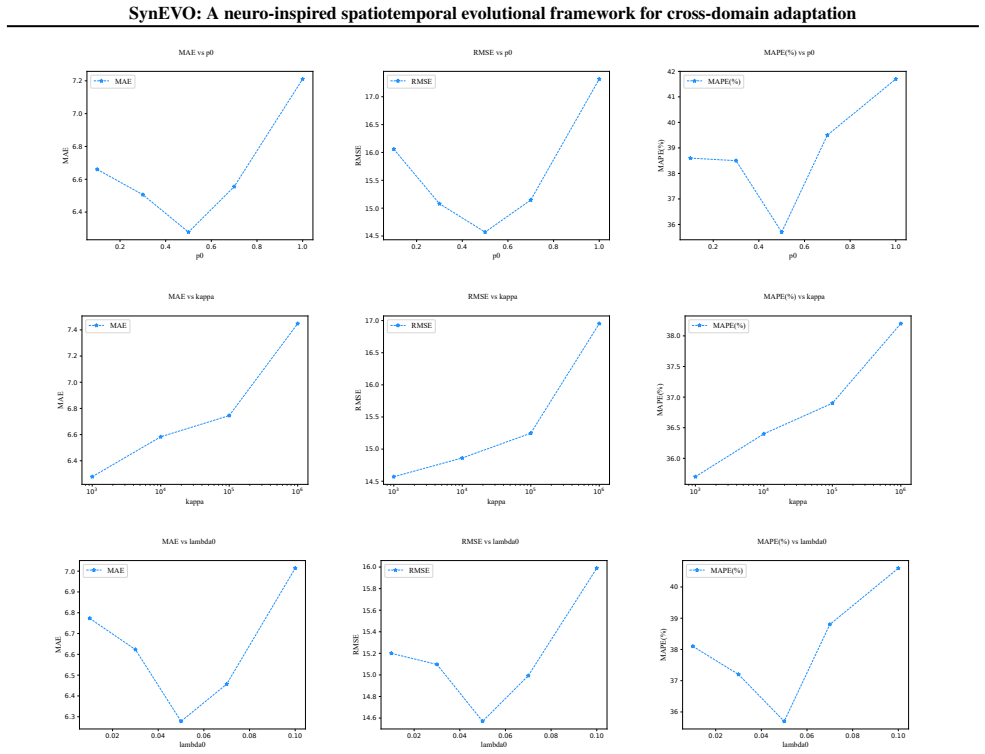
- [Section 5.7 and Section 5.4] The reported comparisons use different optimal hyperparameters on different datasets (e.g., p0=0.5 and λ0=0.05 on NYC and SIP; p0=1 and λ0=0.1 on CHI; p0=0.7 and λ0=0.07 on SD), yet no validation protocol, standard deviations, or significance tests are provided, and the code is not released. This makes it difficult to assess whether the improvements are statistically meaningful and whether SynEVO generalizes without per-dataset tuning.
minor comments (6)
- [Section 4.3.1, Eqs. (10)-(11)] The expressions 'e^{l(d_c)-d_max}' should be typeset as exp(l(d_c)-d_max) for clarity; the current notation is easy to misread.
- [Section 4.4, Eq. (15)] Eq. (15) says λ_{k+1} is computed based on Eq. (10), but Eq. (10) defines the dropout factor; the weight decay coefficient is defined in Eq. (11).
- [Section 5.4] The sentence 'SynEVO outperforms other baselines except CMuST on average by about 25.0% on NYC, 2.6% on CHI, 5.8% on SIP and 18.3% on SD' should specify the metric and the exact set of baselines used in the comparison.
- [Table 4] The table header contains a spacing typo, 'SYNEVO-E LA', and the text inconsistently uses 'CMUST' and 'CMuST' in Tables 2 and 3 and elsewhere.
- [Figure 1] The figure labels an 'Information squash' component, but this term is not defined or explained anywhere in the text.
- [Reproducibility] No code or data-release statement is provided, which limits reproducibility; the authors should state the availability of these resources.
Circularity Check
The central theorem's monotone information growth is assumed at Eq. (26) and then renamed as Info(M); the proof never defines Info(M) or derives it from the learning model.
-
other
[Appendix A, Eq. (26) in the proof of Proposition 3.1]
"Then we have assumed the involved datasets are sharing common patterns, with ∀i, j(1 ≤ i < j≤ k), I(Xi; Xj) > 0, we can obtain, I(Xi; X1, X2, . . . ,Xi−1) < I(Xi+1; X1, X2, . . . ,Xi) (26)"
Eq. (26) is the data-side form of the theorem's conclusion: it asserts that each new source strictly increases the accumulated mutual information. It does not follow from pairwise positive mutual information plus the equal-entropy normalization in Eq. (24); pairwise positivity only gives H(Xi|Xj) < H(Xi), not monotonicity of I(Xi; X1..Xi−1). The proof then uses Eq. (26) to obtain Eq. (27) and declares the model's information boundary expanding. The central monotonicity is therefore an input assumption, not a derived result.
-
self definitional
[Appendix A, after Eq. (27)]
"H(Xi|X1, X2, . . . ,Xi−1) > H(Xi+1|X1, X2, . . . ,Xi) (27) which means the model is expanding the boundary of learning."
Info(M) is never defined in information-theoretic terms, and the proof never connects the data conditional-entropy inequality Eq. (27) to M, its parameters, or the representation Z in the Information Bottleneck objective Eq. (19). The proposition's conclusion Info(M(X1..Xk)) > ... is simply the asserted data inequality renamed as model information. The theorem's consequent is thus equivalent to the assumed Eq. (26) by stipulation, not derived from any property of the learning model.
full rationale
The empirical evaluation is self-contained: SynEVO is compared against external baselines on held-out domains, and the elastic-container engineering is a testable design. The paper does not fit a parameter and then call the fit a prediction, and self-citations (e.g., CMuST, Yi et al. 2024) are used as baselines rather than as load-bearing support. However, the headline theoretical claim, Proposition 3.1, is circular in its proof: Eq. (26) asserts the very monotonicity that the proposition needs, and the proof then renames the resulting data inequality as 'the model is expanding the boundary of learning' without defining Info(M) or deriving a model-level inequality. Since the claimed theoretical guarantee of increased information is the paper's central load-bearing result, the derivation reduces to its input assumption and the score is high.
Assumptions & free parameters
free parameters (4)
- p0 (base dropout factor) =
0.5 (NYC, SIP), 1.0 (CHI), 0.7 (SD)
- lambda0 (base weight decay) =
0.05 (NYC, SIP), 0.1 (CHI), 0.07 (SD)
- kappa (coupler threshold) =
1000 on all datasets
- m (contrastive margin) =
not reported
assumptions (6)
- domain assumption All pairs of source domains share positive mutual information, I(Xi;Xj)>0 (Prop 3.1 Eq.3/16).
- ad hoc to paper All source entropies are equal, H(Xi)=H(Xj) (Appendix A Eq.24).
- ad hoc to paper I(Xi;X1..Xi-1) < I(Xi+1;X1..Xi) (Appendix A Eq.26).
- domain assumption Gradient norms and gradient differences measure task difficulty and model-data consistency (Sec.4.2).
- domain assumption The MAE-trained network is governed by an information bottleneck objective L=I(X;Z)-beta*I(Z;Yhat) (Appendix A Eq.19).
- domain assumption Neurotransmitter release probability Pr=P0(1-e^{-tau}) transfers to dropout and weight-decay schedules (Lemma 4.1, Eq.8-11).
Cite this review
Pith. "Pith review of SynEVO: A neuro-inspired spatiotemporal evolutional framework for cross-domain adaptation." pith.science (2026). https://pith.science/paper/3OR5RTVZ
@misc{pith2026250516080,
  author       = {Pith},
  title        = {Pith review of: SynEVO: A neuro-inspired spatiotemporal evolutional framework for cross-domain adaptation},
  year         = {2026},
  howpublished = {\url{https://pith.science/paper/3OR5RTVZ}},
  note         = {Machine review of arXiv:2505.16080}
}
read the original abstract
Discovering regularities from spatiotemporal systems can benefit various scientific and social planning. Current spatiotemporal learners usually train an independent model from a specific source data that leads to limited transferability among sources, where even correlated tasks requires new design and training. The key towards increasing cross-domain knowledge is to enable collective intelligence and model evolution. In this paper, inspired by neuroscience theories, we theoretically derive the increased information boundary via learning cross-domain collective intelligence and propose a Synaptic EVOlutional spatiotemporal network, SynEVO, where SynEVO breaks the model independence and enables cross-domain knowledge to be shared and aggregated. Specifically, we first re-order the sample groups to imitate the human curriculum learning, and devise two complementary learners, elastic common container and task-independent extractor to allow model growth and task-wise commonality and personality disentanglement. Then an adaptive dynamic coupler with a new difference metric determines whether the new sample group should be incorporated into common container to achieve model evolution under various domains. Experiments show that SynEVO improves the generalization capacity by at most 42% under cross-domain scenarios and SynEVO provides a paradigm of NeuroAI for knowledge transfer and adaptation.
Figures


Figures from the paper (4 more)


Reference graph
Works this paper leans on
-
[1]
Arani, E., Sarfraz, F., and Zonooz, B. Learning fast, learning slow: A general continual learning method based on complementary learning system. arXiv preprint arXiv:2201.12604,
-
[10]
Graph wavenet for deep spatial-temporal graph modeling
Wu, Z., Pan, S., Long, G., Jiang, J., and Zhang, C. Graph wavenet for deep spatial-temporal graph modeling. arXiv preprint arXiv:1906.00121,
arXiv 1906
-
[11]
Spatial-temporal transformer networks for traffic flow forecasting
Xu, M., Dai, W., Liu, C., Gao, X., Lin, W., Qi, G.-J., and Xiong, H. Spatial-temporal transformer networks for traffic flow forecasting. arXiv preprint arXiv:2001.02908,
arXiv 2001
-
[12]
Spatio-temporal graph convo- lutional networks: A deep learning framework for traffic forecasting
Yu, B., Yin, H., and Zhu, Z. Spatio-temporal graph convo- lutional networks: A deep learning framework for traffic forecasting. arXiv preprint arXiv:1709.04875,
-
[13]
11 SynEVO: A neuro-inspired spatiotemporal evolutional framework for cross-domain adaptation In the Appendix, we provide the necessary proof our proposition and supplementary experiments for model evaluation. A. Proof of Proposition 3.1 Cross-domain learning can increase the learned information. Proposition A.1. Increased information with cross-domain lea...
work page 2000
-
[2000]
Tishby, N., Pereira, F. C., and Bialek, W. The informa- tion bottleneck method. arXiv preprint physics/0004057,
-
[2009]
Bertram, R., Sherman, A., and Stanley, E. F. Single- domain/bound calcium hypothesis of transmitter release and facilitation. Journal of Neurophysiology, 75(5):1919– 1931,
work page 1919
-
[2019]
Dimensionality reduction by learning an invariant mapping
Hadsell, R., Chopra, S., and LeCun, Y . Dimensionality reduction by learning an invariant mapping. In 2006 IEEE computer society conference on computer vision and pattern recognition (CVPR’06), volume 2, pp. 1735–
work page 2006
Show all 11 references
-
[2020]
Kingma, D
URL https://arxiv.org/abs/2004.11362. Kingma, D. P. Adam: A method for stochastic optimization. arXiv preprint arXiv:1412.6980,
2004 arXiv
-
[2021]
9 SynEVO: A neuro-inspired spatiotemporal evolutional framework for cross-domain adaptation Feng, Y ., Wang, Q., Xia, Y ., Huang, J., Zhong, S., Wang, K., Cheng, S., and Liang, Y
URL https://arxiv.org/ abs/2106.12931. 9 SynEVO: A neuro-inspired spatiotemporal evolutional framework for cross-domain adaptation Feng, Y ., Wang, Q., Xia, Y ., Huang, J., Zhong, S., Wang, K., Cheng, S., and Liang, Y . Spatio-temporal field neu- ral networks for air quality i...
-
[2024]
Trafficstream: A stream- ing traffic flow forecasting framework based on graph neural networks and continual learning
Chen, X., Wang, J., and Xie, K. Trafficstream: A stream- ing traffic flow forecasting framework based on graph neural networks and continual learning. arXiv preprint arXiv:2106.06273,
Reviewed August 7, 2026 · model on record in the stance chip above.
Discussion (0). Continue with ORCID to comment.