REVIEW 5 major objections 8 minor 1 cited by
EraRAG: Efficient and Incremental Retrieval Augmented Generation for Growing Corpora
T0 review · 5 major / 8 minor · reviewed 2026-08-06 · deepseek-v4-flash
Pith's one-line read Incremental graph updates keep RAG retrieval accurate without full rebuilds.
desk verdict A genuinely incremental graph-RAG construction method with a strong dynamic-update story, undermined mainly by an absent LightRAG baseline and an overreaching Theorem 4. read the letter →
The pith
A machine-rendered reading of the paper's core claim, the machinery that carries it, and where it could break.
The reading
What carries the argument
The load-bearing object is the hyperplane-based LSH hierarchical graph: chunks are projected onto n stored random hyperplanes to get binary hash codes, buckets are merged or split against size bounds [Smin, Smax], each adjusted bucket becomes a segment summarized into a parent node, and the process recurses to build layers. Because the hyperplanes are kept rather than discarded, hashing is reproducible, so a new chunk can be inserted into its existing bucket without recomputing the whole assignment. Updates then re-summarize only affected segments and mark their ancestors for the same treatment, keeping unaffected subgraphs untouched; retrieval runs as a flat top-k search over the collapsed graph.
What would settle it
Track, over many insertions into a corpus deliberately arranged so most buckets sit near Smin or Smax, the number of segments re-summarized per update at each layer; if that count grows with the layer depth L or with the number of added chunks Δ, the claimed O(Δ(nd+S_LLM)) update bound is false, while a constant count would confirm the locality assumption.
Extended reading notes
Core claim
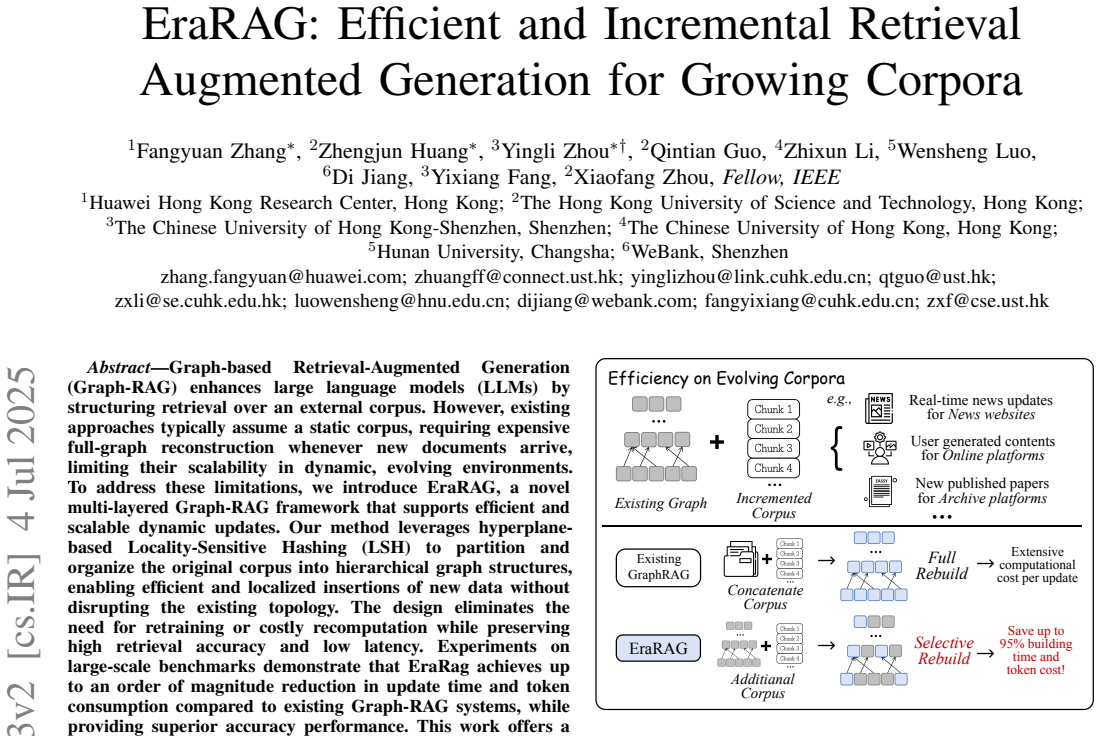
The paper's central claim is that selective, localized re-computation preserves the retrieval quality of a fully rebuilt hierarchical graph while making updates dramatically cheaper. EraRAG builds a recursive summary tree by hashing chunk embeddings onto a fixed set of random hyperplanes, splitting or merging buckets to keep segment sizes in a user-controlled range, and summarizing each segment with an LLM. The same hyperplanes are reused at update time, so new chunks land in their correct buckets without reshuffling the rest of the corpus; only segments touched by insertion, splitting, or merging are re-summarized, and the effect propagates upward only through affected ancestors. The paper argues this keeps retrieval on par with full reconstruction while reducing update cost to O(Δ(nd+S_LLM)) for Δ new chunks, where S_LLM is the amortized cost of one LLM summarization.
Load-bearing premise
The load-bearing premise is that each insertion perturbs only a constant number of segments at each layer, so the number of affected ancestors stays bounded; if an insertion cascades across many near-capacity buckets, per-update cost scales with the number of layers and the advertised savings shrink.
Editorial extensions
If this is right
- Deployments with daily or hourly document arrivals can keep a graph RAG index current without nightly full rebuilds.
- The same stored hyperplanes make hash assignment deterministic and reproducible across update rounds, so concurrent updates do not require global re-indexing.
- Retrieval quality after a long sequence of insertions approaches the static upper bound of building the graph from the complete corpus in one pass.
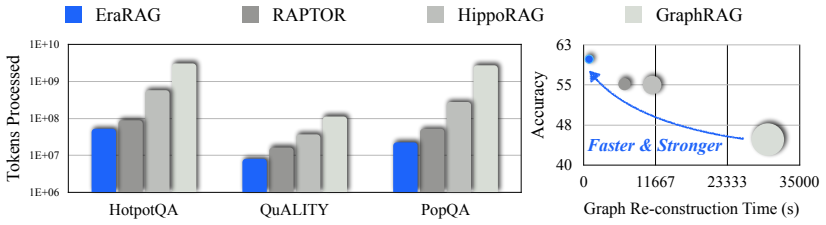
- Token cost of graph maintenance drops by up to 57.6% and rebuilding time by up to 77.5% versus the next best baseline, with order-of-magnitude gains at small update sizes.
- Because re-summarization dominates update cost, further speedups are available by distributing summarization of affected segments across localized small models.
Reading between the lines
- The order-of-magnitude claim inherits an unproven locality assumption: if many buckets are simultaneously near their size limits, a single insertion could trigger a cascade of splits and merges, pushing update cost toward the number of layers; a stress test with adversarial bucket fill would settle this.
- The technique behaves like consistent hashing for text, so it could plausibly be combined with other dynamic index structures such as HNSW or IVF-PQ that also need incremental maintenance in the same embedding space.
- The paper's accuracy comparisons use a fixed 50%-initial, ten-insertion protocol; a natural test is whether the quality gap to full rebuild widens when insertions arrive out of semantic order or in bursts concentrated in one corpus region.
- The headline gains are measured against baselines that rebuild from scratch; against a hypothetical incremental baseline that also reuses old summaries, the advantage would reduce to the quality of selective re-summarization itself.
Editorial analysis
A structured set of objections, weighed in public.
Referee Report
Summary. The paper proposes EraRAG, a hierarchical graph-RAG method that groups chunk embeddings with random hyperplane LSH into bounded-size segments, recursively summarizes segments into a multi-layer graph, and supports incremental updates by reusing the stored hyperplanes to re-hash newly arriving chunks and re-summarize only affected segments and their ancestors. Static and dynamic QA experiments on five benchmarks compare EraRAG with GraphRAG, HippoRAG, RAPTOR, and other baselines, reporting accuracy on par with or better than the baselines and substantially lower update time and token consumption.
Significance. If the efficiency claim holds, EraRAG addresses a real bottleneck for RAG over evolving corpora: preserving the projection hyperplanes makes bucket assignment deterministic across updates, so that only affected branches of the hierarchy need re-summarization. The paper provides a public code/data link, a broad experimental campaign including multiple datasets, and several ablations (initial coverage, segment-size tolerance, backbone LLM, chunk size), which are strengths. However, the headline 'order of magnitude' claim is not yet established against the most relevant incremental baseline, and the formal update-cost bound rests on an unproven locality assumption. The core idea is plausible, but the evidence and proof need strengthening before the paper's central claims can be accepted.
major comments (5)
- [Section V, Figures 4-6] The dynamic evaluation compares EraRAG only with GraphRAG, HippoRAG, and RAPTOR, all of which (by the paper's own protocol) are rebuilt from scratch at each insertion. Section II identifies LightRAG as a graph-RAG method that supports dynamic addition of documents without rebuilding the full index, making it the most direct competitor for the claimed 'up to an order of magnitude reduction in update time and token consumption compared to existing Graph-RAG systems.' Without a LightRAG dynamic arm or a clearly justified exclusion, the headline comparison is against heavier full-rebuild pipelines, and the claimed advantage may be an artifact of comparing incremental versus full-rebuild construction. Please add LightRAG to the dynamic protocol or explicitly qualify the claim.
- [Section V, Figures 4-6] There is no same-method control: the paper never reports the cost of fully rebuilding EraRAG at each insertion. Since EraRAG's static construction pipeline (LSH plus segmentation) differs from RAPTOR's clustering and GraphRAG's community detection, the measured savings are not cleanly attributable to the selective re-segmentation mechanism itself. A 'full-rebuild EraRAG' arm under the same 50%-initial/5%-insertion protocol would isolate the benefit of the incremental update.
- [Section III-E, Theorem 4] The proof of Theorem 4 asserts that each insertion perturbs 'no more than segments of a constant number' at each layer and that 'the layer depth L is a constant factor,' but neither condition appears in the theorem statement. If a split/merge cascades through several near-capacity buckets at multiple layers, or if L grows with corpus size (it is a user-defined maximum in Algorithm 1, and the stopping criterion also depends on d+1), the O(Δ(nd + S_LLM)) bound does not follow. Moreover, the assumption Smax = O(1) conflicts with Section III-C, where Smin and Smax are user-defined Θ(c) quantities. Please state the locality assumption as a hypothesis and prove it, or replace the guarantee with an amortized bound.
- [Section V, Tables II and V, Figures 4-6] The empirical results are reported for what appear to be single runs without error bars or replication counts. Since the construction uses random hyperplanes and LLM summarization, both of which are stochastic, the statements that EraRAG 'consistently' outperforms baselines and 'nearly converges to' the static upper bound need either multiple seeds with variance estimates or a clear statement that the procedure is deterministic (for example, fixed hyperplane seed and greedy decoding).
- [Section IV and Section V] The reported experiments omit key hyperparameter values needed to reproduce the results: the number of hyperplanes n, the segment-size bounds Smin and Smax (or the base value c and tolerance δ), the maximum depth L, the retrieval count k, the token budget T, and the adaptive proportion p are not given. The discussion of δ in Exp-4 only gives multiples of an unspecified δ. Please provide a configuration table with the exact values used for each dataset.
minor comments (8)
- [Section III-A and Table I] The symbol k is used both for the number of hyperplanes (Table I and Algorithm 3 input) and for the number of retrieved nodes (Theorem 3 and Algorithm 2); please disambiguate these two uses.
- [Section V, Dynamic Insertion Consumption] The sentence describing HippoRAG as 'though incremental' is inconsistent with the protocol statement that baselines without dynamic support are fully rebuilt at each update; please clarify whether HippoRAG was run in an incremental mode or rebuilt from scratch.
- [Abstract and Section VII] The abstract promises 'up to an order of magnitude reduction in update time and token consumption,' but the conclusion reports at most 57.6% token savings and 77.5% time savings over the next best baseline; please reconcile the wording with the actual measured range and state which baseline corresponds to each figure.
- [Table V] The row for threshold δ reports '878.23' without the unit 's' used in the other rows; the unit should be included.
- [Figure 7] The text 'The velvet colored options are the correct ones' appears to be a typo; the intended color word is not 'velvet.'
- [References] Reference [38] is incomplete: the venue is given as 'Available at arXiv or similar venue (specific venue not provided).' This should be completed before publication.
- [Section VI, Exp-1 and Table VI] The dataset is called 'MultihopRAG' in some places and 'MultihopQA' in others; please standardize the naming.
- [Theorem 2 proof] The space-complexity claim O(|C|d) uses |C|d + nd = O(|C|d), which requires n = O(|C|); please state this assumption or include n in the bound.
Circularity Check
No significant circularity: the central efficiency and accuracy claims are measured against external corpora or EraRAG's own one-shot rebuild; the only self-citation, the authors' benchmark framework [33], is minor and non-load-bearing.
-
other
[Section IV (Experimental Setup), Implementation Details paragraph; reference [33]]
"To ensure fair comparison and consistent evaluation across RAG baselines, all methods are implemented within the unified framework proposed in [33], which provides a systematic platform for integrating and benchmarking both graph-based and non-graph-based retrieval-augmented generation architectures."
This is the paper's only self-referential element: reference [33] (whose listed authors include Yingli Zhou, corresponding author of this paper) provides the benchmark platform on which EraRAG and every baseline are implemented, so the authors' own framework supplies the measurements behind the efficiency and accuracy claims. If [33] itself asserted the outcomes, the empirical section would reduce to self-support, but it does not: update time and token counts are wall-clock and LLM-token measurements over external corpora (HotpotQA, QuALITY, PopQA), and accuracy is scored against external QA benchmarks and against EraRAG's own one-shot full rebuild (Figure 5 and Table IV). None of the paper's theorems or equations is justified by [33].
full rationale
EraRAG's derivation chain is self-contained. Its central efficiency claim (up to an order-of-magnitude reduction in update time and tokens) is a measured design consequence: Algorithm 3 processes only newly arrived chunks and their affected ancestor segments, and Section V/Figure 4 reports wall-clock times and token counts against GraphRAG, HippoRAG, and RAPTOR, which are rebuilt from scratch. The 'parity with fully rebuilt graphs' claim is anchored externally: Figure 5 compares incremental EraRAG against a one-shot build of the complete corpus by the same system, and Exp-3 (Table IV) shows the two are not identical by construction (final accuracy varies from 41.3 at 0% initial coverage to 62.9 at 100%), which demonstrates the parity is an empirical finding rather than a definitional equivalence. Theorems 2 and 3 are complexity bookkeeping derived from the construction's own geometric decay (N_{l+1} <= N_l/Smin) and standard vector-search costs; no parameter is fitted to evaluation data and then renamed as a prediction (the adaptive retrieval parameter p is introduced but explicitly not used in the main experiments). Theorem 4's T_update = O(Delta(nd + S_LLM)) is conditional on unproven locality premises ('no more than segments of a constant number become inconsistent', 'the layer depth L is a constant factor'); this is a soundness/rigor gap, not circularity, because the premises assert which segments change while the conclusion is a time bound, and the bound is not fed back in as the premise. The only self-citation is [33], the authors' unified RAG benchmark framework used as the implementation platform; it justifies no central premise and the underlying measurements are externally reproducible, so it is minor and non-load-bearing. Benchmarking concerns (LightRAG, the one incremental baseline, is excluded from the dynamic evaluation; the abstract's 'order of magnitude' wording exceeds the 57.6%/77.5% savings reported against the next-best baseline RAPTOR) belong to correctness risk and reporting consistency, not circularity.
Assumptions & free parameters
free parameters (6)
- n: number of random hyperplanes
- Segment size bounds S_min/S_max (c +/- delta)
- L: maximum number of layers
- k: retrieved node count
- T: token budget for retrieval context
- p: adaptive retrieval layer proportion
assumptions (5)
- standard math Random hyperplane hashing: P(same bit) = (1 + cos(theta))/2 for normalized vectors (Theorem 1)
- domain assumption BGE-M3 embedding cosine similarity captures semantic relatedness of text chunks
- domain assumption LLM summaries of segments preserve the information needed for downstream QA
- domain assumption One-to-one segment assignment with size bounds outperforms overlapping clustering (e.g., RAPTOR)
- ad hoc to paper Insertions perturb only a constant number of segments per layer, and layer depth L is constant
Cite this review
Pith. "Pith review of EraRAG: Efficient and Incremental Retrieval Augmented Generation for Growing Corpora." pith.science (2026). https://pith.science/paper/3PHZHKAP
@misc{pith2026250620963,
  author       = {Pith},
  title        = {Pith review of: EraRAG: Efficient and Incremental Retrieval Augmented Generation for Growing Corpora},
  year         = {2026},
  howpublished = {\url{https://pith.science/paper/3PHZHKAP}},
  note         = {Machine review of arXiv:2506.20963}
}
read the original abstract
Graph-based Retrieval-Augmented Generation (Graph-RAG) enhances large language models (LLMs) by structuring retrieval over an external corpus. However, existing approaches typically assume a static corpus, requiring expensive full-graph reconstruction whenever new documents arrive, limiting their scalability in dynamic, evolving environments. To address these limitations, we introduce EraRAG, a novel multi-layered Graph-RAG framework that supports efficient and scalable dynamic updates. Our method leverages hyperplane-based Locality-Sensitive Hashing (LSH) to partition and organize the original corpus into hierarchical graph structures, enabling efficient and localized insertions of new data without disrupting the existing topology. The design eliminates the need for retraining or costly recomputation while preserving high retrieval accuracy and low latency. Experiments on large-scale benchmarks demonstrate that EraRag achieves up to an order of magnitude reduction in update time and token consumption compared to existing Graph-RAG systems, while providing superior accuracy performance. This work offers a practical path forward for RAG systems that must operate over continually growing corpora, bridging the gap between retrieval efficiency and adaptability. Our code and data are available at https://github.com/EverM0re/EraRAG-Official.
Figures

Figures from the paper (5 more)


Forward citations
Cited by 1 Pith paper
-
Beyond Retrieval: Analytic Memory for Multimodal Agents
ADAMM induces queryable analytic tables from multimodal interaction histories and combines them with semantic retrieval, improving benchmark accuracy by up to 11.3 points over memory baselines.
Reference graph
Works this paper leans on
-
[1]
Josh Achiam, Steven Adler, Sandhini Agarwal, Lama Ahmad, Ilge Akkaya, Florencia Leoni Aleman, Diogo Almeida, Janko Altenschmidt, Sam Altman, Shyamal Anadkat, et al. Gpt-4 technical report. arXiv preprint arXiv:2303.08774, 2023
arXiv 2023
-
[2]
An Yang, Baosong Yang, Beichen Zhang, Binyuan Hui, Bo Zheng, Bowen Yu, Chengyuan Li, Dayiheng Liu, Fei Huang, Haoran Wei, et al. Qwen2. 5 technical report. arXiv preprint arXiv:2412.15115 , 2024
arXiv 2024
-
[3]
Llama: Open and efficient foundation language models
Hugo Touvron, Thibaut Lavril, Gautier Izacard, Xavier Martinet, Marie- Anne Lachaux, Timoth ´ee Lacroix, Baptiste Rozi `ere, Naman Goyal, Eric Hambro, Faisal Azhar, et al. Llama: Open and efficient foundation language models. arXiv preprint arXiv:2302.13971 , 2023
arXiv 2023
-
[4]
Yang Zhang, Hanlei Jin, Dan Meng, Jun Wang, and Jinghua Tan. A comprehensive survey on process-oriented automatic text summarization with exploration of llm-based methods. arXiv preprint arXiv:2403.02901, 2024
arXiv 2024
-
[5]
Llm-based code generation method for golang compiler testing
Qiuhan Gu. Llm-based code generation method for golang compiler testing. In Proceedings of the 31st ACM Joint European Software Engineering Conference and Symposium on the Foundations of Software Engineering, pages 2201–2203, 2023
2023
-
[6]
Llm-sr: Scientific equation discovery via pro- gramming with large language models
Parshin Shojaee, Kazem Meidani, Shashank Gupta, Amir Barati Farimani, and Chandan K Reddy. Llm-sr: Scientific equation discovery via pro- gramming with large language models. arXiv preprint arXiv:2404.18400, 2024
arXiv 2024
-
[7]
A survey of graph meets large language model: Progress and future directions
Yuhan Li, Zhixun Li, Peisong Wang, Jia Li, Xiangguo Sun, Hong Cheng, and Jeffrey Xu Yu. A survey of graph meets large language model: Progress and future directions. arXiv preprint arXiv:2311.12399 , 2023
arXiv 2023
-
[8]
Beyond one-model-fits-all: A survey of domain specialization for large language models
XUJIANG ZHAO, JIAYING LU, CHENGYUAN DENG, C ZHENG, JUNXIANG W ANG, TANMOY CHOWDHURY , L YUN, HEJIE CUI, ZHANG XUCHAO, TIANJIAO ZHAO, et al. Beyond one-model-fits-all: A survey of domain specialization for large language models. arXiv preprint arXiv, 2305, 2023
work page 2023
Show all 57 references
-
[9]
Openagi: When llm meets domain experts
Yingqiang Ge, Wenyue Hua, Kai Mei, Juntao Tan, Shuyuan Xu, Zelong Li, Yongfeng Zhang, et al. Openagi: When llm meets domain experts. Advances in Neural Information Processing Systems , 36:5539–5568, 2023
2023
-
[10]
A survey on hallucination in large language models: Principles, taxonomy, challenges, and open questions
Lei Huang, Weijiang Yu, Weitao Ma, Weihong Zhong, Zhangyin Feng, Haotian Wang, Qianglong Chen, Weihua Peng, Xiaocheng Feng, Bing Qin, et al. A survey on hallucination in large language models: Principles, taxonomy, challenges, and open questions. arXiv preprint arXiv:2311.05232, 2023
2023 arXiv
-
[11]
A survey on hallucination in large language models: Principles, taxonomy, challenges, and open questions
Lei Huang, Weijiang Yu, Weitao Ma, Weihong Zhong, Zhangyin Feng, Haotian Wang, Qianglong Chen, Weihua Peng, Xiaocheng Feng, Bing Qin, et al. A survey on hallucination in large language models: Principles, taxonomy, challenges, and open questions. ACM Transactions on Informatio...
2025
-
[12]
Llm lies: Hallucinations are not bugs, but features as adversarial examples
Jia-Yu Yao, Kun-Peng Ning, Zhen-Hui Liu, Mu-Nan Ning, Yu-Yang Liu, and Li Yuan. Llm lies: Hallucinations are not bugs, but features as adversarial examples. arXiv preprint arXiv:2310.01469 , 2023
2023 arXiv
-
[13]
When scaling meets llm finetuning: The effect of data, model and finetuning method
Biao Zhang, Zhongtao Liu, Colin Cherry, and Orhan Firat. When scaling meets llm finetuning: The effect of data, model and finetuning method. arXiv preprint arXiv:2402.17193 , 2024
2024 arXiv
-
[14]
A closer look at the limitations of instruction tuning
Sreyan Ghosh, Chandra Kiran Reddy Evuru, Sonal Kumar, Deepali Aneja, Zeyu Jin, Ramani Duraiswami, Dinesh Manocha, et al. A closer look at the limitations of instruction tuning. arXiv preprint arXiv:2402.05119 , 2024
2024 arXiv
-
[15]
Getting it right: the limits of fine-tuning large language models
Jacob Browning. Getting it right: the limits of fine-tuning large language models. Ethics and Information Technology , 26(2):36, 2024
2024
-
[16]
Retrieval- augmented generation for large language models: A survey
Yunfan Gao, Yun Xiong, Xinyu Gao, Kangxiang Jia, Jinliu Pan, Yuxi Bi, Yi Dai, Jiawei Sun, Haofen Wang, and Haofen Wang. Retrieval- augmented generation for large language models: A survey. arXiv preprint arXiv:2312.10997, 2, 2023
2023 arXiv
-
[17]
A survey on rag meeting llms: Towards retrieval-augmented large language models
Wenqi Fan, Yujuan Ding, Liangbo Ning, Shijie Wang, Hengyun Li, Dawei Yin, Tat-Seng Chua, and Qing Li. A survey on rag meeting llms: Towards retrieval-augmented large language models. In Proceedings of the 30th ACM SIGKDD Conference on Knowledge Discovery and Data Mining, pages...
2024
-
[18]
Retrieval- augmented generation for natural language processing: A survey
Shangyu Wu, Ying Xiong, Yufei Cui, Haolun Wu, Can Chen, Ye Yuan, Lianming Huang, Xue Liu, Tei-Wei Kuo, Nan Guan, et al. Retrieval- augmented generation for natural language processing: A survey. arXiv preprint arXiv:2407.13193, 2024
2024 arXiv
-
[20]
Retrieval-augmented generation for ai-generated content: A survey
Penghao Zhao, Hailin Zhang, Qinhan Yu, Zhengren Wang, Yunteng Geng, Fangcheng Fu, Ling Yang, Wentao Zhang, Jie Jiang, and Bin Cui. Retrieval-augmented generation for ai-generated content: A survey. arXiv preprint arXiv:2402.19473 , 2024
2024 arXiv
-
[21]
Trustworthiness in retrieval-augmented generation systems: A survey
Yujia Zhou, Yan Liu, Xiaoxi Li, Jiajie Jin, Hongjin Qian, Zheng Liu, Chaozhuo Li, Zhicheng Dou, Tsung-Yi Ho, and Philip S Yu. Trustworthiness in retrieval-augmented generation systems: A survey. arXiv preprint arXiv:2409.10102 , 2024
2024 arXiv
-
[22]
Retrieval augmented generation (rag) and beyond: A comprehensive survey on how to make your llms use external data more wisely
Siyun Zhao, Yuqing Yang, Zilong Wang, Zhiyuan He, Luna K Qiu, and Lili Qiu. Retrieval augmented generation (rag) and beyond: A comprehensive survey on how to make your llms use external data more wisely. arXiv preprint arXiv:2409.14924 , 2024
2024 arXiv
-
[23]
Enhancing llm factual accuracy with rag to counter hallucinations: A case study on domain-specific queries in private knowledge-bases
Jiarui Li, Ye Yuan, and Zehua Zhang. Enhancing llm factual accuracy with rag to counter hallucinations: A case study on domain-specific queries in private knowledge-bases. arXiv preprint arXiv:2403.10446 , 2024
2024 arXiv
-
[24]
Towards understanding retrieval accuracy and prompt quality in rag systems
Shengming Zhao, Yuheng Huang, Jiayang Song, Zhijie Wang, Chengcheng Wan, and Lei Ma. Towards understanding retrieval accuracy and prompt quality in rag systems. arXiv preprint arXiv:2411.19463 , 2024
2024 arXiv
-
[25]
How much can rag help the reasoning of llm? arXiv preprint arXiv:2410.02338 , 2024
Jingyu Liu, Jiaen Lin, and Yong Liu. How much can rag help the reasoning of llm? arXiv preprint arXiv:2410.02338 , 2024
2024 arXiv
-
[26]
Retrieval-augmented generation with graphs (graphrag)
Haoyu Han, Yu Wang, Harry Shomer, Kai Guo, Jiayuan Ding, Yongjia Lei, Mahantesh Halappanavar, Ryan A Rossi, Subhabrata Mukherjee, Xianfeng Tang, et al. Retrieval-augmented generation with graphs (graphrag). arXiv preprint arXiv:2501.00309 , 2024
2024 arXiv
-
[27]
A survey of graph retrieval-augmented generation for customized large language models
Qinggang Zhang, Shengyuan Chen, Yuanchen Bei, Zheng Yuan, Huachi Zhou, Zijin Hong, Junnan Dong, Hao Chen, Yi Chang, and Xiao Huang. A survey of graph retrieval-augmented generation for customized large language models. arXiv preprint arXiv:2501.13958 , 2025
2025
-
[28]
Haoyu Han, Harry Shomer, Yu Wang, Yongjia Lei, Kai Guo, Zhigang Hua, Bo Long, Hui Liu, and Jiliang Tang. Rag vs. graphrag: A systematic evaluation and key insights. arXiv preprint arXiv:2502.11371 , 2025
2025
-
[29]
Grag: Graph retrieval-augmented generation
Yuntong Hu, Zhihan Lei, Zheng Zhang, Bo Pan, Chen Ling, and Liang Zhao. Grag: Graph retrieval-augmented generation. arXiv preprint arXiv:2405.16506, 2024
2024 arXiv
-
[30]
Graph retrieval-augmented generation: A survey
Boci Peng, Yun Zhu, Yongchao Liu, Xiaohe Bo, Haizhou Shi, Chuntao Hong, Yan Zhang, and Siliang Tang. Graph retrieval-augmented generation: A survey. arXiv preprint arXiv:2408.08921 , 2024
2024 arXiv
-
[31]
arxiv. Arxiv. https://arxiv.org/list/cs.CL/pastweek?show=1000, 2025
2025
-
[32]
Dragin: Dynamic retrieval augmented generation based on the information needs of llms
Zecheng Liu, Yujia Zhao, Shumin Zhang, Can Xu, and Zhoujun Yu. Dragin: Dynamic retrieval augmented generation based on the information needs of llms. arXiv preprint arXiv:2403.10081 , 2024
2024 arXiv
-
[33]
In-depth analysis of graph-based rag in a unified framework
Yingli Zhou, Yaodong Su, Youran Sun, Shu Wang, Taotao Wang, Runyuan He, Yongwei Zhang, et al. In-depth analysis of graph-based rag in a unified framework. arXiv preprint arXiv:2503.04338 , 2025
2025 arXiv
-
[34]
From local to global: A graph rag approach to query-focused summarization
Darren Edge, Ha Trinh, Newman Cheng, Joshua Bradley, Alex Chao, Apurva Mody, Steven Truitt, Dasha Metropolitansky, Robert Osazuwa Ness, and Jonathan Larson. From local to global: A graph rag approach to query-focused summarization. arXiv preprint arXiv:2404.16130, 2024
2024 arXiv
-
[35]
Approximate nearest neighbors: Towards removing the curse of dimensionality
Piotr Indyk and Rajeev Motwani. Approximate nearest neighbors: Towards removing the curse of dimensionality. In STOC, pages 604–613, 1998
1998
-
[36]
Locality-sensitive hashing scheme based on p-stable distributions
Mayur Datar, Nicole Immorlica, Piotr Indyk, and Vahab S Mirrokni. Locality-sensitive hashing scheme based on p-stable distributions. In PoCG, pages 253–262, 2004
2004
-
[37]
Razenshteyn, and Ludwig Schmidt
Alexandr Andoni, Piotr Indyk, Thijs Laarhoven, Ilya P. Razenshteyn, and Ludwig Schmidt. Practical and optimal LSH for angular distance. In NeurIPS, pages 1225–1233, 2015
2015
-
[38]
Lightrag: Simple and fast retrieval-augmented generation, 2024
Zirui Guo, Lianghao Xia, Yanhua Yu, Tu Ao, and Chao Huang. Lightrag: Simple and fast retrieval-augmented generation, 2024. Available at arXiv or similar venue (specific venue not provided)
2024
-
[39]
Dyprag: Retrieval-augmented generation with dynamic parameter- efficient adaptation
Yifan Yang, Yang Chen, Baolin Peng, Chris Brockett, and Jianfeng Gao. Dyprag: Retrieval-augmented generation with dynamic parameter- efficient adaptation. arXiv preprint arXiv:2503.23895 , 2024
2024 arXiv
-
[40]
Parth Sarthi, Salman Abdullah, Aditi Tuli, Shubh Khanna, Anna Goldie, and Christopher D. Manning. Raptor: Recursive abstractive processing for tree-organized retrieval. In The Twelfth International Conference on Learning Representations (ICLR) , 2024
2024
-
[41]
Gslb: The graph structure learning benchmark
Zhixun Li, Liang Wang, Xin Sun, Yifan Luo, Yanqiao Zhu, Dingshuo Chen, Yingtao Luo, Xiangxin Zhou, Qiang Liu, Shu Wu, et al. Gslb: The graph structure learning benchmark. Advances in Neural Information Processing Systems, 36:30306–30318, 2023
2023
-
[42]
A survey on locality sensitive hashing algorithms and their applications
Omid Jafari, Preeti Maurya, Parth Nagarkar, Khandker Mushfiqul Islam, and Chidambaram Crushev. A survey on locality sensitive hashing algorithms and their applications. arXiv preprint arXiv:2102.08942 , 2021
2021 arXiv
-
[44]
Multihop-rag: Benchmarking retrieval- augmented generation for multi-hop queries
Yixuan Tang and Yi Yang. Multihop-rag: Benchmarking retrieval- augmented generation for multi-hop queries. arXiv preprint arXiv:2401.15391, 2024
2024 arXiv
-
[45]
Hotpotqa: A dataset for diverse, explainable multi-hop question answering
Zhilin Yang, Peng Qi, Saizheng Zhang, Yoshua Bengio, William W Cohen, Ruslan Salakhutdinov, and Christopher D Manning. Hotpotqa: A dataset for diverse, explainable multi-hop question answering. arXiv preprint arXiv:1809.09600, 2018
2018 arXiv
-
[46]
Quality: Question answering with long input texts, yes! arXiv preprint arXiv:2112.08608 , 2021
Richard Yuanzhe Pang, Alicia Parrish, Nitish Joshi, Nikita Nangia, Jason Phang, Angelica Chen, Vishakh Padmakumar, Johnny Ma, Jana Thompson, He He, et al. Quality: Question answering with long input texts, yes! arXiv preprint arXiv:2112.08608 , 2021
2021 arXiv
-
[47]
Musique: Multihop questions via single-hop question com- position
Harsh Trivedi, Niranjan Balasubramanian, Tushar Khot, and Ashish Sabharwal. Musique: Multihop questions via single-hop question com- position. Transactions of the Association for Computational Linguistics , 10:539–554, 2022
2022
-
[48]
Large language models are zero-shot reasoners
Takeshi Kojima, Shixiang Shane Gu, Machel Reid, Yutaka Matsuo, and Yusuke Iwasawa. Large language models are zero-shot reasoners. Advances in neural information processing systems , 35:22199–22213, 2022
2022
-
[49]
Some simple effective approximations to the 2-poisson model for probabilistic weighted retrieval
Stephen E Robertson and Steve Walker. Some simple effective approximations to the 2-poisson model for probabilistic weighted retrieval. In SIGIR’94: Proceedings of the Seventeenth Annual International ACM- SIGIR Conference on Research and Development in Information Retrieval, ...
1994
-
[50]
Retrieval-augmented generation for knowledge- intensive nlp tasks
Patrick Lewis, Ethan Perez, Aleksandra Piktus, Fabio Petroni, Vladimir Karpukhin, Naman Goyal, Heinrich K ¨uttler, Mike Lewis, Wen-tau Yih, Tim Rockt¨aschel, et al. Retrieval-augmented generation for knowledge- intensive nlp tasks. Advances in neural information processing sys...
2020
-
[51]
Hipporag: Neurobiologically inspired long-term memory for large language models
Bernal Jim ´enez Guti ´errez, Yiheng Shu, Yu Gu, Michihiro Yasunaga, and Yu Su. Hipporag: Neurobiologically inspired long-term memory for large language models. In The Thirty-eighth Annual Conference on Neural Information Processing Systems , 2024
2024
-
[52]
Toolformer: Language models can teach themselves to use tools
Timo Schick, Jane Dwivedi-Yu, Roberto Dess `ı, Roberta Raileanu, Maria Lomeli, Eric Hambro, Luke Zettlemoyer, Nicola Cancedda, and Thomas Scialom. Toolformer: Language models can teach themselves to use tools. Advances in Neural Information Processing Systems , 36:68539–68551, 2023
2023
-
[53]
When not to trust language models: Investi- gating effectiveness of parametric and non-parametric memories
Alex Mallen, Akari Asai, Victor Zhong, Rajarshi Das, Daniel Khashabi, and Hannaneh Hajishirzi. When not to trust language models: Investi- gating effectiveness of parametric and non-parametric memories. arXiv preprint arXiv:2212.10511, 2022
2022 arXiv
-
[54]
Llama-3.1-foundationai-securityllm-base- 8b technical report
Paul Kassianik, Baturay Saglam, Alexander Chen, Blaine Nelson, Anu Vellore, Massimo Aufiero, Fraser Burch, Dhruv Kedia, Avi Zohary, Sajana Weerawardhena, et al. Llama-3.1-foundationai-securityllm-base- 8b technical report. arXiv preprint arXiv:2504.21039 , 2025
2025 arXiv
-
[55]
A general retrieval-augmented generation framework for multimodal case-based reasoning applications
Ofir Marom. A general retrieval-augmented generation framework for multimodal case-based reasoning applications. arXiv preprint arXiv:2501.05030, 2025
2025 arXiv
-
[56]
M3-embedding: Multi-linguality, multi-functionality, multi-granularity text embeddings through self-knowledge distillation
Multi-Linguality Multi-Functionality Multi-Granularity. M3-embedding: Multi-linguality, multi-functionality, multi-granularity text embeddings through self-knowledge distillation. 2024
2024
-
[57]
Memorag: Moving towards next-gen rag via memory-inspired knowledge discovery
Hongjin Qian, Peitian Zhang, Zheng Liu, Kelong Mao, and Zhicheng Dou. Memorag: Moving towards next-gen rag via memory-inspired knowledge discovery. arXiv preprint arXiv:2409.05591 , 2024
2024 arXiv
-
[58]
Language models are few-shot learners
Tom Brown, Benjamin Mann, Nick Ryder, Melanie Subbiah, Jared D Kaplan, Prafulla Dhariwal, Arvind Neelakantan, Pranav Shyam, Girish Sastry, Amanda Askell, et al. Language models are few-shot learners. Advances in neural information processing systems , 33:1877–1901, 2020
1901
-
[59]
The chronicles of rag: The retriever, the chunk and the generator
Paulo Finardi, Leonardo Avila, Rodrigo Castaldoni, Pedro Gengo, Celio Larcher, Marcos Piau, Pablo Costa, and Vinicius Carid ´a. The chronicles of rag: The retriever, the chunk and the generator. arXiv preprint arXiv:2401.07883, 2024
2024 arXiv
Reviewed August 6, 2026 · model on record in the stance chip above.
Discussion (0). Sign in to comment.