REVIEW 3 major objections 53 references
Vision-language models judge physical reachability by appearance matching and linguistic belief rather than physical process, and inserting visual simulation as an intermediate step corrects much of that failure.
Reviewed by Pith at T0; open to challenge. T0 means a machine referee read the full paper against a public rubric. the ladder, T0–T4 →
T0 review · grok-4.5
2026-07-14 07:25 UTC pith:3PRBCVFY
load-bearing objection Solid new benchmark that exposes real VLM physical-reasoning failures; the simulator half of the story is under-validated but does not sink the paper. the 3 major comments →
RetroHolmes: When Semantic Plausibility Fails Retrospective Physical Process Reasoning
The pith
A machine-rendered reading of the paper's core claim, the machinery that carries it, and where it could break.
Core claim
State-of-the-art vision-language models systematically fail Retrospective Physical Process Reasoning on RetroHolmes: they show strong judgment bias on whether one object state can physically reach another, and they prioritize contradictory human belief prompts over visual physical evidence, mirroring sycophancy. A Simulate-and-Verify analysis-by-synthesis method that inserts visual simulation between planning and verification improves reachability accuracy and reduces belief-conflict sensitivity, validating the benchmark’s diagnostic value.
What carries the argument
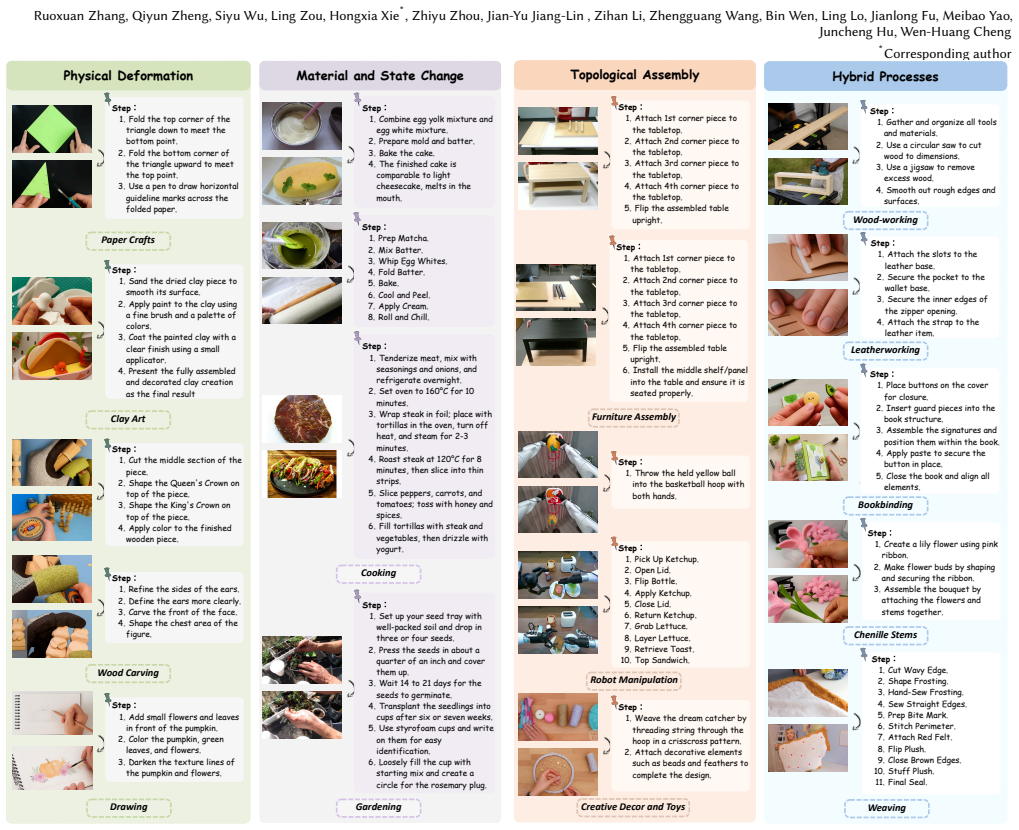
Retrospective Physical Process Reasoning: given sparse visual endpoints (IA, IB), decide whether a physically valid transition exists and, if so, reconstruct the latent causal step sequence. Operationalized by the RetroHolmes benchmark (reachability labels, causal steps, five evaluation dimensions) and diagnosed by the Simulate-and-Verify loop that uses video generation as an intermediate physical simulator.
Load-bearing premise
The method assumes that a pretrained video generation model, conditioned on start and end images plus a textual plan, produces intermediate trajectories faithful enough to real physics that a verifier can trust them for reachability and causal consistency.
What would settle it
Replace the physical simulator with non-physical generation (pure noise or unrelated video) or measure whether belief-induced answer flips still occur with unchanged attention maps on RetroHolmes; if gains vanish under non-physical simulation or bias and flips persist under stronger dynamics training without simulation, the central diagnostic claim fails.
If this is right
- Benchmarks that only score forward prediction or linguistic plausibility will overstate physical understanding in vision-language models.
- Models that follow linguistic priors over visual physics remain unreliable for planning, robotics, and safety-critical visual reasoning.
- Physically grounded intermediate representations such as simulated trajectories can measurably reduce belief-conflict sensitivity.
- Evaluation suites need belief-conflict and irreversibility probes to expose shortcut reasoning on invariant visual features.
- Analysis-by-synthesis with generative world models is a practical route to better retrospective physical reasoning.
Where Pith is reading between the lines
- The same attention-to-invariant-patches shortcut may explain failures on other irreversible or multi-step physical tasks outside this benchmark.
- Further language-only alignment without dynamics supervision may increase, rather than reduce, belief dominance over evidence.
- As video simulators improve, closed-loop Simulate-and-Verify could become a standard test-time method for physical question answering and planning.
- Endpoint reachability judgments of the RetroHolmes type could serve as a diagnostic for any world model that claims to capture physics.
Editorial analysis
A structured set of objections, weighed in public.
Referee Report
Summary. The paper introduces Retrospective Physical Process Reasoning: given sparse visual endpoints (I_A, I_B), a model must judge physical reachability and, if reachable, reconstruct a causal step sequence under physical constraints. It presents RetroHolmes, a real-world object-centric benchmark of 9,530 image pairs spanning four physical-transition categories and 14 domains, with five diagnostic dimensions (ED1–ED5) and metrics for judgment accuracy (JA), belief-conflict sensitivity (BCS), and step completeness (SC via RougeL). Zero-shot evaluation of 11 VLMs reveals systematic judgment bias and belief dominance over visual evidence (sycophancy-like). The authors then propose Simulate-and-Verify, an analysis-by-synthesis loop that uses a video generator (Wan2.2-TI2V-5B) as an intermediate physical simulator, reporting gains in JA, BCS, and SC over the base Qwen3-VL-8B and ablations.
Significance. The work targets a genuine and under-evaluated gap: whether VLMs capture physical realizability rather than linguistic/procedural plausibility. RetroHolmes is a concrete, multi-domain, dual-output benchmark with explicit reachability labels and causal chains, plus a useful diagnostic suite (especially ED3 belief conflict and ED5 irreversible micro-states). The multi-model Table 2 results, attention analyses (Fig. 4), and ablations (SFT-only; w/o Stage 2) provide credible evidence of judgment bias and belief dominance. If the findings hold under stronger step-quality and simulator-fidelity checks, the benchmark would be a lasting diagnostic resource for physical reasoning in VLMs, and the analysis-by-synthesis framing would usefully connect world-model/generation work to feasibility reasoning.
major comments (3)
- Section 4.2 (Physical World Simulation) and Table 2: The central claim that Simulate-and-Verify improves reasoning via physically grounded intermediate representations rests on Wan2.2-TI2V-5B producing trajectories that are faithful enough to real dynamics to verify reachability/causal consistency. The paper reports no fidelity metric (human ratings of simulated videos, physical-consistency rate, or correlation between simulator-detected inconsistencies and ground-truth unreachability). The 'Ours w/o Stage 2' ablation shows degradation but does not isolate physical fidelity from the mere addition of denser intermediate visual tokens. Without such evidence, the large BCS drop (50.32% → 7.53%) and JA gains can be explained by extra visual context or the planner–verifier loop rather than genuine physical grounding. Please add a fidelity study or substantially temper claims that attribute ga
- Section 3.2 Evaluation Metrics and Table 2 (SC columns): Step Completeness is measured primarily by RougeL against reference text. RougeL rewards lexical/structural overlap and does not assess physical feasibility, causal order correctness, or law violations—the very failure modes the paper diagnoses (law/causality/identity/space/goal errors in Fig. 2). The manuscript mentions a human study of reconstructed sequences but does not report its protocol, scale, or results in the main evaluation. For a paper whose thesis is that semantic plausibility fails physical reasoning, SC as currently reported is too weak to support claims of improved causal reconstruction. Report human ratings (or a physics-aware automatic metric) for step quality, at least for the main models and Simulate-and-Verify.
- Section 3.2 (ED1 construction) and taxonomy: Unreachable pairs for ED1 are synthesized via 'intra-category goal swapping.' This is an ad-hoc axiom that is load-bearing for JA on unreachable cases. The paper does not report inter-annotator agreement, expert validation rates, or failure modes of this procedure (e.g., swapped goals that remain physically reachable via alternative processes). Please quantify how often swapped pairs are truly unreachable under the stated physical constraints, and how this affects ED1/ED5 interpretation.
Circularity Check
No significant circularity: RetroHolmes labels and metrics are external to the models under test; Simulate-and-Verify gains are measured against those fixed labels, not defined by them.
full rationale
This is an empirical benchmark-and-method paper, not a first-principles derivation. Reachability labels and causal step sequences are constructed from external procedural datasets plus human checks; Judgment Accuracy, Belief-Conflict Sensitivity, and Step Completeness are then scored against those fixed annotations. The multi-model failure modes (judgment bias, belief dominance) are comparative measurements on that held-out suite, including independent closed-source models (GPT-5.2, GPT-4o, Gemini 3 Pro). Simulate-and-Verify is an analysis-by-synthesis pipeline whose reported JA/BCS/SC improvements are likewise evaluated against the same external labels; no free parameter is fitted to a subset of RetroHolmes and then renamed a prediction, and no uniqueness theorem or ansatz is imported from overlapping-author prior work as a load-bearing premise. Mild reuse of Qwen3-VL variants as both baseline and planner/verifier, and of Qwen3-VL-Plus as one of two label verifiers for ED4, is ordinary engineering practice and does not reduce any central claim by construction. The paper is therefore self-contained against its external benchmark; circularity score is 0.
Axiom & Free-Parameter Ledger
free parameters (2)
- number of intermediate simulation frames N
- top-10% attention patch threshold for CLIP similarity analysis
axioms (4)
- domain assumption A pretrained conditional video generation model encodes sufficiently accurate physical dynamics to serve as an internal simulator for reachability verification.
- domain assumption Rouge-L against gold step sequences is an adequate proxy for causal step completeness under physical constraints.
- domain assumption Human-annotated reachability labels and step sequences correctly encode real-world physical possibility and minimal causal chains.
- ad hoc to paper Intra-category goal swapping produces valid unreachable pairs for ED1.
invented entities (3)
-
Retrospective Physical Process Reasoning paradigm
no independent evidence
-
Five evaluation dimensions ED1–ED5
no independent evidence
-
Simulate-and-Verify framework
no independent evidence
read the original abstract
Humans can infer hidden physical processes from sparse observations, yet current evaluation protocols for Vision Language Models fail to assess whether such physical reasoning is genuinely captured. To address this gap, we introduce Retrospective Physical Process Reasoning, a new evaluation paradigm to reason backward from outcomes under explicit physical constraints. Building on the paradigm, we present RetroHolmes, the first real-world benchmark for Retrospective Physical Process Reasoning, comprising object-centric image pairs annotated with reachability labels and causal step sequences across diverse physical transitions. Using RetroHolmes, we analyze state of the art Vision Language Models and uncover systematic failure modes, including judgment bias in reachability assessment and belief dominance over physical evidence, mirroring sycophancy behavior observed in large language models. We further demonstrate a simple analysis-by-synthesis instantiation with visual simulation as an intermediate step, validating the diagnostic value of RetroHolmes and highlighting the importance of physically grounded intermediate representations for physical reasoning.
Figures




Reference graph
Works this paper leans on
-
[1]
Josh Achiam, Steven Adler, Sandhini Agarwal, Lama Ahmad, Ilge Akkaya, Floren- cia Leoni Aleman, Diogo Almeida, Janko Altenschmidt, Sam Altman, Shyamal Anadkat, et al. 2023. Gpt-4 technical report.arXiv preprint arXiv:2303.08774 (2023)
Pith/arXiv arXiv 2023
-
[2]
Xiang An, Yin Xie, Kaicheng Yang, Wenkang Zhang, Xiuwei Zhao, Zheng Cheng, Yirui Wang, Songcen Xu, Changrui Chen, Didi Zhu, et al. 2025. Llava-onevision- 1.5: Fully open framework for democratized multimodal training.arXiv preprint arXiv:2509.23661(2025)
Pith/arXiv arXiv 2025
-
[3]
Shuai Bai, Yuxuan Cai, Ruizhe Chen, Keqin Chen, Xionghui Chen, Zesen Cheng, Lianghao Deng, Wei Ding, Chang Gao, Chunjiang Ge, Wenbin Ge, Zhifang Guo, Qidong Huang, Jie Huang, Fei Huang, Binyuan Hui, Shutong Jiang, Zhaohai Li, Mingsheng Li, Mei Li, Kaixin Li, Zicheng Lin, Junyang Lin, Xuejing Liu, Jiawei Liu, Chenglong Liu, Yang Liu, Dayiheng Liu, Shixuan ...
Pith/arXiv arXiv 2025
-
[4]
Yizhak Ben-Shabat, Xin Yu, Fatemeh Saleh, Dylan Campbell, Cristian Rodriguez- Opazo, Hongdong Li, and Stephen Gould. 2021. The ikea asm dataset: Understand- ing people assembling furniture through actions, objects and pose. InProceedings of the IEEE/CVF Winter Conference on Applications of Computer Vision. 847–859
2021
-
[5]
Qingwen Bu, Jisong Cai, Li Chen, Xiuqi Cui, Yan Ding, Siyuan Feng, Shenyuan Gao, Xindong He, Xu Huang, Shu Jiang, et al. 2025. Agibot world colosseo: A large-scale manipulation platform for scalable and intelligent embodied systems. arXiv preprint arXiv:2503.06669(2025)
Pith/arXiv arXiv 2025
-
[6]
Prateek Chhikara, Dhiraj Chaurasia, Yifan Jiang, Omkar Masur, and Filip Ilievski
-
[7]
InProceedings of the IEEE/CVF winter conference on applications of computer vision
Fire: Food image to recipe generation. InProceedings of the IEEE/CVF winter conference on applications of computer vision. 8184–8194
-
[8]
Xiaowei Chi, Chun-Kai Fan, Hengyuan Zhang, Xingqun Qi, Rongyu Zhang, Anthony Chen, Chi-min Chan, Wei Xue, Qifeng Liu, Shanghang Zhang, et al
-
[9]
Eva: An embodied world model for future video anticipation.arXiv preprint arXiv:2410.15461(2024)
Pith/arXiv arXiv 2024
-
[10]
Aditya Chinchure, Sahithya Ravi, Raymond Ng, Vered Shwartz, Boyang Li, and Leonid Sigal. 2025. Black Swan: Abductive and Defeasible Video Reasoning in Unpredictable Events. InProceedings of the IEEE/CVF Conference on Computer Vision and Pattern Recognition
2025
-
[11]
Wei Chow, Jiageng Mao, Boyi Li, Daniel Seita, Vitor Guizilini, and Yue Wang. 2025. PhysBench: Benchmarking and Enhancing Vision-Language Models for Physical World Understanding. arXiv:2501.16411 [cs.CV] https://arxiv.org/abs/2501.16411
Pith/arXiv arXiv 2025
-
[12]
Yilun Du, Mengjiao Yang, Pete Florence, Fei Xia, Ayzaan Wahid, Brian Ichter, Pierre Sermanet, Tianhe Yu, Pieter Abbeel, Joshua B Tenenbaum, et al. 2023. V ideo language planning.arXiv preprint arXiv:2310.10625(2023)
Pith/arXiv arXiv 2023
-
[13]
Aaron Foss, Chloe Evans, Sasha Mitts, Koustuv Sinha, Ammar Rizvi, and Justine T Kao. 2025. Causalvqa: A physically grounded causal reasoning benchmark for video models.arXiv preprint arXiv:2506.09943(2025)
Pith/arXiv arXiv 2025
-
[14]
Jiayi Gao and Huaiwen Zhang. 2025. Evaluating and Mitigating Sycophancy in Large Vision-Language Models. InProceedings of the 33rd ACM International Conference on Multimedia. 11706–11715
2025
-
[15]
Qiyue Gao, Xinyu Pi, Kevin Liu, Junrong Chen, Ruolan Yang, Xinqi Huang, Xinyu Fang, Lu Sun, Gautham Kishore, Bo Ai, et al. 2025. Do vision-language models have internal world models? towards an atomic evaluation.arXiv preprint arXiv:2506.21876(2025)
Pith/arXiv arXiv 2025
-
[16]
Google DeepMind. 2025. A new era of intelligence with Gemini 3. https://blog. google/products-and-platforms/products/gemini/gemini-3/. Accessed: 2026-01- 29
2025
-
[17]
Yanjia Huang, Xianshun Jiang, Xiangbo Gao, Mingyang Wu, and Zhengzhong Tu
-
[18]
arXiv preprint arXiv:2512.00041(2025)
VISTAv2: World Imagination for Indoor Vision-and-Language Navigation. arXiv preprint arXiv:2512.00041(2025)
arXiv 2025
-
[19]
Yanjia Huang, Mingyang Wu, Renjie Li, and Zhengzhong Tu. 2025. Vista: Gen- erative visual imagination for vision-and-language navigation.arXiv preprint arXiv:2505.07868(2025)
arXiv 2025
-
[20]
Harsh Jhamtani and Taylor Berg-Kirkpatrick. 2018. Learning to Describe Differ- ences Between Pairs of Similar Images
2018
-
[21]
Dacheng Li, Yunhao Fang, Yukang Chen, Shuo Yang, Shiyi Cao, Justin Wong, Michael Luo, Xiaolong Wang, Hongxu Yin, Joseph E Gonzalez, et al. 2025. World- ModelBench: Judging Video Generation Models As World Models. InProceedings of the IEEE/CVF Conference on Computer Vision and Pattern Recognition
2025
-
[22]
Chin-Yew Lin. 2004. Rouge: A package for automatic evaluation of summaries. InText summarization branches out. 74–81
2004
-
[23]
Fei Liu, Shichao Xie, Minghua Luo, Zedong Chu, Junjun Hu, Xiaolong Wu, and Mu Xu. 2025. NavForesee: A Unified Vision-Language World Model for Hi- erarchical Planning and Dual-Horizon Navigation Prediction.arXiv preprint arXiv:2512.01550(2025)
arXiv 2025
-
[24]
Guoshan Liu, Hailong Yin, Bin Zhu, Jingjing Chen, Chong-Wah Ngo, and Yu- Gang Jiang. 2025. Retrieval augmented recipe generation. In2025 IEEE/CVF Winter Conference on Applications of Computer Vision (W ACV). IEEE, 2453–2463
2025
-
[25]
Liang Ma, Jiajun Wen, Min Lin, Rongtao Xu, Xiwen Liang, Bingqian Lin, Jun Ma, Yongxin Wang, Ziming Wei, Haokun Lin, et al. 2025. Phyblock: A progressive benchmark for physical understanding and planning via 3d block assembly. In The Thirty-ninth Annual Conference on Neural Information Processing Systems Datasets and Benchmarks Track
2025
-
[26]
Antoine Miech, Dimitri Zhukov, Jean-Baptiste Alayrac, Makarand Tapaswi, Ivan Laptev, and Josef Sivic. 2019. Howto100m: Learning a text-video embedding by watching hundred million narrated video clips. InProceedings of the IEEE/CVF international conference on computer vision. 2630–2640
2019
-
[27]
NVIDIA. 2025. Cosmos-Reason2-8B. https://huggingface.co/nvidia/Cosmos- Reason2-8B. Accessed: 2026-01-27
2025
-
[28]
OpenAI. 2025. Introducing GPT-5.2. https://openai.com/index/introducing-gpt- 5-2. Accessed: 2026-01-29
2025
-
[29]
Dong Huk Park, Trevor Darrell, and Anna Rohrbach. 2019. Robust Change Captioning
2019
-
[30]
Akhil Perincherry, Jacob Krantz, and Stefan Lee. 2025. Do visual imaginations improve vision-and-language navigation agents?. InProceedings of the Computer Vision and Pattern Recognition Conference. 3846–3855
2025
-
[31]
Renjie Pi, Kehao Miao, Li Peihang, Runtao Liu, Jiahui Gao, Jipeng Zhang, and Xiaofang Zhou. 2025. Pointing to a llama and call it a camel: On the sycophancy of multimodal large language models. InProceedings of the 2025 Conference on Empirical Methods in Natural Language Processing. 20177–20191
2025
-
[32]
Li Puyin, Tiange Xiang, Ella Mao, Shirley Wei, Xinye Chen, Adnan Masood, Li Fei-Fei, and Ehsan Adeli. 2025. QuantiPhy: A Quantitative Benchmark Evalu- ating Physical Reasoning Abilities of Vision-Language Models.arXiv preprint arXiv:2512.19526(2025)
arXiv 2025
-
[33]
Tomáš Souček, Prajwal Gatti, Michael Wray, Ivan Laptev, Dima Damen, and Josef Sivic. 2025. Showhowto: Generating scene-conditioned step-by-step visual instructions. InProceedings of the IEEE/CVF Conference on Computer Vision and Pattern Recognition. 27435–27445
2025
-
[34]
Yansong Tang, Dajun Ding, Yongming Rao, Yu Zheng, Danyang Zhang, Lili Zhao, Jiwen Lu, and Jie Zhou. 2019. Coin: A large-scale dataset for comprehensive in- structional video analysis. InProceedings of the IEEE/CVF Conference on Computer Vision and Pattern Recognition. 1207–1216
2019
-
[35]
Team Wan, Ang Wang, Baole Ai, Bin Wen, Chaojie Mao, Chen-Wei Xie, Di Chen, Feiwu Yu, Haiming Zhao, Jianxiao Yang, Jianyuan Zeng, Jiayu Wang, Jingfeng Zhang, Jingren Zhou, Jinkai Wang, Jixuan Chen, Kai Zhu, Kang Zhao, Keyu Yan, Lianghua Huang, Mengyang Feng, Ningyi Zhang, Pandeng Li, Pingyu Wu, Ruihang Chu, Ruili Feng, Shiwei Zhang, Siyang Sun, Tao Fang, T...
Pith/arXiv arXiv 2025
-
[36]
Qineng Wang, Wenlong Huang, Yu Zhou, Hang Yin, Tianwei Bao, Jianwen Lyu, Weiyu Liu, Ruohan Zhang, Jiajun Wu, Li Fei-Fei, et al . 2026. ENACT: Evaluating Embodied Cognition with World Modeling of Egocentric Interaction. InInternational Conference on Learning Representations
2026
-
[37]
Weiyun Wang, Zhangwei Gao, Lixin Gu, Hengjun Pu, Long Cui, Xingguang Wei, Zhaoyang Liu, Linglin Jing, Shenglong Ye, Jie Shao, et al. 2025. Internvl3. 5: Ad- vancing open-source multimodal models in versatility, reasoning, and efficiency. arXiv preprint arXiv:2508.18265(2025)
Pith/arXiv arXiv 2025
-
[38]
Yifan Wang, Shiyu Li, Peiming Li, Xiaochen Yang, Yang Tang, and Zheng Wei
-
[39]
Render-of-Thought: Rendering Textual Chain-of-Thought as Images for Visual Latent Reasoning.arXiv preprint arXiv:2601.14750(2026)
Pith/arXiv arXiv 2026
-
[40]
Xiyang Wu, Zongxia Li, Jihui Jin, Guangyao Shi, Gouthaman KV, Vishnu Raj, Nilotpal Sinha, Jingxi Chen, Fan Du, and Dinesh Manocha. 2025. MASS: Motion- Aware Spatial-Temporal Grounding for Physics Reasoning and Comprehension in Vision-Language Models. arXiv:2511.18373 [cs.CV] https://arxiv.org/abs/2511. 18373
Pith/arXiv arXiv 2025
-
[41]
Xianjin Wu, Dingkang Liang, Tianrui Feng, Kui Xia, Yumeng Zhang, Xiaofan Li, Xiao Tan, and Xiang Bai. 2026. Generation Models Know Space: Unleashing Implicit 3D Priors for Scene Understanding.arXiv preprint arXiv:2603.19235 (2026)
Pith/arXiv arXiv 2026
-
[42]
An Yang, Anfeng Li, Baosong Yang, Beichen Zhang, Binyuan Hui, Bo Zheng, Bowen Yu, Chang Gao, Chengen Huang, Chenxu Lv, Chujie Zheng, Dayiheng Liu, Fan Zhou, Fei Huang, Feng Hu, Hao Ge, Haoran Wei, Huan Lin, Jialong Tang, Jian Yang, Jianhong Tu, Jianwei Zhang, Jianxin Yang, Jiaxi Yang, Jing Zhou, Jingren Zhou, Junyang Lin, Kai Dang, Keqin Bao, Kexin Yang, ...
Pith/arXiv arXiv 2017
-
[43]
Yuncong Yang, Jiageng Liu, Zheyuan Zhang, Siyuan Zhou, Reuben Tan, Jianwei Yang, Yilun Du, and Chuang Gan. 2025. MindJourney: Test-Time Scaling with World Models for Spatial Reasoning.arXiv preprint arXiv:2507.12508(2025)
arXiv 2025
-
[44]
Shaofeng Yin, Jiaxin Ge, Zora Zhiruo Wang, Xiuyu Li, Michael J Black, Trevor Darrell, Angjoo Kanazawa, and Haiwen Feng. 2026. Vision-as-Inverse-Graphics Agent via Interleaved Multimodal Reasoning.arXiv preprint arXiv:2601.11109 (2026)
Pith/arXiv arXiv 2026
-
[45]
Shoubin Yu, Yue Zhang, Zun Wang, Jaehong Yoon, Huaxiu Yao, Mingyu Ding, and Mohit Bansal. 2026. When and how much to imagine: Adaptive test-time scaling with world models for visual spatial reasoning.arXiv preprint arXiv:2602.08236 (2026)
Pith/arXiv arXiv 2026
-
[46]
Kai Zhang, Lingbo Mo, Wenhu Chen, Huan Sun, and Yu Su. 2023. Magicbrush: A manually annotated dataset for instruction-guided image editing.Advances in Neural Information Processing Systems36 (2023), 31428–31449
2023
-
[47]
Ruoxuan Zhang, Jidong Gao, Bin Wen, Hongxia Xie, Chenming Zhang, Hong- Han Shuai, and Wen-Huang Cheng. 2025. RecipeGen: A Step-Aligned Multimodal Benchmark for Real-World Recipe Generation. InProceedings of the 33rd ACM International Conference on Multimedia(Dublin, Ireland)(MM ’25). Association for Computing Machinery, New York, NY, USA, 12659–12665. doi...
doi:10.1145/3746027 2025
-
[48]
Ruoxuan Zhang, Bin Wen, Hongxia Xie, Yi Yao, Songhan Zuo, Jian-Yu Jiang-Lin, Hong-Han Shuai, and Wen-Huang Cheng. 2025. CookAnything: A Framework for Flexible and Consistent Multi-Step Recipe Image Generation. InProceedings of the 33rd ACM International Conference on Multimedia. 7854–7863
2025
-
[49]
Wenliang Zhao, Yongming Rao, Yansong Tang, Jie Zhou, and Jiwen Lu. 2022. Videoabc: A real-world video dataset for abductive visual reasoning.IEEE Trans- actions on Image Processing31 (2022), 6048–6061
2022
-
[50]
Yunpu Zhao, Rui Zhang, Junbin Xiao, Changxin Ke, Ruibo Hou, Yifan Hao, and Ling Li. 2025. Sycophancy in vision-language models: A systematic analysis and an inference-time mitigation framework.Neurocomputing(2025), 131217
2025
-
[51]
Fengzhe Zhou, Jiannan Huang, Jialuo Li, Deva Ramanan, and Humphrey Shi
-
[52]
PAI-Bench: A Comprehensive Benchmark For Physical AI.arXiv preprint arXiv:2512.01989(2025)
arXiv 2025
-
[53]
Luowei Zhou, Chenliang Xu, and Jason Corso. 2018. Towards automatic learning of procedures from web instructional videos. InProceedings of the AAAI conference on artificial intelligence, Vol. 32
2018
discussion (0)
Sign in with ORCID, Apple, or X to comment. Anyone can read and Pith papers without signing in.