REVIEW 3 major objections 5 minor 95 references
Rethinking Query-based Transformer for Continual Image Segmentation
T0 review · 3 major / 5 minor · reviewed 2026-08-06 · deepseek-v4-flash
Pith's one-line read SimCIS claims that object queries pre-aligned to image features preserve built-in objectness across continual stages, yielding state-of-the-art ADE20K panoptic and semantic segmentation while remaining stable across class orders and using…
desk verdict SimCIS's query pre-alignment is a genuinely useful new mechanism, but the paper's across-setting claims outrun the evidence: only the overlap protocol is evaluated, and the 10x storage claim doesn't match the tables. read the letter →
The pith
A machine-rendered reading of the paper's core claim, the machinery that carries it, and where it could break.
The reading
What carries the argument
The load-bearing mechanism is 'lazy Query Pre-Alignment' (QPA): instead of learning N object queries from scratch, the model selects N pixel-feature locations with the highest dot-product similarity to class prototypes and sets the queries to those feature vectors, with stop-gradient protecting the feature map. 'Consistent Selection Loss' (CSL) then uses a KL divergence between similarity distributions to make the selected locations for a given image match the previous stage's selection. 'Virtual Query' (VQ) stores matched decoder queries in a class-wise bank and replays them into the FFN layers only, skipping attention, to preserve class semantics without storing images. Together these turn built-in objectness from a property the model happens to have into an explicit assignment mechanism.
What would settle it
Train SimCIS on disjoint ADE20K 100-5 and 100-10 splits where each image is annotated once and Eq. 6 cannot be computed, then compare the full method against an ablation without CSL under several random class orders; if the CSL contribution nearly vanishes or the variance across orders matches the frozen baselines, the paper's cross-stage objectness and order-stability claims would not transfer.
Extended reading notes
Core claim
The paper argues that built-in objectness in Mask2Former arises because object queries learn to align with semantic priors already present in the pixel feature map, and that this alignment is what protects mask proposals from catastrophic forgetting. It then claims that this objectness decays across continual stages because background semantic shift and newly introduced classes break the query-feature alignment. SimCIS restores the alignment by lazy Query Pre-Alignment: at each stage, the model selects the N pixel-feature locations with the highest similarity to trainable class prototypes and uses those features as the object queries, with stop-gradient applied so the feature map stays stable. A Consistent Selection Loss forces the selected locations for the same image to match those chosen in the previous stage, and a Virtual Query bank replays class-matched decoder query vectors through the decoder's FFN layers only, bypassing attention, to combat class forgetting without storing images. The paper reports consistent improvements over prior methods on continual panoptic and semantic segmentation, including near-joint performance in short task sequences and stable results under shuffled input orders.
Load-bearing premise
The Consistent Selection Loss (Eq. 6) assumes the same image has been processed at the previous stage, so the previously selected feature positions still exist for the current image; all experiments use the overlap protocol where images repeat across tasks, and the method is never tested in the standard disjoint protocol where each image is annotated only once.
Editorial extensions
If this is right
- Decoupling mask generation by freezing parameters is unnecessary; pre-aligning queries from image features preserves objectness while keeping training open for new classes.
- New-class plasticity is maintained even in short task sequences where frozen-mask methods collapse to or below the fine-tuning baseline.
- Class replay can be done with stored query vectors instead of images, cutting disk usage to roughly a tenth at comparable or better PQ while avoiding image-specific order effects.
- The model stays within a few PQ or mIoU points of the joint oracle on short sequences, and on 100-50 panoptic segmentation it matches or exceeds the joint oracle on base classes.
- Performance under shuffled and even descending class orders remains stable, unlike the frozen-prompt baseline whose all-class PQ drops sharply when classes are learned in descending order.
Reading between the lines
- Because Eq. 6 needs the previous stage's feature map for the same image, the CSL component is validated only in the overlap protocol; a reader should not assume QPA and VQ alone reproduce the reported gains on disjoint splits.
- The same pre-alignment recipe could be dropped into other Mask2Former-style universal segmenters, which the paper lists as future work; a direct test would be whether prototype-based query selection transfers without the CSL term.
- The storage and privacy advantages of VQ depend on query vectors encoding category semantics; whether stored queries transfer across datasets or generalize to unseen object shapes is untested.
- The descending-order experiment shows the method is stable when rare classes are learned first, but the ten random orders are permutations of ADE20K's fixed class ranking; robustness to arbitrary image-level or intra-stage ordering is a separate question.
Editorial analysis
A structured set of objections, weighed in public.
Referee Report
Summary. The paper proposes SimCIS, a continual image segmentation method built on Mask2Former, with three components: Lazy Query Pre-alignment (QPA) initializes object queries by selecting top-k pixel features with highest similarity to per-class prototypes; Consistent Selection Loss (CSL) enforces stability of selected feature locations across stages via a KL divergence between similarity distributions; Virtual Query (VQ) stores matched decoder queries per class and replays them through a skip-attention path to preserve class predictions. Experiments on ADE20K for continual panoptic and semantic segmentation report state-of-the-art results across multiple task splits (Tables 1-3), component ablations (Table 4), a storage-efficiency comparison (Table 5), and ten random class-order runs (Table 7). The method's core idea is to directly select image features for query assignment, preserving objectness while allowing new-class plasticity.
Significance. If the reported results hold, SimCIS is a simple and effective baseline that avoids freezing mask-generation parameters, addresses the plasticity and input-order sensitivity issues of decoupled frameworks, and reduces replay storage by about tenfold compared with image replay. The paper's strengths include extensive comparisons across panoptic and semantic segmentation settings, a clear component-wise ablation, a thoughtful storage-efficiency analysis, and a novel random-order evaluation with ten orders. However, the evaluation is restricted to the overlap protocol, the random-order experiments only compare against ECLIPSE, and no variance estimates or multiple-seed runs are reported; these gaps leave the claimed across-setting and across-order generality partially unsupported.
major comments (3)
- [Sec. 4.2, Eq. (6); Supplementary Sec. 8] The Consistent Selection Loss is motivated by keeping, "for the same image, the most semantically significant locations selected in the previous stage" (Sec. 4.2). In the disjoint protocol, each image is annotated only once, so no image is revisited across stages; although Eq. (6) is technically computable by running the frozen stage-(t-1) model on the current image, its semantic role degenerates from cross-stage selection consistency on the same image to a consistency regularizer between the frozen and current models on a new image. The manuscript states in Supplementary Sec. 8 that only the overlap protocol is used, and Tables 1-3 therefore contain no disjoint-protocol results. This leaves the claimed "across settings" generality unsupported exactly where the core novelty is stressed; please add disjoint-protocol results for the main tables and an ablation of CSL without overlap, or explicitly restrict the claims to the overlap setting.
- [Sec. 5.4, Table 7] The robustness-to-input-order claim is supported only by random-order experiments against ECLIPSE, only under the overlap protocol, and only for the 100-5 panoptic segmentation scenario. No random-order comparison is made with BalConpas or other state-of-the-art methods, no random-order results are reported for semantic segmentation or for the 50-base-class settings, and no disjoint-protocol random-order experiments are provided. Because the abstract and contribution list claim consistency "across ... input data orders," this evidence base is too narrow to support the claim; please broaden the comparison and report variance across the random orders.
- [Tables 1-3, 7] No error bars or multiple-seed runs are reported anywhere in the experimental section. Continual learning results are known to be sensitive to initialization, hyperparameters, and data ordering, so single-run numbers make the "consistently outperforms" claim fragile. Please report at least three seeds with standard deviations for the main tables and for the random-order table, or justify why a single run is sufficient for the conclusions.
minor comments (5)
- [Abstract] The abstract promises that "All models and codes will be made publicly available" with a GitHub link, but no code or model is provided with the submission; please clarify availability or provide the link.
- [Sec. 9, Table 7] The sentence "our model achieves an increase of 41.9% across all classes compared to ECLIPSE" is ambiguous: it likely refers to a relative improvement in average PQ, but the text reads as an absolute increase. Please state the comparison metric explicitly.
- [References] References [2] and [9] are the same paper (Baek et al., Decomposed Knowledge Distillation), and references [58] and [59] are also duplicates (Rusu et al., Progressive Neural Networks); please remove the duplicates.
- [Sec. 4.3, Eq. (9)] The exponent 1/2 in the pseudo-distribution weighting formula (Eq. 9) is introduced without justification or sensitivity analysis; please state how this value was chosen and whether results are robust to it.
- [Table 5] The header "Reply Num Disk" appears to be a typo; it should be "Replay Number Disk" or similar.
Circularity Check
No significant circularity: SimCIS's components are explicit architectural and loss choices, and the reported benchmark gains are external empirical comparisons rather than predictions derived from fitted inputs.
full rationale
SimCIS is an empirical method paper rather than a derivation chain, so the circularity patterns do not arise. The closest step to 'by construction' is Query Pre-Alignment: Eq. 4 selects top-K feature locations by prototype similarity and Eq. 5 initializes QN from those locations, so the query and the selected feature are identical by definition; however, the paper presents this as an explicit design to enforce alignment, not as a prediction or discovered result. Its effectiveness is then tested on held-out benchmarks (Tables 1-3) against external methods, which is independent evidence. The Consistent Selection Loss (Eq. 6) is a training regularizer, not a fitted quantity later renamed as a prediction; the CSL weight (2.0) and queue length h are hand-chosen hyperparameters. Virtual Query (Eqs. 7-11) is a replay mechanism validated by ablations and memory comparisons. Self-citations in the reference list (e.g., [38], [65], [69]) appear in related-work contexts and are not load-bearing for the central claim. A genuine limitation, but not a circularity, is that the random-order evidence (Table 7 and Table 6) only compares against ECLIPSE under the overlap protocol, and Supplementary Sec. 8 states 'We choose the more challenging overlap setting as our experimental protocol' without disjoint-protocol results; this weakens the broad claim of robustness across all settings and orders, yet it does not make any result equivalent to its own input. Accordingly, the appropriate circularity score is 0.
Assumptions & free parameters
free parameters (4)
- CSL loss weight =
2.0
- Number of virtual queries sampled per iteration (j) =
up to 80
- Virtual query queue length h =
not specified
- Pseudo-distribution exponent =
1/2
assumptions (4)
- domain assumption Pixel-decoder features F remain semantically clustered across continual stages (Fig. 2, Sec. 1)
- domain assumption Overlap protocol: the same image can appear in different stages with different labels (Sec. 8)
- standard math Mask2Former decoder equations (Eq. 2) as meta-architecture (Sec. 3.2)
- standard math Bipartite matching from DETR/Mask2Former is used to assign queries to ground truth (Eq. 8)
invented entities (2)
-
Virtual Query Bank (B_vq)
independent evidence
-
Trainable per-class prototypes P^t
Cite this review
Pith. "Pith review of Rethinking Query-based Transformer for Continual Image Segmentation." pith.science (2026). https://pith.science/paper/3Q7AQEXM
@misc{pith2026250707831,
  author       = {Pith},
  title        = {Pith review of: Rethinking Query-based Transformer for Continual Image Segmentation},
  year         = {2026},
  howpublished = {\url{https://pith.science/paper/3Q7AQEXM}},
  note         = {Machine review of arXiv:2507.07831}
}
read the original abstract
Class-incremental/Continual image segmentation (CIS) aims to train an image segmenter in stages, where the set of available categories differs at each stage. To leverage the built-in objectness of query-based transformers, which mitigates catastrophic forgetting of mask proposals, current methods often decouple mask generation from the continual learning process. This study, however, identifies two key issues with decoupled frameworks: loss of plasticity and heavy reliance on input data order. To address these, we conduct an in-depth investigation of the built-in objectness and find that highly aggregated image features provide a shortcut for queries to generate masks through simple feature alignment. Based on this, we propose SimCIS, a simple yet powerful baseline for CIS. Its core idea is to directly select image features for query assignment, ensuring "perfect alignment" to preserve objectness, while simultaneously allowing queries to select new classes to promote plasticity. To further combat catastrophic forgetting of categories, we introduce cross-stage consistency in selection and an innovative "visual query"-based replay mechanism. Experiments demonstrate that SimCIS consistently outperforms state-of-the-art methods across various segmentation tasks, settings, splits, and input data orders. All models and codes will be made publicly available at https://github.com/SooLab/SimCIS.
Figures


Figures from the paper (4 more)


Reference graph
Works this paper leans on
-
[2]
Decomposed knowledge distilla- tion for class-incremental semantic segmentation
Donghyeon Baek, Youngmin Oh, Sanghoon Lee, Junghyup Lee, and Bumsub Ham. Decomposed knowledge distilla- tion for class-incremental semantic segmentation. Advances in Neural Information Processing Systems, 35:10380–10392,
-
[3]
Cascade r-cnn: Delv- ing into high quality object detection
Zhaowei Cai and Nuno Vasconcelos. Cascade r-cnn: Delv- ing into high quality object detection. In Proceedings of the IEEE conference on computer vision and pattern recogni- tion, pages 6154–6162, 2018. 3
2018
-
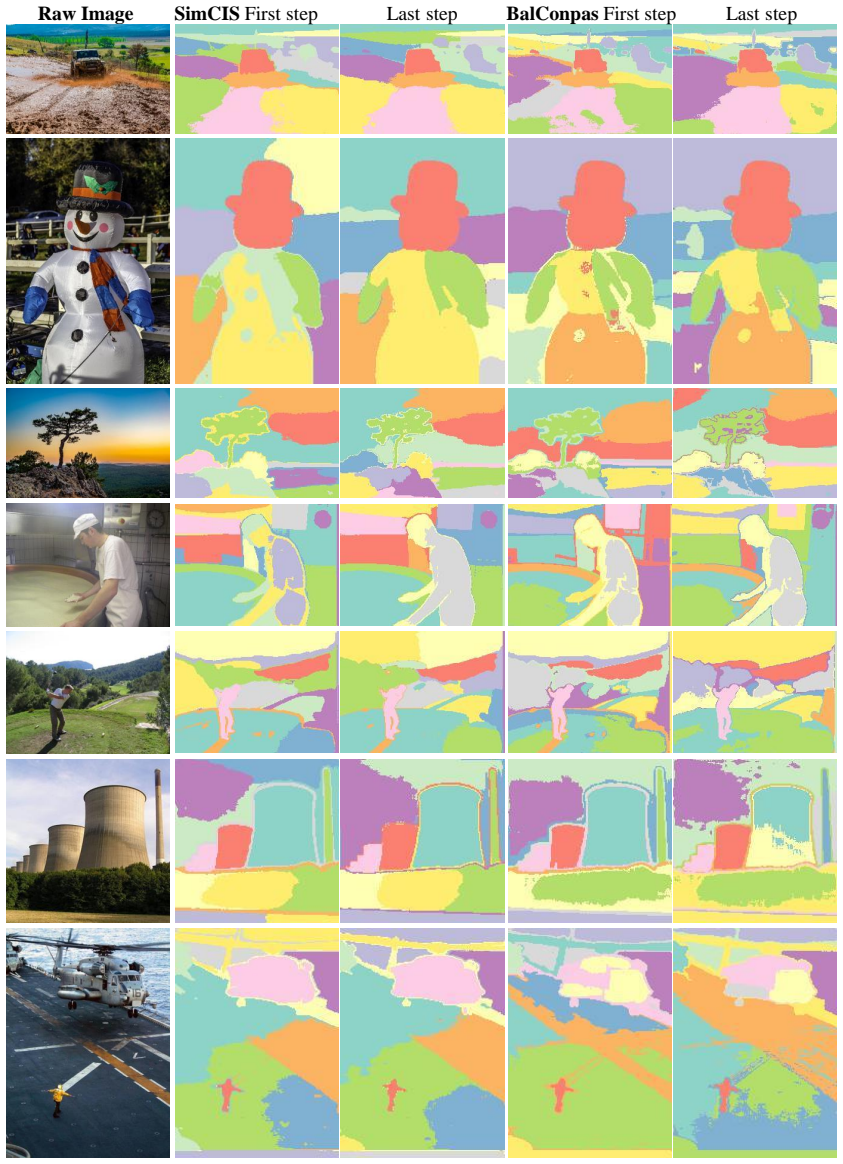
[4]
End-to- end object detection with transformers
Nicolas Carion, Francisco Massa, Gabriel Synnaeve, Nicolas Usunier, Alexander Kirillov, and Sergey Zagoruyko. End-to- end object detection with transformers. In European confer- ence on computer vision, pages 213–229. Springer, 2020. 5
2020
-
[5]
End-to-end incre- mental learning
Francisco M Castro, Manuel J Mar ´ın-Jim´enez, Nicol´as Guil, Cordelia Schmid, and Karteek Alahari. End-to-end incre- mental learning. In Proceedings of the European conference on computer vision (ECCV), pages 233–248, 2018. 1, 3
2018
-
[6]
Modeling the background for incremental learning in semantic segmentation
Fabio Cermelli, Massimiliano Mancini, Samuel Rota Bulo, Elisa Ricci, and Barbara Caputo. Modeling the background for incremental learning in semantic segmentation. In Pro- ceedings of the IEEE/CVF Conference on Computer Vision and Pattern Recognition, pages 9233–9242, 2020. 3, 5, 6, 7, 14
2020
-
[7]
Com- former: Continual learning in semantic and panoptic seg- mentation
Fabio Cermelli, Matthieu Cord, and Arthur Douillard. Com- former: Continual learning in semantic and panoptic seg- mentation. In Proceedings of the IEEE/CVF Conference on Computer Vision and Pattern Recognition , pages 3010– 3020, 2023. 3, 5, 6, 7, 14
2023
-
[8]
Ssul: Semantic segmentation with unknown label for exemplar- based class-incremental learning
Sungmin Cha, YoungJoon Yoo, Taesup Moon, et al. Ssul: Semantic segmentation with unknown label for exemplar- based class-incremental learning. Advances in neural infor- mation processing systems, 34:10919–10930, 2021. 1, 3, 5, 6, 7
2021
-
[9]
Ssul: Semantic segmentation with unknown label for exemplar- based class-incremental learning
Sungmin Cha, YoungJoon Yoo, Taesup Moon, et al. Ssul: Semantic segmentation with unknown label for exemplar- based class-incremental learning. Advances in neural infor- mation processing systems, 34:10919–10930, 2021. 16
2021
Show all 95 references
-
[10]
Riemannian walk for incremen- tal learning: Understanding forgetting and intransigence
Arslan Chaudhry, Puneet K Dokania, Thalaiyasingam Ajan- than, and Philip HS Torr. Riemannian walk for incremen- tal learning: Understanding forgetting and intransigence. In Proceedings of the European conference on computer vision (ECCV), pages 532–547, 2018. 1, 3
2018
-
[11]
Efficient lifelong learning with a- gem
Arslan Chaudhry, Marc’Aurelio Ranzato, Marcus Rohrbach, and Mohamed Elhoseiny. Efficient lifelong learning with a- gem. arXiv preprint arXiv:1812.00420, 2018. 3
2018 arXiv
-
[12]
A survey on graph neural networks and graph transformers in computer vision: A task-oriented perspective
Chaoqi Chen, Yushuang Wu, Qiyuan Dai, Hong-Yu Zhou, Mutian Xu, Sibei Yang, Xiaoguang Han, and Yizhou Yu. A survey on graph neural networks and graph transformers in computer vision: A task-oriented perspective. IEEE Trans- actions on Pattern Analysis and Machine Intelligence, 2024. 1
2024
-
[13]
Strike a balance in continual panoptic segmentation, 2024
Jinpeng Chen, Runmin Cong, Yuxuan Luo, Horace Ho Shing Ip, and Sam Kwong. Strike a balance in continual panoptic segmentation, 2024. 3, 5, 6, 7, 8, 15, 18
2024
-
[14]
Semantic image segmentation with deep convolutional nets and fully connected crfs
Liang-Chieh Chen. Semantic image segmentation with deep convolutional nets and fully connected crfs. arXiv preprint arXiv:1412.7062, 2014. 3
2014 arXiv
-
[15]
Rethinking atrous convolution for semantic image segmentation
Liang-Chieh Chen. Rethinking atrous convolution for semantic image segmentation. arXiv preprint arXiv:1706.05587, 2017
2017 arXiv
-
[16]
Deeplab: Semantic image segmentation with deep convolutional nets, atrous convolu- tion, and fully connected crfs
Liang-Chieh Chen, George Papandreou, Iasonas Kokkinos, Kevin Murphy, and Alan L Yuille. Deeplab: Semantic image segmentation with deep convolutional nets, atrous convolu- tion, and fully connected crfs. IEEE transactions on pattern analysis and machine intelligence, 40(4):834–...
2017
-
[17]
Spgnet: Semantic prediction guidance for scene parsing
Bowen Cheng, Liang-Chieh Chen, Yunchao Wei, Yukun Zhu, Zilong Huang, Jinjun Xiong, Thomas S Huang, Wen- Mei Hwu, and Honghui Shi. Spgnet: Semantic prediction guidance for scene parsing. In Proceedings of the IEEE/CVF international conference on computer vision , pages 5218– 52...
2019
-
[18]
Per- pixel classification is not all you need for semantic segmen- tation
Bowen Cheng, Alex Schwing, and Alexander Kirillov. Per- pixel classification is not all you need for semantic segmen- tation. Advances in Neural Information Processing Systems, 34:17864–17875, 2021. 3
2021
-
[19]
Masked-attention mask transformer for universal image segmentation
Bowen Cheng, Ishan Misra, Alexander G Schwing, Alexan- der Kirillov, and Rohit Girdhar. Masked-attention mask transformer for universal image segmentation. In Proceed- ings of the IEEE/CVF conference on computer vision and pattern recognition, pages 1290–1299, 2022. 1, 3, 6, 7, 15, 16
2022
-
[20]
Curriculum point prompting for weakly-supervised referring image segmentation
Qiyuan Dai and Sibei Yang. Curriculum point prompting for weakly-supervised referring image segmentation. InPro- ceedings of the IEEE/CVF Conference on Computer Vision and Pattern Recognition, pages 13711–13722, 2024. 1
2024
-
[21]
Learning without mem- orizing
Prithviraj Dhar, Rajat Vikram Singh, Kuan-Chuan Peng, Ziyan Wu, and Rama Chellappa. Learning without mem- orizing. In Proceedings of the IEEE/CVF conference on computer vision and pattern recognition, pages 5138–5146,
-
[22]
Podnet: Pooled outputs dis- tillation for small-tasks incremental learning
Arthur Douillard, Matthieu Cord, Charles Ollion, Thomas Robert, and Eduardo Valle. Podnet: Pooled outputs dis- tillation for small-tasks incremental learning. In Computer vision–ECCV 2020: 16th European conference, Glasgow, UK, August 23–28, 2020, proceedings, part XX 16 , pag...
2020
-
[23]
Plop: Learning without forgetting for contin- ual semantic segmentation
Arthur Douillard, Yifu Chen, Arnaud Dapogny, and Matthieu Cord. Plop: Learning without forgetting for contin- ual semantic segmentation. In Proceedings of the IEEE/CVF conference on computer vision and pattern recognition , pages 4040–4050, 2021. 3, 5, 6, 7
2021
-
[24]
Dytox: Transformers for continual learning with dynamic token expansion
Arthur Douillard, Alexandre Ram ´e, Guillaume Couairon, and Matthieu Cord. Dytox: Transformers for continual learning with dynamic token expansion. In Proceedings of the IEEE/CVF Conference on Computer Vision and Pattern Recognition, pages 9285–9295, 2022. 3
2022
-
[25]
Bacs: Background aware continual semantic segmentation
Mostafa ElAraby, Ali Harakeh, and Liam Paull. Bacs: Background aware continual semantic segmentation. arXiv preprint arXiv:2404.13148, 2024. 3
2024 arXiv
-
[26]
The pascal visual object classes (voc) challenge
Mark Everingham, Luc Van Gool, Christopher KI Williams, John Winn, and Andrew Zisserman. The pascal visual object classes (voc) challenge. International journal of computer vision, 88:303–338, 2010. 14
2010
-
[27]
Catastrophic forgetting in connectionist networks
Robert M French. Catastrophic forgetting in connectionist networks. Trends in cognitive sciences, 3(4):128–135, 1999. 3
1999
-
[28]
Multi-evidence filtering and fusion for multi-label classification, object de- tection and semantic segmentation based on weakly super- vised learning
Weifeng Ge, Sibei Yang, and Yizhou Yu. Multi-evidence filtering and fusion for multi-label classification, object de- tection and semantic segmentation based on weakly super- vised learning. In Proceedings of the IEEE conference on computer vision and pattern recognition, page...
-
[29]
Continual segmentation with disentangled objectness learn- ing and class recognition
Yizheng Gong, Siyue Yu, Xiaoyang Wang, and Jimin Xiao. Continual segmentation with disentangled objectness learn- ing and class recognition. In Proceedings of the IEEE/CVF Conference on Computer Vision and Pattern Recognition , pages 3848–3857, 2024. 1, 3, 5, 7, 14, 16
2024
-
[30]
Attribution-aware weight transfer: A warm- start initialization for class-incremental semantic segmenta- tion
Dipam Goswami, Ren ´e Schuster, Joost van de Weijer, and Didier Stricker. Attribution-aware weight transfer: A warm- start initialization for class-incremental semantic segmenta- tion. In Proceedings of the IEEE/CVF Winter Conference on Applications of Computer Vision, pages 3...
2023
-
[31]
Simultaneous detection and segmentation
Bharath Hariharan, Pablo Arbel ´aez, Ross Girshick, and Ji- tendra Malik. Simultaneous detection and segmentation. In Computer Vision–ECCV 2014: 13th European Conference, Zurich, Switzerland, September 6-12, 2014, Proceedings, Part VII 13, pages 297–312. Springer, 2014. 3
2014
-
[32]
Clustering algorithms
JA Hartigan. Clustering algorithms. John Wiley google schola, 2:25–47, 1975. 15
1975
-
[33]
Deep residual learning for image recognition
Kaiming He, Xiangyu Zhang, Shaoqing Ren, and Jian Sun. Deep residual learning for image recognition. In Proceed- ings of the IEEE conference on computer vision and pattern recognition, pages 770–778, 2016. 6
2016
-
[34]
Mask r-cnn
Kaiming He, Georgia Gkioxari, Piotr Doll ´ar, and Ross Gir- shick. Mask r-cnn. In Proceedings of the IEEE international conference on computer vision, pages 2961–2969, 2017. 3
2017
-
[35]
Non-local context encoder: Robust biomedical image segmentation against adversarial attacks
Xiang He, Sibei Yang, Guanbin Li, Haofeng Li, Huiyou Chang, and Yizhou Yu. Non-local context encoder: Robust biomedical image segmentation against adversarial attacks. In Proceedings of the AAAI Conference on Artificial Intelli- gence, pages 8417–8424, 2019. 1
2019
-
[36]
Distilling the knowledge in a neural network
Geoffrey Hinton, Oriol Vinyals, and Jeff Dean. Distilling the knowledge in a neural network. stat, 1050:9, 2015. 5
2015
-
[37]
Learning a unified classifier incrementally via rebalancing
Saihui Hou, Xinyu Pan, Chen Change Loy, Zilei Wang, and Dahua Lin. Learning a unified classifier incrementally via rebalancing. In Proceedings of the IEEE/CVF conference on computer vision and pattern recognition, pages 831–839,
-
[38]
Free-bloom: Zero-shot text-to-video gener- ator with llm director and ldm animator
Hanzhuo Huang, Yufan Feng, Cheng Shi, Lan Xu, Jingyi Yu, and Sibei Yang. Free-bloom: Zero-shot text-to-video gener- ator with llm director and ldm animator. Advances in Neural Information Processing Systems, 36:26135–26158, 2023. 1
2023
-
[39]
Mvtokenflow: High-quality 4d content generation using multiview token flow
Hanzhuo Huang, Yuan Liu, Ge Zheng, Jiepeng Wang, Zhiyang Dou, and Sibei Yang. Mvtokenflow: High-quality 4d content generation using multiview token flow. arXiv preprint arXiv:2502.11697, 2025. 1
2025 arXiv
-
[40]
Ccnet: Criss-cross attention for semantic segmentation
Zilong Huang, Xinggang Wang, Lichao Huang, Chang Huang, Yunchao Wei, and Wenyu Liu. Ccnet: Criss-cross attention for semantic segmentation. In Proceedings of the IEEE/CVF international conference on computer vision, pages 603–612, 2019. 3
2019
-
[41]
Oneformer: One transformer to rule universal image segmentation
Jitesh Jain, Jiachen Li, Mang Tik Chiu, Ali Hassani, Nikita Orlov, and Humphrey Shi. Oneformer: One transformer to rule universal image segmentation. In Proceedings of the IEEE/CVF Conference on Computer Vision and Pattern Recognition, pages 2989–2998, 2023. 16
2023
-
[42]
Vi- sual prompt tuning
Menglin Jia, Luming Tang, Bor-Chun Chen, Claire Cardie, Serge Belongie, Bharath Hariharan, and Ser-Nam Lim. Vi- sual prompt tuning. In European Conference on Computer Vision, pages 709–727. Springer, 2022. 3, 15
2022
-
[43]
Eclipse: Efficient continual learning in panoptic segmen- tation with visual prompt tuning
Beomyoung Kim, Joonsang Yu, and Sung Ju Hwang. Eclipse: Efficient continual learning in panoptic segmen- tation with visual prompt tuning. In Proceedings of the IEEE/CVF Conference on Computer Vision and Pattern Recognition (CVPR), pages 3346–3356, 2024. 1, 3, 5, 6, 7, 8, 14, 15, 16
2024
-
[44]
Mask dino: Towards a unified transformer-based framework for object detection and segmentation
Feng Li, Hao Zhang, Huaizhe Xu, Shilong Liu, Lei Zhang, Lionel M Ni, and Heung-Yeung Shum. Mask dino: Towards a unified transformer-based framework for object detection and segmentation. In Proceedings of the IEEE/CVF Con- ference on Computer Vision and Pattern Recognition, pa...
2023
-
[45]
Learning without forgetting
Zhizhong Li and Derek Hoiem. Learning without forgetting. IEEE transactions on pattern analysis and machine intelli- gence, 40(12):2935–2947, 2017. 3
2017
-
[46]
Structured attention network for re- ferring image segmentation
Liang Lin, Pengxiang Yan, Xiaoqian Xu, Sibei Yang, Kun Zeng, and Guanbin Li. Structured attention network for re- ferring image segmentation. IEEE Transactions on Multime- dia, 24:1922–1932, 2021. 1
1922
-
[47]
Gradient episodic memory for continual learning
David Lopez-Paz and Marc’Aurelio Ranzato. Gradient episodic memory for continual learning. Advances in neu- ral information processing systems, 30, 2017. 3
2017
-
[48]
Packnet: Adding mul- tiple tasks to a single network by iterative pruning
Arun Mallya and Svetlana Lazebnik. Packnet: Adding mul- tiple tasks to a single network by iterative pruning. In Pro- ceedings of the IEEE conference on Computer Vision and Pattern Recognition, pages 7765–7773, 2018. 1, 3
2018
-
[49]
Piggy- back: Adapting a single network to multiple tasks by learn- ing to mask weights
Arun Mallya, Dillon Davis, and Svetlana Lazebnik. Piggy- back: Adapting a single network to multiple tasks by learn- ing to mask weights. In Proceedings of the European con- ference on computer vision (ECCV), pages 67–82, 2018. 3
2018
-
[50]
Incremental learn- ing techniques for semantic segmentation
Umberto Michieli and Pietro Zanuttigh. Incremental learn- ing techniques for semantic segmentation. In Proceedings of the IEEE/CVF international conference on computer vision workshops, pages 0–0, 2019. 3
2019
-
[51]
Continual semantic segmentation via repulsion-attraction of sparse and disentan- gled latent representations
Umberto Michieli and Pietro Zanuttigh. Continual semantic segmentation via repulsion-attraction of sparse and disentan- gled latent representations. In Proceedings of the IEEE/CVF conference on computer vision and pattern recognition , pages 1114–1124, 2021. 3
2021
-
[52]
Learning to remember: A synaptic plasticity driven framework for continual learning
Oleksiy Ostapenko, Mihai Puscas, Tassilo Klein, Patrick Jah- nichen, and Moin Nabi. Learning to remember: A synaptic plasticity driven framework for continual learning. In Pro- ceedings of the IEEE/CVF conference on computer vision and pattern recognition, pages 11321–11329, 2019. 3
2019
-
[53]
Class similarity weighted knowl- edge distillation for continual semantic segmentation
Minh Hieu Phan, Son Lam Phung, Long Tran-Thanh, Abdes- selam Bouzerdoum, et al. Class similarity weighted knowl- edge distillation for continual semantic segmentation. In Proceedings of the IEEE/CVF Conference on Computer Vi- sion and Pattern Recognition, pages 16866–16875, 2022. 3
2022
-
[54]
icarl: Incremental classifier and representation learning
Sylvestre-Alvise Rebuffi, Alexander Kolesnikov, Georg Sperl, and Christoph H Lampert. icarl: Incremental classifier and representation learning. In Proceedings of the IEEE con- ference on Computer Vision and Pattern Recognition, pages 2001–2010, 2017. 1, 3
2001
-
[55]
Catastrophic forgetting, rehearsal and pseudorehearsal
Anthony Robins. Catastrophic forgetting, rehearsal and pseudorehearsal. Connection Science, 7(2):123–146, 1995. 1, 3
1995
-
[56]
Incremental learning for robust visual tracking
David A Ross, Jongwoo Lim, Ruei-Sung Lin, and Ming- Hsuan Yang. Incremental learning for robust visual tracking. International journal of computer vision, 77:125–141, 2008. 1
2008
-
[57]
Learning representations by back-propagating er- rors
David E Rumelhart, Geoffrey E Hinton, and Ronald J Williams. Learning representations by back-propagating er- rors. nature, 323(6088):533–536, 1986. 4
1986
-
[59]
Progressive neural networks
Andrei A Rusu, Neil C Rabinowitz, Guillaume Desjardins, Hubert Soyer, James Kirkpatrick, Koray Kavukcuoglu, Raz- van Pascanu, and Raia Hadsell. Progressive neural networks. arXiv preprint arXiv:1606.04671, 2016. 1
2016 arXiv
-
[60]
Incrementer: Transformer for class-incremental semantic segmentation with knowl- edge distillation focusing on old class
Chao Shang, Hongliang Li, Fanman Meng, Qingbo Wu, Heqian Qiu, and Lanxiao Wang. Incrementer: Transformer for class-incremental semantic segmentation with knowl- edge distillation focusing on old class. In Proceedings of the IEEE/CVF Conference on Computer Vision and Pattern Re...
2023
-
[61]
Edadet: Open-vocabulary object detection using early dense alignment
Cheng Shi and Sibei Yang. Edadet: Open-vocabulary object detection using early dense alignment. In Proceedings of the IEEE/CVF international conference on computer vision, pages 15724–15734, 2023. 1
2023
-
[62]
Logoprompt: Synthetic text im- ages can be good visual prompts for vision-language models
Cheng Shi and Sibei Yang. Logoprompt: Synthetic text im- ages can be good visual prompts for vision-language models. In Proceedings of the IEEE/CVF International Conference on Computer Vision, pages 2932–2941, 2023. 1
2023
-
[63]
The devil is in the object bound- ary: Towards annotation-free instance segmentation using foundation models
Cheng Shi and Sibei Yang. The devil is in the object bound- ary: Towards annotation-free instance segmentation using foundation models. arXiv preprint arXiv:2404.11957, 2024. 1
2024 arXiv
-
[64]
Part2object: Hierarchical unsupervised 3d instance segmentation
Cheng Shi, Yulin Zhang, Bin Yang, Jiajin Tang, Yuexin Ma, and Sibei Yang. Part2object: Hierarchical unsupervised 3d instance segmentation. In European Conference on Com- puter Vision, pages 1–18. Springer, 2024. 1
2024
-
[65]
Plain-det: A plain multi-dataset object detector
Cheng Shi, Yuchen Zhu, and Sibei Yang. Plain-det: A plain multi-dataset object detector. In European Conference on Computer Vision, pages 210–226. Springer, 2024. 1
2024
-
[66]
Continual learning with deep generative replay
Hanul Shin, Jung Kwon Lee, Jaehong Kim, and Jiwon Kim. Continual learning with deep generative replay. Advances in neural information processing systems, 30, 2017. 1, 3
2017
-
[67]
Calibrating cnns for life- long learning
Pravendra Singh, Vinay Kumar Verma, Pratik Mazumder, Lawrence Carin, and Piyush Rai. Calibrating cnns for life- long learning. Advances in Neural Information Processing Systems, 33:15579–15590, 2020. 3
2020
-
[68]
Segmenter: Transformer for semantic segmenta- tion
Robin Strudel, Ricardo Garcia, Ivan Laptev, and Cordelia Schmid. Segmenter: Transformer for semantic segmenta- tion. In Proceedings of the IEEE/CVF international confer- ence on computer vision, pages 7262–7272, 2021. 3
2021
-
[69]
Con- trastive grouping with transformer for referring image seg- mentation
Jiajin Tang, Ge Zheng, Cheng Shi, and Sibei Yang. Con- trastive grouping with transformer for referring image seg- mentation. In Proceedings of the IEEE/CVF conference on computer vision and pattern recognition , pages 23570– 23580, 2023. 1
2023
-
[70]
Temporal collection and distribution for referring video object segmentation
Jiajin Tang, Ge Zheng, and Sibei Yang. Temporal collection and distribution for referring video object segmentation. In Proceedings of the IEEE/CVF International Conference on Computer Vision, pages 15466–15476, 2023. 1
2023
-
[71]
Lifelong learning algorithms
Sebastian Thrun. Lifelong learning algorithms. In Learning to learn, pages 181–209. Springer, 1998. 3
1998
-
[72]
Learning to prompt for continual learning
Zifeng Wang, Zizhao Zhang, Chen-Yu Lee, Han Zhang, Ruoxi Sun, Xiaoqi Ren, Guolong Su, Vincent Perot, Jennifer Dy, and Tomas Pfister. Learning to prompt for continual learning. In Proceedings of the IEEE/CVF Conference on Computer Vision and Pattern Recognition , pages 139–149,
-
[73]
Memory replay gans: Learning to generate new categories without forgetting
Chenshen Wu, Luis Herranz, Xialei Liu, Joost Van De Wei- jer, Bogdan Raducanu, et al. Memory replay gans: Learning to generate new categories without forgetting. Advances in neural information processing systems, 31, 2018. 3
2018
-
[74]
Large scale incre- mental learning
Yue Wu, Yinpeng Chen, Lijuan Wang, Yuancheng Ye, Zicheng Liu, Yandong Guo, and Yun Fu. Large scale incre- mental learning. In Proceedings of the IEEE/CVF conference on computer vision and pattern recognition, pages 374–382,
-
[75]
Endpoints weight fusion for class incremental semantic segmentation
Jia-Wen Xiao, Chang-Bin Zhang, Jiekang Feng, Xialei Liu, Joost van de Weijer, and Ming-Ming Cheng. Endpoints weight fusion for class incremental semantic segmentation. In Proceedings of the IEEE/CVF Conference on Computer Vision and Pattern Recognition (CVPR) , pages 7204–7213,
-
[76]
Segformer: Simple and efficient design for semantic segmentation with transform- ers
Enze Xie, Wenhai Wang, Zhiding Yu, Anima Anandkumar, Jose M Alvarez, and Ping Luo. Segformer: Simple and efficient design for semantic segmentation with transform- ers. Advances in neural information processing systems, 34: 12077–12090, 2021. 3
2021
-
[77]
Early preparation pays off: New classifier pre-tuning for class incremental semantic segmen- tation
Zhengyuan Xie, Haiquan Lu, Jia-wen Xiao, Enguang Wang, Le Zhang, and Xialei Liu. Early preparation pays off: New classifier pre-tuning for class incremental semantic segmen- tation. arXiv preprint arXiv:2407.14142, 2024. 3
2024 arXiv
-
[78]
Early preparation pays off: New classifier pre-tuning for class incremental semantic segmen- tation
Zhengyuan Xie, Haiquan Lu, Jia-wen Xiao, Enguang Wang, Le Zhang, and Xialei Liu. Early preparation pays off: New classifier pre-tuning for class incremental semantic segmen- tation. In European Conference on Computer Vision, pages 183–201. Springer, 2025. 16
2025
-
[79]
Der: Dy- namically expandable representation for class incremental learning
Shipeng Yan, Jiangwei Xie, and Xuming He. Der: Dy- namically expandable representation for class incremental learning. In Proceedings of the IEEE/CVF conference on computer vision and pattern recognition, pages 3014–3023,
-
[80]
Bottom-up shift and reasoning for referring im- age segmentation
Sibei Yang, Meng Xia, Guanbin Li, Hong-Yu Zhou, and Yizhou Yu. Bottom-up shift and reasoning for referring im- age segmentation. In Proceedings of the IEEE/CVF Con- ference on Computer Vision and Pattern Recognition, pages 11266–11275, 2021. 1
2021
-
[81]
Ocnet: Object context network for scene parsing
Yuhui Yuan, Lang Huang, Jianyuan Guo, Chao Zhang, Xilin Chen, and Jingdong Wang. Ocnet: Object context network for scene parsing. arXiv preprint arXiv:1809.00916, 2018. 3
2018 arXiv
-
[82]
Representation compensation networks for continual semantic segmentation
Chang-Bin Zhang, Jia-Wen Xiao, Xialei Liu, Ying-Cong Chen, and Ming-Ming Cheng. Representation compensation networks for continual semantic segmentation. In Proceed- ings of the IEEE/CVF Conference on Computer Vision and Pattern Recognition, pages 7053–7064, 2022. 1, 3
2022
-
[83]
Slca: Slow learner with classifier align- ment for continual learning on a pre-trained model
Gengwei Zhang, Liyuan Wang, Guoliang Kang, Ling Chen, and Yunchao Wei. Slca: Slow learner with classifier align- ment for continual learning on a pre-trained model. In Proceedings of the IEEE/CVF International Conference on Computer Vision, pages 19148–19158, 2023. 1, 3
2023
-
[84]
Mining unseen classes via regional object- ness: A simple baseline for incremental segmentation
Zekang Zhang, Guangyu Gao, Zhiyuan Fang, Jianbo Jiao, and Yunchao Wei. Mining unseen classes via regional object- ness: A simple baseline for incremental segmentation. Ad- vances in neural information processing systems, 35:24340– 24353, 2022. 3
2022
-
[85]
Coinseg: Contrast inter-and intra-class representations for incremental segmentation
Zekang Zhang, Guangyu Gao, Jianbo Jiao, Chi Harold Liu, and Yunchao Wei. Coinseg: Contrast inter-and intra-class representations for incremental segmentation. In Proceed- ings of the IEEE/CVF International Conference on Com- puter Vision, pages 843–853, 2023. 3
2023
-
[86]
Pyramid scene parsing network
Hengshuang Zhao, Jianping Shi, Xiaojuan Qi, Xiaogang Wang, and Jiaya Jia. Pyramid scene parsing network. In Proceedings of the IEEE conference on computer vision and pattern recognition, pages 2881–2890, 2017. 3
2017
-
[87]
Ddcot: Duty-distinct chain-of-thought prompting for multimodal reasoning in language models.Advances in Neu- ral Information Processing Systems, 36:5168–5191, 2023
Ge Zheng, Bin Yang, Jiajin Tang, Hong-Yu Zhou, and Sibei Yang. Ddcot: Duty-distinct chain-of-thought prompting for multimodal reasoning in language models.Advances in Neu- ral Information Processing Systems, 36:5168–5191, 2023. 1
2023
-
[88]
Scene parsing through ade20k dataset
Bolei Zhou, Hang Zhao, Xavier Puig, Sanja Fidler, Adela Barriuso, and Antonio Torralba. Scene parsing through ade20k dataset. In Proceedings of the IEEE conference on computer vision and pattern recognition , pages 633–641,
-
[89]
Continual semantic segmentation with automatic memory sample selection
Lanyun Zhu, Tianrun Chen, Jianxiong Yin, Simon See, and Jun Liu. Continual semantic segmentation with automatic memory sample selection. In Proceedings of the IEEE/CVF Conference on Computer Vision and Pattern Recognition , pages 3082–3092, 2023. 3 Rethinking Query-based Trans...
2023
-
[90]
Pseudocode for our SimCIS In this section, we present the overall workflow of our method in the pseudo-code Algo. 1. At the beginning, we define some modules, functions, and variables. For the cur- rent stage t and the previous stage t − 1, we define the backbone modules f t b...
-
[91]
Following previous works [7, 29, 43], we use ADE20k [88] to train and evaluate our model for both continual panoptic segmentation and continual se- mantic segmentation tasks
More Dataset and Implementation Details Dataset Information. Following previous works [7, 29, 43], we use ADE20k [88] to train and evaluate our model for both continual panoptic segmentation and continual se- mantic segmentation tasks. The ADE20K dataset con- tains 20, 210 tra...
-
[92]
As shown in Tab
Continual Learning with Random Order Experiment Details. As shown in Tab. 7, we conduct ex- tensive experiments on our model and ECLIPSE [43] under the ten random orders (detailed orders shown in Tab. 9), where nine of them were completely randomly generated using the random m...
-
[93]
As shown in the Tab
More Ablation Study for Stop Gradient As we mention in the main text, we apply stop gradient on selected object query QN after the QPA strategy, to ensure that the information in feature mapF is not disrupted during training, keeping the objectness information stable across di...
-
[94]
7, we additionally compare our SimCIS with BalConpas [13] in the 100-5 continual semantic seg- mentation task
More Visualization Results for CSS As shown in Fig. 7, we additionally compare our SimCIS with BalConpas [13] in the 100-5 continual semantic seg- mentation task. In the first, second, and fourth row from Fig. 7, BalConpas encounters misclassification of the TV and lamps. In t...
-
[95]
In the multi-scale feature generated by the pixel decoder, we choose the fea- ture with the highest resolution for clustering
Built-in Objectness Maintenance Detailed clustering implementation. In the multi-scale feature generated by the pixel decoder, we choose the fea- ture with the highest resolution for clustering. To evaluate the quality of objectness information contained in the fea- tures, we ...
-
[96]
However, in our proposed Lazy Query Pre-alignment strategy, the query features have rich information
The Order of Attention Layers In Mask2Former [19], the authors employ a cross then self- attention mechanism, as they argue that query features to the first self-attention layer are image-independent and do not have signals from the image, thus applying self-attention is unlik...
-
[97]
To ensure a fair comparison, we adopt the same Mask2Former [19] as our meta-architecture for im- age segmentation
Discussion, Limitation and Future Work Discussion of the choice of meta-architecture for image segmentation. To ensure a fair comparison, we adopt the same Mask2Former [19] as our meta-architecture for im- age segmentation. However, recent years have witnessed rapid advancemen...
Reviewed August 6, 2026 · model on record in the stance chip above.
Discussion (0). Continue with ORCID to comment.