The Stellar "Snake"-V: the census within 3 kpc in the Solar Neighborhood
Pith reviewed 2026-07-02 18:10 UTC · model grok-4.3
The pith
Gaia DR3 yields a catalogue of 1,256 Stellar Snake candidates with 802,489 stars within 3 kpc of the Sun.
A machine-rendered reading of the paper's core claim, the machinery that carries it, and where it could break.
Core claim
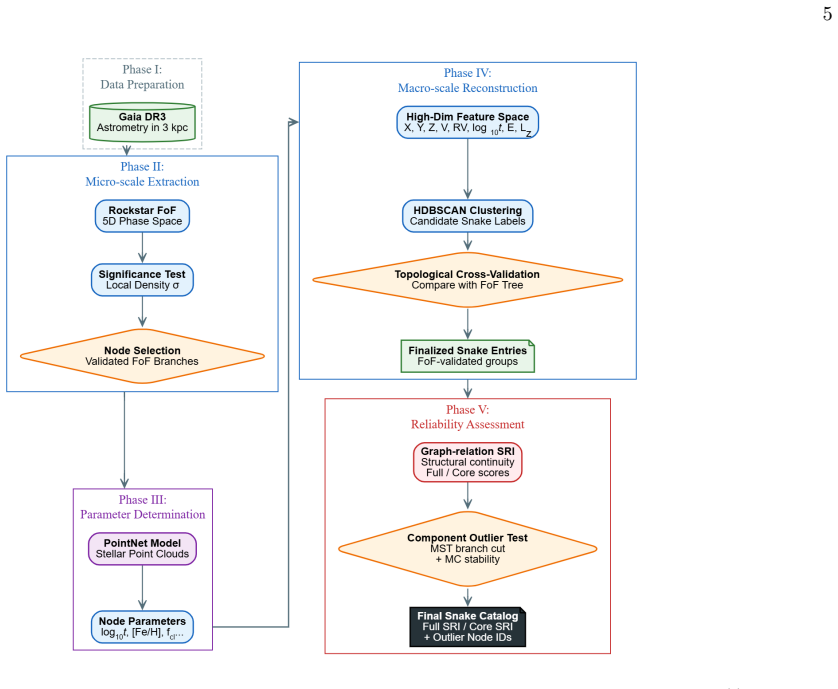
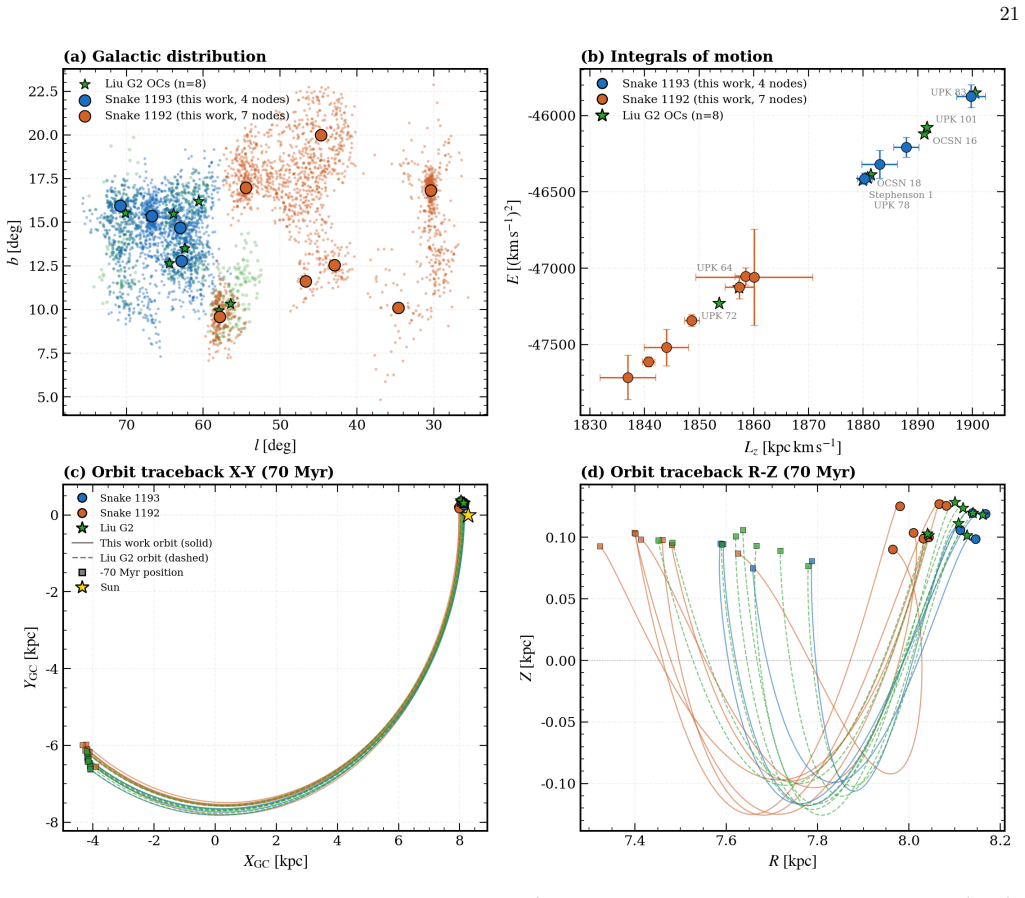
The paper presents a Gaia DR3 source-level census of Stellar Snake complexes within 3 kpc, defining them as mutually coherent associations of two or more stellar overdensities with consistent properties in positions, kinematics, orbital invariants, ages, and chemical abundances. Using a pipeline that extracts statistically significant non-overlapping base nodes, infers homogeneous parameters with a PointNet regressor, and links nodes across 9D space spanning positions, tangential velocities, radial velocity, age log t, and orbital integrals (E, L_Z), followed by FoF-topology cross-validation and boundary resolution, it identifies 1,256 candidates comprising 802,489 unique member-star entries
What carries the argument
The multi-stage pipeline that extracts base nodes from individual Gaia sources and links them into macro-structures in 9D space using FoF-topology cross-validation after PointNet parameter inference.
If this is right
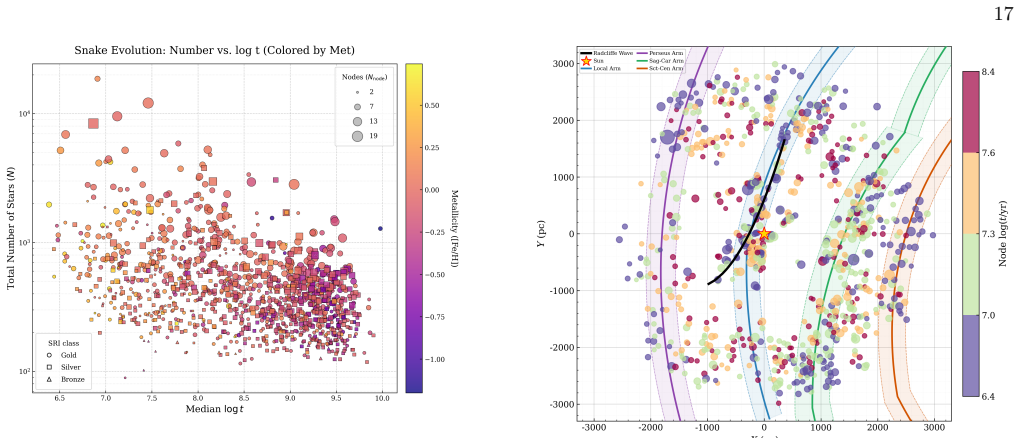
- The census shows a broad age-metallicity pattern at the population level.
- There is a declining upper envelope of member-star entries toward older ages.
- Young Snake nodes exhibit a projected association with nearby spiral-arm loci and the Radcliffe Wave.
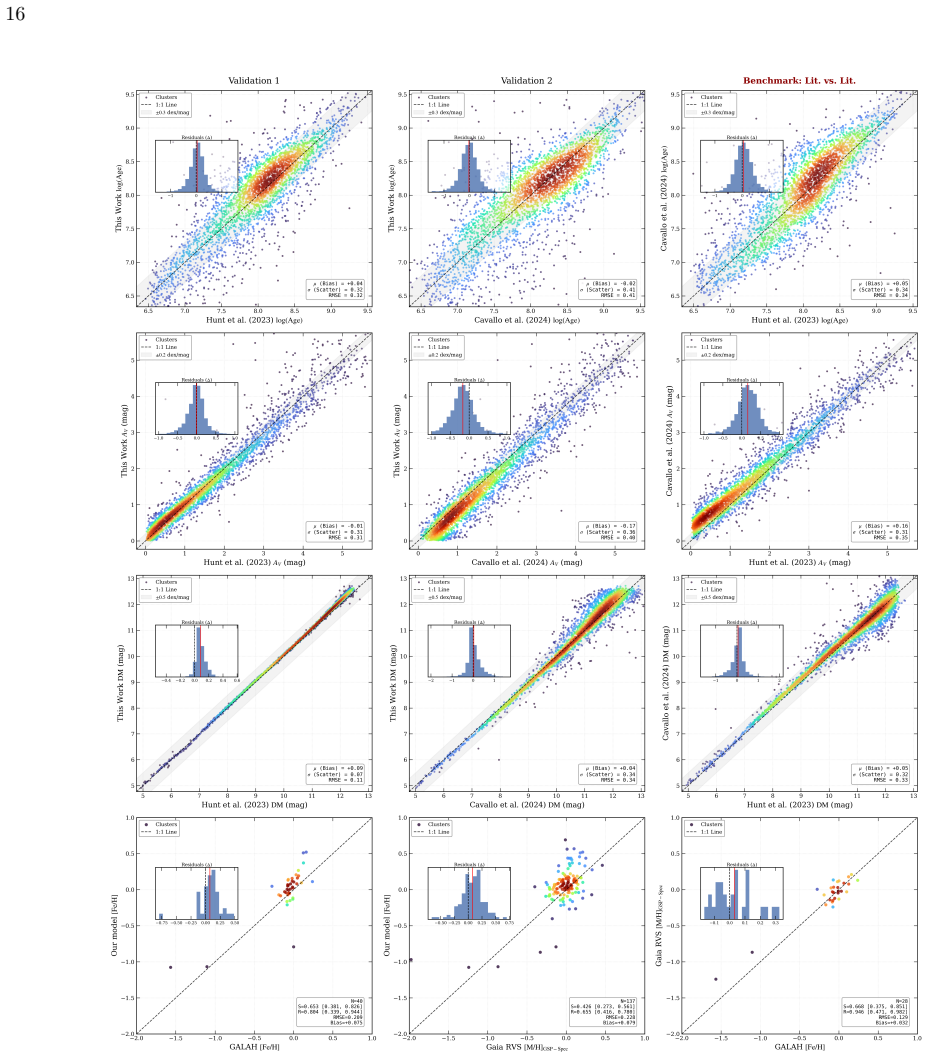
- Derived parameters receive validation against external open-cluster catalogues and spectroscopic benchmarks.
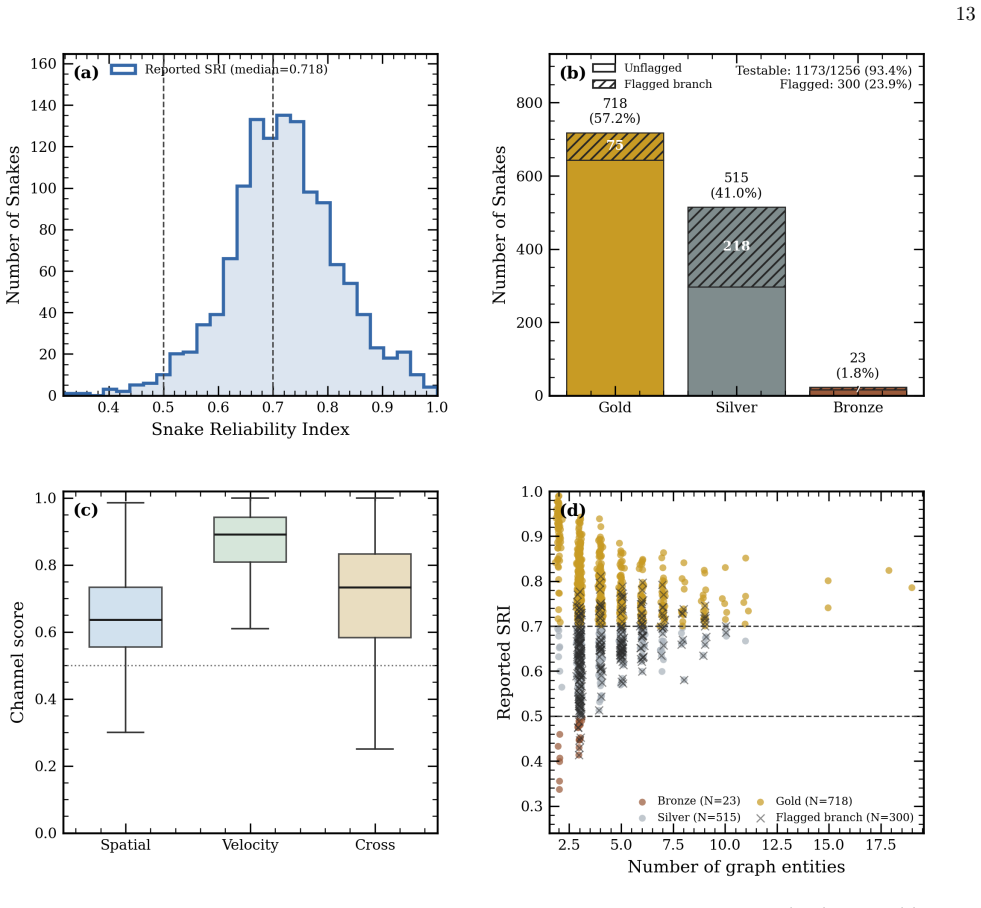
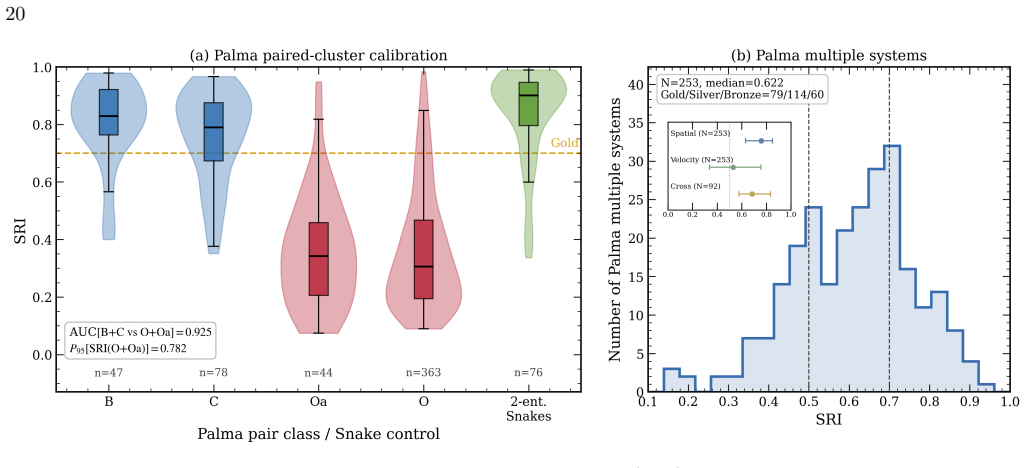
- The Snake Reliability Index together with Gold/Silver/Bronze quality flags and peripheral-branch diagnostics quantifies structural coherence for each candidate.
Where Pith is reading between the lines
- The catalogue could serve as input for testing models of how stellar complexes disperse or migrate within the galactic disk over time.
- Additional radial-velocity or abundance data from future surveys could be used to test whether the 9D coherence persists at higher precision.
- The same node-linking approach might be applied to larger volumes once Gaia DR4 or complementary datasets become available.
- The reported link between young nodes and spiral-arm features suggests a possible role for galactic density waves in triggering the formation of these extended associations.
Load-bearing premise
Consistent positions, kinematics, orbital invariants, ages, and chemical properties in 9D space reliably indicate physically coherent associations rather than chance alignments or selection effects.
What would settle it
A simulation of random stellar distributions in the solar neighborhood that produces a comparable number of apparent 9D-coherent associations with matching properties and SRI values would falsify the physical reality of the reported Stellar Snakes.
Figures
read the original abstract
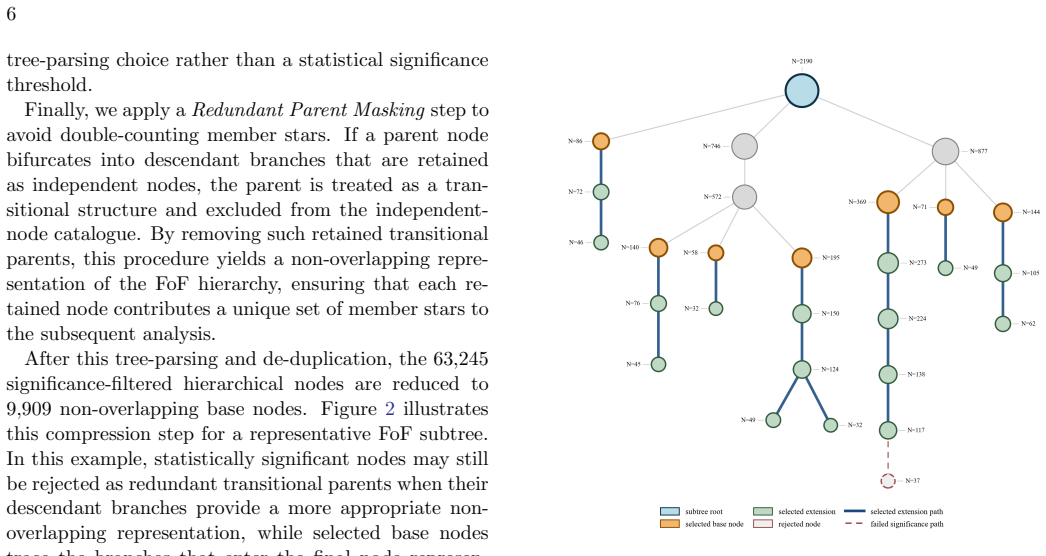
We present a Gaia DR3 source-level census of \emph{Stellar Snake} complexes within 3\,kpc of the Sun. We define a Stellar Snake as a mutually coherent association of two or more stellar overdensities, characterised by consistent positions, kinematics, orbital invariants, ages, and chemical properties, rather than as a single gravitationally bound object. Moving beyond catalogue-driven searches seeded by known open clusters, our framework operates directly on individual Gaia sources to recover extended, low-density substructures and interconnecting stellar bridges. The multi-stage pipeline extracts statistically significant, non-overlapping base nodes, infers homogeneous parameters using a PointNet point-cloud regressor, and links these nodes into large-scale macro-structures across a 9D space spanning positions, tangential velocities, radial velocity, age \(\log t\), and orbital integrals \((E,L_Z)\). After FoF-topology cross-validation and boundary resolution, the final catalogue contains 1,256 Stellar Snake candidates comprising 802,489 unique member-star entries in 5,491 final base nodes selected from a 9,909-node input pool. Derived parameters are validated against external open-cluster catalogues and spectroscopic benchmarks. To quantify structural coherence, we introduce a graph-relation Snake Reliability Index (SRI), coupled with a peripheral-branch diagnostic and Gold/Silver/Bronze quality flags. At the population level, the census shows a broad age--metallicity pattern, a declining upper envelope of member-star entries toward older ages, and a projected association between young Snake nodes, nearby spiral-arm loci, and the Radcliffe Wave. This homogeneous inventory provides an observational foundation for probing the formation, coherence, and dynamical evolution of hierarchical stellar complexes in the Milky Way.
Editorial analysis
A structured set of objections, weighed in public.
Referee Report
Summary. The manuscript presents a Gaia DR3 source-level census of Stellar Snake complexes within 3 kpc, defining a Stellar Snake as a mutually coherent association of two or more overdensities in 9D space (positions, kinematics, orbital invariants, age log t, chemistry). The multi-stage pipeline extracts non-overlapping base nodes, infers parameters via PointNet, and links nodes via FoF topology cross-validation to produce a final catalogue of 1,256 candidates containing 802,489 unique member stars in 5,491 nodes (from a 9,909-node input pool). It introduces a graph-based Snake Reliability Index (SRI) with Gold/Silver/Bronze flags, validates derived parameters against external open-cluster and spectroscopic catalogues, and reports population-level trends including age-metallicity patterns and projected links to spiral arms and the Radcliffe Wave.
Significance. If the 9D linking step reliably recovers physically coherent macro-structures, the resulting homogeneous inventory of 1,256 extended complexes would constitute a substantial observational resource for studies of hierarchical stellar assembly and dynamical evolution in the Milky Way disk. The direct source-level approach (avoiding pre-seeded cluster catalogues) and the introduction of the SRI metric for quantifying structural coherence are methodological strengths that could be adopted more broadly.
major comments (3)
- [Abstract] Abstract (validation paragraph): the statement that parameters are 'validated against external open-cluster catalogues and spectroscopic benchmarks' supplies no recovery fractions, contamination rates, or mock-catalogue results for the FoF linking step; this is load-bearing for the headline catalogue size of 1,256 Snakes and 802k members.
- [Methods (FoF linking subsection)] Pipeline description (9D FoF linking): the central assumption that coherence across positions, tangential velocities, radial velocity, log t, and (E, L_Z) reliably indicates physical association rather than chance alignments or selection effects is not accompanied by quantified false-positive control that accounts for the inhomogeneous Gaia selection function or age-metallicity degeneracies.
- [Results (catalogue construction)] Results (catalogue statistics): the final numbers depend on multiple pipeline thresholds and the PointNet regressor; no sensitivity tests or robustness checks against variations in these free parameters are reported, leaving the stability of the 5,491-node output pool unquantified.
minor comments (2)
- [Abstract] Abstract: the definition of 'Stellar Snake' is given in full but the acronym SRI is introduced without an immediate parenthetical expansion.
- [Abstract] Notation: the orbital integrals are written as (E, L_Z) without an explicit statement of the reference frame or units in the abstract.
Simulated Author's Rebuttal
We thank the referee for their constructive report and recommendation of major revision. The comments correctly identify areas where additional quantitative support is needed. We address each major comment below and will revise the manuscript accordingly.
read point-by-point responses
-
Referee: [Abstract] Abstract (validation paragraph): the statement that parameters are 'validated against external open-cluster catalogues and spectroscopic benchmarks' supplies no recovery fractions, contamination rates, or mock-catalogue results for the FoF linking step; this is load-bearing for the headline catalogue size of 1,256 Snakes and 802k members.
Authors: We agree that the abstract would benefit from explicit metrics. The main text and supplementary material contain validation against external catalogues, but specific recovery fractions, contamination rates, and mock results for the FoF step are not summarized in the abstract. In the revised manuscript we will update the abstract to include these quantities (e.g., recovery rate for known open clusters, contamination estimate from mocks) to better support the reported catalogue statistics. revision: yes
-
Referee: [Methods (FoF linking subsection)] Pipeline description (9D FoF linking): the central assumption that coherence across positions, tangential velocities, radial velocity, log t, and (E, L_Z) reliably indicates physical association rather than chance alignments or selection effects is not accompanied by quantified false-positive control that accounts for the inhomogeneous Gaia selection function or age-metallicity degeneracies.
Authors: The referee correctly notes the need for quantified false-positive control. While the manuscript motivates the 9D parameter choice and applies FoF topology cross-validation, it does not present dedicated mock tests that fold in the Gaia selection function or age-metallicity degeneracies. We will add a dedicated subsection with such mock-catalogue experiments and report the resulting false-positive rates. revision: yes
-
Referee: [Results (catalogue construction)] Results (catalogue statistics): the final numbers depend on multiple pipeline thresholds and the PointNet regressor; no sensitivity tests or robustness checks against variations in these free parameters are reported, leaving the stability of the 5,491-node output pool unquantified.
Authors: We acknowledge that sensitivity to the pipeline thresholds and PointNet hyperparameters is not quantified. The current version reports the final numbers after the chosen settings but does not include systematic variation tests. In the revision we will add robustness checks that vary the key free parameters and quantify the resulting changes in the node pool and final Snake count. revision: yes
Circularity Check
No significant circularity; catalogue derived from external data with independent validation
full rationale
The paper applies a multi-stage pipeline directly to Gaia DR3 sources to extract base nodes, regress parameters via PointNet, and link nodes via FoF in 9D space according to the stated definition of coherence. The final catalogue numbers and member counts are outputs of this data-driven process. Validation occurs against external open-cluster catalogues and spectroscopic benchmarks that are independent of the pipeline inputs and definitions. No load-bearing step reduces by construction to the inputs, no self-citation chain is invoked for uniqueness or ansatz, and no fitted parameter is relabeled as a prediction. The derivation is therefore self-contained as an observational census.
Axiom & Free-Parameter Ledger
free parameters (1)
- pipeline thresholds and model parameters
axioms (1)
- domain assumption Gaia DR3 data provides accurate positions, kinematics, and derived parameters for stars
invented entities (1)
-
Stellar Snake
no independent evidence
Reference graph
Works this paper leans on
-
[1]
The Astropy Project: Building an inclusive, open-science project and status of the v2.0 core package
The Astropy Project: Building an Open-science Project and Status of the v2.0 Core Package. , keywords =. doi:10.3847/1538-3881/aabc4f , archivePrefix =. 1801.02634 , primaryClass =
work page internal anchor Pith review Pith/arXiv arXiv doi:10.3847/1538-3881/aabc4f
-
[2]
Astropy: A Community Python Package for Astronomy
Astropy: A community Python package for astronomy. , keywords =. 2013. doi:10.1051/0004-6361/201322068 , archivePrefix =. 1307.6212 , primaryClass =
work page internal anchor Pith review Pith/arXiv arXiv doi:10.1051/0004-6361/201322068 2013
-
[3]
SExtractor: Software for source extraction. , keywords =. 1996. doi:10.1051/aas:1996164 , adsurl =
-
[4]
Quantifying the Observational Effort Required for the Radial Velocity Characterization of TESS Planets. , keywords =. 2018. doi:10.3847/1538-3881/aacea9 , archivePrefix =. 1807.01263 , primaryClass =
work page internal anchor Pith review Pith/arXiv arXiv doi:10.3847/1538-3881/aacea9 2018
-
[5]
X-Ray Scattering Echoes and Ghost Halos from the Intergalactic Medium: Relation to the Nature of AGN Variability. , keywords =. 2015. doi:10.1088/0004-637X/805/1/23 , archivePrefix =. 1503.01475 , primaryClass =
work page internal anchor Pith review Pith/arXiv arXiv doi:10.1088/0004-637x/805/1/23 2015
-
[6]
, keywords =
The 2013 Release of Cloudy. , keywords =. 2013
2013
-
[7]
1989", month =
T _ E X and LAT _ E X Macro Definition Files for Astronomical Publications. , year = "1989", month = "Mar", pages =
1989
-
[8]
LaTeX: A Document Preparation System. 1994
1994
-
[9]
The Astrophysical Journal Supplement Series , volume=
Hunting for neighboring open clusters with Gaia DR3: 101 New open clusters within 500 pc , author=. The Astrophysical Journal Supplement Series , volume=. 2023 , publisher=
2023
-
[10]
Astronomy & Astrophysics , volume=
Binary open clusters in the Gaia data , author=. Astronomy & Astrophysics , volume=. 2022 , publisher=
2022
-
[11]
Quasi-periodic Fast Propagating Magnetoacoustic Waves during the Magnetic Reconnection Between Solar Coronal Loops. , keywords =. 2018. doi:10.3847/2041-8213/aaf167 , archivePrefix =. 1811.08553 , primaryClass =
work page internal anchor Pith review Pith/arXiv arXiv doi:10.3847/2041-8213/aaf167 2018
-
[12]
Nominal values for selected solar and planetary quantities: IAU 2015 Resolution B3
Nominal Values for Selected Solar and Planetary Quantities: IAU 2015 Resolution B3. , keywords =. 2016. doi:10.3847/0004-6256/152/2/41 , archivePrefix =. 1605.09788 , primaryClass =
work page internal anchor Pith review Pith/arXiv arXiv doi:10.3847/0004-6256/152/2/41 2015
-
[13]
Swift X-Ray Observations of Classical Novae. II. The Super Soft Source Sample. , keywords =. 2011. doi:10.1088/0067-0049/197/2/31 , archivePrefix =. 1110.6224 , primaryClass =
work page internal anchor Pith review Pith/arXiv arXiv doi:10.1088/0067-0049/197/2/31 2011
-
[14]
Galaxy emission line classification using 3D line ratio diagrams
Galaxy Emission Line Classification Using Three-dimensional Line Ratio Diagrams. , keywords =. 2014. doi:10.1088/0004-637X/793/2/127 , archivePrefix =. 1406.5186 , primaryClass =
work page internal anchor Pith review Pith/arXiv arXiv doi:10.1088/0004-637x/793/2/127 2014
-
[15]
The Astrophysical Journal , volume=
Discovery of a Young Stellar Snake with Two Dissolving Cores in the Solar Neighborhood , author=. The Astrophysical Journal , volume=. 2020 , publisher=
2020
-
[16]
Monthly Notices of the Royal Astronomical Society , volume=
Uncovering a 260 pc wide, 35-Myr-old filamentary relic of star formation , author=. Monthly Notices of the Royal Astronomical Society , volume=. 2020 , publisher=
2020
-
[17]
Whole structure and properties , author=
The stellar ‘Snake’--I. Whole structure and properties , author=. Monthly Notices of the Royal Astronomical Society , volume=. 2022 , publisher=
2022
-
[18]
The mass function , author=
The stellar ‘Snake’--II. The mass function , author=. Monthly Notices of the Royal Astronomical Society , volume=. 2024 , publisher=
2024
-
[19]
Untangling the galaxy. I. Local structure and star formation history of the milky way , author=. The Astronomical Journal , volume=. 2019 , publisher=
2019
-
[20]
Untangling the Galaxy. II. Structure within 3 kpc , author=. The Astronomical Journal , volume=. 2020 , publisher=
2020
-
[21]
The Astrophysical Journal , volume=
Disconnecting the Dots: Re-examining the Nature of Stellar “Strings” in the Milky Way , author=. The Astrophysical Journal , volume=. 2022 , publisher=
2022
-
[22]
Comparison of clustering algorithms applied to Gaia DR2 data , author=
Improving the open cluster census-I. Comparison of clustering algorithms applied to Gaia DR2 data , author=. Astronomy & Astrophysics , volume=. 2021 , publisher=
2021
-
[23]
An all-sky cluster catalogue with Gaia DR3 , author=
Improving the open cluster census-II. An all-sky cluster catalogue with Gaia DR3 , author=. Astronomy & Astrophysics , volume=. 2023 , publisher=
2023
-
[24]
using cluster masses, radii, and dynamics to create a cleaned open cluster catalogue , author=
Improving the open cluster census-iii. using cluster masses, radii, and dynamics to create a cleaned open cluster catalogue , author=. Astronomy & Astrophysics , volume=. 2024 , publisher=
2024
-
[25]
Astronomy & Astrophysics , volume=
Painting a portrait of the Galactic disc with its stellar clusters , author=. Astronomy & Astrophysics , volume=. 2020 , publisher=
2020
-
[26]
Annals of Botany , volume=
A new method for determining the type of distribution of plant individuals , author=. Annals of Botany , volume=. 1954 , publisher=
1954
-
[27]
2004 IEEE International conference on fuzzy systems (IEEE Cat
Validating clusters using the Hopkins statistic , author=. 2004 IEEE International conference on fuzzy systems (IEEE Cat. No. 04CH37542) , volume=. 2004 , organization=
2004
-
[28]
Monthly Notices of the Royal Astronomical Society , volume=
Galactic rotation and solar motion from stellar kinematics , author=. Monthly Notices of the Royal Astronomical Society , volume=. 2012 , publisher=
2012
-
[29]
Annual Review of Astronomy and Astrophysics , volume=
The galaxy in context: structural, kinematic, and integrated properties , author=. Annual Review of Astronomy and Astrophysics , volume=. 2016 , publisher=
2016
-
[30]
The Milky Way tomography with SDSS. I. Stellar number density distribution , author=. The Astrophysical Journal , volume=
-
[31]
The Astrophysical Journal , volume=
The stellar kinematics in the solar neighborhood from LAMOST data , author=. The Astrophysical Journal , volume=. 2015 , publisher=
2015
-
[32]
Astronomy & Astrophysics , volume=
Hunting for open clusters in Gaia DR2: 582 new open clusters in the Galactic disc , author=. Astronomy & Astrophysics , volume=. 2020 , publisher=
2020
-
[33]
Astronomy & Astrophysics , volume=
Hunting for open clusters in Gaia DR2: the Galactic anticentre , author=. Astronomy & Astrophysics , volume=. 2019 , publisher=
2019
-
[34]
Astronomy & Astrophysics , volume=
Hunting for open clusters in Gaia EDR3: 628 new open clusters found with OCfinder , author=. Astronomy & Astrophysics , volume=. 2022 , publisher=
2022
-
[35]
Astronomy & Astrophysics , volume=
Formation and evolution of new primordial open cluster groups: Feedback-driven star formation , author=. Astronomy & Astrophysics , volume=. 2025 , publisher=
2025
-
[36]
Akhmetali , author=
Fractality of open clusters in singles, pairs, and groups: A. Akhmetali , author=. Journal of Astrophysics and Astronomy , volume=. 2026 , publisher=
2026
-
[37]
Astronomy & Astrophysics , volume=
A study of newly discovered close binary open cluster candidates in the Milky Way from Gaia DR3 , author=. Astronomy & Astrophysics , volume=. 2025 , publisher=
2025
-
[38]
Nature , volume=
Most nearby young star clusters formed in three massive complexes , author=. Nature , volume=. 2024 , publisher=
2024
-
[39]
Nature , volume=
A Galactic-scale gas wave in the solar neighbourhood , author=. Nature , volume=. 2020 , publisher=
2020
-
[40]
Nature , volume=
The Radcliffe wave is oscillating , author=. Nature , volume=. 2024 , publisher=
2024
-
[41]
Astronomy & Astrophysics , volume=
A box full of chocolates: The rich structure of the nearby stellar halo revealed by Gaia and RAVE , author=. Astronomy & Astrophysics , volume=. 2017 , publisher=
2017
-
[42]
Open cluster pairs, groups and complexes , author=
A RAVE investigation on Galactic open clusters-II. Open cluster pairs, groups and complexes , author=. Astronomy & Astrophysics , volume=. 2017 , publisher=
2017
-
[43]
Astronomy & Astrophysics , volume=
Open cluster kinematics with Gaia DR2 , author=. Astronomy & Astrophysics , volume=. 2018 , publisher=
2018
-
[44]
Astronomy & Astrophysics , volume=
Multiple retrograde substructures in the Galactic halo: A shattered view of Galactic history , author=. Astronomy & Astrophysics , volume=. 2019 , publisher=
2019
-
[45]
Proceedings of the IEEE conference on computer vision and pattern recognition , pages=
Pointnet: Deep learning on point sets for 3d classification and segmentation , author=. Proceedings of the IEEE conference on computer vision and pattern recognition , pages=
-
[46]
Annual Review of Astronomy and Astrophysics, vol
The O associations in the solar neighborhood , author=. Annual Review of Astronomy and Astrophysics, vol. 2, p. 213 , volume=
-
[47]
Symposium-International Astronomical Union , volume=
Systems of stellar associations in galaxies , author=. Symposium-International Astronomical Union , volume=. 1986 , organization=
1986
-
[48]
Astronomical Journal v
Star complexes and associations: fundamental and elementary cells of star formation , author=. Astronomical Journal v. 110, p. 2757 , volume=
-
[49]
Monthly Notices of the Royal Astronomical Society , volume=
Hierarchical star formation from the time—space distribution of star clusters in the Large Magellanic Cloud , author=. Monthly Notices of the Royal Astronomical Society , volume=. 1998 , publisher=
1998
-
[50]
Astronomy & Astrophysics , volume=
Asteca: Automated stellar cluster analysis , author=. Astronomy & Astrophysics , volume=. 2015 , publisher=
2015
-
[51]
Proceedings of the International Astronomical Union , volume=
The nature and nurture of star clusters , author=. Proceedings of the International Astronomical Union , volume=. 2009 , publisher=
2009
-
[52]
Monthly Notices of the Royal Astronomical Society , volume=
Velocity distribution of stars in the solar neighbourhood , author=. Monthly Notices of the Royal Astronomical Society , volume=. 1999 , publisher=
1999
-
[53]
Astronomy & astrophysics , volume=
Local kinematics of K and M giants from CORAVEL/Hipparcos/Tycho-2 data-Revisiting the concept of superclusters , author=. Astronomy & astrophysics , volume=. 2005 , publisher=
2005
-
[54]
Characterization in the observational kinematic-age-metallicity space , author=
Origin and evolution of moving groups-I. Characterization in the observational kinematic-age-metallicity space , author=. Astronomy & Astrophysics , volume=. 2008 , publisher=
2008
-
[55]
The Astronomical Journal , volume=
A HIPPARCOS census of the nearby OB associations , author=. The Astronomical Journal , volume=
-
[56]
Astronomy & Astrophysics , volume=
A Gaia DR2 view of the open cluster population in the Milky Way , author=. Astronomy & Astrophysics , volume=. 2018 , publisher=
2018
-
[57]
Astronomy & Astrophysics , volume=
A new method for unveiling open clusters in Gaia-New nearby open clusters confirmed by DR2 , author=. Astronomy & Astrophysics , volume=. 2018 , publisher=
2018
-
[58]
Astronomy & Astrophysics , volume=
Global properties, fractality, and mass segregation in single, paired, and grouped open clusters , author=. Astronomy & Astrophysics , volume=. 2025 , publisher=
2025
-
[59]
Monthly Notices of the Royal Astronomical Society , volume=
Discovery and description of two young open clusters in the primordial group of NGC 6871 , author=. Monthly Notices of the Royal Astronomical Society , volume=. 2023 , publisher=
2023
-
[60]
Universe , volume=
The effect of age on the grouping of open clusters: the primordial group hypothesis , author=. Universe , volume=. 2022 , publisher=
2022
-
[61]
Research in Astronomy and Astrophysics , volume=
New open clusters found by manual mining of data based on Gaia DR2 , author=. Research in Astronomy and Astrophysics , volume=. 2021 , publisher=
2021
-
[62]
Astronomy Reports , volume=
The List of Possible Double and Multiple Open Clusters between Galactic Longitudes 240° and 270° , author=. Astronomy Reports , volume=. 2021 , publisher=
2021
-
[63]
Astronomy & Astrophysics , volume=
The. Astronomy & Astrophysics , volume=. 2016 , publisher=
2016
-
[64]
2018 , publisher=
Astronomy & Astrophysics , volume=. 2018 , publisher=
2018
-
[65]
2023 , publisher=
Astronomy & Astrophysics , volume=. 2023 , publisher=
2023
-
[66]
Astronomy & Astrophysics , volume=
Binary and grouped open clusters: A new catalogue , author=. Astronomy & Astrophysics , volume=. 2025 , publisher=
2025
-
[67]
Monthly Notices of the Royal Astronomical Society , volume=
Investigating Galactic binary cluster candidates with Gaia EDR3 , author=. Monthly Notices of the Royal Astronomical Society , volume=. 2022 , publisher=
2022
-
[68]
Astronomy & Astrophysics , volume=
Aggregates of clusters in the Gaia data , author=. Astronomy & Astrophysics , volume=. 2021 , publisher=
2021
-
[69]
Monthly Notices of the Royal Astronomical Society , volume=
PARSEC: stellar tracks and isochrones with the PAdova and TRieste Stellar Evolution Code , author=. Monthly Notices of the Royal Astronomical Society , volume=. 2012 , publisher=
2012
-
[70]
The Astrophysical Journal , volume=
Variations of the stellar initial mass function in the progenitors of massive early-type galaxies and in extreme starburst environments , author=. The Astrophysical Journal , volume=. 2014 , publisher=
2014
-
[71]
Annual Review of Astronomy and Astrophysics , volume=
Stellar multiplicity , author=. Annual Review of Astronomy and Astrophysics , volume=. 2013 , publisher=
2013
-
[72]
The Astronomical Journal , volume=
Parameter estimation for open clusters using an artificial neural network with a QuadTree-based feature extractor , author=. The Astronomical Journal , volume=. 2024 , publisher=
2024
-
[73]
, author=
hdbscan: Hierarchical density based clustering. , author=. J. Open Source Softw. , volume=
-
[74]
Publications of the Astronomical Society of Australia , volume=
The GALAH survey: Data release 4 , author=. Publications of the Astronomical Society of Australia , volume=. 2025 , publisher=
2025
-
[75]
Astronomy & Astrophysics , volume=
Gaia data release 3-analysis of RVS spectra using the general stellar parametriser from spectroscopy , author=. Astronomy & Astrophysics , volume=. 2023 , publisher=
2023
-
[76]
The Stellar" Snake"-III: Co-evolution of Stars and Molecular Clouds Unveiled by Gaia, MWISP, and LAMOST , author=. arXiv preprint arXiv:2604.02717 , year=
work page internal anchor Pith review Pith/arXiv arXiv
-
[77]
The Astrophysical Journal Letters , volume=
Emergence of a Lithium Dip in 35 Myr “Snake” Open Clusters , author=. The Astrophysical Journal Letters , volume=. 2026 , publisher=
2026
-
[78]
Astronomy & Astrophysics , volume=
Gaia early data release 3-the astrometric solution , author=. Astronomy & Astrophysics , volume=. 2021 , publisher=
2021
-
[79]
Astronomy & Astrophysics , volume=
Gaia data release 3-summary of the content and survey properties , author=. Astronomy & Astrophysics , volume=. 2023 , publisher=
2023
-
[80]
Monthly Notices of the Royal Astronomical Society , volume=
A GALAH view of the chemical homogeneity and ages of stellar strings identified in Gaia , author=. Monthly Notices of the Royal Astronomical Society , volume=. 2022 , publisher=
2022
discussion (0)
Sign in with ORCID, Apple, or X to comment. Anyone can read and Pith papers without signing in.